Mayor Reed Press Conference Tuesday @ 1 pm

For those who are wondering where all the South Bay community leaders are regarding the San Jose ballpark project, they’ll be at City Hall tomorrow at 1 p.m. for Mayor Chuck Reed’s press conference. Reed will undoubtedly tout the revenue and growth potential cited by the week-old economic impact report. Here’s the press release:

Mayor Reed to Discuss Economic Benefits of a Proposed Major League Ballpark in San Jose

Event:
This Tuesday, Mayor Reed will host a press conference to discuss the findings of an Economic Impact Analysis for a Proposed Major League Ballpark, and highlight the estimated General Fund tax revenue and job generation benefits that the City and other local agencies stand to gain. Key baseball supporters, business leaders and labor representatives will be available for interviews. Following the press conference, the San Jose City Council is expected to accept the economic impact report at the Council Meeting.

When:
Tuesday, September 15, 2009
1:00 p.m. to 1:30 p.m.

Where:
San Jose City Hall, Wing Room 120
200 E. Santa Clara Street, San Jose, CA 95113

Who:
Mayor Chuck Reed
Former Mayor Susan Hammer, Pro Baseball San Jose
Larry Stone, Santa Clara County Assessor
Pat Dando, President & CEO, San Jose Silicon Valley Chamber of Commerce
Neil Struthers, Chief Executive Officer, Santa Clara & San Benito Counties Building Trades Council
Carl Guardino, President & CEO, Silicon Valley Leadership Group
Michael Mulcahy, business leader, Pro Baseball San Jose

Other prominent community leaders and supporters of Major League Baseball will also be in attendance.

Background:
In May, the San Jose City Council unanimously approved Negotiating Principles for a proposed Major League Ballpark in downtown San Jose. These included requirements that construction and operation of a stadium be privately financed, and that the proposed project have a positive impact on the City’s General Fund. An Economic Impact Report released earlier this month found that the proposed ballpark could annually generate $1.5 million for the City of San Jose, $1.5 million for the San Jose Redevelopment Agency, as well as $2 million for Santa Clara County and other local agencies. The report also estimated that a stadium would generate 350 new construction jobs (annually for three years) and 980 net new jobs as well.

Interviews:
Mayor Reed, event speakers and other civic leaders will be available for one-on-one interviews immediately following the event.

I think I’ll be scheduling a late lunch to cover the event myself.

Liveblog from Visioning Workshop

Large group at San Jose’s Parkside Hall B to discuss the Diridon Station & Ballpark plan. It’s a workshop, which means that lots of reps from City, transit, and consultants are all over the place to answer questions. Updates will be posted here as they come.

1:20 pm – No real ballpark news. This was a community event to get area residents to provide feedback on how the surrounding area should be developed.

2:10 pm – The next workshop, which will be focused and land use and transit, is scheduled for sometime in late January. That will be important simply because it will introduce something that hasn’t really been discussed (even during this workshop), phasing. Consider the timeline for all of the construction work being projected to this point:

  • 2011-13 – Realignment of Montgomery/Autumn Streets to Autumn Parkway.
  • 2011-14 – Ballpark is constructed, plus Caltrain electrification.
  • 2015-20 – High speed rail, including expanded Diridon Station.
  • 2020-25 – Downtown segment of BART extension.

That’s a really lengthy development time, plenty to get different objectives accomplished but also difficult to understand the timing of various pieces. How long will much of the immediate area be gigantic holes in the ground? Does the city work on the greenscape first or parking infrastructure? Can they be done simultaneously? Of course, there’s the lingering question of how much parking should go there, which didn’t get addressed at the workshop. There will be plenty of battles about how much housing if any should be there, alternatives to a ballpark, public art, and ways to better connect the station area to downtown. Everyone’s playing nice now, but several garden-variety development battles are promised – and that’s even after the long-awaited ballpark EIR is certified.

Cutting through the B.S.

The Merc’s Tracy Seipel has a new article featuring quotes from economists questioning some of the projections in the San Jose Economic Impact Report. Here’s one of the better takeaways from the article:

But experts who study the economics of ballparks reviewed the numbers for the Mercury News and raised plenty of concerns. Chief among them: The cost for the city land the ballpark would be built upon is significant, they said. With three more parcels to buy, acquiring the land for the stadium over the years could amount to at least $42 million, according to a Mercury News analysis.

“You can’t come out saying that this doesn’t have a cost if all we’re supplying them (the A’s) is the land,” said Victor Matheson, associate professor of economics at the College of the Holy Cross in Worcester, Mass. “The land is very valuable real estate.”

Rather than be redundant, I’m reposting the “Cutting through the B.S.” entry from last week, which covers much of the same ground.


First, I’ll start off with some context on the report. The media has published several figures that sound good, but further understanding is in order.

  • $130 million per year in direct spending in San Jose. This is based on what’s called a “stabilized” year, which for the purposes of the report is 2018. This acknowledges that much of the newness of the ballpark will wear off over time, allowing attendance to settle just under 2 million/year (24,300/game). This breaks down to $82.8 million of spending in the ballpark, $40.5 million outside the ballpark, $1.8 million by the various visiting teams, and $5.2 million for non-MLB events. There are some odd ratios used to get to these totals. For instance, the study assumes that 10% of players will live in San Jose, and that 10% will spend 50% of their income in the city. What? The other 90% will live outside San Jose and will spend only 5% of their income in the city. All-in-all, some 5.1 million (7%) will be spent within the city. Another $50 million would come from spending directly related to ballpark and team operations. Compare the $130 million figure to projections for the 49ers stadium, which were $72 million and $160 million for the City and County, respectively. I’m skeptical about these numbers, but CSLI claims they’re based on information from MLB teams, other sports franchises, and surveys. There must be some correlation, but the numbers described within the text don’t always match up with what’s in the tables.
  • Nearly 1000 jobs will be created outside of construction. Granted, moving team operations from Oakland to San Jose will net dozens, if not hundreds of new jobs. From a greater regional standpoint, it’s really just displacement. Moreover, there will be displacement of the low-paying jobs. Many of the Aramark-sourced vendors in Oakland will lose a seasonal baseball gig, while Aramark-sourced vendors in San Jose will gain one. For years many of these vendors have worked multiple venues to help make ends meet, which makes sense since we have the luxury of having six local pro sports teams combining to cover the entire calendar year. And if the 49ers and/or Raiders move to Santa Clara, there will be even more displacement. Many vendors won’t be willing to travel 40 miles to work food or janitorial service. So it’s great for South Bay workers, terrible for East Bay workers. Not that I needed to explain that in great detail.
  • Per capita spending. The study separates fans into different groups in order to properly establish their spending patterns. For A’s games, in-ballpark spending is projected to be $49 per person per game. That sounds high until you break it down into its components: $30 for a ticket, $15 for food and beverage ($6 nachos + $7 beer + $3 dessert = $16), $3 merchandise (part of more expensive item spread out over multiple visits), $1 parking (3 people per car, 30% of fans using available parking). The Coliseum’s 2009 Fan Cost Index is $46.81 per person per game, and that includes a child discount on tickets. Many fans (including myself) go quite cheap by finding free parking, or by bringing in outside food. Still, I pay $13 for a bleacher seat, $7.20 roundtrip from Fremont BART to the Coliseum, $3 in gas, plus $7 for a large sandwich and drink from somewhere else. It adds up.
  • That hint. In the afternoon post, I mentioned there was a hint at the deal. In the general fund revenue section is this sentence, “Under the Ballpark Development Scenario, the hard
    construction costs of the stadium are used as a proxy for the assessed value.” Assuming there are no appraisal shenanigans like the kind the Giants pulled in SF, the figure points to an assessment of the ballpark only, which means that the land will remain City property while the A’s will lease it for the stadium. In other words, it’s a repeat of the Giants’ land deal.

What you, gentle reader, want to know is: Are these realistic numbers? The strange breakdown of player spending and the projections of property tax pass throughs to school districts are specious. Other numbers appear to be realistic, in some cases conservative. The study projects $1.5 million in tax revenue. It’s not high, and there’s a good reference point in HP Pavilion. Sharks games produce between $1.2 and $2 million per year in taxes with fewer games and less overall attendance (though greater ticket prices). That said, $1.5 million is a drop in the bucket for a city of 1 million people. Claims of making money from the deal are key for Mayor Chuck Reed, as he wants to uphold his fiscal conservative credentials. Given the litany of bad stadium deals listed in the last appendix in the report, it would be a great victory if the project were simply revenue neutral. Not sexy, but a little more realistic.

Media coverage of the economic impact report and reactions:
The money: Wolff connects the dots @ Bloomberg, talks T-rights @ Forbes
The lede @ the Merc and SFGate
The tube: KTVU and KGO stories

Can San Jose meet the demand?

Tonight’s contribution comes from frequent commenter gojohn, who in a previous thread had some thoughts on the future makeup of a San Jose A’s fanbase. I told him that it looked like he needed some room to flesh out the concept, so I gave him this post to do it. I’ll add my own thoughts at the end of the post.


Thanks to Marine Layer for allowing me to do this guest post. Half of it was written while sporting my 1929 A’s hat at the game today. I didn’t want to be “that guy” with a laptop at the game, but I figured I was exempt since I was writing about the A’s. I was stuck in the Stomper Fun Zone most of the game anyway.

When I was looking over the San Jose Economic Impact Report the table below stood out to me. 

I was a bit surprised to see it estimated that 50% of the ballpark attendees would be coming from San Jose. So, I attempted to come up with my own number based upon the only data that I know of that is publically available. That would be the table below from the Fremont Economic Impact Report.

This table breaks down the advance ticket sales by county for the 2005 Oakland Athletics season. Ticket sales per county should vary mainly based on the population of that county and its distance from the Oakland Coliseum. Below is scatter plot of the % county population attending games by the distance of each county from the ballpark (I assumed only one game a person. Obviously not right, but I made that assumption for all counties so it shouldn’t affect the slope of the line).

Allow me to make a few observations from this graph before moving forward. First, Napa County loves the A’s. Those fans take the long haul to the park in numbers that far exceed expectations. If the A’s move south, Napa County might be the biggest losers. Second, Alameda County attendance is slightly above expected, but Santa Clara County is a bit lagging. Doesn’t really fit with the notion that the South Bay is deserving of a new ballpark more than Alameda County because the former will support the team more. Maybe they’re better Giants fans? Obviously, there are many issues unrelated to attendance alone that factor into the decision to move the team South, and the purpose of this post isn’t to reignite the Oakland vs. San Jose debate. I’m just sayin’, if you are going to talk the talk…

To estimate how the placement of the ballpark in San Jose might affect the relative attendance values from surrounding counties, I took the trendline formula from the scatter plot above and plugged in the distance of the counties from Diridon (I’m not a statistician, but I believe this is regression analysis). Using that formula, a Diridon ballpark would result in 433K less fans per year than the Coliseum, demonstrating that having a centrally located ballpark does have a significant positive affect on attendance. Keep in mind, this assumes no increase in fan interest from the 2005 values, it is only taking the ballpark from one location and putting it in another. I had to increase the y-intercept value (aka: the fan interest index) 34% to get an attendance value equal to the Coliseum numbers. In other words, a San Jose ballpark may indeed generate more interest than an Oakland one, but the interest needs to be ~34% higher to make up for the asymmetrical location of the ballpark in the Bay Area.

The graph below shows the percentage each county would be expected to contribute to Diridon ballpark attendance. To the right of the pie graph is a bar graph that breaks down each individual city in Santa Clara County.

The 18.6% value from “other California or out of state” is taken directly from the 2005 values in Oakland. Alameda County attendees would be expected to drop by ~160K fans, while Santa Clara county would be up 570K. Of note is San Jose, which I project to consist of only about a quarter of all ballpark attendees (470K fans/year). My number is half of the estimate stated in the San Jose economic report. I can’t quite reconcile how the two values are so far off. Perhaps the report relied more on figures from Sharks games and other MLB venues. Maybe they don’t think the relationship between attendance and distance from the ballpark is linear. It’s even possible they fudged a bit. It’s tough to say without knowing their method and having access to the numbers they do. I can only say my numbers seem reasonable and that’s good enough for me.

I would think that my numbers are much more encouraging to a future ballpark in San Jose than those outlined in the report. One million fans from San Jose may be difficult to achieve. However, since I think it is unlikely the report would want to come up with estimates that would suggest a ballpark is not feasible in San Jose, I can only assume they believe 1 million fans from San Jose is reasonable. Perhaps it would be driven by a huge influx of local corporate ticket sales. If 1 million fans truly end up coming from San Jose alone, based on my estimates, the Diridon ballpark is going to be a huge success. I realize I’m beating a dead horse here, but if I’m right I hope the demand for tickets will justify adding more seats to the venue sooner rather than later.


Ed.: My only criticism is of gojohn’s acceptance of the 2005 distribution as a transferable system. The layout and population distribution of the Bay Area makes that difficult, just as it’s hard for a newcomer to the area to understand our microclimates. A truly thorough analysis (which to his credit gojohn clearly says he is not doing) would go into at least city-based figures and at best ZIP code level granularity. To understand this complexity, I went to the USGS to get a recent Bay Area population density map (PDF map from 2000). I then overlaid 20-mile radius circles around the three locales: AT&T Park (orange), the Coliseum (yellow), and Diridon South (blue). Click on the map for a larger (1.5 MB) version.

Both the orange and yellow circles represent approximately 4 million residents. Within the blue circle there are 2 million residents. The overlap of the orange and yellow circles makes product centrally located within the Bay Area, yet also inefficient in its availability. Of the blue circle’s 2 million residents, half are in San Jose. That’s probably where the 50% comes from. That doesn’t necessarily mean 50% of game attendees will naturally come from San Jose. I expect a lower percentage due to higher ticket prices and the greater affluence of nearby communities and likely higher corporate patronage, much of which is not in San Jose proper.

Note: I neglected to mention where the 20-mile radius came from. I had previously seen a presentation showing that the vast majority of ticket buyers for a future ballpark will come from within a 18-20 mile radius. The current Coliseum location defies this convention thanks in large part to BART.

Developers wooing A’s away from Phoenix

That’s Phoenix, as in Municipal Stadium, not Oakland. In January I wrote about the A’s discussing renovations to Muni with City officials. Apparently the officials couldn’t wrap their brains around the radical concept – team pays for it up front, gets reimbursed or compensated later – so that went nowhere.

Hopefully this time Phoenix and Mayor Phil Gordon are more open to the idea now that local developers want to lure the A’s from Muni/Papago Park to a newly built complex on the Salt River Reservation. The reservation is only a few miles to the east, sandwiched between Scottsdale and Mesa. It’s a well-integrated part of the community despite its sovereign status, as Scottsdale Community College sits on reservation land. The two Tucson-based teams, the Diamondbacks and Rockies, are already set to move to the reservation following the 2011 season.

“The Oakland A’s aren’t moving,” Gordon said. “Mr. Wolff is a man of his word, and he isn’t going to be playing city against city or nation against city.”

Mayor Gordon touts his good relationship with Lew Wolff, and I have no reason to doubt that. Still, interest from a private party may have been just the ticket to get Phoenix to the table. Not only would it be a shame if the A’s left Phoenix, it would suck if there were no spring training games played at Muni, which remains a venerable yet casual baseball-only institution in the Valley of the Sun.

Oakland Metro Chamber seeks letters of support

Picked this up from V Smoothe @ SFGate’s in Oakland blog.

The Oakland Metropolitan Chamber of Commerce is distributing a letter to member businesses, imploring them to show their support for “a new, state-of-the-art, transit-friendly ballpark
within its currently defined MLB territory” by signing the letter and sending it back to the Chamber. The Chamber will then package the letters as part of a presentation that will be sent to MLB at the end of the month.

[PUT YOUR COMPANY LETTERHEAD OR LOGO HERE]

September __, 2009

[Read & delete: DO NOT send this to Bud Selig directly. Return all letters to the Oakland Chamber of Commerce! We will forward them all as part of Oakland’s PROPOSAL to Major League Baseball. Thank you!]

Mr. Bud Selig
Commissioner
Major League Baseball
12 E 49th St # 24
New York, NY 10017

Re: Support for a New Baseball Park in Oakland for the A’s

Dear Commissioner Selig:
It is my understanding that Major League Baseball (MLB) has appointed a three-person committee to evaluate the options for the development of a new, world-class ballpark for the Oakland Athletics. As part of the MLB analysis, I understand that the appointed, three-member MLB committee will review the level of support in the business community for the Oakland A’s, including specific interest in luxury suites,
season tickets and other forms of corporate support.

As a member of the business community that operates within the A’s territory, I am pleased to inform MLB that should the A’s succeed in moving forward on a new, state-of-the-art, transit-friendly ballpark within its currently defined MLB territory, [INSERT BUSINESS NAME HERE] would be interested in supporting the A’s, including pursuing the rights to a luxury suite and/or a package of season tickets
subject to a more formal evaluation based on ticket price and availability.

We strongly support the City of Oakland’s efforts to retain the Oakland A’s. As you are aware, since making Oakland its home in the late 1960s, the A’s have won four World Championships, bringing pride to our community. We are proud to offer our support for the retention of this historic organization.

The Oakland A’s represent one of America’s great urban franchises, which in years past enjoyed strong support from the region’s business community – and will enjoy strong support going forward should the franchise make a real commitment to Oakland.

In prior years, the Oakland A’s had strong attendance and business community support. From 1982 – 2004, average annual home attendance (excluding the strike year of 1994) was over 1.87 million.

American League average home attendance during the same period was 2.1 million. In recent years, notwithstanding the recent economic challenges confronting the entire country, the East Bay region (Contra Costa and Alameda Counties) has continued to grow and represents an economically robust and vibrant region. Oakland and neighboring Emeryville have a thriving economic base, including serving as the headquarters for major corporations such as Kaiser Permanente, Clorox, Cost Plus, Dreyer’s Grand Ice Cream, Waste Management, Ask.com, Pixar Studios and Novartis. The University of California system, the world’s finest public university system, is also headquartered in Oakland. The Port of Oakland, already one of the country’s largest, is moving forward with a significant expansion further contributing to regional economic prosperity. The Tri Valley area extending east of Oakland and home to such corporations as Chevron, Safeway, Ross Stores, Sybase, and Polycom, is one of the fastest growing regions in the United States, and represents an untapped opportunity for the Oakland’s A’s.

We look forward to the committee completing its work and, hopefully, attending games in a new world-class, baseball-only ballpark in the City of Oakland.

Sincerely,

I wonder if a ballpark at NUMMI/Warm Springs would’ve elicited this kind of effort. That site fit the “a new, state-of-the-art, transit-friendly ballpark within its currently defined MLB territory” criteria, didn’t it?

Ever the realist, V Smoothe also reflects on Lew Wolff’s quotes in yesterday’s Bloomberg article:

The most delusional Oakland partisans will surely find a way to spin these lines, just like they have with all similarly unambiguous statements, as part of an elaborate scheme from a shrewd businessman to get some great deal out of Oakland, while the moderately more rational ones will continue to insist that Major League Baseball and territory rights will come to their rescue. But for those not blinded by love and hope, it’s pretty hard to deny that it’s looking increasingly clear that the best option for everyone involved (except, of course, Oakland) is for the team to move down south, and it’s really only a matter of time before that’s final.

Can’t say I have much more to add to this.

FAQ/Talking Points

While everyone’s focused on the economic impact report (and rightly so), the City of San Jose managed to slip in one other document under the radar. This one’s a Frequently Asked Questions (PDF) document, which seems to be timed specifically to provide ballpark proponents two new weapons for their arsenal. You can download the document from the provided link, or simply read on for the whole shebang.

Potential Ballpark
Frequently Asked Questions
1. How will the City of San Jose and the South Bay benefit economically from having a ballpark?
People throughout San Jose will benefit from the $2.9 billion in economic output from the Ballpark.
Employees will benefit from thousands of new job opportunities created by the construction and operation of the Ballpark.
Residents will benefit from City services supported by the additional $1.5 million a year in General Fund revenues from the Ballpark.
Local business will benefit form the $130 million annual economic output driven by spending from new visitors to downtown, and the spending of the team itself for their business operations and service providers for the operation of the ballpark itself.
The entire local economy will benefit from the stimulus of new spending and investment during a time of global economic downturn.
2. How many new jobs will the project create?
The Ballpark would generate almost 1,000 new jobs a year, once in operation, on top of some 350 new construction jobs in San Jose for each of three years. These jobs include full, part time, and seasonal positions.
3. Who is paying for the new ballpark? How much will the ballpark cost the public?
The Major League Baseball team to be responsible for the cost of constructing and operating the ballpark facility.
4. Is there a plan to deal with the increase traffic and noise?
The Mayor and City Council have directed the initiation of a community engagement process and the formation of a Good Neighbor Committee for the Diridon Station Area (the area around the ballpark site). The purpose of this committee is to provide a forum to work collaboratively in addressing the issues and opportunities that arise from proposed projects in the Diridon Area, including a Major League Baseball ballpark.
5. Why was the Diridon site chosen as a potential ballpark site? Why not another (existing) site?
The site was chosen because it is the only identified site in downtown San Jose that is large enough for a Major League Baseball facility that is readily accessible by freeways and major public transportation facilities including Caltrain, VTA bus and light rail.
Access to the project will be further enhanced with the planned BART and High Speed Rail connections at Diridon Station. With the addition of BART and High Speed Rail to Diridon Station the site represents one of the best development sites in the entire Bay Area.
6. What is the timeline for the project?
There are many milestones to accomplished for a project like the baseball stadium to constructed and opened. The first step is for Major League Baseball to come to a conclusion on territorial rights. Pending a favorable conclusion, a vote by the citizens of San Jose will be necessary. It is anticipated that this will be necessary. It is anticipated that this will occur in 2010. If all goes well, the earliest a ballpark would open is Spring 2014.

SJ Economic Impact Report

I’ll get into the nitty gritty later tonight. For now I’ll make a few observations on the new Economic Impact Report:

1. The firm used for this version, Conventions Sports & Leisure, is the same one used by the City of Santa Clara for their 49ers stadium study. I will be looking carefully for unrealistic projections.

2. Cost of the 32,000-seat ballpark is projected to be $461 million in 2009 dollars, $489 million in 2011 dollars. Ballpark would open in 2014.

3. The City’s projected impact is ~$1.5 million in additional general fund revenue, net of increased city service costs ($45k). The A’s would pay for all gameday police, emergency and traffic expenses.

4. Projected 2.1 million in attendance plus 3 non-baseball events.

5. 50% of attendees would not be from
San Jose and would be coming in solely for an A’s game.

6. Jobs – 350 during construction period, 980 net new jobs including 138 ballpark-specific jobs. I’ll get into why I’m skeptical about this later.

7. There are hints about what kind of deal could be struck within the numbers. Think property taxes.

8. An alternative development scenario projects just over 1 million new s.f. In office space. It could produce nearly 3x the number of post-construction jobs but yield $300k less tax revenue annually. The difference here is that completion of the construction would occur some 20 years after a ballpark due to commercial market conditions.

9. Yes, there is a section devoted to indirect impacts, which I will largely ignore.

10. This is the first official analysis from the City which refers to the A’s by name (88 instances).

Oklnd.com

Might as well post this before someone puts it in a comment.

A new site, oklnd.com, is selling baseball-style shirts with traditional Oakland A’s colors, but sans the “A’s.” Part sociopolitical statement, part middle finger to management and baseball. Some will say it’s clever, some will say it’s pointless. To me it looks like a rip-off of CSN California’s ad campaign.

The site is run by SF-based Typebox, LLC. Typebox is fronted by Mike Kohnke, who is “best known for his innovative type designs.” (see Wikipedia page and history)

On a tangentially related note, I’m reminded of Oklahoma City sportstalk host Jim Traber, who grilled (MP3) OKC Thunder power forward Nick Collison for saying how nice the weather was in Collison’s offseason (and former in-season) home of Seattle.

Howard Terminal Revisited

Everyone likes trains, right?

This short video was shot yesterday afternoon between Jack London Square and Howard Terminal. There’s no better illustration of the impact of trains through the area. They are the lifeblood of the port’s operations and an important conduit for commuters on Capitol Corridor. Should a ballpark be planned for Howard Terminal, multiple pedestrian bridges will have to be built to span The Embarcadero in order to ensure fan safety. However, that’s not the only issue.

The sign above is your typical underground pipeline warning sign. Many pipelines are found alongside railroad tracks since both are meant to go long distances. In this case, the pipeline has a much more local purpose – the Oakland Power Plant.

The tank in the upper left of this picture doesn’t hold water. It holds oil for the plant. Nasty, potentially flammable stuff. The plant itself is not operational 24/7, it’s meant to provide peak-demand power when needed. Oakland Power Plant spans 3 blocks and is owned by Houston-based Dynegy, along with the plant in Moss Landing.

The CA Public Utilities Commission and the Port of Oakland have occasionally gotten into skirmishes about the plant. There’s no denying the importance of a piece of power infrastructure like this, but the Port has resisted attempts by past owners to expand the plant. An audit performed two years ago (warning: PDF) by the CPUC revealed instances of lax training and emergency preparedness, though nothing was deemed dangerous within the scope of the plant’s operation.

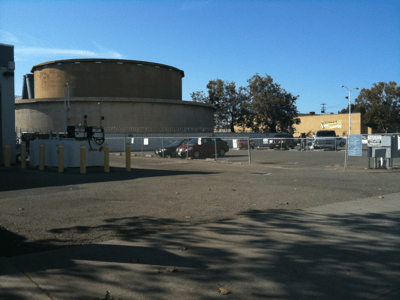
I’ve been told that with Matson’s long-term deal with the Port, it’s nearly impossible to relocate them. The City has been mum on a specific site in the area, but given the circumstances it may be better to focus on other land nearby. Which is too bad, imagine the building below as part of a majestic concrete/masonry ballpark façade. (It’s part of the power plant.)

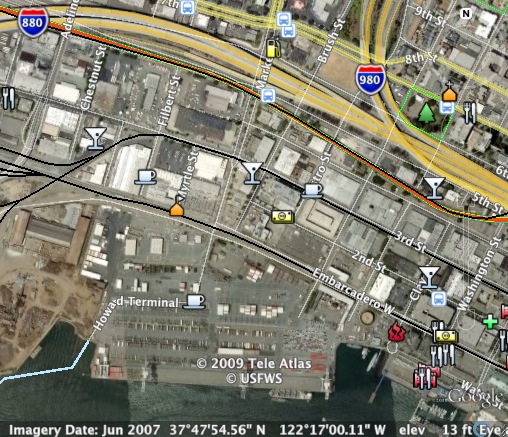
So where to focus? The best place may be the area north of Howard Terminal and the power plant, bounded by the BART tracks/5th Ave on the north, MLK to the east, 2nd St to the south, and Market/Brush Sts to the west.

No, it’s not on the waterfront. It does have a nice view of Downtown Oakland. It’s also a shorter distance to the 12th St BART station, just over 1/2 mile as opposed to 3/4 mile from the station to Howard Terminal. Admittedly, it would be strange to have BART running right past the place even though there wouldn’t necessarily be a co-located station. Fortunately, there is some vacant land that would be perfect for station portals if all parties could get it together. Just as important, it’s a shorter stumble to-and-from The Trappist.

Most importantly, land deals would be done with individual private landowners, not the Port. Port land is really City land, but that doesn’t make it any easier to do a deal given the politics involved. We’re talking about 5-6 blocks, the same amount as Diridon South.

Is this doable? I have no idea. I’m just as in-the-dark about actual proposals emanating from Oakland as many of you.