Poole gets it terribly, horribly wrong

Monte Poole has written yet another screed about Lew Wolff and John Fisher. Three questions about this: 1) Would Poole be writing this if the Raiders had made the playoffs, giving him something to write about?, 2) Couldn’t he have bothered to ask Wolff about this?, and 3) Is Poole now tasked with the now-retired Dave Newhouse’s role as chief ownership critic?

Apparently the answer to the first two of those questions is a resounding NO. Poole’s grievous error comes down to this:

Months prior to taking co-ownership, while working as the A’s executive hired to find a suitable yard, Wolff proposed a “ballpark village” on land north of the current site. That’s rich. He realized such a project would require relocating 60 to 80 businesses. And, by the way, Wolff added that this village would require the creation of a new BART station, this one between the Coliseum and Fruitvale stations.

That was their pitch to Oakland. Judge for yourself the goodness of the faith within.

Meanwhile, Wolff said zilch about the land to the south, from the stadium perimeter through the parking lot and out to Hegenberger Road. There’s a Denny’s not much else, other than plenty of space, mostly paved.

Amazing how only a few years can bend someone’s memory. Here’s what really happened:

  • When he was working for Steve Schott and Ken Hofmann, Wolff suggested looking at the HomeBase site (a.k.a. “Coliseum South”). They wanted to split the cost on a $500k feasibility study there, with the Coliseum Authority (JPA) paying the other half. The Authority declined to pay for their share, and the idea died.
  • Wolff did not present the 66th-High “Coliseum North” concept until August 2005, five months after he took control of the franchise.
  • For whatever reason, even though Larry Reid and others from Oakland considered Coliseum South a possibility after Coliseum North collapsed, no one pursued the option.
  • The Coliseum eventually bought the property in 2010 years after HomeBase was destroyed in a fire, dedicating the land to a Raiders stadium redevelopment project.

All Poole needed to do was call or email Wolff. Or Guy Saperstein. Is it that hard? I suppose it is.

Mark Purdy gets a lot more of the history right, though he fails to include the Oakland/East Bay ballpark study of 2001.

Oakland focuses on EB-5 program to replace redevelopment funding

We now know how Oakland will replace all of those lost redevelopment dollars: Foreigners! At least that’s the program according to today’s Trib report by Angela Woodall.

Before I go further, I have to give credit to Oakland Mayor Jean Quan for going this route. It has some potential, and it’s something that we’ve discussed on the blog previously as it pertains to a foreign investment in a new Sacramento Kings arena. While it’s unfortunate that neither she nor the City Council have had the “adult conversation” I argued for in the post, at least Oakland’s been resourceful enough to identify a path forward.

It makes sense for Oakland to look for creative, out-of-the-box methods to attract investment to the City, and the federal government’s EB-5 program is one of them. Quan has gone to China to look for investors, and may be onto something with EB-5. The program allows immigrants a green card if they put $1 million or more into a new or “troubled” American businesses. Investors also have to create 10 full-time jobs with each application. That money requirement goes down to $500,000 in the case of rural or high unemployment areas, Oakland being one of the latter. Pool enough of these together and a company may have enough capital to move forward.

The Bay Area Regional Center is a government-certified investment firm whose charter is to bring in foreign investment under the EB-5 program. Its service area is most of the Bay Area and Sacramento. Yet the projects it identifies as most ready for investment are three in Oakland. That’s not surprising because BARC is based in Jack London Square, with one of its principals being Oakland developer Jim Falaschi. In fact, BARC is trying to bring in nearly $70 million for Signature’s stalled Oak-to-9th project. (Signature is also trying to get Lawrence Berkeley Laboratory to build its next campus there too.) The Trib article notes that BARC was involved in the $8 million Tribune Tower deal, though records of actual foreign investment in the project are murky. An admission that BARC “is still looking” for a project 2 1/2 years after opening, while honest, is not encouraging.

That’s not to say that EB-5 programs don’t attract investment. Chinese investors put $249 million into the Atlantic Yards project in Brooklyn, though that money didn’t go directly into the Barclays Center arena. According to Bloomberg Businessweek, $1.5 billion has come into the U.S. from foreign investors through EB-5. Like any government program, it’s rife with bureaucratic delay. Applications have often taken months to process. One report this week indicates there are some kinks to work out as the program grows. It can be difficult for foreign investors to separate the good investments from the poor ones based on sales pitches from needy businesses who could easily inflate their projects’ potential.

As cities start to look for alternate avenues for investment, the market for foreign investment will start to get competitive. For Oakland, the biggest issue may be, well, Oakland. Foreigners can understand investing in New York, Los Angeles, or San Francisco. They also get things like ski resorts or wineries. Oakland, for obvious reasons, is a tougher sell. It’s possible that Oakland will need to claim multiple success stories before they can attract enough investors for a major project like Coliseum City. There’s still the problem of getting team owners and leagues to buy in. They’re the head while the foreign investors are the tail. Every application is an investment, not just $500k for a green card. It’s going to take a lot of selling – and even more believing – for Oakland to pull off major funding with EB-5. Or as economist Scott Barnhart, writing for EB5info, wrote in response to a NY Times editorial:

For example, if the 34 floor tower typically used for retail, office space and/or residential purposes did not qualify in New York, one can be assured that states with the highest unemployment levels are not likely close substitutes for a Manhattan address for either the developer or prospective investors, so this project would likely be shelved. Similarly, a large condominium in Florida will not sell if located in a high unemployment area away from the coast instead of a lower unemployment area on the coast, yet the labor will be imported to the site.

There’s a reason why O29 isn’t taking off. And it’s the same reason why Victory Court and Coliseum City probably won’t take off either. It’s still worth a shot, at least from the City’s perspective.

Finally, the EB-5 program is limited to 10,000 approved visas per year, potentially limiting investment. Compared to going the regular (and now shuttered) redevelopment route with its self-contained process, EB-5, with all of its marketing, multiple stakeholders, and delay, may be tantamount to climbing Mt. Everest.

.

To read more about EB-5, check out the EB5news site and Twitter feed, and EB5info.

49ers release club seat license prices

Apparently the bye week is only for the players, because the 49ers front office has been busy. Aside from hammering down lease terms and dealing with newly energized opposition to the stadium project, the team has also taken the time to release pricing (via the Merc’s Mike Rosenberg) for their club “seat builder licenses.”  And boy, the prices are a doozy. Not as bad as what the Cowboys charged their fans, but considering the same Cowboys-owned company that market the Cowboys’ licenses was hired to sell the 49ers’, it stands to reason that the pricing models would be somewhat similar. Lower club seats on the 50 yard line will carry a $80,000 license fee along with a season ticket price of $3,750.

Ticket price based on 10-game season ticket package

In 2009 I took a stab at SBL pricing. I couldn’t have been more off. Prices for prime seat location licenses are more than five times what I guessed. Whether the market will actually bear those prices is up for debate, though the marketing firm must have done some research over the last six months to determine pricing. Mike Rosenberg’s article doesn’t mention financing for the licenses, but I expect that financing will be available. It’s just another way for the 49ers to make money on the stadium. At 9% over 20 years, the $80k license would cost $8,040 per year, or $795 per month.

Timing has to be taken into consideration. Would the 49ers be able to charge these prices if the team had racked up another sub-.500 record? Probably not. Because they have home field advantage and at least a decent shot against either the Saints and Packers, the fanbase is back – which means demand is back.

As is customary with ticket sticker shock, many fans will be priced out of the prime seats. The 49ers haven’t yet announced pricing for regular seats, so I’m curious as to how many of those will carry SBL fees. This pricing model could imply that the premium seat buyers will carry much of the freight for construction, which could drive down the ticket prices for other locations. On the other hand, it could mean that rising costs and debt have to be passed on to the public in the form of SBL prices. We’ll have to wait to see the prices on non-club seats to know for sure. I don’t think licenses will come with 80% of all seats like Cowboys Stadium, but I’ve been wrong on this already once.

Herhold tracks down history of SJ stadium vote

Whether or not I agree with their work, Scott Herhold’s piece in today’s Merc is why I’m glad there are still veteran reporters and columnists at the Bay Area papers. Herhold takes the wayback machine to 1991, when another Merc employee, Susan Strain, led the charge for a referendum on any stadium or arena project of 5,000 seats or greater.

Strain, now in New Orleans, was then living in Hyde Park, a quiet northside neighborhood framed by the old City Hall and County Government Center to the west, 880 and 101 to the north, Japantown to the south, and light industrial businesses to the east. She and other Hyde Park residents objected to the possibility of a homeless shelter opening in their neighborhood (IIRC an emergency women’s and children’s service center opened instead). Frustrated by the lack of response by City Hall, Strain really got Mayor Tom McEnery’s attention by organization a referendum push, a requirement that still exists to this day. Though it’s short, the article gets Strain’s and McEnery’s sides of the story, and is a good read.

In hindsight, the referendum requirement has probably prevented multiple sports opportunities from happening in San Jose, by scaring off teams or their parent leagues looking to build or locate teams there. The leagues’ M.O. for the last several decade or so has been to avoid a vote as much as possible (Target Field, Marlins Ballpark), even when it involves getting into legally suspect territory regarding financing.

The actions leading up to the San Jose Arena vote should also provide lessons to all parties in the ongoing stadium debates in Santa Clara and San Jose. Petitioners looking to reopen the 49ers stadium deal on financial grounds had to compete with local IBEW members looking to dissuade the public from signing any petitions. The San Jose ballpark is already going to vote so it’s unlikely to follow the same script, but you can bet that labor will be out in force to support the project if there is any sign of it being in jeopardy.

P.S. – Speaking of the Niners, they’ll be paying $12.5 million to Cedar Fair to get the Great America operator to drop its lawsuit. All that for four Sundays a year? Well played, Cedar Fair.

What happens after 2013?

You’re probably aware that the leases for both the Raiders and A’s run out after their 2013 seasons are completed. Problem is for both that neither team can move into a new facility before 2015, whether it’s in Oakland, Santa Clara, or San Jose. Both teams have limited options to play elsewhere, and City and County still have a large mortgage to pay off. It would seem that a simple one-year extension – perhaps with an option year or two – would be simple to ratify.

However, things are not always that simple. The icy relationship between Oakland and the A’s has some within Oakland feeling that they were misled the last time the lease was negotiated, so they may be a much tougher nut to crack this time around. Chances are that the A’s will be paying a good deal more than the $1 million they’ve been averaging, if only to cover the cost of field conversion. The Coliseum Authority has been talking with the Raiders for some time, but Coliseum City doesn’t appear any closer to fruition now than it did over a year ago, when the Authority bought the Home Base site and unveiled the now-evolved plan. With all of that in mind, it’s a good time to explore the teams’ options after the 2013 season.

Raiders

No matter what the two football teams are saying about pursuing separate facilities or not sharing one somewhere, there’s no reason to think that they aren’t getting pressure from Roger Goodell and the other NFL team owners to shack up. There’s little practical reason for them not to do it, since they’d have less debt service to deal with and they would be able to join up instead of compete for precious limited G-4 loan money. Even if they came together, there’s still a year between the end of the Coliseum lease and a new one in Santa Clara or Oakland simply due to the required construction time. What to do then?

  • If a new stadium were being built at the Coliseum complex, it’d be simple. There’d already be a pre-arranged lease extension for the bridge year, and the new stadium would be configured to minimize impact on the existing Coliseum.
  • If the existing Coliseum were being gutted, the Raiders would have to endure one year of reduced capacity (47,000) and come back to a practically new stadium. 2014 could be the bridge year and leave 19-20 months to complete everything.
  • If the Raiders chose to go to Santa Clara, which to me would be a last-minute decision for the franchise, they could either rely on goodwill with Oakland and Alameda County to get the 2014 lease in place, especially if they “promise” that the Santa Clara move wasn’t permanent.
  • It seems highly unlikely that the Raiders would play 2014 in either Candlestick Park, Cal’s Memorial Stadium or Stanford Stadium. The colleges don’t want the headaches, and the ‘Stick would only be an option if the Coli were unavailable for some reason.

One strategic issue for me is, Did Oakland/Alameda County push for a Coliseum revamp? A new stadium may be prohibitively expensive, whereas a revamp could provide all of the necessary amenities for half the cost. Does the NFL consider the Coliseum damaged goods? The G-4 loan program specifies funding for existing facilities, and it’s believed that the Bills will try to use this funding for Buffalo’s Ralph Wilson Stadium, and that place can’t be measurably worse than the Coliseum (especially in its football guise).

The A’s could conceivably throw a wrench into the works by negotiating on a new facility at the Coliseum (like that’s going to happen under this ownership group). There would be enough land to build a new ballpark at the Home Base/Malibu site, and the existing Coliseum could be left intact for 2014. Or if the A’s tried to save money by leveraging what they could from the current Coliseum, the Raiders would be forced out.

Athletics

Mutual distrust between the team and City/County leads me to believe that any lease negotiations won’t be sunny. The A’s would need a facility for at least a year. Renting out Cashman Field for two series, as was done when Mt. Davis was being built, won’t fly for an entire season. Oakland wouldn’t have much incentive for renewal if they knew the team were leaving immediately after the lease was up, unless they got a lot of money for that one year or there was enough negative PR that came with refusing the A’s request out of spite. Unlike the Raiders, the A’s options would be wildly varied and mostly suboptimal.

  • Expansion of 4,200-seat San Jose Municipal Stadium to even 15-20,000 seats is impractical because the team facilities are clearly nowhere close to major league standards. Improving these enough to make it acceptable would probably cost $15-20 million, which would be crazy to pay for one year of play and little return on that investment.
  • The Earthquakes’ 18,000-seat stadium is soccer-specific, and MLS is not going to go along with sharing yet another facility.
  • Building another stadium alongside the Quakes’ stadium at Airport West would require a new EIR and probably wouldn’t go anywhere politically.
  • There’s the possibility of sharing AT&T Park for a year, but that would be entirely up to the Giants. There’s also a logistical issue at play. When Shea Stadium was used by both the Mets and Yankees for a year while Yankee Stadium was getting rebuilt, it already had enough team facilities because it was built as a multipurpose stadium. AT&T Park has only two clubhouses and scant room to build new ones. Where would the A’s or their road opponents go?
  • The A’s could play a season at the River Cats’ Raley Field in West Sacramento, but it’s even more limited than AT&T Park. At least there’d be a political path towards making it work as a temporary facility.
  • Candlestick’s pretty much “stuck” in its football configuration, so it’s unlikely that the A’s would play there.

The Raiders could throw a wrench into any 2014 lease plans if they agreed to rebuild the Coliseum, so that’s yet another complication. Unless cooler heads prevail, the A’s will be in a tough spot figuring out what to do for 2014. At this early juncture, my guess is that the A’s and the Coliseum Authority will figure something out, but the A’s will pay handsomely for the privilege. If something interferes, 2014 is up in the air for the A’s, and there’s no telling where they’d land. And if a delay forces them to not open Cisco Field until 2016? Yikes.

Unintentional funny of the week

There’s a podcast called A’s Fan Radio which I listen to once in a while. I try to catch as many as I can: Athletics After Dark and the new Tarp Talk being two others. A’s Fan Radio is not bad when they’re covering on-field stuff. As for the off-field and business stuff, I mostly tune into AFR because of the sheer unintentional comedy (warning: explicit language) of it all.

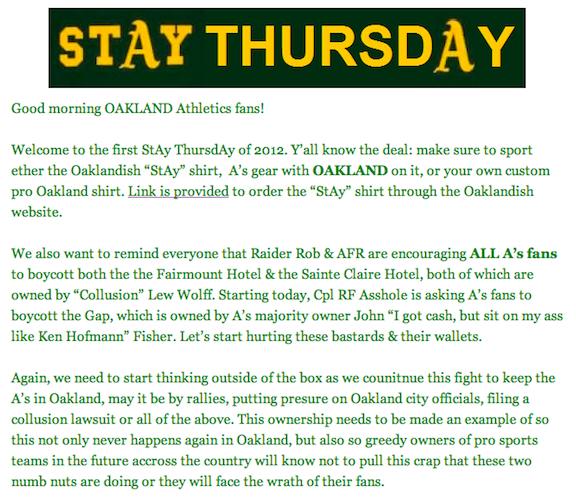
Perhaps the best moment in the short history of A’s Fan Radio came Thursday, when the siterunners asked A’s fans to boycott various businesses owned (or not owned) by Lew Wolff, John Fisher, and company. Here’s the hearty request:

stay-thursday

Surely there’s a meme that could come from this.

There is one GAP store in Oakland, so the boycott there might have some effect. At least it might draw attention. Then there’s the request to boycott the “Fairmount Hotel” and “Sainte Claire Hotel.” The Hotel Sainte Claire recently received some pub for being bought by a coalition including the Wolff family. The “Fairmount” is obviously a misspelling of the Fairmont chain, which has the flagship in San Francisco and another location in San Jose. Surely they can’t be referring to the Fairmount Apartments in Portland, which were converted from a hotel, or the 37-room Fairmount Hotel in San Antonio. That hotel is so cute it has its own dog mascot, Luke Tips, who greets guests and can be requested to stay in a guest room if a guest is lonesome for his/her dog at home (huge thumbs up from me in that regard).

Go ahead. Boycott this. I dare you.

Then again, maybe efforts would be better focused on “putting pressure on Oakland city officials” because when you look back on everything that’s happened related to retaining teams over the last year, it’s clearly evident that the nonexistent effort to keep the A’s in town is related to the nonexistent pressure to keep the A’s in town. As for filing a collusion lawsuit, there are plenty of lawyers affiliated with Let’s Go Oakland. Maybe one of them could take it up. I’m sure the Giants will be happy to pitch in. On second thought, that might come off as collusive.

Chances are that these boycott attempts will have the same effect as most ill-conceived boycotts: zero. After all, there’s no Fairmont or Sainte Claire in Oakland, and many of the Oakland-only crowd claim that there are very few A’s fans in the South Bay, so how much of an impact could it possibly have? Nevermind that most of the guests are out-of-town business travelers who have no clue who owns the hotels. Prove your point and hurt those bastards! And their wallets! Good luck. Oh, and make sure to wear your shirt for maximum impact. Yeah, that’s it. Try this on for size:

#OccupyColiseum

An article with actual substance is due later today. Until then, enjoy your Friday.

P.S. Having an elephant take “batting practice” at the Marlins Stadium is so not cool.

News for 1/5/12

Not the busiest week. Some news is coming in.

The Dodgers and MLB will start entertaining bids towards the end of the month. So far eight groups have been emerged:

  • Orel Hershiser, Steve Garvey, and pet food magnate Joey Herrick
  • Peter O’Malley
  • Fred Claire, Ben Hwang, and Andy Dolich
  • Dennis Gilbert, Larry King, and Jason Rees
  • Mark Cuban
  • Magic Johnson, Stan Kasten, and Mark Walter
  • Joe Torre and Rick Caruso (Torre quit his MLB executive position to be the frontman for the bid)
  • Time Warner

It should be competitive. In addition, Judge Leonard Stark is expected to rule next week on whether the Dodgers’ future TV rights can be sold with the team. For those thinking one of the losing groups could easily pick up the A’s if Lew Wolff is denied San Jose, I have to bring it up again: it’ll cost at least $400 million for the team (when including the premium) and $500 million for a ballpark (privately financed, of course). If Mark Cuban is balking at the Dodgers’ price tag at $1 billion, why would he put $900 million into Oakland? These guys aren’t in it to lose money.

More news:

  • Lowell Cohn provides a counterpoint to my appearance on Athletics After Dark. Or a vitriolic diatribe. You decide.
  • Governor Jerry Brown presented his new budget today, which would eliminate 3,000 jobs and consolidate numerous agencies.
  • Redevelopment agencies are set to officially shut down by February 1. Legislation is in the pipeline to extend that deadline to tax day, April 15. Good luck with that.
  • The replacement railings being installed at Rangers Ballpark will cost the team $1.1 million. They’re part of a $12 million package of improvements, much of them located in the outfield area.
  • The Minnesota Vikings’ lease at the H.H.H. Metrodome ended with their last game of the season. They have said that they will not move forward with a lease renewal unless they get state help on a new stadium. The Vikes continue to tout their Arden Hills plan, while also looking at stadium sites closer to downtown Minneapolis.
  • New York Governor Andrew Cuomo wants to reclaim Manhattan’s Javits Convention Center in order to allow for redevelopment, while allowing a developer to build a replacement convention center at the old Aqueduct race track in Queens. Matthew Yglesias wonders what the value proposition is for building the really large facilities, as opposed to the smaller ones often included in hotels.
  • The SF chapter of the Sierra Club filed a second appeal against the America’s Cup waterfront project, halting construction until a hearing for the appeal is held later this month.
  • Added 1/6 1:00 AM – Silicon Valley/San Jose Business Journal takes a look a development in the area between HP Pavilion and the ballpark site.

That’s all for now.

Just another way for the big boys to make money

.

The NFL is poised to start getting nearly $5 billion per year from TV deals with ESPN, NBC, CBS, and Fox. Time Warner Cable is considering simply buying the Dodgers for $1+ billion instead of paying $4 billion over 20 years for the team’s TV rights. The newly vertically integrated NBC/Comcast will stream the Super Bowl on the web for free next month. And today, as part of a decade-long Disney/ABC/ESPN rights renewal deal, Comcast is going to have the various Disney-owned networks “to be streamed live on the Web behind a wall, accessible only to cable subscribers.”

It’s a new strategy that’s at once beneficial and detrimental to consumers. Terms of the Comcast-Disney deal weren’t disclosed, but you can bet that if you’re a Comcast subscriber, your Digital Basic subscription fee is sure to rise. Of course, this is the first large deal in which all live network programming was available on TV and the web simultaneously. Until now, a handful of networks have been experimenting with the dual-delivery model, including the ESPN3 “network” and CNN’s simulcast. As far as programming goes, Comcast is usually out ahead of other cable providers, so expect Time Warner and Cablevision to follow suit, then smaller companies like Charter and Cox. DirecTV has been beefing up its digital bonafides by adding 12 streaming channels to its iPad app.

There was speculation towards the end of 2011 that going into the CBA negotiations, Bud Selig was going to deal with archaic problem of TV market exclusivity. That did not come to pass, and with Selig motioning as if he will exit stage left sooner rather than later, it’ll take a more forward-thinking commish to make that change a reality. Blackout rules are here to stay for now.

Any thought that the internet would quickly democratize delivery of sports for the fan has been extinguished. The way the carriers are paying hundreds of millions or billions for sports properties – and exclusivity in many cases – it’s terrible for the consumer. The providers are overpaying to keep their subscribers from leaving, and in many cases it’s working. Okay, I’m glad that Comcast is going to provide all of this streaming stuff. But I’m also an NFL Sunday Ticket subscriber, which means that I’m wedded to DirecTV. I also like DirecTV’s digital forays. I’m not going to subscribe to two television providers. I would love to have all of this stuff available to me through one provider, and that’s not happening. It might be that I’ll be able to get the streaming ABC/ESPN because I have Comcast Internet, but I don’t expect that to last.

Who is this good for? The rich guy. Someone wealthy enough to want to consume all of this content in every way imaginable may not bat an eyelash at paying $300 or more per month just for TV. I’d like to think that this is just a bubble that will burst sometime soon. I can’t. The cable providers may have been behind the times, but they’ve delayed just long enough to figure out new business models. Want a streaming-only option? Sure, but you’ll pay a lot for it to make up for their “lost ad revenue.”

The winner, no matter how much the cable providers and networks want to sell it, is not the guy behind the remote control. It’s the guy high up in a board room somewhere, figuring out the quarterly dividend checks.

KQED Forum talks franchises

Last week I got a call from the folks at KQED’s Forum program to see if I’d be interested in being on today’s show. Then yesterday, I received word that their panel was full so I wouldn’t be needed for the show. That’s just as well, because it was a pretty good show hosted by Joshua Johnson and with guests Susan Slusser, Mark Purdy, and Glenn Dickey. Giants CEO Larry Baer also chimes in later in the hour. If you haven’t listened to it yet, do so. Below are the embedded player and an MP3 link.

MP3 Audio

A couple of observations:

  • Purdy mentioned that he talked to sources on the MLB panel. According to them, the Giants’ contractually are not tied to South Bay territorial rights.
  • Baer is content with a two-team market as long as the market definitions stay as is. Pressed on what defines the South Bay, Baer hemmed and hawed, finally mumbling that it includes San Mateo and Santa Clara Counties. He also talked Warriors, saying that he’s going along with the process to evaluate options in both Oakland and San Francisco.
  • The 49ers and the potential for a new referendum on the revised stadium deal were discussed, especially by callers. I don’t think there’s enough political will to make that happen, but you never know.

I need to do a full relisten to see if there’s anything else, as I didn’t bother to take notes.

Ballpark on layaway

The new CBA has a major change to its debt rule that will affect the A’s as they try to put a ballpark deal together.

The Debt Service Rule will be maintained, but the default EBITDA multiplier has been lowered from ten to eight, and from fifteen to twelve for Clubs incurring stadium-related debt in the first ten years of a new or renovated stadium.

Questions about the commissioner’s actual enforcement of the rule aside, suddenly the A’s have a little less of a ceiling to play with when it comes to building a stadium. For Wolff/Fisher, debt will be limited to 12x the team’s gross income, which according to Forbes has been $22-23 million for the past two seasons, and probably won’t change significantly this year. Should that hold steady, the maximum debt the owners could incur is $270 million. The team already has $90 million on the books, which reduces to available figure to $180 million. Let’s say the team pays down $20 million in the next year. That would put the ceiling at $200 million…

…Unless something were to change dramatically for the A’s. As Billy Beane gets rid of arbitration-year guys like they’re going out of style, the effect is that it can drive up the team’s EBITDA/gross profit. Right now the A’s payroll projects at $24 million unless they sign a series of one-year veteran deals.  Beane told Murray Chass that he’s willing to go with a payroll in the $50+ million range, which would immediately turn into roughly $10 million of additional gross profit. If the A’s maintain that level over the next two seasons, the A’s profit figure will hit $30 million or more, which would put make their debt ceiling as much as $360 million, assuming the team pays down some of its existing debt (which it can do thanks to the saved payroll).

That extra $100-150 million is a huge difference, perhaps large enough to be difference between financing the ballpark and not financing it. We should remember a few basic things about how the A’s would move forward with a ballpark, regardless of location:

  • The projected cost was $450 million for the smaller, 32,000-seat stadium. Now that MLB has pushed for a larger park (35-36,000), the cost will go up to around $500 million.
  • Cisco’s naming rights deal in Fremont was worth $4 million per year for 30 years, or $60 million in net present value against the construction cost. I think the rights are worth more in San Jose than in Fremont, which could translate into $5 million a year or $75 million NPV if the A’s wanted to reopen the discussion.
  • Wolff/Fisher have to set aside additional money for the remaining land acquisitions and infrastructure work. Depending on what’s negotiated, that could be $50-75 million.

The total cost of the stadium is well above the team’s debt ceiling, however I think a little creative accounting is at play. Financing for any stadium usually falls into two debt buckets: one that is easily secured (naming rights, sponsorships, pouring and concessionaire rights, etc.) and one that is not (tickets, actual concession sales). The easily secured stuff can have a 5% or 6% interest rate, plus in some cases (East Coast) the team is able to sucker a city or county into raising tax exempt bonds, or some other instrument which can save millions. The other stuff often hits at 7-8%, or in the 49ers case, as much as 8.5%. That’s junk bond grade debt. It’s absolutely critical that the A’s structure their debt that as little as possible is at the higher rate, which is an automatic limiting factor (this is a good thing). For that reason, I can’t see the applicable stadium debt being any higher than $250 million. Everything else will either be paid down early or locked into the “first bucket” revenue streams. MLB doesn’t appear to be as worried about the first bucket as it is the second, which also goes for the banks that will eventually provide construction loans.

$250 million at 7% over 25 years translates into $20 million in annual debt service. It’s a lot, but it’s manageable. One thing to consider is that A’s tickets, with the exception the Diamond Level seats, are generally 25-50% lower than comparable tickets at other ballparks. That leaves a ton of headroom in ticket prices that the A’s can use when establishing their 2015 Cisco Field pricing structure. Yesterday I did a quick survey of 2012 season ticket prices for several non-New York ballparks.

2012 Season Ticket Prices for several MLB teams. Dodgers prices include large discounts which may only be in effect for 2012.

Now let’s take a look what happens if the A’s, entering the 2015 season, priced tickets more in line with (but slightly less than) the going market trend.

2015 estimated prices, factoring in 4% annual inflation

What does it mean for annual revenue? If the A’s sell 2.5 million tickets, they’ll rake in over $78 million just in tickets. If they sell out the season, that jumps up to $91 million. That doesn’t include proceeds from concessions or  parking, which are worth at least $30 million more in annual revenue, or $12-15 million in profit assuming a 40% margin.

2015 projected revenue with two scenarios: total attendance of 3 million (37,000/game) and 2.5 million (30,500/game)

Now you’re getting to a magical number of $1 million in ticket revenue per game. The challenge here is to maintain at least 2.5 million in annual attendance. If attendance drops to 2.2 million per game, that’s $8-9 million in revenue not realized, and that’s when the mortgage starts to hurt. Historically, the A’s have gotten 2.5 million fans or more only three teams in their tenure in Oakland, and never prior to that. The team will be highly dependent on new fans, casual fans, and existing fans who are so turned off by the Coliseum that they don’t bother going. Overcoming that stigma will be a challenge to say the least. If the Giants, Cardinals, and Phillies are successful examples of how to deal with an eight-figure annual debt service, it’s definitely feasible.