News for 9/6/12

Update 9/6 10:30 AM – Several items added.

Not much to celebrate on the field, so we’ll focus off it.

  • Sure, the A’s didn’t draw well Tuesday and Wednesday. Neither did the White Sox, Nationals and Braves. Yet league attendance is up 3% over last year. Nothing changes overnight.
  • Brodie Brazil wrote a goofy column about stuff that should carry over from the Coliseum to a new A’s ballpark. [CSN Bay Area]
  • Good to see that the regular media (Merc, NBC BA, KQED) picked up on the recent S4SJ lawsuit activity. I’ve heard that S4SJ is expected to respond with its own motion by Monday 9/10, followed by another response by the City by 9/14. If nothing else it keeps the case in the news.
  • Forbes NFL team valuations are in right on schedule. #1 is the Cowboys at a whopping $2.1 billion, followed by the Patriots and Redskins. The 49ers are at #9 with a $1.175 billion, thanks to the team’s playoff run and the start of stadium construction. The Raiders came in at #30 with a $785 million valuation, and were one of two teams to have an operating loss (according to Forbes). [Mike Ozanian]
  • We’re 9 days from the NHL’s lockout deadline, and there’s no telling what will happen. The two sides are reportedly very far apart. [SB Nation DC/Ted Starkey]
  • With ESPN’s TV deal signed, MLB may be looking for $800 million per year for the combined Fox/Turner schedules. Combined with ESPN, MLB would net $1.5 billion per year, translating to $50 million per team. Add other central revenue to that (merchandise, MLB AM, XM, etc.) teams should be able to get $70 million in national revenue every season starting in 2014. That figure doesn’t include revenue sharing (local redistribution). [Sports Business Journal/John Ourand]
  • So I guessed wrong on 95.7 The Game getting the Warriors and switching to NBC Sports Radio. The station stayed with Houston-based Yahoo! Sports Radio, and the W’s chose to renew their deal with KNBR, apparently feeling that the signal coverage was worth the third-tier status on the stations. That’s a bad loss for Entercom, though it highlights the biggest problems with The Game: its ratings aren’t going to get much better until they get more local pro teams and boost the station’s signal. The new deal runs through the 2015-16 season.
  • The good news for The Game is that the station posted a 1.1 rating for August, the highest since the programming change. The A’s haven’t moved the needle at The Game for well over a year. Perhaps this is a sign that now they are effecting change. [BA Sports Guy/Scott Willis]
  • Legislators are attempting to bring back redevelopment through various bills that have just reached Governor Brown’s desk. I won’t give the bills much attention unless Brown signs them into law. In the meantime, some groups are applying for federal tax credits to help foot the bills for projects. [ABC 7/Kendall Taggart; 10 News San Diego]
  • Save Oakland Sports has a profile in the Tribune. When talking about the upcoming fundraiser, co-founder Jim Zelinski said, “A cynic might laugh … but it all adds up.” Sure it does. Fundraisers like this, which has no set fundraising goal, can help – about 1 PSL’s worth at a time. [Oakland Tribune/Matthew Artz]
  • The federal government will lose up $4 billion in tax revenue ($146 million annually) thanks to tax-exempt bonds used on many stadia, including the Coliseum and the new 49ers stadium. [Bloomberg Businessweek/Aaron Kuriloff and Darrell Preston]

More as it comes.

49ers Stadium going up quickly

I’ve been taking pictures of the 49ers Stadium site every so often from the Amtrak station. It’s amazing how quickly it’s going up. First, a shot from five weeks ago.

July 30

Now one from eight days ago.

August 27

Then from yesterday.

September 3

Much of this is possible due of the extensive use of steel. The foundation was drilled piers, so locals didn’t hear constant piledriving racket as they did when the garage across the street was built. And unlike the garage, the stadium has little concrete at the moment so there’s no curing time. This allows the crews to put up level after level very quickly, starting with what I assume are the field club and main concourses. Clark Pacific in Woodland is building the precast concrete risers that will eventually make up the seating bowl and many of the concrete walls inside. At this rate I’m starting to think the Niners will make their Fall 2014 opening date. I just hope that Turner Devcon will take this expertise to the Quakes and A’s stadia.

City of San Jose seeks to depose Stand for San Jose

Update 9/5 10:30 AM – If you haven’t seen it yet, the Merc’s John Woolfork has picked up the story and gotten quotes from San Jose City Attorney John Doyle.

Activity regarding the astroturf group Stand for San Jose‘s lawsuit challenging the A’s Diridon land deal appears to have picked up in the last week, as the respondents, the City of San Jose and the A’s, have submitted a request to depose Stand for San Jose and its members. I’ve uploaded a copy of the motion (6 MB PDF) for your perusal.

The thrust of the City’s argument is that it complied with S4SJ’s numerous information requests, while asserting that it has the right to request information about S4SJ’s inner workings to determine if S4SJ has standing. The motion asks for relevant documents related to the operation of S4SJ, as well as a person to represent the group in a deposition. This maneuver comes after repeated requests made by the City for this information. Through attorney Geoffrey L. Robinson from the A’s-hired firm Perkins Coie, the motion asks for some in-depth information.

The matters on which the deponent will be examined include the following:

  1. The standing of Stand for San Jose to assert any or all of the claims raised in the First Amended Petition in this case.
  2. The nature of the beneficial interest held by Stand for San Jose in the subject matter of this litigation and the extent to which those interests differ from those of the general public.
  3. The origin and formation of Stand for San Jose.
  4. The organizational purpose, structure, functions and activities of Stand for San Jose.
  5. The governance, direction, control and/or leadership of Stand for San Jose.
  6. Taxes paid by Stand for San Jose to the City of San Jose or any other public entity.
  7. The funding or financing of Stand for San Jose’s activities.
  8. The legal or financial relationships between Stand for San Jose and its members and/or any persons or entities funding or controlling its activities.
  9. Any actual or proposed use of this litigation to impose regulatory burdens on the City or Real Party in Interest.
  10. The “fees and costs, including reasonable attorneys” fees and expert witness costs” (sic)…

Named individuals in the motion include Michelle Brenot, Robert Brown, Karen Shirey, Fred Shirey, Robert Shield, and Eileen Hannan, who initially didn’t know she’d be a plaintiff in the lawsuit. Just in case you’re wondering where her allegiances lie, here’s her Facebook profile picture.

At least we know where Ms. Hannan “stands”

The challenge is a technical one – if the plaintiffs don’t have standing, the suit can be dismissed. S4SJ claims they have standing by the nature of the suit (originally an EIR challenge). The tax issue is interesting, in that the City is arguing that if the plaintiffs aren’t taxpayers in San Jose they have no standing. The motion will be made on September 21 at 9 AM. (Come on people, I’m supposed to be in an iPhone 5 line at that time! You’re killing me.)

Seriously, this is the first real sign that the legal team that the A’s were assembling in the spring is breaking out some weapons to use in could be a lengthy legal battle. Could the lawsuit blow up if it’s found that the Giants were behind the whole thing (snicker)? I guess we’ll find out.

P.S. – I look forward to reading the various lawyers’ assessments of this motion in the comments. Also – I’m not a lawyer or legal reporter, so forgive my butchery of the legalese.

California Memorial Stadium Reopening

Six years ago I went to the first game at the new Stanford Stadium. Yesterday I went to the first game at the renovated California Memorial Stadium on the UC Berkeley campus, eager to compare and contrast the experiences. Both home teams lost their respective first home games. Both stadia received major upgrades in terms of amenities and comfort. That’s where the similarities end. Stanford Stadium is a modern facility that bears little resemblance to its forebear. Memorial Stadium was painstakingly renovated to maintain as much of its early 20th Century charm as possible. It’s with that key difference that I’ll start my review of CMS.
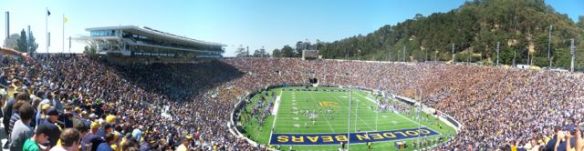
cal_memorial-16-panorama2_sm

Panorama from top of South End of California Memorial Stadium

Like many stadia built 80-100 years ago, CMS was a testament to classical form and simplified function. Slightly less than half of the oval seating bowl was built atop a hill on the east side. The other half was a concrete structure with arches and a single narrow concourse. All of the seats were wooden bleachers. A small press box was affixed at the top of the west side of the bowl. At one time 80,000 could be packed sardine-style into CMS.

Over the years CMS deteriorated noticeably, with huge cracks in the concrete and bleachers splintering everywhere. The stadium was situated directly on top of the Hayward fault line and the west half was not considered safe by modern seismic standards. Many calls were made to replace or refurbish the old girl, with nothing happening until the UC Board of Regents approved a $300+ million plan to rebuild the west side. The new half would contain three club areas, a new and wider general concourse, a large press box, and a training center for the athletic department that would be competitive with other major college sports programs.
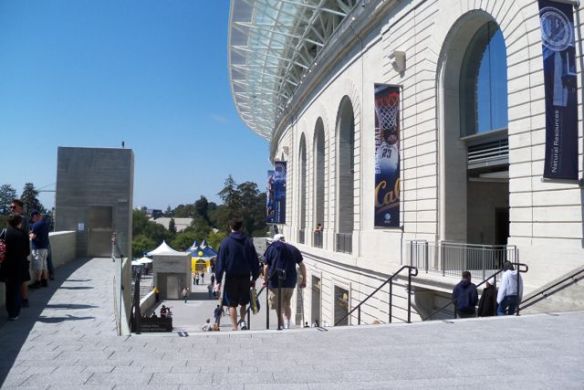
cal_memorial-23-stairs_down_southwest

Area outside West façade descends into additional public spaces, press box hanging above the bowl

The debate over whether the upgrades were worth it will continue for years to come, as Berkeley continues its internal struggle over academic priorities and costs to attend keep rising. What the fan is left with is a sense of history and legacy preserved, with modernity accentuating itself in specific areas.

The three level press box and club building is the big nod to the new landscape of college football, where everything is driven by intense media coverage and alumni with fat wallets. The building is a glass-and-steel structure, its frame forged and delivered in pieces and put together on top of the new concrete support structure that holds up the rest of the west bowl. There’s even a space beneath the press level where the camera positions are located that makes the building appear to float. Chicago’s Soldier Field renovation may come to mind, but the work done at CMS isn’t nearly as imposing or potentially upsetting.
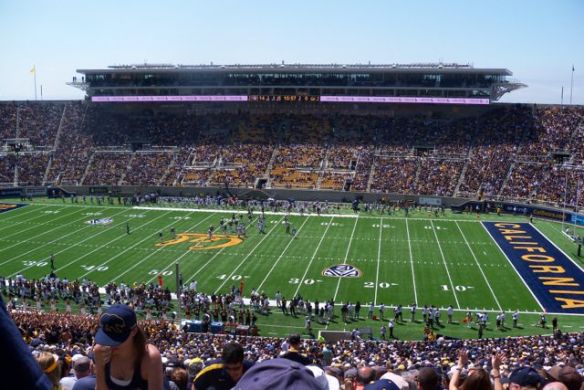
cal_memorial-13-student_side-wide

Press box “floating” above stadium bowl

What was once a single, dark concourse with water seemingly dripping from every crack and opening is now two: the swank lower club level (which I didn’t visit) and the regular concourse, which now lines up with the elevation at Gate 6. The result is that large areas were opened up, allowing natural light coming through the arches to flood the concourse. It also creates numerous scenic vistas of other parts of the campus and the Bay. As the morning fog receded, I was able to see all the way to San Francisco and the Golden Gate Bridge.

The main concourse is 30-45 feet wide depending on where you are. Concession stands alternate with much improved restrooms everywhere you look. Blue tiles of different shades mark the restroom locations, while the concession stands are adorned with names like “Oski’s Place” and “The Fault Line”. Oski is, of course, the beloved bear mascot at Cal, whereas “The Fault Line” playfully notes that it’s located right on the Hayward fault.

Walking through the concourse, it’s hard not to notice the many expansion joints dividing roughly 100-foot sections of the stadium. These joints and piston shocks will help absorb motion in the event of a major earthquake, with as much of six feet of travel allowed. Flexible conduits are located in areas with expansion joints, which should reduce the chances of data or electrical disruption. Concrete columns are spaced every 20 feet, giving an appearance that the structure is overbuilt.
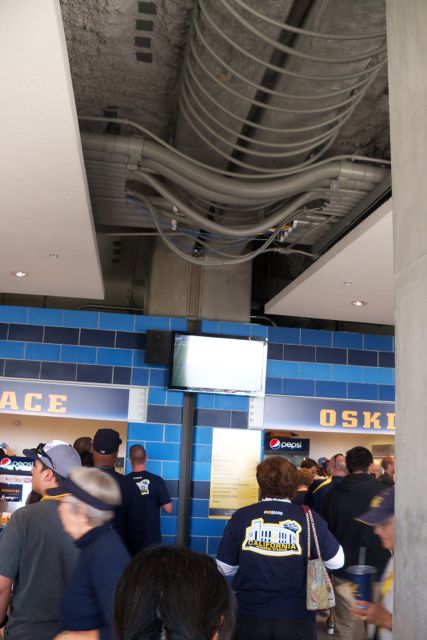
cal_memorial-18-expansion_joint2

Expansion joint with additional support for utilities

Lines for food were long towards the north and south ends of the stadium. Between the 20 yard lines the lines aren’t so bad. Crowds will figure that out by the end of the season. The fare was pretty standard, with a regular hot dog and a Saag’s polish on the menu. Prices were cheaper than at pro games, but noticeably more than at other college venues I’ve been to. Top Dog has three stands on the East upper rim, and those had 20 minute lines from the looks of it. The club most certainly has pricier options.

The only obvious change to the east bowl was the replacement gold aluminum bleachers, matching the rest of the stadium. Padded seat cushions with backs were available for rent. Down near the field where I sat, four rows were ripped out and replaced with ADA-compliant wheelchair locations. The old south tunnel is now just access to two ADA restrooms, from which security had a hard time shooing confused fans. The new Field Turf playing surface was also lowered four feet, which helps sight lines immensely. Way up above the field, Tightwad Hill is still there, with its spectators almost close enough to touch.

On the north side the tunnel remains intact, allowing for a pre-game procession through the campus into the stadium. A ceremonial ribbon-cutting ceremony was held, with Walter Haas III doing the honors in memory of his father, the much-loved former CEO of Levi Strauss, one-time owner of the A’s, and philanthropist whose name is emblazoned on Cal’s arena, a staircase at CMS, and the business school (which faces the north entrance Gates 1 & 2).
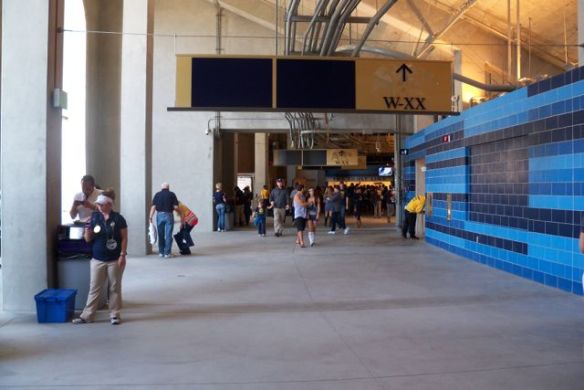
cal_memorial-20-concourse1

Much improved main concourse

Just about all of the flat areas of the Berkeley campus are packed with academic buildings, athletic facilities and other structures, making open space rather scarce. There was some question going into the planning and construction phases for CMS about whether or not there would be places for fans to mingle or even tailgate before games. Some effort has been made in this vein by creating plazas outside the arched façade with tents for additional concessions or grills. It’s not quite the same as tailgating, yet these are spaces that can find a purpose in the future.

All told, Cal and HNTB did a wonderful job of holding true to the idea of maintaining California Memorial Stadium’s architectural and structural integrity. There’s no telling if Cal will be a good football team anytime soon. Nevertheless, Memorial Stadium is a beautiful place to watch a game and a reminder of how stadia don’t have to be overly utilitarian. It’s worth a visit.

A moment to acknowledge how good we have it

While hanging out in the lower concourse after the epic 7th inning of last night’s game, I got word that the San Jose State Spartans had tied Stanford. Knowing that the game probably wasn’t showing in the West Side Club because of the Pac-12 Network’s carriage problems, I found myself wanting to head across the Bay to watch the finish of the football game. Then I realized that I was already doing another doubleheader on Saturday, starting with Cal reopening Memorial Stadium followed by the Saturday night A’s-Red Sox tilt.

Here in the Bay Area, we are practically drowning in spectator sports. I talk about it once in a while. The local and national media don’t. It’s a thoroughly impressive list of teams and events when you list it all:

  • 2 NFL teams
  • 2 MLB teams
  • 1 NBA team
  • 1 NHL team
  • 1 MLS team
  • Seasonal international soccer friendlies
  • 3 FBS/D-I football programs
  • 6 D-I baseball and men’s basketball programs
  • 6 D-I women’s softball, volleyball, and basketball programs
  • Prominent college men’s and women’s soccer programs
  • Nation’s most dominant rugby union college program
  • AT&T Pebble Beach Pro-Am golf tourney
  • US Open @ Olympic Club or Pebble Beach (roughly twice every seven years)
  • Tour stops for ATP and WTA tennis tours
  • NASCAR, IndyCar, and other racing circuits @ Sonoma/Sears Point and Laguna Seca
  • Multiple stages of the Tour of California cycling race
  • 1 arena football team
  • 5 minor league or independent league baseball teams
  • 2 minor league hockey teams
  • 1 minor league basketball team
  • 1 perennial high school football state champion/national powerhouse
  • A hotbed for MMA training and events
  • 3 highly-ranked, world champion boxers
  • Mavericks surfing contest
  • America’s Cup sailing

Not even New York or Los Angeles can match that wide variety and frequency of teams and events, pro and amateur. There’s almost always something to watch. It takes me away from my non-sports fan friends and makes them wonder about my sanity sometimes. I don’t care. I love it, I cherish it, and I try to take as much advantage of it as I can. Or as Captain Comeback says:

Nobody.