I’ve put off writing much about Las Vegas since this blog’s inception. This is not because of any opinion about whether Vegas is a viable relocation candidate or not. Instead, real information about Sin City’s plans has been scarce. Now that the Marlins are in active discussions with potential relocation candidates including Vegas, some details are starting to come out that give a better picture of what’s happening inside the head of flamboyant Las Vegas mayor Oscar Goodman.
Political Landscape
Before I get into the details, it’s important to understand the relationship between the City of Las Vegas and Clark County. The City is the county seat and all of the county’s administration offices are downtown. However, most of what visitors see when they visit Las Vegas isn’t technically within Vegas city limits. The section of the Strip that holds all of the enormous new casinos is part of an unincorporated section of Clark County called Paradise. Despite this, all of the businesses within this section have Las Vegas addresses. This is due to rules set up decades ago to encourage development on the Strip without the taxation associated with setting up in the City. In return, Clark County funded and built some impressive amounts of infrastructure for that area and has tons of cash to build and maintain its schools and other services.
Goodman officially presides over the City’s portion of the Strip, which includes older casinos such Binion’s, where the World Series of Poker is played. This is considered downtown Las Vegas, and in the past it has suffered, living in the shadow of its glitzier neighbor to the south. Tens of millions have been poured into redevelopment over the past two decades to improve the image of downtown. The biggest project so far has been the Fremont Street Experience, a huge overhead light show that serves to visually connect numerous businesses along the street. The area has managed to lose its dingy reputation, but it’s difficult to keep up with billions of private dollars being invested in the construction and renovation of the big casinos down the street.
Inside the city limits, downtown is basically defined by a redevelopment zone, first created in 1986 and expanded twice since then. The creation of such a zone is crucial to raising funds for various public works and public-private projects. Public funds for such projects can be raised without a referendum, and in some cases eminent domain can be used. Below are an aerial view of downtown and a map of the redevelopment zone (in tan/brown), with the dotted line at the bottom representing the southern city limit.

The green section above is a 61-acre parcel called Union Park. It isn’t actually a park. Instead, it’s an empty tract of land that fills Goodman’s dreams. There are various models of what this blank slate will look like throughout City Hall. Plans currently call for an Alzheimer’s research center, which will break ground in a month or so. City Hall may move there. High-rise condominium development is scheduled for the block in conjunction with ground-level retail, a performing arts center, and public space in a sort of self-contained village concept. The new World Market Center furniture showcase and exhibition space had its first phase opened last year to resounding success. It sits kitty corner to the southwest, and expansion is planned for the area just to the west of Union Park.
Goodman’s vision wouldn’t be complete without a ballpark. One variant of his plan has the ballpark on 18 acres of Union Park. Goodman hasn’t revealed how exactly the ballpark would be financed except to say that it has to be done creatively. Some redevelopment funds can be made available, but probably not for an entire ballpark. Since Las Vegas is not known for its pleasant desert summers, any ballpark would have to have a retractable dome, adding $100 million to its cost. That could push the cost to $400-500 million even if the land were thrown in for free. It’s possible that a ballpark could be an extension of the World Market Center or some other flexible convention space, now that technology is available to move a natural grass field either on rollers (Arizona Cardinals new Glendale, AZ stadium) or in pieces (Millenium Stadium in Cardiff, Wales). A typical field covers nearly 4 acres (160,000 square feet), making it a potentially compelling, wide open (no columns) exhibition space with plenty of amenities attached (clubs, restaurants, suites). This is all speculation, of course, but it makes sense for a city bent on dominating the convention market. Having the space available would also help pay the bills during the baseball offseason.
In September a large national developer, Related Cos., backed out of a deal to build condos at Union Park. Related is focusing on the Las Ramblas project, which is fronted by George Clooney among others. Vegas is experiencing a high-rise condo-building boom, so it wasn’t long before numerous other builders stepped to the plate. The eventual “winner” was Newland Communities of San Diego. Newland has an option to buy up to 7.6 acres of land at Union Park, with the ballpark’s 18 acres potentially available for other development if a pro sports team is not negotiating with Vegas on a stadium deal in one year. This is all contingent upon Newland breaking ground in the next year on its development work. Other land in the area could be made available outside Union Park, but that may require more complex dealing, especially if casinos become directly involved by providing land near the Strip. This development is extremely important because it’s the first time that Goodman has played the deadline card. Over the past several years MLB frequently used Vegas as its #1 relocation target. Vegas was considering a compelling candidate for the Expos until it became clear that moving to DC would provide MLB significantly more money than a move to Vegas or Portland. Goodman’s tired of allowing Vegas to play the mistress; he evidently wants a real commitment from MLB. We’ll see if MLB responds in kind or is a mere tease.
Casino Paradox
The table below shows Clark County’s 35 largest employers as of Q2 2005. It should come as no surprise that casinos make up almost 70% of the list. Public entities cover almost all of the rest.
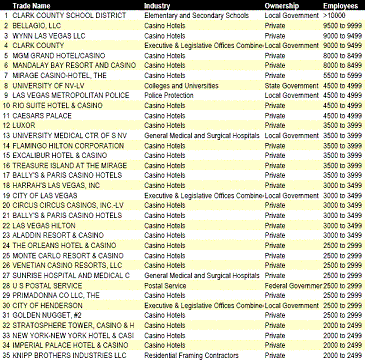
The State of Nevada has been pushing hard to bring in other industries with mixed degrees of success. Nevada has several advantages over California when it comes to taxes and incorporation, but so far the corporate exodus from California predicted when the dot-com crash and recession hit hasn’t really happened. Southern Nevada’s explosive growth means that it’s just a matter of time before it starts to innovate and land other industries. Casinos still have the lion’s share of potential corporate interest for a ballpark, and judging from the number of San Diego-area casinos that had suites at Petco Park (all of them), selling suites and club seats to casinos would be like shooting fish in a barrel. The casinos would in turn comp their high rollers and dignitaries in their suites, writing it off as the cost of doing business and adding it to their portfolio of available entertainment.
As interested as the casinos may be, some major gaming interests have expressed displeasure at the idea of a ballpark being built with public money. Their argument is that they invest their own money in their facilities without expecting handouts. They also pay taxes, an idea that has been lost in the recent era of stadium building, with PILOTs (payments in lieu of taxes) often used as a method to help finance construction. Goodman said in a recent USA Today article, “Major League Baseball needs us more than we need them.” That’s only half of the story. While the Marlins, A’s, and Twins are less moneymaking franchises than some others with new ballparks, it’s not as if MLB is hemorrhaging red ink by allowing them to operate. The other half of the Vegas story is this: The casinos don’t need baseball, but baseball in Vegas definitely needs casinos. Goodman’s posturing aside; it’s obvious that he wants to get a MLB team to earn Vegas its Major League City merit badge.
Sports Betting
The argument about gambling poisoning pro sports may have made sense twenty years ago, but it doesn’t today. Professional players and teams make such astronomical amounts of money that it doesn’t make sense for them to risk their livelihoods to shave points or throw games. Still, MLB reeks of the stench of the nearly century-old Black Sox scandal and Pete Rose’s addictions. It would make sense for MLB to distance itself as much as possible to avoid the appearance of impropriety. However, a gray area already exists by virtue of Indian casinos buying suites in states where they operate. Who actually operates those casinos? The big corporate gaming interests, of course. Sure, the jobs and some money go to the tribes, but it’s the gaming industry that provides the know-how and capital. It wouldn’t be too difficult to connect the dots.
Nevada is the only state in the union with legalized betting on sports. With all of the intertwined money and the encroachment of gaming interests closer to major metropolitan areas, at some point the bellyaching may all become moot. The pro sports each want the casinos to take their respective leagues off the sports books to eliminate any concern about impropriety. That’s a hard sell considering that the industry makes billions every year on sports betting. Would they simply agree to kill a revenue source just to improve the image of their hometown? The casinos already provide image to spare and Vegas really doesn’t need any help in that department.
Where are the fans?
We know that Oscar Goodman is a fan. An influential fan, too, as the recent visits by Marlins officials to Vegas indicate. But where are the prospective seat fillers – the hardcore and casual fans who are expected to regularly go to games by buying season tickets? The answer to this question isn’t clear. Vegas’s growth puts the metro at 1.8 million residents and climbing. That’s not exactly huge since it’s only as big as Santa Clara County and smaller than the combined East Bay (Alameda/Contra Costa Counties). Many of the area’s transplants work in the gaming industry, which presents two problems. Many of the jobs are low-paying, leaving a large part of the population out of the preferred demographic. Since Vegas is a 24/7 city, one-third of the place is working at all times, further reducing the pool of potential fans. Sparse attendance at AAA Las Vegas 51’s games is cited as a negative, but the experience there is nothing compared to a game in an air-conditioned, retractable dome stadium.
Goodman’s argument is that some percentage of his city’s 40 million visitors will see a baseball game there. How much? One percent? Five? It sounds like a flawed premise, especially when you consider that the vast majority of visitors already come from markets with major league baseball. The argument may have worked a decade ago, when Vegas was still in its “family” phase and trying to attract everyone regardless of income level. These days, Vegas has decidedly gone with a more upmarket approach with the ultra-lux casinos like Wynn Las Vegas, with higher-class entertainment and restaurants. Many visitors come from Southern California (27% according to some estimates), the Bay Area, New York, and Chicago. Those markets are already saturated with major league baseball. There’s a potential niche in Goodman’s approach in that for instance, a Chicago-based businessman and lifelong Cubs fan might be attending a convention in Vegas while the Cubs are in town for the weekend, prompting him to grab tickets. Even that is a crapshoot because of schedule incompatibilities. Some stadium junkies like me would go just to check out the ballpark, but that’s typically a one-shot deal and the novelty will fade very quickly.
My biggest concern for Vegas is that it lacks a grassroots organization, like the Oregon Stadium Campaign or Baseball San Jose. These groups are vital for many reasons, including the fact that they automatically gauge and foster support. By conducting petition drives and surveys, they can quickly assess the public’s interest in baseball from hardcore and casual fans, families and corporations. They can raise money for pro-stadium ad campaigns should a stadium come to a vote. They often are comprised of numerous local civic and business leaders who can put their considerable weight behind a campaign by supporting it. Most importantly, these groups can keep the issue in the forefront of the region’s consciousness. It could be argued that Goodman is filling this role now, but what if he runs for Nevada’s available U.S. Senate seat or for the governorship this spring? Suddenly there will be a vacuum with little in place to fill it as Goodman spends much of his time campaigning for a different office. Perhaps Hall-of-Famer Reggie Jackson, who lives in Vegas and has long advocated bringing a team to Sin City, could become the face of the effort. That could work in terms of rallying public support, but it may backfire when dealing with MLB, whose club-like mentality may not have any interest in making room for an outspoken maverick like Reggie.
Conclusion
The clock is ticking for Vegas. If it’s going to happen, MLB will have to do the proverbial “sh*t or get off the pot.” The mayor isn’t messing around anymore. He’s playing for keeps. That should concern fans of the A’s and Marlins, since both of their leases are going to end soon and there’s no telling what Goodman will do to make a deal with MLB. There are major challenges with the MLB-to-Vegas effort, but as I’ve said before, it’s all about the deal. Wolff’s aborted baseball village concept may not be feasible in the Bay Area due to its size, but could it be done in Vegas? We can argue until we’re blue in the face about one the viability of baseball in Las Vegas, but if something were to occur to give a team and MLB a sweetheart deal, it may be impossible for baseball to say no. That would prove that the more things change in Sin City, the more they stay the same, eh? Then again, there’s little reason to believe that Vegas has a ton of cash lying around somewhere just waiting to be spent on a stadium. Once real financial details are available, look for an analysis here. Until then, the mayor has some pretty models to play with.


 newballpark.org