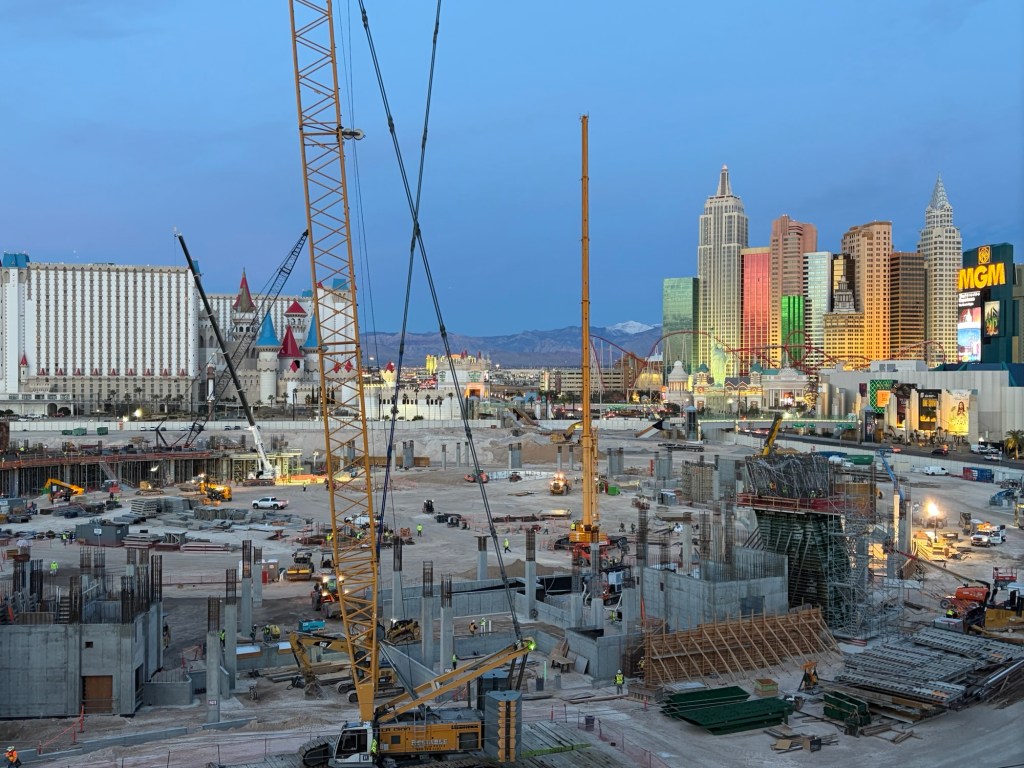
This morning I woke up before dawn to the cacophony of rumbling diesel engines and banging. When I looked outside a wave of relief – no, catharsis – washed over me because I saw this:
View of the Athletics Ballpark construction site from the Oyo Hotel ninth floor
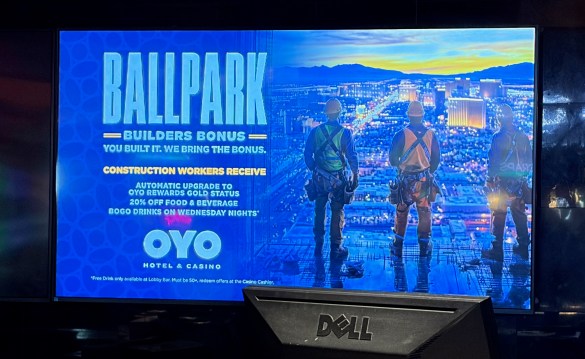
Greetings from the Oyo Hotel and Casino, just east of the A’s ballpark site on the Strip (formerly the Tropicana). I’m in Vegas for a family trip. Some flexibility allowed me to spend Monday night and Tuesday morning at Oyo, previously the Howard Johnson/San Remo/Hooters. If you’re not aware, Oyo is a multi-national hotel brand based in India. When I checked one of the signage displays behind the front desk briefly showed a promo for ballpark construction workers.
Anyway, my plans were to head out to the Athletics Ballpark Experience Center at uncommons in the southwest part of Las Vegas Valley. Unfortunately those plans were foiled by more important matters.
Sodey secured 🔒
We have agreed to terms with left fielder Tyler Soderstrom on a seven-year contract through the 2032 season with a club option for 2033. pic.twitter.com/Ykw9DQz8yJ
According to MLB.com’s Martin Gallegos, the press conference for the Soderstrom signing will be held at the Ballpark Experience Center, so they literally have bigger fish to fry. At least we’ll get to see video of Sodey in the virtual ballpark. I’ll be back later, when it’s fully open to the public. For now, I’ll settle for progress in the form of working construction crews on December 30, 2025. I spent twenty years on this website waiting seemingly in vain, plus ten more since the Raiders moved back to Oakland and destroyed the Coliseum. I can say with great certainty that I’ve been waiting my entire adult life for this moment as the A’s haven’t had a proper home since they left Shibe Park. I only wish the moment was in Oakland, San Jose, or Fremont instead. Alas.
I’ll spend the rest of the morning here before I meet with the fam at Treasure Island. I observed how fleeting this moment is.
As I write it occurred to me that 1) this view will be mostly obscured in a year by the enormity of the ballpark, and 2) Oyo itself probably won’t be standing in 20 years. #todaysperch#Athleticspic.twitter.com/EXT4jT1qrJ
My intent was for this post to be a year-in-review as you typically see after Christmas. Instead I’m going to have breakfast and coffee, enjoy this view and the noise for a few hours, then take the monorail to see my niece and nephew. I’ll do the wrap-up post later. I’ll have plenty of comments about the state of pro sports venue financing, the NBA in Vegas, and the future of pro sports in NorCal. It’ll be a doozy.
— Governor Joe Lombardo (@JosephMLombardo) June 24, 2025
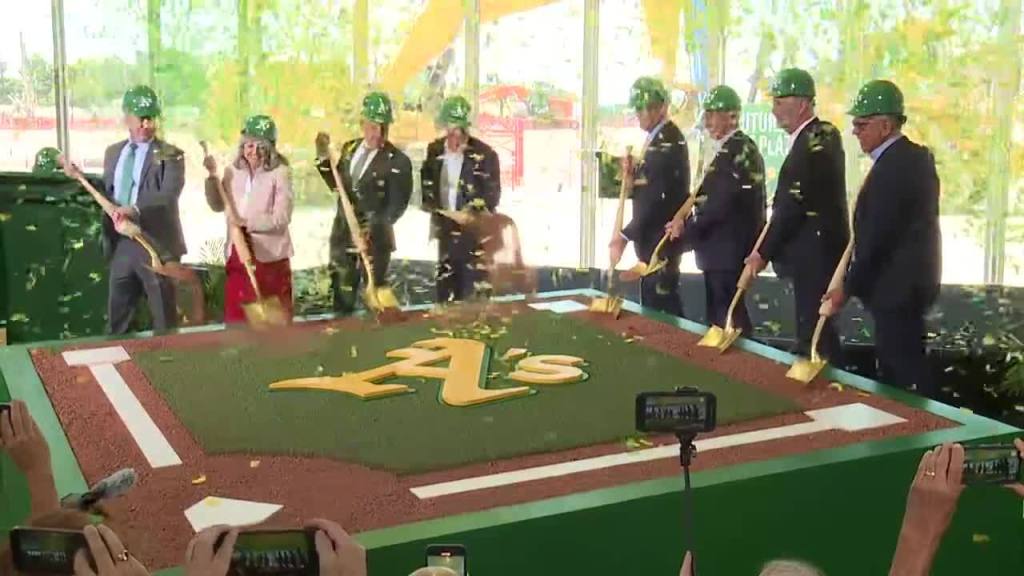
After some intrigue about when it would happen, the A’s chose today, June 23, to have a ceremonial groundbreaking ceremony at their ballpark site on the Vegas Strip. It happened to be a travel day for the team, embarking on a sure-to-be-crushing 10-day road trip to Detroit, New York, and Tampa Bay. A’s management gave the whole event a Vegas flair, with attendees bussed in from the MGM across the street. This makes sense in hindsight, since there’s been a decent amount of excavation on what is now a live construction site. It’s hard to tell how much dirt is removed from overhead views, but from the renderings it looked as if the field was going to be some 20 feet below street level. So while the ceremony was John Fisher and dignitaries shoveling a raised platform with a dirt planter, the A’s staged some yellow iron in front of the windowed event tent for show. Before the actual shoveling, the A’s showed a sizzle reel.
The emcee was Dallas Braden, which upset numerous Oakland partisans who called him a sell out. I mean, Dallas is an A’s employee. I’m sure he still feels bad for the East Bay, but eventually we all have to move on. Braden’s address preceded a number of project principals, including Fisher, who noted that Rickey Henderson attended the demolition of the Tropicana Hotel last summer prior to his untimely death. Steve Hill of LVCVA and Governor Joe Lombardo were also on hand and celebrated the ballpark like it was a rare event instead of yet another massive project going up on The Strip.
If the A’s face minimal delays, the ballpark construction schedule should follow this high-level timeline:
Of course, John Fisher knows stadium construction delays going back to PayPal Park. Baseball’s less likely to forgive mishaps or financial hiccups, though it’s unclear if MLB would provide much help or give Fisher a quick exit if worse came to worse. Sure enough, Rob Manfred was on hand to pump up the project and push for the 2028 opening.
It’s well known that Fisher, while a rich billionaire, is not particularly liquid. So it’s not surprising that he may be selling the San Jose Earthquakes, ostensibly to raise money for the Vegas ballpark. The aim is for a $600 million valuation for the soccer club and perhaps real estate interests such as PayPal Park. Would he be willing to sweeten the pot with a minority share of the Vegas A’s? Anything’s possible when you’re trying to bridge a nearly $1 Billion funding gap. I’m not going to get too much into the intricacies of funding the ballpark, simply because it’s very opaque at the moment, and also because Fisher appears to be doing something quite unusual: a pay-as-you-go model. He had $300 million to do the prep work and the initial concrete podium. After that he has Aramark, the State of Nevada, and Clark County chipping in, then whatever he needs to do to raise the rest, which will surely be over the $1.75 Billion mark when all is said and done. Most stadium projects are financed upfront and funded in tranches as different stages are reached. It will be most interesting to see if Fisher can pull this off, especially if he can avoid much higher interest rates and materials costs than what he probably had penciled in 2-3 years ago. Keep in mind that we haven’t talked about naming rights or other commercialization opportunities that will certainly become more important as the project becomes more… concrete.
For what it’s worth, Globe Life Field took 30 months to complete, with the official opening delayed by the pandemic. Nationals Park took only 26 months, though it is open-air park. LoanDepot Park took 32 months, Truist Park took 30. The A’s have 33 months from now to Opening Day 2028. I may occasionally check it out if I’m in town, though there’s plenty of regular YouTube videos and drone footage to satiate most interested fans.
Should Fisher see this all the way through, there are rules in place to ensure that whenever he sells the A’s, he’ll never have to worry about liquidity again.
There used to be a Bay Bridge Series featuring the two Bay Area MLB franchises, the Giants and A’s. It served as a ceremonial bridge between Spring Training and the long regular season. That’s gone, probably for good. It was replaced this year by some warmup games in Sacramento featuring the Giants and their AAA affiliate, the Sacramento River Cats. The A’s played out their Cactus League string in Arizona before starting the regular season on the road in Seattle.
Meanwhile in Oakland, the Coliseum hosted the Roots’ home opener against fellow USL Championship side San Antonio. The match brought in 26,000 fans who filled both the field and plaza levels. Next week’s game will have a much smaller crowd based on what sections are being sold. At least the sports-starved in the East Bay got a taste. And while there’s no longer a Bay Bridge Series, the San Jose Giants will host the Oakland Ballers in “Battle of the Bay 2.0” at Excite/SJ Muni on April 2nd. So there’s that.
Going back to Sacramento, the main question going into this season concerns the ability of Sutter Health Park’s grass field to withstand the nearly daily pounding of baseballs and baseball cleats.
The previous field was ripped out after the final River Cats game last season, replaced by a very high-tech solution called AirPAT from The Motz Group. AirPAT uses a combination of irrigation and aeration to the grass surface and roots to make for ideal outdoor maintenance conditions. The high-tech part comes from the use of various sensors and drones to monitor surface temperatures, hydration, and drainage. Coincidentally, a spring storm is blowing through California right now just to give the new field its first real test. The forecast calls for the rain to end shortly before first pitch, so we’ll get to see both the field and the grounds crew tested. Motz has a blog post explaining how their system works, though it’s curious that much of the expertise involves artificial turf fields – experience that maps better to Vegas or the original plan to replace grass at Sutter Health Park with a turf system. Motz isn’t bereft of grass experience, as they constructed the field at the Braves’ Truist Park.
Also I know many were curious about the field itself. “The installation of AirPAT technology will optimize root zone oxygenation, improve moisture management, and regulate subsurface temperatures – ensuring a healthier, more resilient playing surface year-round.” pic.twitter.com/3iJldu80J1
In any case, the first half of the 2025 is somewhat frontloaded with A’s games, 51 out of the scheduled 81. They won’t come back to West Sac until July 28, a full two weeks between home games. The River Cats will have nine games during that span, so they’ll get to break in a potentially resodded field just like they broke in the new field last weekend. If there are rainouts, they’re more likely to occur during this first opening series with Cubs than at any other time. That makes August and the first two weeks of September the crucial period for the grass to survive. The second half schedule has nine mutual off days to schedule makeup games if needed, though that may be more necessary for games on the East Coast. Should AirPAT work as advertised, the grass along the river will stay lush and green while much of the surrounding area turns brown.
Truth be told, I’ve been putting off writing this post for weeks. Something always came up. First I was going to comment on Sutter Health Park reverting to grass instead of a turf field in 2025. Next I was going to talk about the Athletics stripping any city designation from their team name during these three or four interim years. The election removed Sheng Thao as Oakland mayor, followed by at least two interim mayors. The A’s dipped into the free agent market to snag Luis Severino to fill a rotation spot*. Then we were hit by the sudden death of Rickey Henderson (RIP GOAT), which made the social media rounds for a nearly 24 hours before an official acknowledgment, apparently at his family’s behest, and finally the announced departure of A’s team president Dave Kaval, who spent most of the last eight-plus years navigating political corridors, eventually arriving on the Vegas Strip. After the Kaval news struck I realized that everyone would be best served with a year-end recap that could also serve as a coda to the Oakland Athletics era.
The Oakland A’s were effectively the middle child among the three major pro sports teams that called Oakland home (the Seals and Invaders were too short-lived to count). As the middle child they experienced many highs and lows and were proportionally ignored within and outside the Bay Area. They were the second team to come to the Coliseum complex and stadium. They were overlooked when it came time to upgrade the facilities, screwed as East Bay leaders desperately brought back the Raiders at the A’s expense. The A’s were also the subject of mostly half-hearted and ultimately failed attempts to keep the team within city limits. So the fact that they ended up staying the longest of all three teams is less a testament to A’s ownership’s resolve than a lack of options. If not for the Giants, the A’s would already be in San Jose. Or perhaps Fremont or somewhere else in Alameda County. Or even Oakland if the parties involved were reasonable about the process. What got lost is a simple practical reality of major pro sports: Cities play for 25-30 years, not forever, and they have to renew and rebuild to keep their teams.
Alas, 2024 is not the year of reason in California. Neither was 2023, 2022, or 2021. With Oakland not agreeable to the A’s terms in mid-2021, the A’s looked to Vegas and announced they were on parallel paths. For whatever reason, neither Thao nor her predecessor, Libby Schaaf, looked at parallel paths as a competitive situation, which set Oakland on its own path to oblivion. You could say that Oakland chose to compete by going along with John Fisher’s grandiose plans for two sites, the Coliseum and Howard Terminal. That worked for a short period when everything seemed to be economically healthy in the Bay Area. After the pandemic hit the money well went dry and Oakland was left with an incomplete process and little to show for their efforts.
Contrast that with what happened recently in St. Petersburg. As recently as spring 2023, St. Pete was considered an also-ran, with the Rays running out the clock on their lease at Tropicana Field. After looking across the bay in Tampa for several years, the Rays and St. Pete started working on a ballpark deal at the Trop site in September 2023. Progress came in fits and starts thanks to uncertainty about the site’s prospects and the Rays’ willingness to build there. Yet St. Pete stayed in the game, got their ducks in a row at the City, County and State levels, and got something done despite an actual hurricane that destroyed the Trop’s roof, leaving the Rays homeless. The eventual face of the effort was Pinellas County Commissioner Chris Latvala, who spent eight years as a State House member before terming out and running for the County post. Latvala brought a perspective that is entirely foreign to the A’s efforts in that he’s a Republican who made his name as a fiscal conservative. He’s also a big Rays fan as evidenced by last week’s interview with Locked on Rays. Latvala was against the Rays ballpark and redevelopment plan at first, then came around when he saw that the future of the Rays in Tampa Bay was at stake. In choosing to support the ballpark, he cited Rob Manfred’s support, which may very well prove a terrible mistake. At least now the onus is on the Rays to follow through on their end. Stu Sternberg has to come up with the money, like John Fisher pledged to do in Vegas. Oakland never got to the step of putting the ball in Fisher’s court. They equivocated, hemmed and hawed, and repeatedly sounded out of their depth when trying to deal with baseball. As the last two Oakland mayors have been women you may think that’s a sort of misogynist, old-boy take on things. It’s more about knowing ball and understanding what the ball club, which is a major constituent, needs to be successful. Without a proper grasp of that, any proposal is likely to turn into a big grab bag of initiatives that is fragile enough to fall apart like a house of cards. Latvala and others in St. Pete even pointed to the Vegas deal as an example of something more fleshed out that should be done in St. Pete, a completely alien sentiment for Oakland. Towards the end of the Oakland era, pols and fans were left to pull stunts to try to get Manfred’s attention. They knew what would it would really take.
In hindsight, it was probably best for all involved that Oakland and the A’s didn’t come to a deal. Because given the state of affairs now, how exactly would they come up with their hundreds of millions of dollars for infrastructure or other promises like community benefits? A bunch of the money meant for the Port has already been assigned to other projects and was never fully pledged towards the Howard Terminal project. Oakland’s current fiscal dire straits is going to involve some painful cost-cutting, which would undoubtedly come at the expense of a not-quite-finalized ballpark project – that’s how clawbacks work. And that would cause the A’s to look for a reason to escape Oakland for good, not that they weren’t already looking.
Times like this I’m reminded of one of my favorite bands of the last twenty years, The Civil Wars. A country duo that started out as a Nashville songwriting partnership, The Civil Wars went on to make two incredibly passionate, perfectly written and produced albums before breaking up (and breaking many fans’ hearts along with it). They were good enough to co-write a song with Taylor Swift to be included on the Hunger Games soundtrack. Whatever the reasons for their breakup, the situation seems as likely for a reunion as the A’s coming back to Oakland. In 2012, when the video below was recorded, everything still felt hopeful for Oakland, The Civil Wars, the world. Worlds can fall apart fast though. At the very least some fans got a year to appreciate the A’s before they were gone.
Note the date of the recording: October 1, 2012, the Monday before Game 162 of the A’s 2012 season
What’s next for Oakland? Hopefully the Ballers will keep playing at Raimondi Park for some time to come. The Ballers didn’t get the happy ending they wanted when the other team that was brought in to prop the Ballers up, the Yolo High Wheelers, won the 2024 Pioneer League championship, then folded their tents to move to a hopefully more permanent home in Marysville. That wasn’t in the script! The Roots are finishing their soccer transformation of the Oakland Coliseum, their sights still set on an interim park next door at the Malibu site, a new interest in Howard Terminal now that the A’s won’t be there, or most likely, a protracted stay at the Coliseum when the other two options prove infeasible or too costly. It’s better than having to crash couches like they’ve been doing for a few years. In Neil Young parlance, is Oakland burning out of fading away? We won’t know the answer for some time. Until then, I hope Oakland can get its act together. There’s nowhere to go but up.
—
* – The Severino contract was obviously done to pull up the A’s payroll to a minimum amount based on their increased revenue sharing receipt. That’s the system right now, and if you’re looking for a floor/cap system to make things more fair, nothing’s going to keep Steve Cohen or the Yankees/Dodgers from running circles around any A’s payroll, whether in Vegas, Oakland, or Timbuktu. Baseball still pays proportionally less to its players than the other sports that have caps and floors, so they are fine through the current CBA’s expiration in 2026. And now they are deferring the crap out of huge money deals to the point that they’re creating Bobby Bonillas left and right. All on Manfred’s watch nonetheless.
In the wake of Hurricane Milton I watched the news feeds closely to see what would happen to Tropicana Field. The fabric dome (an early form of PTFE) had a usable life expectancy of 25 years. The Trop was already 34 years old at the end of the 2024 MLB season, so it would seem that the facility was on borrowed time. Sadly, but not surprisingly, Mother Nature had its own plans for that roof.
The morning after #HurricaneMilton, one of the questions is, “Where will the Rays play?” Let’s go over the options. [1/x] (video from @Ry_Bass)
[2/x] The simplest, though not cheapest, option is to build a new roof at the Trop and play there. Assuming there are no additional structural problems, this is a likely path since the Trop itself is insured. It’s like getting a crappy insurance payout after your car is totaled.
[3/x] The Rays can’t play at the Trop without a roof. Nothing under the dome was properly weatherproofed for outdoor use. In the baking heat and frequent storms of the future it would rapidly degrade. So roofless is not even a short-term solution.
[4/x] Next options are local. There are plenty of spring training facilities – basically AA/AAA quality – where the Rays could play. Their own in Port Charlotte is small and 2 hours south. The closest/largest is George Steinbrenner Field in Tampa, same size as Sutter Health Park.
[5/x] As these are outdoor facilities they will be subject to weather. Everyone in MLB (players, other teams) will have issues. It’s too unpredictable to hang a schedule on. So it’s probably out except for some April games before heat really kicks in.
[6/x] Miami has a retractable roof stadium where the Marlins’ schedule should run roughly opposite the Rays’. That makes it a contingency plan in case the Rays can’t stay local. It would sacrifice any attempt at attendance. I’ve driven Alligator Alley. Miami/Tampa are not close.
[7/x] That leaves other markets outside of Florida. Nashville & Charlotte have AAA parks and desire expansion teams. Oakland has a MLB park and the A’s – who vacated it – playing 90 miles northeast. San Antonio has an old football dome with a baseball configuration. And Montreal.
[8/F] None of those markets are desirable unless they have new MLB ballparks in them. Stadia are too expensive to build on spec these days. So it’s a Catch-22, ironic since Tropicana Field (aka Florida Suncoast Dome) was built on spec. IMO it all leads back to the Trop. For now.
Another thing to consider is that MLB under Manfred is clearly separating East Coast teams like the Rays from West Coast teams like the A’s. They’re not to move between coasts as that affects divisional scheduling and travel.
—
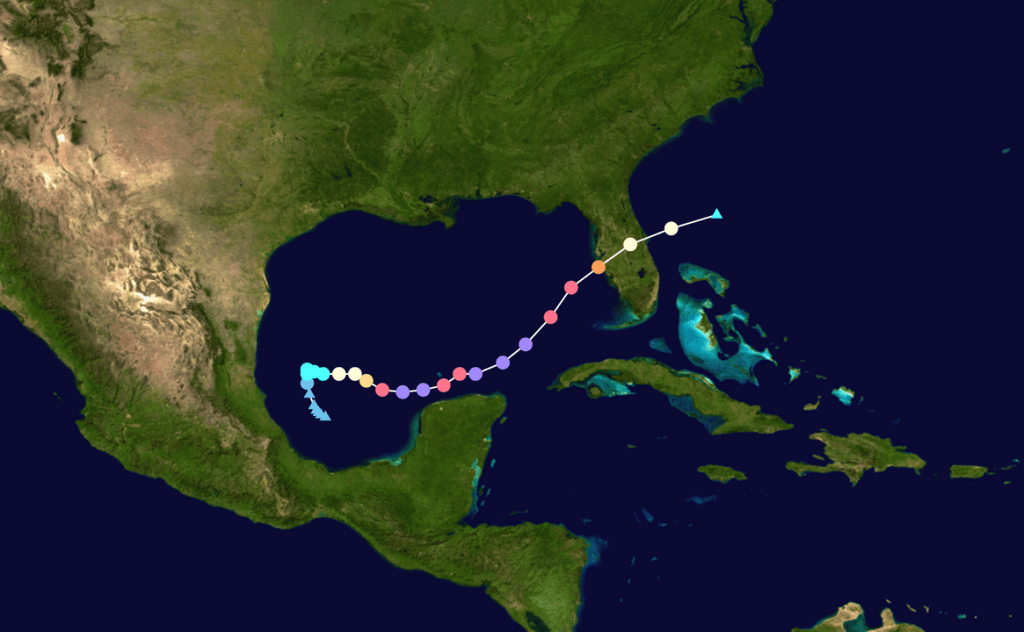
It’s worth briefly discussing how terrifyingly awesome a storm Milton was as it ravaged Florida, not just from the usual torrential rain, wind, and storm surge that comes with a hurricane, but also from a record number of tornadoes that spun up in South Florida and the Atlantic coast well away from the eye of Milton. It started in the Gulf of Mexico off the coast of Veracruz, thanks to the combination of extremely warm Gulf water to fuel the nascent storm and nudges from remnants of another storm from the Pacific. After Helene hit Florida’s Big Bend area and barreled north through southern Appalachia, I was curious about the path the new storm would take.
Milton technically became classified as a hurricane less than a week ago on October 5.
After churning as it made its way northeast, Milton took a slight southerly detour and hit landfall south of Sarasota instead of the Tampa Bay direct hit. Tampa Bay was not spared significant destruction, as shown by the damage done to the Trop’s roof.
In response, the Rays are taking an open approach to dealing with the Trop, saying that a proper damage assessment could take weeks to complete. If the facility was 4 or 14 years old instead of 34, the team would work more urgently to repair the roof and make the place playable again. The Trop is near its practical end-of-life and there is already a plan underway to replace it with a newer dome next door, so you may ask what the point is. Could the Rays and Pinellas County simply roll an insurance settlement into the next project? Presumably, yes. However, I have a feeling the depreciation is going to work against both parties, limiting the payouts to some degree. Still unknown at the moment is the extent of any flood or structural damage, so perhaps patience is in order.
Then again, there is the question of value. On Twitter yesterday I kept pointing to the Metrodome, which had a serious puncture in its inflatable roof that eventually justified a complete replacement two months after the storm damage. Replaced for $18 million, the work was done by August 2011, in time for the next Vikings season. Of course, the Vikings only played at the Hubert Horatio Humphrey Metrodome for two additional seasons as they planned their own dome successor on the same site, US Bank Stadium. The Twins already vacated for Target Field on the other side of downtown Minneapolis, and the University of Minnesota Golden Gophers football team left for the on-campus TCF Bank (now Huntington Bank) Stadium.
That makes the question of refurbishing the Trop largely one of value. This isn’t like the post-Katrina Superdome, which had nine figures of FEMA and state aid poured into it in order to keep the Saints from moving to San Antonio. Tropicana Field should be treated like a short-term case where the facility has a clear expiration date. Will the repairs cost $30 million? $50 million? $100 million? The Rays can’t throw some tarps and FlexSeal over the dome and call it a day. This will be expensive, and yet, clearly not enough.
-=-
P.S. – Al Lang Field, once a Spring Training venue and now the home of the Tampa Bay Rowdies soccer club, is being discussed as a temporary home. Other than it being a really small site, I can’t see anything wrong with it other than the usual weather concerns and the ridiculous “sail-like” roofed concept from over a decade ago. I loved that silly idea, so I will take any opportunity to include it in a post.
Amazingly this Olympic Stadium-lite concept wasn’t even air-conditioned.
Home plate is on its way to Cooperstown. What’s left is quite an image.
The game of bA’seball is worse as we wake today. Can’t shake the sadness & senselessness. Numb flying out of Oklnd knowing 1st hand tens of thousands insanely passionate fans employees families going thru even > pain.HARD goodbyes w/ so many Amazin people who took us in as family pic.twitter.com/UI0P7qlmhg
Ballpark and roof cutaway with scoreboard placed high above right field
A’s Vegas ballpark general contractor Mortenson McCarthy held a meeting and presentation with prospective subcontractors last week. The subs, who are largely experienced entities working on projects on and off the Strip, will be vying for a coveted spot to provide services for the first sports venue on the Strip itself after the Tropicana starts its demolition next month. The presentation puts forth a starting date of Q2 2025 and a 2028 completion. Naturally, there’s a limited amount of flexibility in there because of the normal 30-month construction period for most American sports venues. That could mean the ballpark could open April 2028 in keeping with the expected MLB season, or potentially later if delays arise. Modern Vegas has a well-earned reputation for building frequently and on-time, so it wasn’t terribly surprising that Mortenson McCarthy, which oversaw Allegiant Stadium, is in control of the project.
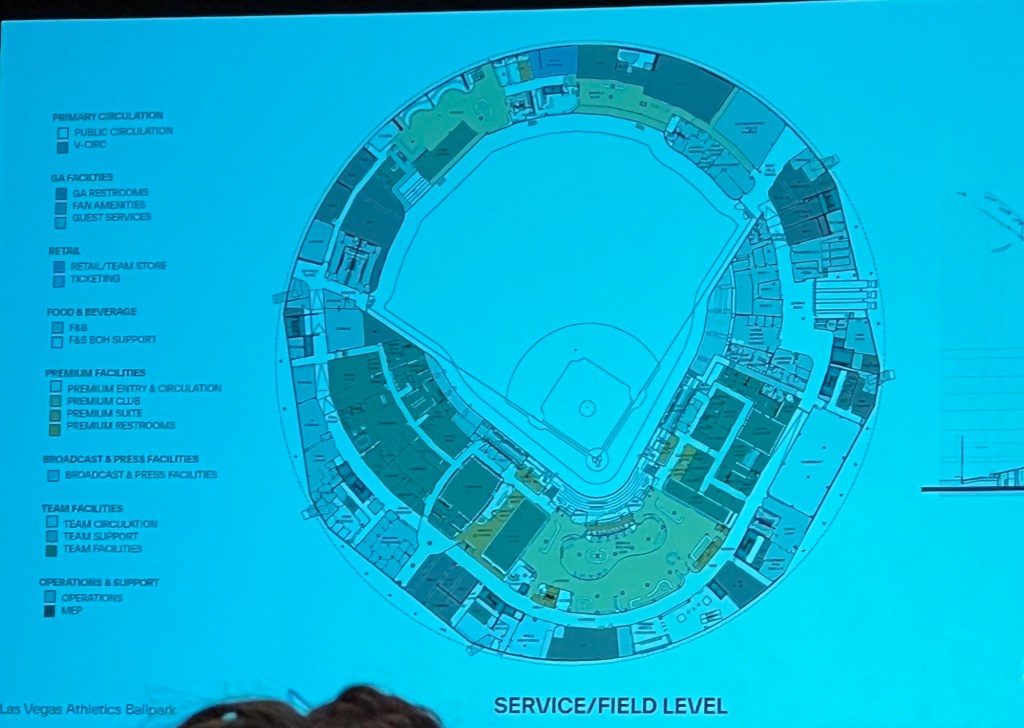
Service/Field Level (Home dugout on 3B side, club behind home plate)
The presentation shown included a number of floor plates to show how the circular dome would be laid out among its six levels. Those details weren’t included in the PDF download, probably because many of the details in there were either still being finalized or were otherwise not meant for public consumption at this early stage. Thankfully, Athletics Nation’s Jeremy Koo was on-hand to screen record the entire thing, so I’ll post some slides as a go. For now, let’s start with the project description directly from the preso:
PROJECT DETAILS
The Las Vegas Athletics Ballpark will be a fully enclosed multi-event sports arena accommodating uses such as baseball, concerts, dirt sports, and other special events.
The ballpark occupies 9 acres within a 35-acre site shared with a Bally’s integrated resort, bounded by Tropicana Avenue, Las Vegas Boulevard, and Reno Avenue.
Capacity:
30,000 fixed seats with 3,000 additional standing room locations
Levels and Height:
6 primary levels with field level close to the average national grade
Maximum height approximately 290′ above field level
Exterior Systems:
Approximately 700′ long-span roof
Metal roof finish with ETFE clerestories
36,000 square foot cable-net glass window
More structural detail including trusswork
The first thing that jumped out to me was the 290’ height. The field is expected to be sunken in 30’-60’, which should put the apex from street level at around 230’. For reference, the two existing hotel towers of the Tropicana are 230’ tall. As a result, there should be few worries about building too tall as the new structure isn’t expected to be taller than what currently exists there. Still, 230 feet is still one of the taller domes in the US. The Superdome and the now-demolished Georgia Dome were both more than 250 feet tall and looked it based on their monolithic appearance.
Ballpark and roof cutaway showing placement of scoreboard in right field
Such a tall roof allows the scoreboard to be placed practically anywhere in the outfield. It’s still in right, anchored to the ceiling above the RF upper seats and slanted down at the bowl for better sight lines, similar to what you see with newer basketball arenas. I would not be surprised if this was expanded either before opening or down the line as the screens seem to be growing exponentially with each generation of technology. Personally, I’m not a huge fan of the RF scoreboard at Globe Life Field since it frequently requires craning one’s neck from the lower deck.
The exterior of the roof will be metal, broken up by the ETFE clerestories and the armadillo-inspired design. I don’t think the current renderings properly capture how immense will be, especially at street level. With no other buildings immediately surrounding it, the only comparisons are other hotel towers the other corners of the Strip, which are at least a football field’s length away.
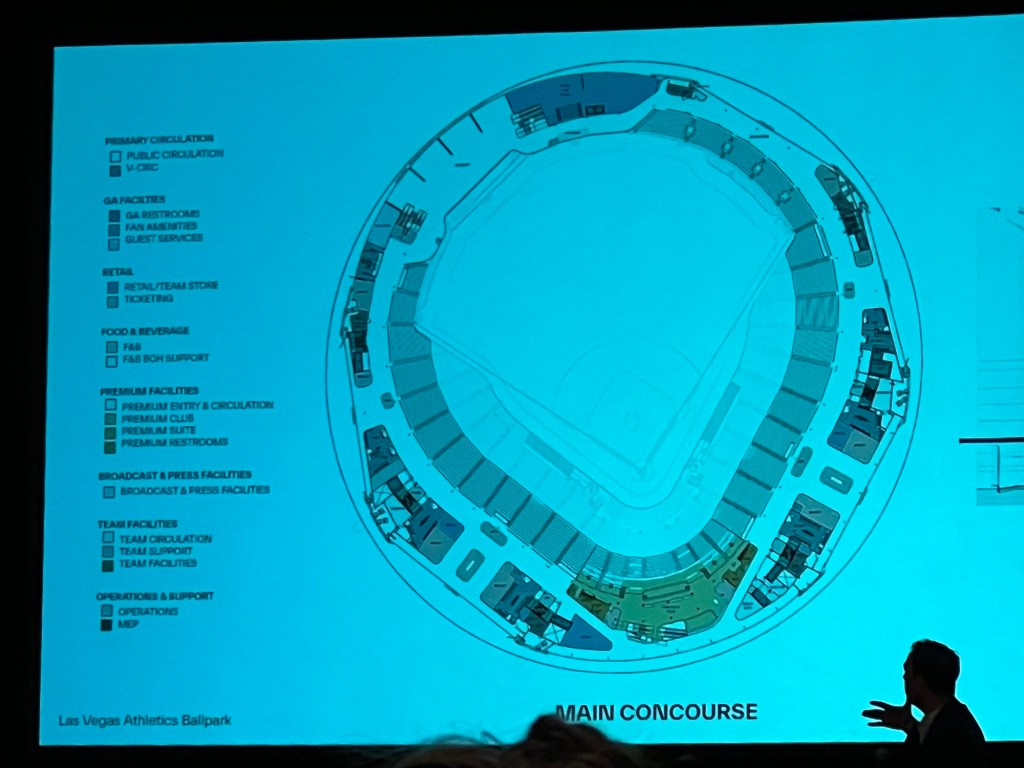
Main concourse
One thing the A’s are adopting is the minimal use of vomitories, or the tunnels and connected staircases that lead from a concourse to seating sections above. There are vomitories in right field, mostly to access higher-end concessions and bar areas along the lower suite concourse. Other than that, fans are mostly meant to access their seats from the top of the concourse. This practice was used for the Glendale Arena (near me), and it helps for hockey where the action covers the entire ice surface. For baseball, where the action is more tightly focused, this matters less.
The suites themselves will be arranged from foul pole to foul pole in the typical arrangement, with larger suites and flexible spaces accommodating placed further down the lines towards the corners. Additional lower suites will be set on their own level behind the backstop. I didn’t see any evidence of bunker suites, so the closest you’ll get to the field while being in a suite is about 12 rows back.
The whole package reminds me of Globe Life Field, with hopefully improved materials. Since there’s no retractable roof, BIG and HNTB can work on ensuring that the clerestories and the big window pane wall in left field are as attractive as possible.
These are some meaty details. They are subject to change with fast-moving stadium architecture trends, so we’ll see what sticks.
Thankfully they went away from the resemblance to the AT&T logo
–
P.S.: Next up for me: a game at Sutter Health Park so I can assess the situation in Sacramento. After all, it will be the A’s home for at least three years.
Update 9/12 – In response to some local Sacramento reporting that the interim ballpark terms may not be approved, MLB released the following statement:
The A's shared this statement from MLB: "It is a certainty that the A's will play their 2025 season in Sacramento as planned. MLB is continuing to work productively with the MLBPA on the details of the transition."
It’s Labor Day, which means there is less than one month remaining in the A’s season, and less than a month remaining in the incarnation known as the “Oakland Athletics.” For at least the next three years, the team will simply be known as the “Athletics,” with no city affiliation to Sacramento, their temporary home, or anywhere else. Once the Vegas ballpark is built at the Tropicana site, the team will go by “Las Vegas Athletics” but not until that point.
The twilight of the Oakland Athletics means there are 13 home games left in the season (and in Oakland history) including tonight’s game vs. the Mariners. The final series against the Rangers sold well, with the final game selling out and commanding ludicrous prices on the secondary market. Unsurprisingly, the penultimate series against the New York Yankees also commands high prices.
I made my last visit to the Coliseum in May with a doubleheader, so that chapter is closed for me. While I have an upcoming trip that puts me in the Bay Area on the same weekend as the Yankees series, I have precious little interest in going to the Coliseum. This funereal final month is a chance for fans to say goodbye. I already did that months ago.
Instead, I plan to attend the final game of the A’s-Cubs series at Wrigley Field on September 18. It’s a day game, a Ferries Buehler school-cutting special, and I’ve never gone to a day game at the “friendly confines.” So I’ll fly in, catch the final interleague contest for the “Oakland Athletics” and grab an Italian Beef and a Chicago dog along the way.
Then I’ll hop on another Southwest flight and head to Omaha, where I’ll have a couple hours to kill before boarding Amtrak’s westbound California Zephyr, destination Sacramento. Much of the trip will be in darkness, which will give me some precious shut-eye time and the always scenic views of the Rockies. I’ll arrive on Friday, September 20 a few hours before the River Cats take on the Sugar Land Space Cowboys (Skeeters) at Sutter Health Park. I’ll take in that game, survey the grounds and the state of affairs before the major improvements to accommodate the “Athletics” begin in earnest. After the game I expect to head down to the Bay Area for the rest of the weekend.
The A’s, who won’t pay rent during their tenure at the former Raley Field in West Sacramento, will share the AAA ballpark with the River Cats. To accommodate the MLB club, grass will be replaced with artificial turf, specifically Shaw Sports’ B1K product in use at numerous MLB domed facilities. B1K is also in use at a number of outdoor college ballparks, though the schedule of NCAA regular season baseball isn’t subject to summer heat the same way any MLB stadium would. Supposedly the A’s are installing a ‘hydration’ element on the surface, which means sprinklers? Many turf facilities water the surface before the game and at halftime for soccer use to help cool down the turf and the infill via evaporation. As baseball doesn’t have halftime, I’ll be curious to see how this is implemented. The A’s are paying for many of the improvements, including building their own clubhouse behind the plate instead of using the River Cats’ clubhouse in the outfield. Visiting teams still have to use the visiting clubhouse (correction: road teams will use the River Cats’ clubhouse), which most of the time is merely sufficient even in MLB facilities.
2024 A’s schedule with likely summer home getaway day games circled in gold
Regardless of the hydration implementation or its efficacy, it’s important to consider how many times it will need to be considered. I took a look at the A’s 2024 schedule and found 13 dates during the summer months of June, July, and August that for scheduling purposes have to be day games. The graphic above circles those dates in gold. White circles indicate non-summer dates, though we all how prolonged summer can feel in California. For night games, a quick spritz before the game will be fine as the evening begins and the atmosphere cools. Night games in Northern California tend to cool off quickly as the sun goes down, so the turf won’t need active cooling or monitoring for heat. I’m more interested in the use of the B1K infill system, which is made of sand and coconut husks instead of the crumb rubber pellets used in the typical football stadium artificial turf. The net effect there is that any infill flyout should be less of a health issue in terms of accidental inhalation of swallowing. That can be a tradeoff for rubber’s greater durability, which is a requirement of football’s higher intensity usage.
Weather Spark charts climate comfort for every city based on historical data in a neat chart format, so you can see what the best times are to play a baseball game in each city irrespective of daily weather changes like storms. For Sacramento (specifically West Sacramento) it looks like this:
West Sacramento year-round climate
Pending weather, the idea is to schedule games away from the “Hot” section (85-94°F) as frequently as possible, or to mitigate its potential effects. The slightly darker contour at the top and bottom of the graph is after sunset and before sunrise, respectively, and includes the effect of twilight and daylight savings time when they occur. A similar graph for Vegas shows that there’s little escape from the heat, hence the need for a roof. Both Vegas and Phoenix have an extra contour labeled “Sweltering” when the temperature surpasses 95°F. There is talk in Sacramento of starting getaway day games before noon to mitigate the heat. At least there’s some flexibility. In Vegas the chart looks like this:
Las Vegas year-round climate
You might be wondering what Oakland’s climate chart looks like. It looks quite pleasant with no mention of the marine layer’s summer effects. That goes to show you how being in a nice climate only gets you so far. Onward, and enjoy what’s left of the Oakland Athletics while they’re still in Oakland.
Or don’t. Pro sports has proven its willingness to leave Oakland in the dust.
–
P.S. – Some folks are crazy enough to suggest opening Mount Davis for the final game on September 26 without opening restrooms or concession stands up there (because they may not be working). Frankly, it could set a world’s record for the largest golden shower. Anyone up for that?
No bathrooms or concessions open on Mount Davis for the final game? For fans who will likely be daydrinking before entering? Oh sure, sounds like a fine fan experience. Have it open, but please give them the basics they are paying for, FFS. https://t.co/BJJRhmbQb8
Last fall, when the 2024 schedule was released in preliminary form, I immediately circled May 8 on my calendar. As you probably saw on Wednesday, on May 8 the baseball version of an eclipse took place: a natural doubleheader. Not a doubleheader that included a makeup game from a previous rainout, or the dreaded day-night or split doubleheader that requires two separate admissions. No, this was old school single ticket double-dip, the second game coming thirty minutes after the first game ends. For me, it offered a satisfying coda to my time as an Oakland A’s fan. My first A’s game was itself a doubleheader in 1988 in which the A’s dominated the Cleveland Indians. And while the 2024 A’s is not the dominant force the Bash Brothers-era A’s were, they are showing promise after a couple of severe rebuilding seasons.
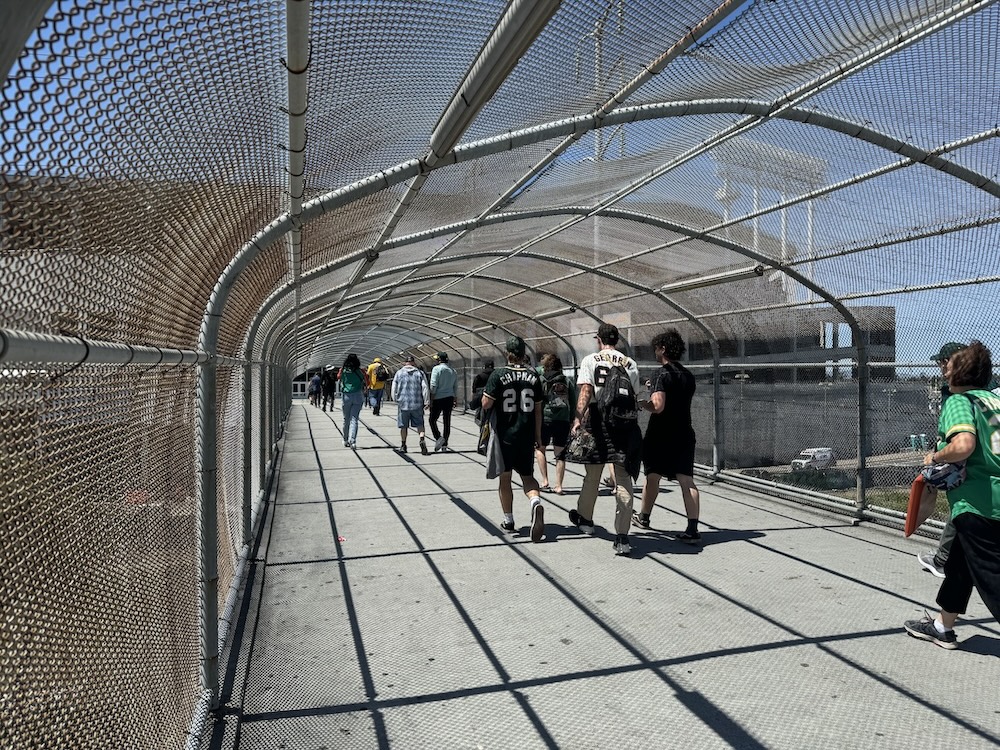
I left my house in Glendale at 6 AM, bound for a 8 AM flight to SJC. I chose to fly into SJC instead of OAK because I wanted to capture the experience of taking my old route from the South Bay. If BART was running all the way to Santa Clara, that would’ve been the choice. Alas, the downtown San Jose extension is still in turmoil, so I went with the Capitol Corridor train out of the Santa Clara station instead. As usual that experience was quite smooth, including a few lovely moments on the platform with an elderly woman who was traveling to Sacramento. I got off at the Coliseum station and took a few pictures of the old haunt from the Amtrak BART ramp. I also noticed an A’s security person stationed at the top of the ramp as it met the BART bridge. That didn’t strike me as particularly notable, but as I found out later, was something to consider as the season progresses.
Warm weather and a double dip are perfectly good excuses to head out to the yard
A half hour before first pitch, there was a good stream of fans headed to the game. I didn’t expect a very large crowd even with the doubleheader, but it was nice to see some turnout. The announced crowd was 8,320. It was clear that there were plenty of no-shows because of the muted reaction to some of the announced groups that supposedly purchased tickets. On the other hand, there was a 2-for-$20 promotion on the field level which brought a number of casual fans, and there was actually a line for walkups at the BART plaza ticket window.
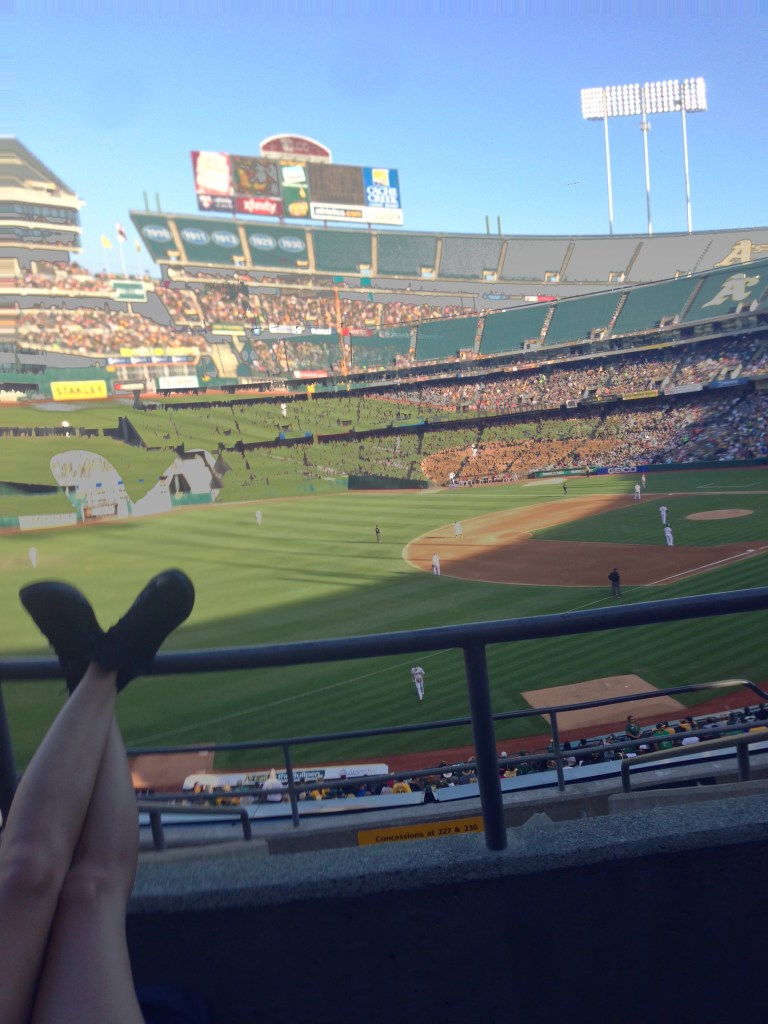
I figured I had plenty of time to get concessions if I was hungry, so I went straight to my seat in 119, next to the Diamond Level section. I was perched above the A’s batting circle, with a great view directly down the first base line. That afforded me a “great” view of Mount Davis, which got me thinking about how the A’s announced a series of giveaways throughout the season, culminating with a replica model of the Coliseum on the final regular season home date ever in Oakland on September 26. Which version of the Coliseum will be given away? The 1966-1995 version with the ice plant in the outfield, or the 1996-present version with the hulking 10,000-seat eyesore? I decided that I wasn’t going to travel all the way to the Bay Area to get the crappiest version of the thing I loved so much. I wasn’t going to proudly place that thing on a mantel or shelf for posterity. While that game will allow for a sort of wake for the club’s time in Oakland, I’ve personally done enough grieving over the years.
Try as you might to minimize it, Mount Davis is immense and unavoidable
To understand my stridence about this, you’ll have to consider my past as a young man covering his childhood love the A’s and the Raiders in the media when the Raiders first came back in 1995. I was working through college, hired by a freelance Bay Area photographer to provide rudimentary copy along with pictures he sold outside the normal wire services. I read enough of the great columnists and the young upstart reporters in the Bay Area papers to provide a reasonable facsimile, so I eagerly took the gig, a wide-eyed 19 year-old sitting in the back row of every press box, but with an assigned seat and a printed name plaque nonetheless (shout out to the greats Al LoCasale and Debbie Gallas, btw). Those first couple of years were a whirlwind, as the Coliseum was in a constant state of upheaval. Were you aware that there were two seating configurations for Raiders games depending on whether the A’s season was still on? During the baseball season, the football field was configured to run from home plate to center field to limit field damage by the temporary football seats. After October, the field was reconfigured to run from foul pole to foul pole in order for the bank of football seats to be installed in the baseball outfield. That was never the most ideal situation for either team, so I was curious what the renovated Coliseum would look like. A month ago, Travis Danner posted a page from the A’s magazine touting the improvements:
Found this bit of 90's ad copy on my 10 year old retired laptop. Is it just me or was Mt. Davis intended to be less tall than it ended up?
In case you can’t read the bullet points, I listed them below
Two large family and corporate picnic areas
Additional rest rooms and specialty food service stands
New BART walkway and entrance plazas
New ticket box office and retail areas
20,000 square foot family entertainment center concourse
Center field corporate club with outfield seating
New outfield seats to replace benches
New computerized matrix scoreboards
Two new high resolution video screens
Improved access to the upper deck
Additional plush Luxury Suites and renovated Suites
Diamond level seats in two areas adjacent to dugouts
New club seating – premier seating in an outdoor setting
20,000 square foot private air-conditioned baseball club with dining areas and two-story bay windows overlooking the field
Six new elevators to all levels
New and enlarged press box and enlarged media elevator
All new armchair seating throughout the entire stadium
Television monitors under overhangs for instant replays
Improved sound system
Premium catering for the Clubs and Luxury Suites
Enlarged clubhouse for A’s players
Refurbished visitor locker room
New media interview room for players
Indoor batting tunnel and pitcher warm-up mounds
Enlarged weight room
Expanded field storage
Club concourse connecting eastern addition with existing stadiums
In hindsight it’s easy to see how the A’s and A’s fans were so thoroughly screwed by these largely football-centric improvements. More seats, more suites, and more clubs in the wrong places, plus no mention of how the baseball experience would be compromised, it was soon to be disastrous for everyone involved from the pols to the teams to the put-upon fans. Back in 1995, that wasn’t so obvious. The retro ballpark craze had just started with only four such ballparks open by the start of the season (Camden Yards, Progressive Field, Coors Field, and New Comiskey if you want to count that). At that point, the retro craze was still a nascent one. It wasn’t until the millennium approached that the trend became a craze.
Back in 1995, I still believed in the utility of the multi-purpose stadium. SkyDome was conceived as a multi-purpose dome (MLB & CFL) and was huge and glitzy. Mostly I was mostly excited that the Coliseum would get an expanded press box. During that early period the auxiliary football press box was set up in one or both of the open Loge areas beyond the original luxury suites in the outfield. There was still overflow press seating for baseball, such as the repurposing of section 317 for visiting writers during the postseason. For the most part, the bigger press box was an enormous improvement – and it wasn’t yet overrun by critters. I saw the image in the A’s magazine and thought that they were fully enclosing the stadium like some of the cookie-cutters (Busch II, Riverfront, Three Rivers). Unfortunately, fans and press were bamboozled. Even when Opening Day 1996 came we didn’t see the full effect of what would become known as Mount Davis, as they hadn’t fully poured all of the concrete for the upper deck. Remember, the A’s had to spend the first week of the season at Cashman Field in Vegas. The video below captures the mix of joy and unease that came with seeing the monstrosity looming over everything else. (Among the other notable things from that video: it was Charlie Finley Day with Monte Moore handling the proceedings, and the otherwise infallible Roy Steele mispronouncing Jeff Reboulet’s name). As Mount Davis fully rose, all A’s fans got were some security guards doing the YMCA dance late in the season.
All of my coverage on this blog and elsewhere has been viewed through the lens of someone who witnessed first hand the short and long-term effects of Mount Davis. I’m aware of how ironic it is that I got my shot through covering the Raiders coming back and that someone else recognized something in me. I’m not now and never have been a Raiders fan, though I had no reason to hate them up to that point. Nearly thirty years later, the Raiders are obviously THE catalyst for killing pro sports in Oakland because the East Bay never properly recovered from the experience, even after the Warriors’ dynasty. I’m often viewed as an enemy of the East Bay, at least on social media. In fact, Steven Tavares wrote an article about it. Criticizing Oakland is not the main focus of this site. Instead it became a chronicle of the litany of missteps and strategic errors made in trying to get a ballpark for the A’s built, by both politicians and ownership. Some were in Oakland, others in San Jose or Fremont, more are destined to come in Las Vegas. In the end, I look at all of these moments as simple matters of timing and execution. Oakland got an AFL franchise because the AFL needed a second West Coast location, and Oakland pitched itself as a good landing spot. Similarly, the A’s came to town because Finley saw more opportunity in the Bay Area than he did in Kansas City. The Warriors were nearly doomed to barnstorming by Franklin Mieuli until the gleaming Oakland Coliseum Arena was built. When East Bay power brokers brought back the Raiders and didn’t tell A’s ownership, baseball noticed but they couldn’t do anything about it. The early 2000’s birthed a renewed effort to give the A’s a proper home. The timing was poor there because there was no support by then-mayor Jerry Brown. Subsequent mayors lacked either the gravitas or the drive to see a ballpark project through, or they were somehow convinced that they could accomplish the same thing at the Coliseum 40 years in even though prevailing trends were pushing teams away from each other. At the same time, post-Haas ownership groups were often focused anywhere but Oakland, to the point that Oakland’s only legitimate shot to retain the came only 6-7 years ago.
Think I’m blowing the Mount Davis effect out of proportion? Take a look at the dwindling number of Coliseum-themed collectibles that are available for sale on eBay or MLB Shop. Posters and photos often set their perspectives to minimize the visual effect of Mount Davis as much as possible. It remains an ugly reminder of how failure can last generations. It’s impossible to deny how East Bay stadium proponents were cowed from making big public investments asks as they squandered all of their political capital on both the Raiders (horrible deal) and the Warriors (a good deal that had a rough ending). That made any and all Oakland efforts focused on the A’s a race against time, a test of MLB’s patience. It’s not that the East Bay suddenly got religion about the folly of publicly-funded stadium projects. The problem was that they knew they couldn’t ask. It’s like trying to fight with one arm tied behind your back.
–
Mason Miller retiring Marcus Semien to end Game 1
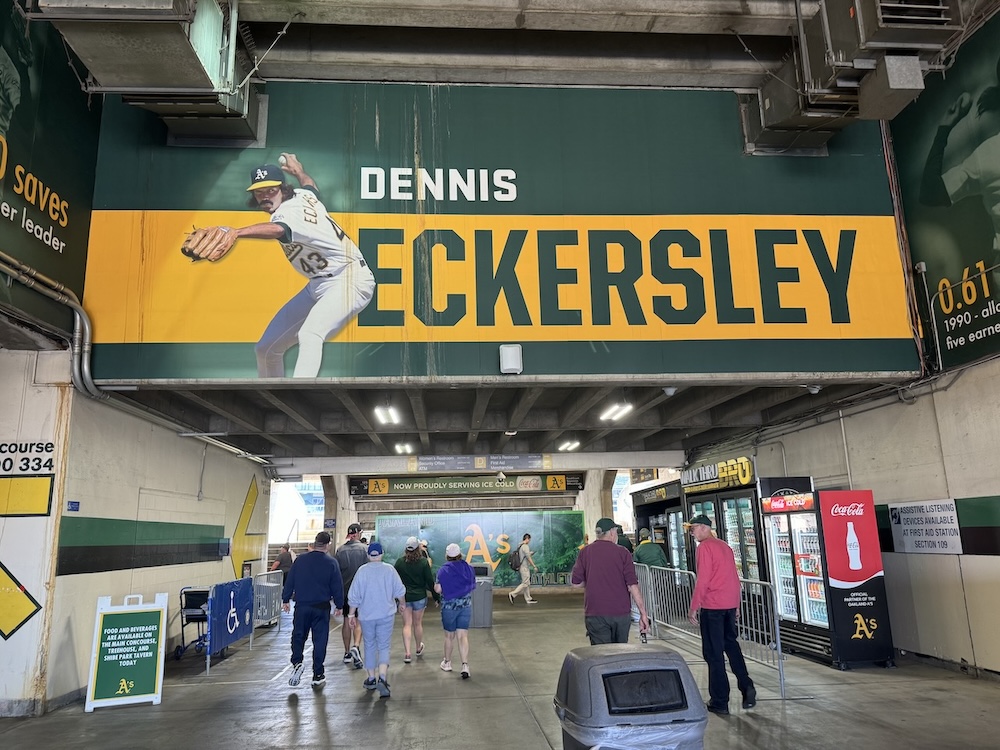
After the A’s won the first game (including a surprise Mason Miller six-out, non-save exhibition of dominance), I made my rounds throughout as much of the Coliseum as I could. I traveled both the field and plaza concourses, went up to the View level, visited the Hall of Fame area, the bleachers, everything except the closed upper decks of Mount Davis. And that’s just fine. I used one of the trough urinals. I used a regular urinal behind left field, though I noticed that entire wall of urinals there hadn’t been flushed. Everything seemed darker and dingier than I remember in previous visits. On the bright side, I noticed that outside one of the concession stands there was a dispenser of various sealed cups of dips and sauces. I immediately thought that was a brilliant bit of convenience. Then I realized that if more fans were here those dispensers would be cleaned out by the second inning. It’s just human nature to take free stuff because it’s there. I have no idea what the vibe will be on September 26, the final game at the Coli. I can imagine that a lot of stuff that isn’t properly bolted down will quickly become souvenirs. That’s more than fair in a sense. Taxpayers paid for this, they might as well get something back. After all, the Coliseum’s not going to need all of those seats for an occasional Ballers or Roots/Soul game. The Coliseum is destined to go the way of RFK Stadium, which was finally cleared for demolition only last week. Then again, DC might bring the Commanders back from the wilderness in Landover/Raljon. Is a major team coming to Oakland anytime soon? Maybe, but first Oakland will have to spend some time in the wilderness. Brooklyn eventually got one, so it’s possible.
—
P.S. – On the way back to the BART station I noticed a pile of trash strewn on the BART bridge. In 36 years of going to the Coliseum I’ve never seen that. That brings me back to the A’s security guy I saw at the Amtrak ramp. It used to be there were either A’s staff at the BART station entrance, sometimes with a golf cart to take mobility-impaired fans in either direction. I saw golf carts circling the Coliseum itself as one of the drivers nicely offered me a ride, but none on the bridge. The Coliseum is not the epicenter of the Bay Area’s apparent doom spiral. The way things are going, it can’t help but get caught up in the cycle.
Saw this on the BART bridge as I was about the enter the station for the airport connector. This was for me the most disturbing image of the day because it’s an indicator of the kind of neglect facing the #Coliseum area. #Athleticspic.twitter.com/YdNZMOT8oH
D GateHonestly, how often are you going to a trough urinal in the wild?Bangeliers having a record dayYou can’t steal all of the free sauce when there isn’t anyone around to take itMount Davis, minimized in a poster











 newballpark.org