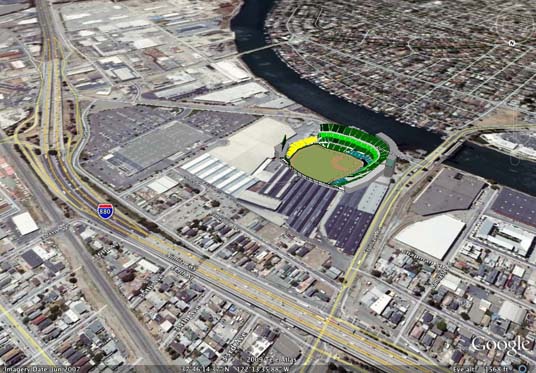
Notes on SJ Redevelopment session 5/12

Running in liveblog mode for this one, though I am not there – I am watching the live stream.

SJRA/Council are voting to approve 5 principles to use going forward in discussions with MLB and/or the A’s regarding a ballpark. The 5th principle reaffirms that any money or land contribution made by the City for a ballpark would require a vote. I say “reaffirm” because that’s already in the City Charter, it’s nothing new.

Public comment period is happening now.

A new ballpark information website is going to be up soon, perhaps by next week.

Motions approved.

CA Sports teams support Prop 1A

Numerous California sports franchises, including the Giants, A’s, Sharks, and Warriors, have contributed $25,000 each to the Yes on 1A campaign, according to Matier & Ross. Lew Wolff, who gave a few quotes to M&R, also gave $25k of his own money to the cause. Also on board are Anheuser Busch and Philip Morris.

It’s clear that in supporting 1A, they are looking out for their own interests. To bridge the budget gap, the state may look towards taxing tickets, food and beverage, parking, anything related to running a franchise. Anchutz Entertainment Group, the giant stadium and arena operator, could become a big time loser if such taxes pass.

While it makes sense that these contributors would back 1A over taxes on their own operations, these two issues aren’t mutually exclusive. 1A isn’t guaranteed to fix the budget, especially if future state revenue falls short of projections. If that occurs, guess who’s next?

I’m curious about the potential revenue the state could raise through a “fun tax.” I suspect that while it would affect teams and fans, the proceeds would be a drop in the bucket for the state.

1A and its companion propositions are losing big time, according to Field Poll results from the beginning of the month.

KQED Interview up

Earlier today I was interviewed by KQED Radio’s Cy Musiker regarding the A’s and San Jose. Check out my dulcet nasal tones in the podcast. I talk about the money that Mayor Reed wants the city to make, NIMBYs, chicken-and-egg scenarios, and yes, hope for Oakland.

Listeners will get an easter egg for their time: the correct pronunciation of my real name! Discuss away.

One more thing: the economic impact report I cited in the interview can be found here (PDF).

Reed, Council to shape ballpark discussions

Tuesday night will mark yet another procedural step in San Jose’s effort to lure the A’s, as they will push forward again with rules for working with MLB, the A’s, and affected communities. More interesting is what the Mayor and City Council are saying, which is what Denis C. Theriault picks up in his article today.

The council Tuesday also will take up its most comprehensive plans yet for ensuring that business owners and other residents remain part of the city’s evolving ballpark conversation. The mayor’s previously announced “Diridon Station Area Good Neighbor Committee,” citywide town hall meetings and frank chats with neighborhood leaders are part of the prescription.

The Diridon committee would include 27 members, including transit officials, neighborhood leaders and representatives from the group that runs HP Pavilion and from nearby businesses such as Adobe Systems. Its work could start as soon as June, Reed said, with a review of the 2007 report clearing use of the Diridon area for a stadium.

I’m a little wary of having 27 members in this committee, but at least no one will be able to say they are being underrepresented. Perhaps it takes a village to build a ballpark.

Mayor Reed also indicates that he wants the project to make money for San Jose, but doesn’t indicate how. The model I drew up in the last post indicates that San Jose wouldn’t make money. They could through a more expensive lease. More likely is some kind of revenue sharing agreement, especially if it involves the redevelopment zone just created out of the Diridon/Arena area.

Credit goes to the Mayor/Council for being steadfast on looking for a public vote. Even if it is only advisory, at least it goes to the point of directly asking citizens if it’s a good deal. I’m not for ballot box planning, especially if no public money is going towards the ballpark itself. However, with the Mayor’s promises of open government, this is an appropriate step.

Blueprint for a deal

While I’ve mentioned the Quakes’ stadium deal from time to time, I haven’t really gone in depth as to how the deal works. Now’s as good a time as any, since the Quakes deal provides some excellent clues into how a San Jose-A’s deal might be structured.

66 of the 75 acres were sold to the Quakes for $89 million, a cost of $1.35 million per acre or $31 per square foot. The remaining 9 acres will be sold to VTA for the BART Extension, as there are plans for a train yard there. Within the 66 acres for the Quakes, 13.5 have been set aside for the stadium.

The idea is for the Quakes to build the stadium, funding the construction on its own. Once completed, the Quakes would donate the stadium to San Jose. In doing this, they would avoid paying property taxes on the stadium, which could amount to $500k per year or more. The “donation” could also provide additional tax breaks for ownership, though I’m not clear on what those would be.

San Jose would own the stadium, the Quakes would own the land. Next, they would set up leases with each other which would probably have a counterbalancing or zero net effect. The business arrangement is the opposite of the Giants-San Francisco deal, in which the Giants owned the stadium and the City owned the land. This is important because the Giants currently pay a sizable property tax bill in the neighborhood of $2 million per year (on top of their AT&T Park mortgage and the ground lease with the Port of SF). Don’t feel too bad for the Giants, though, all of these expenses translate into a $6 million reduction in their annual revenue sharing payment (it’s probably more when other stadium expenses are accounted for).

For the A’s, $2 million a year in property taxes is nothing to sneeze at. It would be much higher if they owned the stadium in San Jose, since a ballpark will run $500 million to build, resulting in a $5 million bill. Surely, longtime ballpark proponent and County Assessor Larry Stone would be willing to reassess the ballpark at a lower value, but the A’s would still be out a few million a year. The avoidance of property taxes would be an integral part of the deal wherever it is built (SJ, Oakland, Fremont, etc.). Why? Let’s say the A’s go out into the market for a $300 million loan for the ballpark. Their interest rate is guaranteed to be 1 full point higher than a comparable loan/bond issue for a public entity such as a city or county. That 1% translates to $2.5 million per year, the same amount as the forgone property taxes.

If we were to apply the principles of the Quakes-SJ deal to the A’s at Diridon South, it might look like this:

  • San Jose completes acquisition of all Diridon South land for ~$60 million.
  • In the deal, the ballpark land only is sold to the A’s for the same amount, $60 million. That translates to $600k in annual property taxes.
  • The A’s build the stadium for $500 million, then donate it to the City.
  • A triple net stadium lease is arranged which covers basic operations costs (insurance, utilities, police and traffic management). That could be worth $4-5 million a year and would escalate annually. The A’s would also be charged with paying into some sort of capital improvements fund.
  • City leases the land from the A’s for the stadium for a nominal amount. This would not completely offset the stadium lease. I’m guessing it’d be around $1 million a year, similar to the Giants-Port of SF arrangement.
  • City applies part of the $60 million towards the PG&E substation relocation and the creation of a park on the fire training site (I hope). The rest of the money goes towards other RDA projects or acquisitions.
  • SVS+E operates stadium on behalf of the A’s. The two parties split concessions and parking revenue.
  • The San Jose Arena Authority would provide oversight, as it already does for HP Pavilion, Municipal Stadium, Sharks Ice, and in all likelihood, the new Quakes stadium.
  • (An alternative would have the City simply lease the land to the A’s, which could run another $2 million a year instead of the upfront $70 million.)

The net annual outlay for the A’s would be $3-5 million, plus the amount paid into the capital improvements fund. These costs would be the same whether the ballpark were publicly or privately owned. In this scenario, the ballpark itself would not be a net revenue generator for the City. However, they could get significant tax increment from the defined TIF zone, and the ballpark would undoubtedly be good for downtown businesses.

Sidebar: A comment in a previous thread asked about the exclusion of the ballpark site from the newly designated TIF zone. I think this is because, as the deal is constructed above, there would be no tax increment to collect. If the land and stadium were City owned they’d be exempt from property taxes. If the land were owned by the A’s the stadium would exempt, but the land would also be frozen in its assessment because the improvements to the land, from which tax increment is derived, would all be tied up in the stadium. Either way, there’s no point in adding them to the zone when they wouldn’t generate significant TIF revenue.

Saperstein’s other letter

Zennie Abraham just posted a second letter from A’s minority partner Guy Saperstein. This time, the message was addressed to Senator Barbara Boxer. He posted it in its entirety, and so will I. The tone is markedly different from the public rebuttal to John Russo.

April 2, 2009
Senator Barbara Boxer
1700 Montgomery St. Suite 240
San Francisco, CA 94111

Dear Barbara:

As you know, Jeanine and I have long supported you and we plan to continue doing so. However, we were very disappointed about the letter you sent to Commissioner Selig. I realize you have a lot on your plate in the United States Senate, but if you are going to weigh in with such resolute conclusions about the A’s, I wish you had made a greater effort to determine the facts. You made no inquiries to the Oakland Athletics about efforts they have made to find a stadium site in Oakland and your letter cites almost no relevant facts. Doug has known for a long time that I am part of the Wolff ownership group, so if you didn’t want to call the A’s directly, you easily could have called me with your concerns. Perhaps after hearing more of the facts, you would have offered a more balanced assessment to the Commissioner.

Your letter cites some of the past history of the A’s in Oakland, but it glosses over and ignores many important facts. It is true the A’s had great baseball teams in the 1970s—experts say some of the best teams in baseball history—but you neglect to mention how Oakland fans responded to these great teams. Not very well. These teams drew less than a million fans per year and that number dwindled to 306,000 in 1979. The A’s couldn’t even sell out the World Series! I remember this because I could walk up on the day of each game and buy a ticket. I’m willing to bet this never has happened before or since in MLB history in any other city. The second thing that should be noted about 1970s is that it preceded free agency. Thus, the A’s owner, Charles Finley, didn’t have to compete with other teams for players by paying them competitive salaries; they were bound to the team by the so-called “reserve clause.” Because of this form of indentured servitude, even small-market teams like Oakland could remain competitive for years. Today, with free agency, the economics of baseball are fundamentally different and small-market teams have fundamentally different challenges.

Your letter also cites the Haas Family era, another period of excellent teams, and even good attendance. But you neglect to note that the Haas’ were losing $10-$15 million per year with those teams in an effort to pay competitive salaries. They were a winning, attractive team which paid big salaries to big stars, but that was because the Haas family was willing to lose millions every year. While we can all thank the Haas family for their beneficence, their model of ownership was and is unsustainable and you cannot expect the Wolff ownership, or any ownership, to operate as a community sports charity.

Not only do the A’s draw far fewer fans than the Giants, but the A’s average ticket price paid is one of the lowest in MLB—approximately half of what Giants fans pay for tickets. The A’s have 8,000 full and partial season ticket holders, compared to the Giants’ 24,000 full season ticket-holders. This is even worse than it appears, because when you rely mainly on game-day walk-up sales, you never know how fans are going to show up that day and, consequently, you don’t know how many vendors to hire, ticket takers, food workers, etc. So you overstaff and overpay, due to uncertainty. By contrast, if you are the Giants and know that 35,000 fans are going to attend every game, you staff properly. Added to these major economic disadvantages, the A’s income from the sale of luxury boxes is one of the lowest in MLB and just a small fraction of what Giants fans pay. This is largely the product of the unpleasant but inescapable fact that Oakland lacks a vibrant business community. When you add all this up, it would be hard to find any MLB owner who would characterize this as strong fan support.

Let me present a few more relevant facts—facts that any ownership must contend with. When Charles Finley brought the A’s to Oakland from Kansas City, Oakland had a population of 367,000 [1960 census] and San Jose a population of 204,000. Forty-one years later, San Jose’s population is 989,000—now the 10th largest city in America—and Oakland’s is 401,000. Which is the more vibrant, growing city? And, while you are promoting Oakland as the only possible site of a new stadium, please note that only 19% of A’s fans come from Oakland.

As currently situated, the San Francisco Giants control 2/3 of the Bay Area market and are located just 12 miles away from the A’s. If the new baseball stadium were to be built in Oakland, it would replicate this imbalance; if it were built in San Jose, 50 miles away from the Giants stadium, the market imbalance would be adjusted and the A’s could be more competitive.

While it is easy to scapegoat the A’s for the ills of Oakland, a fairer assessment of what ails Oakland would start with its inept political leadership—some of whom you prominently endorsed, supported and rarely criticize. Without naming names, let me recall just a few more salient facts.

The long-range planning and leadership of the Oakland Coliseum Authority has been almost non-existent. This group made mistakes of judgment which would be almost beyond imagination except for the fact that they actually happened. They spent $140 million to build Mount Davis at the Oakland Coliseum, then entered into a contract which not only costs the taxpayers of Oakland nearly $20 million per year, but which term is only ten years. So, ten years later, Al Davis and the Raiders are whining about a new stadium—which, predictably, they want the taxpayers to pay for. And what do the taxpayers of Oakland get for this almost unbelievable beneficence? Eight home games a year! Then the Coliseum Authority dropped $100+ million into the laps of the Golden State Warriors, who also play far fewer games than the A’s and have far less economic impacts on the city. Along came the Oakland A’s in 2005, under its new ownership, and in recognition that the A’s were playing in what is basically a football stadium, and now a decrepit one at that, and requested that the Coliseum Authority split the cost for a $500,000 feasibility study for a new stadium. The Coliseum Authority couldn’t even scrape together $250,000 to try to keep its biggest asset! The Authority has allowed the Raiders and Warriors to bankrupt it and there is nothing left for the A’s, despite the fact that the A’s, unlike the Raiders, Warriors and 49’ers, always have been willing to pay for building their own stadium. To put it another way, the A’s may be the only sports franchise left in the Bay Area, and perhaps America, willing to pay for their own stadium, but the Coliseum Authority hasn’t lifted a finger to help the A’s and now politicians like you and Doug [and there probably will be others] are quick to pillory the A’s for even thinking of moving.

Nor has the Oakland political structure helped. Despite the many business reasons to move to San Jose, the A’s explored all options to stay in Oakland. Lew and the A’s can give you the full picture if and when you want to hear it, but I can tell you I have been involved since Day One and when Lew first asked me to become part of the ownership, I said I would love to do it, but I didn’t want to be part of an ownership which just bought and moved the team. Lew assured me that he would make a full effort to stay in Oakland and I don’t think he and his son, Keith, have left a single stone unturned in their efforts to make Oakland work for the A’s. I recall specifically Lew proposing to build a 3,000+ unit housing project and several hundred thousand feet of retail space near the Coliseum and taking the profits from this development to finance a stadium at little or no cost to the taxpayers of Oakland. This would have been the biggest economic development in Oakland since Liberty ships were built during World War II, but the only Oakland City Council Member who showed any enthusiasm was Larry Reid. Give Larry a call and ask him why no one else got behind this plan. And in case anyone might suggest forward thinking and planning was not possible, while Oakland was doing nothing, San Jose bought land in downtown and put together a 50-acre parcel, zoned it for a sports stadium and completed an Environmental Impact Report for the stadium. If they want a baseball team, they are ready for it. You were elected to represent all the cities and citizens of California, not act as surrogate Mayor of Oakland. You have a responsibility to try to determine what is best for the state, for the Bay Area, and, yes, for Oakland AND San Jose. Your letter to the Commissioner plays into the hands of the San Francisco Giants, who have long contended the Bay Area is a one-team region and whose game plan is nothing less than driving the A’s out of the Bay Area. I think you need to rethink your strategy and begin by making sure the A’s are able to stay in the Bay Area.

Like you and Doug, I find it convenient to have a team located 20 minutes from my house and, like you, I will be inconvenienced if the A’s move to San Jose. But should an investment of half a billion dollars for a new stadium to meet the needs of present and future Bay Area baseball fans be based on your, my and/or Doug’s convenience or on a sound economic foundation? I think the answer is obvious and I hope you will begin to review the facts and evidence before making more pronouncements which operate to undermine the A’s opportunities to build a sustainable future.

Lastly, despite serious reservations about the ability of Oakland to provide help in the quest for a new stadium, Lew and I will be meeting with Mayor Dellums in two weeks in an effort to make certain that we have not overlooked any viable site. And, of course, Lew, Keith and I remain available at any time to provide you with additional information about all options.

Best Regards,
Guy T. Saperstein GTS/ht

The immediate observation to be made is that this is the first time anyone from the ownership group has come close to “connecting the dots” regarding the A’s and San Jose. Maybe that was intentional, maybe not. I’m surprised to be reading it. I thought San Jose was like Fight Club. For those who still don’t think San Jose’s the next step I have to ask, Really? Come on, now.

Next up is the issue of the feasibility study the A’s asked for when Wolff took over. According to Saperstein, the $500k cost was to be split between the two parties, but the Coliseum Authority was too tapped out to help. All the while the Authority was finalizing the deal to get rid of Raider PSL’s forever and hiring multiple consultants to get a naming rights deal for the Arena. If this feasibility study assertion is true, you can be sure that it will end up in the Blue Ribbon report.

What I don’t get is Zennie’s response. He rants about Saperstein’s pointing out the 70’s attendance woes. It’s no secret that the A’s weren’t a big draw then, just as they aren’t now. The facts are these:

  • The A’s averaged 764,660 per season during the decade
  • The A’s were as high as 5th in AL attendance once (1972)
  • The A’s topped 1 million twice during the era
  • The A’s were last in AL attendance twice and second-to-last twice
  • Average annual attendance for all AL teams during the 70’s was 1,194,395

When your biggest argument is semantic, you don’t have much of an argument.

I’m also not sure what Saperstein has to apologize to the Haas family about. Nothing he wrote denigrated Wally Haas. He held up Haas as a paragon to which no future ownership group can be favorably compared. At the same time, yes, Haas was losing money. That can’t be disputed. Why so sensitive then?

Now, there are things to quibble about. Russo mentioned in his letter that the Coliseum North proposal would’ve required eminent domain, which is right. Wolff was willing to pay no more than $1 million an acre, a ludicrous amount at the time. When the plan collapsed, Wolff then resubmitted Schott’s old Coliseum parking lot plan, in which the A’s would contribute $100 million. Does anyone remember that?

One of the big keys for any political campaign, even the kind we’re witnessing here, is message discipline. It doesn’t matter if you’re Karl Rove or David Axelrod, Doug Boxer or Lew Wolff. I sense a serious lack of message discipline on both fronts, and it isn’t very becoming for either side.

Zennie and I agree

Before you check out Zennie Abraham’s newest contribution to the his SFGate blog, let me warn you that both the text form and his vlog are lo-o-o-o-ong. Have a seat. Maybe get a beverage.

Zennie comes out guns blazing on everyone, from Mayor Dellums to A’s ownership. Interestingly, he reveals a couple of things that sound absolutely terrible from Oakland’s perspective. One, there are four – count ’em, four – groups working on the ballpark issue. Zoinks!

So it’s that wealth of experience at seeing Oakland stumble all over itself with secret meetings between people who think they know when they can’t even crunch fiscal data let alone craft a decent set of planning scenarios that’s got me riled up. And it’s the fact that we have as of this writing four committees and groups – The Oakland Mayor’s Sports and Entertainment Task Force, Doug Boxer’s MLB Task Force, and the Oakland Metropolitan Chamber of Commerce’s Land Use Committee, and the Oakland Alameda County Joint Powers Authority – looking at the A’s stadium issue and yet never having met as one to talk about this matter and trade information in the objective of presenting a united front that really has been the last straw for me.

Two, Zennie quit the Mayor’s Sports and Entertainment Task Force last week. Zennie asks, “Would you believe…?” and all I can say is “Yes, I believe it.” I’m not surprised. I don’t think any A’s fan or Oakland observer is surprised. I don’t have to touch on the litany of missteps, the situation is practically self-evident.

I ended an interview with a reporter earlier this week with an opinion I’ve been wanting to get off my chest for a while: Owning a major league team, and having it in your city, are privileges, not rights. It is incumbent upon both parties to approach any negotiations with that attitude. No matter how long you’ve owned a team (Marge Schott) or held it in your city (Brooklyn), the fates can be cruel and your privilege can be taken away in an instant. If both parties treated the team as something more than a possession to argue over, more progress could be made.

It can be argued that Wolff/Fisher can treat the team as a possession since, well, they bought the team. Still, owners have a social contract with fans that goes beyond tickets, television, and promotions. There is an unspoken bond between the owners, team, and fans. All have a shared responsibility to protect and grow the franchise. That stewardship begins at the top.

The city, on the other hand, has a much more tenuous grip on the team. It may have a lease agreement as the only legal bond. It also has a responsibility to uphold the relationship with the team. If the city is looking to provide a stadium solution, it behooves them to put aside the political oneupsmanship and games, in order to work together to reach that common goal. This is where Zennie and I are on the same page. The fact that one of Oakland’s staunchest advocates quit over his frustration with the process is perhaps the most disheartening development I’ve heard yet. Zennie’s more a numbers guy than a work-the-channels type, so I’m not going to oversell his value. Regardless, it’s anything but good, and smacks of running to the lifeboats.

I’ll end this post with a quote from the 99-year young John Wooden, the Wizard of Westwood:

Never mistake activity for achievement.

(placing palm on face now)

Jingletown Stadium @ Fruitvale

Faithful New Ballpark readers: Marine Layer made the very foolish decision to let me, Chris Kidd, stand in for him for this post. I come, hat in hand, to offer you something you all thought you would never see. It is a favorite sticking point for San Jose partisans (and something in Oakland which we prefer to ignore) that none of the proposed sites in Oakland have a level of preparedness equal to Diridon. There’s no EIR, they say. The needed infrastructure improvements are too great, they insist. Well, I believe I might have found a site in Oakland that will not only have both of those issues fully addressed within 18 months, but it will be done without costing the Oakland A’s ownership a single penny (and if I might editorialize for a moment: In your face).

What is even more amazing is this site is far superior to both of the rehashed waterfront sites so far proposed in Oakland, specifically the site at Oak to 9th and the site at the Howard Terminal in the port of Oakland. Far superior. Have I whetted your appetite enough yet? Can you not stand the suspense anymore? Well, wait no longer: the site I’m talking about is on the Oakland Estuary at the base of the Fruitvale Avenue Bridge. A site I like to call Jingletown Stadium.

So, let’s first talk about the site itself. It’s 26 acres currently inhabited by the Owens Brockway Glass Container company. It is bounded by Fruitvale Ave to the north/west, Alameda Ave to the south/west, Home Depot to the south/east, and Boehmer and Elmwood Ave’s to the north/east. I call it “Jingletown Stadium” because the site is across the street from the vibrant artist community of Jingletown (photo blog).

Now, let’s compare this site with the two other Oakland waterfront sites: Oak to 9th and the Howard Terminal. When comparing sites, there are some yardsticks to go by: the size of the parcel(s), the ease of acquiring said parcel(s) and dealing with the displacement of the current occupants, the current infrastructure, the current public transit options, and the feasibility of adding infrastructure and parking.

Let’s go point by point, though I’m going to save a little bit for dessert.

  • Size of Parcel: Jingletown Stadium is 26 acres, compared to 029’s 40 acres and Howard Terminal’s 46 acres.
  • Acquisition: Though 029 would be the easiest parcel to acquire, the A’s would be taking on a ginormous NIMBY fight that has stalled out the development of 029 to this day. You don’t want that. Howard Terminal is equally squishy: the port of Oakland just signed a 25 year contract with Matson Shipping and they would be required to relocate them to an equally large site for their exclusive operation. Space like that on the waterfront is neither easily attained nor is it cheap. While Jingletown Stadium would need to relocate the glass factory to elsewhere in Oakland, this is a much easier prospect than moving Matson Shipping. Oakland currently has an over-abundance of available industrial space, and finding another site for them to inhabit should not be difficult. One solution I particularly love is to put them on the Oakland Army Base. It offers the same proximity to a major freeway and the city would be able to offer them the land for free as incentive. Additionally, it would remove a large industrial polluter to an area of the city that isn’t nearly as densely populated. But I digress…
  • Infrastructure: To put it succinctly, they suck for the other two sites. The Howard Terminal is near only 1 freeway exit southbound and 2 exits northbound. 029 doesn’t fare much better with 2 exits northbound and 1 exit southbound. Compare that with Jingletown Junction having 3 exits reasonably close southbound (23rd, Fruitvale & High) and 2 northbound (High & 29th/Fruitvale).
  • Public transit: Here’s where Jingletown Stadium cleans the clocks of the other two sites. Fruitvale BART is only a third of a mile away from Jingletown Stadium. Even better, Fruitvale BART is a regional hub for AC Transit. 029 is over a mile from Lake Merritt BART and Howard Terminal would require an infill station for BART. Screw that mess.

So, you guys have had to slog through quite a bit of article so far, but are you ready for dessert? I saved the best part for last, contained in the question of feasibility for upgrading infrastructure and parking. This is the lynchpin for what makes Jingletown Stadium far superior to all other sites in Oakland: The Central Estuary Specific Plan. Now, I could go through a whole explanation about what the Central Estuary Specific Plan is, or I could use the wonder that is The Internets and show you. I wrote some guest articles about the CESP for Vsmoothe’s phenomenal blog A Better Oakland. They’re here, here, and here. You can also read more by my blogger-crush DJ Crimson at his blog Oakland Streets here and here.

If you’re link-averse, I’ll spare you the work and give you the quick and dirty right here. The city is developing a “specific plan” for the area of Oakland’s waterfront bound by 19th Ave, 54th Ave, 880 and the estuary. An EIR is created which will cover the entire specific plan area, and developers who want to build anything that is contained within the range of this EIR can use it to gain approval to build instead of having to create their own. The process for the approved types of new development will have a much faster time getting approval and getting construction started. For the significant amount of time and money saved by the developer using this EIR, they have to pay a “user fee” which will only be used within the specific plan area. These fees will do things like build sidewalks, create open space, modernize the sewer system, underground utilities, etc.

This is where the A’s come in. If the staff drafting the specific plan include a stadium plan within the EIR, it’s conceivable that the A’s could use it for the stadium. What’s more, the pretty hefty user fee the specific plan area would extract from the A’s could go towards all the types of infrastructural improvements that the A’s would need at a new stadium. Streets can be reconfigured, freeway exits can be modified. The area around Jingletown Stadium is still relatively underdeveloped: it can accommodate a lot of the upgrades needed to the roads and there are many underdeveloped lots that could serve as additional off-site parking to make up for the insufficient amount of space the 26 acres of Jingletown Stadium would provide for parking.

Plus, I bet Jingletown Stadium would have some mean burritos.


Editor’s notes:
Like any site, Jingletown has its positives and negatives. I don’t have any familiarity with this area other than driving through there several years ago while looking for waterfront sites.

  • Of the 26 acres, half would be devoted to the ballpark and the other half to parking in all likelihood. That translates to about 1,600 on-site spaces if only a surface lot were built to save costs. That could grow to 3,000 (two levels) or 4,500 (three levels) if a garage were built, but someone would have to foot the bill for that. The more parking is immediately available, the greater traffic impact. 10,000 spaces for any ballpark would be for any site, regardless of the site’s proximity to transit. A worst case scenario has to be assumed to properly identify problems and create mitigation plans.
  • A 2002 report by environmental watchdog site Scorecard indicates that the Owens Brockway plant has a less than glowing report card in terms of toxic chemical/waste generation. If the site were acquired, it’s likely that some amount of site cleanup would be required. The flipside is that wherever the plant is moved, it’s possible that a cleaner replacement could be built. Owens Brockway’s parent company is one of the largest glass container manufacturers in the world.
  • If Owens Brockway isn’t interested in selling, the plan is dead in the water. Unlike the other two waterfront sites, this one is privately owned. As usual, eminent domain is assumed to be out of the question.
  • The picture intentionally orients the field east instead of creating a “Splash Hit” situation. A street acts as a buffer between the ballpark site and the waterfront.
  • Impact to Alameda is unknown, which means NIMBY reaction to such a concept is unknown.

Discuss.

Quakes get land discount + TIF approved for Diridon/Arena area

Following up on an item from last month, San Jose’s Redevelopment Agency (City Council wearing different hats) unanimously approved the price cut for the Airport West site, from $132 million to $89 million. The land will be used for the Quakes’ new stadium, plus some future commercial development. The discounted price is $8 million more than what the City paid in 2005.

On a more A’s-related note, SJRA also approved creating a tax increment zone just north of the Diridon South ballpark site. The area includes Diridon Station and the 8 blocks between HP Pavilion and the ballpark site, with Guadalupe Parkway/CA-87 on the east border. Virtually all of this area is zoned either industrial or commercial. At least one site, the old SJ Water Company land bought by Adobe, has development plans underway.

TIF funds could be used for the new infrastructure stuff we’ve discussed previously, from the new multimodal transit hub to additional parking to open space. It’s hard to say what yields they are expecting, but it stands to reason that whatever gets built, TIF will be stretched out enough for the corresponding projects to be paid for.

Tying the two news items together, it’ll be interesting to see how quickly construction begins on the Quakes stadium. As I understand it, the land there is already graded and ready to build. Should a new stadium have it groundbreaking in the summer or fall with visible progress over the next several months, it would be a major achievement politically for the City and A’s/Quakes ownership. It’s expected that the ballpark will have its own ballot measure, and there’s no better political capital than showing that you’re getting something done – with your own money, nonetheless.