Coliseum City Draft EIR Review: Ballpark Setting

The renderings in the Coliseum City Specific Plan (co-mingled with the EIR) date back to July 2013. So far, no announcements have been made about architecture firms winning the business for any of the Coliseum City venues. With that in mind, when looking at the renderings don’t worry too much about how they look. They’re effectively placeholders, there to show the mass and complete the layout of the buildings within the plan. If you’re asking about a dome on the stadium or how many seating decks are in the ballpark – don’t bother. It’s highly subject to change.

That said, we can look at a few aspects, such as how the ballpark is placed and oriented within the ballpark. That is the subject of this post.

First, let’s look a bird’s-eye view from the south, with the entire project built out.

birdseye-view_north

Coliseum City with new arena on the other side of the Nimitz

The BART bridge is to be replaced by a much wider pedestrian concourse, connecting a better-connected transit hub, residential development at the BART station parking lot, hotels lining the concourse, and the broader development with the venues. The concourse will be built at what is currently 73rd Avenue, the street connecting San Leandro Street to the Amtrak Station. Doing this moves the dividing line of the complex further south/east, with the bulk of the developable land on the north/west side of the concourse. Several high rise condominium buildings flank the concourse where the existing Coliseum currently sits.
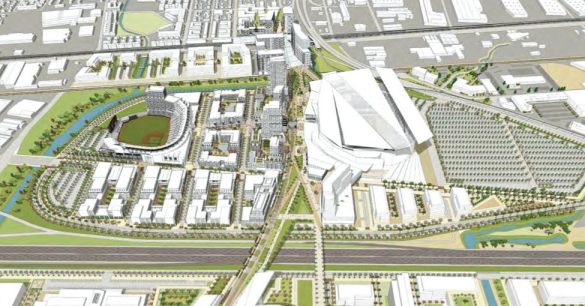
birdseye-view_east

View east across Nimitz down pedestrian concourse

The concourse is widest outside the football stadium and at 880, where there are two (!) bridges spanning the Nimitz.

birdseye_closeup-view_north_ballpark

Above concourse, looking towards ballpark

The Plan describes two levels of circulation: the elevated concourse and street level, where most of the buildings and the ballpark will be situated. Fans would descend stairs to the plaza that leads to the ballpark. There could also be a trolley or streetcar station at this intersection. The plaza and the four blocks surrounding it are the focus of what is called the “Next Generation Sports and Retail District.” This area would be closed to cars on event days, allowing for a big party zone between the two venues.

cutaway-entry

Side view showing concourse and street level elevations, plus cutaways of venues

Should Coliseum City come to fruition, there won’t be anything like it in the country, with two or three venues anchoring a big district. It would also be huge for the City if the large swath of commercially-zoned property slated to be office/R&D could be put together as a potential campus for a large tech company. Right now all of that activity is focused on the Peninsula and the South Bay, with Google, Apple, and Facebook devouring huge tracts of land for future expansion. At the moment Oakland is a few degrees removed from such activity, but that’s where they should be thinking.

district-med

The Plaza between the ballpark and stadium

I’m still not a big fan of orienting the ballpark to the northeast. While that’s proper in terms of MLB guidelines, the orientation turns its back on the plaza and feels like a missed opportunity. It would be nice to have people walking along the plaza be able to see into the stadium, the way you can from much of the Gaslamp District in San Diego. The idea is to fully integrate all elements of the plan, and this is a miss.

There is a publicly-accessible area of the ballpark beyond centerfield, where a Park-at-the-Park like grassy knoll provides views. But getting there requires walking along the edge of the complex, along a perimeter road, past a hulking parking garage. It’s not the friendliest or most accessible approach. A nice side effect of this approach is the fans traveling south on BART will get a good look at the ballpark as they arrive at the Coliseum (City?) station.
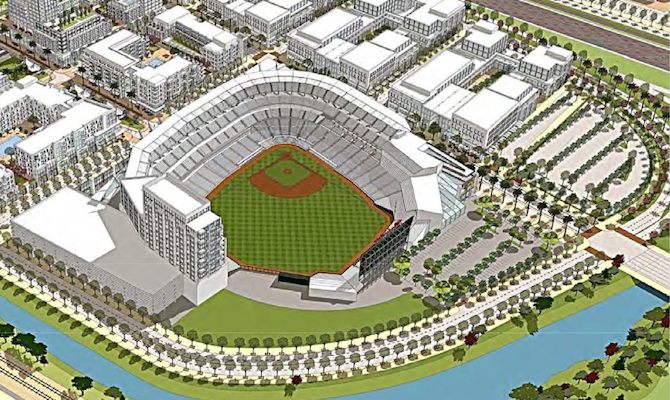
View into ballpark with loop road and publicly accessible "knoll" in foreground

View into ballpark with loop road and publicly accessible “knoll” in foreground

Another thing that bothers me, though it’s entirely understandable, is this from the Project Description (page 3-39):

Operation and scheduling use of the Ballpark would be restricted from having major events (including baseball games) on the same day as football games at the adjacent Stadium. Since no large events could occur simultaneously, parking for the Ballpark would be accommodated within the same on‐site parking facilities as used by the Stadium including the 3,240 surface lot spaces and 7,500 dedicated event parking garage spaces.

The Plan calls for more than 18,000 parking spaces, an 8,000-space improvement over the current complex. 13,000 of those spaces would be in garages, and of those spaces 5,000 would be off limits because they would be slated for hotel and residential use. The net gain for event use, if some of the office parking is used, is an extra 3,000 spaces or 13,000 total. Despite the great reduction in available tailgating space (only possible 3 surface lots totaling 4,200 spaces), a parking restriction like the one described above would remain in effect. That would limit the ability of schedule makers to freely assign weekend home series for the A’s in August, September, and October. It also shuts out any possibility of going to both Raiders and A’s games in the same day within Coliseum City: an A’s game at 1 and a Sunday night Raiders game at 5, or vice-versa. It’s better than sharing a field, I suppose.

Coliseum City Draft EIR Review: Owning vs. Leasing

I’ve done my initial run through of the EIR (except for the traffic data) and have taken lots of notes along the way. Over the next few weeks, I’ll write up specific subjects, the first being the most germane to what we normally talk about, the ballpark at Coliseum City. Before I dive into that, I wanted to touch on something in the language of the EIR that had me curious, and frankly a little baffled.

From Project Description, page 3-34:

NFL Stadium and Multi‐purpose Event Center
…The Oakland‐Alameda County Coliseum Authority would control the use of the Stadium through a management agreement with a professional management association (currently AEG). The Stadium would be leased to the Oakland Raiders, a National Football League (NFL) franchise, for playing home games during the NFL pre‐season, regular season, and post‐season and for other NFL related events.

Page 3-38:
The Ballpark is expected to be developed by the Oakland A’s professional sports franchise on land owned by the City of Oakland and Alameda County. Like the Stadium, the Oakland‐Alameda County Coliseum Authority would control the use of the Ballpark through a management agreement with a professional management association.

The Ballpark would be leased to the Oakland A’s for playing its 81 home games during the MLB regular season6 and potential post‐season games,7 and for other MLB events.

Page 3-39:
The new Arena would be leased to the Golden State Warriors, a National Basketball Association (NBA) franchise, for playing home games during the NBA pre‐season, regular season, and post‐season.

Notice the common theme? All three venues would be owned by the City/County/JPA and leased to the teams. Since this is merely the Project Description of an EIR and not a DDA (Disposition and Development Agreement), it’s not exactly iron-clad. It’s a little strange that the City would continue to want to own and operate these venues, when it has shown frequently over the last 20 years that it’s not all that good at managing venues.

Currently, the structure is set up so that the JPA owns the venues and the land. They collect rents and other revenues and pay for expenses (except for the A’s gameday ops). The JPA is not a “professional management” group, so they hire another company to do that such as AEG or SMG previously. The various agreements with the teams have caused City and County to hemorrhage red ink, whether we’re talking about the ongoing subsidy for the Raiders, the Coliseum’s debt service, or the cloudy nature of the Arena’s debt once the Warriors leave for SF. It’s this difficulty and mismanagement that has caused Alameda County’s Board of Supervisors to be a lot less sanguine about Coliseum City’s prospects than Oakland. Supervisor Keith Carson has been upfront about wanting to get out of the stadium management game.

Now we’re looking at the JPA (or a successor public agency) absorbing billions of additional debt liabilities. Start with at least a half-billion that would cover the infrastructure costs at Coliseum City, plus the $120 million of remaining debt at the existing Coliseum. Add to that $1 billion for the football stadium, $600 million for the ballpark, and probably $700 million for the arena. That amounts to around $3 billion in debt load. Naturally, when dealing with such enormous figures, some questions will arise such as:

  1. How would that debt be structured?
  2. How would City and County taxpayers be protected from shortfalls or defaults, they way they weren’t with Mt. Davis and the redone Arena?
  3. How would the JPA balance out the lease agreements so that no one team benefited more than the others? (This plagued the JPA in the past)

If the City is willing to cover infrastructure costs and pay off the remaining stadium debt, should it also have to go the extra mile to finance these venues? That’s S.O.P. for the NFL (see Santa Clara), but it doesn’t have to be that way. The City & County could say, Look, we’re giving you enough help to get this started, you take it the rest of the way. And the biggest reason to have the JPA do the financing is to provide availability to tax-free bonds. The franchises don’t need that kind of help.

That’s not to say that all publicly-financed stadium deals are terrible. Some of them work out well, like SAP Center and Chase Field. However, the risk the City & County would have to take on is more than a bit much. There are actually multiple privately-financed venues completed over the last 15-20 years: AT&T Park, Gillette Stadium, Staples Center, American Airlines Center. They are also among the most successful venues in their respective sports.

At some point some within Oakland is gonna have to playing hardball and stop giving everything away. If not, maybe they should find new negotiators.

P.S. – Notice how, because all the talks with the Raiders are behind closed doors, there’s little hubbub about them? Contrast that with the very public lease extension talks with the A’s, which only grew more rancorous as they became more public – even though they were over a deal that cost less than $30 million total. No, it makes much more sense to keep quiet on a deal that is worth 100 times as much, right?

Quan, BayIG strike back with “basics” of Raiders deal

Matier and Ross reported today that the City of Oakland and BayIG, the group behind the Coliseum City project, have put together the “basics” of a deal that would include a ~$1 Billion stadium for the Raiders and development of up to 800 acres surrounding the stadium.

Now, Zach Wasserman, an attorney representing backers of a hoped-for sports, housing and retail complex called Coliseum City, says the “basic terms” of a financial deal have been worked out among his group, the city’s negotiators and the Raiders.

The big takeaway is that the City and County, which would be giving up land and paying for infrastructure costs as part of any deal, would also have to pay off the remaining $120 million in Coliseum debt. That is an enormous giveaway on Oakland’s part no matter how you slice it. Both City and County officials have insisted in the past that any large plan like Coliseum required the debt to be taken care of – preferably by the developers. If you can remember back to the “adult conversation” in December, County Supervisor Keith Carson practically hijacked the proceedings by having the first 10-15 minutes of the meeting spent on recounting the debt liability faced by the JPA.

Carson emphasized that there will be no future project if debt isn’t addressed first.

So, let’s tally up what we know are the costs of Coliseum City so far:

  • $344-425 million in infrastructure cost
  • $120 million in Coliseum debt

That’s up to $565 million in project costs, all without building a single stadium, hotel, or office building. And there’s more. Not included is the $80 million in arena debt, the responsibility for which is up in the air. In the EIR (you guys have been reading that, right?), the City states that of the 800 acres covering the entirety of the project, 535 are publicly owned. That includes the City, County, JPA, and EBMUD. The remaining 265 acres are privately owned, making those properties subject to negotiation. Most of that land is on the west side of 880, but some important pieces are right next to the Coliseum or in between the Coliseum and the BART station. Now let’s take a low market rate offer of $2 million per acre. That’s another $530 million that would be borne probably by developers, but could also be paid to some degree by the City since Oakland has eminent domain capability. No matter who pays for it, the total cost of land, infrastructure, and dealing with outstanding debt is $1.1 Billion. That’s the cost of the Raiders stadium right there, or two A’s ballparks.

The counter is that the Raiders, NFL, and BayIG are paying for the football stadium, which may or may not have a retractable roof, may have 56,000 or 68,000 seats, etc. The potential upside is 10,000 new residents, 21,000 jobs, and retaining all of the teams – though it still hasn’t been articulated how any sort of carveout for the A’s would work.

Now compare that to what Lew Wolff is offering, which is to pay off the debt on both the Coliseum and the Arena. While we haven’t seen plans, the planned development is not expected to be as expansive as Coliseum City, as Wolff has said that acquiring private property for this purpose is a bit sticky for his liking (Coliseum North being Exhibit A). Besides, even 120 or 200 acres is a lot of land.

We haven’t yet heard Alameda County’s side, and Carson is certain to raise questions about the giveaway. The City can come to terms on a deal, but without the County as a partner the deal isn’t sealed. I fully expect a sequel to the adult conversation, when all of the costs and liabilities are laid bare. If the A’s get it together in time, there may even be a sort of competitive situation with two bidders. Let the rich guys duke it out over what is purported to be high quality, valuable land. Chances are that such a discussion won’t happen until after the election. After all, there’s something fishy about the timing of this release, considering that last week Oakland mayoral candidate and CM Rebecca Kaplan took credit for “saving the A’s in Oakland” (h/t Zennie Abraham).