What to expect when you’re not expecting

Word came Friday that Floyd Kephart is out from the Coliseum City project, which, you might think, should lead to the demise of Coliseum City.

With Kephart’s negotiating rights set to expire on Thursday, the Oakland City Council and Alameda County Board of Supervisors agreed in separate closed door meetings this week to cut ties and send him a letter outlining deficiencies in his latest proposal, said several officials who asked not to be named because the talks were private.

So that’s that. The deficiencies were largely financial, as we’ve discussed ad nauseum. Having three separate groups try and fail at making Coliseum City work is a clear indicator that there’s really nothing that will make it work, at least the way Oakland wants it to. Part of that is the Raiders’ and A’s insistence on maintaining surface parking instead of allowing for a bunch of development surrounding the stadia. Another factor is the extremely limited public resources on hand, especially in the face of outstanding debt on both the old stadium and arena. The stadium debt is not only an obstacle, it is a potential showstopper. Nine figures of debt doesn’t simply get written off if you’re a municipality.

coliseum-city2-sm

Add this rendering to the long and growing list of failed stadium projects

Oakland and Alameda County continue to talk to the teams, while also exploring a buyout of the County. Alright, before any proposals are made or any substantive talks are to begin with either team, the buyout situation absolutely has to be sussed out. The uncertainty regarding the County’s involvement, which lingered in the background for over a year before becoming a front-and-center in January and remains an unresolved issue to this day, cannot be allowed to complicate any future stadium talks. Either the County is fully out or it will be a partner. There is no in-between. If it comes up again, it will show the NFL and MLB that the East Bay can’t get its act together and can’t be taken seriously. It’s that important.

The buyout is not going to be easy. Normally these types of deals are worked out through swaps of real estate, since municipalities tend to be cash-strapped. Whether that’s workable for the County is another matter, since there is actual cash to be paid out on an annual basis by both parties. If both parties decide to follow through on the County’s wishes, I would expect the deal to be wrapped up in the next six months.

Next, all of the important players are going to have to step it up to a degree that they haven’t displayed so far. That includes:

  • Lew Wolff and/or Mark Davis
  • Oakland Mayor Libby Schaaf
  • Scott Haggerty, Alameda County Supervisor and President of the BoS (if County continues to be involved)

Wolff and Davis will have to provide detailed plans for whatever they want to build at and around the Coliseum. That’s not a problem for Wolff, since he already has HOK working on it. On the other hand, Davis has no such experience and will have to rely heavily on a third party to work out the details. That is, if the Raiders are still staying in Oakland past January. Davis is actively involved in the Carson stadium project. If the NFL puts off the LA decision for a year, or tells Davis to stay put for a while, Oakland will have no choice but to work with him on whatever stadium idea he’s thinking of. Schaaf will have to become a much more visible champion of the project, similar to what Quan did for Coliseum City. Haggerty, who was a leading public figure for the Fremont stadium project, would likely do the same here, with the possibility of fellow supe Nate Miley partnering or taking the lead. Basically, both the public and private sector will need champions, willing to bear the scrutiny and spend money/assign resources to get the project(s) through the planning process.

There’s no timetable for any of this to happen thus far. We may hear more towards the end of the year. I sort of expect the A’s to release renderings and initial plans sometime after the season ends, though I wouldn’t be surprised if that didn’t happen. Procedurally, everyone’s still at the mercy of the NFL, since it actually has its a timetable – one subject to delay – but a timetable nevertheless. Sure, the path towards a new stadium at the Coliseum is less complex with Coliseum City out of the way. Don’t mistake that as being close to a deal. There’s still an extremely long way to go, and many complications to resolve.

P.S. – I neglected to mention the status of the Coliseum land. Ten or twenty years ago, the notion of giving away or highly discounting public land in order to ink a stadium deal was considered a mere cost of doing business. It was the much more politically expedient concept to giving away both the land and a heavy construction subsidy, which most cities were and still are doing. Over the last year groups have protested giving away the 120+ acres at the Coliseum because it represents a giveaway to billionaires, while also not properly addressing the growing housing crunch and concerns about gentrification in East Oakland. What was once practically a given (as it was for the SF Giants in 1997) is now shaping up to be political land mine if not handled properly. As Schaaf and the City Council work out the land DDA (development and disposition agreement), they’ll have to be mindful of how the deal looks to the public. That’s sometimes what happens when parties (cities, teams) don’t act quickly enough. It only gets harder.

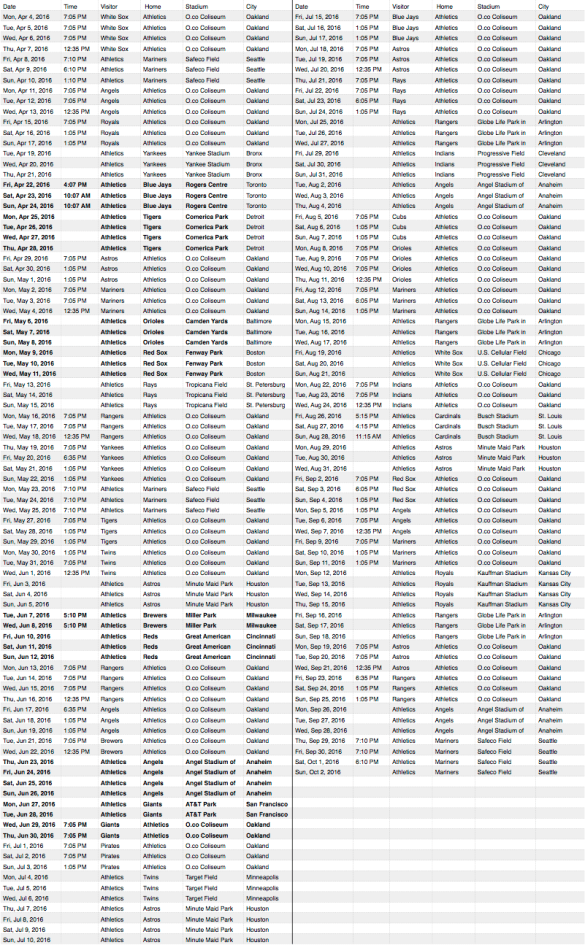
2016 MLB Travel Grid now available

It’s that time of the year again, when I spend a few hours putting together a travel schedule (I call it the “grid”) for the next baseball season. We may be seven months from Opening Day, but it’s never too early to start planning for your weekend getaways or long road trips.

Excerpt from the PDF Travel Grid

Excerpt from the PDF Travel Grid

As I mentioned on Tuesday, the A’s will take six separate trips to Texas, so there’s no chance of seeing the A’s in both Arlington and Houston in one shot.

The Travel Grid is available in five formats:

My initial take on the full schedule is much similar to that of the A’s individual schedule in that it’s not great for those looking to build road trips. You can get a sense for this by looking at the color-coded regions and trying to find out how many game dates can be strung together diagonally. Having cities and stadiums bunched together helps in the Northeast or around Chicago. Elsewhere it can be quite tough. Nevertheless, there will be many opportunities to see three games in three ballparks in three nights, so if you need to quench your baseball jones you won’t have to work too hard.

If you have questions or need recommendations, drop them in the comments and I’ll field them as best as I can.

Tentative 2016 schedule released, A’s screwed over

The A’s got a look at the 2016 schedule a while back, and they were concerned enough to lobby MLB in an attempt to make the travel a little easier. They being the A’s, of course, their concerns fell on deaf ears. Now you may be thinking, These guys fly chartered jets and stay in five star hotels, what are they complaining about? True, big time pro athletes travel quite well. The media and fans that follow them don’t. It’s still a grind, and in 2016 the grind is palpably worse than it has been in recent memory.

2016-all

What stands out for 2016 compared to previous years is the number of lengthy road trips and homestands. In baseball, fans are used to the idea of the team being home for a week, then leaving for a week, cycle repeating for six months. For the A’s scheduling is a bit extreme, with three homestands of 9 games or longer and a separate stretch consisting of 13 of 16 dates at home.

stretch

On the road the A’s scheduling woes are marked by a particularly horrific final two weeks in August, in which they go on the road to Arlington and Chicago, come home for a short series with Seattle, then go back out to the Central time zone to face St. Louis and Houston. Worse, the Texas and Houston series aren’t coupled, which would allow for short trips between the cities (made popular by the NBA’s Texas Triangle of Dallas, Houston, and San Antonio). Instead the team will have to go on six separate trips to the state of Texas, none earlier than June. All three trips to visit the Rangers will occur after the All Star break, when the ballpark will be at its least hospitable.

The AL West is slated to play the NL Central this year, with the A’s at home vs. the Cubs and Pirates, on the road vs. the Reds and Cardinals, plus a 2+2 home-and-home set against the Brewers. Another 2+2 is scheduled against the Giants, ending for now the separate 3-game sets against the cross-bay rivals.

Last time the A’s played the NL Central in 2013 the schedule makers were much kinder to the A’s. One of the road trips had the A’s knocking out series against the Rangers and Astros in one week. Another involving interleague play had the A’s in Milwaukee before busing it down to Chicago. I took in part of that trip, watching a four game A’s-White Sox series on the South Side while also catching a game at Wrigley, plus a game at Miller Park. Nothing like that is available for fans in 2016. Arguably the best trip features Toronto and Detroit early in the season, and only because the two cities are about five hours apart. The more doable, stress-free trip involves the A’s visiting Baltimore and Boston in the same week (May 6-11). That’s easily covered by Amtrak, with the option of stopping in Philadelphia and New York along the way. The O’s are going to make some changes to Camden Yards in the offseason, so even if you’ve been to OPaCY in the past, it may be worth another visit next spring.

Speaking of spring, the A’s also released their home schedule at Hohokam for 2016. It was a nice surprise. For Bay Area A’s fans the schedule is much more flexible than the regular season ordeal. There are home games scheduled at Hohokam every weekend. The second weekend looks especially good, as it includes a home date vs. the Cubs on Sunday with a road game on Saturday.

As usual, I’ll compile the complete MLB schedule and work out a full travel grid for the ballpark junkies out there. Look for that towards the end of the week.

The eternal struggle between sightlines and safety, Part 1: Nets

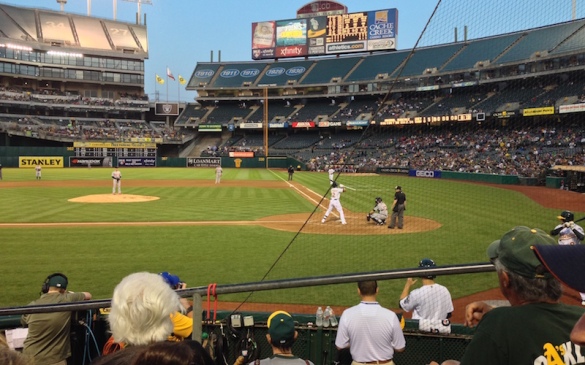
Part of the view from Section 119 is "obstructed" by the backstop net

Part of the view from Section 119 is obstructed by the backstop net

During today’s A’s broadcast, the between-pitch conversation turned to netting and foul balls. New part-time color commentator Eric Chavez provided an anecdote from during his career. He was hitting batting practice at Boston’s Fenway Park, when a ball he hit went into the stands, hitting a child. Chavy found out that the child had subsequently needed five eye surgeries.

Boston became a focal point of safety when parts of Brett Lawrie’s broken bat ended up in the third base stands, hitting a fan in the head. Tonya Carpenter suffered life threatening injuries, but was eventually released from the hospital. Another fan who was hit by a ball while in the usually glass-protected EMC Club decided to sue the Red Sox last week. The glass had been removed for renovations.

Baseball is unique among all major professional sports in that it is the only sport in which the object of play (ball) routinely travels into the seating area. Most are balls hit into foul territory, with some going out in fair territory as home runs or ground rule doubles, or sometimes the occasional errant throw. For many fans, the souvenir ball is a treasure, a real achievement. For others, the foul ball is a source of potential danger. Bats present an even more perilous, albeit less frequent, hazard.

This slideshow requires JavaScript.

These accidents and their often horrific severity have caused MLB to consider changes to ballparks to increase safety, counter to the so-called “Baseball Rule.” The Baseball Rule stipulates that stadium operators can’t be held responsible for injuries caused by stray balls or bats. Over time lawsuits have whittled away at the rule’s strength, to the point that teams have to be much more cognizant of the risk than ever before. Yet little has changed to protect fans. Right now backstop nets generally cover about sixty feet behind home plate and little else. At the Coliseum, the net is full height at the back of the notch, with additional netting angling down towards the front of the notch. The dugouts and field boxes are completely exposed. Only seats at dugout level (sunken below the field) and dugouts at new ballparks tend to be protected. Everything else is typically exposed.

The threat to baseball became more pointed when Gail Payne, an A’s season ticket holder, filed a class action lawsuit against MLB over the threat to fan safety. Never mind that a winged fruit bat has more chance of reaching Payne’s seats than one of Lawrie’s maple bats, there are still plenty of safety issues that MLB has neglected for far too long. A ball coming off the bat can reach the first row behind the dugout in every ML ballpark in one second. 1,750 fans are hit every year, the vast majority in foul territory. The lawsuit asks for new protective netting to be installed from foul pole to foul pole, covering all of the front row seats in foul territory.

chase4_section_s

A foul line drive could reach these seats in less than two seconds

MLB is certain to fight that as much as it can, reasserting its Rule to some extent. To do so would severely impact views for the high-paying fans next to the field. At the same time, they have to be ready for a compromise solution. One that has been discussed recently is an extension of netting to the far edge of each dugout. That should cut down on a number of injuries, though there would still be concerns about fans farther down the lines.

Considering that Lawrie’s bat brought all of this to a head, it’s worth mentioning maple’s role in all of this. Maple bats have long been known for their greater power thanks to the wood being harder than ash. The downside of the maple bat is its tendency to shatter, creating wood shards that fly around like shrapnel, hitting fans and players alike. If it came down to banning maple bats or extending nets, MLB would most likely choose the latter, since the loss of maple bats could have a negative effect on offense.

The increasing role of technology is also a concern, particularly the use of smartphones and tablets during the game. As I sat in the seat pictured above for the A’s-Dbacks game last weekend, I constantly reminded myself to pay more attention to the game. That was a complete failure as I routinely looked down at my Twitter app, putting the phone away only when I was eating (another type of distraction). Going to the other end of the spectrum, it wouldn’t hurt to have a glove on in case something happens. Then again, if the A’s defense is having trouble fielding balls, how much can we expect of fans?

College and amateur facilities have taken the safety net a bit further than the pros have gone, covering some of their small ballparks in nets. Tony Gwynn Stadium at San Diego State University has nets that extend several feet above the railing along the front row.

sdsu_gwynn

Is this a bad view because of the net?

Other parks have a small extended railing, maybe a foot high, above the dugout. The fact is that there’s no proper standard. Factors other than safety can also come into play. The Yankees had difficulty opening the new Yankee Stadium when they had to balance the safety concern with the visual effect of the backstop net on the home plate camera during Yankees broadcasts on the YES Network.

MLB has plenty of data on injuries to institute new standards at current and future ballparks. They’ll have a couple chances to effect change at their two offseason owners meetings, where the safety issue should be a hot topic. Several teams are ready to extend the nets, provided that MLB enacts new standards. The cost should be minimal, in the low five-figures per ballpark. If MLB truly cares, they’ll act quickly by extending the nets instead of creating a task force to study potential changes. Some foul balls will go away, along with the combination of danger and excitement that being exposed entails. It’s worth the sacrifice to reduce the number of injuries.

P.S. – Part 2 will cover railings and their associated risk.

Raiders gave Kephart and Oakland just enough rope

Last year the Raiders’ stadium funding gap was $400 million.

Today? Still $400 million.

And that may be the undoing of Coliseum City, just as was predicted many times since the start of the process.

BANG’s Matthew Artz got ahold of a letter written by Marc Badain to Floyd Kephart in April. Despite Kephart’s spin, the letter is incredibly damaging. The crux of it is this:

What is not clear is what the Developer, City, and County are willing to contribute. The Raiders’ $500,000,000 contribution leaves a funding gap of at least $400,000,000 required to build a new stadium. Simply put, the “terms required for the Raiders to commit to remaining in Oakland” are a plan that fills that funding gap without stripping revenues from the stadium and preserves the current level of surface parking. We have seen no progress toward understanding what the Developer, City, or County is willing to contribute and have received no proposals. As a result, there are no “terms” for the Raiders to evaluate nor are there “terms” for the Developer to communicate to the City and County.

You may come away from that thinking that the Raiders demands – all revenue, protected parking, capped contribution – are ridiculous, and in a sense you’d be right. The problem is that it is now abundantly clear that Badain and Mark Davis are comparing proposals, and whatever Oakland is putting forth is being compared to what is being offered in Carson. And Oakland so far is offering… nothing specific. Land? Not really anymore. Infrastructure? Depends on how much. Due to circumstance, Oakland has regressed in terms of what it can offer, a point that Eric Grubman famously made in the spring.

Ridiculous or not, Badain has a point that the G-4 loan money is tied to various team and stadium revenue streams. Fans tend to gloss over the reality. G-4 is a loan program, not a grant. With ties to luxury seating and TV money set in stone, any team receiving G-4 funds is naturally going to fight any attempt to repurpose any other stadium revenue for paying for the stadium, especially if the Raiders have their own projections. Thankfully for the Raiders, exploding league revenue has expanded G-4 to the point that a nearly $2 billion mega-stadium is more than merely plausible.

Chances are whatever gets built at the Coliseum won't look like this

Chances are whatever gets built at the Coliseum won’t look like this

Throughout the rest of the letter, Badain offered plenty of examples of how the Raiders have cooperated with the process. They met with developers. They laid out their demands wish list. They met with Kephart, and they continue to meet with Oakland on another track. They haven’t taken the lead on any specific stadium proposal. Then again they haven’t done that with Carson or San Antonio, and they surely won’t be leading the pack on Inglewood. Davis appears to be content to play second fiddle, as long as he gets a good deal for his team. That shouldn’t be too difficult since Davis isn’t going for quite as ostentatious a new home as what Stan Kroenke or Dean Spanos are trying to build. Yet since Davis isn’t driving the bus, he doesn’t get to say much about how nice it should be. FUD is emerging about Davis not being able to afford Carson just as he couldn’t afford to do more in Oakland, but remember, selling a piece of the team is his ace-in-the-hole. In the letter Badain admits that equity in the team is available, but only as a way to bridge the funding gap. Whatever the size of that limited stake, whether 10% or 20%, it’s worth perhaps twice as much in LA as it is in Oakland.

The parking situation also seems to be a nonstarter. It was during the spring that both Davis and Lew Wolff indicated that they wanted to preserve surface parking, even if that means severely curtailing development. Even the final proposal from Kephart does little to address the teams’ parking demands, filling half the space with garages and commercial buildout.

By the end of this project, some $5 million will have been spent on Coliseum City, only to find out that the Raiders’ and A’s stadium goals run counter to the broader planning objectives of Oakland pols. A stadium surrounded by parking is not the kind of high-density, constant-use plan envisioned for the Coliseum. Of course, so far we’ve barely scratched the surface of the other side of the debate: fear of gentrification. With so many bargaining chips taken away over the course of the last several months, how much is left to offer? More importantly, is that enough to get a football stadium deal done? My guess it’s not even close to enough. A ballpark is less expensive and gets used more. It’s getting close to the time when Oakland will need to shift the conversation. They’ve done a good job stalling so far. We can only hope that what remains isn’t scorched earth.