More new Howard Terminal renderings

An alert reader pointed me over to the Bjarke Ingels Group’s website, where the page for the A’s project was recently updated. Many of the images are the same as what you’ve seen here and in the traditional media. There are a few new ones that I found interesting, so I grabbed them for discussion here.

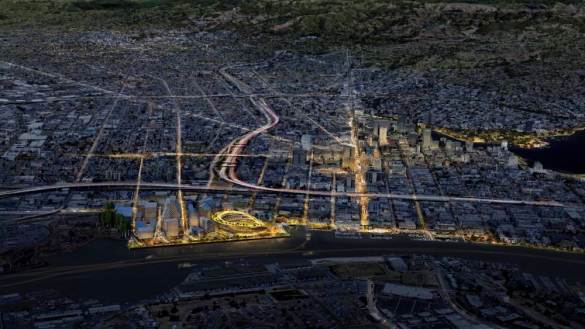
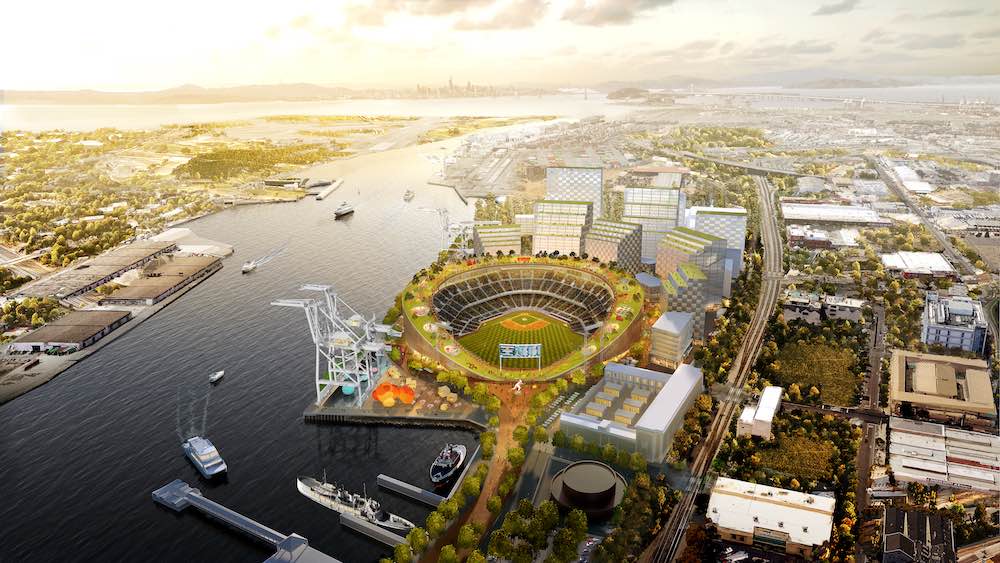
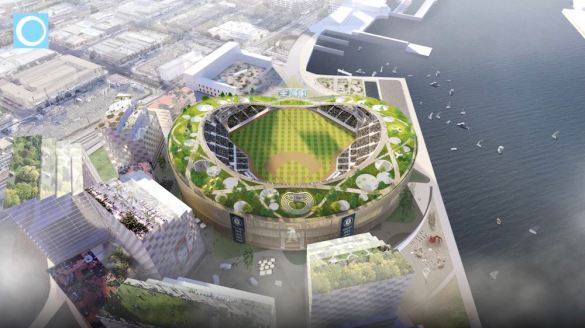
First, a new view. This is is a reverse angle from what you’ve seen previously, elevated and facing east. Note that the entire Howard Terminal pier remains intact, which means the bite hasn’t been taken out of it for the turning basin.

Next is an image you’ve seen before from the ferry pier, only it’s shrouded in fog.

The camera gets pulled back for this one, with the new rounder shape. Strangely, from this angle it appears that the bowl is better suited for a baseball field to be oriented to the west.

The close-up of the facade is cool. I like the way it undulates. As this is envisioned to be part of a “ballpark within a park” I can appreciate this kind of openness. Pulling that off in practice is another matter.

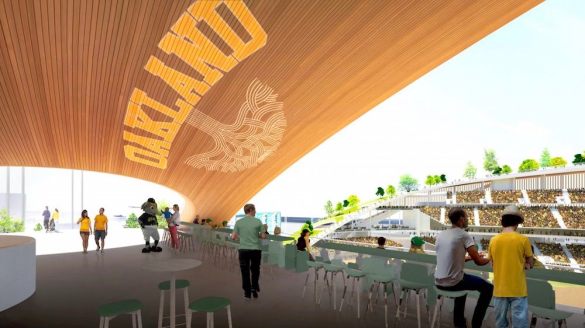
What we have here is the party deck in the left field corner. I like the wood details and the Oakland logo, though I think it might look better if it was burned in instead of painted.

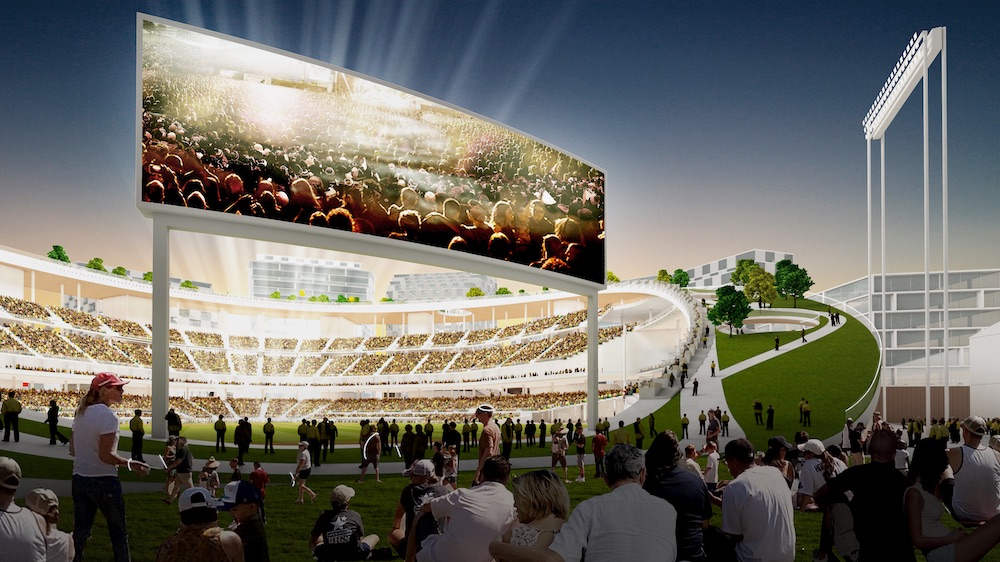
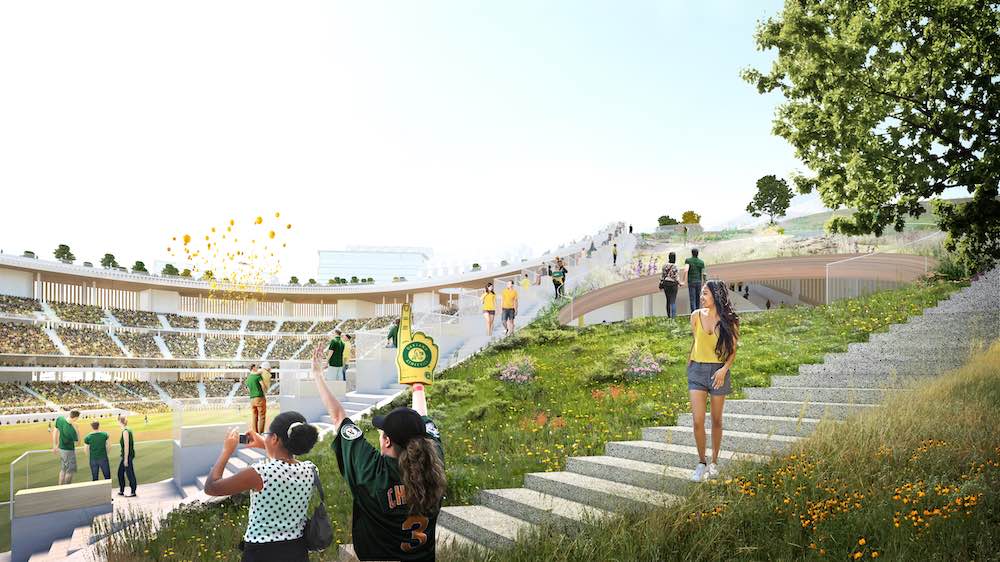
Lastly, we have the incline in left going up to the roof deck. It’s not known exactly how tall the roof will be. The A’s are asking for up to 150 feet building height for the ballpark, so that may provide a hint. The way to think of it is this: It should be at least as tall as the front row of the Mt. Davis upper deck.

One more thing. The description slide says that the ballpark will have 27,000 seats plus 10,000 standing room. Most of the SRO admissions will be on that roof deck. I did the party pass SRO admission at a Dallas Cowboys game a couple years ago, and I can say that once you get past three deep you have no view at all (especially for us vertically challenged folks). Same could be the case at this park, especially because the roof deck in foul territory won’t have an incline or risers. Maybe they’ll allow people to climb trees.

New Howard Terminal renderings released, Port Board Approves Tentative Agreement

We’ve got some new renderings. Seven, in fact.

First, the approach. The “picket fence” exterior treatment helps define the stadium better than previous renderings.

Walk inside the gate and down the approach, which like FanFest should be full of tents and booths. For now, it’s not. I remember the nearly religious experience I had walking to Target Field. This would be Seventh Heaven.

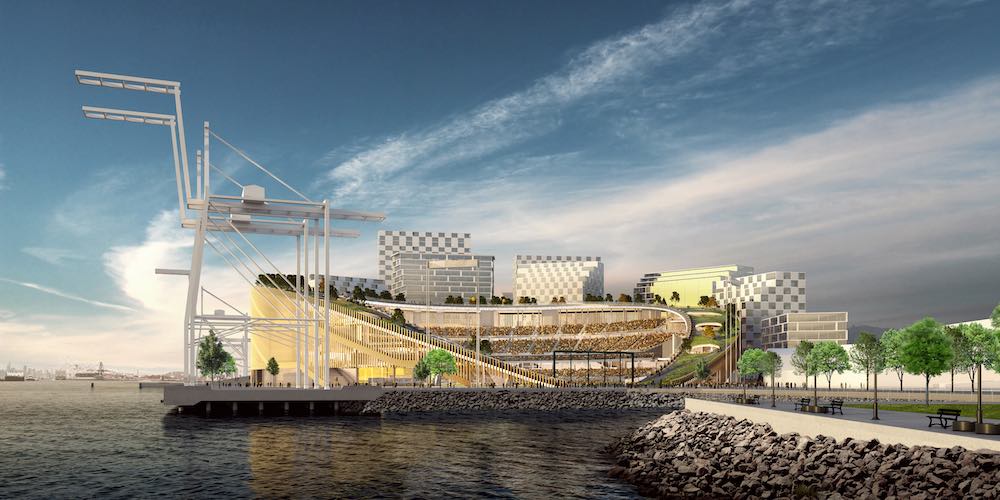
I haven’t seen this before, so I should bring it up: the next rendering is what it would look like as you stepped off the ferry dock coming from Alameda, San Francisco, or elsewhere in the Bay.

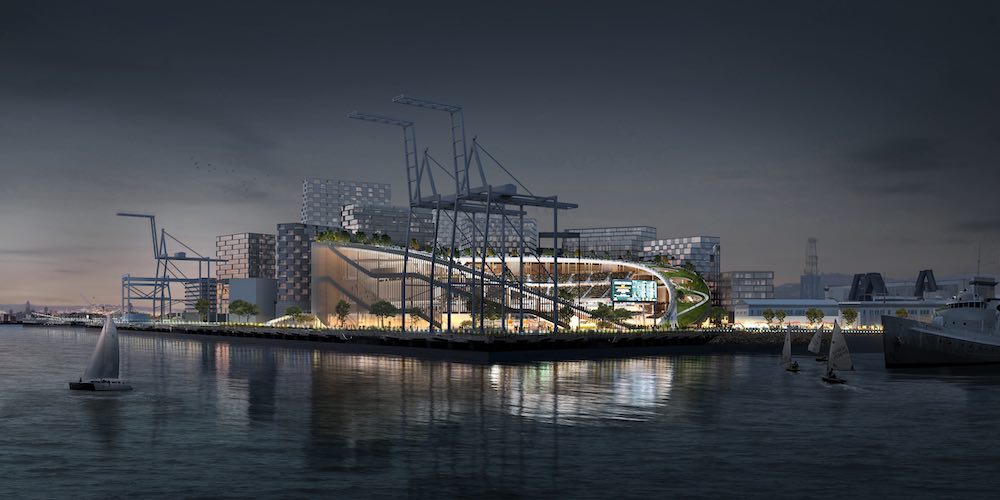
Next is a night view. Field of Schemes’ Neil de Mause noted how there are more cranes present on the property. That is despite the notion that the cranes would be more-or-less ornamental. There’s a touch of irony to that, given the opposition to the ballpark project coming from the shipping industry.
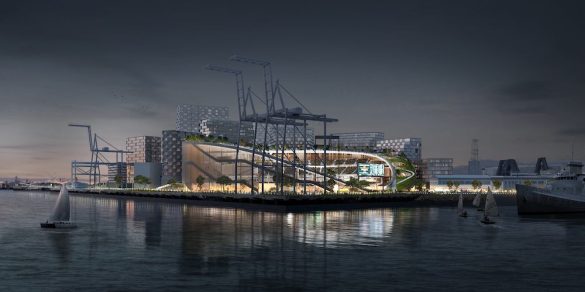
Nevertheless, the Port’s Board voted 7-0 last week to approve a tentative plan for the ballpark and ancillary development. The Port snuck in an amendment calling for the shipping interests and the A’s put together a working agreement to prevent the baseball games from interfering with Port operations. Both sides are digging in for the fight. The preliminary term sheet calls for the A’s to take four years to complete the EIR, all negotiations and site plans.

Some fans are irked by news outlets not updating file photos to reflect the A’s ever-evolving plans. As a stadium geek, I appreciate that thirst. But honestly, that’s missing the forest for the trees. The ballpark is now on its third revision and will undoubtedly undergo more before a shovel is in the ground. What’s important now is that the ballpark stays in the news. So far it’s doing fine in that regard. What personally irks me is that from the beginning, the renderings have generally eschewed basic safety requirements. The rendering above doesn’t have the fences in the outfield or padded walls along foul territory. The next rendering has no railings.

I recognize that simple things like railings and fences tend to be aesthetically annoying clutter. Yet they’re going to be in there if it gets built. It’s the law. There’s no getting around it. So show us what it’s really supposed to look like instead of the fancy marketing push. I’m sure it’s just a layer in the drawing, folks. Just turn it on. By the way, the previous image is the best one yet by far.

One thing that slightly bothers me about the new renderings is that the shrinking of Howard Terminal to accommodate the widened turning basin is not incorporated. Not only does the transformation take away a chunk of the land, it changes the skyline and reduces the amount of available open space. If the shipping industry accepts the wider basin in exchange for ceasing their resistance to the ballpark (no guarantee there), the waterfront would itself undergo some serious changes. The ballpark would effectively sit on a small peninsula jutting out into the Estuary, which frankly is pretty cool even if there likely won’t be splash hits.

The other thing that makes me concerned for the lack of completeness in these renderings is the missing infrastructure. You can see it in the site plans, whether we’re talking about a new ramp to the Adeline overpass or the new bridge to extend MLK Jr. Way over the tracks one block from the ballpark. As fans, we should see what those pieces of infrastructure will look like and how they will affect vehicular traffic flow, pedestrian circulation, and trains running through the area. We don’t even see the gondola on these, even though an animation has already been created. If the team doesn’t put the infrastructure in there, it’s harder to estimate the cost.

I’m aware that much of what I’m requesting will eventually be revealed in the Draft EIR, whether that comes out in the summer or later. Regardless, it’s up to fans and the media to keep pushing for answers. Stadiums appear to be becoming more disposable with each generation, but we should still look for something that lasts, like the 52+ years (51 for the A’s) on the decrepit yet still standing Oakland Coliseum.
To make Howard Terminal work it may have to shrink

You may not be aware that the year-long ENA (Exclusive Negotiating Agreement) started by the A’s and the Port of Oakland expired last week with little notice or fanfare. The pressure was on to get something out to the public, and so the Port did in the form of a preliminary term sheet for the A’s to occupy the dormant Howard Terminal. The Port’s Board is expected to vote on the term sheet on May 13.

We’ll get into business details in the coming week. For now, I’d like to focus on a single drawing of the revised site plan. In the plan, some additional areas are defined. It basically looks like someone took a bite out of the site.

Click to enlarge

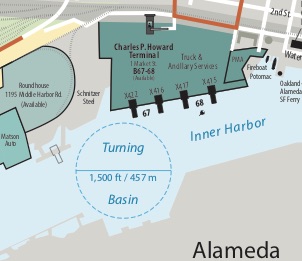
According to the term sheet, the bite (southwest corner defined by the purple lines) amounts to six acres. That’s what’s being offered by the A’s and the Port in order to foster cooperation from the ILWU and shipping interests. Once the A’s give up the acreage, the Estuary’s turning basin inside the Inner Harbor could be expanded to help attract container mega-ships.

Matier and Ross pointed out the A’s offer today. The idea could in theory bring the shipping interests and associated labor on board. Their stance is that they’re threatened by encroaching development. The argument against them is that Howard Terminal itself remains dormant, outdated, and not equipped to handle the new generation of container ships, which the Port badly wants. At the same time, the shippers that would be best positioned to handle the enormous mega-ships the Port covets are situated along the inner harbor, west of Howard Terminal.

If the Port anticipates this new wave of container ships, it might behoove them to facilitate a deal to expand the turning basin outside of Howard Terminal to accommodate those new ships. That could be a vital piece to getting the Matson and SSA on board. However, that’s only part of the story. This kind of change would effectively consolidate the seaport operations along the waterfront, which might make it seem like the Port loses valuable waterfront while it gains greater efficiency for the existing shippers in the process.

Turning basin

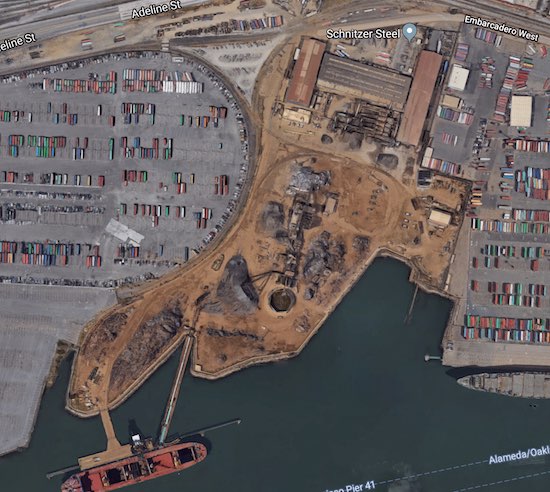
Questions remain about how the Port and City would handle the traffic for both vehicles and trains coming through the area. The EIR should answer much of that. Yet one other party to all of this Estuary action has been silent through all the hubbub last week. Schnitzer Steel has the one privately owned parcel, right next to Howard Terminal. And if you look at how it’s laid out, it stands to reason that it too would have to be reduced or reconfigured to allow for the wider turning basin.

Schnitzer Steel with Howard Terminal to the east

Schnitzer actually wanted part of Howard Terminal when the terminal parcel became available. The Port wasn’t interested in parting out Howard Terminal, so that bid went nowhere. Schnitzer has a dock with a conveyor arm extending out separately from the shore. What if Schnitzer doesn’t want to reconfigure their facility, especially if a bunch of housing is going to be built a few hundred feet away? The solution would appear to be some sort of land swap, in which Schnitzer sells its property to the Port and gets relocated somewhere else on Port property that also has waterfront access.

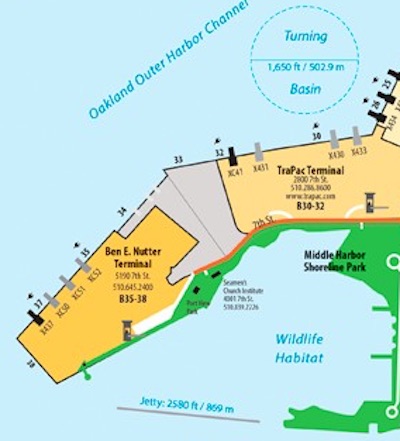
Outer Harbor Berths 33 & 34 provide 16 acres

It just so happens there is such a property along the outer harbor, Berths 33 & 34, where such a swap could conceivably take place. Berths 33 & 34 are available for lease. Whether such a swap is practical or feasible is something for the EIR process to figure out, though Schnitzer holds the cards and they could charge a great deal for the hassle. The track record of the A’s paying top dollar to help neighbors vacate is not great to say the least. If all these things line up – changing the Port designation, legislation for the land swap, moving costs for Schnitzer, and the infrastructure changes needed to make it all work – then the A’s have a shot. Rest assured that next week’s vote isn’t the first step. That step was taken years ago.