Market Relegation: The New Era of Neutral Site Baseball

Numerous great institutions are coming to an end over these last two weeks. The Lakers’ and Celtics’ playoff runs ended, killing Adam Silver’s dream NBA Finals matchup. Another Sun Belt Stanley Cup Final is about to start. English football ended their season in their respective leagues, with the joy and agony of promotion and relegation to come. Great TV shows like “Succession” and “Barry” had their series finales on Sunday, with “Ted Lasso” finishing tonight. And the A’s, whose 2023 season ended before Opening Day, may be saying adios to Oakland in a week if the State of Nevada passes SB 509, which would cement Vegas’s effort to lure the club to the desert.

That’s a lot of drama (and some comedy) to wrap up in two weeks. Series, whether fictional TV or real sports, all have endings, and I can’t help but feel a little wistful. While teams can rebound and rebuild, the A’s as an Oakland entity is on the precipice. In the past I haven’t been eager to overly dramatize that, but this feels real. Judging from last night’s sole public hearing on SB 509, it’s starting to feel like a fait accompli. Oakland’s (or California’s) process is glacial compared to Nevada, which is happening at light speed. We still can’t say how bad a deal this will be for Nevada and Clark County since the projections are too rosy at a glance to seem real and there is no input from a state appointed economist or non-partisan analyst. Yet there may be a method to this madness. The problem is that it includes a future without Oakland on the MLB map. For you, probably an old school baseball fan, you may have to expand your thinking.

The first clue came from last night’s hearing, when LVCVA’s Steve Hill noted that the new scheduling format allows every team to play every other team one series per year, alternating home series for interleague matchups. In previous years you often had to wait three years to see any particular team in the other league, and because of unbalanced divisions it was not necessarily guaranteed that team would come to town at regular intervals. This format change creates stability for travel planning, so much that when I saw that I stopped making the Travel Grid. If you can reasonably expect to see every team at least once every other year or schedule road trips in alternating years, there’s no surprise or delight left in making those schedules. Sorry about that everyone. It’s still good for baseball in that it’s predictable and easily programmable, with the only real sacrifice being some midseason intra-division series.

Next is news out of Orlando that they want to build a domed MLB ballpark for an expansion team. Of course, given Florida’s history with MLB teams it’s preposterous to even consider a third team, so the focus is quickly shifting to St. Petersburg, which is trying to work out a deal with the Rays and developer Hines. The plan includes a fixed dome instead a retractable dome and includes 775 units (23%) of affordable housing. Sounds promising until you remember that the subsidies that provide affordable housing come out of the same general project budget that helps subsidize the ballpark, just like Howard Terminal. As the project is still young, no one is claiming doom yet. The challenge is there, along with the pre-existing fan access problem at the Tropicana Dome site. Regardless, the Rays are locked into the Trop through 2027. Orlando couldn’t open this ballpark until 2028 at the earliest, and FWIW the current CBA runs through the 2026 season.

Yeah, Orlando’s ballpark looks like The Battery in ATL, though the ballpark is oriented… WEST?

Let’s take this a step further and assume that Oakland and St. Petersburg can’t get ballpark deals done, leaving the A’s bound for Vegas and the Rays set to depart for Orlando. Both teams will be in new domed stadiums by 2028, the next CBA will set the stage for a new round of expansion, presumably providing a heretofore unknown level of financial stability for the Rays and A’s. Like it or not, that’s what baseball wants. They’re not afraid to step on some toes to get it. They have their antitrust exemption in their back pocket. And based on the patience MLB has shown towards both clubs and their current home cities, there is no feasible antitrust challenge in sight for either city.

You may ask where that financial stability comes from, knowing that both clubs are headed for historically small markets. Well, they’re gonna get help. Due to Las Vegas’ and Orlando’s status as mid-sized cities, both teams are likely to be classified as small markets, which makes them eligible for full revenue sharing for the foreseeable future no matter how the plan evolves. This is where a potential relocation fee would come into play. It may be $1 Billion, or $500 million or $300 million, or it may be nothing. There is probably a sliding scale on how this works. I suspect that a special mechanism will be made available for these two teams – and only these two teams – because of their tourist-trap locales. The relocation fee could depend on their willingness to part with more of their locally grown revenue.

The current CBA calls for teams to share 48% of their locally-derived revenue including gate receipts, suite sales, and local TV revenue as their main sources. That money would go into a pool that would be split into 1/30 shares. Big market teams were ineligible for the pool of shared revenue based on a formula that changes on an annual basis. After 2016 the A’s were phased off revenue sharing in anticipation of Howard Terminal or another Oakland ballpark, with the idea that they would have requisite revenue to hold their own as a big market franchise. As that failed to result in a new ballpark, the A’s were placed back onto a partial revenue sharing plan with the most recent distribution last winter, though I’m not clear on how much that actually is. In any case, as I’ve mentioned before, to lose revenue sharing would be noticeable but not debilitating thanks to the growing amounts of national revenue (TV, streaming, merchandise, sponsorships). I’m guessing this year’s amount is around $20 million and could grow to $35-40 million next year. If the A’s get a full share it’s worth over $100 million annually plus the national revenues. By keeping the A’s and Rays classified as small markets going forward, all these revenue sources will help to give them ballast as they cultivate local fanbases. 

82 games seems conservative for a venue that could host a dozen more annually

The A’s/Rays situation calls for an exchange. They could minimize their relocation fee in exchange for giving up a percentage of their ticket sales. This is outside the 48% pooled revenue. Here’s how this could work: upon building the Vegas ballpark, the A’s could designate some number seats to be sold directly by the visiting team. The revenue from those sales would go to that team. The visiting teams could choose to take a full allotment of those tickets by game or series which they would sell to their season ticket holders or as part of vacation packages. If that sounds exotic, consider that teams have already started doing these kinds of sales of spring training games. The difference right now is that they’re selling their own Cactus/Grapefruit League tickets instead of another team’s regular season. 

When you go to a MLB game, there is no dedicated road/away supporters section. European soccer and some American college football stadia have away sections, often for fan safety. For baseball, the natural place to implement road sections is the area behind the visiting dugout. Depending on how large a visiting team’s fanbase is, those sections could expand or be reserved for advance or gameday sales. In their projections the A’s expect 405,000 visitors to games each year, which translates to 5,000 visiting fans per game. While this could certainly work for the NY/LA/Chi teams, it’s more of a reach for say, Pittsburgh or Baltimore. That’s okay, because if the visiting team doesn’t claim a full allotment, it will go back into general sale. There would be rules on how advance sales would work for that, but it can be folded into existing season ticket packages or sold as standalone or vacation package deals, which if you haven’t noticed, Vegas and Orlando are par excellence at doing. The actual revenue would be claimed under the visiting team’s local share, 48% of which by rule would go into the revenue sharing pool. The scheme basically allows the home and road teams to call dibs, which harkens back to the old ticket splits that were done prior to revenue sharing. In the end, it’s all accounting.

There’s another wrinkle to the A’s/Rays relocation. The Orlando ballpark plan looks similar to the Braves’ The Battery development with a huge indoor mall-like canopy on top. That may not be possible in Vegas due to the nine acres afforded to the ballpark. Still, Bally’s is figuring out ways to maximize that adjacent space, so if they want to have an air-conditioned public area right outside the ballpark, it’s not like Vegas isn’t chock full of those. 

From a baseball playing standpoint, new events will increase usage of the ballpark. Sure, there will be 81 home games plus at least one spring training warmup game. Beyond that, we got a taste of the future from the exciting World Baseball Classic in March. Once opened, Vegas and Orlando could serve as the pool play and championship round hubs for the WBC every three years. This year, Miami’s LoanDepot Park and Phoenix’s Chase Field hosted 10 pool play games. Miami also hosted two quarterfinal games, two semifinals, and the championship game (Japan hosted the other quarters). In the future, Orlando and Las Vegas can replace Miami and Phoenix to host the pool games while alternating the knockout rounds every 3-6 years. Plus there’s one last wrinkle. Baseball (maybe this is a Manfred initiative) has wanted to put together some sort of in-season tournament for some time. It’s unclear how expansive this tournament would be or how it would affect standings and statistics. Having Las Vegas and Orlando in place takes care of one very important variable: climate control. Because both are domes, there’s no worry of rainouts or postponements as there is at the outdoor parks. I imagine this isn’t something they would implement until baseball expanded to 32 teams, but once it did they could run it annually just like the All-Star Game. The NBA is already considering its own in-season tournament, so it’s only a matter of time for baseball to create their own.

Is there room for Oakland and Tampa Bay in this future baseball fantasy? Tampa perhaps, if it can get its replacement dome together. If it can’t, expect MLB to quickly pivot to Orlando. There are no minor league teams there and spring training vacated Orlando years ago, so no territorial conflicts exist there. Oakland isn’t known as a major tourist destination so it doesn’t fit this concept well. Sadly, the sports world is leaving Oakland behind. Oakland has tons of great sports history and it was a pacesetter in the 60’s. It will have to prove itself again as a worthy competitor in the pro sports world through what it builds, not what it promises.

As for the Vegas ballpark, can you hold your breath for an entire week? You may have to. They probably won’t take the full floor vote until June 5, and only if the NV legislature comes to a budget deal first.

Renderings of Vegas Domed Ballpark Released

Initial impressions

The A’s released initial renderings of the ballpark they’re planning to build at the Tropicana on the south Strip. As I’ve seen plenty of ballpark renderings, especially A’s ballpark renderings, I was prepared to be unimpressed. And I was at first, looking at low-res versions. I called these renderings “placeholders” with the proportions wrong and some details seemingly missing or unfinished. When I got home after work, I found high-res versions and started studying. What I found shedded much more light on what the A’s are attempting to accomplish.

Roof retracted shows off south Strip

First, we’ll start off with the view from behind and slightly to the first base side of home plate. It looks roughly north as I predicted. No big deal there, as that was the most practical orientation available. The backdrop features a high “waist” of the outfield decks. This should’ve tipped me off to how the retractable roof worked, but it didn’t at the time. I had to look at another image to figure that out. 

The backdrop includes MGM Grand in RF, with the other MGM properties visible across the Strip (New York New York, Park MGM/Mirage, Cosmopolitan, Bellagio). MGM must be thrilled to get all the free advertising this ballpark will provide with the ballpark’s orientation. Unfortunately for them, much of that view across the Strip will be obscured by new buildings built by Bally’s on the Tropicana site. Another rendering shows a fairly clear space between the ballpark and the Strip, which will only last 1-2 years as ancillary development is phased in. Bally’s CEO Soo Kim suggested the new resort on the property will be sports-themed. In my last post I questioned the separation of the ballpark from the new casino, partly because of the gambling controversy and because of the desire to separate the revenue streams between Bally’s, the A’s, and any other entities that may get involved. 

Ballpark at a distance looks larger than nine acres

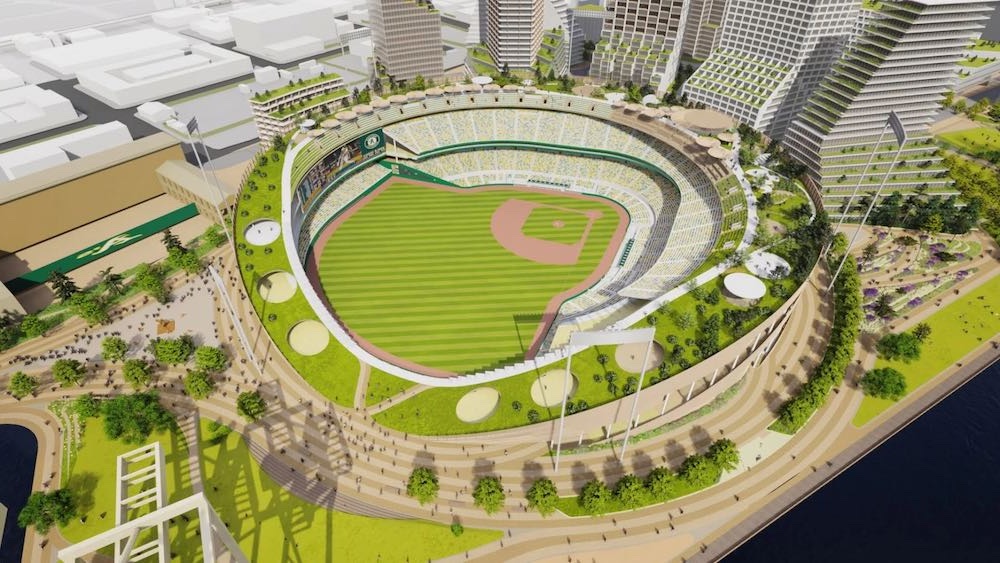
An elevated view from above New York New York presents a ballpark that at a glance appears much larger than the nine acres allocated by Bally’s. The angle showcases a large lighted arch from which the fixed roof is suspended, much like Wembley Stadium. The arch helps to give the appearance of much greater displacement for the ballpark, though there is also an ample buffer area surrounding the circular ballpark’s outer walls that may be misleading. One option that may be available is to make the ballpark part of the entire resort on game days or during events, which will open up the entire complex’s facilities to fans. Little Caesars Arena in Detroit was built in this fashion with multi-use development integrated with it. The arena was also architected by HOK. If this sounds familiar, it should. Lew Wolff wanted this concept going back to the Fremont days.

Now, you might be asking, “Fixed roof, I thought there was a retractable roof?” How about both? The retractable roof doesn’t appear in two of the renderings. A third rendering shows the roof fully enclosing the outfield of the ballpark. The retractable portion is motorized and runs on tracks atop the waist. The roof appears to be made of transparent or translucent ETFE material as was done in sections at US Bank Stadium in Minneapolis and nearby Allegiant Stadium. ETFE promises to allow light in while reflecting heat due to its layered construction, unlike glass which tends to transmit heat. The material can’t be completely transparent, so the view through it may have a somewhat frosted glass appearance depending on how much transparency is involved in the actual fabric used.

Milwaukee’s American Family Field uses a fan-style roof discussed in the last post. The roof sits above the upper decks along the baselines and closes in sections. That roof is extremely complex and prone to failure so it’s unlikely the A’s and HOK (architect) will attempt a similar roof design. Instead, they may are back to the first successful retractable roof stadium for inspiration.

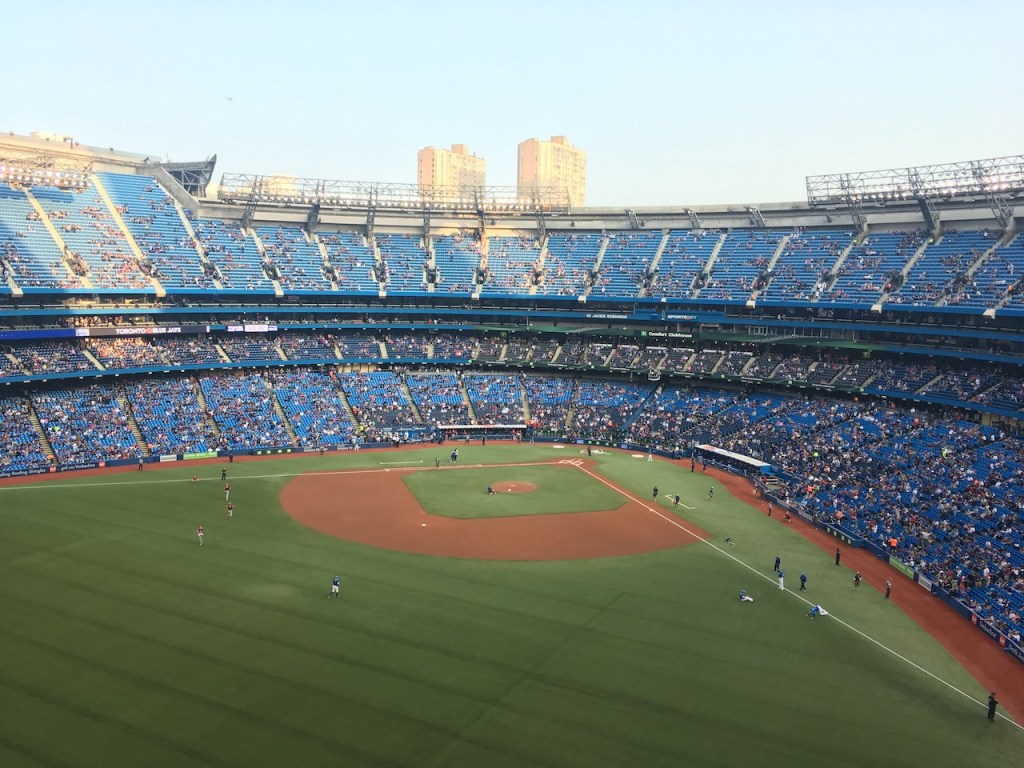
Rogers Centre (née SkyDome) has been operating a hulking retractable roof for over 30 years. If you’ve never been there, you may not notice that it’s a two part roof. The top portion slides back and forth from the outfield towards home plate, which is what you normally see in videos. The lower part of the roof sits behind main grandstand and tucks itself away underneath the top portion for good weather games. The picture below shows what the grandstand looks like when the roof is stowed away.

Fully open roof at Rogers Centre
Open roof in Vegas with dual tracks above the “waist”

For mechanical simplicity, I would expect the A’s retractable roof to move as a single unit like Rogers Centre’s lower section. During mild/spring games or night games, the movable part could tuck into the fixed roof area. It could also be a split roof like Milwaukee, but I wouldn’t expect that. When I started piecing this together, I didn’t immediately think of SkyDome. Instead, I thought of the old Pittsburgh Civic Arena, known as the “Igloo” or by its corporate name, Mellon Arena. I got to see a game there sometime in 2002, during the Penguins’ fallow period between the Jagr and Crosby eras. The arena was famous for its partially retractable roof, which used a similar mechanism to what HOK is aiming for, though the movable portion was actually quite small and turned the arena into an amphitheater with a large bandshell. 

Roof closed from across Las Vegas Blvd.

By designing a retractable roof to be a part of the structure instead of a canopy on top of the structure, the A’s are effectively limiting the ballpark’s footprint. For that reason, and because the normal construction budget concerns, I expect the ballpark to really be nine acres in size. It’s rather pointless to use the other post-SkyDome retractables comparisons because they’re designed much differently.

Closeup of ballpark with roof open shows off lighted arch

There’s no rendering of the ballpark from inside with the roof closed. And that, friends, is the true test of how good this design is. The retractable section looks to be covered by the aforementioned ETFE, which was how Globe Life Field was intended to built. That ballpark instead had one-third of its roof covered in partly transparent ETFE. Whether or not you believe that change was made to reign in costs of an expensive new material, the fact is that’s what the Rangers went with it, making Globe Life Field look like a huge shed. The A’s really want to avoid putting a drab shed among the garish edifices of the Strip, so they would be wise to invest to ensure their facade is not just distinctive, but also cool. The reality is that working with huge HVAC systems and their ductwork is going to clutter up any roofed ballpark, so HOK has its work cut out for them.

Other thoughts

  • The upper deck for this four-deck ballpark is ridiculously huge. That’s probably because the lower deck is quite small, and undoubtedly quite exclusive.
  • Bullpens are in left field in fair territory beyond the fence.
  • The video board in right field is noticeable. Less noticeable are the ribbon boards on three levels of the outfield. Are any of them large enough to function as more than auxiliary displays?
  • The image with the open roof shows that the roof itself is hiding another large display board. Which is interesting, but why is it facing the outfield and away from most of the fans inside the ballpark?
  • The retractable roof has a pitch to it, similar to how Tropicana Field’s roof is tilted down towards the outfield fence.
  • The first rendering shows a grass field, which is unlikely because of how much this ballpark will be used during the other six months of the year and during road trips. 
  • If you think these renderings are ugly or not worthy of a future A’s ballpark versus Howard Terminal, I’ve got bad news for you: they all come from the same architecture firm, HOK.

Thoughts on MLB in Vegas and retractable roofs

Howard Terminal with a twist

I want you to take a long look at the rendering above. You’ll probably say you’ve seen it before, that it’s Howard Terminal. It’s not, for reasons I’ll get into later. For now, study it because it reveals certain things about baseball in the 21st century that you probably weren’t aware of previously.

Before I do the point-by-point tear down, I’ll discuss the report that Bally’s and GLPI are offering 9 acres on the southeast portion of the Tropicana Hotel and Casino plot to the A’s for their ballpark. GLPI, which owns the site land while Bally’s has the development rights, is offering $175 million towards “certain shared improvements within the future development in exchange for a commensurate rent increase.” When I saw that, I immediately thought that is GLPI is providing an enticement for the A’s to build a retractable roof.

I’ve gone to games and taken tours at all of the retractable roof ballparks built in the last 30+ years. I’ve taken notes and seen many of the mistakes made in the first generations of retractable roof ballparks that caused them to evolve. Whether those changes were done to increase fan enjoyment or business opportunities, they’ve come a long way for good and ill. Here are some observations about the sector.

  1. Teams care more about reducing operating expenses than anything else. Two of the early designs in Phoenix (Chase Field, 1998) and Milwaukee (American Financial Field, 2001) used roofs that opened from a home plate-to-center field line, the same method you often see at American football stadia (Arlington, TX and Glendale, AZ). While this allows for a more compact footprint, historically it’s more costly to maintain due to its mechanical complexity. Milwaukee’s roof was mired in lawsuits when the roof broke down soon after construction, incurring costly repair bills. Chase Field’s roof had a less dramatic break down, attributable to age and causing the Dbacks to refrain from operating it unless they know the weather days in advance. Chase in particular is still subject to roof leaks whenever it rains, which is bad news even when it’s closed and a monsoon comes through in the late summer.
  2. Rogers Centre (1989) can’t be made prettier or with a better backdrop. The Blue Jays chose to add improvements along the concourses and in the outfield instead, so it will look even more like an airport concourse than it did when I visited a few years ago. Despite the less-than-picturesque baseball setting, folks in the Great White North definitely appreciate it when there’s blue sky up above instead of white, so the team tries to keep the roof open as much as possible as summers are fleeting. It also helps that the Jays don’t need a massive air conditioning system.
  3. T-Mobile Park (1999) and Minute Maid Park (2000) are similar in that they have roof systems that open towards right field. This makes for expansive sky views when the roofs are open, though RF is merely another grandstand with a scoreboard. Seattle’s design is mostly a roof canopy that allows breezes to come through, whereas Houston’s is a more sealed dome meant to mitigate heat and humidity.
  4. LoanDepot Park (2012) and Globe Life Field (2020) are evolved versions of Seattle and Houston. Miami’s roof opens behind the first base line, while Texas’s opens behind third base. This allows the roof eyesore to be placed out of view of most fans during games when the roof is open, though there’s still the same assemblage of grandstand and scoreboard in RF. Miami started with grass and moved to artificial turf when the team had trouble growing grass there, which is only possible in Florida when you keep closing the roof. In Texas, they didn’t even bother with grass and went straight to a different version of the turf used in Miami. Both also have “partial retractable roofs” which have a large fixed roof component somewhere to keep construction and operating costs down. It’s disappointing for two Sun Belt teams to go this route. However, it’s not just about the roof. Using turf helps both venues get better LEED certification due to less water usage. 

Knowing all of that, it’s a safe bet that any Vegas ballpark will also have turf and possibly a retractable roof if it can be afforded. Again, GLPI’s $175 million pledge is an enticement for the A’s. When I started this blog, the going rate for a value-add retractable dome was $100 million. That makes $175 million in 2023 dollars seem a bit cheap. I suspect that’s all a matter of negotiation. I also suspect that a big part of the negotiation will be the magic trick of where the roof goes when it opens. GLPI and Bally’s can also govern air rights for the stowed roof, making it more appealing for the A’s to deploy something that might be used only two months every baseball season. A retractable roof might be more attractive for non-baseball uses such as concerts. Imagine a packed crowd going nuts when the roof opens for a 9 PM EDM headliner in there. These roofs measure 5-6 acres these days, though I imagine they would aim for something smaller if they could get away with it.

You might also wonder if the A’s could fit a retractable field, much like the grass tray used at State Farm Stadium and Allegiant Stadium. While that was discussed by Dave Kaval previously, I can’t think it’s terribly practical because of the area required. If you search for baseball field sizes online, you’ll often see an estimate of 4.5 acres. That’s a bit much by my estimation. An acre is 43,560 square feet, or a 208.41-foot square. 4 squares of that size would easily accommodate a baseball field and foul territory, but a 4-acre tray is twice the size of the football field-sized trays currently in use. It’s also an amenity that, due to its near constant usage, would claim an even larger footprint than the 9 acres under discussion. There may be an extremely creative way to make that work. I simply don’t think it’s practical.

Angel Stadium in Anaheim size shown for the sake of simplicity

There have been numerous questions about where the renderings are for this now-$1.5 Billion curiosity. In my experience, renderings tend to stay under wraps until it comes time to sell something to the public. Right now everyone’s talking behind closed doors. Frankly, I think we’ve been looking at a perfectly good rendering the whole time. That image at the top of this post is a flipped version of the Howard Terminal ballpark, in which the roof deck slopes down to left field instead of right field. Why? Because if you plan it that way on the Tropicana lot, you open the entire ballpark to the rest of the casino property and the Strip. Add some big glass walls a la Miami and an ETFE fabric roof and you have a panoramic view of Las Vegas with the roof open or closed, or even if it’s fixed. People forget that the original trailblazer, the Houston Astrodome, was built with thousands of skylights filling its roof. Eventually they caused problems for outfielders and couldn’t sustain a grass field (sound familiar?), so Astroturf was invented to fill the need. The technology for both roofs and turf has been evolving ever since. The main takeaway from the history of retractable roof ballparks is that even if you can have the best intentions, you can’t beat physics.

Back to the rendering. Imagine that the roof deck is removed as it’s not needed in Vegas. That roof deck essentially covered all of the back-of-the-house facilities for the ballpark. If you’ve ever been the MGM Grand across the street from the Trop, you know that it’s home to a casino, multiple hotel towers, and several venues all connected by a large main concourse. There’s the theater for David Copperfield, a long-running Cirque du Soleil show, and the MGM Grand Garden Arena, which last night hosted the big Devin Haney-Vasiliy Lomachenko lightweight championship boxing match. The Grand Garden Arena was Vegas’s first real major sports venue, hosting numerous prize fights and concerts over the past 30 years. GGA was a premier venue in the early 90’s that’s been easily eclipsed by T-Mobile Arena down the street, home of the Golden Knights. As MGM has ownership stakes in both venues, it can move events between them without worrying too much about conflicts with the hockey team or UFC events which are hosted at T-Mobile Arena. Now if you’ve been to GGA, you know that it’s fairly barebones and mostly exists as a big exhibit hall with seats. There are concessions there, but if you want something good the rest of the casino is just steps away. As MLB recently signed a deal with FanDuel to be its official betting partner, baseball quickly got into bed with the gaming industry. I would expect MLB to instruct any baseball team moving to Vegas to maintain some amount of separation from actual casino gambling, no slot machines or gaming tables. Sportsbooks are clearly a go. Not having gone to an event at TMA, the pics of it resemble a younger Staples Center or Chase Center. As concourse space in venues is expensive, it may be mostly an issue of efficient fan traffic flow. Anyway, I’m sure Pete Rose is rolling over… somewhere.

Plenty of room to cut from 13 acres to 9, stowing the retractable roof will be a challenge

Finally, I went back into the archives to find some drafts of the HT ballpark. The parcel it was placed on was slightly more than 13 acres. Cut down the roof deck, remove “Athletics Way” outside the ballpark and the extra street areas, and you can get down to 9 acres pretty easily. It will still be a challenge to integrate the ballpark into a larger development while maintaining separation. You can bet, though, that several architecture firms are champing at the bit to do just that.

Approximate placement of HT-sized ballpark on Tropicana LV site (not entirely to scale)

Two Peas in a Decrepit Pod

The Vegas situation created a bit of a cottage industry of skin-deep analysis of the A’s, didn’t it? With little tidbits of news emerging from the desert every other day (site change, legislation, labor deal), the dwindling number of A’s fans breathlessly await the next morsel while cursing John Fisher and Dave Kaval under their collective breaths.

There’s a constant desire by the media to rationalize all of these moves, to make sense of it all. It doesn’t make sense on a local, deal terms basis because it all seems so chaotic and haphazard. Only when you pull back all the way to 50,000 feet does it start to make sense. 

It’s strange that the most useful reveal didn’t come from the Bay Area or Vegas papers, or their respective local news stations. The best commentary may have come Stuart Sternberg, the owner of the Tampa Bay Rays, to the Tampa Bay Times three weeks ago

The goal is to make the whole league healthier, Sternberg said. That is why Manfred waiving any relocation fee makes sense — even though the A’s would be taking a prime site for expansion which, at a time when regional sports networks are teetering, could bring owners $4 billion to split with two new teams.

“It’s in all of baseball’s interests to have the A’s and any baseball team on the firmest footing possible,” Sternberg said. “A fee to put them on the firmest footing possible makes it more difficult for them — to say ‘Look, we’re going to let you move and your revenues are going to go up but we’re going to take them all from you.’

“Everybody wants to see us, they want to see the A’s, on really good ground. Fortunately for us, we’re playing good baseball right now. The A’s had amazing runs over time and recently. You can’t hold that together. It’s hard to hold together even if you have a decent revenue team. It’s next to impossible to hold together if you’re a lower revenue; it’s impossible to hold together.”

Once I read that from Sternberg, everything started to make more sense. The A’s parallel paths strategy. The Rays’ failed split-home plan with Tampa Bay and Montreal. The A’s trying feigning interest in Laney while the Rays kept their fires going in Tampa, then both efforts dying.

The rationale is actually dead simple. Major League Baseball treats these two franchises as the weak links in the baseball’s economic system, and is apparently willing to bend some internal rules in order to get them in better shape. Maybe that means a move, or the split-home concept, or even something even more radical that the teams or the commissioner still has up his sleeve. I first saw an indicator of this when the dust settled after the lockout and a new CBA was ratified. After I started this blog, I opined on multiple occasions that MLB would cut back on revenue sharing to prevent teams from hoarding profits when they couldn’t field competitive teams. MLB actually strengthened and expanded local revenue sharing during that time from 34% to 48%, plus the growing national revenues that come from the various broadcast, streaming, and merchandise deals. After getting phased out of revenue sharing in the last CBA, the A’s were granted a 25% share and could get more if they get a stadium deal approved by next January. 

January 2024 was put out there as the next huge deadline. Make no mistake though, it’s entirely arbitrary in order to put pressure on the cities. If the A’s get the expected 50% local revenue sharing piece, it’s worth an extra $15-20 million. While that might sound impressive, it doesn’t make a huge difference in the A’s financial picture. Even the difference between 50% and 0% is nothing that Fisher wouldn’t be able to accommodate through his now notorious belt-tightening.

So maybe this whole exercise results in a rushed bill getting through the Nevada Legislature and Governor Lombardo signs it, clearing the way for the move. Then again, the legislature could see through this ruse and defer to a special session or even the next regular session in 2025. At this stage it is pointless to compare and contrast the Howard Terminal deal to whatever Southern Nevada is attempting. This isn’t about bridging a gap in public infrastructure funding, the narrative that emerged from Oakland City Hall two weeks ago. And it’s not about the overall value of the real estate that surrounds a ballpark, as that is entirely speculative. No, we are getting down to brass tacks, folks. This is simply about whether or not the parties can get a ballpark deal done, to ownership’s and MLB’s satisfaction. Baseball has time to work out the internal details after any deal’s framework is approved. If this can get done, or if this fails and the ball ends up back in Oakland’s court, it will be a matter of what kind of deal can be done for HT. Same goes for the Rays, who have a deal being hammered out for the Tropicana Field site as I write this. If that fails, that might be it for St. Petersburg as a MLB city the same way this may be it for Oakland.  

What about the fans in all of this? The floggings will continue until morale improves, unfortunately. You could make an argument that forces are aligned against those cities. But you can’t say they aren’t being given a chance. Until something definitively changes, Oakland and Tampa Bay will continue to have every concept thrown against the wall to see if anything sticks.

P.S. – We all know that Rob Manfred can’t be expected to save the A’s in Oakland. We shouldn’t expect Joe Lacob to either. If Fisher suddenly decided he wanted to sell the team, there would immediately be opposing forces weighing on him. Obviously, he’d like to get the greatest return on the club, whose value rose 8x since he bought it. The other MLB owners would also want for him to biggest sale price possible since it would boost their respective valuations. But the A’s poor local revenue showing makes it ripe for lowball offers, which I suspect Lacob tried to throw at Arte Moreno before Moreno pulled the Angels’ for sale sign earlier this year. MLB is still dealing with the coming fallout from the Bally Sports bankruptcy proceedings, which may result in MLB taking back control of local broadcast rights for several teams. It’s entirely possible that for the A’s, Rays, and even the Angels, that nothing gets settled until early next year.