I emailed the commissioner of baseball asking for an explanation as to why 9 acres in Vegas makes more sense than a scaled down stadium-only option at Howard Terminal. I received a reply linking to this blog he calls coherent. Anyone wish to fact check? https://t.co/Aa1EOOMmVzpic.twitter.com/UwR4CrP4yr
If you’ve been reading long enough, you know that the purpose of this site is not primarily to advocate for any one ballpark location or site, it’s to see how the situation progresses, analyze it, and try to look one or two steps ahead. Sometimes I get things wrong. Sometimes they’re right. When I wrote about Fremont, it was with the notion that Fremont was a compromise location that could bridge a gap in the A’s fanbase without infringing territorial rights. When I wrote about San Jose, the idea was that it was the best possible revenue situation if they could resolve those T-rights (they did not). And when I pulled for the Coliseum over Howard Terminal, my argument was that it was the fastest, easiest path to getting a new ballpark even if the revenue potential there was lower. If the comment above actually came from the MLB commissioner, In this case, it may be curtains for Oakland. I wish that wasn’t the case.
How does this map out over the next six months? I expect the A’s to officially apply for relocation sometime next January in keeping with their lease and contractual obligations. They’re putting together a presentation that will go to the rest of the owners probably after the World Series. In the meantime, Oakland has a chance to get Manfred’s attention and put its best foot forward. At the same time, Manfred and Fisher know that with Vegas in their back pocket, they can squeeze Oakland. It really comes down to how badly Oakland wants to keep the A’s. Maybe if an Oakland fan hung out at the Coliseum every day like Greta Thunberg it might get attention. Though in the end, it comes down to making a deal. Is Oakland willing to make more compromises to get it done? That’s the real test for Oakland’s pro sports viability now and into the future. Because if they lose the A’s, it’s hard to imagine any expansion franchise or relocation candidate coming to the Eastshore. Oakland will have to get in line with every other hungry fanbase with limited resources.
–
P.S. – The current mayor and three former mayors of San Jose sent a letter to MLB asking for an expansion franchise if the A’s leave for Vegas. All I can say to that is: That’s cute.
P.P.S. – Dennis Shanahan from KTXL in Sacramento continued his dialogue with Commissioner Manfred, which I found interesting mostly because it shows that Manfred is not ignoring the reports he gets on the ground from Oakland.
I’m not sure if I’m having an email conversation with Rob Manfred or a member of his staff. I tend to think it’s actually him. Either way, this gives further insight to where the MLB commissioner’s mind is on @Athletics stadium situation. @MayorShengThao@Kaplan4Oaklandpic.twitter.com/botU0FRbMn
Things are looking grim at the moment in Oakland. So far, Nevada and Clark County haven’t fumbled the bag, even as John FIsher’s lieutenants looked shaky at times in selling the Vegas ballpark concept. After much deliberation and horse trading, a $1.5 Billion ballpark concept was approved for the southeast corner of the Tropicana property, covering 9 of the 35 acres there. Total public outlay will be $380 million, including $120 million of bonds.
Recently, East Bay politicians and fans settled on a talking point: If Fisher only needed 9 acres and wanted to build only a ballpark, he could’ve done that much more cheaply and quickly at Howard Terminal. If you don’t think about it, it sort of makes sense. But there are obvious problems with the argument.
Oakland loves to claim that they’re putting up $380-440 million towards Howard Terminal. The problem with the argument is that the money, even if they get all of it, can only go towards off-site infrastructure. As we all know, if the area around Howard Terminal is to be commercialized it’s badly in need of redevelopment: sidewalks and signage, rail safety, etc. That’s a completely different commitment than what Nevada/Clark County are providing for the A’s, which is $380 million for the ballpark. Oakland’s not offering that. They’re waiting and hoping for state grants to come in to cover the off-site infrastructure only. I’m not sure how so many got confused about this. Vegas is offering at most $25 million towards off-site infrastructure, because the South Strip area needs it far less than the Oakland waterfront. If you think about it even a little, Oakland’s claims evaporate.
Back in Oakland, there is no pledge of a single dime to build the ballpark. Politically, that’s a smart and consistent stance by recent Oakland mayors after the Mount Davis debacle and the messiness of the Warriors’ departure. Rob Manfred and Major League Baseball have a different interpretation: they think Oakland doesn’t value having the A’s enough to keep the team in town. The whole idea of the $12 Billion mega project was to have all the other development defray the cost of the building the ballpark. If that goes away, what comes in to replace it? Look, I sympathize with everyone in the East Bay who doesn’t want to chance yet another nine-figure stadium subsidy. But the chief pathway to negotiate that, ancillary development, may have dried up in the last year thanks to inflation and new market realities. If that is the case, then what is Oakland offering? Free or no-cost land? Not exactly, even an 8-acre ballpark site won’t escape some amount of taxation, whether we’re talking about property taxes, a land lease, or other taxes. In Vegas, the land lease is basically free and all taxes and payments go to the ballpark district, which will be operated by the same Stadium Authority that operates Allegiant Stadium. It’s a classic version of a PILOT, or payments-in-lieu-of-taxes. PILOTs redirect all collected taxes towards payment of the bonds that were used to build the project. You can read about it at Wikipedia or at Field of Schemes, where Neil de Mause wrote extensively about the subject.
I’m against public funding of stadia in general. However, communities have to realize that in order to compete for a scarce resource like a major professional sports team, they won’t be able to get around making a sizable investment. Sometimes that’s taxes, sometimes it’s land. Either way it’s money. Politicians and media can spin it all they like, couching it in terms of neighborhood investment. The off-site stuff is not the same thing as the ballpark, not even close. If Oakland’s going to show their passion more than some protests and cutting remarks, they need to be ready to show their hand. And if they aren’t willing to do so, what are we really talking about here? Scoring political points while delaying the inevitable? Remember how Oakland latched onto that lawsuit against the Raiders and the NFL, the one that went for naught after 4 years? They’re using the same playbook with the “Moneyball Act” and the threat against the antitrust exemption. If fans and media are rightfully angry with A’s ownership for yanking them around, it’s also well past time to levy the same charges against the City of Oakland. Constantly throwing Hail Mary passes isn’t a strategy unless Al Davis or Don Coryell are calling your plays. Now it’s Sheng Thao, Libby Schaaf, Jean Quan, and now, Barbara Lee. Do you trust them to make the right moves to keep the A’s in town?
If fans want to push for some sort of tax to pay for a new ballpark at HT or anywhere else in Oakland, they’re running out of time to do so. Polls last year showed that it wasn’t the most pressing item for Oakland residents. It’s up to Oakland to be honest with itself about what it’s willing to do to keep the A’s. It’s easy for me to be fine with whatever direction they take since I don’t live there. This is the “adult conversation” I’ve written about in the past. It’s a talk that, frustratingly, Oakland still refuses to have. Oakland saw Vegas steal the Raiders out from under them in 2016. It’s seeing the A’s relocate at breakneck speed in 2023. If taxes are a non-starter, and if the East Bay market has difficulty supporting the higher prices associated with new venues, Oakland needs to show what it is capable of. Otherwise, this is all just talk. At least Oakland can feel comfort in knowing that there are no more major franchises for Vegas to steal.
Proposed NBA site is between Mandalay Bay and the bend in the Strip
What if I told you that a chief reason the A’s got this Vegas ballpark deal done had little to do with baseball or MLB?
Let’s step back almost a month. Major League Soccer (not baseball) announced its 30th franchise, awarded to San Diego. A coalition of a Saudi billionaire, a local Native American tribe, and the new Snapdragon Stadium (SDSU-owned) made it possible, along with a whopping $500 million franchise fee. And with that, MLS is set for now. Bids for MLS expansion teams came from Sacramento, Las Vegas, and Phoenix, with Sacramento awarded at one time and then rescinded when it get a permanent soccer-specific stadium built at the Railyards. The same fates befell Las Vegas, whose Lights FC are stuck at Cashman Field, and Phoenix Rising FC, a team that keeps bouncing around Maricopa County in search of a permanent home. They’re currently playing in a temporary stadium at the old dog track by PHX airport.
Okay, so Vegas can’t get a MLS team for now. They’ve got plenty of other things to do there, right? Vegas is feeling its oats with the recent NHL and WNBA champions, so why not attract more? The A’s launched their Nevada lobbying efforts in earnest in May 2021, one day after they celebrated 510 Day in the Bay Area.
Look at the timestamp. @Athletics barely waited 24 hours to show how calculated a marketing/PR campaign this is. Bring in the bad cop. https://t.co/ghTBFCkfn3
I forgot that the A’s did this and it hits much harder now, two tumultuous years later.
Where was I? Oh right, attracting more teams. Two separate efforts were started recently to attract a NBA expansion team. All Net Arena has been gestating for a decade on the north Strip. Today, Tod Leiweke presented Oak View Group’s arena/resort proposal for some undeveloped land three miles south of the Strip’s famous “Welcome” sign. Vegas is on the short list for a new team, along with Seattle. I’m still unclear at how Vegas can support five arenas of similar size (T-Mobile, MSG Sphere, MGM Grand Garden Arena, Thomas and Mack Center, the proposed NBA venue) and maintain full schedules for all of them. The name of the game is having event nights while limiting conflict by maintaining flexibility. This means not having multiple teams sharing a single arena if it can be avoided.
Neither proposal is at as prime a location as the A’s ballpark site on the Tropicana lot. When the A’s were navigating Clark County and talking with various casino interests, it became clear that the A’s weren’t interested in building the same kind of mixed development they were planning at Howard Terminal. In Vegas, the desire was to build as close to the heart of the Strip as possible. In inking the deal at the Trop, Fisher/Kaval have somehow done something I would’ve considered impossible two years ago:
Prime high-traffic location (Tropicana SE corner)
Leased for $1 per year
Anchoring a resort development to be built by Bally’s and likely baseball-themed
$380 million in public funding through #SB1
$175 million from the land owner, GLPI for ballpark improvements (retractable dome)
The Tropicana, which is due for major redevelopment, has been an undervalued gem for at least a decade. The nine-acre ballpark site, in which people keep wondering how a retractable dome can fit, is more the proper size for another arena or even a soccer stadium. In securing the site, Fisher and Kaval have made sure that no other sport can claim this location for themselves, which at least one Nevada politician noticed a couple days ago.
Assywmn Monroe-Moreno asks about how the corner of Tropicana and Las Vegas Blvd could easily have a replacement venue, perhaps a NBA arena. That or a MLS stadium is probably a bigger factor than we realize, in that this prime location is to be MLB's for decades. #SB1
No, the A’s won’t be able to build a $12 Billion development on Oakland’s waterfront. But they managed to pull off something of a real estate coup which I imagine was highly encouraged by Rob Manfred, who is thinking beyond a single team’s economics. Once the A’s build the $1.5 Billion ballpark, it should be relatively cheap to operate with the small footprint and low operating costs. The flexibility therein will allow them to fill a small venue gap between large arenas and big football stadia, though it’s unclear how many such events occur regularly. LVCVA’s Steve Hill talked about the ballpark being used for large convention gatherings that can’t be done in a single space at the convention center to the north. The fact that the ballpark will be a relatively short distance away via a drive on the surface, Tesla tunnel, or the monorail, doesn’t hurt.
The ballpark renderings showed off a single domed ballpark with little else surrounding it. The casinos and conventioneers saw something else: another opportunity. With the kind of mortgage the ballpark will command, Fisher and Kaval will be happy to rent it out. They intentionally undersold the number of events the ballpark will hold, a clever way to pitch a product in need of $380 million in public money. As for that amount, I’m sure the main reason for that specific ask is that it’s roughly halfway between the $0 public funds for T-Mobile Arena and the $750 million request for Allegiant Stadium. They did it because they have a baseball team and a willing partner. In the process, they put the NBA and MLS on the Strip’s fringes, which is how I imagine Manfred prefers it.
So yeah, this Vegas endeavor is definitely a winner for the A’s ownership, MLB owners, and Rob Manfred. Just about everyone else including Oakland and A’s fans lose. But you already knew that.
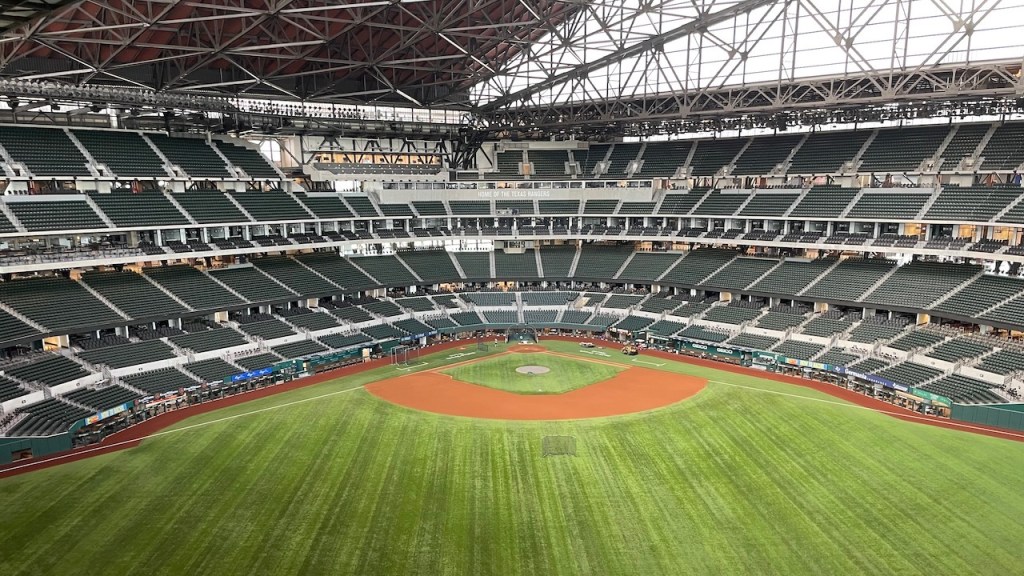
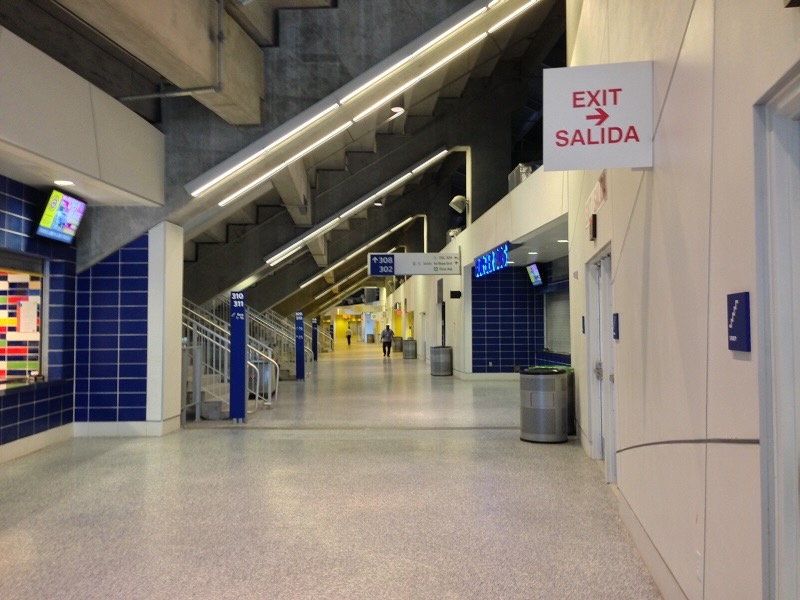
The biggest reaction so far to the A’s reveal of their Vegas ballpark plans is sheer incredulity to the idea of a ballpark in the 21st Century only taking up nine acres of space. At the time I said it wasn’t a big deal. I mentioned that the proposed ballpark would be the smallest since Fenway or Wrigley, which many affirmed by comparing to several newer parks, which are much larger. Those parks are usually 11-15 acres in size. Most of that pursuit was for the purpose of making a more inviting building to visit, one with greater space to both circulate and queue, and even to hang out for a bit. To that I mostly agree, as these creature comforts can help make a place better for repeat visits. Then again, take a look at the next two pictures, both from Globe Life Field in Arlington, TX, and tell me if you don’t think it’s excessive.
Note how far away the upper bowl is from Globe Life Field’s outer wall. It’s the airport concourseification of ballparks.This multi-level cutaway view from the upper concourse also shows how much wasted space is inside
Over the decades, concourses grew from narrow hallways to 30 foot-wide corridors like at the Coliseum to the capacious 40-50 foot indoor mall-like spaces in the new parks. Concourses also include new separate standing and ADA wheelchair areas, which helps free up the through foot traffic. If you take a 30 foot corridor and expand it to 50 feet, you increase your acreage by about a half acre. And that’s on just one level. So it adds up.
It was also customary to have a lower deck with 35-40 rows in it, not counting for separate adjacent club seating. The new trend is to separate those completely, so that there’s a premium club running along the infield and up both baselines. The club may have only 12 or 16 rows followed by a special concourse with a field view or suites. Above that is the main lower level of seating. It’s not something an architect can retrofit to an existing ballpark because it removes some very expensive seats while compromising other views, since it is best accomplished by adding height to every seating position.
Vegas proposal with extremely short field level (club) deckCloseup of seating bowl
For the A’s, separating the lower level creates two benefits every game day. Foot traffic separates between the club and regular levels, creating a feel of exclusivity for both. Having fewer rows to traverse to get concessions or go to the restroom makes for quicker access as well, though architects have to plan for twice the number of restrooms and concession stands and teams have to employ more staff. The downside, which you’ve probably seen at Globe Life Field and LoanDepot Park in Miami, is that the upper decks on both are ridiculously tall. It also prevents fans from accessing the field from the main concourse. That’s the price of progress.
Globe Life Field during a tour
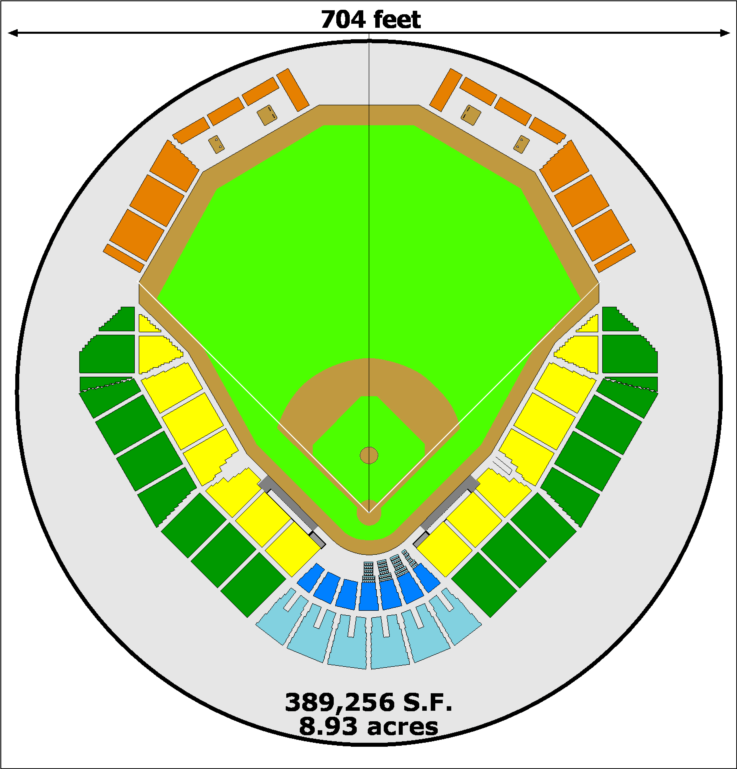
From a purely data-driven perspective, I decided to do a quick sketch of a nine-acre ballpark. I took one of my old sketches and and dropped it on a circular plot, 704 feet in diameter. The result has plenty of space for seating and the amenities you’d expect in the newest ballparks. The premise is that there are four shorter decks (five or six if you count suites) practically stacked on top of each other like balconies at a theater. Make no mistake, this method of design severely increases the cost of any stadium as it increases square footage by at least an order of magnitude. If you’re wondering why these things keep getting more expensive with each passing year, it’s because they’re getting more complex. They’re building more building. The upper decks get tougher since they have to be pulled back a bit and are more cramped, so those concourses might look more like this:
Generic ballpark lower decks fit into a nine acre space with room to spare
I would love to see a return to simplicity similar to the retro ballpark movement 30+ years ago. As these movements are all naked efforts to drive revenue growth, I’m not getting my hopes up.
P.S. – As part of this exercise I took the 704’ diameter circle and matched it up with the Coliseum. It looks like that circle would include almost all of the pre-Mount Davis Coliseum save for the top 7 rows of seats. During that era, the capacity of the Coliseum was 49.219. Do you really think the A’s and Brad Schrock won’t be able to fit 30,000 seats plus standing room in such a space? Think out of the box. There are a number of solutions out there.
Even if you remove half the upper deck to fit in the 704′ circle, capacity was still probably 42,000 based on the Bash Brothers-era capacity of 49.219
P.P.S. – The dimensions of the generic sketch ballpark are 325-376-408-376-325. They would adjust up for dry, slightly elevated desert of Las Vegas.




 newballpark.org