Free Arena or Stadium, No Waiting

The Arizona Coyotes started life as the former WHA team Winnipeg Jets, who joined the NHL in 1979. They moved to Arizona in 1996 as part of Gary Bettman’s Sun Belt expansion and relocation strategy, settling into what was then a modern-albeit-basketball-first America West Arena in downtown Phoenix. Compromised sightlines at AWA forced multiple ownership groups to look elsewhere in Maricopa County, first in South Scottsdale, then in Glendale, at a new entertainment and shopping complex called Westgate. Anchored by the Cardinals’ new retractable dome stadium and a hockey arena, Westgate proved to be a solid hub of activity in the West Valley. However, most of the hockey fans the Coyotes needed lived on the other side of the Valley in Scottsdale/Tempe/Chandler/Mesa/Gilbert. Most of the West Valley was and still is noted for retirement communities in Sun City, Peoria, and Surprise, and while those are solid ticket buyers, those communities lack the corporate and sponsor support needed to sustain the Coyotes long term. Multiple ownership groups shuffled in and out, peaking with the Wayne Gretzky-Steve Ellman era in the early 2000’s.

January 2018 Sharks-Coyotes game halfway through the first period

Gretzky was the big name to grow interest in the franchise. Ellman was a local developer who owned an older mall on the corner of Scottsdale Road and McDowell Road called Los Arcos. Interestingly, during spring training trip in 2001 I stayed at a hotel across Scottsdale from Los Arcos, which was fading and in disrepair. After Ellman’s Los Arcos arena plan stalled, he turned his attention to some undeveloped farmland north of the planned Cardinals stadium in Glendale. Glendale was in the midst of a building boom, its large footprint ensuring water from the Arizona Canal system would be secure. Ellman built Glendale Arena, which underwent several name changes in later years. The arena is fine and functional, with the requisite number of club areas and suites. Its location remained a problem because it was so hard to get hockey fans to come there 41 times a year. Eventually Gretzky stepped away after a disastrous stint as a head coach, and Ellman sold to trucking magnate Jerry Moyes, an even worse disaster that ended in Chapter 11 bankruptcy.

Seriously, if you’re an A’s fan complaining about John Fisher, read The Hockey Writers’ article about Coyotes history. Fisher’s tenure looks comparatively sedate.

After more post-Moyes ownership misadventures, the team ended up in the hands of Alex Meruelo, a casino and media magnate who the NHL touted as its first Latin-American franchise owner. When Meruelo tried Scottsdale again for an arena site, they had little interest. Meruelo turned to Tempe, where a piece of landfill next to the Salt River had some public support and a good location for the East Valley fanbase. A referendum for the arena and development project failed at the ballot box last year. That left Meruelo to regroup. He settled on a site just over the Scottsdale city limit in North Phoenix, which caused Scottsdale mayor David Ortega to blast the plan for its negative local impact (traffic, water use, infrastructure).

Here’s where I can provide some local color. As some of you know, I lived in Scottsdale (Old Town area) for several years after I moved out of California. I now live in Glendale, so I can provide perspective on both sides of the Valley. There are two Scottsdales. There is South Scottsdale, informally south of Shea Blvd., which contains most of the city services, the huge mall, and most of the other commercial and denser residential development. Ortega, who I voted for before I left Scottsdale, is pro-development, and was an easy choice over the more conservative options on the ballot. But the prevailing attitude among the pro-development forces is that new building should occur in South Scottsdale, especially redevelopment of the area in and around Old Town. With some exceptions like the Airpark light industrial area near the airport and the horse training facility WestWorld, most large-scale development is forbidden in North Scottsdale. For those of you in the East Bay Area, it’s like trying to build in the Fremont or Hayward hills, or Rodeo. The residents are allergic to anything that might cause gridlock in their part of town. And if you’re wondering about Talking Stick and the spring training facilities, those are technically on Pima reservation land that’s in the South Scottsdale area. Yes, the Dbacks and Coyotes inquired about building somewhere in Scottsdale. They were denied every time except for smaller projects like Salt River Fields, which was subject to regional public funding.

Gary Bettman made the Sun Belt strategy his legacy to mixed results. Many purists decry the abandonment of traditional hockey markets in Canada in favor of bigger, newer audiences in America. The Phoenix market was promoted, propped up, even sustained by the league for years. After two years of playing in a college arena, the NHL is giving up. For now.

It’s a strange situation, because even though the Coyotes are about to announce a move to Salt Lake City starting next season, the story isn’t over yet. Phoenix is too large to completely vacate, so they’ll keep hope alive for an expansion team, hopefully at the arena Meruelo wants to build in North Phoenix. Ortega’s criticism was walked back earlier this week, but the damage was done. Unfortunately for that plan, the problems remain. The site is completely undeveloped at the moment and will require a large amount of infrastructure. While no one is planning any high-rises for the land, an arena that would create a great deal of event-related traffic on a regular basis is probably a step too far. North Scottsdale made its pact with seasonality, inviting snowbirds to live there during the winter months and encouraging the economic activity they bring. It’s a symbiotic relationship for those 3-5 months every year. An arena there is a hard sell as it goes against North Scottsdale’ sensibilities. There is other land in the Desert Ridge area further west, which is also controlled by the State Land Trust. Meruelo’s first step is to win a public auction for the land he seeks, then engage with the municipalities, Maricopa County, and Arizona DOT to formulate a plan that works for all involved. So the road to getting hockey back to Arizona is long, indeed.

The Coyotes’ foreseeable future lies 600 miles north of Phoenix in Salt Lake City. There, tech billionaire Ryan Smith already owns the Utah Jazz and the venerable Delta Center, situated in downtown SLC. He’s been angling to get a NHL team for some time, either through expansion or relocation. That effort was well publicized in SLC media over the past year. The time to strike came when John Fisher and the A’s chose Sacramento over Salt Lake City, mostly to preserve RSN money during the interim years before they move to Las Vegas for good. That decision left Smith free to pursue the Coyotes, which may be key to locking up the public funding he is going to request for a modern replacement for Delta Center.

Opened in 1991, the Delta Center replaced the old Salt Palace. Ever since the Jazz moved to SLC from New Orleans, the Salt Palace held the distinction as one of the smallest arenas in the NBA with a capacity of 12,666. It was designed like many of its late 60’s multipurpose peers: Phoenix Veterans Memorial Coliseum, Oakland Coliseum Arena, and The Forum in Inglewood. The sightlines were not optimal. It did its job of handling basketball, concerts, and the occasional ice show. Delta Center was built by Jazz owner Larry H. Miller to be first and foremost a basketball arena, a good example of what I call “reactionary” design. As a result, the Delta Center is not set up for quick changes like the former Staples Center or American Airlines Center in Dallas. The video shows how Delta Center set itself up for its annual NHL exhibition game, which required a long ice-making and prep period before the game.

To accommodate both sports, Delta Center will have to do what most multipurpose arenas do by laying down the ice surface before the season begins, and overlaying padding and floor over the top of it as needed. The worry there is condensation or leakage, which could create a slick basketball court if not properly managed. While it’s not an impossible problem to solve, it doesn’t appear that Smith’s staff have much experience doing it, so it will be a new challenge for them. Some of the retractable basketball seats at the ends of the court will have to sit on the overlaid ice as well. The NHL will be involved to ensure the quality and playability of the ice surface, one of the longstanding issues that plagues Sun Belt teams when contrasted with their northern and Canadian rivals.

Beyond the ice surface, the sightlines for hockey are going to suck. Those retracted end seats mean they’ll have to put some portable seats on ice level or leave huge blank spaces as was done for the figure skating competition during the 2002 Winter Olympics. It’s ironic considering the Coyotes left America West Arena because of a similar problem with sightlines. It’s not going to be resolved until a new arena is built that properly accommodates both sports.

Ryan Smith took advantage of two factors in attracting the Coyotes. He owned his arena which meant that a team could conceivably come there rent-free, and having two teams will boost any new arena efforts. You may be surprised to find that there are only a limited number of arenas that house two major pro sports tenants.

⁃ Los Angeles, former Staples Center (3 teams)

⁃ Chicago, United Center

⁃ New York, Madison Square Garden

⁃ Boston, TD Garden

⁃ Washington DC, Capital One Arena

⁃ Dallas, American Airlines Center

⁃ Detroit, Little Caesars Arena

⁃ Philadelphia, Wells Fargo Center

⁃ Toronto, Scotiabank Arena

– Denver, Ball Arena

Salt Lake City is much smaller than all of those markets. Most of those markets also benefit from large legacy cable RSN deals, which aren’t in place in Utah. The arenas in Los Angeles and Las Vegas were privately financed, so given that SLC will have two teams to fill dates, it may be worth debating if a new arena there will need public financing. Smith is reportedly buying the Coyotes from Meruelo for $1.2 Billion, of which $1 Billion will go to Meruelo and $200 million will go to the rest of the NHL as a relocation fee. That large outlay will probably translate into a great debt load for Smith Entertainment Group, the entity that will own the Jazz, Real Salt Lake (MLS), Delta Center, and the Coyotes. That’s before any substantive talks about a new arena are to begin. Smith is rich, but not on the level of Steve Ballmer, who is paying for the entirety of the construction of Intuit Dome in Inglewood, with enough leftover to buy the Forum from MSG. If there are conflicts in the Jazz/Coyotes scheduling or logistics, the Maverik Center in West Valley City should be able to handle it. The Maverik Center was used as the hockey venue for the 2002 Olympics and is home to the ECHL Utah Grizzlies, with a proper hockey rink-shaped seating bowl.

Delta Center in NHL seating configuration

Meruelo is expected to keep Arizona operations going in hopes that the North Scottsdale process results in a winning bid for land there and an arena. After that, Meruelo would presumably get the NHL next expansion franchise, whenever that occurs. He also owns the Tucson Roadrunners, the Coyotes’ AHL affiliate. A 33rd NHL team in a market that ran out of willing cities to provide stadium subsidies? I have my doubts.

Franchise relocations are fairly infrequent in the 21st Century. Baseball had the Expos in 2005 and the A’s in 2024. The NBA had four relocations in the past 20 years (Hornets/Bobcats, Sonics/Thunder, Nets to Brooklyn, Warriors to SF). The NFL’s LA/San Diego shuffle happened less than a decade ago. The aforementioned Thrashers became the second iteration of the Winnipeg Jets. And that’s all for now. Most of the teams that got new buildings in the 90’s-early 2000’s are coming up on the end of their original terms. Many of those teams negotiated lease extensions with improvements or better revenue sharing terms baked in, like the San Jose Sharks. Others like Golden State Warriors built anew to get away from “onerous” lease terms, and to follow the money. In both the A’s and the Coyotes’ relocation sagas, the league stepped in to make a crucial assist. They’ll do it again despite the protests (A’s) or lack thereof (Coyotes). The leagues’ main responsibility is to ensure their respective sports are healthy, which starts with individual teams. You’re only as strong as your weakest link, right?

=

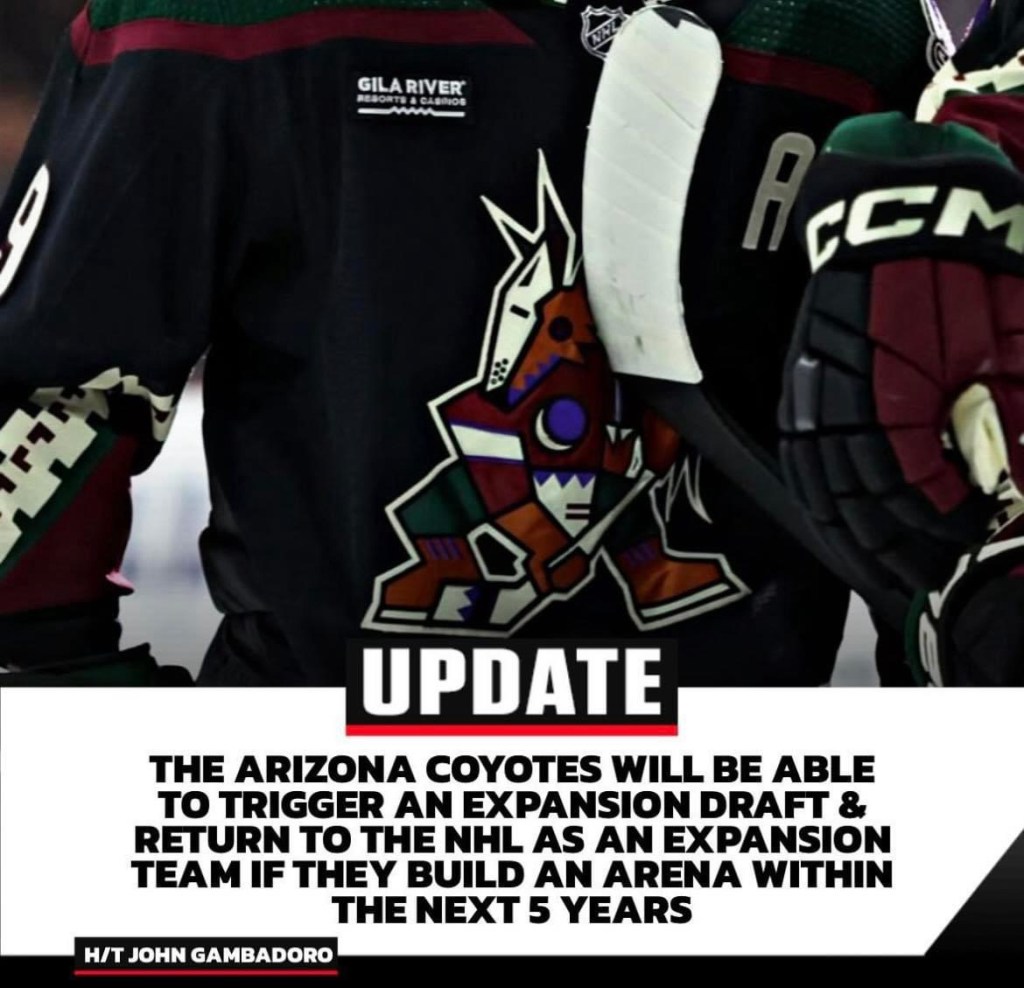
P.S. – If Phoenix media guy John Gambadoro is right, I can only conclude that the NHL needs the Phoenix market, at least more than MLB needs Oakland. 🤷🏾‍♂️

That said, if MLB put the same conditions on Oakland, could Oakland deliver?
YOLO: Carpe the Damned Diem

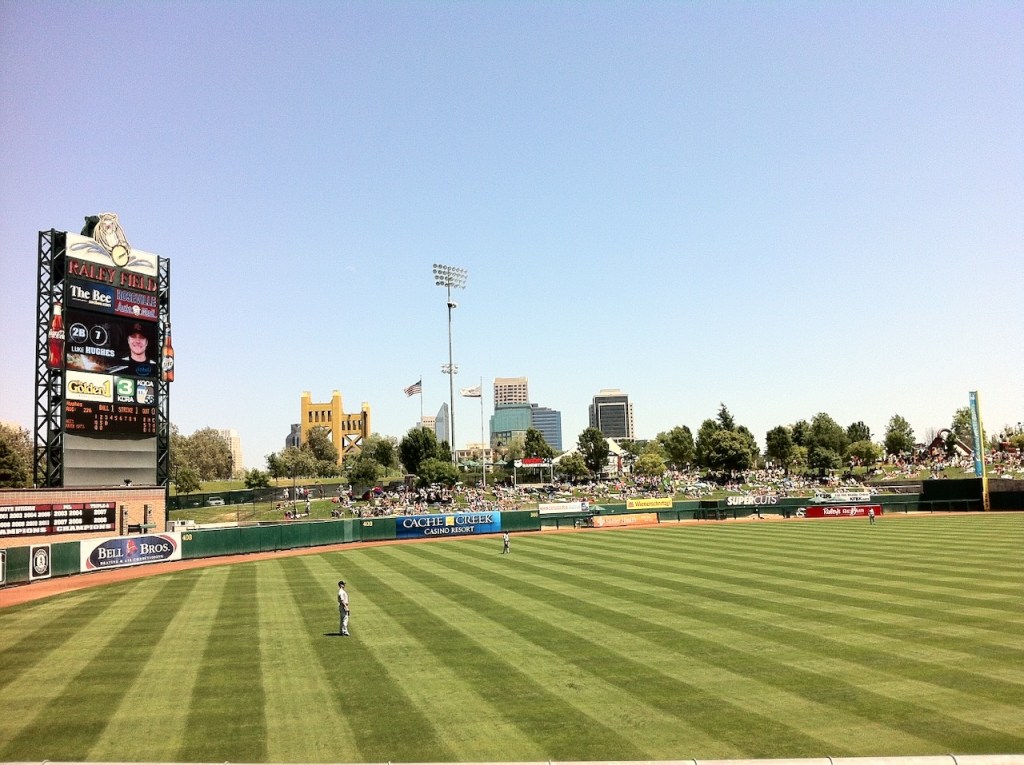
Sutter Health Park (formerly Raley Field) in 2012

“And so it is just like you said it should be

We’ll both forget the breeze

Most of the time”

– Damien Rice, “The Blower’s Daughter”

Based on no evidence whatsoever, I believe it is equally plausible that John Fisher and Vivek Ranadive are friends, or that Rob Manfred played matchmaker for the two to get the A’s an interim ballpark deal in West Sacramento. Both possibilities play into some serious conspiracy theory territory. Did this play into Fisher’s desire to pull the A’s away from his true love, the Giants, or was Rob Manfred the evil mastermind? Or maybe it’s all of the above.

I put that out front today because it is flat out ridiculous to waste more than a passing thought on that line of thinking. It’s April 2024, and there are less than six months remaining in the Oakland Athletics as we know them. Ranadive and Fisher arranged a deal for the A’s to play at Sutter Health Park for the 2025-2027 seasons, with an option on 2028 if there are delays in Las Vegas. The A’s, as I suspected they would last year, rolled out tributes to the rapidly ending Oakland era in A’s history. The East Bay fanbase has descended into alternating states of pettiness and withdrawal. I know many fans who have multiple generations of history with the A’s. While my critiques of both the city and the fans sometimes have been harsh, they weren’t without empathy. I never wanted to have the A’s pulled from Oakland like a limb. What I wanted was a real conversation about what it would take to keep the A’s on sustainable, manageable terms. Sadly that never happened. Instead Oakland bounced from one pie-in-the-sky developer-led initiative to another aided by some feckless mayor with lukewarm regional support.

Once you get past the lazy conspiracy theories and supposed long cons, the truth is that these are a bunch of really rich guys who saw opportunities and quickly made deals to further their goals. Fisher needed a landing spot for the A’s that was less radioactive than Oakland, and found the path to Sacramento easy after Oakland’s preposterous Coliseum lease extension offer. Ranadive sees huge potential in what he calls “City 3.0”, in which Sacramento acts as a hub in Northern California for many different types of entertainment. Think about that for a moment. For three years the A’s and Ranadive’s River Cats will play 162 games at Sutter Health Park, while Golden 1 Center across the river has the Kings and touring shows coming to town. In short order, Ranadive transformed himself into Sacramento’s own version Phil Anschutz or Bill Graham, an impresario overseeing a large domain. The doubling of activity in “The Bridge District” near Sutter Health Park should help reinvigorate a housing market somewhat paralyzed by high interest rates, since those are expected to drop in the coming months. Commenting after the hastily-arranged press conference for the announcement, Ranadive said he had discussions with Rob Manfred about Sacramento’s potential as a MLB expansion city. Did Manfred suggest to Ranadive that he could get first dibs if he did Fisher a solid? Maybe. It’s all very convenient, though Ranadive also said he was not promised anything beyond the A’s interim term.

Ranadive and Fisher promised that Sutter Health Park would be brought up to MLB standards in terms of clubhouse size and training amenities (workout room, batting cages, etc.). Some renovations started last offseason and were ready for Opening Day 2023, independent of the A’s interest. I suspect that won’t be fully sufficient for MLB’s requirements, but if more needs to be built there’s some space to do it in the outfield, where there is a small berm in the LF corner and an expansive berm that curls around from the RF line to right-center. Those are also areas to put in risers for seats, which could be built on top of the berm or with the berm removed if they want to use the space underneath. There’s a range of options depending on how much the A’s and Ranadive want to spend. And for all the pearl-clutching by the media about how Sutter Health Park isn’t a true MLB park, it was built around the time of the newer Cactus League parks and has similar layouts, capacities, and amenities. If the idea is to get something done in a pinch, it is ideal for that challenge.

Renovations to Sutter Health Park completed in 2023

The major problem with the ballpark is that the clubhouses are in the outfield, instead of attached to the dugouts like most MLB ballparks or buried under the main concourse like the Oakland Coliseum. They could rip out the lower deck behind home plate and build much of that if they wanted, but I figure that will be prohibitively expensive for Fisher if not for Ranadive, who is not charging the A’s rent for the privilege of being a housemate for three years. In exchange Ranadive will have even more improved facilities for the River Cats.

As for more fan-oriented improvements, I wondered about the status of the scoreboards at the Coliseum, which the A’s paid for in 2015.

  • Oakland Coliseum, 36’ x 145’ LF, 36’ x 145’ RF
  • Hohokam Stadium, 27.5’ x 55’ LF
  • Sutter Health Park, 8’ x 120’ LF, 120’ x 60’ CF

The LF scoreboard could be made taller with updated technology, while the CF board could be revamped. The LF board is on the facade of the River Cats’ clubhouse, so the square footage is already there whether or not the Fisher adds another clubhouse. These could be good practice for what the A’s want to do in Vegas, where pretty much every surface other than the batter’s eye will be up for grabs.

I briefly mentioned the Giants earlier. Was this all orchestrated by the Giants? I think the best way to look at this is to say that the Giants are holding the door for the A’s on the way out. Obviously the Giants stand to gain the most from its only market competition leaving. It’s a little more complicated than that, as the A’s will now be enshrined as a revenue sharing recipient for the foreseeable future, so the Giants are at least indirectly paying the A’s to go away. The A’s interest in Sacramento was also triggered by their desire to maintain at least a portion of the TV rights contract with NBC Sports California. We won’t know what the full impact is for a few years, as the Giants fully cement Bay Area hegemony. I opined that the Giants curiously didn’t offer to buy the River Cats when they became available in 2022, leading to Ranadive buying the AAA club and the ballpark. He also inherited the player development contract binding the River Cats to the Giants. If the Giants bought the River Cats instead of the Ranadive, they could have forced the A’s to go even further afield to Salt Lake City or stay in Oakland. That’s a case where the Giants’ own frugality may have cost them slightly. The Giants were “encouraged” by Manfred to make this work for the A’s, which would work for MLB as a whole. The fact is that Ranadive and the Sacramento market have this shot to make a good impression on MLB. They weren’t going to get another one outside of open bidding for an expansion franchise. By doing this they leapfrogged other contenders in the West. Hate all you want, but that’s how business is done and everyone involved is aware of the implications.

So here we are. Sadness and anger in the East Bay, confusion and hope in Sacramento, waiting and unease in Las Vegas. Can’t get more A’s than that.

P.S. – I went down my own rabbit hole over the sale of the River Cats and found an interesting tale inside that’s waiting to be told down the road. 

P.P.S. – I’m going to the doubleheader on May 8. I’ll probably go to the final game at the Coliseum on September 26. Sometime between those two games I’ll head out to Sacramento, maybe to catch a weekend of games. If you’re wondering how Sutter Health Park could be expanded to MLB size, don’t bother. It’s not worth it.

SidewA’s and the 32nd Team

Bad public news usually comes out after on Friday afternoon after the markets are closed. Bucking that tradition, this weekend Bay Area media got wind of an upcoming City of Oakland lease extension proposal to the A’s, which will be presented this Tuesday. The City is asking for the following:

  1. $97 million from a 3-5 year lease term from the A’s ($19.4 million/year minimum)
  2. A’s pay for field conversion costs for the Roots and Soul when they play in the Coliseum

Oakland is also asking for the rights to the Athletics franchise name and team colors, as well as a one-year exclusive agreement for Oakland to secure a potential owner for an expansion franchise or the purchase of the A’s.

Let’s take those last items first. With no sign that John Fisher plans to reverse course on the Las Vegas move or sell, any pitch for an A’s sale can only be characterized as the kind of Hail Mary not even Al Davis would have loved. The expansion promise is pointless, as no one actually believes Oakland will be able to put together real deal terms in only a year, including a billionaire willing to subsidize an Oakland team indefinitely while all of the details for the elusive dream ballpark plan come together. Besides that, who would be crazy enough to ink an exclusive negotiating agreement with Oakland, whose track record on such agreements is downright dreadful. ENAs can be a tool as long as they lead to real, measurable progress. Those ENAs are basically paper tigers, little more than talking points that act as a way to kick the can down the road. The City apparently has backed off these requests as an acknowledgment that they don’t have a strong hand in asking for any kind of team with Oakland in as bad of financial shape as it is, and that MLB pumped the brakes on expansion recently as bigger economic issues are resolved.

Asking for $97 million (or $19.4 million/year, non-negotiable) amounts to a 12x annual increase over the current lease. Not only that, the A’s already pay for field maintenance at the Coliseum, so having to foot the bill for the conversions will ultimately be more costly than regular field maintenance, which itself is costly. Conversions currently are a responsibility that the Coliseum Authority previously took on without question for Raiders games and concerts, and were so costly the JPA scheduled them to occur as infrequently as possible, twice during the football season and after a Monster Jam or SuperCross event after the football season ends.

By now you’re probably aware that the only reason for the A’s to keep pursuing the Coliseum in any capacity is that their TV deal with NBC Sports California only pays around $70 million per year if the team stays in the Bay Area. When they go the Vegas it’s gone. If they play in Utah the deal breaks. Sacramento is a gray area currently under discussion, because the A’s wouldn’t be entitled to a full payment, maybe half or $35 million.

For their part, Sacramento is ready and willing to be a temporary A’s home for 3+ years while the Strip ballpark is under construction. Mayor Darrell Steinberg threw in his support, and River Cats/Kings/Sutter Health Park owner Vivek Ranadive is eager to lend a helping hand to his friend, John Fisher. Many in NorCal view this as a betrayal of Oakland and a hypocritical move to grease the skids for the A’s out of Oakland permanently. Ranadive, who is from the Bay Area and once held a minority share of the Warriors, now has control over Sacramento’s sports and event space outside of soccer and summer concerts in Wheatland. The combined public-private pitch is not just to the A’s, but also to impress MLB for a future expansion bid. And that, regardless of how this particular short-term agreement works out, is the real play. Because once Vegas has a team, expansion opportunities out west will be limited.

Salt Lake City remains in play thanks to its flexibility (two ballparks) and distance from the NorCal mess. From a ease-of-transition standpoint it’s by far the winner since no existing teams have to be displaced, and the A’s or whomever is helping them won’t have to face angry fans at every turn. The major caveat is that the A’s will have to forgo their NBCSCA TV rights check in exchange for a much smaller streaming and local TV revenue pool from a cobbled-together network of local affiliates. The A’s would presumably upgrade the new South Jordan ballpark to MLB clubhouse and training standards, which they could hand off to the AAA team in a few years. I’ve read that SLC’s biggest problem is a logistical one in that Sundays are effectively off limits since games aren’t played on the Sabbath. Frankly, the Salt Lake Bees have been playing on Sundays for years so I have no idea where that misinformation comes from.

Neither the Sacramento or Salt Lake City hosting gigs will put either city over the top in an expansion franchise bidding war. It would give them a leg up over other candidates in terms of showcasing each respective market’s viability to leagues and to the corporate and ticket-buying clientele they’re trying to impress. Given the scarcity of opportunities like this, it would be foolish not to bid for the A’s if the capital outlay to bring them in isn’t too high. Beyond that, you have to start thinking about the future of MLB: post-RSN, post-Rob Manfred, post-boom. If MLB is going to expand to 32 teams as they should, they will probably do so with an idea towards completing the consolidation they’ve been doing over the past few decades. Think about it. The American and National Leagues used to have their own league presidents, interleague play, umpiring crews, ways of counting attendance, and yes, the designated hitter in the AL. Over time all of those issues which gave the leagues district identities were streamlined away in favor of a more homogeneous baseball product. That leaves a handful of arcane issues to deal with, such as the curfew rules and realignment, which makes sense in a 32-team league which can be arranged in 4 divisions of 8 teams or 8 divisions of 4.

Realignment is where things truly get interesting, at least to me. Most fans don’t want to hear about something as mundane as multibillion-dollar franchises saving a few bucks by realigning to cut travel costs, but it’s a huge motivator. Consider how Fresno once had a AAA franchise, then lost it not because of its fairly new ballpark. Fresno lost AAA because it was too expensive to fly teams in and out of the Fresno-Yosemite airport, relegating the city to a California League (A) franchise where travel is mostly limited to buses within the state. The same fate is headed for MLB teams, which want nothing more than to limit the number of cross-country flights and total seasonal air miles, expenses which are all incurred by the parent MLB clubs regardless of movement elsewhere in their respective organizations. This also explains the culling of minor league teams and wholesale reorganization of the minors during the pandemic. In the long run it may further marginalize baseball in the eyes of the public. For the owners these are merely costs to cut.

2030 MLB realignment along purely geographical lines

With that in mind, take a look at this table of a future realigned MLB with 32 teams. The American and National Leagues are reconstructed along geographical lines like their counterparts in the NBA and NHL. Going from 30 to 32 teams requires the addition of two franchises. Conventional wisdom had Nashville and Las Vegas as the leading expansion bidders, but with Las Vegas getting the A’s, one spot remains out west to go along with Nashville. Or does it? Nate Silver took a stab at this over the weekend, coming up with some odd regional switches thanks to the strict geographical groupings he put together while maintaining the current AL/NL regime.

This distribution from a month ago makes more sense, though the cross-country travel for the redone American League would be brutal.

I took these a step further by ditching the current AL/NL distribution of teams and realigned as an Eastern-based National League and a Western-based American League. While exploring this, I ran into the problem of figuring out how to put 16 teams in the AL (West). It works best if the West includes the Chicago teams, Milwaukee, and St. Louis to keep the Cubs-Cards and Cubs-Brewers rivalries intact. That leaves 14 teams in the much more compact NL (East) plus two expansion teams in Nashville and either Charlotte, Raleigh-Durham, or Montreal. Those teams couldn’t occur before 2030, or at least not before the A’s and Rays stadium situations are determined. One of Rob Manfred’s remaining charges before he retires is to set the table for this long-awaited expansion round. MLB will have to think long and hard before diving into 32 teams, because there is no easy expansion or contraction once they reach that point. As the NFL found out, 32 is logistically the perfect number of teams to maintain rivalries, invigorate interest in wild card playoff runs via expanded playoff pools, and mitigate travel costs (except for Seattle, they’re always going to be screwed).

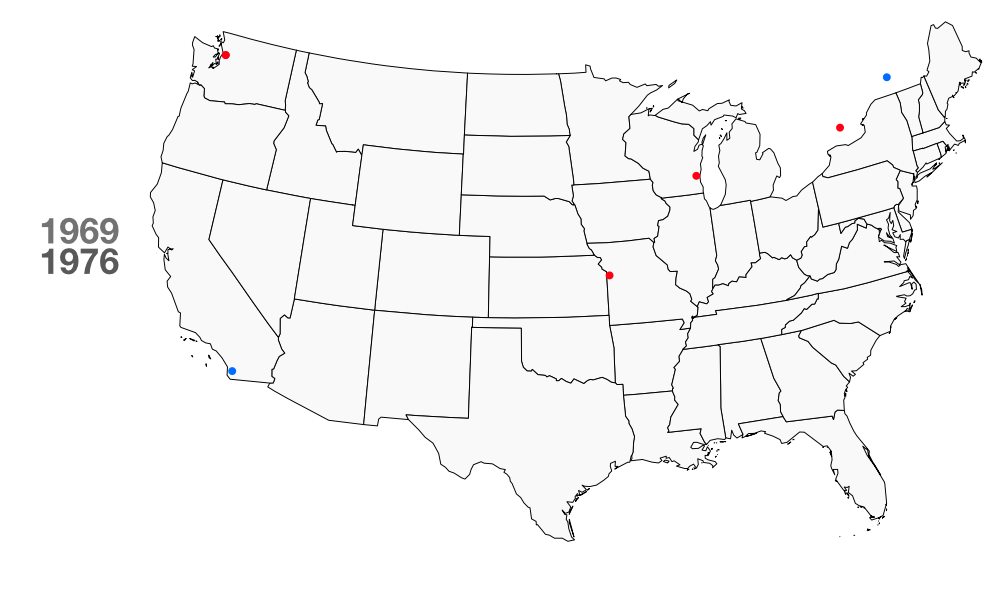
It’s possible that that the 32nd team could be a massive contest between the aforementioned Eastern cities and Western cities like Sacramento, Salt Lake City, Portland, and even Oakland. For now I’m going to posit that with the A’s bound for Vegas, MLB is done expanding in the West. If that sounds extreme, consider how expansion as progressed since 1967, when the A’s played their last season in Kansas City and MLB only had 20 teams. Then look at how it progressed to 1968 with the A’s move, 1969 and 1976 with arrival of six expansion teams (Seattle twice), and the current 30-team distribution. Viewed through that lens, there aren’t many holes left to address in the map once you get to 32 teams as I suggest in 2030. I told you folks last year that MLB viewed the A’s move a lateral one. So for any city to merit the 32nd team, they’re going to have to earn it. No shortcuts or giveaways. If you want in the Lodge, come strong or don’t come at all. Bring well-funded ownership bids and a publicly-funded stadium deal. That’s all.