Black and Blueprint

At the end of yesterday’s 2-2 draw between the San Jose Earthquakes and LA Galaxy, the Quakes’ shoo-in MVP candidate Chris Wondolowski headed to the supporters’ sections behind the north goal to do his ritual handshakes and celebration with the fans. A camera followed him over and suddenly, in view, was a large sign featuring a drawing of Lew Wolff’s head. The banner thanked him and John Fisher for, well, being the owners of the Quakes. There were no mustaches or devil’s horns drawn on the image, no effigies of Wolff hanging nearby. Whether it’s love is based on one’s perspective. Clearly, there is a level of appreciation among Quakes fans that isn’t being felt in Oakland, and perhaps never will. Being more tuned into what’s happening in Oakland, I thought my eyes deceived me at first. Thankfully, another observer saw the image on television as well.

That appreciation was on display earlier in the day, as the Quakes held their stadium groundbreaking ceremony on the other side of the tracks from Buck Shaw. 6,256 fans showed up at 1125 Coleman Avenue for what would eventually be declared a Guinness World Record for the most simultaneous participants in a groundbreaking. During the typically long __, Quakes President David Kaval thanked Wolff, his son Keith Wolff, and Fisher for bringing the team back and getting the stadium underway. That elicited hoots and hollers along with the expected applause. Lew was introduced and spoke briefly, thanking the fans. San Jose Mayor Chuck Reed and the City Council was there too, keeping the procession of dignitaries going.

Pretty shovels, all in a row.

Kaval and Quakes defender Jason Hernandez explained to the crowd how the groundbreaking was supposed to work. A large painted soccer ball was hooked onto the end of a crane. When the ball dropped and hit the ground, an airhorn would go off, signaling to the “crew” that it was time to start digging for two minutes. Thousands of commemorative shovels were stuck in the dirt field, which had painted lines and goals at each end. When the horn went off, the assembled crowd started digging. Since we were all in a fairly compressed space, many of us found that within a minute we had pretty much dug up most of the loose dirt in our respective vicitinities, leaving the next layer of hard clay to deal with. For me, that made the second minute of digging more a minute of manicuring. A countdown led to a second horn announcing the end of the two minutes. Public address man Danny Miller laid down a little suspense as he said that the Guinness people had to tabulate the crowd on hand. Miller announced “Six-thousand…” and was quickly drowned out by the crowd’s roar. Kaval held up a certificate in victory, and the masses started to depart.
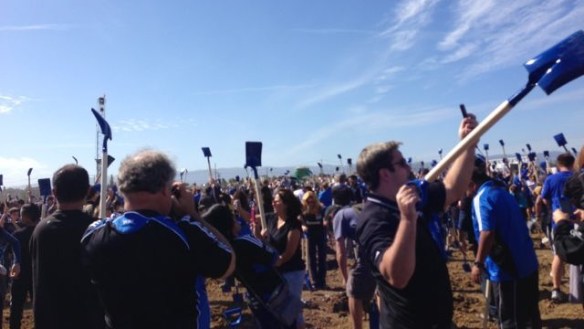
Dig for two minutes and you get a free shovel.

It’s no secret that the stadium has taken longer than anticipated to get built. Whether it was concern over sponsorships needed to get it built or process issues like permitting, fans have been waiting long time for the first permanent, unshared home for the franchise to materialize. When AEG took the first MLS incarnation of the Earthquakes to Houston, Colts-style, after the 2005 season, a pall descended on the fanbase. The logos and branding would remain in San Jose, but there was no indication that a new franchise would materialize right away. AEG, which operates the Coliseum complex, Staples Center, and owns the LA Kings NHL team, is reviled in San Jose even more than Lew Wolff is in Oakland. Don Garber, the MLS commissioner who flew in to attend the ceremony, was AEG’s evil puppet and accomplice in December 2005.

Commemorative shovel

The expansion Quakes franchise took the field for the 2007 season, when Wolff and Fisher swooped in. For MLS, Lew Wolff and John Fisher represented enough money and local ties to keep the team going throughout what would be trying times ahead. Fisher may well have been the most interested person within the ownership group in getting a franchise. As for Wolff, building a stadium for the Quakes would be a good warmup for doing a much larger, more expensive stadium for the A’s, whatever the location. Wolff’s son Keith would focus on the details. As the recession struck and sponsorship dollars disappeared, the Wolffs pursued land deal concessions, which they received. The vision for the stadium was scaled back, then when the economy recovered, expanded. When the Earthquakes Stadium opens in March 2014, it will have been over 8 years from when the team was purchased to opening kickoff. If the Wolffs are tired of going through the “process”, the outward signs are slight. Still, Lew has talked about not being around for when a ballpark finally happens, and Keith has certainly dealt with enough that he may be gunshy about saddling up for an even bigger battle. Yet that’s what will be necessary if they want to get something built for the A’s. Maybe it’ll be in San Jose, maybe it’ll be in Oakland. However it proceeds, there are probably a lot of lessons from the Quakes stadium experience that are applicable for an A’s ballpark. Given how hard it is to get something funded and built in California, having that experience can’t hurt one iota.

Dare to dream of the $80 million payroll

At once insane and tantalizingly possible, the Oakland Athletics are buyers this offseason. Any questions about Billy Beane’s M.O. were answered swiftly when word came this afternoon of the first big winter trade (Winter? I was wearing shorts on a 71 degree sunny day today.). Middle infielder Cliff Pennington and prospect Yordy Cabrera were traded to Arizona for former All Star CF Chris Young and $500,000 cash. Cabrera was later sent to Miami for reliever Heath Bell, but we’ll ignore that for the time being.

Young will earn $8.5 million this year and $10 million in 2014 if the A’s pick up his option. If not, the buyout price is $1.5 million. Coco Crisp, the A’s current CF, makes $7 million in 2013 with a $7.5 million 2014 option ($1 million buyout). That puts the A’s investment in four outfielders – Crisp, Young, Yoenis Cespedes, Josh Reddick – at $24 million, nearly half the 2012 payroll. Even with that kind of money, the four players combined for 13.6 WAR in 2012, making the 2013 expenditure pretty good value any way you slice it.

When the news was first released, the most prominent immediate fan reaction was to wonder what would happen to Crisp. It was Crisp who was re-signed only nine months ago, and many fans wondered if that was a wise decision considering the number of nearly ready young outfielders in the A’s farm system. Once Cespedes signed with Oakland in February, it seemed as though Crisp’s days were numbered. When the A’s had their nine-game losing streak at the end of May, Crisp’s name surfaced as trade bait, despite his struggles throughout the first two months of the season. Yet Crisp got himself right in June, perhaps because he got the starting CF job back. His energy and skill at the top of the order made him arguably the most dangerous weapon in the A’s lineup by the All Star Break. Now Crisp seems almost indispensable among many fans, at least judging from reactions on Twitter. It’s a remarkable story that stands among many on the A’s squad. Crisp does have a lengthy injury history, though this year he was out at times because of illness (flu, pinkeye) rather than a muscle or joint problem.

If anyone is likely to be moved or non-tendered, it’s Jonny Gomes, Seth Smith, or both. Both contributed nicely in a DH+occasional OF platoon situation. Smith will hit his second arbitration year, and his value is strictly in that platoon role vs. RHP. Gomes is the opposite, mashing against lefties and coming in very cheap with a $1 million salary for 2013. Both players will command around $3.5 million, and both will want multiyear deals if possible and more plate appearances – which may be few and far between if the “Four Horsemen” stay healthy and get their 550-600 PAs. Young assumes Gomes’ role, which is a shame because Gomes is such a likable guy and a local, but that’s how the business works. Beane has already said on a conference call Saturday that Gomes would be affected by the Young acquisition.

I’ve put together a spreadsheet showing the A’s projected 2013 payroll. It makes certain key assumptions about the makeup of the A’s roster:

  • Stephen Drew’s $10 million mutual option is picked up. Drew showed improvement late in the season and appears healed from his ankle injury troubles. That’s not going to make the A’s or anyone commit to a really rich deal, no matter how much Scott Boras pushes for one.
  • Seth Smith is retained. I don’t think this is a given because of the reasons previously defined. If he stays it’s probably for $3.5 million. If he is replaced by someone in the A’s system like Collin Cowgill or Shane Peterson, the A’s will save $3 million in the process. Keep that in mind for future payroll projections.
  • Brandon McCarthy is re-signed. The elder statesman of the pitching staff, he’ll never reach 35 starts in a season because of lingering shoulder problems. But he is very effective when healthy and is a great clubhouse leader and spokesman for the club, and his (and his wife’s) media presence helps put a face to a team that might otherwise go relatively anonymous. He should be affordable to keep, and worth it.
  • Brett Anderson is not traded. If Anderson had not suffered elbow trouble that resulted in Tommy John surgery, Anderson might already be elsewhere. Having come back late in the season, he looked very good in limited action. He has ace-quality stuff, which as we’ve seen in the playoffs, can be pretty important.
  • No other big trades or free agents signings are done. This is the A’s we’re talking about, so nothing’s for certain when it comes to personnel. I’m keeping it like this to illustrate what the the payroll looks like now and to show how much headroom remains.

Minimum salary for 2013 is $490,000 per CBA. Specific salary estimates are based on previous published salaries for players with similar service time and/or performance.

All told, the payroll is as much as $65 million. Brandon Moss should have Super Two status, so he may earn more than what is listed. Without Smith (and Gomes), the payroll is only $62 million. The pattern for the A’s has been to respond to an encouraging season (2006, 2010) by bumping up payroll. In 2007 the A’s came off an ALCS appearance and boosted payroll to $79 million, with $46 million devoted to five players: Jason Kendall, Eric Chavez, Mike Piazza, Mark Kotsay, and Esteban Loaiza. None of those five produced in any meaningful way for various reasons, and all except Chavez were off the team during or shortly after the end of the 2007 season.

The 2008 season showed promise, with a solid young core and a .500 record. Payroll was bumped for 2009 from $48 million to $62 million. We know how 2009 went: Matt Holliday produced well but not like a superstar he was advertised to be, and Jason Giambi proved that you can’t go home again. So we know how this could play out if the team flames out. The A’s could easily spend another $10-15 million without much trouble, but if the team is 10 games back by July trading deadline, we could very well see another selloff. The Marlins tailed off in the NL East by the end of June, resulting in the trades of Hanley Ramirez, Anibal Sanchez, Omar Infante, Gaby Sanchez, Edward Mujica, and Heath Bell. Not even a new ballpark could keep the fans from leaving in droves, forcing the directive for Larry Beinfest to cut costs posthaste.

It’s not by accident. This is a script all low-revenue teams have to work with. The A’s pulled in 1.6 million fans this season. Say they brought another 400,000 fans in to bring the 2013 total to a cool 2 million. At $30 a person, that translates to $12 million in extra revenue, about half of that going to payroll. The annual winter revenue sharing payment should also help. Success has cascading effects, as there’s also a lower percentage of no-shows and greater revenues from media and sponsorships. It’s a snowball effect. We’ve seen it run positively in the last few weeks, and negatively in recent years.

That makes a $62-65 million payroll something of a jumping off point. The A’s could support an $80 million payroll if things continue to go well. $80 million isn’t still in the bottom third of MLB, but it’s a good deal of extra budget to play with. However, we know that free agent spending has yielded mixed results, and that cost per win can be very difficult to pin down at times from a GM standpoint. Fortunately the team is strong in the outfield and pitching staff, making the weak spots easier to live with. How should Beane and Forst use $15-18 million of headroom? They could stand pat. They could make another trade or pick up a free agent (or two). They could go into the international market as they have in the past (Cespedes, Iwakuma, Ynoa) to bid on a young arm like Japanese high school phenom Shohei Otani. They could save it for some midseason deadline deals. Whatever way the front office chooses to go, the possibilities are practically endless. The future is bright, it’s ahead of schedule, and the A’s world – from owner to fan and everything in between – can’t be anything but happy about it.

News for 10/19/12 (plus Young trade thoughts)

Update 10/20 3:00 PM – The A’s front office decided to kick off the hot stove league early by trading IF Cliff Pennington and 3B prospect Yordy Cabrera to Arizona for CF Chris Young (not that Chris Young) and $500,000. This has immediately led to speculation regarding the future of current CF Coco Crisp, who is scheduled to earn $7 million in 2013 and has a $7.5 million club option for 2014 ($1 million buyout). Young is due $8.5 million in 2013 and has a $11 million club option for 2014 ($1.5 million buyout). Cabrera was flipped to Miami for reliever Heath Bell. 

Pennington was either going to remain a mediocre shortstop or become an okay second baseman surrounded by many other okay second basemen in Oakland. That makes a trade for Young a steal, even if there’s no obvious place for him at the moment. Young came off a subpar 2012 season, especially compared to his 2010 All-Star campaign. September callup Adam Eaton (not that Adam Eaton) appears to be the CF of the future for the Snakes.

The A’s still have something of a logjam at 2B going forward. Jemile Weeks, Adam Rosales, Scott Sizemore, and Eric Sogard are on the 40-man roster. Grant Green waits in the wings. Expect more trades.

….

Much to go over in this edition.

  • The NHLPA rejected the NHL’s most recent CBA proposal, which would have had the owners/players revenue split at 50/50. The union responded with three different proposals which would’ve more gradually brought the split down to 50/50. In response, the NHL has cancelled all games through the end of October. At this point it seems highly unlikely that the proposed 82-game compressed schedule could be pulled off. [NHL | Washington Times/Steven Whyno | NJ.com/Charles Curtis]
  • The Raiders received a 24-hour extension to the weekly TV blackout deadline imposed by the NFL, and were able to reach the goal of 85% of seats sold for the game Sunday vs. the Jags. Next potential blackout date: the next home game against another Florida team: Tampa Bay. (Also – kind of weird that the Raiders are playing all three Florida teams this season.) [CSN Bay Area/Paul Gutierrez]
  • The City of Reno was able to get a ballpark built in the middle of the Great Recession by getting a $55 million short-term loan. That loan will be due before the end of 2014, and the City and Reno Aces are scrambling to refinance the loan. Property taxes used to fund a TIF plan for the ballpark have dropped drastically, forcing the two parties to come up with something else. The Aces, which are owned by Indiana Pacers owner and mall magnate Herb Simon, are willing to pay $1 million in rent per year, with the rest of the $3 million annual obligation split between the City’s general fund, a ticket tax, whatever meager redevelopment money can be scraped up, and other public sources. Simon has threatened to move the team if no deal can be met. The Aces won the 2012 AAA championship and were awarded the AAA All-Star Game for 2013. [Reno Gazette Journal/Brian Duggan]
  • Lew Wolff came out against San Jose’s Measure D, which would raise the city’s minimum wage from the state’s $8/hour to $10/hour. Wolff’s argument is that the hike is unfair to hotels and restaurants in San Jose, which could potentially lose business to Santa Clara and other neighboring cities. The hike would also presumably affect seasonal employees at the two stadia Wolff wants to build, the Earthquakes Stadium and Cisco Field. Wolff played down that issue, saying that there’s less direct competition there to affect the Quakes/A’s. The City Council is split on the measure, while Mayor Chuck Reed has come out against it, along with the Chamber and Restaurants Association. My take? I hope it’s passed in San Jose, because like the plastic bag ban that was passed a couple years ago that spurred similar bans throughout the county, it could lead to a minimum wage hike countywide. As I’ve mentioned before, I have relatives who work low-pay, low-skill hotel/restaurant jobs, and they could certainly use the hike – though they don’t work in San Jose proper. [San Jose Mercury News/John Woolfolk]
  • Speaking of the Earthquakes, their groundbreaking ceremony is Sunday at 11:30 AM at 1125 Coleman Ave, San Jose. At least 5,500 have RSVP’d for the event, which should break a Guinness record. Walkups are welcome if they bring their own shovels.
  • Teams are announcing their ticket prices for the upcoming season. At least in terms of season tickets, the A’s have no change from 2012. The Cubs have announced modest drops in response to a large attendance dropoff, and the crosstown White Sox have announced even bigger cuts. [Chicago Tribune/Paul Sullivan | ChicagoNow, James Fegan]
  • The A’s announced their 2013 promotional schedule, and while it doesn’t have everything yet, there are now six fireworks nights instead of the usual five on the slate. There will now be two in August, on the 3rd and 31st.
  • The Port of Oakland placed its executive director on paid leave pending an investigation into improper spending and expensing by Port employees. This included a $4,500 tab at a Houston strip club, and numerous other suspect charges in the US and abroad by the Port’s maritime director James Kwon. Abuses could be so widespread as to be institutional. Yesterday, port workers scheduled a protest against fiscal mismanagement. The blowback from this investigation could curtail or place a trained eye on certain Port activities, such as (pre) development at Howard Terminal. Knowing the Port’s history, it’ll probably be more of the same. [SFGate/Matier & Ross | KTVU | SF Business Times/Eric Young]
  • Cal may have trouble paying off the $11.6 million annual debt service on Memorial Stadium because of lackluster premium seat sales. This smells a lot like the Mt. Davis deal. [Daily Californian/Justin Abraham]
  • The Warriors further explain their SF arena vision, with the help of Snøhetta architect Craig Dykers. The form will be “soft” and “lozenge-shaped”. The Fiscal Feasibility Report unveiled earlier this week can be viewed here. [Golden State Warriors | SocketSite]

More as it comes.

49ers stadium finalist for Super Bowl in 2016 or 2017 + Raiders news

The NFL’s rules for building a stadium are simple:

  • City/municipality must have skin (money) in the game
  • Minimum capacity of 63-65,000, with potential expansion to 70,000+
  • NFL will provide up to $200 million for per team/stadium if new construction
  • If successful, NFL will award a Super Bowl at a future date

At the NFL owners meetings today, the 49ers were notified that they are one step closer to that last bit. According to Sports Business Journal’s Daniel Kaplan, San Francisco/Santa Clara is a finalist for Super Bowl L (2016) along with Miami. The city that loses out on L becomes a finalist for LI (2017), competing with Houston.

View from nearby Capitol Corridor/ACE train station. Picture taken 10/9

The Super Bowl is an award from the league for getting a stadium deal. It’s no small reward, as numerous cities would kill for the opportunity to bring in hundreds of millions in economic impact to a region. The actual amount of economic impact is up for considerable debate, but no one can doubt the amount of media coverage, blocks of hotel rooms booked solid, and plain spending from visitors that occurs with each big game. Last February we discussed what hosting a Super Bowl in San Francisco would be like and what it would entail. It’s worth a read if you’re interested.

View from Santa Clara Golf & Tennis Club of north side of stadium

Miami is the competitor for L, and despite its 10-time history of hosting the game, is at a distinct disadvantage. NFL Commissioner Roger Goodell has warned the Dolphins and Miami that if the region wanted to continue hosting the game, improvements such as a roof would be required. For now, all the NFL is looking for are some improvements to sightlines, lighting and sound, and a canopy over some of the stands. If those improvements don’t happen (and they aren’t funded at the moment), it’s easy to see the 49ers and SF/SC winning by virtue of its newer facility and novel location.

…..

Kaplan also had a key Raider-related tweet coming out of the owners meetings.

In addition, Davis talked about how outdated the Coliseum is (Shush! Can’t badmouth the Coliseum dude!), while saying that he has little interest in sharing the Santa Clara stadium with the 49ers even though the 49ers deserve great credit for getting the stadium project done. The Coliseum remains the default option simply because the land and location are already prime, but as Davis continues to talk up Dublin’s Camp Parks site, one has to wonder what Davis really wants. Is he looking to pit two East Bay cities against each other, the way his dad had done in the past? Davis has to be looking to minimize the team’s exposure. Yet it’s hard to see how the Raiders could put together as richly-backed a deal as the 49ers for a new stadium. It sure seems as though the Raiders will be sticking at the Coliseum until the best deal possible falls into Davis’s lap.

SF shows Oakland how to get things done

The Warriors and the City of San Francisco are in the early stages in what will be a long, frequently uncertain struggle to get an arena built at Piers 30/32, and yet they’re already well ahead of Oakland in a few key ways. In the Chronicle article jointly written by John Coté and John King, the City/Port has already identified a financing mechanism for refurbishing the piers to the point that they could be used for the Warriors’ arena.

The team in return would build and pay for the arena and other buildings as well as the open spaces. It would be the team’s responsibility to strengthen the dilapidated piers, an endeavor that city officials say would cost an estimated $120 million.

The proposed deal calls for the city to reimburse the team up to that amount for infrastructure upgrades.

The city’s financial liability would be capped there even if the rehabilitation costs exceed that, said Jennifer Matz, the point person for Lee’s administration on the project.

All told, the arena and adjacent development are projected to cost $1 billion, city officials said.

The deal is essentially a reimbursement of the pier rehab costs (free land), while the Warriors sign a lease for up to 66 years. It’s the same kind of deal struck with the Giants. The Giants got development rights to the parking lots across Mission Creek from the ballpark. The Warriors would get dev rights to Seawall Lot 330, the parking lot across the street from the piers. The lot could hold a hotel or high-rise condos. Either way it’s easy to see the return. What’s impressive is that this was put together in less than six months. There’s much left to do: EIR, detailed costs sheet, W’s coming up with the money, state approval, etc. – but this is a significant step forward. It makes the deal easy to communicate and pitch to the public.

As for Oakland? Well, @EastshoreEmpire got to ask Mayor Jean Quan about Howard Terminal and Coliseum City over the weekend, and was nice enough to check with me to supply some Q’s. I said to ask about the two stadium projects, and here is the response:

Okay, then. The Port of Oakland will to handle it, from soup to nuts. Makes sense, since they’re a fairly autonomous governmental body. The Port also has some bonding capacity for a Howard Terminal infrastructure project and good bond ratings. How would that infrastructure be paid for? Would it be tacked onto the cost of the ballpark? Is there another development deal whose proceeds could pay it back, such as Seawall Lot 330 in SF? It doesn’t appear that there is.

Well, at least a Coliseum City EIR should be here before the end of the year.

Warriors release arena site plan renderings

The Golden State Warriors released some long-awaited sketches of their planned waterfront San Francisco arena this afternoon. Since the team picked Norwegian architectural firm Snøhetta and arena giant AECOM to draw up the arena and site plans, my thought was that they’d come up with something distinctive that “merges” the sea with the land. I wasn’t disappointed on that count.

Wide sunrise view from China Basin/Mission Bay with arena in center, Bay Bridge west span in background, AT&T Park in foreground

The plan claims to have 50% of the Piers 30/32 site used as open space, with numerous connected public spaces including an amphitheater, promenade, and multiple plazas. A long, broad, gradual staircase takes visitors from street level to what would presumably be the concourse level of the arena. From there it slope down to the water. Kayaks could dock on the south end. Not sure how popular that would be during January and February, but it could be very popular if the W’s made the finals in June.

Site plan shows how public spaces will be integrated. Southeast corner is a dock for fire and police boats.

Surprisingly, little was shown of the exterior of the arena, perhaps to indicate that the vision there isn’t yet final. From all appearances it’s glass curtainwall of some sort, though word is that the roof will tilt to allow for enhanced view of the Bay. Orientation of the arena is slightly north-northeast (from basket to basket), and it’s not symmetrical. The concourse photo below indicates a largely column-free design, though it’s not clear where services such as restrooms and concession stands would go.

Lower concourse. A ramp appears almost disconnected from the rest of the arena.

The surprising news is the intended capacity of the arena: 17,500. That would be the smallest capacity of any arena outside New Orleans or Sacramento, and would lead to an intense scarcity situation for tickets. It could also make the arena slightly cheaper to build, since there’d be less concrete needed to fill it out. Other important numbers, with my comments in brackets:

  • Venue Footprint: 170,000 square feet [3.9 acres]
  • Venue Height: 135 feet. For reference, AT&T Park is 183 feet to the light standard, 132 feet to the top of the seating bowl [Important because the Giants were able to get an exemption from the State Lands Commission because of height of the structure. The W’s are apparently mimicking this plan.]
  • Venue Seating Capacity: 17,500. For reference, the capacity of Oracle Arena is 19,596 [Prices will likely reach Staples Center/MSG levels to make it all work.]
  • Venue Total Square Footage: (excluding practice facilities and meeting rooms): 740,000 square feet [In between Barclays Center’s 675,000 and Amway Center’s 875,000, likely because of the reduced capacity.]
  • Practice Courts: 21,000 square feet [First time in the Warriors’ Bay Area history that they’ll have a co-located practice facility with the arena.]
  • Community Event Room: 10,000 square feet [Necessary carrot for City Hall/Board of Supervisors to sign on]
  • Parking Spaces: approximately 630. Piers 30-32 currently parks 1,500 cars [Probably a garage under open space area]
  • Retail: 105,000 square feet
  • Open Space: 333,000 square feet out of 548,500 square feet total. The Warriors are committed to no less than 50 percent of the site being dedicated to open space. [Open space is good to fulfill EIR requirements. Also serves double-duty as additional staging area for pre-event activities for games, concerts, etc.]

View from south end of kayak docking area

The key issue will be parking and transportation, which are already scarce in the area. 630 spaces will cover only the team, VIPs, and little else. Caltrain and BART are both a 3/4-mile walk from the site, roughly the edge of what most people are willing to walk, though having a picturesque area like the Embarcadero helps. Muni’s N and KT lines serve the Brannan station. Even with that, something will have to be done to better regulate parking management, even if means severely restricting parking in the immediate area. It could get especially dicey if there are conflicting events at AT&T Park.

Greater site plan

There’s still much to figure out and negotiate before a Warriors’ SF arena is approved. At least they’re releasing information on an aggressive schedule, which shows that they’re eager to make this happen.

Cinderella Men

If you read this blog, the chances are good that you hate the Yankees. I know I do. I enjoy watching them lose. I enjoy how they constantly overpay for  talent (Raul Ibanez excepted). I enjoy the fact that Yankees fans have to endure John Sterling and Suzyn Waldman on the radio. And I enjoy watching the scene at the Yankees’ overpriced stadium, with its overpriced, empty seats and empty atmosphere.

But I look a recent article by CSN’s Ray Ratto with bemusement. He compared Yankee Stadium’s current atmosphere to the Coliseum’s last week during the ALDS. Ratto proclaimed the great Oakland fanbase, as it magnanimously came back for the last week of the season and the playoffs to create the kind of 10th-man crowd rarely seen in baseball.

The fact is, the fans in Oakland made Oakland a cool place to play the last few weeks, not out of obligation, but because the players taught them how to overcome their annoyance at the people who run the franchise. And it certainly wasn’t out of anticipation for a new stadium somewhere, either.

It was the moment that made the ballpark, and the comparisons with Yankee Stadium have never been more apt.

As A’s fans, we’ll always have that moment, the 2012 season (July-October, anyways), and the improbable tally of 15 walkoff victories to hold in our hearts forever and to keep us hopeful for the future. Maybe someone will write a book or make a movie about it. If moments were enough to sustain the A’s, we’d have no worries about the future of the franchise. The harsh reality of the situation is this:

  • All four teams in the LCS have payrolls over $110 million, and have been at or above that level for several years.
  • Three of the four teams have won the last three World Series.
  • The exception, the Tigers, went to the ALCS last year and the World Series in 2006.

The teams that are left in the postseason, they aren’t satisfied with disparate moments. They want success. They demand it regularly. They have the revenue to pay for that success, and that’s exactly what they do: pay for it. With that comes raised expectations, such as winning the World Series every year in the Yankees case. They aren’t the A’s, who are famously beneath 50 feet of crap. Sustained success is not something A’s fans can realistically demand every year because the franchise doesn’t pay for it, and neither do the fans. So Ratto can smugly claim superiority, but the real story is that A’s fans had zero expectations going in, making the whole season feel like we were playing with house money. Yankees fans, well, they are the house. They expect returns. Should they not be entitled to the same kind of disaffection many A’s fans have felt? We all vote with our wallets, right?

Disaffection means people walk. For the A’s, it means people don’t pay for cheap tickets. For the Yankees, it means people don’t pay for expensive tickets, whether on the primary or secondary market. Going into 2012, Yankees regular season tickets were 238% the cost of A’s tickets, according to FCI. Nosebleed seats for the ALCS, which start at $41 and escalate quickly up to $1,500, remain available for potential Games 3 and 4. StubHub has an enormous inventory of available ALCS tickets. Sure, the Yankees are gouging their fans. But even in the old Yankee Stadium, where tickets are generally cheaper, the Yankees choked plenty of times in the playoffs. Did the 10th man have any measurable effect there? It certainly didn’t get them over the hump. In Game 5 of the A’s-Tigers ALDS, Justin Verlander quieted the crowd with strikeout after strikeout. The fans’ only release came after the final out, when a long and deserved standing ovation greeted the fallen heroes. What the Yankees are experiencing now and the A’s did from 2007 to 2011 are not fundamentally different. The only real difference was the level of expectations for both teams.

This great postseason we’ve witnessed so far this year has reminded me a lot of a really good NCAA Men’s Basketball tournament. You have your major conference powers like Duke, Connecticut, North Carolina, and Kentucky (Red Sox, Yankees, Cardinals). They’re the teams that constantly make the Sweet Sixteen (third and fourth rounds), even the Final Four (semis/finals). Then you have your Cinderella teams, the mid-major schools like Belmont or George Mason. Frequently overlooked, and with a fraction of the resources the big schools have, no one expects these teams to win. When they do win it becomes a big story. That’s what the A’s and Orioles represented this year, along with the Moneyball A’s and recent Tampa Bay teams of the past.

Sometimes those Cinderella teams get to the Final Four. Almost invariably, they don’t win it all. The last Cinderella team to win the NCAA basketball championship was Rollie Massimino’s 1985 Villanova squad, and they’re arguably a Cinderella because Villanova was perennially competitive in the hoops-crazy, big money Big East. The last win-it-all Cinderella story in MLB was the 2003 Florida Marlins ($49 million payroll), and unlike Villanova, they sank into mediocrity shortly after the World Series. It’s great to revel in these stories, but let’s remember that they’re exceptions, not the rule. The Yankees and Tigers beat the Orioles and A’s, respectively, because they can afford $20 million/year aces like C.C. Sabathia and Justin Verlander. More than ever, it seems as though premium pitching comes at a premium – and is worth the investment. Try as everyone can – and Billy Beane does – to beat the house, the house usually wins. And that’s nothing to be smug about.

Update 7:28 PM – This Grantland post and mine came to similar conclusions. 

Boxer advocates for A’s to stay in Oakland, for W’s to leave for SF

Earlier this week, Let’s Go Oakland’s Doug Boxer led the charge to collect 10,000+ names on a petition asking the A’s to take down the tarps at the Coliseum for the playoffs. The move worked insofar as the team announced the takedown for potential ALCS and World Series games. Sadly, we know now that those games won’t be played. Despite that, the petition drive succeeded in getting attention for the tarps and the fanbase, although Boxer’s phrasing the petition as “giving paying fans access to playoff games” was a bit of a stretch.

It’s unlikely that Boxer will be leading any petition drives to keep the Warriors in town, since the San Francisco Business Times and the San Jose Mercury News both report that Boxer, in addition to his LGO duties, is a paid consultant to the Warriors for their waterfront arena project. Boxer is a former Oakland Planning Commissioner and is well connected, making his counsel pretty valuable for getting a complex project like an arena at Pier 30/32 off the ground.

Since the Warriors unveiled their plans in May, we’ve gotten a bunch of questions here asking why keeping the A’s in Oakland is such a passionate movement while the Warriors have gotten a collective shrug, relatively speaking. The A’s have only been in Oakland three years longer than the W’s. The W’s have had much more consistent attendance and TV ratings than the A’s. The answer comes in part from Boxer’s response to the SFBJ when they asked him about his seeming inconsistency in supporting the W’s move while fighting to keep the A’s from leaving.

“The entire Bay Area shares one NBA team, its fans are all over the region, and the best place for it to be situated is right in the middle of the whole region, at a spectacular waterfront location, at Piers 30-32, equally accessible from every city, north, south, east and west,”

It’s a very diplomatic non-answer, but it sheds light on a couple of possible explanations. We already know that the team’s identity is the bland “Golden State Warriors”, a name that has only succeeded in getting fans from other cities to ask where “Golden State” is located. The Warriors have generally refused to take on the Oakland moniker, though I’d heard that when the arena was renovated for the 1997 season, then-owner Chris Cohan was willing to consider the name change in exchange for significant lease breaks. Prior to Cohan, neither Franklin Mieuli nor the Dan Finnane/Jim Fitzgerald group wanted a name change. So while the W’s are literally the only NBA game in town, the fanbase is linked mostly to the W’s regional legacy and proximity rather than a city identity. When the team started marketing alternate jerseys featuring the old “The City” logo nearly a decade ago, the jerseys proved extremely popular.

Jason Richardson and Baron Davis before the “We Believe” season started.

In response to “The City”, “The Town” design clothing started showing up around Oakland. That right there is a microcosm of the issue we’re seeing. With the A’s, there’s a rivalry across the bay, a distinct identity, winning tradition, all things to rally around. The Warriors don’t have any of that. Even the one championship the Warriors got in 1975, the Coliseum Arena was booked for the NBA Finals, forcing home games to be played at the Cow Palace. There’s precious little to get riled up about. It shows in the lack of grassroots or other political movements to retain the Warriors like Let’s Go Oakland. The City of Oakland’s “Oakland Loves Its Sports Teams” recent week of events barely mentioned the W’s at all. There are no websites or Facebook pages devoted to such a cause, no outlets to foment this kind of anger against ownership. Sites like Warriorsworld and Golden State of Mind aren’t terribly concerned with the issue right now. Plus there is a decent-sized contingent of fans who would love to see the W’s in San Francisco to bring SF’s prestige to the team.

Back to the subject of Doug Boxer. How can his inconsistency be explained? He can use the whole “centrally located” line with the A’s just as he does for the W’s. The problem with that is that having two “centrally located” baseball teams in the Bay Area has caused them to repeatedly steal each others customers, as the A’s did in the late 60’s-early 70’s and the Giants did when AT&T Park was built. The Bay Area has grown to the north, south, and east with no proper adjustment by the teams to reflect that change, making it possible that this cycle will continue. Thing is, that’s not LGO’s argument. To Boxer and LGO, the A’s are first and foremost and Oakland/East Bay team. And that’s fine, though Boxer’s stance short circuits at least one of the arguments being espoused by those wanting to keep the A’s in town, including Oakland resident Katherine Brown in the Tribune:

I cannot bear the thought of the hundreds of jobs that people from Oakland could lose if the A’s ventured to another city. I cringe at the idea of a stadium remaining dormant for 9 months out of the year- filled not with thousands of cheering, Bernie-leaning fans, but only with the memories of what was.

Perhaps Boxer should discuss what will happen to the jobs that normally service 44 Warriors games at Oracle Arena, or the memories of the “We Believe” season or Run TMC. I’ve personally asked Boxer on several occasions to write a post here, on this blog. I promised that it would be unedited and that it could run without comments if he requested it. He came close to doing it once, but so far has chosen not to write a post. That’s fine, but I think he owes an explanation to a lot of people about this inconsistency – and it doesn’t have to be here. Doug Boxer is a genial guy. Jeffrey and I had lunch with him a while back and it was nothing but pleasant. Other than that experience, there’s a specific observation I can make about Boxer. About a year ago at what was probably the unveiling of the Coliseum City plan I talked to him at City Hall after the press conference. He told me that there are no innocents in this franchise politics business, and I agreed with him. I just didn’t realize back then that he was Exhibit A in showing how conflicted this whole mess is.

The bar has been raised

Last night I gave myself until midnight to mourn the end of the A’s 2012 season. At midnight I realized that I hadn’t eaten since lunch, too nervous to do so during or before the game. So I took an hour and took care of my hunger pangs before settling in to start this post.

The memories of this season will remain fresh throughout the winter, through the inevitable rumors about roster shuffling. Which starting pitchers will be kept? Can Billy Beane find a real solution at second? And most importantly, what expectations will we have for the A’s in 2012, after they came out of nowhere to take the division from two teams (Rangers & Angels) whose combined payroll was five times that of the A’s?

That’s what it comes down to. Going into 2012, no one had any expectations of the roster, the fans, ownership, or anything else associated with the Oakland Athletics. All that has changed starting October 12, 2012. The bar has been raised. Everyone from fans to the media to the rest of baseball will expect more out of the A’s. The element of surprise that fueled much of the euphoria this year will have evaporated. That childlike joy, that sense that no one has anything to lose, will have to give way for a more consistent, more professional franchise. New expectations come with a weight for a team to bear, and in our case, the fans also have to bear it. It’s not enough to look at two weeks or a month and call Oakland “saved” for baseball. That would be like looking at Brandon Inge’s first week in an Oakland uniform and declaring him the third baseman of the future. It’s asinine and completely absurd. No, the test starts now: of ownership to cultivate this success, of the front office to sustain it, and of the fans to respond in kind.

Nothing gets a pro sports team’s sales organization going like a playoff run. In September the A’s sales group started to push hard for season ticket deposits, fueled by renewed fan enthusiasm. They got me on board for 2013, my yearlong experiment with walkup and online ticketing over. I’m an easy sell. I don’t have a grudge against ownership, and my worldview isn’t inextricably tied to the word “Oakland”, keeping me from investing my fandom. Many longtime A’s fans have stayed away because of ownership. They are naturally going to be tough sells. Has this fresh, exciting team brought those fans back into the fold, or will they look for more from ownership to convince them?

Yesterday’s pregame announcement of tarp removal for the ALCS/World Series elicited some positive reaction, but that isn’t enough going forward. Those same tarps for the original upper deck (West Side) should be removed forever, just as I had outlined as an option last week. Close down the Plaza Reserved seats to dial back the capacity somewhat, and simply sell sections of the upper deck on an as-needed basis as the Dodgers have done in the past. That should bring the capacity back to 43,000 or so, with 36,000 in play most of the time until high-demand or premium games comes around.

As for the roster, the front office is fortunate that there is only one high-priced free agent on whom to make a decision, Stephen Drew. While Drew played solidly since his trade from Arizona, $10 million is a high price and from a pure value perspective, not worth it. There’s a chance that Drew is bought out and a new deal done, but that would also put him on the open market, where there could be a premium for a someone who is ostensibly an average-to-good shortstop.

Then there’s Brandon McCarthy. Take away the horrendous line drive incident, because McCarthy’s already throwing and all parties were looking to clear him for the World Series. He even took time to write a back-page article for SI. No, McCarthy’s issue has, and always will be, the health of his right shoulder. Prior to September, McCarthy had to be put on the disabled list twice in 2012 and frequently had extra days between starts as his shoulder issues kept creeping. That may sound like a good opening for the team to let him go as many young starters are waiting in the wings, but I go back to what Farhan Zaidi said on Blog Day: “We try to build a set of options – 8, 9, 10, 11-deep of starting pitchers.” In that context, McCarthy should be a fairly easy guy to make a case for, since his injury history has depressed his value somewhat. His effectiveness when he’s there, his presence in the clubhouse, and the outsize positive attention both he and his wife Amanda have brought to the team are all reasons to bring him back for 2 years/$14 million.

Jonny Gomes was a major force, even though he saw only one at bat during the ALDS due to matchups. He should be back, also for 2 years at maybe $6-7 million. Bartolo Colon, who was practically forgotten as A.J. Griffin and Dan Straily were brought up, may not be too easy to dismiss. His PED suspension should’ve driven him out of baseball completely. Yet there’s something appealing about a guy who can simply eat innings. That helped the A’s staff in no small measure in 2012. Maybe he gets signed to a minor league deal and is stashed in Sacramento if he’s willing to be there. Then there’s the case of Dallas Braden, who’s as snakebit now as Justin Duchscherer was a few years back. Again, there’s a limited market for Braden’s services, so non-tender him, sign him to a minor league deal, and let him work out his shoulder problems in the spring and extended spring training.

The second base dilemma is the most puzzling, because none of the options are great. Five or six guys could play the position. Cliff Pennington’s the best defensively because of his arm. Jemile Weeks has the speed and potential leadoff ability but regressed badly in 2012. Adam Rosales is all heart and arm and little else. Scott Sizemore is an unknown because of his lost year. Eric Sogard may have disappeared down the depth chart for good. Grant Green, a organizational fan favorite, has a bat and no glove. Chances are that some guys will be non-tendered, at least one will be traded, and someone else will be stuck in Sacramento for another year, blocked by someone else in Oakland with marginally greater ability. The organization should expect more from second base in the future. It’s up to these players to break through and take the starting job for themselves.

Will the front office attempt another international free agent splash signing? Which Josh Donaldson and Chris Carter will we see to start 2013? How much can the catchers improve defensively? All of these questions have much of the internet fanbase already going through that yearly phase called rosterbation, what has classically been called the Hot Stove League. People in general are talking about the A’s again. There’s real interest and the non-hardcore fanbase may have been aroused enough to commit.

That’s where it gets difficult. The A’s fanbase won’t be judged solely on the last two weeks, as much as people would like to see it. The media liked to characterize this pennant chase as “rekindling Oakland’s love affair with baseball”. It’s romantic and hits all the right notes. But you know what often happens with affairs, right? They wither. They end. What starts as grand and limitless in May can be consigned to the dustbin in December. This is where the fans come in. Fans have to commit. Whatever anyone thinks of ownership, they have produced a winning team. Now it’s time for fans to respond by buying season tickets. Last I heard, season ticket subscriptions added up to 7-8,000 full-season equivalents when accounting for all of the partial plans. If you want this team to stay in Oakland, you need to do your part. Get that number to 10,000. Aim for 2 million in total attendance. Both are modest figures when compared to what happens regularly across the bay, but it’s a start. MLB may be struggling with its Oakland/San Jose decision because it needs to see real numbers like these to justify whatever decision it makes. In Oakland, MLB needs to see that even without a new ballpark, enough fan interest can be generated to avoid a Miami-like situation where attendance dropped off a cliff after the team started to disappoint in their new digs. In San Jose, MLB needs to see that enough of the existing East Bay fanbase can come along even after being alienated to help support the fans in the South Bay. Fan interest, or an apparent lack thereof, is a problem that affects both cities, whether the booster groups and ownership want to admit it or not. If you live in the Bay Area and you love the A’s, now’s the time to show it. Time to stop the posturing. Time to end the excuses. All of the goodwill built up over the last four months will evaporate if  next May there’s another run of 10k crowds at the Coliseum. If fans deserve a winning team, they got it. The players have earned our support. The least we can do is provide support en masse. The bar has been raised for us fans too, as it should. If we can’t step up, then we’ll be back to the same old questions about viability and ownership and disaffection. And no one will care outside of the Bay Area, including MLB.

Official: Tarps for original upper deck (West Side) to be removed for ALCS & World Series

Update 9:40 PM – Well, I guess this post is now moot.

Press release from the A’s:

10/11/2012 6:02 PM ET

A’s announce plans to remove tarps for ALCS

More than 11,000 tickets placed on sale with opening of third deck at O.co Coliseum

OAKLAND, Calif. – The Oakland Athletics have announced the team will remove the tarps and open up the west side of the third deck of O.co Coliseum for any American League Championship Series home games.

“This has been a sensational year for the Athletics and for our fans,” said Lew Wolff, owner and managing partner of the team.  “We are thrilled with the tremendous outpouring of fan support.”

Based on increasing ticket sales after each post-season game and ticket sales projections for the ALCS, the A’s have opened 11,698 new seats for sale, priced at $55 each.  American League Championship Series tickets will continue to be priced dynamically so fans are encouraged to buy early and save.  Total capacity for the ALCS and World Series will now be 47,505 seats.

The tarps will remain off for the rest of this post season.  Tickets can be purchased online at www.oaklandathletics.com/postseason, by calling 877-493-BALL (2255) or visiting the Coliseum box office.

The “West Side” is parlance for the original third deck, which includes the three sections of the Value/View Deck (316-318). Tarps for the extremely tall and sight-obstructed upper deck atop Mt. Davis will not be sold. Capacity for the ALCS and World Series will be 47,505 seats, plus 1-2,000 standing room tickets that can be sold per game. Tickets are showing up in the system now, starting at $55.

Tarps on Sections 300-315 plus Value Deck sections

Tarps on Sections 319-334 plus Value Deck sections

Well, it’s up to us fans to sell out the Coli. But first, there’s the matter of a Game 5.

Update 4:02 PM – The LA Times’ Bill Shaikin has a comment from Bud Selig regarding the tarp removal:

Selig said he was not troubled by the A’s decision to keep the tarps on for the ALDS, even as fans wondered why the team might artificially restrict ticket sales and television showed an entire deck covered up.

“I don’t think it’s embarrassing,” Selig said. “You saw it all year. They made, I think, the right decision all year.