Kaiser Permanente to sponsor Warriors’ Santa Cruz arena

Warriors ownership moves quickly, you have to give them that.

As reported by the Santa Cruz Sentinel, the team now has a naming rights sponsor for its Santa Cruz D-League home, along with a logo for the Santa Cruz Warriors. I figured they’d use a surf theme. Instead they kept it quite close to the corporate identity, right down to the use of the Copperplate font.

Perhaps Brick Tamland should be the Santa Cruz Warriors' mascot

Oops, here’s the proper logo:

Now there's a trident.

The curious thing about Kaiser’s move is that the company has no facilities, no hospitals, no presence in Santa Cruz County. Competitors like Sutter and CHW do, and there’s little stopping Kaiser from expanding surfside – yet they haven’t. If anything, the move allows Kaiser a chance to have its name mentioned frequently without paying the freight for a major venue naming rights deal. I had argued in the past that Kaiser, which has sponsored the Warriors for years as well as the LA Angels, would have a hard time justifying a multimillion, decades-long naming rights deal as a nonprofit. A deal of this scale, which may well be part of Kaiser’s recent presenting sponsorship deal, is a lot easier to swallow.

The Warriors and the City of Santa Cruz have only a few months to get the tent arena built in time for the upcoming NBA/D-League season, which is guaranteed to include an exhibition game played by the big Warriors. When groundbreaking occurs, I’ll be sure to head over there for the ceremony and every so often to check on the arena’s progress.

P.S. – I noticed something interesting in the D-League’s scheduling. To presumably keep travel costs low, a road team will often play a two-game weekend series at an opponent, a scheduling model not practiced by either the NBA or NHL. It’s not particularly consequential for fans, but it makes sense for the league.

Quakes sell out luxury suites, start selling club seats

Even though the official groundbreaking has yet to occur, the San Jose Earthquakes announced today that they have sold out their entire allotment of luxury suites – 12 in all. In addition, the club announced that they are now selling club seats to the public. A total of 576 club seats will be made available, all at field level, just like the suites.

Club interior

There always was room for premium facilities to be built, so it makes sense that they’d wait to introduce club seats until other premium options such as suites were sold out. The key thing I noticed when looking at the renderings is the lack of walls. In last year’s big Lew Wolff interview, he mentioned how expensive it is to fully build out a space with air conditioning. The sold-out luxury suites are the only premium option that is fully built out. The club here won’t be behind walls of any kind and doesn’t appear to be air conditioned, which should reduce operating costs a good amount. The amenities don’t look any less plush than at other venues, and patrons will have in-seat service.

Four separate club areas consisting of four three-row sections apiece will be spread throughout. Two will be located near midfield, two towards the ends. Priced by the row, tickets will range from $90 to $125 per seat in season ticket packages, 20% more for single game purchases.

Patio suite exterior and interior

The Quakes are also selling patio suites, which are like the luxury suites except with no walls (or A/C). This option effectively splits the difference between the club seats and the luxury suites.

View from Patio Suite

I have a feeling that Lew and Keith Wolff are using Earthquakes Stadium as a testbed for future offerings at Cisco Field. If they can get the mix of hardcore Quakes fans, general soccer fans, and casual fans right, there are numerous lessons that are applicable to the construction and deployment of similar amenities at Cisco Field. For now, the stated capacity remains 18,000, though as we can see in this case, market conditions can change quickly.

News for 6/10/12

We’re overdue for one of these.

  • Matier and Ross reported on the contents of the Wolff-Knauss summit two weeks ago. Wolff laid out his 1 hour, 45 minutes case, Knauss and other East Bay execs made their case to work in Oakland – or sell the team. When the latter came up, things apparently got a little testy.

The only flare-up came when Knauss suggested that the business execs had deep-pocketed investors who would buy the A’s if Wolff and his ever-silent co-owner, John Fisher, weren’t interested in keeping them in Oakland.

“You can’t buy what’s not for sale,” Wolff told the group, according to Knauss. “I’m surprised you brought that up.”

  • In the same article, contractors at the Cal Memorial Stadium retrofit indicated that the project may not be ready in time for this fall’s football opener. Not that big a deal, same thing happened at Stanford.
  • Prices for the non-premium seats at the 49ers stadium have been revealed. The per-ticket prices aren’t bad, but some fans may bristle at the required seat license fee (which can be financed). The pricing structure looks very similar to that employed at Cowboys Stadium, which makes sense considering that the firm marketing the seats is partly owned by the Cowboys.
  • If Farmers Field begins construction next year, it’s likely that the E3 convention, held last week, would have to be moved out of the LA Convention Center. San Diego, anyone?
  • Chelsea F.C., which has seemingly won everything this season in the Premier League other than the outright league championship, lost out to other developers in its bid to redevelop the hulking Battersea Power Station into a new, 60,000-seat stadium.
  • KNBR’s Damon Bruce tweeted on Friday that the Warriors’ Piers 30-32 deal was dead. So far the story hasn’t been corroborated, and other sources indicate it’s incorrect. Seems odd to say something’s dead when it the process hasn’t yet started.
  • The Arena Football League suffered its first ever forfeited game when players on the Cleveland Gladiators went on strike before the scheduled Friday game against the Pittsburgh Power. The strike is part of an ongoing CBA negotiations.
  • Marlins manager Ozzie Guillen joked that he’d contribute “a couple million” towards a new Tampa Bay Rays ballpark.
  • Keeping the Astrodome running and up-to-date could cost $270 million or more, even though the dome wouldn’t have a tenant team.
  • The Glendale, Arizona City Council approved a deal that would bail out incoming Phoenix Coyotes owner (and former Sharks exec) Greg Jamison to the tune of $325 million over 20 years to stay in the desert suburb. Jamison has not yet been fully approved to take over the Coyotes by the NHL’s Board of Governors, pending a review of the Jamison group’s finances. The conservative Goldwater Institute wants a temporary restraining order to see if the deal violates the state Constitution.
  • In another cautionary tale about public dollars being spent for sports facilities, the Chicago suburb of Bridgeview is in debt up to $250 million for its MLS stadium. What’s paying for the shortfall? Property taxes.
  • Update 6/11 12:19 PM – Numerous sources are reporting that (near) billionaire and Ubiquiti Networks founder/CEO Robert Pera is buying the Memphis Grizzlies. The sale price has not been disclosed. Pera is only 34 years old and is partly based out of San Jose. Update 4:00 PM – The price is in the $350-375 million range. The buyout for the FedEx Forum lease is $105 million as of next year.

Happy reading.

Chukchansi Park and its environs

One of the entrances to Chukchansi Park is right off the Fulton Mall, a 60’s relic of urban planning deserted by one major business after another over several decades. Designed by the inventor of the shopping mall, Victor Gruen, Fulton Mall was to be the first part of a huge, outdoor, pedestrian-friendly superblock development. Even though Fulton Mall opened to wide acclaim and great amounts of traffic, all it took was the departure of one anchor tenant – Montgomery Ward’s in 1970 to a new suburban mall – to set off the eventual, gradual decay of the concept. Throughout the 80’s and 90’s, numerous ideas were pitched to help revitalize downtown, none coming to fruition.

Downtown Fresno in better times.

So it’s easy to see how many civic and business leaders felt that Chukchansi Park (opened in 2002) would become a key catalyst in the redevelopment of Downtown Fresno. Sadly, Fulton Mall is as rundown and empty as ever, the only tenants being thrift stores and other retailers catering to the Latino community. It’s an all-too-familiar example of how ballparks don’t bring urban renewal. Peeking into restaurants and storefronts before the game, it appeared that what few patrons were there were not also ballpark-bound. With a garage and a surface lot close by, there’s never a need to hang out in the dilapidated downtown.

The large buffer area between the stadium and the entry gates makes the stadium feel somewhat detached from the neighborhood.

That said, Chukchansi Park is still a decent AAA park, centrally located in the region, and easily accessible by public transit. If you’re a baseball junkie and have time for a day trip, Fresno’s reachable in four hours or less from most of the state. The single concourse at Chukchansi is vast at 50 feet wide. There are mist nozzles at the edge of the overhang that are deployed when it gets too hot. A beer garden is in the left field corner, though it mainly serves Tecate (a key sponsor) and Bud Light.

Spacious concourse provides much-needed relief from scorching summer days.

Speaking of overhangs, Chukchansi Park is one of two in the Pacific Coast League’s Pacific Conference that has two seating levels (the other is Spring Mobile Ballpark in Salt Lake City). Most PCL parks have the press/suite level above or attached to a single seating level. When building to 10,000 seats, going with one or two decks shouldn’t affect sightlines to any significant degree. Two decks puts the suites higher than you might expect at other minor league parks, though that is also not typically a deciding factor for those interested in suites.

Seating deck layout at Chukchansi Park

Perhaps the most unique aspect of Chukchansi Park is its inclusion of several amusement park attractions within the grounds. Behind the plate is a carousel. In remote right field are a ferris wheel and funhouse. The attractions were added for this season and could stay or go in the future depending on their popularity. Considering that there’s little to see in the outfield other than some cars and the portable stage that gets used occasionally, the ferris wheel is a welcome sight.

Ferris wheel provided by Hanford's Wold Amusements

After the game ended at around 5 p.m., I walked through the Fulton Mall towards the train station about 15 minutes away. My walking route took me through the office/commercial area defined by the convention center, Selland Arena, and the William Saroyan Theatre. All three were completed by 1966, around the same time as the Fulton Mall. Though these venues are a bit old and not as compelling as newer facilities (Save Mart Center has more-or-less replaced Selland Arena), the buildings themselves are in much better shape than Fulton Mall. Moreover, as I walked through the area I noticed something eerily unusual: not a living soul anywhere. Only three blocks away from a ballpark and two from the heart of downtown, absolutely nothing was happening. It was a Sunday so I suppose that was to be somewhat expected. Still, it left an impression.

The 60’s were a time of great nervous social experimentation. The 1968 film embedded near the top was put together by Victor Gruen Associates as a crowning achievement to be shown in the White House. While Gruen was known most for pioneering the indoor shopping mall, he also had bold ideas of how to transform rundown urban areas to make them more inviting. Much of his work in this vein was centered around banishing the car, which the film’s narrator cites as largely responsible for the ills of urban living. In a 2004 feature for The New Yorker, Malcolm Gladwell pointed out the irony in Gruen trying to recreate Vienna’s Ringstrasse in America, only to have it perverted by cars and developers and popularized to the point that Old World city Vienna has some America-style commercial development. It’s an important lesson to keep in mind for the next generation of urban planners. Fresno’s rebuilt downtown was done in the mid 60’s, at the same time as the Oakland-Alameda County Complex. The Coliseum was done without an ancillary commercial component, which in hindsight didn’t help Downtown Oakland as much as it could have. If Coliseum City were to come to fruition, effectively creating a second downtown, it’ll be interesting so how much it adversely affects the current downtown. As we’ve seen in Fresno and San Jose, legacy downtowns don’t suffer competition well.

Baer, Wolff had dialogue (really!)

Thanks to CSN’s Casey Pratt for going to the trouble of pulling quotes from two of The Game’s Newsmakers interviews with Larry Baer (Monday) and Lew Wolff (Thursday). For the most part, neither executive said anything substantive about the Giants-A’s stalemate, which means that once again, we’ve got to put up the proper image.

If you want to torture yourself by reading into the interviews, you can glean a few things about what has been happening:

  • Both Baer and Wolff are pointing to Commissioner Bud Selig to resolve the dispute.
  • Baer and Wolff have had an ongoing dialogue (negotiations) regarding territorial rights.
  • Baer backed off from saying that the Giants would welcome the A’s looking elsewhere, such as Sacramento. The Giants consider the Bay Area a two-team market.
  • Wolff continues to press that the plan is San Jose-or-bust.
  • Asked about what happened during Wolff’s meeting with Don Knauss, Wolff demurred and asked the interviewers (Tierney and Townsend) to ask Knauss.

Everything else we’ve heard before ad nauseum. This concludes your weekly non-update.

Museum concept

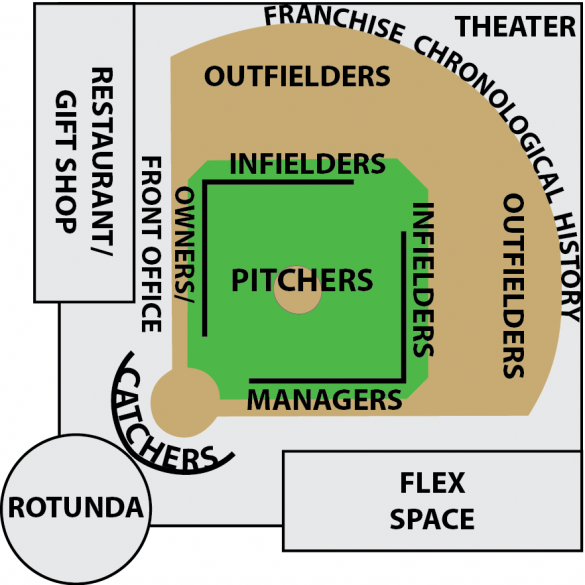
I’ve been kicking around this idea for the better part of a decade. It took until this week for me to jot it all down. The principle is simple. Like most museums, circulation is meant to flow in specific directions, though it’s not rigid.

The premise is simple. You start off in the rotunda area, which would be paved with bricks of leading donors. You enter to the right and reach the on-deck circle. Once there, you can either go to the restaurant or forward into the main hall. Follow the diamond to check out the franchise’s great managers, or go left to check out catchers and pitchers. Dressed-up lockers would contain exhibits for hall-of-famers or other greats. Round first and you can split off into either infielders or outfielders. End the tour with exhibits for owners and general managers (does Connie Mack get two exhibits?), or walk along the outer wall to go over the franchise’s entire history. Various islands throughout would have educational information about baseball for children, and the whole experience would be accompanied by custom iPad/iPhone apps. There’s also a theater for multimedia presentations.

While the layout is for a single-story building, it could be vertically aligned to as many as four floors with a smaller footprint if there were site size constraints. The flex space shown could be used for offices and for traveling exhibits such as those sponsored by MLB. There would have to be heavy coordination with the Bay Area Sports of Hall of Fame, which has no specific home and has spread out its inductee plaques at venues all over the Bay Area.

Then there’s the problem of running a museum. I don’t have any doubt that an A’s museum would be able to attract enough startup money or fill an endowment for the establishment of the museum. Ongoing operating costs to can be difficult to manage. It’s enough to create all sorts of financial difficulties 3, 5, 10 years down the road. It’s not realistic to expect the franchise to cover the budget, because franchises tend to throw most of their money and resources at the on-field product and run everything else as lean as they can afford to. Unless the museum makes money (an almost guaranteed “no”), there’s little reason to justify it. It’s with that sobering realization that I know that a museum isn’t terribly likely. Still, I can dream. And if shooting this high ultimately means settling for a great set of monuments at a future ballpark, that’s fine with me.

Now for some input from you. I’d like to frame this discussion around a set of questions. If I like your responses I’ll post them here within the post body.

Questions:

  • How would you organize the exhibits at an A’s museum?
  • How much attention would you pay to the franchise’s stints in Philadelphia and especially Kansas City?
  • How does the steroid era and its A’s notables get treated?
  • How large of an exhibit should each HoFer get?
  • Should there be an exhibit devoted to the designated hitter?
  • What kinds of kid-friendly exhibits and attractions should the museum have?
  • Should there be an exhibit containing other great Bay Area players who never played for the A’s?

If you have other questions you’d like to pose, put them in the comments and I’ll add them to the post.

A pretty cool museum idea

In 2006, when the economy was still strong, Adobe Systems bought 8 acres of land from the San Jose Water Company. The thought was that Adobe was expanding rapidly, so it might need the land for a future headquarters expansion. At that point, Adobe’s stock was at $40 and its position as a leading software vendor in the creative community was unquestioned. Now the stock is priced at $30, and there are a few questions about where the company is headed as it pushes its subscription software model on the public. Nothing has been built or even approved for the land, which is bisected by Delmas Avenue and fronts the Guadalupe River to the east.

Along with the land is the old San Jose Water Company headquarters. Built in 1934 and designed by prominent South Bay architecture firm Binder and Curtis, the building received landmark status in 1991. Any new development by Adobe will have to leave the building intact, and it’s likely that any master planner would work to integrate the HQ into the site plan somehow.

The corner of West Santa Clara and Delmas, Adobe HQ in background right

After several decades at the prime downtown location, SJWC felt that it was time to turn one of its vital assets into cash. It was the right move on the company’s part since it came right before the real estate crash. Now Adobe has the land, which should factor into its future plans, and the building, which could be used for some commercial purpose, but not in a way that would impact its landmark status. Currently there is no tenant.

Closeup of building highlights its mix of styles

The building is a mishmash of styles, done with enough subtlety to not appear gaudy. There are neoclassical elements in the columns, bas relief carvings throughout, and a Spanish revival tiled roof. Its location is prominent in that it’s at the bend in Santa Clara Street where you can either go east towards downtown or west towards the arena and The Alameda. The site is at the confluence of the Guadalupe River and Los Gatos Creek. It also happens to be right under a landing approach to Mineta Airport, which makes it a poor spot for a ballpark (if you’re wondering).

Looking across the Guadalupe River towards the SJWC building

When I asked Lew Wolff last year about having a museum at Cisco Field, he indicated that a museum would be hard to incorporate due to the lack of space at the site. He said that John Fisher may be interested in a museum tailored to the art of sports, though not necessarily an A’s museum. At 15,900 square feet, the SJWC building is a good size for a museum, whether it’s specifically for the A’s, Fisher’s sports art pursuits, or maybe both. Inside the Santa Clara Street entrance is a large, high-ceiling space, formerly cubicles, now empty. I haven’t been anywhere else in the building, so I can’t comment on what the rest of the interior looks like. Offices are located upstairs. Museums tend to run on very lean budgets due to their revenue sources, so a space this large may be too expensive unless Adobe cuts the museum a deal.

Nearing 80 years old, the building would undoubtedly require some amount of renovation work and continued upkeep to keep it going for the next several decades. The interior would have to be changed to fit a museum use better. Other than that, it should be good to go. It has dedicated parking (for now), and it’s fairly close to the ballpark. Is it close enough? You be the judge.

Location of Adobe/SJWC properties in relation to Cisco Field site and other nearby landmarks

At the northeast corner of the Adobe/SJWC site, the building is 1/4 mile from the nearest point at Cisco Field. It’s a shorter walk to the arena from either the ballpark site or SJWC. Perhaps that’s too far to bring gameday traffic in on a consistent basis. On the other hand, SJWC’s location on Santa Clara Street is on the way to the ballpark from many points within downtown proper. It’s likely that if/when Adobe builds something there, a large public parking structure will have to be built to keep up with demand for the arena and ballpark. There’s also a chance that Adobe partners with someone like the A’s on a mixed-use development that takes advantage of the Wolff family’s development experience while helping to defray some of the cost of a new corporate campus for Adobe. And there’s always the possibility that Adobe sells the land to Wolff or other San Jose interests if they decide that a new campus isn’t in the cards.

Skyline view from San Fernando light rail station at sunset

One other interesting piece of news about Adobe may come into play. For years Adobe was a key sponsor of the San Jose Giants, the company logo emblazoned in the outfield. I haven’t been down to Muni yet this year so maybe someone can confirm this, but it appears that Adobe is no longer a sponsor (or at least a key one). That may have something to do with Adobe’s place as one of the SVLG 75, and the group’s opposition to the Giants’ continued roadblocks of the A’s efforts to move south. Perhaps Adobe and the A’s have already had discussions about how to move forward. The loss of redevelopment has meant the death of publicly-assisted development efforts. As for entirely private projects, there may be something there. Hopefully that something includes an Athletics Baseball museum, one worthy of the 112 years (and counting) of the club’s legacy.

P.S. – I intend to keep writing and rallying support for an A’s museum until it comes to fruition, whether it’s in San Jose, Oakland, or Timbuktu. The next post will about what should be in such a museum, so save any comments about content for that post. Thanks.

P.P.S. – Yes, I’m aware of the Philadelphia Athletics Historical Society and Museum. There should be some way to partner with those folks. If you know of a site that would fulfill this purpose in Oakland and is within walking distance of one of the downtown/JLS ballpark sites, I’d like to write about it.

Baseball for baseball’s sake

Today at the Oakland-Alameda County Coliseum, the CIF North Coast Section will have its finals. As I understand, tickets are $9 and cover the whole day – four games of championship high school baseball. By now, the Division IV game has finished, leaving only the Divisions I-III games. If I wasn’t in LA for the weekend, I would’ve gone up to the Coli to check it out.

Decent crowd for the final game of the night

The California Interscholastic Federation is comprised of 10 regional sections, including four city-specific sections: San Francisco, Oakland, Los Angeles, and San Diego. (Late-growing cities such as San Jose and Sacramento are part of regional sections.) The SF and Oakland city championships were held at AT&T Park and the Coliseum,  respectively. LA’s city championship is being held now at Dodger Stadium. I still had a couple of days on my Amtrak California Rail Pass to kill, so I decided on a whim to head down to LA to catch the Southern Section championships. Honestly, I wasn’t prepared for how incredible the experience would be.

Also held at Dodger Stadium this year, the Southern Section championships covers just about every school that’s in SoCal but isn’t in either LA or SD. That makes for a very competitive playoffs, and it showed last night. The Division II final between Orange County schools Aliso Niguel and Pacifica (Garden Grove) was a masterpiece, with the latter winning 3-2 in 10 innings (7 is regulation). The D I final was no slouch as Newbury Park upset powerhouse Mater Dei coming in and outlasted Corona to win the title.

With a starting time of 1 PM, many fans at the D III final, given the choice, sat underneath the short overhang. Note the infamously narrow aisle.

My chief motivation for going was simple: having no rooting interest as a parent or alumnus of any of these schools, I simply wanted to catch a ballgame (or three) in some of the best seats at Dodger Stadium. And it was fabulous. Only the infield part of the lower deck was open for seating. The club section behind the plate was closed and off limits, a policy which created tension later as some kids from one of the winning schools climbed over some walls and through the club sections to jump onto the field. The closures effectively limited the capacity to around 5,000, which didn’t matter much as nearly all of the schools provided solid supporting sections. It was fun to see and hear small, vocal groups of fans on either side of the plate rooting against each other juxtaposed against the soaring backdrop at Chavez Ravine. Nothing quite prepared me for hearing pep bands at baseball games, a practice which I have to say – painfully as a former pep band member – should be banned.

My view for the D I and D II championships

I managed to get a seat in the front row of Section 2 behind the plate. Somehow I felt extremely fortunate as I had never sat this close (single game price for a Dodger game: $115) before and probably never would again. One of the nice, unexpected baseball fan treats was that the starting pitcher for Newbury Park threw with a three-quarter delivery (Eck, Huston Street, Rod Beck), so his arm angle was right in my line of sight. It made his breaking pitches look that much more outrageous.

Concessions were half-price, although only three stands were open, leading to long, concourse-clogging lines. Still, a half-price Dodger Dog is about the right price IMHO. The lower concourse, stands, and restrooms were properly renovated (waterfree urinals, no troughs), but with no space to widen the concourses, circulation was as cramped an affair as ever.

Towards the end of the Division I final with fog having descended on Dodger Stadium

I’ve been to a few games at Dodger Stadium in the past at different times during the season and both hot and cool weather. I didn’t expect the ballpark’s transformation as day turned to twilight and then into nightfall. Unlike AT&T Park and the Coliseum, where you can easily see the fog coming in as a sort of gloom settling over the place, when I sat down low here the marine layer seemed to sneak up on the me. It was almost as if someone flipped a switch for a fog machine. As would be expected, the moist, cool, dense air knocked down fly ball after fly ball, including a couple of shots that should’ve been homers. At the same time, San Gabriel Mountains receded into blackness and the whole game seemed to be played in a hazy mist, a halycon dream. The picture above doesn’t do it justice, and it’s hard to appreciate from the upper levels of the park, where I had almost always previously sat. The fog created a magical, movie-like quality to the event, similar to what I felt during the on-location filming of Moneyball two years ago – except not constantly interrupted by the process of filmmaking. The crowds were boisterous, the players intense and yet all too human, the coaches animated. I soaked up the whole thing, and when it was over at 10:30, I was sorry to leave. Now I finally see why Hollywood shoots here so frequently. They couldn’t have dreamed up this environment with a billion dollars of CGI and their wildest dreams. The new Dodger ownership group would have to be absolutely insane to even entertain the thought of leaving this place.

Joy in Mudville

Stockton’s leaders may make the toughest decision in the city’s history next Tuesday. Drowning in debt and scrambling for ways to restructure or forgive that debt, the city is expected to decide whether or not to enter Chapter 9 bankruptcy. Chapter 9 is an avenue set aside by the federal government for municipalities, and was most prominently almost twenty years ago when Orange County’s debts soared to an unsustainable level thanks to criminally poor fiscal management. Already, a $35 million building bought to be utilized as the next City Hall has been repossessed.

View across the channel from Weber Point toward ballpark (center) and arena (right)

A downtown bar featured in a LA Times article in March has closed. As I walked around during a weekday morning, I felt as if tumbleweeds were going to blow across the streets. Storefronts were frequently empty. The movie theater complex had little activity. The only places that felt alive were the local Starbucks, and, as I would find out within an hour, the ballpark.

The foul pole is a scant 300 feet from home plate.

The day game I attended was nearly sold out thanks to a number of elementary and middle school children who were in attendance. They were treated to the Ports’ 15-3 shellacking of the San Jose Giants. The win halted a Stockton 12-game home losing streak. The section I was in got coupons for In-n-Out Double Doubles thanks to a Max Stassi double, and the whole crowd got a free meal at a local Denny’s because of Chad Oberacker’s grand slam. I don’t know when I’ll be in Stockton again to redeem the vouchers. That’s life.

The only entrance to Stockton Ballpark/Banner Island Ballpark

Stockton Ballpark, as it’s officially known, was built by Swinerton and Frank M. Booth, the same company that built Raley Field. It’s very intimate, with 12-16 rows throughout the grandstand. Wedged between the channel and the arena, the left field foul pole is only 300 feet from the plate. There’s no second deck, no suite/press level cantilevered over the single concourse, and only a small club section. This was done to keep costs under control, which is a net positive in the end. There are plenty of concession stands down the first base line, very few down the third base line. A design quirk has an elevated bridge connecting the outfield berm area with the grandstand in the RF corner. To allow for service vehicle clearance, the bridge requires fans to take a flight up steps up and down. The berm wraps around to center, where it meets a Kinder’s BBQ stand. The bullpens and a seated picnic area are in left.

Exterior of arena facing channel

A road winds between the ballpark and the arena, connecting both to the waterfront. The 10,000-seat Stockton Arena is a clean, tidy affair, with decent concourse space and an auditorium-style layout for concerts. The side facing the water is glass, the other sides are concrete, metal, and wood panels, the latter of which are having their protective film fraying. No matter, it’s a decent looking building even if it towers over the ballpark and looks somewhat out of place in downtown Stockton.

As the City continues to fight for its future, there’s a lingering question of whether Stockton’s redevelopment efforts were worth it. California is unique in that it has a few cities that are the size of major league cities elsewhere in the country, yet places like Stockton, Fresno, Riverside, and Long Beach don’t get the kind of attention Cleveland, Buffalo, Milwaukee, or St. Louis does. Stockton saw a gravy train of new residents looking for cheap exurban housing and didn’t see the collapse of the housing market immediately behind it. They paid inordinate salaries and benefits to public employees, which put Stockton in the financial straits it’s in today. No one knows how exactly Stockton will get out of it, and what Stockton will look like when that happens. Chances are that the arena will be there. The ballpark will be there. And Dallas Braden will be there too by all rights. That can’t be all bad.


Tuman: Oakland should be like Brooklyn, not Detroit

Joe Tuman re-entered the public sphere in Oakland today with a scathing indictment of Oakland’s attempts (such as they are) to keep its pro teams in town. In an op-ed in the Tribune, Tuman called the Coliseum City project’s proponents in City Hall “depressing” and “in denial”. Those words could be important a five months from now, as Tuman is running for the At-Large City Council seat this year against Rebecca Kaplan. Both were also in the 2010 mayoral election, with Kaplan finishing 3rd and Tuman 4th to Jean Quan.

First, back to Tuman’s column. Tuman, who is also a professor of communications at SF State, compared Coliseum City (and indirectly, Victory Court) to China Basin and AT&T Park.

What did work in San Francisco is the new AT&T baseball park. But while we in Oakland admire that, we often overlook that economic redevelopment of SOMA (south of Market area) was under way before the new ballpark was planned or constructed.

It occurred because so many tech companies and startups wanted office and loft space in the less-expensive SOMA area.

Tuman absolutely nails it here. Yes, the Giants deserve credit for transforming a rundown section of San Francisco, but let’s remember that in 1997, the region was in the throes of the dot-com boom, epicentered only a few blocks from the ballpark site. That’s why when people ask, I say that South Park was just as important or more important than Pac Bell Park. Back then, SOMA was one of the last redevelopment frontiers in SF (remember the live-work zoning weirdness?). In most cities with new ballparks, the ballpark district is where you can find reasonably priced apartments, condos, and office space. In SF? Yeah, right.

Every so often I get a question from an East Bay citizen or fan about why companies from the SVLG couldn’t just support the A’s if a ballpark were built in Oakland or some such. I usually reply with an answer along the lines of, “You know how a San Jose stadium wouldn’t be convenient for you? Well, an Oakland stadium isn’t convenient for them.” Things are different from football, which plays the majority of its games on Sundays, or basketball/hockey, where the schedules aren’t as rigorous as MLB’s. Convenience is only one factor, with civic/regional pride and the attractiveness of the location are major factors. In the post-redevelopment era, with tax increment usage forbidden or severely curtailed, these redevelopment-based models need to be replaced with something more practical and smaller in scale (I’ll go into this more later tonight).

Tuman also goes on to point out how there’s no Airport Connector stop along Hegenberger which could be a focal point for transit-oriented development.

Zennie Abraham got Tuman to comment on Zennie’s blog about the A’s during his mayoral campaign.

Should Oakland Sue The Oakland A’s?

Tuman’s not in favor of using the legal process against the Oakland A’s, which seems to be threatening to leave Oakland every year, as he thinks it just encourages them to try harder to do so. But suing the City of San Jose is something Tuman’s willing to consider, as that municipality has worked to try to take the A’s away from Oakland, interfering with contracts between the parties in the process.

Tuman says he will be a friend to all of Oakland’s sports teams, but does not want to give away public money to retain them.  But he does leave tax increment revenue as an exception because of it’s market  generated nature.

Tuman isn’t anti-sports. He is realistic about the City’s interests and likelihood in keeping one or more of its teams, and frankly it’s good to hear this kind of talk. It’s a lot more honest than anything that’s been coming out of City Hall for the last few years. Now, Tuman probably isn’t going to beat Kaplan with her plucky attitude and infectious energy, especially on the campaign trail. (It’s a bit ironic that a communications professor is woefully behind on linking up with social media.) Still, a little more honesty and reason can’t hurt discourse. Honest discourse is exactly what Oakland needs.

Of course, the Brooklyn that Tuman refers to has itself succumbed to the allure of pro sports. Barclays Center will open this fall and the once-New Jersey Nets have already taken up the Brooklyn moniker replete with new colors and logos. Sometimes even Brooklyn can’t always be Brooklyn.