The fence dilemma

Last night, Brandon Hicks hit what looked to be an opposite-field home run to the 362 mark in right, only to be robbed by the 15-foot high wall. Over the years, many a hitter has been robbed by the high walls in both power alleys. It was merely Hicks’s turn. Until most recently, the A’s have been a power-starved bunch, which when combined with the already pitcher-friendly dimensions of the Coliseum, has had many a fan and media member calling for changes to the field. CSN’s Casey Pratt, in particular, has had issues with the high wall. Last night he brought it up after Hicks’s double, and radio play-by-play guy Vince Cotroneo mentioned it in the postgame wrap. It didn’t matter that the issue was rendered moot once Jemile Weeks singled home Hicks, and Chris Carter’s blast in the 11th left no doubt about what a home run looks like.

20120707-112225.jpg

Regardless of the outcome, there still remains a sense that the Coliseum’s deck is stacked too much in the direction of pitchers. You won’t find last night’s starter Tommy Milone complaining, that’s for sure. Then again, do you remember any M’s hitters reaching the warning track off Milone?

Pratt has long advocated that the high fence between the 362 and 388 marks in left and right should be taken down to the 8-foot height down the lines and in center. The high wall containing the out-of-town scoreboards could be kept intact, which makes sense since those are the most hitter-friendly parts of the park. I suggest going a step further by getting rid of the contrived “Jagged Edge” outfield fence design altogether, going with a fairly straight fence that lowers the alleys to eight feet and brings in the 367′ dimensions at the stairs in 10-15 feet. The out-of-town scoreboards would stay more-or-less intact.

The field would still play pitcher-friendly to fair, mostly because of the atmospheric conditions. Historically, the Coli hasn’t played as poorly as Petco, Safeco, or even AT&T. It may be Billy Beane’s desire to keep the ballpark geared towards pitching, since that’s been much easier to develop over the last several years. Yet it might make sense to change the dimensions to create a transition to a new ballpark, especially if the new place ends up with much more hitter-driven dimensions like Cisco Field. It’s easy to think that in the A’s current consecutive-games-with-a-HR streak, that power isn’t that hard to come by. Just remember the last two years of A’s squads. Power does come at a premium.

News for 7/4/12

Stuff to read while you’re getting the BBQ going.

  • Late Tuesday, the 49ers successfully fought to keep $30 million in redevelopment funds out of the County’s hands until at least July 27, when another hearing will be held to determine the fate of the money. While the team was lawyered up, the County’s oversight board had no legal representation for the hearing in Sacramento. The issue is whether or not the $30 million (originally $42 million) at stake is considered an “enforceable obligation” between the 49ers and the City of Santa Clara. If it is ruled an enforceable obligation, the money should be safe to use for the stadium. [San Jose Mercury News/Mike Rosenberg & Steve Harmon]
  • AEG pulled out of a plan to help build and run a new Sacramento arena without the Kings as a tenant, effectively killing the plan outright. The next move is the Maloofs’, as they could apply to move from Sacramento before the end of the 2012-13 season (which is entirely expected). Will Mayor Kevin Johnson concede defeat and push for a different initiative, such as a stadium? Perhaps, but the teams that KJ would be interested in (A’s, Raiders) would have to show their own interest. So far they haven’t. [Sacramento Bee/Ryan Lillis]
  • Oakland’s Uptown was profiled in an All Things Considered segment as a positive example of how redevelopment can revitalize a neighborhood, while the death of redevelopment could halt further progress. [NPR/Richard Gonzales]
  • Another article from the Chronicle takes a stab at figuring out what will happen to Oakland’s three pro sports franchises. As usual, Mayor Jean Quan lacks specifics, instead using grandiose phrases such as “Staples on Steroids” to describe the Coliseum City project. She also seems to be gravitating further towards a retractable dome concept-cum-convention center, which new partner AEG would certainly champion. Careful hitching your horses to the AEG wagon, Madam Mayor. As we saw in Sacramento, AEG will ditch a city posthaste if they see no future there. Plus, all of the secrecy behind Quan’s supposed “secret committee” working on Coliseum City doesn’t help when it comes to taking her seriously, as she recently took a huge hit to her credibility with new data released about her “100 blocks” policing plan. [SFGate/Vittorio Tafur, Matthai Kuruvila]
  • Cities are looking for ways to resurrect redevelopment, and one popular one emerging is the establishment of revitalization zones via state legislation. The zones would have similar tax increment and bonding powers as redevelopment agencies did, plus they would be enshrined by state law. SF Assemblyman Tom Ammiano is pushing for the creation of an infrastructure financing district to serve the America’s Cup development along the waterfront. The problem with this method is that eventually any law passed by the Legislature still has to go to Governor Jerry Brown for approval. Brown has been steadfast in opposing any kind of old-school-style redevelopment for the past year, making it hard to see him signing any legislation that could undermine his redevelopment clawback efforts. [Sacramento Bee/Dan Walters]
  • Added 4:30 PM – Today’s the halfway point of the home schedule. Because the first two home games were played in Japan, the Attendance Watch box on the right has shown multiple representations of attendance, one with the Japan games included and one without. Projected over the rest of the season, the total 81-game attendance (with Japan) would be 1,733,521. The total 79-game attendance (without Japan) would be 1,599,938. ESPN and other statistics aggregators usually include the Japan games in their attendance tables. Based on games sold, the A’s consider today’s game #39. Attendance tends to pick up throughout July and into August, just before the school year begins, then drops off, the variance depending largely on the team’s record. At this juncture, three teams already have surpassed the A’s projected season attendance (both figures): Philadelphia, Texas, and the NY Yankees.

More as it comes.

Walk-up observations

I didn’t get season tickets this year. I waffled about the decision all the way through April. In the end I chose not to get a package this year, forgoing the savings a package can provide. I’ve been fortunate to have a few friends who provided freebies on occasion. Most of the time, I’ve simply walked up to get tickets.

Years ago, before the advent of the internet and the mobile power that comes with smartphones, the A’s had freestanding booths for day-of-game tickets. The booths were located outside all of the main gates. Agents manning the booths were furnished with stacks of preprinted tickets, with different quantities for certain sections or price levels. The booths went away around the time the Wolff/Fisher group took control of the team.

For years, fans choosing to get day-of-game tickets just before the game had no choice but to buy from the permanent booths on the BART plaza and near gates C and D. This year, the booths have been supplemented with electronic kiosks, which, like the booths, charged no fees on any tickets sold (including advance tickets). This has helped alleviate some of the frequently long lines, along with providing multiple places to pick up will-call tickets.

Tonight I noticed something odd about the system. Every Red Sox game is a “premium” game, with slightly higher ticket prices compared to games against most other teams. The A’s charge higher prices knowing that demand is expected to be greater, though I’ve noticed that demand for Red Sox games has gone down precipitously in the last few years (Monday night’s attendance: 17,434). I kept track of what tickets online seller tickets.com had available through the website. By the early afternoon, I noticed that no Value Deck seats were available. There’s nothing special about the demand for Value Deck seats except when a group buys a large block of them (only 1,000 are available per game). I figured that because of the missing Value Deck tickets, demand was reasonably high. Running counter to that assertion was the fact that the team was also selling “Dynamic Deal” tickets, at $22 for Plaza Level and $10 for Plaza Outfield.

The crowd during the bottom of the 2nd.

I got one of the $10 seats, got some food, and sat in my seat at 7 on the dot. The bleachers were about half-full. So were many other sections. I thought that perhaps there might be a late-arriving crowd, but I was wrong. Based on the way the sections were filled, the place looked half full. 17,434 paid attendance seems to confirm that, though there were probably 2-3,000 no-shows as well. I looked up at the Value Deck repeatedly and noticed that those sections were also at best half full. Yet the advance tickets were sold out. So what gives?

I can’t come up with an explanation for what happened, and as a single data point it would be foolish to draw any specific conclusions from it. The A’s don’t have anything to gain from manipulating the availability of any ticket type, simply because the demand is so elastic that the gains would be worth peanuts. The observation has certainly made me want to pay more attention in the future to inventory and availability compared to the in-house optics. Next opportunity is Wednesday’s series-ender against the Sawx.

Padres to sell for $600 million

Fox Sports’ Ken Rosenthal got the tip last night that the San Diego Padres are about to be sold. Three bidding groups have been pared down to two: the O’Malley family led by Peter Seidler, and Gary Jabara, with the O’Malley family reportedly in the lead.

The total price of the sale is expected to be $800 million, with $600 million for the team itself and $200 million for the Padres’ equity share of the recently launched Fox Sports Net San Diego regional sports network.

Jeff Moorad was supposed to be the owner, having negotiated a $530 million price a few years ago with a five-year phase-in of the acquisition. During the last offseason, it became clear that forces within MLB (the “Lodge”) were not going to approve the sale, so when combined with John Moores’ realization that he could get more thanks to the new TV deal, the Padres were pulled out from under Moorad (and minority partners such as Bob Piccinini).

Compared to this year’s Forbes valuation of $458 million, the combined $800 million sale price represents a 75% premium over the appraised value. Even when the TV component is separated out, the premium is 31%. In the wake of the Dodgers’ record-shattering $2.1 billion sale price, some sort of premium was to be expected, and I wrote then that $600 million for the Padres was a good starting point. The Padres serve as a good benchmark for any potential sale of the A’s, because the teams’ market dynamics are similar. San Diego represents the A’s if the A’s got a new ballpark and TV deal, thus the higher valuation ($458 million vs. $321 million).

All of this makes it fairly easy to project what the A’s would be worth on the open market. Lew Wolff has said unequivocally that the team is not for sale, but it’s still a worthwhile exercise – at least on the blog. If I apply the 31% premium to the A’s now, the new asking price is at least $420 million. That’s not going to be enough for Bud Selig, as one of his main responsibilities over the last decade has been to raise franchise sale prices on behalf of outgoing owners as much as possible. If he wasn’t able to lobby to get San Jose for frat buddy Lew Wolff, he’d at least give Wolff and John Fisher a massive golden parachute. It would be practically inconceivable to have any starting price be any less than $500 million. Add at least $500 million in private funding for a new ballpark (more depending on the site), and the cost to keep the A’s in Oakland becomes a cool $1 billion. That’s why I thought it curious when the fan letter to Fisher from the spring circulated, imploring the majority owner to either work to stay in Oakland or sell the team.

$500 million for the team, $500 million for the stadium. Those two parts are attached at the hip, because Selig wouldn’t approve any sale without a bulletproof (and underway) ballpark development plan. The problem with such a plan is that any future franchise sale price would be less than the combined $1 billion, because of the nature of the stadium financing. Building a new ballpark is like buying a new car and driving it off the lot – depreciation immediately kicks in. Since much of the ballpark revenue would be directed toward paying debt, it would reduce the attractiveness and market value of the franchise. Anyone who bought the franchise would be burdened by that debt until it was cleared 30, 40 years later – and that doesn’t even take into account debt incurred to buy the team. The same revenue/valuation drag goes for San Jose, except that at least Wolff/Fisher bought the team in 2005 for the relatively low price of $180 million, and they would presumably be able to service the debt better thanks to Silicon Valley’s economic strength.

So there you have it. $1 billion to keep the team in Oakland. Good luck with that, Don Knauss and company.

It takes more than a village to raise a village (update: AEG approved)

Update 8:18 PM – The Coliseum Authority board approved AEG 7-1, the only vote against coming from Ignacio De La Fuente.

Oh to be on the Coliseum Authority board these days. The board has two weeks to decide on a firm to manage the Coliseum complex, and the firm they’re grooming to take over, AEG, is getting a lot of unexpected scrutiny over their ability to take the Raiders away even as they manage the stadium for the next several years. The Trib’s Angela Woodall reports that AEG’s status as a potential “poacher” is hanging up approval of the facilites management contract.

The JPA/Authority has sought assurances that AEG would not try to lure any of the current tenant teams away, which is fine and dandy, except that the JPA’s counsel has said that such a stipulation has little teeth. The only thing the JPA could do is terminate the contract, which would entitle them to keep $4.5 million in money promised by AEG to manage the complex.

$4.5 million is a pittance for AEG, considering their claim that they’ve spent $27 million on studies and preparation for the Farmers Field project. They’ve promised to spend $10 million on badly needed improvements to a Metro Rail station near the LACC/Staples/Live!/Farmers complex. The Oakland-Alameda County Coliseum complex may be a nice item to put in their portfolio, but Farmers Field is AEG’s big bet. It’s a beautiful situation for AEG because they can play both cities against each other – they’re practically doing it now! They’ll be in bed with the JPA as Oakland pushes Coliseum City while getting cozy with the Raiders, who are considering LA to some extent, in the process.

The whole scenario puts the Authority in a bind. They need AEG to do consulting on Coliseum City (as farfetched as it is), yet they can’t have AEG poaching the Raiders. There’s no other competitor that has anywhere near the kind of real world experience handling single-site, multiple venue development as AEG. Chris Dobbins of Save Oakland Sports and Alameda County Supervisor Nate Miley were both in lockstep about their concerns.

And let’s get real about this, the only team AEG has any interest in is the Raiders. AEG is booked solid at Staples with its three teams and the company hasn’t expressed much interest in baseball. While Oakland has expressed interest in retaining the Warriors and Athletics, they’ve taken the most steps to keep the Raiders. AEG has Oakland by the short hairs, thanks to Mayor Jean Quan putting Oakland’s chips behind Coliseum City. Even when there is a big player involved, the City part of Coliseum City can be extraordinarily difficult to get off the ground, as the St. Louis Cardinals and developer Cordish can attest. Comparisons to Mission Bay/South Beach in SF are meaningless because that area and East Oakland are on different planets economically.

Alternately, the JPA could choose incumbent SMG, with whom they’ve had an up-and-down relationship, or Comcast’s Global Spectrum, which comes closest to AEG in that they operate the Wells Fargo Center and the newly opened Xfinity Live! in Philadelphia. The latter finally came to fruition several years after the two stadia and the WFC had opened, and after the old Spectrum was demolished to make way for Xfinity Live!.

If the Raiders went to LA, that creates a situation in which the Coliseum could be available for a new A’s stadium, which is probably the only solution at the complex that MLB would sign off on (assuming the ancillary development came in). The problem with that solution is that there would still be $100 million in Mt. Davis debt to deal with and either a demolished or decaying facility, and the A’s and MLB would want nothing to do with that. That brings us back to the question, What’s in it for the A’s?

It’s a tough situation to be in. Mayor Quan believes that Coliseum City is the best hope for retaining the teams and revitalizing East Oakland, yet it can be argued that bringing in AEG is akin to letting a fox in a henhouse, which could kill the vision of Coliseum City before it even gets started. I’d like to think that the City will make a prudent decision here, but by paving the way for AEG before the decision is made they’re almost locked into a specific path. It may well be a path to ruin.

News for 6/10/12

We’re overdue for one of these.

  • Matier and Ross reported on the contents of the Wolff-Knauss summit two weeks ago. Wolff laid out his 1 hour, 45 minutes case, Knauss and other East Bay execs made their case to work in Oakland – or sell the team. When the latter came up, things apparently got a little testy.

The only flare-up came when Knauss suggested that the business execs had deep-pocketed investors who would buy the A’s if Wolff and his ever-silent co-owner, John Fisher, weren’t interested in keeping them in Oakland.

“You can’t buy what’s not for sale,” Wolff told the group, according to Knauss. “I’m surprised you brought that up.”

  • In the same article, contractors at the Cal Memorial Stadium retrofit indicated that the project may not be ready in time for this fall’s football opener. Not that big a deal, same thing happened at Stanford.
  • Prices for the non-premium seats at the 49ers stadium have been revealed. The per-ticket prices aren’t bad, but some fans may bristle at the required seat license fee (which can be financed). The pricing structure looks very similar to that employed at Cowboys Stadium, which makes sense considering that the firm marketing the seats is partly owned by the Cowboys.
  • If Farmers Field begins construction next year, it’s likely that the E3 convention, held last week, would have to be moved out of the LA Convention Center. San Diego, anyone?
  • Chelsea F.C., which has seemingly won everything this season in the Premier League other than the outright league championship, lost out to other developers in its bid to redevelop the hulking Battersea Power Station into a new, 60,000-seat stadium.
  • KNBR’s Damon Bruce tweeted on Friday that the Warriors’ Piers 30-32 deal was dead. So far the story hasn’t been corroborated, and other sources indicate it’s incorrect. Seems odd to say something’s dead when it the process hasn’t yet started.
  • The Arena Football League suffered its first ever forfeited game when players on the Cleveland Gladiators went on strike before the scheduled Friday game against the Pittsburgh Power. The strike is part of an ongoing CBA negotiations.
  • Marlins manager Ozzie Guillen joked that he’d contribute “a couple million” towards a new Tampa Bay Rays ballpark.
  • Keeping the Astrodome running and up-to-date could cost $270 million or more, even though the dome wouldn’t have a tenant team.
  • The Glendale, Arizona City Council approved a deal that would bail out incoming Phoenix Coyotes owner (and former Sharks exec) Greg Jamison to the tune of $325 million over 20 years to stay in the desert suburb. Jamison has not yet been fully approved to take over the Coyotes by the NHL’s Board of Governors, pending a review of the Jamison group’s finances. The conservative Goldwater Institute wants a temporary restraining order to see if the deal violates the state Constitution.
  • In another cautionary tale about public dollars being spent for sports facilities, the Chicago suburb of Bridgeview is in debt up to $250 million for its MLS stadium. What’s paying for the shortfall? Property taxes.
  • Update 6/11 12:19 PM – Numerous sources are reporting that (near) billionaire and Ubiquiti Networks founder/CEO Robert Pera is buying the Memphis Grizzlies. The sale price has not been disclosed. Pera is only 34 years old and is partly based out of San Jose. Update 4:00 PM – The price is in the $350-375 million range. The buyout for the FedEx Forum lease is $105 million as of next year.

Happy reading.

Baer, Wolff had dialogue (really!)

Thanks to CSN’s Casey Pratt for going to the trouble of pulling quotes from two of The Game’s Newsmakers interviews with Larry Baer (Monday) and Lew Wolff (Thursday). For the most part, neither executive said anything substantive about the Giants-A’s stalemate, which means that once again, we’ve got to put up the proper image.

If you want to torture yourself by reading into the interviews, you can glean a few things about what has been happening:

  • Both Baer and Wolff are pointing to Commissioner Bud Selig to resolve the dispute.
  • Baer and Wolff have had an ongoing dialogue (negotiations) regarding territorial rights.
  • Baer backed off from saying that the Giants would welcome the A’s looking elsewhere, such as Sacramento. The Giants consider the Bay Area a two-team market.
  • Wolff continues to press that the plan is San Jose-or-bust.
  • Asked about what happened during Wolff’s meeting with Don Knauss, Wolff demurred and asked the interviewers (Tierney and Townsend) to ask Knauss.

Everything else we’ve heard before ad nauseum. This concludes your weekly non-update.

Museum concept

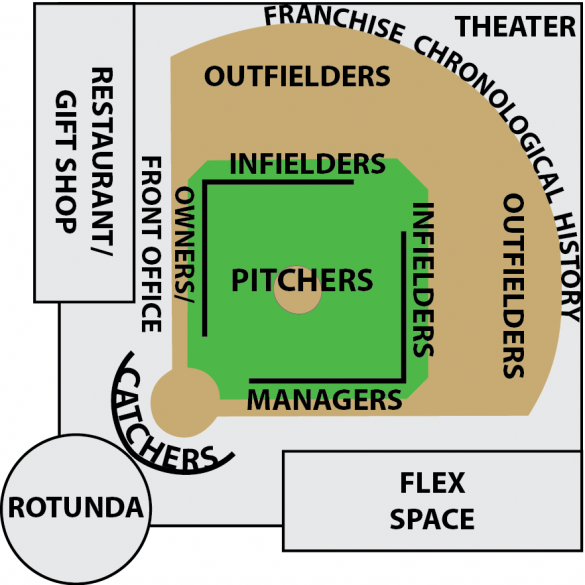
I’ve been kicking around this idea for the better part of a decade. It took until this week for me to jot it all down. The principle is simple. Like most museums, circulation is meant to flow in specific directions, though it’s not rigid.

The premise is simple. You start off in the rotunda area, which would be paved with bricks of leading donors. You enter to the right and reach the on-deck circle. Once there, you can either go to the restaurant or forward into the main hall. Follow the diamond to check out the franchise’s great managers, or go left to check out catchers and pitchers. Dressed-up lockers would contain exhibits for hall-of-famers or other greats. Round first and you can split off into either infielders or outfielders. End the tour with exhibits for owners and general managers (does Connie Mack get two exhibits?), or walk along the outer wall to go over the franchise’s entire history. Various islands throughout would have educational information about baseball for children, and the whole experience would be accompanied by custom iPad/iPhone apps. There’s also a theater for multimedia presentations.

While the layout is for a single-story building, it could be vertically aligned to as many as four floors with a smaller footprint if there were site size constraints. The flex space shown could be used for offices and for traveling exhibits such as those sponsored by MLB. There would have to be heavy coordination with the Bay Area Sports of Hall of Fame, which has no specific home and has spread out its inductee plaques at venues all over the Bay Area.

Then there’s the problem of running a museum. I don’t have any doubt that an A’s museum would be able to attract enough startup money or fill an endowment for the establishment of the museum. Ongoing operating costs to can be difficult to manage. It’s enough to create all sorts of financial difficulties 3, 5, 10 years down the road. It’s not realistic to expect the franchise to cover the budget, because franchises tend to throw most of their money and resources at the on-field product and run everything else as lean as they can afford to. Unless the museum makes money (an almost guaranteed “no”), there’s little reason to justify it. It’s with that sobering realization that I know that a museum isn’t terribly likely. Still, I can dream. And if shooting this high ultimately means settling for a great set of monuments at a future ballpark, that’s fine with me.

Now for some input from you. I’d like to frame this discussion around a set of questions. If I like your responses I’ll post them here within the post body.

Questions:

  • How would you organize the exhibits at an A’s museum?
  • How much attention would you pay to the franchise’s stints in Philadelphia and especially Kansas City?
  • How does the steroid era and its A’s notables get treated?
  • How large of an exhibit should each HoFer get?
  • Should there be an exhibit devoted to the designated hitter?
  • What kinds of kid-friendly exhibits and attractions should the museum have?
  • Should there be an exhibit containing other great Bay Area players who never played for the A’s?

If you have other questions you’d like to pose, put them in the comments and I’ll add them to the post.

A pretty cool museum idea

In 2006, when the economy was still strong, Adobe Systems bought 8 acres of land from the San Jose Water Company. The thought was that Adobe was expanding rapidly, so it might need the land for a future headquarters expansion. At that point, Adobe’s stock was at $40 and its position as a leading software vendor in the creative community was unquestioned. Now the stock is priced at $30, and there are a few questions about where the company is headed as it pushes its subscription software model on the public. Nothing has been built or even approved for the land, which is bisected by Delmas Avenue and fronts the Guadalupe River to the east.

Along with the land is the old San Jose Water Company headquarters. Built in 1934 and designed by prominent South Bay architecture firm Binder and Curtis, the building received landmark status in 1991. Any new development by Adobe will have to leave the building intact, and it’s likely that any master planner would work to integrate the HQ into the site plan somehow.

The corner of West Santa Clara and Delmas, Adobe HQ in background right

After several decades at the prime downtown location, SJWC felt that it was time to turn one of its vital assets into cash. It was the right move on the company’s part since it came right before the real estate crash. Now Adobe has the land, which should factor into its future plans, and the building, which could be used for some commercial purpose, but not in a way that would impact its landmark status. Currently there is no tenant.

Closeup of building highlights its mix of styles

The building is a mishmash of styles, done with enough subtlety to not appear gaudy. There are neoclassical elements in the columns, bas relief carvings throughout, and a Spanish revival tiled roof. Its location is prominent in that it’s at the bend in Santa Clara Street where you can either go east towards downtown or west towards the arena and The Alameda. The site is at the confluence of the Guadalupe River and Los Gatos Creek. It also happens to be right under a landing approach to Mineta Airport, which makes it a poor spot for a ballpark (if you’re wondering).

Looking across the Guadalupe River towards the SJWC building

When I asked Lew Wolff last year about having a museum at Cisco Field, he indicated that a museum would be hard to incorporate due to the lack of space at the site. He said that John Fisher may be interested in a museum tailored to the art of sports, though not necessarily an A’s museum. At 15,900 square feet, the SJWC building is a good size for a museum, whether it’s specifically for the A’s, Fisher’s sports art pursuits, or maybe both. Inside the Santa Clara Street entrance is a large, high-ceiling space, formerly cubicles, now empty. I haven’t been anywhere else in the building, so I can’t comment on what the rest of the interior looks like. Offices are located upstairs. Museums tend to run on very lean budgets due to their revenue sources, so a space this large may be too expensive unless Adobe cuts the museum a deal.

Nearing 80 years old, the building would undoubtedly require some amount of renovation work and continued upkeep to keep it going for the next several decades. The interior would have to be changed to fit a museum use better. Other than that, it should be good to go. It has dedicated parking (for now), and it’s fairly close to the ballpark. Is it close enough? You be the judge.

Location of Adobe/SJWC properties in relation to Cisco Field site and other nearby landmarks

At the northeast corner of the Adobe/SJWC site, the building is 1/4 mile from the nearest point at Cisco Field. It’s a shorter walk to the arena from either the ballpark site or SJWC. Perhaps that’s too far to bring gameday traffic in on a consistent basis. On the other hand, SJWC’s location on Santa Clara Street is on the way to the ballpark from many points within downtown proper. It’s likely that if/when Adobe builds something there, a large public parking structure will have to be built to keep up with demand for the arena and ballpark. There’s also a chance that Adobe partners with someone like the A’s on a mixed-use development that takes advantage of the Wolff family’s development experience while helping to defray some of the cost of a new corporate campus for Adobe. And there’s always the possibility that Adobe sells the land to Wolff or other San Jose interests if they decide that a new campus isn’t in the cards.

Skyline view from San Fernando light rail station at sunset

One other interesting piece of news about Adobe may come into play. For years Adobe was a key sponsor of the San Jose Giants, the company logo emblazoned in the outfield. I haven’t been down to Muni yet this year so maybe someone can confirm this, but it appears that Adobe is no longer a sponsor (or at least a key one). That may have something to do with Adobe’s place as one of the SVLG 75, and the group’s opposition to the Giants’ continued roadblocks of the A’s efforts to move south. Perhaps Adobe and the A’s have already had discussions about how to move forward. The loss of redevelopment has meant the death of publicly-assisted development efforts. As for entirely private projects, there may be something there. Hopefully that something includes an Athletics Baseball museum, one worthy of the 112 years (and counting) of the club’s legacy.

P.S. – I intend to keep writing and rallying support for an A’s museum until it comes to fruition, whether it’s in San Jose, Oakland, or Timbuktu. The next post will about what should be in such a museum, so save any comments about content for that post. Thanks.

P.P.S. – Yes, I’m aware of the Philadelphia Athletics Historical Society and Museum. There should be some way to partner with those folks. If you know of a site that would fulfill this purpose in Oakland and is within walking distance of one of the downtown/JLS ballpark sites, I’d like to write about it.

Mayors go on the offensive, Wolff to meet with Knauss on Friday

Oakland Mayor Jean Quan is having caviar dreams on a canned tuna budget.

Quan finally agreed to an interview with The Game’s Chris Townsend, though he had to travel to Oakland City Hall to do it. I listened to the exchange intently, looking for some semblance of consistent messaging throughout. For the most part the message was consistent, but probably not what the teams and fans are looking for.

Quan continued to tout Coliseum City as a massive development stretching over 500 acres that could attract 32,000 jobs, major hotels, corporations, and anywhere from one to four pro sports franchises. That’s right, four. When Townsend pressed her on what she meant by that, she said that the City was looking at teams outside of the current three tenants.

In the wake of the Warriors’ announcement that they intend to build a new arena in San Francisco, East Bay backers are already talking about luring either the Sacramento Kings or San Jose Sharks to Oakland. Oracle Arena is built for basketball, not hockey, so the Sharks are out of the question. The Kings are a more intriguing proposition since Oracle is miles ahead of ARCO/Power Balance in terms of modernity and amenities. However, you can bet that Joe Lacob and Peter Guber would fight tooth and nail to keep a second team out of the Bay Area. Even if the NBA were to allow it, the Lacob/Guber ownership group would get a tidy compensation check from whomever brought a team to Oakland. You can forget about that being the Maloofs since they’re broke. David Stern has also stopped Larry Ellison twice from relocating a team to San Jose, so you can glean from those vetoes that Stern considers the Bay Area a single-team market. Remember that Oakland’s gambit is to replace Oracle Arena with a new one if the Warriors stayed. There is zero chance of anyone building an arena in Oakland if the Warriors are in SF. They’ll just soldier on with the current arena, which again is a perfectly fine venue from a technical standpoint.

As for the A’s, Quan revealed a couple of things that are quite germane to Oakland’s efforts going forward. She seems fully committed to Coliseum City in whatever form it takes. When asked about a site in downtown Oakland, she said that if Clorox CEO Don Knauss wants to move in that direction and can figure out how to pay for the extra cost, it shouldn’t affect Coliseum City adversely. She didn’t exactly dismiss Howard Terminal or Victory Court, but by now she has to be fully aware of the nine-figure costs associated with either of those sites, which makes them quite difficult to develop. For that she deserves a lot of credit – Oakland’s advantages are that it has land and a potentially easier process to develop venues. The flipside to that argument is that Oakland’s not as desirable or coveted as SF or San Jose, so there’s a very good reason why it’s easier or more available.

Beyond that, Quan may be getting a bit too starry-eyed for her own good.

As long as we have one huge sports facility [plus] we will have a much bigger convention center than we currently have in downtown Oakland.

That sounds like a pivot to me. If Quan and the City are pivoting it’s probably no coincidence that AEG is on board to manage the complex and provide consulting for the next phase of the Coliseum, which would be to have something along the lines of what they are planning in LA: retractable roof stadium, arena, and convention center in one location. Maybe AEG will get a team to relocate there, maybe they won’t. What they can do is influence both LA and Oakland by shaping development there. It worked in LA, and it sure looks like it’s moving in that direction at the Coliseum. Two years I wrote about re-using the Coliseum for a convention center after teams vacated. It sounded preposterous back then, but it could make sense with AEG steering things. Though again, it’s important to note that AEG has never shown much interest in baseball. AEG could decide that it would be best to use as much available land as possible for a top-notch convention center. A large convention center can easily take up a greater footprint than two stadia side-by-side.

The “one huge sports facility” term has me intrigued. Now the thought of Cowboys Stadium doesn’t sound quite as far-fetched since it would be part and parcel with the convention center. The key would be the flexibility of the stadium. If you want to go full-bore crazy, Oakland should shoot for what Doha, Qatar is doing with one of its 2022 World Cup venues. Called Doha Sports City Stadium, it’s a retractable domed affair with movable seating decks and facilities built into the roof, not a mere steel or fabric shell.

Inside the 65,000-seat Doha Sports City Stadium, which is planned for a 2017 completion date.

The project picks up where Japan’s Saitama Super Arena left off, doubling SSA in size and scale (UNLV has a similar proposal to SSA). Let’s be clear about what DSCS is: $1.5 billion in state oil profits to be used for a showcase venue that could conceivably be used for a future Olympics gig. And if you think the picture above is nuts, save your jawdrop for the next image.

Exterior view. The stadium is only a part of the extremely large development, with ancillary features all under the "single" roof.

I suppose that the attitude here is that if this is going to cost $2 billion, might as well go all the way. Something like DSCS would certainly give Oakland the “one huge sports facility” that Quan alluded to.

Meanwhile in San Jose, the City is quietly building up its case and legal team for a potential attack on baseball’s antitrust exemption. The call for such a lawsuit has only gotten louder in the last several weeks as the team continues to languish with no direction in sight. San Jose is not going to sue as long as Lew Wolff continues to follow MLB’s process. The buzz will only get louder. I’ve even heard that legal proceedings may not cost the City much if anything. We’ll see if that actually happens. I wrote last week that as long as Selig doesn’t make a decision, there’s no trigger for a lawsuit since Bud Selig can say he’s continuing to study the matter. That could be a big reason why Wolff’s position has been “any decision is better than none” since either a yes or no could provide a jumping off point for Wolff.

Wolff supposedly met or is meeting with Don Knauss today, according to the Chronicle’s Susan Slusser. Maybe they’ll share Diamond Level seats for tonight’s Yankees game. Maybe Wolff will host Knauss in the owner’s suite. Knowing what we know about what both sides want, I don’t expect any earthshaking news. If I hear something I’ll be sure to update this post accordingly.

Update 5/26 7:37 AM – BANG’s Joe Stiglich has this regarding the Wolff-Knauss meeting:

A’s co-owner Lew Wolff confirmed that he met Friday with Clorox CEO Don Knauss, who has been outspoken about wanting to keep the A’s in Oakland.

Wolff declined to share what exactly the two discussed, other than to say he enjoyed the chance to talk with Knauss.

“I think we had a nice dialogue,” Wolff said. “We just exchanged some ideas. That’s all I want to say.”

There you have it. 

BTW, I’ll be tailgating at today’s Yankees game. If you want to drop by and chat, reply here or via Twitter. I’ll provide location info once in the parking lot.