Out of the formality that was the Coliseum extension news on Tuesday was a related item that got Oakland fans all excited and hopeful. Lew Wolff, in full photo op mode with the various assembled pols, mentioned that he was working with an architect on a ballpark design at the Coliseum. Wolff gave few specifics, other than saying that “several design ideas” were being considered. Wolff declined to say much else, or even identify the architecture firm he’s working with.
The general sense of astonishment I saw in articles and social media feedback, and in Damon Bruce’s lighthearted take on it on his radio show yesterday, confirmed yet again the fact that the average fan is not going to be bothered to keep up with much of the news. Not that they should be expected to, this is a fairly boring subject at the planning and political stage, and has niche value once shovels hit dirt. Still, fans called in and mused with great hope about one feature or another being integrated into a new ballpark at the Coliseum. But it seemed as if they weren’t going to believe in Wolff’s overtures until he uttered those magic words, I’m working with an architect. My goodness, an architect! Fiddle-dee-dee!
Of course, those who have been following this stadium saga for some time probably already know that Wolff has been working with a prominent architecture firm for nearly a decade. That firm is 360 Architecture, a company that had roots in HOK and created an offshoot, Heinlein Schrock Stearns, before merging with another to become 360 in 2004. They opened an office in San Francisco in the fall of 2005, as the Coliseum North plan transformed into Fremont’s Pacific Commons. Later they worked up plans for the Diridon site and the soccer stadium near San Jose Airport. And if you read SVBJ scribe Nate Donato-Weinstein’s interview with 360 principal Brad Schrock from Tuesday, you might’ve picked up a hint of what was happening next.
Donato-Weinstein: What’s your dream project?
Schrock: We’ve been working with the A’s for such a long time. I’d love to do a ballpark for the A’s. I’d love to do one in San Jose or Oakland. The A’s are just such an interesting franchise. Trying to craft a facility that meets their mojo is a lot of fun. The other one I would die to be involved in is if the city of LA ever gets an NFL team. That would be phenomenal to work on.
While there are no major league ballparks under Schrock’s new shingle, his firm is responsible for the lovely Huntington Park, which I visited a few weeks ago. During his Heinlein Schrock Stearns days he was responsible for Safeco Field, which to me is #1 or #2 in the bigs. 360 is more well known for arenas than stadia, having designed Sprint Center in KC, but with most arenas being early in their lifespans, the firm has done outdoor venues. They cut their NFL teeth on MetLife Stadium, whose soullessness is not 360’s fault but rather the design-by-committee, tug-of-war conducted by the Giants and Jets. Now they’re working an an incredibly ambitious project, the new Atlanta Falcons Stadium. They also have the upcoming Rogers Place in Edmonton under construction, and the Earthquakes Stadium, which is set to open next year.
Some of the plans under consideration in Fremont included a truly retro design featuring columns, similar to legacy ballparks Wrigley Field and Fenway Park. Partly motivated by cost savings and a desire for better sightlines, the concept didn’t appear to go far thanks to the stigma held by obstructed view seats. Assuming that column-free, minimal-cantilever is the chosen path, I think there are some very important positive lessons than can be taken from being stuck at the Coliseum – not just the Coliseum of yesteryear, but the current tarped-off, Mt. Davis-eyesore version.
One of those lessons has to do with the noise level. Sure, the expansive foul territory makes the seats down the lines terribly far away from the action. The activity of the crowd, which is good even on 15k nights, makes up for the lack of line-hugging seats. Yet there’s one other thing that contributes to the noise factor, and it only really started when the tarps were installed in 2006.
Simply put, about 90% of the Coliseum’s seats (in current baseball configuration) are lower than 60 feet above the field. That’s about 32,000 seats. That vertical conservation concentrates crowd noise to a degree not known since old Comiskey and Tiger Stadium were still around. That’s why today’s MLB players are so taken aback when they come into the Coliseum, because despite the old girl’s decrepitude, it’s uncommonly loud.
Why? Just look at how ballparks are constructed these days. It’s easy to point to levels of suites, and yes they are largely responsible, but there are also regulatory standards that come into play. On the lower concourse, wheelchair rows need to be 30-36 inches above the row in front of them for proper compliance. That height grows the higher you go. Plus architects have their own guidelines to prevent people in the back rows from having their views clipped by an overhang, which happens in the back rows of both the Field and Plaza levels at the Coli.
In new ballparks, especially those that follow the familiar HOK blueprint, you have a lower deck of about 30-40 rows, then the elevated wheelchair row merged with the concourse, then decent height so standees can properly see the action. Then there are club and suite levels in different configurations. Finally there’s the upper deck, which these days is split into two decks. When you look at a cross section of a ballpark, it’s easy to identify 4 or 5 separate seating levels, all the better for the teams to separate those levels by price.

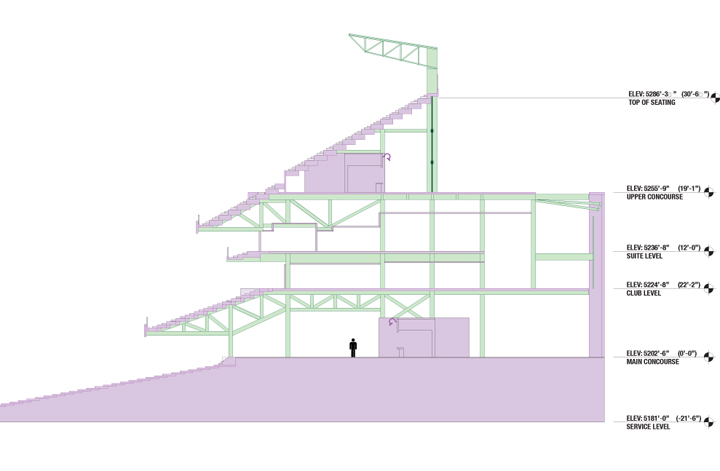
Coors Field, which is similar to AT&T Park. Top row is 105 feet above field.
Take Coors Field, which is pretty much the standard bearer among the modern, HOK/Populous breed. Lower deck, Club level, Suite level, Upper deck. It’s a big building that was downsized before the start of the season. That’s good, but it won’t fix the sightline problem. The top row is 105 feet above the field, which makes the action truly look like it’s a Mile High. Add to that the limited cantilevering and it’s pretty far from the action, nearly 235 feet from home plate to that back row in the upper deck. Could be worse, though. Mt. Davis’s top row at the 50-yard line is 335 feet from the near sideline. That’s longer than a home run in the LF/RF corners.
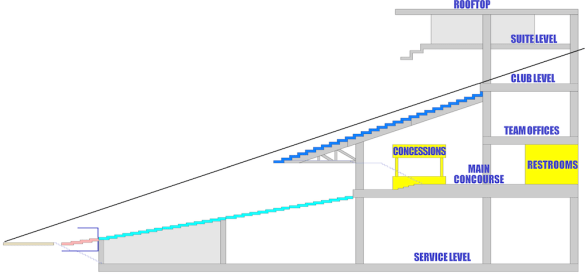
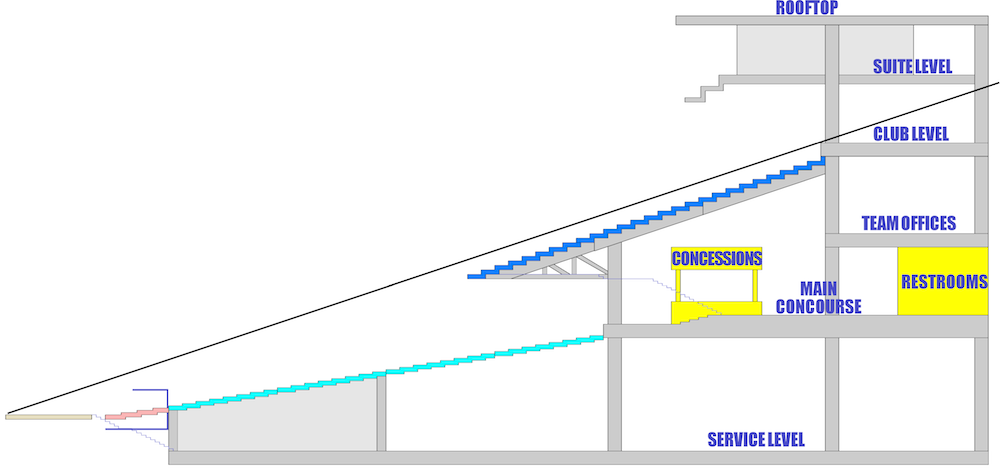
A two-deck ballpark design with no suites in between
Now look at this cross-section, which somewhat mimics the first two decks at the Coliseum. It has 32-36 rows down low, 24 rows up above, then skyboxes over it. The last row is only 56 feet above the field. There is only one regular concourse, but it’s 65-83 feet wide. There are club seats and a separate club concourse up top, probably with no fancy lounge or restaurant. Above the suites is a rooftop deck, which can be used the same way the 49ers use theirs at Levi’s Stadium. Or it could simply provide expanded seating in the future. The roof is only 88 feet above the field, or almost 2 stories lower than the top row at Coors.
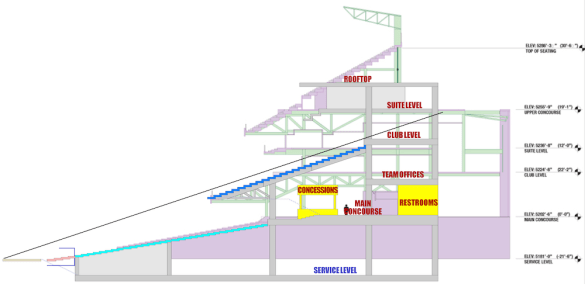
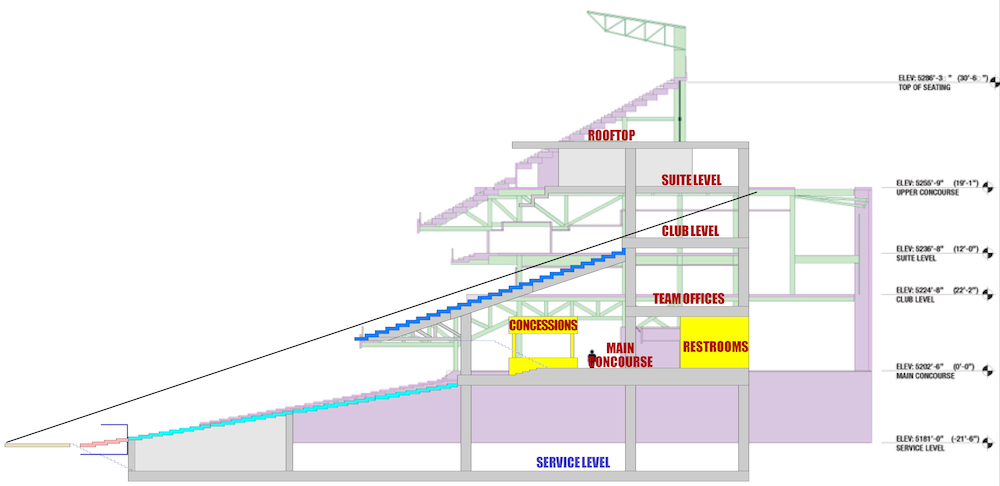
Overlay of Coors and two-deck concept
There are compromises. The suites and club seats are about 20-25 feet further away from their counterparts at Coors (AT&T). Does that matter? I doubt it.
To be clear, I have no idea if 360 and Wolff are pursuing anything like this. It would be a great way to go. It brings over that vertical conservation that no other ballpark in the majors save for PNC Park attempts to accomplish. If the goal is the best baseball viewing experience, I hope that this is something that the A’s-360 team is exploring. We’ll all be better off in the end if they did.




 newballpark.org