Oakland Fan Pledge seeks to garner interest in an Oakland ballpark

A pair of Oakland A’s fans and longtime readers of this site have started a site called Oakland Fan Pledge. The purpose is to gauge interest in tickets and different seating options at a hypothetical Oakland ballpark, either at the Coliseum complex or Howard Terminal. Results of this survey may be shared with MLB, public officials, and the A’s if the team ever decides to stay in Oakland.

This new effort follows similar campaigns in Sacramento and Seattle to build interest in a new arenas in those cities. Sacramento’s Here We Buy has received more than 11,000 season ticket pledges so far. A similar drive in Seattle claimed more than 44,000 season ticket pledges and 268 suites. Obviously a pledge is not the same as a binding contract to purchase tickets, but as long as people are being honest about their levels of commitment, the information gathered from these kinds of campaigns can be useful. Interestingly, because Seattle and Sacramento were so public about their efforts, it’s likely that Oakland Fan Pledge may be compared to the cities fighting over the Kings/Sonics, however unfair that may seem. Here’s the press release from the group.

FOR IMMEDIATE RELEASE
April 22, 2013
John Hansen
John Jackson
info@oaklandfanpledge.com

Oakland Baseball Fans Launch Campaign for New Stadium
April 22, 2013

Oakland, CA – Baseball fans who want the A’s to stay in the East Bay have a new way to show their support: pledging to buy ticket plans at a potential new baseball-only stadium in Oakland. Oakland Fan Pledge (www.OaklandFanPledge.com) is a new independent website created by A’s fans to show Major League Baseball, A’s ownership, and Oakland city officials that local fans will support a new ballpark in Oakland by pledging their dollars to buy tickets.

On the website fans can choose from various ticket plans and pricing levels at a hypothetical ballpark. While no monetary transaction takes place, those who pledge are asked to be realistic about what they could afford if a new stadium were to be built. Ticket prices are based on averages of other recently-opened stadiums throughout Major League Baseball (MLB). Premium seats include a separate fee for ‘seat rights,’ similar to what was done for the Giants’ opening of Pacific Bell Park in 2000, a standard for a privately-financed stadium. The full list of tickets and money pledged will be continuously updated on the site and shared with MLB, city officials in Oakland, and the A’s. If the time comes that the current, or future, A’s owners commit to a stadium in Oakland, the site’s owners plan to share their list of pledges.

Oakland city officials have identified two possible sites for a new baseball stadium within city limits: one at the existing Coliseum complex and another on port-owned land near Jack London Square in downtown Oakland. Oakland Fan Pledge provides a clear way for A’s supporters in the region to weigh in. By committing to buy ticket plans at a new Oakland baseball stadium, fans can rally around keeping their team in town by sending a clear message. “The A’s owners have told the team’s fans for years that the A’s are as good as gone from Oakland, and it’s frustrating,” says John Jackson, a lifelong fan who is helping to organize Oakland Fan Pledge. “There are tens of thousands of fans that would open their wallets and buy ticket plans if a long term commitment to Oakland was made and a new stadium was built.”

Oakland Fan Pledge began as a grassroots response to frustration around the team’s uncertain future in Oakland and lack of progress in building a new stadium for the team. Major League Baseball has spent over four years reviewing potential Bay Area stadium sites without making a decision. Meanwhile, the A’s ownership has alienated much of the team’s local fan base by repeatedly expressing their desire to abandon the East Bay for Santa Clara County, which is currently under the control of the San Francisco Giants through MLB territorial rights.

“Oakland Fan Pledge is more than a way for A’s fans to show a financial commitment to their team and to Oakland,” says John Hansen, another organizer of the site. “It gives fans a way to move beyond being told their team is done in Oakland, and visualize a new hometown stadium the team’s current owners have tried to convince them isn’t possible. We believe not only is a new stadium in Oakland possible, but that local fans are ready by the thousands to fill it up. Through Oakland Fan Pledge, we look forward to sending this message loud and clear to Major League Baseball and the team’s owners, and dispelling the myth that Oakland is anything but an extremely viable home for the A’s for decades to come.”

I’ll be sure to fill out my survey ASAP.

Giants refinancing ballpark debt to fund other development

The Chronicle’s John Shea confirmed something I had heard about the reasoning for the Giants’ AT&T Park debt refinancing.

The Giants’ plan to pay off their stadium debt by 2017? No longer in the works, we hear. There have been steps to refinance the $170 million loan to help fund their proposed development on parking lot A across from McCovey Cove. There was a time the Giants said they had to limit their payroll because of the $20 million annual mortgage.

Remember how, in 2009, SF City Attorney Dennis Herrera threatened to sue baseball over the perceived financial threat posed to the City if the A’s were granted territorial rights to the South Bay? Well, I’m glad for everyone’s sake that the Giants feel it’s safe enough to take on even greater debt to grow their empire. I was so worried for a while there.

Meanwhile, a group of East Bay mayors including Oakland’s Jean Quan and Berkeley’s Tom Bates are trying to upend legislation introduced by SF assemblyman Phil Ting that would help smooth (or bypass) some of the environmental review and approval process for the Warriors’ arena. It’s not strange that they would pursue this route, since it is local politics at work. The irony is that whatever new law helps the W’s arena could provide a blueprint and pave the way for an A’s ballpark at Howard Terminal, which makes sense because both are on waterfront sites and face the same restrictions.

Of course, if Howard Terminal never gets past the talking points stage no one ever has to find out how expensive it’ll be to build there.

Dodger Stadium post-renovations

The middle game of a three-night set at Dodger Stadium had thousands of discounted tickets available on StubHub, a reminder that even for teams with $200 million payrolls and season attendance totals surpassing 3 million almost regularly, it’s still possible to find a deal. Or in Tuesday night’s case, an empty house.

I came because I happened to be in town for a week and I wanted to catch a game at either Chavez Ravine or Anaheim. I also wanted to take the Dodger Stadium Express, the bus that runs directly from Union Station to Dodger Stadium. This year there was also the added benefit of a bus-only lane going up Elysian Park Drive to help speed up the trip. I calculated that it took 15 minutes to get from Union Station to the intersection of Sunset and Elysian Park, then less than 5 minutes to get to the final destination behind centerfield. As you can see from the picture below, the buses get packed. It’s a good option for those who want to take Metro or a Metrolink train in. The $1.50 fare is waived if you show a ticket on the way in. The driver doesn’t bother to check for anything on the way back.

Inside a packed Dodger Stadium Express bus

The Tuesday night game had no giveaway and was billed as Taiwan night. Pre-game festivities included a traditional band from Taiwan who played a mournful version of The Star Spangled Banner. Since this is Hollywood, there was also a purely commercial wrinkle as the American band Fall Out Boy was on hand to promote their new record. Pete Wentz threw the ceremonial first pitch. I entered the stadium greeted by this view.

Before sunset with the normally late-arriving crowd

There isn’t much else to say about the experience, other than that the scoreboards by ANC Sports are quite impressive. Circulation between the levels is still impossible, and since I got the $11 ticket near the RF foul pole, I couldn’t go any higher than the club concourse. The final crowd (announced 35,898) was not much better than what you see above. I assume that the events surrounding the Boston Marathon incident may have scared some people off. The Padres dropped a 4-spot on the Dodgers in the first inning off Chris Capuano, so the small crowd that showed up wasn’t tempted to stick around for long. Security didn’t seem heightened to a great degree.

A new display set above the RF Pavilion

The best way to describe the new scoreboards is to think of them as a set of three. The lower part along the outfield fence is an out-of-town board and a State Farm ad. When a Dodger comes up to bat it usually changes to an animated intro. This is mirrored on the small display underneath the diamond/hexagon large display. The strip is a great addition because it’s the perfect spot for a perpetual in-game line score. Unfortunately, the geniuses at Dodger Stadium don’t keep it perpetual at all, instead choosing to include the strip as part of the ongoing multimedia presentation. The big board is very impressive. Even the funky shape works to the team’s advantage, as there are little nooks for the clock, the on-base situation, even logos for the teams above the lineups. When a Dodger comes up to hit, the LF board shows a big picture (in keeping with the old setup) and on the bottom corner is the player’s Twitter handle. Statistical presentation is clean and modern, though it could use more advanced stats.

I was eventually able to sneak down to the field club seat area down the lines. By the 8th inning everyone wanted to go home. An attempt to sing Sweet Caroline in honor of Boston was met with a big SoCal “meh”. WiFi was supposed to be better, but I couldn’t tell. Who knows what would’ve happened if the game were better? We’ll never know. Maybe the next time I go to Dodger Stadium, someone will give a damn.

2013 ballpark trips (tentative)

Last year I focused much of my baseball-related travel within California, a state full of quality baseball and inexpensive to boot. This year I’m going back to traveling to other major league cities, to see a few new ballparks I haven’t yet seen or ballparks that have undergone changes and upgrades. If you’re in one of these cities and you want to take in a game over a couple of beers, let me know. Here’s the plan for now. It’ll be firmed up in the next few weeks. The theme here is weekends, 2-3 days for the most part, minimal vacation time required.

  • June 7-9: Chicago/Milwaukee. I did this section as part of the 2010 Midwest trip. The last experience was marred by a train accident that forced me to miss a White Sox game. The Brewers were also out of town, though I was able to take a tour of Miller Park instead. This time all three MLB teams are in town, including the White Sox hosting the A’s. Unfortunately the A’s Midwest League affiliate, the Beloit Snappers (WI), are not in town. Exact trip details TBD.
  • August 22-25: New York/Florida. I could take two separate trips to New York and Miami to cover the three new parks, but I’d just as soon do it all in one trip if I can. It would start with Blue Jays @ Yankees on 8/22, Tiger @ Mets on 8/23, and Rockies @ Marlins on 8/24 or 8/25. I may even throw in a Yankees @ Rays game during the weekend if I can hack it. Alternate dates: June 27-30.
  • September 28-29: A’s @ Seattle. It’s a day-after-night set at the end of the season, so I can fly in Saturday afternoon and fly back Sunday evening. Easy, no fuss, $200 roundtrip on Southwest or Alaskan. Hopefully the games will be meaningful. Alternate dates: June 22-23.

There are also plans for one or two trips to Southern California to catch all three MLB teams there. That’s a bit more fluid. There’s also the possibility of an Ohio trip, but I’m not sure I can fit it in.

I have to admit that these short jaunts are inspired in part by Anthony Bourdain’s The Layover, which covers the celebrity food writer/TV host’s 24-48 hour stints in numerous world cities. Expect new travelogue entries to go with the trips.

Are you planning any ballpark trips this year? Do you have any comments or suggestions? You know where to go.

Baseball in Oakland has gotten cheaper

When the A’s converted the all-you-can-eat sections in the upper deck to the Value Deck in 2010, it marked a major change in how tickets and concessions were priced at the Coliseum. Prior to 2010, both offerings were steadily increasing. Team Marketing’s Fan Cost Index, which tracks the cost of a game for a family of four, had the A’s above the middle of the pack even though the venue itself was no great shakes. Since the introduction of the Value Deck and Menu, prices have dropped and stayed remarkably flat as the newest MLB edition of FCI shows.

Fan Cost Index for the last four years

Fan Cost Index for the last four years

FCI considers the cost of four tickets plus soft drinks, beers for the adults, parking, programs, and caps. The caveat here is that such a package is not usually purchased by a family that goes to the park regularly. It also doesn’t take into account that many fans will eschew value menu fare and go for something a little more upmarket. In any case, it’s a fairly honest representation of pricing and spending at every stadium, and as you can see from the table above, a game at AT&T Park is considerably more expensive to attend than one at the Coliseum. As a matter of practice, Team Marketing surveys each team prior to the beginning of each season.

The A’s have chosen to keep prices steadily, remarkably stable for four straight years despite last year’s AL West crown. In 2010, FCI for the team was nearly 9% below MLB average. Now it’s almost 21% below the league. Instead of raising prices throughout, the team has chosen to charge more for premium items found in the Westside Club, Round Table pizzas or craft brews. It’s a reasonable philosophy to have, though for me personally I choose to drink my craft brews in the parking lot when I have the chance.

It’s normal for teams to raise prices in proportion to payroll increases. A’s payroll, like FCI, has remained steady over the last four years. Revenue has risen, though not dramatically. Revenue sharing fills in the gaps, so even if the A’s boosted prices that revenue increase would be partly offset by decreased revenue sharing.

As we’ve seen during the first homestand, fans aren’t terribly responsive to price, or even success carried over from last year. Tuesday’s “free parking” crowd was identical in size to the BART $2 Wednesday crowd. “Inclement” morning weather scared away Thursday’s getaway game walkup crowd. A multitude of factors play into every fan’s and family’s decision making process when it comes to attending any one game. The numbers show that advance and season tickets have improved measurably, but it’s not enough to move the needle much in terms of revenue.

For now the A’s price things to what they think the market will support. There’s enough room for one or two extra salaries to come via trade at midseason or at the deadline. The system allows for that. If the A’s wanted to boost payroll to $80 million, revenue would have to be boosted at least another $20 million independent of revenue sharing. Would the fanbase support the increased prices and attendance that would be necessary to generate that extra revenue? I’d sure like to find out.

Good cop, bad cop, legacy (Updated to include Mayor’s letter)

Added 1:00 PM – I’ve taken the liberty of posting the text of Mayor Reed’s letter to Commissioner Selig.

Mr. Bud Selig, Commissioner
Major League Baseball
777 E. Wisconsin Avenue, Ste. 3060
Milwaukee, WI 53202

Dear Commissioner Selig:

When will the A’s be moving to San Jose? That’s the question that is most often asked of me by CEOs of Silicon Valley companies competing to retain and attract global talent, by youngsters excited about competing in little league baseball, and by fans throughout San Jose.

The A’s ownership continues to express its desire to locate the team in San Jose and I strongly endorse that outcome. There should be no doubt of San Jose’s ability to be a great host city for the team and for Major League Baseball. There should also be no doubt that the stadium could have been under construction by now.

We respect your desire to examine fully all aspects of allowing the A’s to move to Northern California’s largest city. In 2011, former MLB President Bob Dupuy, speaking on behalf of your office, asked that our City Council delay approving a public vote to advance a planned stadium project in Downtown San Jose. We abided by that request. Mr. Dupuy also indicated that you would soon make a final decision and, if favorable towards San Jose, the MLB would assist the City with the costs of a future election. Two years have passed since. As you know, we have been contacted many times by the MLB’s Blue Ribbon Panel and we have responded promptly and thoroughly in every instance. Meanwhile, we continue to communicate with leaders in the community and are prepared to advance implementation actions to the City Council following your decision.

Direct communication between us will help resolve any lingering issues about our commitment to having the A’s home plate located in San Jose and could reduce the probability for additional litigation. I’d appreciate an opportunity to discuss this with you and have asked my Chief of Staff, Pete Furman, to contact your office regarding scheduling a meeting with you. I hope you will look favorably upon the request.

Best Wishes,

Chuck Reed
Mayor

c: Lew Wolff

—–

It’s probably not a coincidence that in the span of two hours, Lew Wolff spoke for the first time this regular season about the stadium situation on Chronicle Live!, followed by San Jose Mayor Chuck Reed asking for a meeting with Bud Selig via a one-page letter sent to  the Commissioner’s office.

Reed is positioning the requested meeting as something that could head off future litigation. Over the last year, San Jose has become more vocal about challenging MLB through the courts. So far MLB hasn’t budged. I can’t imagine that this will work either. Regardless of whether San Jose actually has standing in a case against baseball, the sport still has the lion’s share of leverage. If granted the meeting, maybe Reed will come with a phalanx of high-profile lawyers to shake down Selig. More likely is the idea that Reed will continue to pitch San Jose’s positives (of which there are many) and try to allay any fears that the A’s can be self-sustaining in the long run. Remember, they have to be off revenue sharing in a new Bay Area stadium.

As for Wolff, he was peppered with a lot of questions by ChronLive’s Jim Kozimor. Unfortunately, Wolff refused to talk about any progress on the decision-making front for a stadium location, citing the Selig-imposed gag order on both teams. He was able to comment on other matters. On the prospects of the five year lease Wolff requested last year:

The environment of getting a (lease extension) is very positive.

That’s encouraging. All A’s fans hope that the flying rhetoric stops and the team and the JPA can work out an extension that benefits both sides. That’s not going to be easy with the Raiders asking for more revenue control. We’ll see over the coming months if a proper agreement can be worked out for all sides.

Asked if Wolff and the Fisher family would consider selling the team if Wolff doesn’t get his wish to move the franchise to San Jose:

The answer is no… we want to keep this generational.

Following the 14-minute interview, in-studio guest Mark Purdy further elaborated on the “generational” aspect. Purdy indicated that Lew could cede more of the stadium effort in the coming years, as he approaches 80. Next in line is Lew’s son Keith Wolff, who has been working on plans for Cisco Field and the Earthquakes Stadium, where major site work started happening in the last week. Lew says that the Quakes stadium is on track, but process could slow it down. For now he says that the Quakes stadium should be open for the 2014 MLS season, conceding that there could be delays in completing the project. I figure that once that venue is up and running, Keith Wolff will assume his father’s place as the public face of the stadium effort, if not the franchise itself. With the recent trend of teams acting as investment vehicles and development anchors, this is naturally hard-to-believe. Considering how Wolff views his ownership of the franchise and how he attends games frequently with his grandson, it’s not necessarily that far-fetched. Wolff dismissed Kozimor’s suggestion that the team is just fine collecting revenue sharing checks, responding that he wanted to leave the team and the sport in a better place than he found it. As long as there continues to be an impasse vis-à-vis San Jose, that’s inconceivable.

$100 million sure don’t buy what it used to

A little over six years ago, the renovated Stanford Stadium opened. Recall that the 50,000-seat stadium was built by area real estate magnate John Arrillaga in nine months for $100 million. It had a proper mix of seats and bleachers, a small club beneath the press box, and far better amenities than the old, dilapidated stadium had previously. While it lacks significant architectural character and can be best described as serviceable and utilitarian, no one’s going to complain about the cost (low and all paid for) or features it may lack compared to Stanford’s Pac-12 rivals. It was built efficiently and quickly, and unlike the review I wrote back in 2007, Stanford Stadium has a good team to go with the more pleasant surroundings.

On Monday, the Los Angeles Dodgers played their first game in their renovated (yet again) Dodger Stadium, yet if you went to the game, you might be hard pressed to identify what that $100 million paid for. The project, announced shortly after Guggenheim Partners assumed ownership of the team, sought to upgrade several areas that needed refreshing: scoreboards, restrooms in the upper decks, and concourses. Much of the money went towards ripping out a large amount of the lower deck so that the Dodger clubhouse could be expanded to twice its original size. Since Dodger Stadium was literally built into a hill, this meant pulling out concrete risers and excavating the dirt beneath them to increase square footage.

LA Times graphic showing changes at Dodger Stadium

Under the field level is a batting cage which people in the Dugout Club will be able to view. Photos of the clubhouse look impressive, though I wasn’t able to tour the clubhouse last year even when the team was on a road trip. I suppose that if the owners are going to start supporting $200 million payrolls, they better fix up the house enough to keep all those overpaid players happy.

Other fan friendly changes include an expansion of the concourse behind the third (reserve) deck, including a play area. A few rows at the back of the club and lower levels were removed and replaced with standing areas with drink rails. Since seats were removed, the Dodgers will officially declare a sellout at 53,000 paid. Anything above that number will come from standing room admissions. By eliminating those back rows, the cramped concourses will be 8-9 feet wider, enough to accommodate groups of standing fans while freeing up some of the concourse area for concession lines or circulation. Perhaps most importantly, the troughs behind the top deck are gone, replaced with urinals. (Sorry trough lovers, your days are numbered.)

The only obvious improvement was the replacement of the scoreboards in left and right field. Now both have the signature hexagon shape, and both are versatile score/videoboards provided by ANC Sports. Both will also have a small ribbon-like strip beneath them, which should work well for showing the line score or captions.

When Frank McCourt bought the Dodgers, he envisioned a vast redevelopment of the 260-acres at Dodger Stadium to include new commercial and residential to surround the stadium. For now, Guggenheim has stayed mum on their future plans for the land, these changes portend a re-engineering of the experience at Chavez Ravine. The expansion of the upper gate area is probably a trial balloon for further expansion of the paid area into the parking lots. For most of Dodger Stadium’s life it has lacked circulation between levels, a hallmark of its exclusive, segregated design. While a set of escalators behind home plate provides one way to circulate among the levels, the only practical way to increase that movement is to create spaces behind the existing concourses. To successfully execute this, project head Janet Marie Smith (of Camden Yards and Fenway renovation fame) will have to strike a balance between utility and the impeccably manicured grounds at the complex. Take away too much greenery and it will start to look like a cookie-cutter stadium. Remove too little for preservation’s sake and the solutions may prove too time-consuming for fans to use. In the coming years, Dodger Stadium is expected to undergo numerous small renovations in conjunction with major changes to the complex. It’ll be a good test of whether the stadium can be integrated into Downtown, and perhaps the last major “redevelopment” project in LA. Hopefully they’ll do it right.

Alamodome exhibition game

Eager to see pics of what a MLB game looks like in San Antonio’s Alamodome? No? Well, tough, here they are anyway.

rangers-padres-alamodome-entirefield

Is it the Alamodome? Or the Metrodome? Or the Kingdome?

rangers-padres-alamodome

Yes, that’s 285 feet to the right field corner. It’s 354′ to the other corner, 410′ to center, and reportedly 387′ to the power alleys. I had guessed it’d be 280′ to right, so I was close.

rangers-padres-alamodome-baggie

Metrodome-style baggie wall

rangers-padres-alamodome-pressbox

There’s no place for a press box behind the plate, so they used the football press box, placing the broadcast crews well down the LF line

The field was purchased for the games by Ryan Sanders, the baseball holding company partly owned by Nolan Ryan and his son Reid. It’s expected that additional exhibition games will be played there over the next couple of years. I hate to say it, but as silly and dome-y as it looks, the Alamodome could work as a temporary home. Maybe not for a full regular season. For a 22-game Expos-in-Puerto Rico barnstorming stint? I could see it. It could even work to the Rangers’ and Astros’ advantage if A’s “home” series against those two teams were held at the Alamodome. As long as the gate was divvied up to all parties’ satisfaction, it could work quite well as long as everyone understood that San Antonio’s role was truly temporary, instead of the threat of relocation experienced with the New Orleans Saints post-Katrina. Nolan Ryan’s future with the Rangers is a bit murky at the moment, so there’s no telling what will happen there. Still, Ryan Sanders will continue to have a big presence in terms of baseball in Texas, so if Bud Selig wanted to use a temp venue such as the Alamodome, he knows who to call.

The guy in the middle of the final picture above is a City Councilman whose name I didn’t pick up during the interview. He and the Rangers broadcast team talked about MLB in San Antonio. The discussion was framed in terms of San Antonio getting a future expansion team if MLB went to 32 teams. There was no discussion of San Antonio as a relocation candidate.

Attendance for the first game was 34,641. The Alamodome’s capacity is 65,000 (slightly less for baseball), so as you’d expect, the place looked half full. Or at least the upper deck looked empty. Perhaps they could’ve used some tarps.

Finally, take a look at this video showing the conversion of the Alamodome from empty floor to half-grass, half-arena football layout, then the installation of the infield. They even went to the trouble of laying down a dirt pattern for the entire infield, even though like most artificial turf indoor ballfields, they used dirt cutouts instead of a true dirt infield as in Tropicana Field.

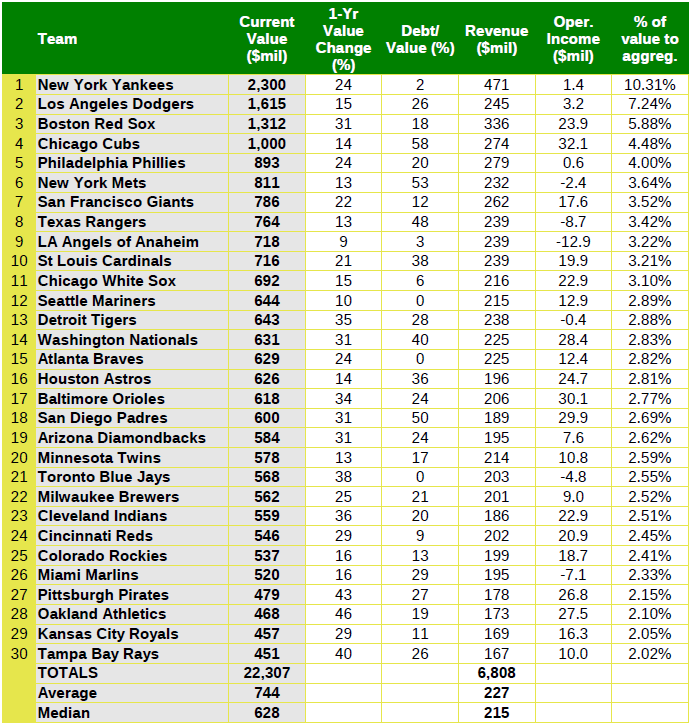
Forbes ranks A’s 28th in team valuations at $468 million

For me, when the Forbes MLB valuations are published every March, it’s like Christmas nine months early. Forbes goes to the trouble of sleuthing around baseball even as team financials are meant to be heavily safeguarded. It provides this blog and others with that last bit of off-the-field news just before the season starts in earnest. Thanks to Mike Ozanian and Kurt Badenhausen for putting the 2013 edition and previous editions together (full list).

2013_valuations

2013 Forbes franchise valuations with some additional extrapolation

As expected, the combination of the Dodgers ($2.1 billion) and Padres ($600 million) sales plus new TV contracts on the horizon pushed franchise values up. Way up. No team has a valuation lower than $450 million. Credit also goes to MLB Advanced Media, whose expanding product line includes MLB.tv, the At Bat apps for phones and tablets, and Tickets.com. Forbes estimates that if it were public, MLB AM could be worth $6 billion on its own. Slow, deliberate baseball is not the kind of enterprise one thinks of when looking for examples of startup culture, yet the success of MLB AM is undeniable and felt in every owner’s pocketbook every year.

These new valuations result in an aggregate $3.5 billion rise over last year. The A’s, who were last in 2012 with a $321 million valuation, are now 28th with a $468 million valuation. That’s a whopping 45.8% gain, all without negotiating any lucrative new media deals or the benefit of new ballpark revenues. $468 million is reflective of the new national TV deals that MLB will receive starting with the 2014 season. Even with the increase, the A’s are $160 million below the media franchise value and $276 million below the average valuation. For reference, the big market Giants got a $143 million boost and moved from 9th to 7th place. As we observed last year, the bubble is real. Thanks to baseball’s solid, diverse revenues, the bubble is also not going to burst anytime soon.

Debt that the A’s are carrying appears to be unchanged at around $90 million. This is no surprise because haven’t signed any big contracts since Yoenis Cespedes. By staying put, the debt-to-value ratio has gone down from 28% to 19%. That’s important because if Lew Wolff is going to build a new stadium in the next several years, it’s best to keep debt relatively low and operating income high so that they can borrow big for a ballpark. The downside of that conservative approach is that much of the A’s young talent could be out the door sooner rather than later, as we’ve seen frequently over the years.

Forbes also explained a little of their methodology this go-around.

Our team valuations are enterprise values (equity plus debt) and are calculated using multiples of revenue. Thus while teams value MLBAM and BELP on their balance sheets on a “cost basis,” which understates their true value, we incorporate market value estimates for those assets. Two more significant ways our accounting differs from the P&L statements of many teams: we include revenue teams keep from concerts, soccer games and other events at their ballparks; and we deduct from revenue stadium debt payments that are paid with stadium revenue. In short, our team values are meant to reflect what a buyer would be willing to pay in an arms-length transaction and our operating income measures are meant to indicate how much cash is generated.

Basically, Forbes is making the distinction that their numbers are reflective of how each team is run as a business, as opposed to P&Ls reported to baseball which may be products of arrangements designed to hide or minimize secondary revenue sources and expenses. While commissioner Bud Selig and the owners will downplay or write off Forbes’ figures, we can feel a little more confident in their soundness based on what they’ve dug up and the new industry information that has come in over the last two years.

Wait, what’s that BELP thing? BELP stands for Baseball Endowment Limited Partners, a sort of internal baseball hedge fund. It was started when the owners collected the franchise fee for the Washington Nationals into another partnership called Baseball Expos Limited Partners. The owners and Selig decided to reinvest that $500 million instead of distributing it to each ownership group. The strategy has literally paid dividends for the owners, because once money from BELP I was rolled over into BELP II, baseball started getting major profits from the fund. BELP was first exposed a few years ago when Deadspin received leaked financials from several teams, but the kinds of investments BELP chose to venture into were kept under wraps. In the past, I’ve put BELP in the category of “Other” when accounting for Central Revenue. I’ll probably break it out going forward, though that will be based entirely on estimates since BELP isn’t public.

The main article ends with a few notes on the A’s, which is somewhat unusual. It’s pointed out that the A’s got another fat revenue sharing check of over $30 million, and an attendance boost coinciding with the team’s division crown. Local revenues continue to lag, so revenue sharing and central revenues are (more than) keeping the team afloat. That’s a double-edged sword, as it gives critics of Wolff and John Fisher ammo to say the team is again being “cheap” with regards to how it runs the team. Now that payroll is taking up less than 40% of revenues, it’s worth asking if the team is saving money – perhaps for a ballpark. If the marginal cost per win in terms of talent is difficult to justify (see: $11 million/year for Kyle Lohse), filling the piggy bank for a ballpark wouldn’t be a bad way to go.

Of course, there’s another side to the revenue-payroll debate. With all of the money that’s coming in, Wolff, Fisher, and the other partners would have to be absolutely nuts to sell the team. They’ll only get more money next year, which they can invest in one of their cornerstone players. The windfall also makes it even more difficult for interested East Bay parties such as Don Knauss to get the team. Last year, as the Dodgers and Padres sales happened, I predicted that the A’s value would hit at least $500 million. They haven’t that number yet, but they’re almost guaranteed to hit it in 2014. So again, that puts the cost to keep the A’s in Oakland at $1 billion: $500 million for the team + $500 million for the ballpark. Good luck with that.

San Jose files motion to disqualify in S4SJ lawsuit

Update 3/23 1:30 AM – Pillbury made its own motion in response. They’re aiming to “augment the administrative record; memo of p’s and a’s” (points and authorities), so they’re providing their defense of their behavior in the case. I’ll try to get a copy of the motion ASAP.

—–

There’s a fairly new term being used in baseball talk on the internet these days: TOOTBLAN. It’s short for Thrown Out On The Bases Like A Nincompoop. It’s very popular on Twitter, and its lineage dates back to some misadventures on the basepaths by Ryan Theriot, who naturally was on the Cubs when the term was coined. When it comes to baserunning, Theriot is the polar opposite of Coco Crisp, whose recent profile by Grantland’s Jonah Keri elevated Coco to ninja-like levels between the bags. Still, Theriot has two World Series rings in the past two years, so who’s the nincompoop now? Well, it’ll forever be Theriot. Sorry dude.

The City of San Jose committed its own TOOTBLAN in the Stand for San Jose lawsuit. During the suit’s discovery period, the City inadvertently released several documents that clearly should have been protected by attorney-client privilege. When City attorneys found out, they asked S4SJ’s attorneys at Pillsbury to return the documents. Instead, Pillsbury held onto the privileged docs and sought to augment their own case with the documents. That forced the City to file a temporary restraining order against Pillsbury, which was granted by a judge in January 2012. Suspecting that Pillsbury lawyers would use the information anyway, last week (3/11) the City filed its own motion to disqualify counsel (read the PDF for the blow-by-blow), saying that Pillsbury’s conduct during discovery should force them off the case. From the motion:

By this motion, respondents and real party in interest seek disqualification of Pillsbury Winthrop Shaw Pittman LLP (“Pillsbury”) from further involvement in this case. Pillsbury attorneys closely examined and attempted to use nine privileged documents inadvertently produced by the City of San Jose. Pillsbury was ethically obligated not to review these documents any more than necessary to determine they were privileged and to immediately notify the City of its possession of the documents. In derogation of these obligations, Pillsbury not only reviewed the privileged documents in their entirety and failed to notify the City that it possessed them, it refused to return the documents after the City discovered the inadvertent production and requested that the documents be returned. Instead, Pillsbury affirmatively sought to incorporate the documents into the administrative record in this case and use the information in them to support petitioners’ claims, threating a motion to augment the record if they were not included. The City was forced to bring a TRO and preliminary injunction proceeding, which resulted in an order requiring Pillsbury to return the privileged documents and all copies. The documents contained highly confidential attorney/client communications and attorney work product bearing directly on the issues in this case. Pillsbury’s possession of this information prejudices the defense of this case, and there is no effective remedy short of disqualification.

I consulted with some folks who have a better grasp of the legal issues here. Apparently the motion to disqualify counsel is not something that is successfully granted often, and any such claims have to pass a fairly stringent test to force such an action. At the same time, the inadvertent release of privileged or confidential information during discovery isn’t all that uncommon, given the reams and boxes of documents that have to be made available for a trial. Still, this is an embarrassing moment for the City and it seems like they want to be rewarded for making a pretty big mistake.

The documents in question include marked up versions of the EIR, analyses and comments from the City Attorney’s office, and to my surprise, a draft of a Disposition and Development Agreement – effectively the lease terms for the ballpark and/or land. Frankly, I want to see this information and the public should have the right to see it. For now, records requests may have to be filed to gain access, and that may not happen until after a trial ends. Regardless, it’ll be interesting to see how Judge Hubner rules on this next month. Just like last fall’s motion to compel, this is a long shot at best, but Pillsbury’s conduct could result in sanctions if not disqualification. If Pillsbury were thrown off the case, S4SJ would be forced to bring in new counsel and prepare a new case, creating considerable delay. Plus the new legal team wouldn’t be the Giants’ own firm. Considering how the Giants may have pressured the Controller’s office to take actions against San Jose in the ballpark land rollback, just about anything’s fair game at this point. The hearing will be at Santa Clara County Superior Court on April 12, 9 AM. I expect to be there for the proceedings.

—–

Note: I spent a couple of fruitless hours at the Superior Court trying to get a copy of the motion, because it hadn’t been properly filed yet. I strolled a few blocks over to City Hall and went to the City Attorney’s office to request a copy. I received it via e-mail within an hour of the request.