I got your lease right here!

In the world of pro sports, $85,000 is not much money. It barely pays for a month of a rookie minimum contract in MLB. It’s the rough equivalent of one decent section’s worth of revenue at a San Francisco Giants game, or the A’s typical daily parking take. In the grand scheme of things, it’s not much. For the City of San Jose, it might be a very important piece of leverage which the City can use against the San Jose SF Giants.

The Merc’s John Woolfork reports that the City wants to get more financial disclosures from the team before it authorizes $85,000 in maintenance funds for Municipal Stadium. The main thrust of the argument against the expenditure comes from a memo (PDF) jointly written by councilmembers Sam Liccardo and Pete Constant.

Finally, as we contemplate whether to continue subsidizing the rent and repair at Municipal Stadium or any other City facility, we should know the extent to which any related entity is financing litigation costing our taxpayers thousands of dollars. Extended delays caused by frivolous CEQA litigation could stall or prevent the most transformative private economic development project – a privately-financed half-billion dollar major league baseball stadium- in anyone’s memory. It would seem minimally sensible to know whether we’re paying for the bullets with which we’re being shot.

Indeed, why subsidize someone else’s antagonism? It’s not exactly neighborly of the Giants to continually come to the trough while suing the city.

Moreover, the memo shed some light on the sweetheart deal the SJ Giants have been getting from San Jose for years. The team is set up as a nonprofit, which is not entirely unique among minor league teams. Thanks to the Giants being a nonprofit, their rent at Muni starts at $1,000 per month. Think about that. The Giants pay less in rent than most apartment renters in San Jose, or the rest Bay Area for that matter. The Giants contribute to upkeep as part of the lease terms, as does the City. But keep in mind that whatever leasehold improvements the team makes can be a tax writeoff (one of many depreciation items), which makes it the costs only slightly more than trivial. And the nature of the improvements is important: the City has paid for structural maintenance and improvements, such as a new scoreboard, electrical equipment, and lockers. The Giants have paid for value-add items like flat screen TVs on the concourse. Next year, the last of the current lease, the Giants will pay $29,000 in rent, which is a tiny improvement.

The memo also compares the Giants’ deal with the Sharks’ lease at Sharks Ice (next door to Muni) and Team San Jose’s arrangement at the San Jose Convention Center. The Sharks paid $5.5 million over the last two years for capital improvements and debt service for Sharks Ice, in addition to $5.3 million in rent just last year alone at HP Pavilion. With the lease due for renegotiation next year, the SJ Giants will be lumped in with the A’s and Raiders, whose respective leases also expire in 2013. Just as you can expect the Oakland leases to reflect additional contributions from the teams, the same should be expected of the SJ Giants.

After all, the Giants definitely don’t need the nonprofit status they’ve had since the beginning of their existence in 1988. That might have made sense back then, when it wasn’t clear how well the community would support the franchise (Lew Wolff knows a little about that). The Giants are routinely one of the best gate performers in A-ball and have their operations almost completely subsidized by their SF parent club/owners. If the Giants want to keep operating as a nonprofit, per the next lease they should comply with the Council Policy 7-1 (PDF), which requires financial disclosures of nonprofits operating city facilities:

…under Council Policy 7-1, non-profit organizations obtaining use of city facilities at a reduced rent must provide a “certified financial statement, including sources of funding and any constraints applied to funds,” and the “City may require, prior to and during the lease/property use agreement, the submission of such additional information as may be needed.”

It would be the neighborly thing to do. If the Giants don’t like it, well, I’m sure there are plenty of other places ready to offer a sweetheart stadium deal. Then we’ll see what kind of blowback the Giants get for being both leeches and antagonists. The irony is delicious. Oh, and if you think this has no teeth, here’s some very interesting language from Council Policy 7.1:

A below market lease/property use agreement may be terminated by the City at any time for any of the reasons established in the lease/property use agreement…

– and –

The City will not enter into leases or property use agreements at below market rates to organizations engaged in political activities or to religious organizations that would use the leased premises to promote sectarian or religious purposes.

Can the Giants’ efforts to derail Cisco Field be called political? Not overtly, but there’s something there.

News for 6/10/12

We’re overdue for one of these.

  • Matier and Ross reported on the contents of the Wolff-Knauss summit two weeks ago. Wolff laid out his 1 hour, 45 minutes case, Knauss and other East Bay execs made their case to work in Oakland – or sell the team. When the latter came up, things apparently got a little testy.

The only flare-up came when Knauss suggested that the business execs had deep-pocketed investors who would buy the A’s if Wolff and his ever-silent co-owner, John Fisher, weren’t interested in keeping them in Oakland.

“You can’t buy what’s not for sale,” Wolff told the group, according to Knauss. “I’m surprised you brought that up.”

  • In the same article, contractors at the Cal Memorial Stadium retrofit indicated that the project may not be ready in time for this fall’s football opener. Not that big a deal, same thing happened at Stanford.
  • Prices for the non-premium seats at the 49ers stadium have been revealed. The per-ticket prices aren’t bad, but some fans may bristle at the required seat license fee (which can be financed). The pricing structure looks very similar to that employed at Cowboys Stadium, which makes sense considering that the firm marketing the seats is partly owned by the Cowboys.
  • If Farmers Field begins construction next year, it’s likely that the E3 convention, held last week, would have to be moved out of the LA Convention Center. San Diego, anyone?
  • Chelsea F.C., which has seemingly won everything this season in the Premier League other than the outright league championship, lost out to other developers in its bid to redevelop the hulking Battersea Power Station into a new, 60,000-seat stadium.
  • KNBR’s Damon Bruce tweeted on Friday that the Warriors’ Piers 30-32 deal was dead. So far the story hasn’t been corroborated, and other sources indicate it’s incorrect. Seems odd to say something’s dead when it the process hasn’t yet started.
  • The Arena Football League suffered its first ever forfeited game when players on the Cleveland Gladiators went on strike before the scheduled Friday game against the Pittsburgh Power. The strike is part of an ongoing CBA negotiations.
  • Marlins manager Ozzie Guillen joked that he’d contribute “a couple million” towards a new Tampa Bay Rays ballpark.
  • Keeping the Astrodome running and up-to-date could cost $270 million or more, even though the dome wouldn’t have a tenant team.
  • The Glendale, Arizona City Council approved a deal that would bail out incoming Phoenix Coyotes owner (and former Sharks exec) Greg Jamison to the tune of $325 million over 20 years to stay in the desert suburb. Jamison has not yet been fully approved to take over the Coyotes by the NHL’s Board of Governors, pending a review of the Jamison group’s finances. The conservative Goldwater Institute wants a temporary restraining order to see if the deal violates the state Constitution.
  • In another cautionary tale about public dollars being spent for sports facilities, the Chicago suburb of Bridgeview is in debt up to $250 million for its MLS stadium. What’s paying for the shortfall? Property taxes.
  • Update 6/11 12:19 PM – Numerous sources are reporting that (near) billionaire and Ubiquiti Networks founder/CEO Robert Pera is buying the Memphis Grizzlies. The sale price has not been disclosed. Pera is only 34 years old and is partly based out of San Jose. Update 4:00 PM – The price is in the $350-375 million range. The buyout for the FedEx Forum lease is $105 million as of next year.

Happy reading.

Baer, Wolff had dialogue (really!)

Thanks to CSN’s Casey Pratt for going to the trouble of pulling quotes from two of The Game’s Newsmakers interviews with Larry Baer (Monday) and Lew Wolff (Thursday). For the most part, neither executive said anything substantive about the Giants-A’s stalemate, which means that once again, we’ve got to put up the proper image.

If you want to torture yourself by reading into the interviews, you can glean a few things about what has been happening:

  • Both Baer and Wolff are pointing to Commissioner Bud Selig to resolve the dispute.
  • Baer and Wolff have had an ongoing dialogue (negotiations) regarding territorial rights.
  • Baer backed off from saying that the Giants would welcome the A’s looking elsewhere, such as Sacramento. The Giants consider the Bay Area a two-team market.
  • Wolff continues to press that the plan is San Jose-or-bust.
  • Asked about what happened during Wolff’s meeting with Don Knauss, Wolff demurred and asked the interviewers (Tierney and Townsend) to ask Knauss.

Everything else we’ve heard before ad nauseum. This concludes your weekly non-update.

Museum concept

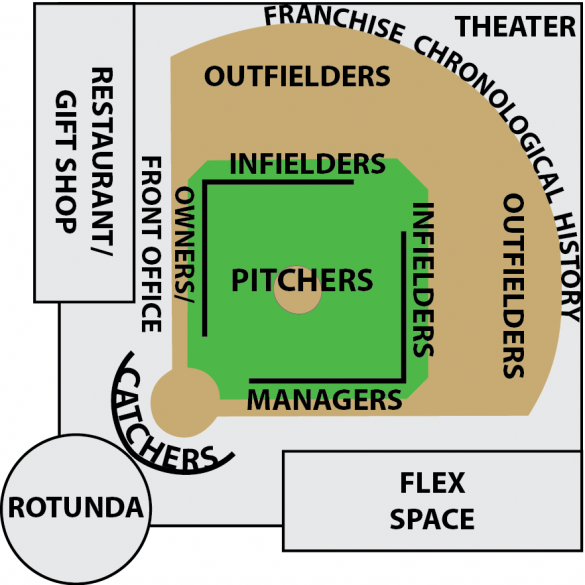
I’ve been kicking around this idea for the better part of a decade. It took until this week for me to jot it all down. The principle is simple. Like most museums, circulation is meant to flow in specific directions, though it’s not rigid.

The premise is simple. You start off in the rotunda area, which would be paved with bricks of leading donors. You enter to the right and reach the on-deck circle. Once there, you can either go to the restaurant or forward into the main hall. Follow the diamond to check out the franchise’s great managers, or go left to check out catchers and pitchers. Dressed-up lockers would contain exhibits for hall-of-famers or other greats. Round first and you can split off into either infielders or outfielders. End the tour with exhibits for owners and general managers (does Connie Mack get two exhibits?), or walk along the outer wall to go over the franchise’s entire history. Various islands throughout would have educational information about baseball for children, and the whole experience would be accompanied by custom iPad/iPhone apps. There’s also a theater for multimedia presentations.

While the layout is for a single-story building, it could be vertically aligned to as many as four floors with a smaller footprint if there were site size constraints. The flex space shown could be used for offices and for traveling exhibits such as those sponsored by MLB. There would have to be heavy coordination with the Bay Area Sports of Hall of Fame, which has no specific home and has spread out its inductee plaques at venues all over the Bay Area.

Then there’s the problem of running a museum. I don’t have any doubt that an A’s museum would be able to attract enough startup money or fill an endowment for the establishment of the museum. Ongoing operating costs to can be difficult to manage. It’s enough to create all sorts of financial difficulties 3, 5, 10 years down the road. It’s not realistic to expect the franchise to cover the budget, because franchises tend to throw most of their money and resources at the on-field product and run everything else as lean as they can afford to. Unless the museum makes money (an almost guaranteed “no”), there’s little reason to justify it. It’s with that sobering realization that I know that a museum isn’t terribly likely. Still, I can dream. And if shooting this high ultimately means settling for a great set of monuments at a future ballpark, that’s fine with me.

Now for some input from you. I’d like to frame this discussion around a set of questions. If I like your responses I’ll post them here within the post body.

Questions:

  • How would you organize the exhibits at an A’s museum?
  • How much attention would you pay to the franchise’s stints in Philadelphia and especially Kansas City?
  • How does the steroid era and its A’s notables get treated?
  • How large of an exhibit should each HoFer get?
  • Should there be an exhibit devoted to the designated hitter?
  • What kinds of kid-friendly exhibits and attractions should the museum have?
  • Should there be an exhibit containing other great Bay Area players who never played for the A’s?

If you have other questions you’d like to pose, put them in the comments and I’ll add them to the post.

A pretty cool museum idea

In 2006, when the economy was still strong, Adobe Systems bought 8 acres of land from the San Jose Water Company. The thought was that Adobe was expanding rapidly, so it might need the land for a future headquarters expansion. At that point, Adobe’s stock was at $40 and its position as a leading software vendor in the creative community was unquestioned. Now the stock is priced at $30, and there are a few questions about where the company is headed as it pushes its subscription software model on the public. Nothing has been built or even approved for the land, which is bisected by Delmas Avenue and fronts the Guadalupe River to the east.

Along with the land is the old San Jose Water Company headquarters. Built in 1934 and designed by prominent South Bay architecture firm Binder and Curtis, the building received landmark status in 1991. Any new development by Adobe will have to leave the building intact, and it’s likely that any master planner would work to integrate the HQ into the site plan somehow.

The corner of West Santa Clara and Delmas, Adobe HQ in background right

After several decades at the prime downtown location, SJWC felt that it was time to turn one of its vital assets into cash. It was the right move on the company’s part since it came right before the real estate crash. Now Adobe has the land, which should factor into its future plans, and the building, which could be used for some commercial purpose, but not in a way that would impact its landmark status. Currently there is no tenant.

Closeup of building highlights its mix of styles

The building is a mishmash of styles, done with enough subtlety to not appear gaudy. There are neoclassical elements in the columns, bas relief carvings throughout, and a Spanish revival tiled roof. Its location is prominent in that it’s at the bend in Santa Clara Street where you can either go east towards downtown or west towards the arena and The Alameda. The site is at the confluence of the Guadalupe River and Los Gatos Creek. It also happens to be right under a landing approach to Mineta Airport, which makes it a poor spot for a ballpark (if you’re wondering).

Looking across the Guadalupe River towards the SJWC building

When I asked Lew Wolff last year about having a museum at Cisco Field, he indicated that a museum would be hard to incorporate due to the lack of space at the site. He said that John Fisher may be interested in a museum tailored to the art of sports, though not necessarily an A’s museum. At 15,900 square feet, the SJWC building is a good size for a museum, whether it’s specifically for the A’s, Fisher’s sports art pursuits, or maybe both. Inside the Santa Clara Street entrance is a large, high-ceiling space, formerly cubicles, now empty. I haven’t been anywhere else in the building, so I can’t comment on what the rest of the interior looks like. Offices are located upstairs. Museums tend to run on very lean budgets due to their revenue sources, so a space this large may be too expensive unless Adobe cuts the museum a deal.

Nearing 80 years old, the building would undoubtedly require some amount of renovation work and continued upkeep to keep it going for the next several decades. The interior would have to be changed to fit a museum use better. Other than that, it should be good to go. It has dedicated parking (for now), and it’s fairly close to the ballpark. Is it close enough? You be the judge.

Location of Adobe/SJWC properties in relation to Cisco Field site and other nearby landmarks

At the northeast corner of the Adobe/SJWC site, the building is 1/4 mile from the nearest point at Cisco Field. It’s a shorter walk to the arena from either the ballpark site or SJWC. Perhaps that’s too far to bring gameday traffic in on a consistent basis. On the other hand, SJWC’s location on Santa Clara Street is on the way to the ballpark from many points within downtown proper. It’s likely that if/when Adobe builds something there, a large public parking structure will have to be built to keep up with demand for the arena and ballpark. There’s also a chance that Adobe partners with someone like the A’s on a mixed-use development that takes advantage of the Wolff family’s development experience while helping to defray some of the cost of a new corporate campus for Adobe. And there’s always the possibility that Adobe sells the land to Wolff or other San Jose interests if they decide that a new campus isn’t in the cards.

Skyline view from San Fernando light rail station at sunset

One other interesting piece of news about Adobe may come into play. For years Adobe was a key sponsor of the San Jose Giants, the company logo emblazoned in the outfield. I haven’t been down to Muni yet this year so maybe someone can confirm this, but it appears that Adobe is no longer a sponsor (or at least a key one). That may have something to do with Adobe’s place as one of the SVLG 75, and the group’s opposition to the Giants’ continued roadblocks of the A’s efforts to move south. Perhaps Adobe and the A’s have already had discussions about how to move forward. The loss of redevelopment has meant the death of publicly-assisted development efforts. As for entirely private projects, there may be something there. Hopefully that something includes an Athletics Baseball museum, one worthy of the 112 years (and counting) of the club’s legacy.

P.S. – I intend to keep writing and rallying support for an A’s museum until it comes to fruition, whether it’s in San Jose, Oakland, or Timbuktu. The next post will about what should be in such a museum, so save any comments about content for that post. Thanks.

P.P.S. – Yes, I’m aware of the Philadelphia Athletics Historical Society and Museum. There should be some way to partner with those folks. If you know of a site that would fulfill this purpose in Oakland and is within walking distance of one of the downtown/JLS ballpark sites, I’d like to write about it.

Baseball for baseball’s sake

Today at the Oakland-Alameda County Coliseum, the CIF North Coast Section will have its finals. As I understand, tickets are $9 and cover the whole day – four games of championship high school baseball. By now, the Division IV game has finished, leaving only the Divisions I-III games. If I wasn’t in LA for the weekend, I would’ve gone up to the Coli to check it out.

Decent crowd for the final game of the night

The California Interscholastic Federation is comprised of 10 regional sections, including four city-specific sections: San Francisco, Oakland, Los Angeles, and San Diego. (Late-growing cities such as San Jose and Sacramento are part of regional sections.) The SF and Oakland city championships were held at AT&T Park and the Coliseum,  respectively. LA’s city championship is being held now at Dodger Stadium. I still had a couple of days on my Amtrak California Rail Pass to kill, so I decided on a whim to head down to LA to catch the Southern Section championships. Honestly, I wasn’t prepared for how incredible the experience would be.

Also held at Dodger Stadium this year, the Southern Section championships covers just about every school that’s in SoCal but isn’t in either LA or SD. That makes for a very competitive playoffs, and it showed last night. The Division II final between Orange County schools Aliso Niguel and Pacifica (Garden Grove) was a masterpiece, with the latter winning 3-2 in 10 innings (7 is regulation). The D I final was no slouch as Newbury Park upset powerhouse Mater Dei coming in and outlasted Corona to win the title.

With a starting time of 1 PM, many fans at the D III final, given the choice, sat underneath the short overhang. Note the infamously narrow aisle.

My chief motivation for going was simple: having no rooting interest as a parent or alumnus of any of these schools, I simply wanted to catch a ballgame (or three) in some of the best seats at Dodger Stadium. And it was fabulous. Only the infield part of the lower deck was open for seating. The club section behind the plate was closed and off limits, a policy which created tension later as some kids from one of the winning schools climbed over some walls and through the club sections to jump onto the field. The closures effectively limited the capacity to around 5,000, which didn’t matter much as nearly all of the schools provided solid supporting sections. It was fun to see and hear small, vocal groups of fans on either side of the plate rooting against each other juxtaposed against the soaring backdrop at Chavez Ravine. Nothing quite prepared me for hearing pep bands at baseball games, a practice which I have to say – painfully as a former pep band member – should be banned.

My view for the D I and D II championships

I managed to get a seat in the front row of Section 2 behind the plate. Somehow I felt extremely fortunate as I had never sat this close (single game price for a Dodger game: $115) before and probably never would again. One of the nice, unexpected baseball fan treats was that the starting pitcher for Newbury Park threw with a three-quarter delivery (Eck, Huston Street, Rod Beck), so his arm angle was right in my line of sight. It made his breaking pitches look that much more outrageous.

Concessions were half-price, although only three stands were open, leading to long, concourse-clogging lines. Still, a half-price Dodger Dog is about the right price IMHO. The lower concourse, stands, and restrooms were properly renovated (waterfree urinals, no troughs), but with no space to widen the concourses, circulation was as cramped an affair as ever.

Towards the end of the Division I final with fog having descended on Dodger Stadium

I’ve been to a few games at Dodger Stadium in the past at different times during the season and both hot and cool weather. I didn’t expect the ballpark’s transformation as day turned to twilight and then into nightfall. Unlike AT&T Park and the Coliseum, where you can easily see the fog coming in as a sort of gloom settling over the place, when I sat down low here the marine layer seemed to sneak up on the me. It was almost as if someone flipped a switch for a fog machine. As would be expected, the moist, cool, dense air knocked down fly ball after fly ball, including a couple of shots that should’ve been homers. At the same time, San Gabriel Mountains receded into blackness and the whole game seemed to be played in a hazy mist, a halycon dream. The picture above doesn’t do it justice, and it’s hard to appreciate from the upper levels of the park, where I had almost always previously sat. The fog created a magical, movie-like quality to the event, similar to what I felt during the on-location filming of Moneyball two years ago – except not constantly interrupted by the process of filmmaking. The crowds were boisterous, the players intense and yet all too human, the coaches animated. I soaked up the whole thing, and when it was over at 10:30, I was sorry to leave. Now I finally see why Hollywood shoots here so frequently. They couldn’t have dreamed up this environment with a billion dollars of CGI and their wildest dreams. The new Dodger ownership group would have to be absolutely insane to even entertain the thought of leaving this place.

Joy in Mudville

Stockton’s leaders may make the toughest decision in the city’s history next Tuesday. Drowning in debt and scrambling for ways to restructure or forgive that debt, the city is expected to decide whether or not to enter Chapter 9 bankruptcy. Chapter 9 is an avenue set aside by the federal government for municipalities, and was most prominently almost twenty years ago when Orange County’s debts soared to an unsustainable level thanks to criminally poor fiscal management. Already, a $35 million building bought to be utilized as the next City Hall has been repossessed.

View across the channel from Weber Point toward ballpark (center) and arena (right)

A downtown bar featured in a LA Times article in March has closed. As I walked around during a weekday morning, I felt as if tumbleweeds were going to blow across the streets. Storefronts were frequently empty. The movie theater complex had little activity. The only places that felt alive were the local Starbucks, and, as I would find out within an hour, the ballpark.

The foul pole is a scant 300 feet from home plate.

The day game I attended was nearly sold out thanks to a number of elementary and middle school children who were in attendance. They were treated to the Ports’ 15-3 shellacking of the San Jose Giants. The win halted a Stockton 12-game home losing streak. The section I was in got coupons for In-n-Out Double Doubles thanks to a Max Stassi double, and the whole crowd got a free meal at a local Denny’s because of Chad Oberacker’s grand slam. I don’t know when I’ll be in Stockton again to redeem the vouchers. That’s life.

The only entrance to Stockton Ballpark/Banner Island Ballpark

Stockton Ballpark, as it’s officially known, was built by Swinerton and Frank M. Booth, the same company that built Raley Field. It’s very intimate, with 12-16 rows throughout the grandstand. Wedged between the channel and the arena, the left field foul pole is only 300 feet from the plate. There’s no second deck, no suite/press level cantilevered over the single concourse, and only a small club section. This was done to keep costs under control, which is a net positive in the end. There are plenty of concession stands down the first base line, very few down the third base line. A design quirk has an elevated bridge connecting the outfield berm area with the grandstand in the RF corner. To allow for service vehicle clearance, the bridge requires fans to take a flight up steps up and down. The berm wraps around to center, where it meets a Kinder’s BBQ stand. The bullpens and a seated picnic area are in left.

Exterior of arena facing channel

A road winds between the ballpark and the arena, connecting both to the waterfront. The 10,000-seat Stockton Arena is a clean, tidy affair, with decent concourse space and an auditorium-style layout for concerts. The side facing the water is glass, the other sides are concrete, metal, and wood panels, the latter of which are having their protective film fraying. No matter, it’s a decent looking building even if it towers over the ballpark and looks somewhat out of place in downtown Stockton.

As the City continues to fight for its future, there’s a lingering question of whether Stockton’s redevelopment efforts were worth it. California is unique in that it has a few cities that are the size of major league cities elsewhere in the country, yet places like Stockton, Fresno, Riverside, and Long Beach don’t get the kind of attention Cleveland, Buffalo, Milwaukee, or St. Louis does. Stockton saw a gravy train of new residents looking for cheap exurban housing and didn’t see the collapse of the housing market immediately behind it. They paid inordinate salaries and benefits to public employees, which put Stockton in the financial straits it’s in today. No one knows how exactly Stockton will get out of it, and what Stockton will look like when that happens. Chances are that the arena will be there. The ballpark will be there. And Dallas Braden will be there too by all rights. That can’t be all bad.


A city’s predicament

I fear for Trib reporter Matt Artz’s email inbox, because it’s about to get pummeled.

In today’s edition, Artz tries to explain why Oakland’s three teams are varying shades of noncommittal with regards to staying at the Coliseum, or even in Oakland in general. For most of us who follow the situation closely, the information is pretty much old hat. Still, it’s good to read someone in the local media deal it as plainly as Artz did, even if the truth is unpleasant.

As Oakland fights to keep its teams, industry leaders say it’s hampered by the fact that its main lure was a site more attractive 40 years ago than it is today.

“I think that’s a real problem,” Smith College economics Professor Andrew Zimbalist said. “The times have passed it by.”

Exactly. No one questions how devoted or hardcore Oakland and East Bay fans are, they are among the best in the nation. Unfortunately, the business of pro sports has become such a high-stakes affair that economically, Oakland is practically a AAA market while San Francisco and San Jose/Silicon Valley are major league markets. Nowadays money trumps hardcore seven days a week.

Yesterday I was looking into how Orlando’s Amway Center was built, hoping to understand how it surpasses Oracle Arena in terms of amenities. Oracle does well in having four premium seating options: courtside seats, suites, and two different club options. Amway Center has an astounding seven options: courtside seats, founders suites, presidents suites, legends (party) suites, MVP tables, 4- and 6-person loges, and club seats. All seven options are priced specifically to target certain well-heeled demographics, whether they are big corporations, prominent small businesses, or rich people who simply want more elbow room. A future post will go into how all of this works. For now let me tell you that there’s no going back. All four North American pro sports leagues are multibillion dollar outfits. So are NASCAR and NCAA football.

Oakland Mayor Jean Quan talked Thursday about having a huge Cowboys Stadium-like facility in the Coliseum complex, to be co-anchored by a convention center. One thing she didn’t mention was the price tag for such a complex, or even just the stadium itself. Lest we forget, Santa Clara’s Stadium Authority is on the hook for $700 million of the 49ers stadium costs. Zygi Wilf and the Vikings will be paying 49% of the Metrodome’s $1 billion replacement, leaving the rest to public funding sources. Even if you buy the somewhat dubious argument that the 49ers are paying for the lion’s share of the cost (who runs the Authority, again?), Santa Clara had to put up $144 million in hard dollars initially. What price will Oakland/Alameda County have to pay to stay in the game? $200 million? $500 million? Quan cites the $200 million NFL G-4 fund, but that’s available to every team, every market. Any new stadium will cost at least $1 billion.

Also today, a sobering analysis by the Atlanta Journal-Constitution shows how cities struggle to make their money back even with glistening new stadia, characterizing these efforts as an “arms race”. Good thing that the leagues appear to be bedrock solid for the foreseeable future, because if they weren’t municipalities would be wading into their own “mutually assured destruction”. So dream big, people, because it’s not your money! Until there’s a price tag. Then it’s definitely your money.

Mayors go on the offensive, Wolff to meet with Knauss on Friday

Oakland Mayor Jean Quan is having caviar dreams on a canned tuna budget.

Quan finally agreed to an interview with The Game’s Chris Townsend, though he had to travel to Oakland City Hall to do it. I listened to the exchange intently, looking for some semblance of consistent messaging throughout. For the most part the message was consistent, but probably not what the teams and fans are looking for.

Quan continued to tout Coliseum City as a massive development stretching over 500 acres that could attract 32,000 jobs, major hotels, corporations, and anywhere from one to four pro sports franchises. That’s right, four. When Townsend pressed her on what she meant by that, she said that the City was looking at teams outside of the current three tenants.

In the wake of the Warriors’ announcement that they intend to build a new arena in San Francisco, East Bay backers are already talking about luring either the Sacramento Kings or San Jose Sharks to Oakland. Oracle Arena is built for basketball, not hockey, so the Sharks are out of the question. The Kings are a more intriguing proposition since Oracle is miles ahead of ARCO/Power Balance in terms of modernity and amenities. However, you can bet that Joe Lacob and Peter Guber would fight tooth and nail to keep a second team out of the Bay Area. Even if the NBA were to allow it, the Lacob/Guber ownership group would get a tidy compensation check from whomever brought a team to Oakland. You can forget about that being the Maloofs since they’re broke. David Stern has also stopped Larry Ellison twice from relocating a team to San Jose, so you can glean from those vetoes that Stern considers the Bay Area a single-team market. Remember that Oakland’s gambit is to replace Oracle Arena with a new one if the Warriors stayed. There is zero chance of anyone building an arena in Oakland if the Warriors are in SF. They’ll just soldier on with the current arena, which again is a perfectly fine venue from a technical standpoint.

As for the A’s, Quan revealed a couple of things that are quite germane to Oakland’s efforts going forward. She seems fully committed to Coliseum City in whatever form it takes. When asked about a site in downtown Oakland, she said that if Clorox CEO Don Knauss wants to move in that direction and can figure out how to pay for the extra cost, it shouldn’t affect Coliseum City adversely. She didn’t exactly dismiss Howard Terminal or Victory Court, but by now she has to be fully aware of the nine-figure costs associated with either of those sites, which makes them quite difficult to develop. For that she deserves a lot of credit – Oakland’s advantages are that it has land and a potentially easier process to develop venues. The flipside to that argument is that Oakland’s not as desirable or coveted as SF or San Jose, so there’s a very good reason why it’s easier or more available.

Beyond that, Quan may be getting a bit too starry-eyed for her own good.

As long as we have one huge sports facility [plus] we will have a much bigger convention center than we currently have in downtown Oakland.

That sounds like a pivot to me. If Quan and the City are pivoting it’s probably no coincidence that AEG is on board to manage the complex and provide consulting for the next phase of the Coliseum, which would be to have something along the lines of what they are planning in LA: retractable roof stadium, arena, and convention center in one location. Maybe AEG will get a team to relocate there, maybe they won’t. What they can do is influence both LA and Oakland by shaping development there. It worked in LA, and it sure looks like it’s moving in that direction at the Coliseum. Two years I wrote about re-using the Coliseum for a convention center after teams vacated. It sounded preposterous back then, but it could make sense with AEG steering things. Though again, it’s important to note that AEG has never shown much interest in baseball. AEG could decide that it would be best to use as much available land as possible for a top-notch convention center. A large convention center can easily take up a greater footprint than two stadia side-by-side.

The “one huge sports facility” term has me intrigued. Now the thought of Cowboys Stadium doesn’t sound quite as far-fetched since it would be part and parcel with the convention center. The key would be the flexibility of the stadium. If you want to go full-bore crazy, Oakland should shoot for what Doha, Qatar is doing with one of its 2022 World Cup venues. Called Doha Sports City Stadium, it’s a retractable domed affair with movable seating decks and facilities built into the roof, not a mere steel or fabric shell.

Inside the 65,000-seat Doha Sports City Stadium, which is planned for a 2017 completion date.

The project picks up where Japan’s Saitama Super Arena left off, doubling SSA in size and scale (UNLV has a similar proposal to SSA). Let’s be clear about what DSCS is: $1.5 billion in state oil profits to be used for a showcase venue that could conceivably be used for a future Olympics gig. And if you think the picture above is nuts, save your jawdrop for the next image.

Exterior view. The stadium is only a part of the extremely large development, with ancillary features all under the "single" roof.

I suppose that the attitude here is that if this is going to cost $2 billion, might as well go all the way. Something like DSCS would certainly give Oakland the “one huge sports facility” that Quan alluded to.

Meanwhile in San Jose, the City is quietly building up its case and legal team for a potential attack on baseball’s antitrust exemption. The call for such a lawsuit has only gotten louder in the last several weeks as the team continues to languish with no direction in sight. San Jose is not going to sue as long as Lew Wolff continues to follow MLB’s process. The buzz will only get louder. I’ve even heard that legal proceedings may not cost the City much if anything. We’ll see if that actually happens. I wrote last week that as long as Selig doesn’t make a decision, there’s no trigger for a lawsuit since Bud Selig can say he’s continuing to study the matter. That could be a big reason why Wolff’s position has been “any decision is better than none” since either a yes or no could provide a jumping off point for Wolff.

Wolff supposedly met or is meeting with Don Knauss today, according to the Chronicle’s Susan Slusser. Maybe they’ll share Diamond Level seats for tonight’s Yankees game. Maybe Wolff will host Knauss in the owner’s suite. Knowing what we know about what both sides want, I don’t expect any earthshaking news. If I hear something I’ll be sure to update this post accordingly.

Update 5/26 7:37 AM – BANG’s Joe Stiglich has this regarding the Wolff-Knauss meeting:

A’s co-owner Lew Wolff confirmed that he met Friday with Clorox CEO Don Knauss, who has been outspoken about wanting to keep the A’s in Oakland.

Wolff declined to share what exactly the two discussed, other than to say he enjoyed the chance to talk with Knauss.

“I think we had a nice dialogue,” Wolff said. “We just exchanged some ideas. That’s all I want to say.”

There you have it. 

BTW, I’ll be tailgating at today’s Yankees game. If you want to drop by and chat, reply here or via Twitter. I’ll provide location info once in the parking lot.

Peter Guber talks to Tierney & Davis

Warriors co-owner Peter Guber went on The Drive yesterday, and the 20-minute interview that came out of it was the most entertaining bit of owner-speak I’ve heard in a long time. Guber is not like most co-owners, sitting in silence. He’s a Hollywood producer with showmanship befitting the town. A big-money player may work as the managing partner, whereas Guber appears to have a running mate-like role, selling the team’s concepts and working over the media. Joe Lacob, like Lew Wolff, has had some difficulty establishing a rapport with the local media and fans. For Guber this is old hat. However, Guber is taking on a similar role with the Dodgers, one that will take just as much effort if not more, so I can see why he wouldn’t be a managing partner of any one team.

Guber explained the process of selecting a San Francisco site, why Oakland was passed over (which will fall on deaf ears in the East Bay, I figure) and his history of ownership stints dating back to Mandalay Sports Entertainment, a conglomerate of minor league franchises including the model minor league team, the Dayton Dragons. Curiously, he considered the Warriors the only Northern California NBA franchise, a clear indicator that the Maloof family is more than one-foot-out-the-door in Sacramento. He even got in a little shot at the Maloofs:

GUBER: We believe – it’s a belief – that we’re going to turn it [the arena] into reality. We believe we can accomplish it. If we didn’t believe it, why would I take the energy and resources in the third act of my life and put it into something I thought was folly? No. All of us believe – Joe [Lacob], the different owners of the group, there’s a large group of intelligent owners – believe this is a beautiful, successful endeavor that we can bring to fruition. If we didn’t, I would go play poker in Las Vegas.

TIERNEY: Which casino by the way?

GUBER: Let me put it this way. Not. The Palms.

Guber went on to talk about how Larry Baer brought the Lacob-Guber team in to buy the Warriors. Guber indicated that Baer could have ended up as part of the ownership group, but dropped out during the process.

GUBER: When Larry Baer – yes, Larry Baer – called me at home in Los Angeles and said, “How would you like to buy the Warriors?” I said, “Great!” It fit my compass. I wanted to be able to get to a place within an hour, that I could go there regularly and be part of the community. Before, I had worked with Bob Piccinini to buy the Oakland A’s. In fact, closed the deal, made the deal with Billy Beane at my house, gave him a piece of the equity, negotiated the whole thing. Then, lo and behold, Bud Selig said “we’re going to do contractions” back in 2002 or 2004. “Let’s do contraction!” You know what contraction is? Not the same as what women have before they have a baby. This is what the league said they wanted to do with the teams. They wanted to get rid of Oakland and Minnesota. Ultimately, they made a deal with Lew Wolff about a year later. My partner (Lacob) went after that team as well. So Larry Baer said, “Let’s try to get the Warriors.” We went after the Warriors. Larry dropped out. Joe and I teamed up to buy the Warriors.

There’s a problem in Guber’s timeline. The contraction threat came with the 2002 CBA negotiations, which were the greatest threat for a work-stoppage since 1994-95. Contraction talk had started in 1999, and dragged on contentiously until August 30, 2002, when a deal was put in place that pushed out the contraction threat to 2006. The 2006 deadline passed without a peep, and contraction hasn’t come up in any substantive discussions since. The new CBA, which was finally made publicly available today, has language that the league won’t talk contraction until after the CBA expires in 2016. I digress.

Again, Guber talked 2002. But the Dolich-Piccinini group was knocked out in 1999, not 2002, a fact confirmed by Piccinini himself. Either the group was kept in play until 2002 as Guber said, or he has his dates mixed up. Piccinini is now also a part of the Warriors’ ownership group. He was also part of Jeff Moorad’s failed bid to buy the Padres. From the looks of things, Larry Baer was very active in getting the group as far away from the A’s as possible. Contraction died, which foiled the Giants’ attempt to get rid of the A’s via subterfuge. Now there’s simply no economic justification for it, and the price to contract two teams (estimated $1 billion) is too high for the owners and MLB to swallow.

The only question I have coming out of this is one I’ve had for the last few weeks: Why on earth is the City of Oakland working with the Giants and Larry Baer? Sacramento Mayor Kevin Johnson said yesterday that he is looking at the A’s situation closely, with Sacramento potentially there if something can’t be done in the Bay Area. Guess who’d love it if the A’s had no choice but to leave the Bay Area? Larry Baer.

Update 8:47 PM – Guber was referring to the “secret” 2001-02 negotiations done by his group, Mandalay, and Steve Schott. The group also included Bob Piccinini, which I was not aware of until the interview. At the time, Schott was pushing for a move to Santa Clara and was in discussions with the City Council. Because of the sale talks, the Council felt betrayed and terminated any further pre-development work. The ownership would have included, among others: Guber, Piccinini, Paul Schaeffer (Mandalay VP), and Billy Beane. It’s difficult to keep these ownership groups straight.