Opening Day success, Wolff says San Jose “Not worth nasty battle”

Well, that was nice. The A’s finally won on Opening Day for the first time in forever, Sonny Gray nearly pitched a no-no, the scoreboards were a huge success (with a few hiccups), and many new A’s made solid debuts.

Off the field, Lew Wolff broke his own news, courtesy of Phil Matier:

Oakland A’s owner Lew Wolff said a possible move to San Jose is ‘not worth a nasty battle’ over territorial rights with the San Francisco Giants, and is hopeful the city’s new mayor can helpthem get a new stadium built in Oakland.

Wolff also fought back against the constant critics, while reserving praise for Oakland Mayor Libby Schaaf. I’m not sure what’s going to convince the critics that Wolff is serious besides an actual groundbreaking ceremony. I’m glad that at the very least Schaaf doesn’t have the same combative tone as her predecessor.

Whether Wolff was told outright by The Lodge or not, San Jose is not in the plans anytime soon. And if Wolff actually wants to get this done while’s he still breathing (something he’s alluded to in jest more than once), Oakland’s the only path. The only way San Jose opens up is if a Raiders’ plan is approved, kicking the A’s out. Then you have to deal with the payout, the CBA, all these things that The Lodge has avoided like the plague over the last two CBA ratifications and would prefer to avoid again. Of course, many of the A’s brass are totally on board with building in Oakland. Broadcasting veep Ken Pries, from last July:

From our position, we just don’t think that (Raiders project) is going to happen – we are betting it doesn’t.

This isn’t hard to figure out. A’s ownership knows that the money is in San Jose. Anyone with a brain can figure that out. Wolff and Fisher also know that they are boxed in, try as they did to escape that box. With the Raiders’ future up in the air, the A’s should take advantage of a potential Raiders departure. As I mentioned Saturday, there are still issues to work out in terms of revenue sharing, but they’re minor compared to a T-rights fight, whatever that may entail.

Unlike Coliseum City, there’s no real timeline or framework for the A’s to do anything. So far their strategy is to wait the Coliseum City process out. If they, like MLB, are gambling on Coliseum City failing, the Coliseum should be delivered on a silver platter. Then again, Wolff did hedge a bit by re-signing that land option in San Jose.

Hey, Lew’s gotta have a Plan A and Plan B, right?

We’re All Screwed

Great sentiment to take into a new season, isn’t it? Things may not seem that dire, but consider that I’ve been writing this blog for ten years and we’re no closer to a stadium than we were in 2005. As Howard Bryant explains in his latest ESPN The Magazine article, we may actually be further from a solution than before. There remains a single site in the Bay Area that baseball is willing to consider, and it is encumbered by a competing development process (Coliseum City). Everyone involved has acted and looked bad and has generally failed abysmally:

  • A’s don’t want Oakland, still covet San Jose
  • Giants remain greedy and recalcitrant
  • MLB provides no leadership
  • Oakland interests trashed A’s ownership, tried to force sale of A’s to no avail
  • San Jose sued MLB, making them a non-entity in terms of negotiation while lawsuit was ongoing

Bryant goes on to explain that MLB is banking on the Coliseum City falling through and the Raiders leaving, which would leave the A’s at the Coliseum to work out a deal, a solution presenting itself with no intervention required on Commissioner Rob Manfred’s part. Convenient, right?

https://twitter.com/hbryant42/status/584208678024118273

Of course, progress made recently on the EIR process won’t necessarily translate into actual deal success. City archives all over the state are full of dead EIRs from projects that were never built.

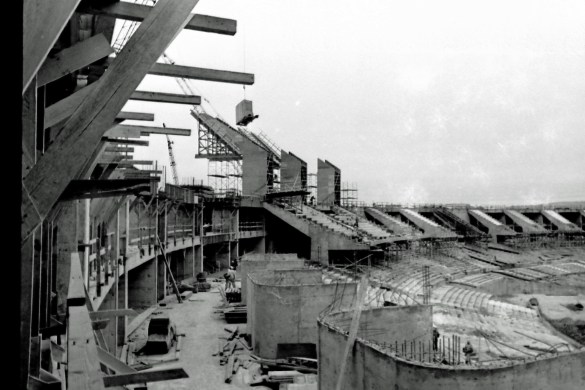
An under construction Coliseum in more hopeful times

An under construction Coliseum in more hopeful times

Nevertheless, that’s the outcome MLB sees. It’s one that A’s management is willing to play along with, for now at least. It doesn’t mandate getting a ballpark built right away or even soon, thanks to a lease that can take the A’s through the 2024 season.

Like Lew Wolff assuming that The Lodge would work out a deal for San Jose, MLB assumes that the Raiders are in LA after 2015. But even that’s difficult to forecast at this point. Stan Kroenke’s Inglewood stadium plan has the most momentum at this point, and the Carson concept is being spearheaded by the Chargers. Both teams have plans to accommodate a second team, though they have both declared that a second team is not a necessity. The NFL wants no more than two teams in Southern California (including the San Diego market). Those two teams could be the ones spearheading separate stadium projects. Or they could partner together on a single stadium. The Raiders, not having their own stadium plan to push, have to hope that Kroenke’s plan falls through and Carson succeeds, allowing the Raiders and Chargers to be the LA teams. If Kroenke gets his stadium, it doesn’t matter whether the Chargers stay in San Diego, move to Carson in their own stadium, or partner at Inglewood, the Raiders are the odd man out. There’s the odd chance that either the Chargers or Raiders could move to St. Louis, but few outside of St. Louis are considering the idea seriously.

Therefore, MLB’s hopes rest with a very silent man who has little interest (and zero actual financial interest) in baseball. Kroenke owns or has owned franchises in every other major sport, including top tier English soccer (Arsenal).

Whither the A’s in all of this? As usual, that depends. If the Raiders are shut out of LA because of the Rams’ and Chargers’ activity, the Raiders would effectively be forced to work on a stadium in Oakland, ostensibly at the Coliseum. Naturally, that would conflict with the A’s and MLB’s plans. Don’t believe for a moment that either team or league is going to actively work with the other on a joint development plan. With no public subsidy in sight, the Raiders and A’s will look to horde whatever revenue-generating opportunities they can, whether we’re talking entitlements or parking. Either way, that will run into conflict with Oakland’s designs on the Coliseum land, which are to create a new neighborhood with up to 10,000 new residents. Strangely enough, a “same as existing” use plan for the Coliseum lands would work best for entrenched interests in the area, including East Oakland residents concerned about gentrification and businesses west of 880 fighting against losing industrial land.

Should the Raiders look elsewhere in the East Bay, the A’s would be in the driver’s seat for the Coliseum. Yet as previously investigated sites are eliminated – Camp Parks and Concord NWS have their own plans underway – the Raiders will be even more boxed in at the Coliseum. Worst case they stumble to Santa Clara, where they would play tenant to the 49ers instead of the JPA. Chances are that they’d partner with a developer (SunCal?) for the Coliseum. Finally, that choice that I’ve been talking about for years, the one nobody in the East Bay has wanted to talk about publicly, would have to be made.

That doesn’t mean any choice would be made immediately, let alone a stadium built. Look at what happened for the San Jose Earthquakes. The team was reborn in 2008, had a stadium promised in 2010, didn’t start construction until 2012, and didn’t open until 2015. Seven years, and for a city that Lew Wolff actually loves. It’s easier to start construction when you’re absolutely sure the checks will come in.

Having to privately finance an entire stadium is hard enough, now the A’s would have to do so in small market Oakland. It’s not even so much about whether Wolff and John Fisher want to do it, does MLB want to subsidize it for 30-40 years via revenue sharing? If the A’s are going to carry a big mortgage in Oakland with iffy corporate support, revenue sharing seems an absolute necessity to keep the A’s in good financial health. That’s the alternative to negotiating with the Giants.

And if the Raiders build at the Coliseum instead? Well, the A’s would be able to leave the Coliseum, but for where? San Jose is not a player in this scheme, but you’d be surprised at what avenues can open up once MLB runs out of options and leverage. That might mean Diridon, it might mean Howard Terminal. It would be fitting for MLB to actually do something after years of actively sitting on its hands. As long as the A’s remain in the Bay Area, even severely delayed progress would be well worth it.

A’s show off scoreboards before season begins

The A’s invited media to the Coliseum on Friday, in order to showcase the fancy new scoreboards, ribbon boards, and a slew of additional improvements at the Coliseum. Fought over by the team and the City for more than two years, the change marks the first significant improvement at the old venue since Mt. Davis was erected 20 years ago. Karl Buscheck of Bleacher Report got a few pictures.

Apparently when the media was brought in, they saw what appeared to be the old scoreboard. It was actually a reproduction of the layout and ads on the original scoreboard, auxiliary fascia board, and DiamondVision, right down to “broken” lamps in some places. That was transformed into the modern design, which can accommodate significantly more information and even dual HD video feeds side-by-side.

The equipment took several weeks to install and test, not to mention the construction of a two-story control room inside the press box. On game days the video control room will have up to 18 people in it, managing everything from replay feeds to ads to in-game score and that new between-innings clock.

As we discussed a couple months ago, each screen on its own would place in the middle of the pack as far as displays in MLB ballparks go. The difference between the boards at the Coliseum and those at other ballparks is that the Coli’s displays are much further above and behind the seats than comparable displays elsewhere. Knowing this, graphic designers for the new system worked on font sizing to ensure that everything was crisp and legible even from far away. Some elements are similar to those at Hohokam Stadium, such as the 90-degree tilt for stat types. Tweaking is likely as more games bring in more fans to provide feedback.

Other improvements to the Coliseum were announced:

  • A 30-person President’s Suite on the Club level, created out of two suites
  • Interactive team shop on lower concourse behind Section 105, including jersey press and bat engraving stand
  • Weight room for visiting club
  • New press conference room for media availability (the old one was the size of a master bedroom)
  • Renovated press lounge

I won’t be there in person for the first homestand, but I’ll be there soon enough. In the meantime, send in feedback when you get your first look.

Oakland approves Coliseum EIR & Specific Plan, Raiders lease, Arena refinancing

Thank Jeebus for meeting minutes. I was only able to catch part of the Coliseum City agenda item during the March 31 City Council meeting. Oakland voted 7-0 with one abstention to certify the EIR and Specific Plan, figuratively paving the way for financiers and developers (and, Oakland hopes, at least one team) to make CC happen. The good news is that a major bureaucratic hurdle has been overcome. The bad news is that several key issues related to the project haven’t been resolved.

As has become commonplace over the past few months, a litany of residents and business in the Plan area and surrounding neighborhoods made their way to the mic to address specific concerns. The business owners got their biggest concern dealt with, housing in the Airport Gateway area west of 880. Zoning has been changed to eliminate housing in that area, referred as C/D/E in the Plan. They also got housing eliminated from Area B, along Edgewater facing the Estuary.

D-CO-4 (along Estuary) has become part of D-CO-3

D-CO-4 (along Estuary) has become part of D-CO-3

The change is nothing to sneeze at since it removes 1,750 units out of 5,750 total. All 4,000 units will be located in either around the BART station (2,300) or as part of the “Ballpark Village” at the Coliseum (1,700). That puts even more pressure on money men and developers to figure out creative ways to bridge the football stadium funding gap. It’s also a blessing in disguise because putting housing right on the water was expected to be highly contentious, any development requiring numerous approvals from outside agencies (ALUC, BCDC, EBMUD, EBRPD to name a few).

Residents of East Oakland found less to agree with, thanks to a lack of consensus on just how much affordable and low income housing would be built there. In the post-redevelopment era, Oakland has set targets of 15% of units as affordable or below market rate. Unfortunately, funds used to help subsidize affordable housing have dwindled to practically nothing. The normal instrument for replenishing such funds, housing impact fees, continue to be merely a study topic for Oakland with no release of the study – let alone decision on how to enact such fees – until next year. Larry Reid, in whose district lies the Coliseum and East Oakland, continued his protest against having affordable housing at Coliseum City, running directly in opposition to many of his own residents who maintain concern over gentrification and rising rents in the neighborhoods surrounding the Plan areas.

A community benefits agreement negotiated weeks ago is meant to provide jobs, but that’s the low hanging fruit of the project that is entirely dependent on what gets built. Those jobs won’t materialize on their own. They need a catalyst and willing developers to bring those jobs to fruition.

All of that is not to diminish the accomplishment of getting the EIR work done. It’s done, and while it’s not perfect, it’s an important benchmark to getting something built. The actual deal – that’s the hard stuff. As of today Floyd Kephart has about 11 weeks to start making good on his deliverables.

Not reported elsewhere were two other important items that were also on the agenda. The Raiders lease, which was approved at the JPA level a month ago, was approved 7-0 by the City Council last night. One year, no drama. At least until the fall.

—-

Oakland is also wrestling with what to do with the Arena. The Warriors may be hell bent on leaving, but that isn’t stopping the City from incorporating the Dubs into Coliseum City, hope against hope. In the near term there’s also the problem of the ongoing debt at the Arena, whether or not the Dubs are there past 2017-18. Despite the ongoing uncertainty, the City and County have until June 21 of this year to refinance that debt. Without refinancing in place they could be liable for $19 million per year thanks to the expiration of a letter of credit. Refinancing at current historically low rates could save $10 million per year regardless of the Warriors’ plans. Refinancing would also require meeting of some sort of “seismic criteria,” which could involve a retrofit or other additional work to keep the venue in good shape.

Refinancing was approved 7-0. The Warriors may not be much longer for Oakland, but the City and County appear to be getting ready to move on after the Warriors leave.

Prominent developer SunCal brought in for Coliseum City study

SunCal, a large developer based out of Irvine, was brought into the Coliseum City project this week. Their role isn’t as the project’s master developer, it’s to determine whether the stadium, parking, and ancillary development can all properly fit on the 120-140 acre Coliseum site. Intriguingly, SunCal was brought in by the Raiders and Mark Davis, who have lingering concerns about having enough parking for football games.

SunCal has plenty of experience in the East Bay, having worked previously on Alameda Point before the project drowned in a sea of hubris and red tape. They also resurrected the long dormant Oak Knoll redevelopment plan, which had previously suffered from the depths of the recession.

New City’s Floyd Kephart wanted to make clear that SunCal’s role here is as a consultant:

Presumably, SunCal’s study, which was not a specific requirement for the ENA, will help guide Davis’s decision making process later this year. Just as important, it will probably guide the NFL’s. The league really likes plans with tons of parking, as seen in both the Inglewood and Carson plans. The hypothetical, then, is what if SunCal comes back with a larger parking requirement than is prescribed in Coliseum City? Of the 13,000 spaces programmed into the project, only 4,200 are surface parking (good for tailgating and buses). Everything else is in a garage, which when Lew Wolff mentioned the difficulty with garages, he got hammered. I wonder what will happen when the Raiders want more surface parking for their stadium.

Sure, there is BART, which according to the Raiders currently serves 30% of fans. You still need, well, 13-15,000 spaces for everyone else. And we have no idea whether SunCal’s study will include a baseball stadium.

SunCal could also find the project attractive enough to become the master developer, which would be a huge positive. Unlike Alameda, where SunCal is persona non grata, they don’t have a poisoned relationship with Oakland. They could be exactly what Coliseum City needs, though it’s clear they are acting in a thoroughly noncommittal role at the moment.

When I first heard the news I was surprised that it hadn’t gotten out at the beginning of the week, as the NFL owners meetings started. Then I saw SunCal’s limited role and it made more sense. If they express more interest in May, then it’s something for Kephart and Oakland to hang their hats on.

City and County set new targets for Coliseum City ENA

Update 3/19 1:20 PM – Oakland’s City Council has scheduled a special meeting for Friday, March 20 at 11:30 AM to vote on a resolution supporting the ENA. You can find the agenda at the meeting link. In addition to the deadlines set forth in yesterday’s news, there’s also an option to extend the agreement for up to six months if some of the deliverables aren’t met or other holdups. There’s also this:

competing

Nothing about the “alternative proposals” shows up in the resolution, however. Once the City and County both approve the ENA including this facet, the A’s (and Raiders for that matter) could start sending in their own concepts. I expect one at some point from the A’s, but as noted previously, they are under no deadlines to deliver anything as New City and the Raiders are.

Original post:

Yes, we wrote two months ago about how the City of Oakland and Alameda County were coming together to work on Coliseum City. The signs were that both parties were finally on the same page.

Well, we’re hearing the same thing again, though this time it might actually be for real. After some back and forth between the County and Floyd Kephart of New City, the County’s Board of Supervisors are looking to vote on the ENA at the end of this week. Or early next week. Or something. The SF Business Times’ Ron Leuty has the details.

Besides the ever plodding deal machinations, Leuty also picked up the new terms of the ENA. June 21 marks a midterm deadline for New City to provide certain deliverables. The “final” deadline is August 21, with even more deliverables. All told it’s 23 separate items, all important, few minor.

June 21st’s set is all about creating the framework of the deal. It should answer basic questions like How many teams will be involved? and How long will it take to develop?

  • An initial financing plan for a new stadium for the Raiders, including ancillary development and land and infrastructure to support a potential new stadium for the Oakland Athletics. It will include projected sources and types of funding as well as the estimated equity stake from New City, its partners and affiliates.
  • Terms and conditions required to win a commitment from the Raiders, A’s or the Golden State Warriors to Coliseum City. This will include an update on the status of negotiations between New City and each team.
  • Initial site plans for new Raiders and/or A’s stadiums.
  • Financial and market feasibility analyses for various elements of the development other than sports facilities.
  • A development schedule for the sports facilities and ancillary development, including the timing of entitlements for all phases of the project.
  • An estimate of infrastructure cost and a funding plan for the infrastructure, including a list of potential regional, state and federal grant sources.
  • Plans for tax financing districts for infrastructure.
  • A preliminary plan for subdividing parcels, if needed.
  • Proposals for addressing the existing Coliseum debt.
  • Proposed timetables for disposing of land for various parts of the project.
  • An outline contracting plan.
  • An outline community benefits plan for the project.

August 21 is about buttoning up the deal and figuring out all of the little details defined in June.

  • A detailed description of the plan for project development.
  • Refined terms and conditions required to win a commitment from the Raiders and/or A’s and a project schedule for obtaining a commitment.
  • A refined financing plan for Raiders and/or A’s stadiums, including identification of all sources of financing.
  • A refined description of the financing structure for ancillary development and the proposed developers for each element of those pieces of the development.
  • A clearer schedule for development of the stadiums and the ancillary development, including the timing of entitlements.
  • A better estimate of infrastructure cost and a funding plan for the infrastructure.
  • A refined proposal for establishing tax financing districts for financing infrastructure.
  • A clearer plan for subdividing parcels.
  • A refined proposal addressing existing Coliseum debt.
  • Proposed terms for the lease disposition and development agreement and financing for various elements of the project.
  • A refined contracting plan and community benefits plan.

By late April we should expect that the EIR will be certified and the Specific Plan approved, which are their own framework in that it defines zoning. With that zoning component there are no entitlements on which developers can build at the Coliseum.

To date many of the deadlines put forth by the City have been about timing in concert with some important date for the Raiders and the NFL. Previously the ENA was supposed to be completed before the 2014 season over, then before the franchise relocation window opened, then 90 days from that (April). Now the ENA deadline is being pushed to just before the 2015 NFL regular season starts. That itself is arbitrary, and allows for yet another 3-5 months of slack before the Raiders have to make a decision on LA or another possible move. With that in mind, I fully expect Coliseum City to slip yet again past August. The list of deliverables above is daunting. The DDA alone can take months to put together. While everyone’s operating from the notion that once a team signs on everything else will fall into place, there’s little reason to believe that negotiations will be that tidy. This project has a growing number of stakeholders, including housing and jobs activists who will make their stamp on a community benefits agreement. The financing for a project of this size is incredibly complex. And the City and County have to be on their toes to ensure that they don’t get taken by the private stakeholders in the project: New City, developers, and the team(s). Without clear terms done in thoughtful, deliberate manner, you get Mt. Davis.

I haven’t mentioned the A’s or Lew Wolff yet. Wolff has made his position clear in that he has no interest in Coliseum City. The difference for him is that he and the A’s have no deadlines, arbitrary or otherwise. What happened to the idea of allowing competing bids? That appears to have disappeared into the ether. For now.

Tenth Anniversary Edition: A Decade of Running in Place

If you’ve been around from the beginning (you probably haven’t), you may have read the very first post I made to this blog on March 14, 2005. That was ten years ago. Here’s a quick, incomplete list of things that have happened since then:

  • Bud Selig stays commissioner until 2015, is replaced by Rob Manfred
  • Expos move (are bought-contracted-expanded) to Washington, DC
  • Six new ballparks open throughout MLB (in St. Louis, DC, New York twice, Minneapolis, and Miami)
  • Levi’s Stadium developed and opened
  • Warriors get new ownership, declare intent to move to SF, buy land for arena
  • AEG moves SJ Earthquakes to Houston. Team is reborn in 2008, has stadium built for 2015 season
  • A’s propose ballparks at sites in Oakland, Fremont, and San Jose – none are successful
  • Oakland is on its fourth mayor since the blog started

That same day I posted about the A’s potentially building a ballpark south of the existing Coliseum. Pending what happens with Coliseum City, we may be talking about that very same possibility in the future. Weird how things might come full circle, eh?

As we wait for good news on the stadium front, I have some good news of my own. A couple years ago I asked for donations for the site to keep it running. Many of you responded very generously. which helped keep the site and my continuing work going. This site is a labor of love, so I haven’t asked for donations much (twice to my recollection). Back in 2013, I promised those of you who donated that I’d provide a sort of digest of previous posts. I tried many times to compile and curate that digest, but over time I’ve learned that I am a much worse editor than I am a writer (which is already rather questionable). Everything read like filler, not moving the narrative forward. I put that aside for a while and swore to get back to it. It wasn’t until earlier this year, when I put together the timeline feature, that it all came together. I was able to put together all the necessary posts, with additional context inserted where necessary. So I’m proud to announce that I have that “book” ready. The download link is below. Those of you who previously donated have already gotten the link via email. Please take a look at it and provide feedback if you like. If you donated and haven’t gotten the book, send me a note/tweet and I’ll make sure to take care of you. And if you have already donated, you don’t need to do anything else, but if you want to donate again I won’t stop you.

I’ve titled the book:

A Decade of Running in Place: A Digest of Selected Blog Posts from the First Ten Years of Newballpark.org

Book download link (Scribd, PDF)

Donate Button

I’ve poured over a million words, 10,000+ hours, and my entire heart and soul into this site. The A’s getting a new ballpark has been a dream of mine since high school, when I first saw drawings of New Comiskey Park and Camden Yards. I don’t expect anyone to have the same kind of obsession with this topic that I have. I figure that I’ll be the obsessive so that you don’t have to be. Thousands of people read this site every day. About 2% of them have donated. If you value the work here and the process, please consider donating. $10 would be great.

The book weighs in at 210,000 words and 664 pages in PDF format. It’s entirely in chronological order. There are what appear to be section or chapter markers. Those are points at which I think the scene shifts. They aren’t meant to encapsulate the story.

Editing and pagination are rough, mostly having to do with the transition from web to print-ready format. I’d like to take the time to give it a whirl in InDesign, with the ultimate goal of making printed copies. A donated of $25 or more would get the ball rolling.

Since this is the 10th anniversary, I’ve started thinking of other things to commemorate this milestone. What do you folks think? T-shirts? Caps? Stickers and decals? Should I do a crowdfunding campaign? I’m all ears at this point. Some of you readers are creatives of different stripes. Send me your suggestions.

Finally, many thinks to all the readers over the years. I’ve met and become friends with many of you. We’ve broken bread, gotten beers, talked plenty of things besides an A’s ballpark. It’s been a pleasure. It will continue until the day that this blog is no longer necessary. After all this time I still hope. I think many of you do too. It’s what binds us. I don’t know how much longer it will take for the A’s to get a new home. Another 10 years? 10 months? However long it takes, I’ll be here for the ride. I hope you enjoy appreciate it as much as I do.

P.S. – Special thanks to Susan Slusser, who suggested the timeline a couple months ago while working on her own A’s history book (due this summer and highly anticipated). Without that I never would’ve gotten properly organized.

P.P.S. – This is not “the book” that I’ve been talking about writing. That book is still very much in progress.


Raiders could stay at Alameda HQ through Feb 2019 even if they leave Oakland next year

Update 10:00 AM from Steven Tavares:

Original post:

When the Raiders balked at paying past due rent at the Coliseum last month, we figured it had something to do with the lease extension, but we couldn’t figure out the rationale. Now, looking at the new lease terms – set to be voted on by the Coliseum JPA Friday morning – there’s little that stands out. There are clarifications on how to handle signage and advertisements inside the stadium, along with updated parking revenue definitions. The $400,000 in back rent will be paid. Then I saw this:

7.5 Additional Payments for Use of Permanent Training Facility and Training Site. If the Raiders announce a relocation or sign a lease to play football games outside of the City of Oakland or Alameda County (a) for the 2015 season prior to March 1, 2015, then, commencing on March 1, 2015, or (b) for the 2016 season prior to March 1, 2016, then, commencing on March 1 of the year following such announcement Raiders shall have the option of continuing to use the Permanent Training Facility and Training Site for up to thirty-six (36) months, up to and including February 28, 2019 as determined in Raiders’ discretion. For the first two years, Raiders shall make an additional payment to Licensor each month for continued use of the Permanent Training Facility and Training Site in an amount equal to the fair market rental value of the Permanent Training Facility and Training Site on a monthly basis, as determined by a mutually agreeable licensed commercial real estate broker based on comparable rental space. Raiders and Licensor agree that the fair market rental value shall not exceed $525,000 per year for the first two years. For the third year, Raiders shall pay Licensor an amount of One Million Fifty Thousand Dollars ($1,050,000), payable monthly in equal installments. In the event the Raiders are engaged in good faith discussions concerning an extension of the Operating License or other arrangement for the Raiders to play future Football Events in the OACC Stadium as of March 1, 2016, any obligation to make payments shall not commence while such discussions are continuing and the thirty-six (36) month period and obligation to make additional payments shall begin when Raiders agrees to play football games at a location other than OACC Stadium for the 2016 season; provided, however, that if Raiders agrees to play football at such other location, Raiders shall pay such rental payments retroactively from March 1, 2016.

Compare that to the same clause from the 2014 lease, which allowed for 24 months of training facility use and ended on February 28, 2017. Now they’ll get an extra year, giving them until early 2019 to stay. That could prove useful if the Raiders head to LA for the 2016 season, but the Carson and/or Inglewood stadium plans fall apart in the interim.

It’s a great situation for the Raiders, allowing them to stay fairly cheaply in Alameda while entertaining stadium concepts in Oakland, LA, etc. Allowing the team to be in Alameda past the 2018 effectively gives Mark Davis a three-year grace period, even if the Raiders leave Oakland starting with the 2016 season. If they stay at the Coliseum and engage in further stadium talks, rent on the facility is abated.

Can, kicked.

The grace period allows Davis to not have to look for or build a training facility in LA right away. He could continue to keep the team training in LA, fly them down for “home” games at a temporary stadium on the weekend, and fly them back up Sunday night. The stadium plan in Carson has to be modified to include a second team training facility, though chances are it wouldn’t be ready until at least spring 2018, based on what we know about the political landscape involved and construction lead times.

Let’s be clear about this: a training facility is not make-or-break item when billions of dollars of stadium speculation are the order of the day. It’s still a critical part of team operations. That’s where players will be 5 of 7 days every week during the season, and where they’ll report going back to OTAs. Now it makes more sense that the Raiders are funding improvements to the weight room and other parts of the facility, since they know they’ll be there for a few more years.

As usual, it’s Davis looking out for his team first. Maybe he’s not so different from his dad after all.

Oakland Planning Commission postpones Coliseum City vote to 3/11

Update 3/11 – After another round of comments, the Planning Commission unanimously approved the Specific Plan and Zoning changes. There will be additional public meetings (see schedule below), including City Council sessions on 3/31 and 4/21. The last meeting is when the EIR can be certified.

Original post:

The night started with a report on affordable housing, and pretty much ended with a discussion about affordable housing. Item #3 in tonight’s Oakland Planning Commission meeting was Coliseum City, but the debate among the commenters wasn’t much about environmental impacts or zoning as was expected. Instead it was something of a face-off between Raiders fans who believe that Coliseum City will bring much needed jobs and an economic boost to the area, and East Oakland residents and advocates who fear the displacement effects CC could bring.

Public comments were taken for a good two hours. Many commenters had signs or stickers that said “Public Land Public Good.” They focused on trying to get living wage jobs as part of the deal, truly affordable housing for locals, and rent protections against broad speculation. One speaker noted that 70% of residents in the Coliseum’s ZIP code are renters, so there’s likely to be a solid base of potentially affected citizens.

If that wasn’t enough, the Commission announced that the information packet for the agenda item wasn’t complete, so they would be forced to move the item to a special meeting on March 11. Oral comments were still taken during the meeting, and written comments will be accepted through the 11th, but the vote will be taken next Wednesday.

That won’t be the only vote, as the process must continue. Several other public meetings are planned, culminating in two City Council actions three weeks apart. A first reading of zoning changes and adoption of the Specific Plan are slated to occur at the end of March. A final vote to certify could occur as early as April 21. Here’s the list of remaining meetings:

  • Planning – 3/11
  • ALUC – 3/18

City Council

  • CED – 3/24
  • 3/31 – First Reading of zoning, adoption of Specific Plan
  • 4/21 – Second Reading of zoning

That last date is 60 days after the EIR was distributed, which makes the approval process technically kosher. Since tonight’s meeting was rather light on EIR discussion, I’ll cover that separately tomorrow. I fully expect the EIR to be certified and approved, if only because it’s so vague on what the actual project is.

Until then, I’ll leave this Keith Olbermann interview of Jerry Springer (h/t @StadiumShadow). Skip to 4:21 for the relevant stadium discussion.

Tomorrow I’ll get into many of the EIR details that weren’t covered in the meeting.

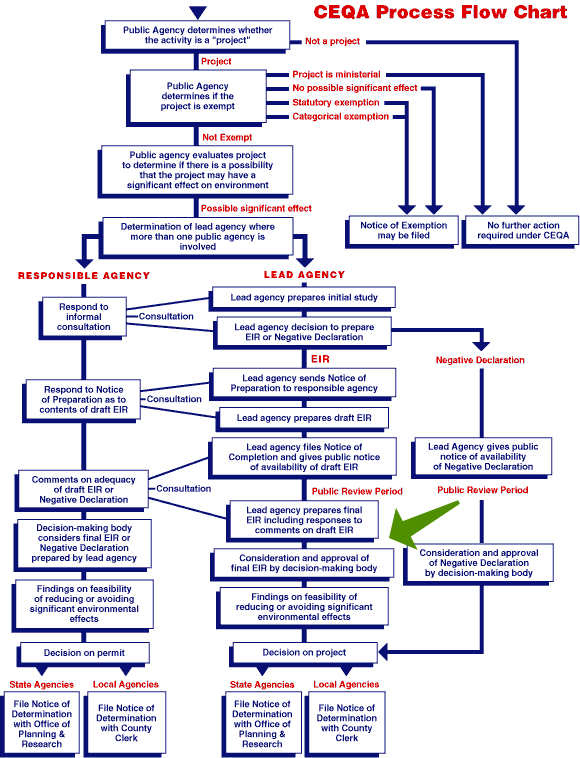
P.S. – In case you’re wondering, the green arrow on the chart below shows where Coliseum City is in the CEQA process. Keep in mind that this has nothing to do with funding the project or getting teams to sign on.

ceqa_process_chart-arrow

P.P.S. – The real highlight of the night was this:

Wolff wants surface parking over garages and development at Coliseum

Here we go again with that nasty word: infrastructure.

Lew Wolff told Matthew Artz today that not only was he not interested in Coliseum City, he felt there isn’t enough space at the 120-acre Coliseum for development the City desires and the surface parking the team needs. That’s a major revelation because Wolff’s vision not only precludes other development in what’s considered a potentially high-density transit hub area, it goes against the City’s goals for the Coliseum.

There’s a lot that’s being unsaid by Wolff, who demurred on questions about financing and multiple venues. Let’s focus on what he said.

The only way it could work, Wolff said, would be to build multilevel parking garages, but that would leave fans waiting in long lines to exit the garages and begin their drives home.

‘Parking is a key issue for us,’ Wolff said. ‘We want surface parking surrounding the ballpark wherever we build it unless we’re in the heart of a downtown.’
‘We said it before he even came on the scene that we are going to 100 percent control our own destiny, period,’ Wolff said. ‘We don’t need a third party involved.’

First off, let’s be clear about how much land is available: 141 publicly owned acres in the area bounded by 66th Ave, Hegenberger Rd, 880, and Damon Slough. Take away 18 for the existing Coliseum or its replacement, and 8 for the arena if it stays. There’s other stuff like the sewer interceptor and power lines, but we’ll leave that out for now. The remaining land totals 115 acres.

As Andy Dolich notes in the same article, garages are ill-suited because they’re expensive and don’t get utilized well. Parking garages cost around $20,000 per space to build. ROI can be difficult to achieve unless those garages can be filled nearly everyday. But the City is supposed to fund infrastructure like garages at Coliseum City, so why is this such a big deal? The surface parking requirement, which Raiders owner Mark Davis has also communicated at times, stands in the way of the City’s plans for Coliseum City, whether you’re talking 120, 200, or 800 acres. The Coliseum City plan has 13,000 event parking spaces in it, only 4,200 of which are surface spaces mostly in the south lots out to Hegenberger.

Blue and dark gray are garages, medium gray is surface parking

From the Coliseum City Specific Plan: Blue and dark gray are garages, medium gray is surface parking

Shouldn’t 4,200 (or maybe 5-6,000) spaces be enough for most A’s games when taken with a few thousand new garage spots?  Especially if the TPMP (Transportation & Parking Management Plan) were conceived in a way to manage traffic from these various lots and garages? Especially if it’s only a single venue such as a ballpark? Let’s say that the A’s average 30,000 in attendance at a new ballpark. According to BART, 15-20% of fans take the service. Let’s make it 20%. That means 24,000 will come in cars. At 3 per car, the A’s would need 8,000 spaces. So they’d need some 2-3,000 additional spaces, maybe half of those in garages, the rest in a remote lot on the other side of the complex where people would have to walk through the retail/commercial area to get to the game. That way you have everyone covered:

  1. Fans who want direct access to the ballpark and the quickest in-out (4,200 surface spaces adjacent to ballpark, south)
  2. Fans who want to have dinner/drinks at a restaurant nearby (3,000 garage spaces, perhaps with validation, center)
  3. Fans who want cheap parking and don’t mind walking through the business district (3,000 remote surface spaces, north)

If you look at the parking depiction above, it’s not hard to see how that would come together. Put the ballpark where the football stadium is and the remote parking where the ballpark is and you have the basic concept. The idea presupposes that the arena is no longer there either.

The problem, as ever, is that no one wants to pay for any infrastructure like parking. A 2,000-space garage is bad enough, and it’s merely a piece of the $300 million of infrastructure. Wolff has suggested that he’d take care of the Mt. Davis debt, but if he has to pay for infrastructure too it starts to become too much. The City has suggested a slew of taxes that would pay for it through huge Mello-Roos and infrastructure financing districts, but that isn’t certain. Some of those taxes would eat into A’s revenues, so again it becomes a question of cost-benefit for the A’s.

In the end, if the A’s and the City/County are going to make this work they’ll have to come to a compromise. Whether the A’s claim a large piece of the land for ballpark and parking and leave the rest for the development, or the A’s control development rights to the whole thing, they’ll have to come half way. That also means the City will have to dial down its pie-in-the-sky dreams of a bustling second downtown anchored by multiple sports venues for something a little less ambitious. There probably is a way to accommodate both Wolff’s and Oakland’s goals. It’ll take a lengthy negotiation, which I should remind you, hasn’t happened yet. In fact, we’re not even close to negotiating yet.

P.S. – Would you believe that until last year, there were no major pro sports venues in the Bay Area with adjacent or nearby garages? It’s true. The Coliseum, which houses three teams, obviously has no garages. Neither does AT&T Park, which has surface parking across Mission Creek from the ballpark. SAP Center has multiple surface lots, including an elevated lot next to the arena that some might mistake for a garage. Candlestick Park had a small peninsula of parking next to it.

That changed when Levi’s Stadium opened last year. As part of the deal, an 1800-space garage was built directly opposite the stadium on Tasman Drive in Santa Clara. That garage has been notorious for excruciatingly long waits to leave, thanks to its single point of entry/exit. Wolff knows this because his Earthquakes opened Levi’s last summer, Quakes fans as guinea pigs. As we saw with the Sharks-Kings Stadium Series game over the weekend, parking and transportation is still a puzzle that hasn’t been figured out by the 49ers, Santa Clara, and VTA.

Other ballparks in suburban locales (Dodger Stadium, Angels Stadium) also don’t have garages. PETCO Park, Chase Field are downtown ballparks with attached garages that work well in concert with other nearby parking options. Coors Field has practically all surface lots available as parking. Downtown ballparks not only have garages or plenty of nearby parking infrastructure, they have the proper street grids and built-in traffic management needed to support large events. The Coliseum City plan is not set up like a new downtown with many ways in and out. It’s essentially the same plan as before, which has led to poor level of traffic service (LOS) grades in the Coliseum City EIR. It’s natural for Wolff to want to avoid the Levi’s situation.