Brown to Redevelopment: Your days are numbered

Governor Brown just finished his press conference, where he explained his budget plans. Brown is pushing for $12.5 Billion in spending cuts, and he is asking the legislature (and the voters) to extend temporary income, sales, and car taxes that are set to expire this year. As for the redevelopment golden goose, Brown said that existing (already bonded) projects are safe. New projects, on the other hand, are in trouble. Brown wants to “phase out” redevelopment agencies and start taking back $1.7 Billion in tax increment annually. What it comes down to is this: If you don’t have your project started and well underway in the next 12-18 months, you are screwed. There continues to be some debate as to how the governor could eliminate RDA’s, with the agencies enshrined in Article 16 in the Constitution and recently passed Prop 22 acting as protection. The governor seems to be saying, “If we get rid of RDA’s, there are no more protections.” Yow. Okay, who would this impact? Let’s put together a list:

  • San Jose Diridon Ballpark – While the City is speeding up land acquisition, what about Autumn Parkway and other mitigations? Will the funds be in place for the rest of the project, or will it get kicked down the road?
  • Oakland Victory Court Ballpark – Oakland already had to deal with a tight schedule based on a 2015 Opening Day. Now, Oakland will have to get its bonds raised and land in place right around the time an EIR is certified, or even before certification. Expect for Oakland to push MLB harder to decide in its favor, even without anything significant in place.
  • 49ers Stadium in Santa Clara – The quasi-public stadium authority would have to get its loans and/or bonds in place in the next 18 months as well.
  • New Raiders Stadium at the Coliseum – A new stadium is practically a nonstarter given the funding questions. Expect the Raiders to look south sooner rather than later.
  • Downtown Los Angeles NFL Stadium – The now $1.5 Billion stadium (+$500 million in the last two weeks) would require $350 million in bonds, which won’t be available if RDA’s go away.
  • City of Industry NFL Stadium – Ed Roski’s plan involves his own land, but much of the stadium cost would be funded by tax increment on the land improvements, thanks to much of the city being one large redevelopment zone. Uncertainty regarding RDAs makes the prospects for building infrastructure for the stadium and ancillary development, murky at best.
  • Sacramento Kings Arena – As Kevin Johnson’s arena task force continues to talk things out, time is running out, especially for an arena at the long dormant Railyards.
  • San Francisco Arena – Land south of AT&T Park could serve as the site for a new arena. Controlled by the Port and with development rights given to the Giants, it’s likely that any dev plan there will require at least the same kind of public outlay that made the ballpark deal work. Proponents would have to find another source for that funding.
redev_cut

Slide captured from the governor’s briefing

The message is abundantly clear: If you want to get something built, get a move on. (BTW, take a look at the counter on the right today. Eerie.)

CBA Talk 2011: A comparison of leagues

Three of the four major professional sports leagues have collective bargaining agreements which will expire later this year. In the NBA and NFL, discussions between management and labor have been contentious for at least the last year, with threats of work stoppages all too real and quite likely. That makes MLB an outlier, as there has been little tension in its ongoing labor discussions, even though its CBA will run out only a few months after the other two leagues’. The NHLPA authorized a one-year extension of its current agreement in the fall, allowing its CBA to expire after the 2011-12 season, but under the terms of the agreement, no further extension can be negotiated between the union and league. With Donald Fehr brought in to helm the NHLPA’s side of future talks, the players there aren’t looking to go soft at the table.

Before we get into the details, I’ve put together an overview of each league’s current CBA, sans drug testing details. Next week, each league will get its own post and in depth analysis. For now, take a look at the table and if any questions or corrections come to mind, throw them into comments. Every effort has been made to verify all of the data in the table, including each league’s CBA documents when possible. Still, there may be some issues with what’s reported, so here’s your chance to fact check. It’s also your opportunity to steer the discussion in a certain direction if you so choose.

I look forward to your questions and comments. Until then, enjoy the rest of the football weekend. My thoughts are with those who were senselessly hurt or killed at the Tucson atrocity today, and their families.

The Big Not So Easy

I’m multitasking this evening. On the plasma is basketball, first the Warriors and their furious 4th quarter comeback victory over New Orleans, and then Lakers-Suns. On one LCD monitor I’m watching the Microsoft/Steve Ballmer keynote address at CES. Some graphics are being put together on another screen for this post and a special project I’m working on. I’m watching my Twitter feed regularly, and I’ve got dinner in the oven.

Now, thanks to commenter Vince, I have to follow some new rumor about Larry Ellison’s interest in the NBA-owned Hornets. A blog entry by Forbes sports business guy Mike Ozanian indicates that Ellison could pursue the team with the intent to move it to San Jose. There’s a possible revenge/rivalry angle to the deal, as Ellison failed to buy the Warriors while the Lacob-Guber group put up the winning (and on-time) $450 million bid.

First off, let’s synopsize the Hornets’ situation. The team has struggled to get decent attendance in the post-Katrina era, despite having a decent team, a new arena, and a bona fide superstar in point guard Chris Paul. In three full seasons since returning from Oklahoma City, the team has averaged only 15,402 per game. This season, the Hornets average only 14,086 through 19 home games. Worse, the team has an out clause in its lease at New Orleans Arena in which it can leave the Crescent City if the team averages less than 14,213 during a 13-game stretch from December 1, 2010 through January 17, 2011. So far, the results aren’t inspiring if you want to keep the Hornets in town.

Someone may have to go out of pocket and buy 1,000 seats for each of the next two games to reach the target.

Hornets fans tend to respond to the schedule in a similar way to A’s fans do: show up for “event” games such as the Lakers matchup in the table above. Tonight’s crowd against a mediocre Warriors squad was a poor 13,532. Fans will have to average 15,428 over the next two games to reach the minimum 14,213 over the 13 games. Orlando should bring in a good crowd, Toronto most certainly won’t. Fans have gone as far as putting together 2-for-1 ticket deals to help get the count over the hump.

Last month I described the NBA’s purchase of the team from George Shinn an Expos-style deal. With the team bought for $310 million, the league and the other 29 owners stand to make a serious profit if the team does sell for $400 million or more. The league’s intent is to keep the team in the Crescent City, or at least that’s how it appears. Previous minority owner Gary Chouest was supposed to put together a group to buy the team, but his livelihood may have taken a hit after the BP Deepwater Horizon disaster. If a local buyer can’t be found – a process that probably won’t last more than a year – the Hornets will be up for grabs.

Ozanian’s piece puts the figure to move the Hornets to San Jose at $450 million, though that includes an unspecified amount of compensation to the Warriors for invading their 75-mile radius. The last NBA team to encroach upon another’s territory was the Clippers in 1984, who moved from San Diego after six ho-hum seasons at the Sports Arena. While the Lakers were not adversely affected by the constant cellar dwelling Clippers, there’s no guarantee that the Warriors won’t be affected by a second NBA team in the Bay Area. It would be a shock if Lacob-Guber didn’t level a sizable lawsuit at the league, trying to protect their near half-billion dollar investment. The NBA may have the most hard-nosed commissioner in pro sports in the form of David Stern, but he doesn’t have an leaguewide antitrust protection in his back pocket as Bud Selig does.

And Ellison won’t be the only interested party. The aforementioned Ballmer (whose keynote at CES was not exactly riveting) is Seattle’s Ellison, a man expected to bring the Sonics back to life. Unfortunately for Seattle, the lack of what Stern considers an NBA-quality arena in place is a considerable hurdle for the Emerald City. At this point, Seattle is just as hostile to new public sports venue financing as California is. Kansas City remains a town with an arena but without a white knight to bring a team in.

The upcoming labor situation in the NBA could be a determining factor in terms of when and to whom the team gets sold. Both sides are gearing up for a lockout, and if it proceeds like the one that shortened the 1999 season to 50 games, the timeline could be stretched out a few more months. The league could wait until a new CBA is ratified, as the Hornets could be more valuable with greater cost certainty ingrained in the new agreement. Then again, they could try to sell the team as quickly as possible, though this isn’t a league that is hurting for cash.

All of this leaves San Jose is a strange situation. With the specter of another redevelopment fund raid looming, San Jose has to pick and choose where it spends. The quest for baseball has spanned over five years in this attempt alone and there is still no light at the end of the tunnel. While the land investment for a ballpark would have greater potential (2+ million visitors per year vs. 750k for hoops), an investment in the arena and land for a Hornets practice facility may be a more prudent way to spend RDA funds. Even in better fiscal times, I can’t see San Jose having the resources available to attract both the Hornets and A’s simultaneously unless Ellison or SVSE footed the bill for all necessary HP Pavilion renovations and the practice facility (around 3 acres) as well.

The corners are vacant due to an older, less flexible seating configuration

As for the state of HP Pavilion, I’ve said before that it’s a good arena, but as it stands currently it wouldn’t be in the upper half of venues in the league. The seating bowl ends would need dual-rise seating tiers to maximize capacity and sightlines for basketball. The technology would also help change from hockey/arena football configuration to basketball more quickly. Yes, I said arena football, as the Sabercats are due to return to the AFL this March.

The biggest change may be in the area most fans don’t get to see. NBA standards don’t just include seats and suites, they include locker rooms and related amenities. The arena’s facilities are good, but they’ll have to be expanded just to accommodate an NBA team properly. While the Hornets won’t need everything listed in the plan below due to a degree of overlap, you get an idea how much space is required to house a team.

Note the size difference between the home and visitor locker rooms

It’s hard to say where and how an arena expansion could occur. It’s been 15 years since I was last in the bowels, covering the Warriors as a stringer while the team played its lone season at then San Jose Arena. I fondly remember one preseason game in which press row was placed in the hockey benches for some reason. Anyway, while there is some flex space at event level, it’s unclear whether that would be enough to make all of the necessary renovations.

In the long run, the biggest winner could be San Francisco and the Giants. If the Giants are intent upon building a new arena in SF, they’d be able to play Lacob-Guber and Ellison & Co. against each other in order to get a good deal for themselves, whatever that may be. Of course, by the time they’d get to make the deal they probably won’t have RDA to help with cheap or free land. You can’t win ’em all, I guess.

P.S. I would be remiss if I didn’t note how ironically bizarre it would be for the Ellison to send the Hornets to Oakland to play twice a season at the arena named after his company, while playing home games at the arena named after the company he just blew up publicly.

Also, Ellison has clarified (via the Merc’s Brandon Bailey) what his intent was with the Hornets:

“I did offer $350 million” for the New Orleans Hornets, Ellison told reporters, adding that he was “slightly outbid” by the National Basketball Association when the league bought the bankrupt team last month from owners George Shinn and Gary Chouest.

Ellison’s comments put a damper on the hope floated in a Forbes blog post that he planned to buy the team and move it to San Jose.

The prospect was warmly greeted by San Jose officials, intrigued with the notion of another pro franchise moving to the city, but Ellison flatly said the report was “not true.”

More grist for the mill.

P.P.S. An expansive article by the Merc’s John Woolfork about San Jose’s RDA just became available. The agency, which is the second largest in the state, pulls in $185 million in property tax receipts yearly.

What’s next for Oakland?

Now that funding for the Victory Court EIR has been approved, what will the next year-plus look like? How does the process work, and what could speed up or slow it down?

I posted a possible timeline for the EIR work at AN. Here’s the entire comment:

2011
Jan-Mar: Draft EIR prepared
Apr: Notice of availability, distribution of Draft EIR
Apr-May: 45-60 day comment period
Jun-Nov: Final EIR prep

2012
Dec: Final EIR notice of availability and distribution
Dec-Feb: Final EIR comment period (30-60 days)
Mar: EIR Certification, 30-day period to allow for challenges

That leaves anywhere from 12-18 months to do land acquisition, depending on if/when MLB gives the green light. That could be the biggest problem, since there’s little chance that Oakland will start negotiations or property takings if MLB doesn’t commit to Oakland. The later it starts, the worse it gets. Construction should start in a 6 month window between November 2012 and April 2013 if all parties want to make Opening Day 2015. Also, this schedule is based on everything going smoothly. For big projects in Oakland, often someone mounts a legal challenge that inevitably delays the process.

The final EIR prep may be shorter or longer because it is largely a response to new information requests and comments by various public agencies and private parties. There’s also the possibility that some of the methodology may be questioned, which could cause some portion of the EIR to be redrafted.

CEQA‘s flowchart shows more detail:

CEQA usually calls for a feasibility study to scope out the cost of mitigation for the project. That’s the last step before the City approves the project, and the cost of mitigation tends to vary greatly depending on what’s involved. This is often a point where lawsuits come in, because certain parties may not feel that mitigation measures are comprehensive enough or even completely lacking.

MLB could make this much easier on Oakland by making a decision in the City’s favor sometime in the next few months. Then Oakland could start the land acquisition process, though that would be with the idea that they’d have an uncooperative ownership group for whom they’d be buying the land. A long period for land acquisition helped San Jose in the long run, as SJRA benefited from dropping property values over the last three years.

Oakland and its boosters would also have to get MLB to commit to bringing in a more Oakland-friendly group, a task which will range somewhere between difficult and impossible. Looking for Larry Ellison? Don’t bother, since he and his buddies will be investing $150 million either in San Francisco or Newport, RI over the next 2-3 years. At this point, I think it’d be more likely that MLB buys the A’s as they did the Expos and as the NBA is buying the New Orleans Hornets. If MLB can’t find a suitable buyer or Oakland drops the ball, then well, I really don’t want to go there.

A cup of Joe with the Georges

2/22/16 – George Vukasin Sr. passed away last week at the age of 82. George Jr. informed me of this sad news earlier this morning. SFGate and BANG covered the man’s life. I only met George Sr. once. Fortunately, I wrote about it. Apparently he liked the article, as did many other readers. So in honor of George Sr., I’m reposting my article from December 13, 2010 (was it that long ago?). RIP George Vukasin Sr. Wherever you are, I’m sure the coffee just got a lot better.

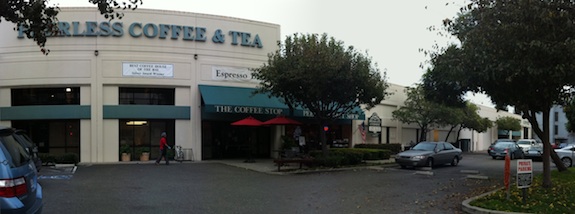
peerless-sm

Peerless Coffee is based out of a low-slung, light industrial building built in 1976. Established in 1924, the company has seen it all: wars, boom and bust cycles, and several sports teams. Three generations of the Vukasin family have helmed the company, and they are Oaklanders through and through. They have every intention and desire to continue being a pillar of the Oakland business community. How that can continue with a ballpark proposal lingering in the immediate future is uncertain.

As I approached the building, the aroma of roasting coffee nearly overwhelmed me. I sipped an au lait inside the store as I waited to interview George Vukasin, Jr., who runs the business, and George Vukasin, Sr., who left the company to his children and still is a major presence there. George Sr. is also well known as a major proponent of Oakland and East Bay sports, as he was pivotal in making the Coliseum complex come into being. I sat down in their front office and we talked for nearly two hours. I could’ve easily sat there for another two as George Sr. recounted stories of Oakland sports glories past, but I had to start writing. Maybe another time.

We first talked about how the Coliseum deal was struck. George Sr. happily took on the role of historian, recalling how the late developer Bob Nahas put together a coalition of civic and business interests, including the elder Vukasin, to get a sports showcase built in the East Bay. They quickly focused on a site in East Oakland. The land was undeveloped, with the major owners being the Port of Oakland, EBMUD, and PG&E. Deals were struck with both utilities to maintain easements at the complex while a land swap was negotiated with EBMUD for a parcel on High Street, where the utility’s maintenance yard now resides. The Port of Oakland handled the land deal, as George Sr. was a Port commissioner at the time. The process from first discussion to groundbreaking took 2 years and was unencumbered by CEQA laws or other red tape.

The Coliseum Commission ran the complex for close to three decades. They understood what it took to keep the complex in the black, such as the need for 130 event days at the complex every year. While that should be easy to do with 81+ baseball games, 7-10 football games (sometimes), and 41+ basketball games, occasionally things would run tight. One particular year, Vukasin couldn’t figure out what to do so he called rock promoter Bill Graham and asked for help. Graham magically produced 7 days of Grateful Dead shows at the arena, the proceeds of which allowed the Commission to take care of the debt service.

Around the same time, Amnesty International contacted the Commission about putting on a single concert, which would be held at the stadium. Walter Haas, who had put a good deal of money into renovating the Coliseum, was not particularly fond of having a large number of concertgoers trampling his pristine baseball field, as evidenced by the declining number of Day on the Green concerts during the Haas era. When Amnesty International inquired, Haas and Roy Eisenhardt unequivocally said no. Vukasin and others tracked Haas down at the Pacific Union building in San Francisco, where they asked him to grant permission face-to-face. Haas, ever the gentleman, relented on the spot and the concert was held, as long as there were assurances that the field would be kept in good condition. No contracts, no litigation, just a talk and a handshake.

We shifted topics to Victory Court, and that’s when George Jr. was able to speak more. He was contacted 18 months ago by Mike Ghielmetti and Jim Falaschi, who suggested that Victory Court would be a studied site for a ballpark, and that the Peerless Coffee property was one of the targeted parcels. That led to a meeting with Ghielmetti and the City of Oakland’s real estate manager, Frank Fanelli. Little happened during the meeting, and no direct contact has been made since. Once George Jr. caught a man surveying and measuring the property. The man couldn’t divulge who sent him, and George Jr. asked him to leave. The man got in his car and went around to the back of the property, which is accessible from both Oak and Fallon Streets. George Jr. saw him surveying that side and kicked him off the property for good. To this day the Vukasins don’t know who the appraiser was, let alone who sent him. They asked me who I thought it was, and I guessed that it was MLB, contracting the work as part of its “due diligence.”

I asked why the current site was so crucial, and George Jr. went into great detail about how the business worked. While the plant looks like a 70’s office building from the outside, the nondescript façade hides many unique features that are part and parcel of what makes Peerless Coffee run the way it does. Among the important features:

  • The floor is an extra thick concrete pad, which allows the company to stack huge bags of coffee from floor to ceiling without worrying about weight.
  • The plant’s location near the port lowers transportation costs.
  • Peerless rents out some surplus space in the back, with the knowledge that the space can be repurposed for a plant expansion if need be.

Perhaps the most interesting thing is the process of roasting coffee itself. Peerless does a lot of custom roasting for different clients, such as restaurants and hotels. This makes it important for the company to have extremely precise control over the variables that come into play, from humidity to the shape of the natural gas flame as the beans are being roasted. Roasting the beans an extra five minutes can severely change a coffee’s flavor profile, according to George Sr. George Jr. followed that up, saying that the process is so delicate, a transition period of 18 months would be necessary, including construction time. During that time, both facilities would be running (or under construction), allowing the new plant to work out the kinks and match the old plant’s flavor. The fact that coffee is perishable, coupled with the change of equipment and environment, mandates such a long transition. It’s possible that a lot of product will be wasted along the way. When another coffee roaster built a new plant to replace an old one, it supposedly took 6 months or more after it started operating to “dial in” the flavor properly. Essentially, the coffee is roasted based on the conditions in that exact location. Any changes would require a costly upheaval.

In preparation for what could happen, George Jr. and his sister, Kristina Brouhard, have done the necessary background work just in case. As I was talking with the two Georges, Kristina, an attorney who is also Peerless Coffee’s legal counsel, popped in for a moment and we exchanged pleasantries. They’re getting ready to (and I’m paraphrasing here) man the troops.

That’s not to say that manning of any troops will be needed. I asked the Georges if, as I had suggested last week, a ballpark land grab extended as far out as Fallon Street, instead of the taking of all land between Oak Street and Lake Merritt Channel. They both said they’d be fine with it, though no one has explained to them why all of the land was needed. They’re perfectly content to be neighbors to the ballpark, and their comfort with their specialized operation suggests that they aren’t in this just to hike up the price on their property. George Jr. doesn’t want anyone to feel sorry for the business, but he was very clear in saying, “This business is our family.” And right now it’s threatened by the ballpark. Already, customers are asking if Peerless is going out of business, which is clearly not the case. If you think that battling perception is hard now, just wait until the word gets out about a ballpark.

There were plenty of other anecdotes about Wally Haas, Herb Caen, Franklin Mieuli, Ken Hofmann, and strangely enough, former Warriors bust Chris Washburn, who George Sr. said had a “Rolls Royce grille on a Volkswagen.” George Sr. lamented how the revenue chase has made getting a fair stadium deal so difficult. We talked about how genuine Oakland’s (and Let’s Go Oakland’s) efforts were, and I was surprised how much we were all on the same page. There was a bittersweet moment in realizing that it is possible that Oakland, so defined by its sports franchises and full of history, could lose two or all three of them. George Sr. would’ve preferred a ballpark at Howard Terminal. George Jr. would’ve liked a downtown site. They told me how much they appreciated my work, and I thanked them for the time they gave me to discuss the issues. As I got up to leave, George Sr. had the most surprising parting words for me,

You never go over the owner’s head. If you call the commissioner, the first thing he’ll do once he gets off the phone is call the owner.

Coming from a man who has heard and seen it all – especially in Oakland and in dealing with pro sports teams – those are sage words.

Dolich supports a new “multi-use” stadium

A reader alerted me to Andy Dolich’s piece last week in the Biz Ball section of the CSN Bay Area/California website. Dolich goes back through the postwar history of stadia in America, going from the multipurpose bowls of yesteryear to the new single purpose venues of the last twenty years. He then summarizes the current difficulty experienced by California teams when it comes to getting stadia built. After that, he proposes an idea so strange it might have come out of the 60’s: the 49ers, Raiders, and A’s should all share one stadium where the Coliseum currently sits. In supporting this “multi-use” concept, Dolich cites major technological advances, such as the movable seating decks at ANZ Stadium and customizable LED displays used everywhere nowadays. While Dolich’s sense of history is sound, he left out a major factor that has sent both the NFL and MLB on different tracks. The Neo-Classical ballparks are much smaller in terms of capacity than their predecessors, while the new football stadia are much larger. 40,000 has emerged as a sweet spot for MLB, while 65,000 is preferable for the NFL. No amount of new technology is going to be able to mask or easily move 25,000 seats, not even tarps. The requirements for baseball and football have diverged so much that it’s hard to envision even attempting to make a multipurpose stadium work these days. Let’s take a look at how the two sports’ requirements differ:

  • Proximity to the field. In baseball, it’s customary to have the first row at the same level as the field, or perhaps a foot above the field. In football, the first row may be 6-10 feet above the field.
  • Quantity of premium seating. Football stadia tend to have 7,500 club seats and 100-200 suites. Ballparks have 3-4,000 club seats and around 40 suites.
  • Confinement. Colder seasons force football stadia to enclose their suites behind glass, whereas ballparks like to take advantage of the summer by putting the seats outside the glassed-in parts of the suites.
  • Surfaces. While Field Turf and other advanced artificial surfaces have gotten better at mimicking grass, they’re still far away from being truly comparable for baseball applications. The fake stuff is welcome in football, where there’s no need to worry about having a true ball bounce or roll. If a stadium were to utilize grass, the dirt infield problem emerges.
  • Environment aesthetics. In football, the stadium is the scene. In baseball, ballparks are frequently designed take advantage of a pastoral or urban backdrop.
ANZ Stadium's pitch. Note the tracks used to move the seats in and out.

ANZ Stadium’s pitch. Note the tracks used to move the seats in and out.

The technology that Dolich espouses does little to address the differences in fan experience that the single purpose venues achieve. For instance, ANZ Stadium‘s movable seating sections could be an inspiration. Prime lower deck seats are mounted on tracks that expand and contract based on each sport’s specifications. It sounds good until you realize that the difference in capacity between ANZ’s rectangular (rugby, soccer) and oval (cricket, Aussie Rules) is only 2,000 seats. As a cricket venue it is severely compromised in terms of dimensions, with far more cricket tests played at Sydney’s older Cricket Ground. Movable seating decks have been employed to mixed success in the United States, the most prominent examples being the Louisiana Superdome and Candlestick Park. Aloha Stadium and Mile High Stadium both had novel methods to move entire seating stands. At Aloha, four double-deck stands either pinched in for football or widened out for baseball. Eventually the stadium was locked into its football configuration, much the same way The Stick’s east stands have been kept in their football mode. LED displays are great replacements for signage. They make an excellent platform for disseminating game information. But they don’t address the capacity disparity. From a fan experience standpoint, it could be said that the displays are sometimes counterproductive since they are so distracting. Either way, they’re just window dressing. Dolich uses the current economic state as justification for building a multipurpose stadium. Why bother, if the fan experience will only be marginally better than the current stadium, and will always be compared to superior experiences at single purpose venues? Dolich worked for the 49ers as a consultant to help improve the experience at The Stick, and was not particularly prominent in the selling of the new stadium to Santa Clara residents. He was unceremoniously let go at the beginning of this calendar year, and now he’s practically endorsing an alternative to the plan. If this were the 60’s, when both baseball and football were played in 50,000-seat ashtrays, it might be feasible. Times have changed. Until someone figures out how to make 25,000 seats disappear, the idea is not really worthy of discussion.

Setting Oakland’s table

Update 12/8 17:23 – Susan Slusser has an update on the Ballpark Digest “report” and Lew Wolff’s reaction. Jane Lee filed something similar. From SuSlu’s update:

Ballpark Digest is reporting that the Major League Baseball committee investigating the A’s ballpark situation is favoring the new proposed site in Oakland; I am trying to determine the veracity of that, but there are no sources cited. The A’s have not heard that and – stop me oh oh oh stop me if you’ve heard this one before – team owner Lew Wolff told me in an e-mail, “Not to my knowledge. We have, as I have said when asked, exhausted all options in Oakland.”

If the A’s are not granted the territorial rights they want in San Jose, they are under no obligation to move to a site recommended by the committee. They can spend no money at all and stay at the Coliseum, or the owners can sell the team. I’m not sure there are many prospective buyers who believe the better market is in Oakland right now, either, but maybe Joe Lacob can take another look at the club and try to inject some of the enthusiasm he’s put into his new Warriors ownership. Lacob was part of a group that tried to buy the A’s when the Wolff group got them. I can state with certainty that the current group does not believe that the optimal market is in Oakland. It’s pretty obvious.

Note: When Lacob was interested in the A’s, he was going to partner with Billy Beane. When Peter Guber was interested, he was going to partner with Bob Piccinini. BTW, it’s wet and dreary today. I’ll go with SuSlu’s hint.

Update 12/8 11:15 – I asked Maury Brown, who is also at the winter meetings this week. His response?

RT Nothing. Owners meetings was last time @newballpark: Are you hearing anything regarding the A’s stadium situation this week?

Update 12/8 10:54 – Ballpark Digest (via The Drumbeat) has some juicy grist for the mill:

Indeed, the talk at the Winter Meetings is that an Oakland recommendation is now pretty much a done deal — with the additional spin (albeit accurate) that this proved the committee was right all along in waiting things out before making a recommendation.

Which is great, as long as MLB is setting Oakland up to succeed. Then again, they could be setting Oakland up to fail. At least The Town is getting a shot. This would also invert the situation in terms of how I perceived it: San Jose is the hedge, Oakland is the main option.

Robert Gammon does his best to equate Oakland’s stadium proposal to San Jose’s, but he misses a major, major point.

Before I get into that, there’s a bunch of good factual stuff.

  • Parking availability shouldn’t be a big issue because of the large inventory in downtown. Still, the City wants to build 2,500 spaces on site, which could prove problematic in that it triggers larger EIR impact for traffic and requires a large land acquisition, which could prove difficult.
  • Peerless Coffee doesn’t want to sell. Neither do its neighbors.
  • Among infrastructure upgrades, an extra lane from an 880 off-ramp (880 N to Oak St is my guess) would be needed.
  • A pedestrian bridge from JLS to Victory Court would also be needed. (Note – pedestrian bridges recently completed in Walnut Creek and Berkeley cost over $6 million)
  • 980 Park is being dismissed because of timeline/deadline issues, not site feasibility (this line by the City has been pretty constant).
  • “The league’s experts selected the Victory Court site as the most viable spot for a new ballpark.” That makes sense. Still doesn’t make sense why it took a year to get from four sites to one, when the number could’ve been two and whittled to one quickly.
  • Gammon projects which City Council members will be for and against the project, at least as far as the EIR funding is concerned.
  • As mentioned in the last post, the traffic study is moving forward. After that, it’s probably up to MLB.
  • Total price tag to make improvements and acquire land: $80-100 million. At A Better Oakland I speculated that $100 million would be a likely amount. The total could vary based the amount of land acquired, or the scale of certain land and infrastructure improvements.

The part I have to pick apart is this:

Under Oakland’s plan, the Central District of the city’s redevelopment agency would sell twenty- to thirty-year bonds to finance the land purchases and infrastructure upgrades. The bonds would then be paid back with property tax revenue generated by the ballpark and the surrounding planned development, which is to include housing, retail, and office space.

This is, of course, a classic TIF scenario. That’s not really a big deal procedurally since the site and surrounding area falls under one of two redevelopment districts. Gammon’s quick to equate what Oakland’s doing to what San Jose’s doing, but there’s a major difference, in that it’s $100 million of additional indebtedness to be incurred by the Oakland Redevelopment Agency. San Jose hasn’t had to raise any bonds and won’t have to raise any bonds for its project, so no additional debt there. If Wolff ponies up for the rest of the San Jose land, he may end up causing San Jose to forego a vote, the last remaining procedural hurdle. $20+ million for peace of mind and a green light from MLB? Not a bad investment.

While $100 million in RDA funds is not going to be up for voters to decide, it’s still not going to be a slam dunk politically. The big issue will be the cost of the land acquisitions and the possibility of eminent domain, which appears likely even in this early stage. If Oakland underestimates the amount needed to buy the properties, it will severely impact its ability to complete other parts of the project, whether it’s a parking garage or that pedestrian bridge. And given Peerless Coffee’s $30 million relocation estimate, acquisitions alone could break the bank. Legally, eminent domain proceedings can happen fairly quickly. Politically, they could prove difficult. And if Oakland lowballs as they did with Uptown? It could drag on for a while. Already another project in West Oakland is scaring landowners due to the potential use of eminent domain.

vc_with-buildings-sm

Not shown: Elevated Nimitz Freeway running through the area

Thankfully for Oakland, there’s a way to make it work within whatever the budget is. The easiest thing to do would be to scale things back a bit. This doesn’t mean that eminent domain can be ruled out, but it may be that Oakland won’t have to make lowball offers in an effort to stay under budget. It may even be able to pull off regular negotiations with affected landowners.

One thing that hasn’t been mentioned anywhere is that Oakland doesn’t need to acquire the Peerless Coffee parcel, or really anything else between Oak and Fallon Streets. It may want to pick up pieces of land at the northwest and southwest corners (Oak & 5th, Oak @ UPRR) to create nice public plazas for a ballpark, but it doesn’t need to grab all 20 acres. If you look at the way I’ve placed and oriented the ballpark in the above image, the footprint is well removed from Fallon St. Reduce the amount of land needed and it suddenly becomes much more feasible. Sure, there will still be the need to relocate a triplex, some warehouses, a storage facility, the fire training site (already acquired), and East Bay Restaurant Supply, but that’s a lot better than having to slog through negotiations with a dozen or more different landowners.  You may recall that San Jose’s land acquisitions started with 20-22 acres and were reduced to 14 in the end. The smaller ballpark requirement, less parking needed, and budget constraints all contributed to that eventuality. This is what awaits Oakland, though Oakland will create for itself hard limits on what it can spend. In San Jose, they can sell a piece of land here or there to shore up the fund, or  even depend on an old man’s kindness. In Oakland they’ll need to get it exactly right, or else it’ll fall apart. Quick note: Based on the numbers in the latest ORA budget report, this project would raise total TIF debt from $440 million to $540 million, an increase of 23%.

What I don’t understand is exactly why MLB is having Oakland put together 20 acres in the first place. I wonder what would happen if Oakland went to MLB and said, “Okay, we love the idea, but we’d like to scale it down to make it more feasible.” Would MLB be flexible, or would it have a hard line? If, as I’ve discussed previously, Oakland is a hedge, MLB should be pretty flexible in its requirements. If they aren’t, I might be a little suspicious…

Gammon ends with this:

In other words, for the A’s to move to San Jose, the league must conclude that Oakland’s ballpark plan is unviable. At this point, that doesn’t appear to be the case.

“At this point.” Well, yeah. No one’s had to work out the hard stuff yet. Clock’s ticking…

A big hedge

As part of Susan Slusser’s preview of next week’s owner’s meetings in Orlando, there’s a couple of paragraphs devoted to the stadium situation.

There has been speculation that Major League Baseball’s committee examining the A’s stadium might issue its findings during the meetings, but team owner Lew Wolff said that he does not believe that will be the case, though an announcement should come soon. “All we want is a yes or a no,” Wolff said of efforts to get approval for a stadium in San Jose.

So an announcement should come soon, but not next week. Calgon, take me away!

A year ago, I wrote about three options that MLB could pursue regarding the A’s. They could either A) approve a move south, B) deny the move, or C) give Oakland one more shot with a deadline. Given the recent news on Oakland’s front, such as it is (and the lack of news on MLB’s part), option C would appear to have been the choice, in retrospect. Whether Oakland is getting a full shot is unclear, they’ve gotten at the very least a year. Yet there are plenty of things that don’t seem to fit that make me wonder what the real endgame is here.

Earlier in the fall, there were murmurs of a pending decision, which South Bay boosters have held onto ever since. Wolff’s retreat from that position in Slusser’s piece indicates that something may have changed, but to what extent? Wolff has held firm to wanting a “yes or no” from Selig, while the boosters have framed the South Bay as a chance to “explore” the territory. MLB appears to be in communication with both San Jose and Oakland city governments, giving the whole affair the appearance of a horse race.

If you ask me, “horse race” is not the proper term. “Contingency plan” is much more apropos. I get the sense that with the economy the way it is, the difficulty in getting things done in California, the T-rights issue affecting San Jose, and the uncertainty regarding Oakland’s ability to pull a deal off, MLB may view a dual-track plan as the best course of action right now.

First, let’s understand what the Bay Area means to MLB from a historical context. If you read the blog post from before Thanksgiving, you might see the Bay Area as one big bag of fail. Couple that with the litany of failed attempts to get something built for the Giants, aborted attempts to move by both the Giants and A’s (Tampa Bay and Denver respectively), and a lengthy delay in getting the only new MLB ballpark in California built (PETCO), you might actually excuse MLB for not believing that any ballpark plan in the Bay Area was a sure thing. Frankly, I’d be cautious too.

And so it may be that MLB is going to approach the A’s solution in a manner that won’t satisfy boosters from either San Jose or Oakland. It’s highly possible that MLB will foster Oakland’s efforts, while granting Wolff his chance to “explore” the South Bay simultaneously. Those of you pro-Oakland folks will look at this and say that The Town will be screwed since San Jose is so far ahead in the process. Well, nothing stopped Oakland from starting this process a year or at worst six months ago, instead of now. The nice thing politically about the way Oakland has gone about this is that they haven’t had to spend any money or make any significant decisions. Now we’ve got IDLF demanding that MLB commit to Oakland before they spend money on an EIR, which probably got many a chuckle going in NYC and Milwaukee. MLB doesn’t have to commit to anything. In fact, they can turn it around and pay for some or all of the EIR, thereby forcing Oakland to start making some decisions.

As for San Jose, they’re not the undisputed winners, at least not yet. They’ll have one chance. That’s it. While Oakland officials have pointed to a 2015 opening day for a Victory Court ballpark, San Jose won’t have as long, with a 2014 opening looming instead. The 2013 end of the Coliseum lease makes this a necessity. There may also be some lingering disinterest in opening the T-rights can until San Jose is completely in the bag, which right now it isn’t at all. Political capital for Selig to get consensus from the owners may not happen until everything is signed, sealed, and delivered. Selig won’t move until he has that consensus. And as long as a referendum is the deciding factor, he may not want to push all of his chips towards San Jose.

Oakland, then, is a hedge. Suppose that MLB helps fund the EIR, just as they’ve promised to partly fund San Jose’s special election. Since it’s unlikely that Wolff would be involved in an Oakland ballpark, MLB could arrange an ownership change to Oakland interests once the ballpark deal was in place, probably by buying the team Expos-style. Knowing the position in which they sit, Oakland has to decide whether to move forward or not. There will be some who are clearly offended by being placed second in the process. They may ask to pull out of the running entirely. Or they could take advantage of the opportunity, following through on all of the necessary steps just in case San Jose blows up – just as Fremont and Coliseum North did. Is it a long shot? There’s no denying it. Over the last 15 years Oakland’s made missteps and had the deck stacked against them. Yet it still has a chance, however remote, of keeping the A’s. To not work with that would be the utmost display of spite and would give MLB every excuse to finalize the move to San Jose without the slightest tinge of regret.

For many who are wrapped up in civic identity, the A’s saga is a zero-sum game. For someone to win, the opponent has to lose. For the rest of us A’s fans, it’s not zero-sum at all. We just want the A’s to stay local and for the era of free agent sluggers spurning us to end. For different reasons, MLB probably has a similar view. They want 30 vital teams. Despite the occasional talk of contraction by tinfoil hatters out there, Selig doesn’t want the failure of two contracted teams on his resume. There’s a decent chance that if San Jose doesn’t work out, Oakland will get its chance, and if that doesn’t work out – well, someone’s been thinking about what might happen in that case.

Five degrees of separation

Here at the ballpark blog, we’ve been very upfront about one particular issue when it comes to Cisco Field: We don’t like bandboxes. From the initial look, that’s exactly what it appears to be. We were even concerned enough to consult a noted expert about the ramifications of implementing the ballpark using the speculated dimensions, and the results only made us more fearful. We’ve been conditioned, as good A’s (and baseball) fans, to love the occasional 1-0 shutout that runs only 2:15. While the Diridon site creates limitations as to the layout, there’s still plenty of room to put in a neutral field.

To refresh your memory, here’s what the existing plan looks like.

In hopes of effecting some kind of change, I took the projected layout and revised it slightly. The changes are as follows:

  • Field orientation is rotated 5 degrees north (counterclockwise).
  • Home plate is moved roughly 10 feet east.  This may seem strange considering the space constraints on the east side of the lot, it’ll make sense later.
  • The seating bowl, which is at a 75 degree angle, is made more acute to end up at 65 degrees.
  • The outfield wall is redrawn to keep the the left field grandstands parallel to streets and existing lot lines.

Now here’s what the revised layout looks like.

The outfield dimensions are now 328-375-402-376-314.

A lot better, no?

Rotating the field makes an incredible difference, even a 5 degree change. It opens up the outfield a ton and makes for a much deeper transition from the right field corner to the power alley. Now that extra set of seats/bleachers in right field isn’t so bad, as the 36-foot high wall goes from 314′ to 370′ and then drops to a 12′ high wall at 356′. Left field is a pretty standard set of dimensions, with the quirk being a pitcher-friendly jump from 328′ to 370′. Center field’s 402′ is pretty blah.

There are some compromises and penalties that come with rotating the field. The LF line cuts into the grandstand more, so much that I was forced to move home plate 10 feet east to compensate. By doing this, the LF corner can be fairly standard and not many seats are lost. To keep the simple contour of the seating bowl, the angle of the bowl had to be brought in 10 degrees. If that hadn’t been done, a kink or bend along the first base line would’ve been required. The resulting angle is 65 degrees, which should create for better sight lines than the original concept (75 degrees).

As with the original analysis, I’ve projected two capacities, one in which there are a minimal number of rows and another where there are four additional rows for both the lower and upper decks. All else stays the same. One change is the inclusion of a service tunnel near the LF corner. An outline of seating sections is shown where the affected seats would be taken out.

Additional notes:

  • ADA locations refers to wheelchair locations and companion chairs. It is assumed that some accessible seats within the seating bowl will have flip-up armrests.
  • Temporary seating refers to rows of seats at the back of available sections. It’s a simple way to add seats for a nominal cost, and can be easily adjusted on an as needed basis. Unused ADA rows can be replaced by rows of temporary seats if space is available. The Giants have employed this method of adding seats extensively.
  • The third deck (club) has been omitted to reduce clutter. The suite level (tucked underneath the upper deck) is obscured.
  • After some discussion, I’m going with 36-foot high wall in right, which is closer to what Jeffrey and gojohn10 have suggested. (The Green Monster is 37′ 3″ high)
  • Bullpens are still in center.

Questions? Fire away.

Have You Heard the One About…

Way back, all those eons ago, when Baseball San Jose released the renderings of the potential Cisco Field, I noted that there were two questions that seemed to be on every A’s fan’s mind. The first was, would the park be hitter, or pitcher, friendly. The second was, What the heck is that thing in Right Field?

While we know (thanks to ML) that the answer to the second question is a “colonnade,” the first question has yet to be answered in any sort of educated way. Until now.

A fellow named Greg Rybarczyk runs a very cool website called Hit Tracker. On the site, he tracks things like the actual distances of Home Runs across the league, the atmospheric conditions when the home runs are hit, the angle that the ball left the bat and the speed at which it traveled. The best part of all of this is that he can take this data and, through a highly scientific method, derive a HRPF (Home Run Park Factor) for each of the Major League stadiums.

Long time reader, gojohn10, reached out to Mr. Rybarczyk and he graciously agreed to build a model for the potential Cisco Field using some assumptions about field dimensions and fence heights combined with actual data based on the positioning of the field and it’s geographical coordinates. Using this model, we can safely say the answer to the first question can be phrased something like this, “Did you hear the one about the ballpark in San Jose?”

The punch line would then be, “150/101/100/168/142.”

HRPF works a lot like BPF (Batting Park Factor). The Park Factor is calculated such that 100 means “MLB average.” A number below 100 indicates a park where home runs are less likely. A park with numbers above 100 indicates “Band Box” designation. The further a number is from 100, above or below, the more/less likely it is that bombs will be droppin’ like rain in Seattle. The aggregate HRPF for Cisco Field, as rendered, would likely be something around 132. The highest HRPF presently is Coors Field with a whopping 118.

What’s worse? The easiest Left Field HR, presently, is at the erstwhile Enron Field, 132. The easiest Right Center Field is at Coors Field, 145. The easiest Right Field is at Miller Park, 137. Cisco Field would best all of them. Today, only one park is the most easiest place to hit a Home Run to more than one field, Coors Field is the easiest to CF and RCF. Cisco Field wouldn’t only be the easiest, it’d be the easiest by a landslide and to 3 different parts of the park.

The numbers in the punchline are the projected HRPF at the potential Cisco Field starting in the Left Field corner and moving around the outfield to the Right Field corner. Left Center and Center Field would play fair… Everywhere else would resemble Slow Pitch Softball. Greg theorizes that Bay Area weather conditions could bring that number down by about 10 points. Even so, Cisco Field would still be an easier place go yard than Coors Field. Start signing sinker ballers, and guys who fly out to the warning track 20 times a year, now Billy!

Some important things to note:

  • The Right Field line fence height in the model is 24 ft. There was some debate amongst the three of us (ML, gj10, me) as to what the real height would be. I estimated 35 ft. gj10 estimated 30 ft. ML, the brains of the operation, estimated 24ft. So this is sort of a worst case scenario in the Right Field corner.
  • Similarly, we all had different guesses for the rest of the fences. Though, the differences in our estimates were pretty insignificant. The model is based on 9 ft. fences in Left and 12 ft. fences in Center and Right Center.
  • The upshot is, while the Right Field corner could be moved considerably closer to the magic “100” with a fence as much as 10 ft. taller, Left Field and Right Center would need to be moved back quite a bit to be closer to average.

Uncle Lew, if you are reading this… Please consider changes similar to what ML suggested here. Thank you!