Slow steady wins the race

If I were a man who frequently donned a tinfoil hat and blurted out unintelligible nonsense in public on a regular basis, I might be led to believe that the Rangers and Giants getting into the World Series was all some elaborate plan to buttress the two teams financially. After all, the Greenberg-Ryan group paid $100 million more than they expected for the Rangers, and a World Series appearance or win for the Giants could certainly salve any wounds related to having to relinquish the South Bay. (Note: Rangers pitching coach Mike Maddux jokingly agrees with some of this.)

Thankfully, I am not such a conspiracy theorist. Thing is, it’s that kind of thinking that is only slightly less crazy than “OMG! If the Giants do well the A’s will loose the South Bay forever!!!!!” talk I’ve been hearing.

Calm down. Relax. As eternal douchebag Jeff Kent once said, “Enjoy the game more!”

The Giants are going on an all-out marketing push in the South Bay. Part of it surely has to do with strengthening ties to the area, but it mostly has to do with trying to capitalize on the Giants’ on-field exploits. Going into this season, the Giants’ season ticket roll stood at 21,000, down from the 25,000 peak of the Bonds era. According to Matier and Ross, the team has already sold 3,500 new season tickets, thanks to the Giants’ recent success. Sales of full plans have cascading effects on the team’s business model, such as:

  • Better positioning for higher-priced sponsorships, because more people are guaranteed to be in the park
  • Higher baseline prices for dynamically-priced seats due to lower inventory
  • The upfront cash and ability to project a higher payroll for the 2011 season

There’s always a need to strike while the iron’s hot, and if we’re being honest, I wouldn’t do anything different from what the Giants are doing this year business-wise. While the Giants may feel that they are fundamentally entitled to T-rights to San Jose, the best way to give a team higher revenues is to ensure that the team is competitive, which the Giants haven’t done the previous seven years.

Of course, it’s hard enough to get to the playoffs, let alone get to and win the World Series. Success is often painfully fleeting. That’s why the Giants’ run and the accompanying media hype can’t be construed as more than a blip. Maybe the blip last for several years, but it’s still a blip. On a related note, that’s what the Bash Brothers era was for the A’s: another memorable blip.

MLB can’t be run on blips, not for a single team at least. It’s run on a collection of blips over time, with the hope that each team can get its blip to germinate into serious baseball culture, or maintain what already exists. Over time, the league gets better national TV deals, better ballparks, greater merchandise sales – all things to create a rising tide to lift all boats. At the local level, who knows? Tim Lincecum may become the next Sandy Koufax. Then again, he may bolt for Seattle or New York, or like Koufax, retire early because of health issues. MLB can’t really afford to determine long-term planning and strategy on blips. It has to go on whatever the team’s financial fundamentals are. It puts mechanisms in place to help teams that help themselves, such as the stadium expenses deduction. It provides examples of teams diversifying to supplement income. Beyond that, you’re getting into the area of playing favorites. While Bud Selig can be criticized for many, many things, playing favorites is not one of them. Witness the low-revenue WS matchup (ratings down 25% from 2009). Or the lack of playoff appearances by his beloved Brewers. Or Lew Wolff’s continued frustration that his frat buddy has been stalling on a decision to allow him to move the team.

So to suddenly undo 19 months of “study” just because the Giants are doing well would most certainly be playing favorites. And it would run counter to how business is done within MLB, which is a slothlike, conservative structure to say the least. The Giants can and will certainly make a claim that the South Bay is valuable because of what happens when the team is good, but that only means that in bottom line terms the Giants have a lot of bandwagon fans, and a lot of them live in the South Bay. And the East Bay. And the North Bay. Sure, the Giants could get greater compensation in the end, it may even be likely. If you’re expecting some life-altering, earth-shattering, 180-degree change, you don’t really know MLB that well.

What A New Stadium Means for Payroll

I read here, and in other places like the sfgate.com Drumbeat Blog, opinions on what would happen if the A’s suddenly had a Target Field like infusion of revenue. Opinions vary from “Lew Wolff is cheap and won’t spend anymore” to “The A’s will spend more money than the Angels!” The real answer, they will spend more but won’t be a West Coast version of the Yankees or Red Sox, is much more interesting. While I will never be a GM for any self-respecting MLB franchise, I have stayed at a Holiday Inn Express. Which means, I have ideas for what a future A’s roster/dynasty might look like.

First things first, how do we set a projected payroll? First, we have to have an idea of what revenues might look like (thanks ML). Second we have to have an understanding of how revenues impact Major League payrolls. Forbes has an answer:

Data Provided by Forbes

A few interesting factoids from this table. First, if we are to believe Forbes, only two MLB teams took a loss in order to fund their on the field product this season. Only one of those teams took a “significant” loss. Neither of those teams factored much into the playoff picture. Do you smell what I am cooking? As much as you can’t blame the Yankees for their $200M payroll, you can’t harp on A’s ownership for their smallish payroll. The days of teams spending way more than they have, in order to be competitive, are history. Revenue matters.

The second factoid, that MLB teams spend an average of 55% of their revenue on payroll, sets the stage for what could be. In ML’s piece, he split the difference between Wolff’s number and that of Forbes. Here, I am just gonna run with the numbers provided by Forbes to keep it simple. So, a new stadium should provide, roughly, a 14% increase (that was ML’s number, $149M plus 14% is $170M) for this article we will assume that number is $177M ($155M*1.14). That SWAG number puts the A’s in the neighborhood of the Rangers and their $95M payroll. Heck, if the A’s wanted to “go for it” they could actually have a payroll of $106M and be within the range of Operating Income makers on the Forbes chart ($177*.6).

That gives us a range of $95M to $106M…. Oh, how I salivate. What’s better? As ML pointed out, the A’s have huge payroll flexibility in the coming seasons, if we assume they have this new revenue stream. To keep the core together, the A’s would need to have an $80M payroll in 2013. If they are in limbo, forget about it. If they are in construction… $80M is great… That would give them up to $26M to spend on players in the first year (assuming a 2014 opening). So who could they add?

Assuming the A’s have locked up the new Big Three, Anderson, Cahill and Gonzalez.  Max Stassi has taken over for Suzuki and is a second year player. Grant Green is manning Short Stop and in his second year at the big league level. Adrian Cardenas, or Eric Sogard, is Green’s double play partner and relatively cost controlled. Daric Barton, Chris Carter and Michael Taylor are rocking 1B, LF and RF collectively. Bullpen roles are what they are. That leaves the A’s with a definite need for a Center Fielder, a 3B and a couple of starting pitchers.

Zack Grienke anyone? Tim Lincecum anyone? Certainly not both, but would the A’s really need both? The new Big Three, the New Jack Bash Brothers and the developed youngsters make it so that only one would be required.

Or, Ian Krol and Clay Mortenson have developed into a fine back of the rotation. Matt Kemp in center?

The more I think about it, the more I realize the possibilities are infinite. I am just highlighting shock and awe type moves. Silver bullets, if you will. Reality, if Billy Beane’s past is an indication of his future, is that the money would be spread around and the sum of multiple parts would be greater than the any single player. The point is that Wolff could keep payroll right in alignment with what is normal now, add in the new revenue, and we would all be really happy with the result. Here is my wishful glance at a 2014 roster/payroll with a lot of crystal ball gazing (and rose colored performance projecting) mixed in:

The debt rule and you

When the current CBA was ratified in 2006, it was largely seen as little more than extension to the 2002 CBA. That is, except for one pretty important detail. Prior to 2006, all MLB teams had to conform to what was called the 60/40 debt rule (assets/liabilities). Enforcement of the rule was at best lax, allowing teams to make some really bizarre long term contracts without batting an eye. With the new CBA, the debt rule had radically changed. Instead of pinning available debt to franchise value under the 60/40 rule, debt was to be capped based on earnings. Here’s the initial language of the rule:

DEBT SERVICE RULE
Section 1.    The Rule. No Club may maintain more Total Club Debt than can reasonably be supported by its EBITDA. A Club’s Total Club Debt cannot reasonably be supported by its EBITDA if Total Club Debt exceeds the product of the average of that Club’s EBITDA over the most recent two years multiplied by the Cash Flow Multiplier applicable to that Club; provided, however, that a Club may elect, on or before April 1, 2007, to utilize, in both 2007 and 2008, the average of its EBITDA over the most recent three years.

To illustrate this, let’s look at Forbes’ 2010 financial profile of the A’s. In it, operating income (EBITDA) came out to $22.1 million. For 2009, it was $26 million. Averaged, it’s $24 million. To get the Total Club Debt ceiling, multiply that last figure by 10, and you get $240 million in debt ceiling. Also in the profile, the A’s have a 30% debt/value ratio, putting the team’s applicable current debt at $88.5 million. Every team gets a debt exemption of $36.5 million. Factored in, that puts the A’s debt at $52 million. That leaves $188 million under the team’s cap.

According to the listed definitions of what constitutes debt, just about anything that is borrowed or to be paid later falls in. This includes loans from MLB or third parties such as banks, non-player deferred compensation, stadium debt (only when the stadium opens), loans from related parties (ex.: partly or wholly owned regional sports networks), and any other debt except for a player compensation and an initial $36.5 million deduction (like the standard income tax deduction).

The 10x multiplier changes to 15x when a new stadium opens. This is important, because, as Jeffrey pointed out two weeks ago, MLB is ready to provide a loan of up to $150 million for construction. Assuming that EBITDA stays fairly constant, the A’s debt ceiling will move to $360 million. In the meantime, the A’s would likely pay down existing debt (either from annual profits or by bringing in additional partners) to get itself in the right position to get the stadium financing.

The kicker here is that while player compensation is not supposed to be part of the calculus, it is no doubt a considering factor. Selig has a mandate for mid/small market teams to get their houses in order prior to opening a new ballpark. Any number of punitive measures can be taken against a club if they go over their debt cap, including restrictions against future borrowing and even limits to new player contracts. If anything, this is the true spirit of the debt rule: to keep teams living within their means. (Big market teams such as the Dodgers and the Rangers under Tom Hicks benefited from selective enforcement.)

To understand how this affects the A’s moving forward, let’s take a look at where the teams stands in terms of payroll as of the end of the season:

Now let’s assume that certain housekeeping moves are made. Trevor Cahill is locked up through his arb years in a similar deal to what Brett Anderson received, plus Daric Barton is also secured. In addition, Mark Ellis is brought back, as well as Kevin Kouzmanoff. Jack Cust is gone, while Michael Taylor starts the season in RF. Gio Gonzalez, Dallas Braden, and Andrew Bailey are also back through short-term/non-arb deals. No one of note is traded, but a free agent slugger is brought in for a 2-year, $20 million deal with a third year team option. Here’s what that would look like:

If you’re Selig and you’re looking at the two tables, you’re thinking “That’s it. Give me your credit card.” It doesn’t matter that this kind of debt technically doesn’t count toward’s the CBA definition, it’s still debt. Salaries weren’t supposed to count under the old 60/40 rule either, but they did. It’s a terribly unfair way to run a competitive league, but them’s the breaks. By 2013, the payroll will head into the $80 million territory because of the normally occurring raises. As a team that is not yet fully capable of carrying its own weight, the A’s have their own de facto salary cap. Most of it is due to circumstance. Type A free agents aren’t going to sign 2-3 year deals here unless they have a problem that makes other teams balk at giving them 5-6 year deals (injury history, age, consistency). Yet that 2-3 year window is exactly what the team should exercise while costs are contained. Lew Wolff mentioned recently that the one-year rental idea doesn’t work that well, which is true at least historically. So what’s the best way to fill in the holes in the lineup? More Coco Crisps? Trade one or more of the pitchers for a bat?

Most importantly, how does this affect how you view the A’s future, or the league in general?

Note: If you’re wondering how the Yankees operate within the rules even though they’ve accrued billions of dollars of debt, the answer is simple. The team doesn’t “own” most of the debt. Its related parties do.

If You Got Any Money Left Over, Buy Yourself Something REAL Nice, Clark.

The headline is a quote from one of my favorite movies of all time, National Lampoon’s Christmas Vacation. It is spoken by Cousin Eddie as he loads up a shopping cart with dog food that his Cousin-in-Law, Clark Griswold, is expected to pay for. At this point in the movie, Clark is telling Eddie that he wants to make sure Eddie’s children have a nice Christmas and that he is willing to buy them some gifts if it will help. Eddie’s “gratitude” is clear when he pulls out a prepared list of things his children want for Christmas. What the heck does this have to do with the A’s and a new stadium?

The elephant in the room, the one everyone seems to be ignoring, is that the details of any financing plan for a new Bay Area stadium are murky, at best. We all hear “privately financed” bandied about in media reports. But what does that really mean? After all, with rare exceptions, MLB has played Cousin Eddie to just about every city that has seen a new stadium go up in the past 25 years.

The only real exception, though it was not entirely privately financed, is AT&T Park. Using this park as an example, 96% was privately financed, we can back into what “privately financed” actually means. Roughly half of that funding was provided through corporate support,  or the combination of naming rights (Pac Bell) and Charter Seat sales. The other half was in the form of a loan provided by Chase Bank, secured with MLB’s help. It seems clearer and clearer that this is, mostly, the model that MLB has in mind for the A’s.

So what evidence do we have that a ballpark in either Oakland or San Jose will follow a similar model? For one, we have the report that MLB has discussed a loan of $150M with folks in Oakland. We have the letter from Ron Dellums and Jane Brunner talking up deposits from 35 companies (amongst other things). We also have a recent letter from Silicon Valley power players to Bud Selig supporting a move down 880. Now we have the follow up Op Ed in the Mercury News, authored by two of those power players (Mike Klayko of Brocade and Tom Werner of Sun Power) pretty much restating the original letter. The key line from the Op Ed is:

Along with other respected and diverse organizations, we stand ready to offer any support needed to move this important project forward.

And from the SVLG 75 CEO/Other Important People Open Letter (Fourth paragraph, first sentence):

The Silicon Valley Leadership Group, along with other respected and diverse organizations, stands ready to offer any support needed to move this important project forward.

On the surface, these are clear statements meant to persuade Selig. In part, they are meant to show that the corporate support needed for both long term viability and a private financing scheme is there, in both cities. This is where the similarities end.

In the San Jose case, There are a few other Easter eggs that are not getting much mention.

I think MLB’s propensity for being Cousin Eddie, to (Insert City Name Here)’s Clark, is part of what the letters and Op Ed are about. Or, in other words, these messages are not only intended to allay Bud Selig’s fears (assuming he has them). They are also a signal to let citizens know that their “Corporate Citizens” are ready, willing and able to buy Charter Seats and sponsorships as part of any plan. We already know that Cisco is going to play Pac Bell’s role in a San Jose version of San Francisco’s funding scheme.

Another part of this message is, Miami is mad at you MLB for playing Cousin Eddie while the Marlins weren’t really living out of an RV, as they had claimed. If you come to San Jose, you don’t have to worry about that. We, the SVLG, will be Clark instead of the tax payers.

Additionally, there is the repeated mention of Giants fans within the SVLG communiques. This is meant to let Bud Selig know that there won’t be a mass exodus of Corporate support up in Baghdad by the Bay. That the Giants won’t become destitute, as Larry Baer wants us all to believe, provided the A’s move south. To undercut Bill Neukom’s argument for locking MLB out of San Jose.

There is one other thing hidden in the subtext. Watch this video, the important part comes up at 5:05.   When you combine John Chambers’ message (We won’t put our name on a Stadium in New York because we are in San Jose) with the fact that the SVLG letter and the Brocade/Sun Power Op Ed go out of their way to avoid mentioning the word “Oakland” and “new stadium” in the same context, the message is pretty clear. Bud Selig, we want the A’s in San Jose and will buy sponsorships and ticket packages for both the Giants and A’s if it gets us a stadium in San Jose. Not so much in Oakland.

I think it is fair to say that this what the messages are, don’t you?

What we don’t know, what the letters don’t tell us, is how much of any new stadium will be financed by corporations/presales and how much by loans, exactly. In the San Jose case, if 60 of those 75 companies bought some bundle of seats and advertising, and Cisco maintained $130M in naming rights, they would each need to pledge $1.7M of their Selling, General and Administrative budgets to Cisco Field in order for the combination of naming rights and Corporate sponsorships to cover half of the projected construction costs. As a point of reference, Yahoo’s S, G and A budget last year was $1.8B, which means this overly simplified $1.7M number represents less than one tenth of a percent of the budget where it would need to come from. There is a similar situation with Cisco ($9B), Brocade ($500M), Ebay ($3.6B), and so on and so forth.

Of course, we know that SVLG has well over 75 members and more members might be willing to chip in (while others, like the San Jose Giants, won’t be). I am guessing Bud Selig knows this, too. This is the biggest thing going against the possibility of Clorox Coliseum. If Oakland isn’t pledging public dollars for construction, how does the thing get paid for? If Oakland really is pledging pubic dollars (as I have been told) for construction, how long before pitch fork wielding citizens show up at City Hall?

The answer to this question (How does stadium construction get paid for?), not Larry Ellison’s attempt to buy the Warriors, not Bill Neukom’s Anti-Trust case won/loss record, and not 15 years of back and forth between the A’s and Oakland is what will, ultimately, decide where the A’s will play.

In short, it is “tradition and history” v. “a clear source of funding.” We can handicap this however we want, but it is what it is. I don’t know which will win out.

****(I am adding a table that shows the split between private and public funding at the most recent 21 MLB ballparks built for all of our info. It originally came for  the San Jose Economic Impact Analysis)

Funding Mix Private v. Public

The Sensible, if Overlooked, Alternative

Bryan Grunwald is a resident of Oakland with a passion for his city. He is also Principle for an Urban Planning and Architecture firm. He has worked on projects like the Mission Bay campus for UCSF. So why is the City of Oakland seemingly ignoring him and his concept, in favor of inferior ideas?

Before we answer that question, we first have to tell you about his idea. One that was mentioned in passing in a previous post by my partner, ML. I like to think of the concept as, “Lew Wolff says there is no land suitable to build a stadium in Oakland so why don’t we create new land to build on?”

Anybody see any land worth building on here?

The picture above is centered on a concrete moat that separates Downtown Oakland from West Oakland. Most of us refer to it as the Interstate 980 freeway. Grunwald, taking a cue from other cities (like Seattle, Duluth, and Trenton), has proposed “decking” the 980 freeway and constructing a ballpark on top of it.

I admit, when I first heard this, I thought it was a little too Star Trek. But as I looked into the idea and read more about the other cities successes and the challenges at Victory Court, I realized it was way more Star Wars. That is to say, it was my kind of geeky.

Grunwald's vision with Fenway standing in for to be determined stadium

First, the traffic concerns of JLS don’t exist here. This spot is at the confluence of several concrete rivers, or Highway 24, I-980 and I-880. Additionally, there are no trains that run nearby to cause congestion on the two surface streets that pass nearby. There are two BART stations within walking distance. Add to that, a plethora of parking within the nearby vicinity, much closer than parking options at Victory Court.

Other pluses include reconnecting West Oakland with Downtown. In between the stadium site and Uptown/City Center sits several blighted and underdeveloped properties, the stadium could serve as anchor to drive development in the area that sorely needs it. While this could be said of Victory Court, this site requires none of the upheaval that Victory Court does. In a city like Oakland, with a limited business community, why wouldn’t you consider an alternative where existing businesses get to stay put and continue to operate, create jobs and pay taxes?

One last thing, I consider a major advantage. Go back and look at the “renderings” ML created for my original Victory Court post. The view of the estuary is not really that stunning. The estuary is, after all, a man made channel for shipping purposes, not the alluring open space of the San Francisco Bay that AT&T visitors get across the bay. This site offers a true alternative at about one fifth ($30M v. $150M) the price. You can look at a skyline!

The view of Oakland (notice nearby BART stations) from the proposed portion of I-980

This last point leads me to why I really, really like this concept. If the A’s are to stay in Oakland, and be within shouting distance of one of the best stadiums in all of baseball, they need to have something different to offer. A cheap knock off of AT&T Park on the east side of the bay does not offer that. Let’s Go Oakland seems to think that it will be wildly popular. But just like the Public Market in Oakland isn’t attracting anything like the expected demand for office/retail space, partly because businesses would prefer to be close to the real Embarcadero, casual baseball fans will spend their money at the original waterfront park in the only World Class City in Northern California when given the choice of that or an imitation on an inferior “waterfront.” It is what marketing types call “differentiation,” and it is at the heart of the advantage San Jose has by being so far away from San Francisco. Oakland should embrace being different, not try to be the same.

Back to the original question. Why has this been dismissed by Oakland? The answer, for me, rests in the “Property Value Benefit” associated with Victory Court. Think about who stands to gain from that projected increase in property values. Think about who footed the bill for the Economic Impact Analysis. I find it ironic that Oakland Boosters disparage Lew Wolff as a greedy developer, when it is Signature Properties that is pulling the puppet strings on Victory Court. That’s right a “greedy developer” owns most of the land that will increase in value and will see most of the benefit of increased property values.

One last thing of note for those who are skeptical of what is driving this process. Oakland released an RFQ for an EIR to evaluate the potential for a stadium at Victory Court. Responses were due last week. Here is some feedback from one of the companies who received the RFQ but didn’t respond:

No I didn’t respond. The EIR consultant community thinks the engagement is wired due to the impossible timeline. Just like the whole process is wired by Signature Properties.

C’mon Oakland, us A’s fans deserve better.

**** 9/14/2010 HCF asked for an alternate view, here are 3. jeffrey****

VIew Towards the Hills

View Towards JLS

View of San Francisco

The Miner and the Bomb

I have had the opportunity to talk to a few folks from Oakland over the past week about ballpark related items. It all started when I got a message to my facebook account that said something like, “There is a site in Oakland that no one is talking about.”

I made a few phone calls, spoke with a few folks (very excellent, forthcoming people who shall remain nameless as I have promised) with varying degrees of information and I came away with one conclusion. Oakland is playing Stratego while Oakland Boosters think they are playing chess.

Oakland’s strategy has three main points:

  1. Wait out MLB. Obstruct and keep from having a decision on TR’s made in San Jose’s favor.
  2. When Lew Wolff grows tired of waiting/TR’s are reaffirmed, recruit Larry Ellison to buy the team.
  3. Pledge public funds for a ballpark at Victory Court.

I know, I know. I teased you all with a “plan,” implying specific tactics, and came back with a high level “strategy.” Let’s delve into each of the points above a bit, shall we?

Territorial Rights Affirmation

To a man, everyone with knowledge I talked to said, “There is no way MLB will let the A’s into San Jose.” Almost that direct quote, almost like it was being read off a card.

“Why?”

The answer? Various versions of, “because the Giants owners told us so.” The main argument is that San Francisco floated bonds to fund 5% of AT&T Park based on the Giants existing territory (As Dennis Herrera said when threatening a law suit). They claimed there was a contract between MLB and San Francisco. I can only assume they are referring to the letter from former National League President, Leonard Coleman, sent in 1997. That is what Herrera referred to in his shot across the bow (PDF).

Recruit Ellison

I’ll be honest, this one baffles me. From what I can tell… the idea hasn’t been broached with Larry Ellison. It is an assumption that has been made by those who want a new owner. Larry Ellison wanted to buy the Warriors and lost out. The Warriors are in Oakland. Therefore, Larry Ellison wants a professional sports team based in Oakland.

It sounds crazy. The thing is, multiple people told me that Ellison is the guy that Oakland will try to persuade to buy the team. They didn’t say, “We will find a new local owner.” They said, “We will try to get Larry Ellison to buy the team.”

I am not sure if they realize Ellison also tried to buy the Seattle Sonics and move them to San Jose, before he tried to buy the Warriors. I am not sure if that is important.

As you can probably tell, this part seems really unrealistic to me. But what do I know?

Victory Court

We have all assumed this already, right? Victory Court is the site that Oakland refuses to confirm as the site. There are some challenges though, and I wonder if avoiding a spotlight on said challenges is the real reason for all the subterfuge.

Newballpark.org has obtained a series of letters from nearby neighborhood associations, most notably the Jack London District Association, urging the City of Oakland to consider an alternative to the alternatives presented to MLB. Here are the reasons as stated in the letter:

It is far too soon to actually endorse this plan vs. any other option, but the preliminary assessment is that it would create far less disruption to existing businesses and residents and create an environmentally preferable commute for many of the workers at the facility, who could walk from their West Oakland and downtown homes. In addition, there would be far fewer environmental mitigation issues, compared to the frequently toxic environmental conditions in much of the Port and Jack London District Areas. This new site proposal also has the advantage of requiring far less land acquisition, reducing cost and potential litigation, when compared to other suggested sites.

Those near Victory Court are concerned with a one thing in particular, in addition to those called out in the paragraph above. Traffic.

Even with BART about a quarter of a mile away, most folks will come to baseball games via automobile. Should only half of all spectators come by car there will be thousands of cars that aren’t normally there. The freeway infrastructure around Victory Court, and the surface streets in the area are not set up to handle a great deal of cars. There are basically two approaches, one coming West on Oak Street, which requires use of an off ramp with a sharp 90 degree turn. Or, coming up from the South on Embarcadero, which requires crossing train tracks. The combination of an inadequate off ramp and trains, that frequently pass through the area, have the potential to create a huge traffic nightmare. How huge? We won’t know until someone way smarter than me does a real traffic study for an EIR.

If my sources are correct, and I believe them, MLB has told Oakland that it will come up with a loan of about $150M for a ballpark in the city, if it is in the right place. That would leave Oakland CEDA on the hook for an estimated $150M for property acquisition, business relocation and environmental remediation. There is another $400M to be found somewhere in this calculus.

I am told, that some portion of this money is expected to come from City issued Bonds. Raiders, anyone?

In Summary

When I used to love to play Stratego, my favorite part was figuring out where to set my bombs and using my miners to defuse my opponents bombs. It was a slow, and painful progression at times. Sometimes, it worked and I captured the opponents flag. Sometimes it didn’t and before I defused enough bombs they had my flag. It seems to me that the City of Oakland is doing something similar. Lying in wait, watching the progress of San Jose from afar and banking on too many bombs blowing up in their path. Leaving Oakland with the only clear path to the flag. Is it a good strategy? I guess time will tell, but I can think of a better one.

This started with someone reaching out to me about a different potential site in Oakland, didn’t it? And didn’t the letter from JLDA above mention an alternative to consider?

Those are one in the same. Stay tuned….

Diridon Capacity Estimates

While the Diridon renderings left many wondering about the little details, one major item we had no inkling about was the stadium’s capacity. Only vague mentions of 35,000 or 45,000 have been floated, but only briefly. So I figured that, absent a press release or backing documentation, I’d deconstruct 360’s model to determine the capacity. Keep in mind that this is my interpretation of what I’ve seen, so take it with several grains of salt as it is not gospel.

In doing this, several assumptions were made.

  • Regular seating is normally 19-inch, 20 per row, with 2-4 inches on each side to accommodate standards. Aisles are at least 4 feet wide. A switch to 20-inch seats would reduce capacity.
  • All seats are chairs with backs, no benches.
  • Club seats are at least 24 inches wide with or without side tables, plus drink rails.
  • Although not illustrated, a reduction in seating due to dugout placement is taken into account.
  • ADA requirements nowadays recommend a dispersal of accessible locations, not just behind a section (this is why you see front row accessible sections in many stadia). This is not taken into account. However, I’ve been aggressive about providing ADA locations, so a reduction of seating as part of making such accommodations would be minimal.
  • Bullpens are in center field.
  • The field is sunken 25 feet.
  • There are 40 suites and 40 minisuites. Club seats are up top. A club area in the grandstand behind the plate would reduce capacity slightly.
  • Reduction of seating due to columns has not been calculated. Neither has a number of potential obstructed view seats.
  • The press box has also not been factored in. It could displace up to 400 seats in the balcony.
  • Terminology: Grandstand (lower level from foul line to foul line), Balcony (upper level from foul line to foul line), Outfield reserved (lower level left field), Outfield Balcony (upper level left field), Bleachers (lower level right field)
  • The 1,500 figure for standing room comes from San Francisco’s maximum SRO limit for AT&T Park.

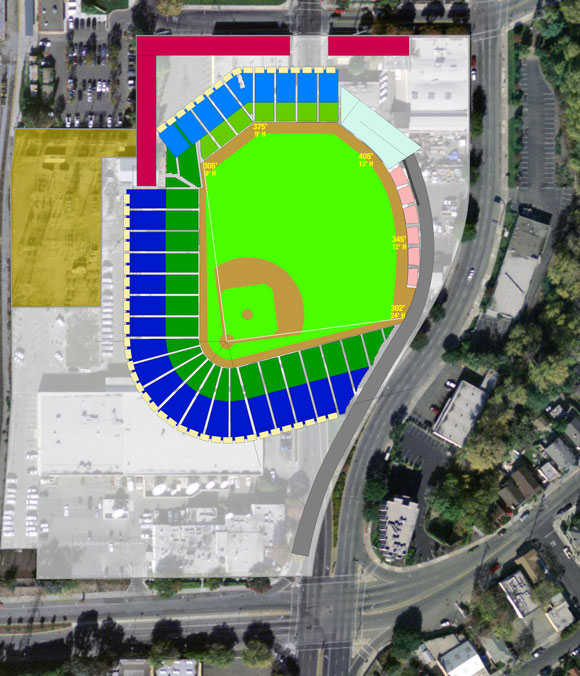
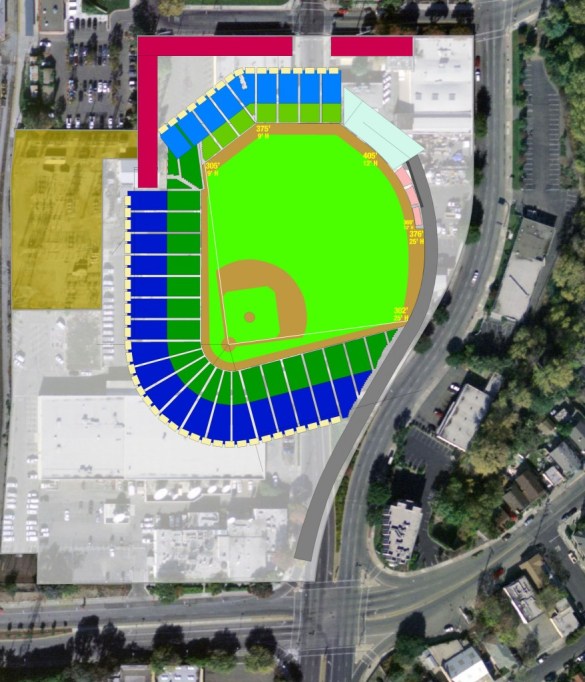
In my previous analysis, I had mentioned that I thought both decks would need more rows to make up for their limited length. To flesh this out, I’ve plotted two models. One has 40 rows in the lower deck and 24 in the upper deck. The other has 40 rows in the lower deck and 20 in the upper deck. In the second model, the last 4 rows have been eliminated in the main balcony level and the outfield balcony as well. The point of this is to illustrate how much of a difference capacity lopping off a few rows makes – in this case, almost 2,300 seats. Update 9/7 2:43 PM: Table updated to include an alternative with only 32,000 seats.

In the comparison, a third model is included. In it, the controversial right field bleachers, which in the 360 concept cut into the playing surface and reduce the RF power alley to a short 345 feet, have been significantly reduced. The result is that nearly 600 seats have been removed, but the alley is now 376 feet, though it quickly becomes 368 thanks to the cut-in of the bleachers.

Below is the original model.

Now here’s the modified version.

One thing mentioned in the comments is the lack of a service entrance to the field for vehicles and such. Since the field is sunken, there isn’t a way to incorporate a simple access ramp from right field. If the design moves forward, I would expect an entrance to be placed in the LF corner, where the multi-angle seating is situated. That would create a loss of up to 150 seats, but it would be space efficient and would allow for access from either the north (San Fernando Street) or south (Park Avenue) via the event level (field) service tunnel.

Note about the field dimensions: the original model’s quasi-rectangular shape (compared to a regular baseball field) would appear to be appropriate for fitting a soccer or football field. Unfortunately, the LF corner would cut into any such field layout, and the seats in the LF corner are terribly angled for either sport. Basically, this can be considered a baseball-only park.

Last item: the field dimensions show a 25-foot height in RF. However, this may actually be much higher if the home run lines are to be believed. The wall could be as much as 40 feet high, which would make it higher than both Fenway’s Green Monster and a similar, slightly taller wall called Arch Nemesis at Sovereign Bank Stadium in York, PA.

So, are you surprised by the capacities? What other questions or comments do you have?

Marine Layer’s Cisco Field Analysis

When the first images of the new Cisco Field @ Diridon came out, I decided to sit back and watch the reaction. Same thing went for the official images, released through Baseball San Jose. My initial thoughts haven’t changed: it’s quite radical. Now, I haven’t talked to anyone at 360 Architecture, Baseball San Jose, or A’s ownership about the images, so my thoughts are not influenced by anything or anyone. With that out of the way, let me explain what I mean by radical.

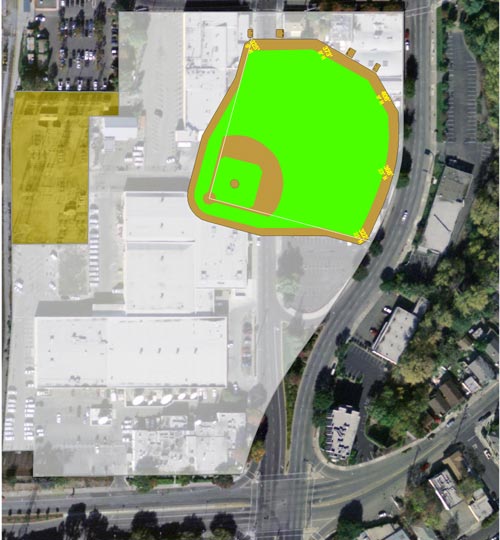
Let’s start off with where the field is placed within the site. First up, here’s what I drew up a couple of years ago.
newballpark1-export-sm

In my sketch, the RF wall hugs the Autumn Parkway contour. The aesthetic effect of that is that fans are confronted with a large wall when walking along Autumn. Additionally, the field is pushed up further north to have more “back of the house” space. By doing this, I effectively put a cap on the number of seats. That isn’t necessarily the case with this new drawing.

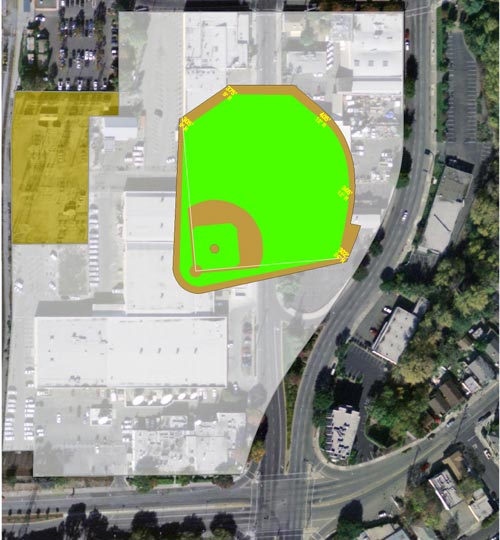
Assuming that the remaining land acquisitions go as scheduled, including a small land swap with PG&E, the field is likely to be situated as you see below, give or take 20 feet north or south (north is up). That orients the field pretty close to true northeast. Prevailing winds tend to come from the northwest, so they should move from the left field foul pole to its counterpart in right on a regular basis. At times, the winds will shift to NNW or WNW. However, the winds in San Jose tend to not be particularly strong, generally topping out at 10-15 mph. Oakland and San Francisco are generally more prone to onshore and offshore movements.

Now for the new 360 layout:
ThreeSixty1-export-sm

The way that Autumn Street/Parkway is contoured, it removes almost all of the RF corner from what would normally constitute a grandstand. And we can’t do an analysis without discussing those field dimensions, with the very short porch in right and a shallow corner in left. Neither of those dimensions are entirely necessary. You can see that there is some space to lengthen both of those out, and I figure that some version of Cisco Field has more “standard” dimensions in place.

Of course, standard dimensions aren’t possible in right if that “thing” is there. What is that thing, anyway? Well, I’ve searched far and wide for some context. It’s not an arcade as in San Francisco, as it doesn’t have arches. Instead, to me it’s, for lack of a better term, a contemporary take on a classic colonnade. To wit:

In classical architecture, a colonnade denotes a long sequence of columns joined by their entablature, often free-standing, or part of a building.

Normally, we think of colonnades as freestanding, such as those used at old LA Forum and Soldier Field. In this case, they house multiple levels of what appear to be minisuites. That’s the first radical step I noticed from the Fremont plan. At Pacific Commons, the minisuites were only 15 rows from the field along the infield. Now they’re part of the colonnades. I suspect the team reached out to potential minisuite holders to see what effect this would have on their interest. If the idea survived this long, the effect must have been minimal.

Depending on what the treatment for the colonnades is, they could become the signature element of the ballpark. There’s no other eye candy in the outfield besides the video/scoreboard, which lines up flush with the top of the colonnades and the roof. I don’t expect to see a neoclassical look, as in the two examples cited previously. Instead, it will probably be more modern and perhaps subdued.

Several sections of outfield seats jut out from the colonnade, creating the crazy 345-foot dimension in right-center. Either they really needed to get those seats in there, or it’s an affectation of sorts. Frankly, it’s unnecessary. The best thing to do would be to take off a few sections, chop off several rows of those seats and turn it into a family or picnic area. The resulting right-center length would be 360 feet or more.

Over in the LF corner, the line could be further extended, eating into more seats and creating a higher wall as a result. I don’t really have a problem with it. Every team should have a righty dead pull hitter who hits frozen ropes down the line. If they get an extra 10 HR that way, so be it.

Features

diagram1-sm

After my 2008 trip to the East Coast and the more recent trip to the Midwest, I came away with one absolute must-have: a majestic plaza for fans to enter the ballpark. AT&T Park has this behind the plate, but the ballpark itself turns its back to the plaza so there’s a sense of separation from the action. At Nationals Park and Target Field, the plaza is integrated into the outfield (Nats Park in left-center, Target Field in right), making the journey to the park all the more momentous. There’s something viscerally stimulating about seeing the grandstand and the field get larger with each step. It’s a reminder of what we had prior to Mount Davis, when the BART bridge walk brought a certain level of excitement. The plaza is large enough (nearly an acre) to hold the family-oriented entertainment options.

The third deck is the other major radical move. Notice how the seats in the first two decks are not defined or articulated, appearing to be benches. Obviously they’re not a bunch of bleacher planks, but the third deck has the same large yellow chairs with side tables next to each seat, just like the minisuites. This appears to be the club level. If so, that’s a marked departure from the club levels we’ve come to expect from most venues. There’s no expansive, separate concourse. There’s scant room for a bar. It’s not indoors. It’s not entirely behind the plate. Instead, it’s three rows of seats, served up with tables and drink rails. This is where I expect Cisco to make its mark. I expect each seat will have video and in-seat concessions ordering, making every seat in the club have diamond level-like wait service. There remains the possibility for a club restaurant down the LF line, and a perhaps another gathering area behind the plate. The seats themselves are at the same height and distance the Coliseum’s suites are, except with more baseball-friendly sightlines. The club will also have the benefit of a roof over the seats, whether it’s the mesh roof from the Pacific Commons version or something different. In moving in this direction, they’re trying to create distinct, separate markets and price points for premium seating that don’t exist elsewhere in the Bay Area, or even in baseball. At the same time, they’re doing what the Red Sox did at Fenway – put the premium stuff at the top of the stadium. It’ll be interesting to see how this pays off.
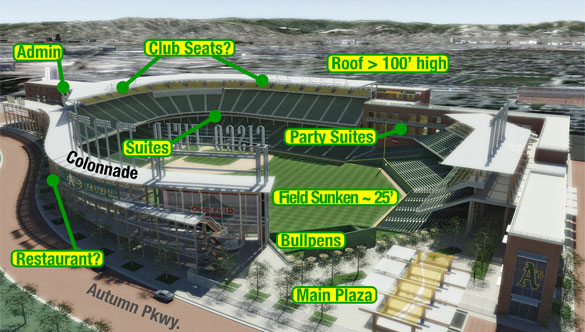
diagram2-sm

The field is sunken, just how I’d prefer it. One of the issues associated with building close to the bay (China Basin, Candlestick, Coliseum, any JLS site) is that to avoid the water table or keep from drainage issues, any stadium pretty much has to have its field at sea level or higher. Diridon is around 90 feet above sea level. There’s still the water table to deal with, but that’s largely an engineering issue that shouldn’t be a problem as long as digging doesn’t go too deep (in the area, the floor of HP Pavilion is also below street level).

The bullpens are sunken below the field and placed at CF. Makes sense to me. It explains why the fence is slightly taller at CF, as opposed to LF. Hell, the Giants should’ve put their bullpens there – oops, they forgot about the pens when designing the place.

The LF corner is where it gets weird. I count 4 different seating angles. First, there’s the normal grandstand. Then there’s a brief 2 sections that run 60 degrees against the grandstand. Slightly beneath that is the start of the outfield section, which follows the outfield wall. Finally, those seats straighten out and run parallel with San Fernando Street. A building in the LF corner houses party suites, and perhaps the aforementioned club restaurant.

I would be remiss if I didn’t point out that the two-deck grandstand would be the shortest in the majors by far. On the 3B side, the grandstand doesn’t go beyond 240-250 feet at best. On the 1B side, Autumn causes a tapering effect that puts the topmost upper deck or club seat just barely beyond the edge of the infield. To compensate, surely there will be more rows of seats in both decks, though it’s not clear how many.

More impressions:

  • The colonnade creates one more aesthetic positive: a net in RF won’t be needed. I figure the height of the roof will be 90 feet in the outfield, making it like a Tiger Stadium/Comiskey Park situation – if someone can get it out of there, he earned it.
  • One thing that’s missing is a view as you exit Diridon Station. I would’ve liked to have seen that. Will transit users have a gate there? Will they go to the main plaza? Or will they use that notch in left-center that lines up with Montgomery Street?
  • I’m still not sure how much of an impact columns in the grandstand will have on views. Columns in the grandstand appear to be recessed into the concourse, not in the seating bowl.
  • With the PG&E substation change, a new access road has to be established. That will probably come from Park Avenue, running by parking lots and/or garages.
  • The tight grandstand all the way around should seal in noise well.
  • 75-degree angle in the grandstand refers to the angle between the first and third base sides. Often in new ballparks, the initial angle is 85 or 90 degrees, with a kink on one or both sides to pull the seating bowl further in. The most severe example may have been old Yankee Stadium, which had a 55-degree angle. Foul territory down the lines was almost non-existent, but the implementation caused the distance from the plate to the backstop to be extraordinarily long (72 feet).
  • The Eric Byrnes sighting. It’s probably nothing, in that they used the first image they had lying around. Or it could be a sign that this thing has been in the oven for a while.

All that said, one question remains: Do I like it? On a scale of 1 to 10, I’d give it a 7 right now. The field dimensions need to be addressed, which is not easy since the only person who has spent more time looking at the land besides 360 and the A’s is probably me, and enlarging the field is a real head-scratcher. I like the back-to-basics design. I’m not sold on how the premium seating all fits together, but I’m not a customer for those so it isn’t my concern. I’m also not clear on what the façade will be. Brick is more commonplace in the Diridon area than just about any other material, yet Lew Wolff has said in the past that the design will not be retro, which should rule out brick. Will it be some marrying of the two?

Most importantly, this will surely be the most intimate major league ballpark built in the last 90 years. Unlike the swept-back HOK/Populous designs which are meant to be essentially inoffensive, this one’s not going to win everyone over. Some will think it’s too small. Others will not like how it’s set up. I suspect that once people get in the seats – perhaps the first open house or walk through – opinions will change quickly. They’ll wonder why the seats at AT&T, which they once thought were the best, are so far away from the action. Skylines are good. Bayviews are nice. San Jose doesn’t have outstanding versions of either, which means the A’s are turning to the original selling point – baseball. I don’t see that as such a bad thing.

Regionality: The New Revenue Stream

Is it possible that the A’s v. Giants rumble for the South Bay is a lot more complex than we even imagined? I mean, Bud Selig keeps saying so. Should we not believe him? Is it possible that the concept of MLB territory is evolving and this dispute is less about right now and more about an emerging revenue stream?

I caught myself pondering this question last week as the All Star Game was struggling to keep my attention. Honestly, my pondering began with a question like “When was the last time I cared about an All Star Game?” Oddly enough, I thought of the 1988 Triple A All Star Game in Buffalo, New York. It was the first Triple A All Star Game to feature all 26 Triple A affiliates and it was televised on ESPN. I remember waiting for the game to start as I sat in a 1950’s era ranch style San Lorenzo home staring at my grandparents 20 inch TV. Jim Kaat and Gary Thorne were waxing poetic about the beautiful new Pilot Field in Downtown Buffalo and the future stars about to take the field.

At the time, my main reason for being so excited was that I would get to see the player I thought would be the 4th Rookie of the Year (after Canseco, McGwire and Weiss) in a row for our Green and Gold heroes, Lance Blankenship. As a baseball card collector, I was also interested in seeing one Gregg Jefferies, a player I had heard about in card shops as a rookie card one needed to possess. They didn’t disappoint! Blankenship was 1 for 3 with a stolen base, while Jefferies was 1 for 2 with a Home Run. Other notable names that participated in the game? Bob Geren, Geronimo Berroa, Mike Devereaux, Joey Cora and Sandy Alomar.

Thinking about the game reminded me how much minor league baseball has changed.  It seemed that, back then, MLB teams didn’t think much about how the distance between the parent club and it’s top affiliate impacted business. The A’s Triple A team was 772 miles away in Tacoma, WA, for example. While that seems like quite a distance, it was nothing when compared with the over 3000 miles that separated the Chicago White Sox and their top affiliate in Vancouver, BC. I threw a quick spreadsheet together and discovered that in 1988, the median distance between a Major League team and it’s Triple A affiliate was 559 miles. (ed. note- This number is based on Google maps and is hardly precise, but close enough to illustrate the point)

If we juxtapose the conditions in 1988 with the conditions in 2009, it is easy to see a trend towards greater regionalization. Consider these things:

  • The median distance between MLB teams and their top affiliate is now only 315 miles.
  • In 1988, there were 2 Triple A affiliates that played within 200 miles of their parent club. Today there are 12.
  • Today there are 3 teams with their top affiliate over 1000 miles away, the greatest distance being the 3600 miles that are between Toronto and Las Vegas. In 1988, there were 6 teams that were separated from their top affiliate by more than 1000 miles, 2 well over 2000 miles.
  • The Braves moved their Triple A affiliate from Richmond, VA after 43 years. The Gwinnett County Braves are just over 30 miles from the parent club
  • The San Diego Padres (or at least some members of the teams ownership group) are actively working to bring the current Portland Beavers (next season Tuscon?) closer to the mothership. Possibly as close as San Marcos (36 mi.) or Escondido (31 mi.).

With MLB Advanced Media generating profits from the web, Fox Sports paying big bucks to broadcast national games, the advent of MLB Network, Regional Sports Networks extending the reach and frequency of each teams broadcasts, and most teams having a newish piggy bank for a stadium… Are minor league affiliates the next money maker for the MLB clubs? Or could there be a different reason for the decline in median distance? Is the shrinking distance between the clubs and their affiliates  about efficiency or marketing or both? Or could it be simply that expansion in the 90’s brought big league baseball closer to existing Triple A cities?

It seems to be all three. Teams are investing in minor league affiliates to make money, closer affiliates help the baseball operations staff by allowing for things like more efficient use of scouts or potentially quicker player call ups and the MLB expansion of the 90’s created the opportunity for MLB Clubs and their Triple A affiliates to move closer together.

Minor League Investments

The Padres are just one of a growing number of ownership groups that are finding it beneficial to invest in the minor leagues. The Braves, Giants, and Red Sox have all made investments in minor league teams at some point in the last decade. While I don’t expect that every team will be out buying up the 150 or so major league affiliated minor league teams across the country, I imagine most are kicking the tires on limited investments.

I find this particular quote from the above linked article to be telling:

“We’re on the record and excited about operating a Triple-A franchise in Padres’ territory,” Moorad said. “And we want to break ground, start turning shovels of dirt within four to six months.

“To be clear, though, our ownership group — not the Padres — will make the deal that makes sense to all parties.”

Is it possible that this view of expanding the reach within their territory by collocating a Triple A franchise is one of the issues that the Selig Panel is reporting on? It seems so.

Efficiency of Baseball Operations

Picture this hypothetical situation that a GM might face. The trade deadline is fast approaching and you are not sure yet if you are a buyer or seller so you need to get good scouting reports on potential targets as well as understand the recent performance of your minor league assets. Your top free agent acquisition is about to go on the shelf with elbow trouble and you aren’t sure who to bring up to take his roster spot. You want to send your most trusted scout to report on both scenarios. If your Triple A team is 80 miles away, and playing at home, and your High A affiliate is even closer, and playing a potential trading partner… It suddenly becomes a few days of driving around the adjacent Metro Area to get an on the ground report rather than a series of plane flights all over the country and back, assuming the two affiliates are playing nearby.

It’s less expensive, your scout is presumably more alert and when you call him on a whim and say, “Ben Sheets elbow is barking, should we call up Bowers, Mortenson, or someone else?” You can expect to get a better answer.

In a scenario that probably more applies to our A’s… Rehab assignments can be monitored by the GM himself if he wants, for crying out loud.

The Changes Since Expansion

Of the markets that hosted Triple A teams in 1988, 2 (Phoenix and Denver) were “promoted” to the bigs and 6 (Calgary, Edmonton, Richmond, Old Orchard Beach Maine, Tuscon and Vancouver) were “demoted” on out of Triple A baseball.

With 4 new Major League teams creating a need for 4 additional Triple A markets, the total new Triple A cities in the past two decades is 12. The new cities, since 1988, are Charlotte, Durham, Fresno, Lawrenceville (Gwinnett County, GA), Allentown (Lehigh Valley, PA),  Memphis, New Orleans, Reno, Round Rock (TX), Sacramento, Salt Lake City and Scranton/ Wilkes-Barre.

With Triple A teams dropping below the Canadian border, and closer to existing MLB franchises, all while new MLB teams were being established closer to existing Triple A cities (Colorado Springs/Denver), it seems only natural that teams would look to realign their minor league affiliations to take advantage of the opportunity to expand their reach into adjacent metropolitan areas. With the growth of Regional Sports Networks, minor league affiliates outside of traditional MLB territory, but inside an expanded TV market, became of greater strategic value.

In conclusion, it is all speculation as to what role this evolving view of the value of minor league affiliates in an extended metro area may hold for big league clubs. That said, it is clear that even small market teams are looking to the minor leagues as potential sources of future revenue. While I am not sure this is something that Selig’s panel is looking into, thinking about it (and mentally squinting really hard) definitely makes me understand some of the delay.

An Experiment in Value

Over Mother’s Day weekend, I decided to give my beautiful wife a day away from her four kids (our three daughters and me). I thought it would be fun to make this day away from Mom an economic experiment of sorts.

The question: Could we sit in the Value Deck, bring our lunch but still eat our fill of crap food, keep one Andrew Bailey Bobblehead and make the day a financial wash otherwise?

The  spend for us was $21.60 for three round trip BART fares (my youngest is not old enough to have to buy a ticket yet) from Pleasanton to the Coliseum and back. $48 for 4 tickets in the 3rd deck and absolutely nothing more. So, our total outlay was $69.60.

The $69.60 got us more than just tickets and a ride to the game. We brought our lunches but we had $24 bucks in food/merch credit to use. We used the credits for two packages of Dibs, two fairly large sodas, and a giant box o’ nachos. All of this on top of a great spot to watch the game from (Section 316) and a good conversation with the Lone Stranger (and almost a visit with LeAndre until we had a melt down).

The second half of the experiment is underway right now… Three bobbleheads on Ebay. Judging from the comparable products… We stand to sell the three for around 15 bucks a piece (after fees and what not). So if that holds true,  we will have spent a lazy Saturday eating dibs and watching Ben Sheets dissect the Rays for about $25 bucks total. And increased my already sizable Oakland A’s Bobblehead collection by a Rookie of the Year Closer. Not bad.

Now if only it had been Dallas Braden Bobblehead Day, we probably could have covered our outlay and then some. Especially today.

A few of other observations about the 3rd Deck based on my first visit to the section since Barry Zito Bobblehead Day in 2003:

  • In my 30 plus years of visiting the Coliseum for baseball games I have sat about everywhere. Section 316 is one of the better places to see the whole field, and though I tried to convince my 10 and 7 year old daughters to move down into the second deck and sit in the shade… They would have none of it. In the 5th inning my oldest said “That Triple wouldn’t have looked as cool if we were down in the shade, Dad.”  I ignored her followup comment about how handsome Ryan Sweeney is (10 going on 30).
  • The concession stand right behind the section is extremely easy to get to and buy what you want. With restrooms right next to it and a wide open concourse, it was easy to take the youngin’s for potty/junk food breaks in between innings and not miss a pitch.
  • The staff up there is awesome. After the infamous melt down that thwarted my attempt to go and see LeAndre the usher came over and, through a big,knowing smile, she said “Last time you take them somewhere without Momma” as she helped me clean up the hurricane of garbage my 3 year old kicked up. I appreciated the observation and the help 🙂
  • I read once, on this very website, a comment about tarping the plaza bleachers and opening more of the third deck. After this trip, I fully endorse the idea. We have taken our girls to games many times and, usually when it is some sort of group outing for school or what not, we get tickets in the Plaza Bleachers. I’d suggest opening Sections 314, 315, 319 and 320 and closing the Plaza Bleachers.

I wonder if any of our readers have done a similar experiment? If so, let us know the particulars and  how it turned out in the comments.