The price of contraction

Tomorrow marks the 7th anniversary of this here blog. Seven years! That’s an amazing amount of time to have nothing happen. Regardless, the blog has been a great learning experience for me, and based on the many positive emails I get, for the readers as well. Since we nothing concrete to go on, this week calls for a series of “what-if” posts. The first one was Monday’s examination of a hypothetical group buying the A’s from Lew Wolff. Today’s post is about the word I hate talking about, contraction. It’s not an idea that has legs at the moment. If the A’s and Rays continue to stagnate money-wise at their current homes, it’s something that could become a wedge issue when the next CBA negotiations come around in 2016.

If MLB were to attempt contraction, they’d run into myriad issues, from a difficult-to-break lease at Tropicana Field to MLBPA complaining about lost jobs (or at least salary) to potentially huge PR and legal muck. If MLB were to move forward on the path towards cutting down the leagues to 28 teams, it’s important to understand what the potential economic impacts are. To that end, I’ve put together a simple table showing lost direct revenues and jobs. I’ve not gone so far as to claim indirect economic loss, because I don’t know enough about the specific economic models of the various major and minor league franchises to make such a claim. Even so, you might find that the figures are staggering.

Contraction is not as simple as changing 25-man roster to 27 in order to compensate. There's a lot more at stake.

Thursday marks Day 1096 of the MLB panel counter, the three year anniversary of the “Blue Ribbon Commission” as so many of you like to call it. I had gone back into my archives to find a specific date on which Commissioner Selig may have convened the panel – no such luck. Absent such a date, I chose to line it up with the Ides of March. So there you have it. Happy Anniversary Week!

Giants revisionist history

One thing that I don’t think can be argued is that over the last 15 years or so, at least since Peter Magowan took control of the Giants franchise, the Giants have had a better PR machine going than the A’s. When the A’s hired former Giants PR head Bob Rose, it was a tacit acknowledgement of that superior effort. The Giants’ needling of the A’s in their Wednesday press release was a great example of their skill.

Except they missed a few facts.

Here’s a chunk of the release:

The Giants territorial rights were not granted “subject to” moving to Santa Clara County. Indeed, the A’s fail to mention that MLB’s 1990 territorial rights designation has been explicitly re-affirmed by Major League Baseball on four separate occasions.

If you read that quickly, you might think it’s a simple, cut-and-dried scenario. In reality, the two sentences aren’t related at all. The Giants actually argued that Santa Clara County was not granted “subject to” a move. It wasn’t? Why was it granted, then? The Giants didn’t go into any explanation for what occurred (bullet points would’ve been helpful). The facts are these:

Bob Lurie asked Wally Haas for permission to take Santa Clara County in 1990. If the Giants feel that’s a myth and desire to dispel that myth, they should explain how they got Santa Clara County in 1990. As far as everyone knows, this is how it happened (via the Chronicle’s John Shea):

As Wally Haas [III] tells the story, the A’s were approached by Giants exec Corey Busch requesting exclusive rights to the area before the Giants’ proposed ballparks in Santa Clara and San Jose.

The A’s said OK, and the transfer became official when baseball owners granted approval.

That was it.

“We shared the territorial rights up to that point, the Giants and the A’s,” Haas said on the set of “Chronicle Live” on Thursday. “They asked if we would cede those rights to them so they could go through the referendum, and we felt that was fine.”

It takes some temerity to deny long-held history and not even provide an alternative. Quick chronology:

  • 1987 – San Francisco Proposition W fails at the ballot box. Bob Lurie throws the door open to building outside of San Francisco.
  • 1989 – Lurie works with San Francisco Mayor Art Agnos and Spectacor on a ballpark at China Basin (Proposition P). That effort fizzled in the wake of Loma Prieta.
  • 1990 – Lurie looks south to Santa Clara, where a ballpark could be built north of Great America. He asks Haas for permission and is granted county. The Santa Clara County (unincorporated)/San Jose/Mountain View/Los Altos/Milpitas/Santa Clara (city) utility tax goes down to defeat.
  • 1992 – Lurie turns his attention to San Jose, where Mayor Susan Hammer worked on a ballpark plan at 237/Zanker. The San Jose-only utility tax lost, and with it the hopes of having the Giants in the South Bay.
  • 1992 – Lurie comes to an agreement to sell the Giants to an investment group in St. Petersburg, where a domed stadium was built on spec.
  • 1993 – Walter Shorenstein and Larry Baer rally SF civic leaders in an effort to rescue the Giants. Peter Magowan, the head of Safeway, is brought in to be the managing partner. The price of the franchise is $95 or $100 million, depending on who you ask. The price is considered a discount in exchange for keeping the team in the Bay Area, as the Tampa Bay bid was higher. Magowan would go on to sign free agent Barry Bonds, and resign his Safeway post to focus full time on the Giants.
  • 1995 – Magowan and Baer craft another China Basin ballpark plan, partnering with Mayor Frank Jordan and later his successor, Willie Brown. In the meantime, Haas sells the A’s to Steve Schott and Ken Hofmann for $85 million, with some $10-15 million of incurred debt discounting the price as well as another “hometown discount” to keep the team local.
  • 1996 – Proposition B, the Giants’ privately financed stadium plan, wins by a landslide.

This goes back to a question I posed when the Bill Madden article came out last weekend. Read it carefully, look back at the chronology, and think about it.

If Bob Lurie had not gone after the South Bay, he wouldn’t have been granted the rights by Wally Haas. After Lurie struck out in SF for the last time and threatened to move to Tampa Bay, Magowan/Shorenstein swooped in to save the Giants. Would Magowan have asked for rights to the South Bay in 1993-96 in order to finance AT&T Park, knowing that he wasn’t actually going to build there but rather in downtown SF?

The Giants maintain that because territorial rights were confirmed with subsequent CBA/Constitution ratifications, Santa Clara County should remain theirs in perpetuity. The problem with that argument is that until recently, no other team has formally pushed for a move to Santa Clara County. Sure, Schott had talks with Santa Clara in 2001, but those went nowhere fast and no serious prep work (EIR, feasibility study) was done. What is there to defend if no one is asking? Now the A’s are challenging those rights, and both teams are getting a little hot under the collar.

Finally, the Giants argue that because of the way the Bay Area was gerrymandered, the Wolff/Fisher 2005 purchase price of $172 or $180 million (depending on who you ask) is not reflective of the A’s having control over Santa Clara County. There is no comparable recent Giants sale price to compare it to, so we have nothing to go on there. The Giants’ 2011 franchise value, $563 million, has multiple components including the value of their ballpark and media empire, neither of which the A’s have. That makes it difficult to isolate what the true value of Santa Clara County is, at least when it comes to locating a stadium there. The Giants have also added and swapped partners in the intervening years more than 70’s Marin County couples at a key party, which makes it even more difficult to understand the value of any specific component or any particular stake.

One comparison you can make is the purchase prices of the two teams when Magowan and Schott entered the fray. To reiterate, Magowan’s bid for the Giants was $100 million in 1993. Schott’s bid for the A’s was $85 million in 1995. If we adjust the 1993 figure for inflation and ignore the downturn caused by the 1994 strike, a 1995 valuation is $105 million, a $20 million difference between the Giants and A’s. That’s probably the best comparison to make because it’s pre-AT&T Park and pre-media empire. Adjust that $20 million gap for inflation and the result is $30 million, which is what Roger Noll has argued territorial rights to the South Bay are worth. To some that may seem low and not reflective of baseball’s impressive post-strike growth. At 5% compound interest, the 2012 value is $45 million. At 10% it’s $101 million.

In any case, there is a value associated with an A’s move to the South Bay. It’s been the Selig panel’s charge to determine that value and the feasibility of the move. Maybe the Giants would be irreparably harmed if the A’s went to San Jose. I don’t believe they would, but I don’t have the information available to appraise the situation properly. The teams are busy spitting out press releases and statements. What I want is real figures. I want the presentation that the panel made to the MLB Executive Committee two months ago. Without that, we’re left with an incomplete picture and a lot of spin. Knowing that’s highly unlikely that I’ll ever see that presentation, I realize that my request is futile. I’m still putting it out there, hoping that at some point, we’ll all be better educated about all of this.

.

P.S. – I’ve also written about the price of T-rights in these posts: The Payoff, The Neukom Doctrine, A Territorial Rights Primer

3/6/12 News Analysis

First off, a quick acknowledgement of the unanimous approval of the Kings ESC arena deal by Sacramento’s City Council. Somehow, that happened a full hour before the Oakland approved its resolutions and expenditures for the Coliseum City project. There’s still a long way to go. The $255 million that Sacramento is committing to the project is the big semi-known. If KJ and company can put a deal together that doesn’t look too risky (and force a referendum because of that risk), they’ll be in pretty good shape. There are still issues of which route the City will go to come up with the $255 million (selling parking rights vs. raising bonds), the Maloofs’ ongoing debt, and the typical EIR mitigation stuff that will be identified in the coming months. Onward and upward.

I realize that my liveblog notes from the Oakland City Council meeting are so messy that they’re nearly incomprehensible, so I’ll boil the whole thing down to its essence.

1. The Council voted for a feasibility study and EIR, not to build anything.

Just to be clear, here’s the relevant language from last week’s committee report (emphasis mine):

The ENA [exclusive negotiating agreement] with the JRDV/HKS/Forest City development team will allow private predevelopment work to proceed for Area 1. The ENA between the City and the development team is for the purpose of determining the capacity of the development team to deliver on the project, and for studying and evaluating the feasibility of a new stadium development.

In other words, it’s a start. It’s not a promise to replace the Coliseum or erect a ballpark next door. It’s about determining whether this concept, Coliseum City, actually makes sense. Speaker after speaker brought up the legacy of major pro sports in Oakland, totaling 111 years (impressive). Some brought up the soul of the city, or how teams leaving could negatively impact the next generation of Oaklanders. Problem is that all these appeals to passion and soul at least indirectly led to the bad deal that the City and Alameda County got into in the first place with Mt. Davis. Ignacio De La Fuente has been consistent in his desire not to bend over backwards for any team, and that any team that wants a deal in what he considers the best land for a stadium in the Bay Area has to be an equal, willing partner. Or in this case, three equal, willing partners. Which brings me to the next issue…

2. The City Council is couching their words.

Libby Schaaf brought up the fact that the original resolution(s) did not specifically call for a project alternative in which no new stadium is built, so she asked for a rewording and got it. This request came after just about every other Council Member other than Larry Reid and Rebecca Kaplan (who was absent) talked about the “no stadium” alternative. That’s the case where either it doesn’t make sense to build a new stadium to replace the Coliseum, or no team is interested in such a stadium, or some other set of circumstances in which a stadium can’t happen. Those in the audience didn’t want to hear it – they want to hear about progress and results – but it’s a big step forward for the City Council. Last year I wrote about the adult conversation that Sacramento was having with its residents over the Kings future. Oakland is getting closer to having their own discussion, which will be all the more painful because it will involve three teams and choosing favorites.

However, the choices won’t be as simple as “build or don’t build”. There will be an array of choices, permutations, and even sites to consider. Assistant City Administrator Fred Blackwell noted at the outset that because the redevelopment money for the Coliseum City is supposed to be confined to that specific redevelopment area, it couldn’t be used outside the project area. Then Eric Angstadt clarified that all reasonable alternatives will be studied, including sites or options that may be outside Oakland. Who’s right? I guess we’ll find out. My immediate reaction is that if redevelopment is going away from a project/operations standpoint, what does it matter what redevelopment area it’s in?

3. 980 Park and the Ghost of Victory Court

I counted two mentions of Victory Court all night, one by Larry Reid and one by a speaker. It’s almost as if VC has been wiped from people’s memories. Just 14 months ago the Council Chambers was packed to the rafters and an overflow room was needed to hold everyone for a planning commission hearing on VC. This time, a third of the audience was on hand for a different, non-sports issue on the Council’s agenda, and they left when that issue was resolved. There were few people in the balconies, and there were plenty of seats available in the chambers for latecomers. I noticed that neither Let’s Go Oakland nor Baseball Oakland heavily promoted this session, so that may have something to do with the lower turnout.

On the other hand, 980 Park rose like a phoenix. Multiple West Oakland residents spoke in favor of it. Bryan Grunwald spoke out about it, as you’d expect. Nancy Nadel mentioned that her constituents were interested in it, and Jane Brunner pushed it forward. Brunner indicated that there were discussions with city staff about 980 Park’s feasibility, so since Coliseum City’s going through a feasibility study, might as well include 980 Park, even if it’s simply to find out if it makes any sense cost or time-wise. Redevelopment funding issue aside, it can’t hurt to include 980 Park as an alternative. One speaker rightly pointed out that if Coliseum City and its Oakland Live! concept became successful, it could seriously harm the existing downtown Oakland. Cities usually don’t have two downtowns, at least not successful ones. San Jose knows this well, as they forever killed downtown’s retail growth by approving Santana Row three miles away. Downtown Las Vegas is the low-rent, shopworn alternative to the glamour of The Strip. In the next year I can see the Council ask for a full economic impact report, explaining how creating a second downtown could have a complementary or deleterious effect on the original downtown.

That’s it for this early morning. I have a postscript item to tack on, but that will have to wait until the business day starts. Until then, comment away.

Ballpark fever in February

Last week I felt like getting a glimpse of Mark Appel, the Stanford hurler and East Bay product who may eventually be the #1 pick in the June draft. So off I went on Friday to Stanford’s Sunken Diamond, one of the many immaculately kept athletic facilities at The Farm. My baseball cravings have come early, too early to be sated by spring training. College baseball is an excellent, affordable brand of ball, and I have to admit being more curious than usual thanks to my recent reading of The Art of Fielding, rookie novelist Chad Harbach’s work about baseball at a small, fictional Midwestern private university.

An unusual 70 feet from the plate to the backstop at Sunken Diamond. Nevermind that as Stanford P Mark Appel rarely had to make C Eric Smith do more than reach down to rein in a pitch.

What started with Appel toying around with the Texas Longhorns to the tune of 10 K’s turned into a mad dash all over Northern California to see baseball wherever I could find it. (This is what happens when you’re not married, have no kids, and you’re comfortable seeing your friends only twice a week.) Sunken Diamond is a pleasant, serene environment, with more than ample foul territory and trees beyond the outfield that effectively block out civilization. The Friday night game, with a published attendance of 2,624, was typical for Stanford baseball: a very family friendly environment with kids running up and down hills to grab foul balls.

On Saturday I drove up to Sacramento because I felt like being environmentally irresponsible. On the way to Cowtown I stopped in Stockton, where there was nothing happening at Banner Island Ballpark. Not wanting to stay in Stockton any longer than humanly necessary, I jumped back on I-5 and headed north. I stopped at Raley Field, hoping that someone was there or that a gate was open. Thankfully, as I arrived a college team (JC?) entered the gates and was getting ready to take the field. There was a sign advertising National Anthem singers, though I didn’t see any staff on hand to guide any audition process. I quickly went in and took a few snapshots, which I’ve never had a chance to do with Raley Field empty (I’m sure if I called the River Cats’ media relations they would’ve granted it but I tend to operate by the seat of my pants). The field was in fine form, just waiting for its masters to handle grounders and make great catches on it.

Ready to go in West Sacramento

Three (!) years ago I wrote an article about how difficult it would be to expand Raley Field to MLB size. Rain caused major changes in construction methods, including a change from enormous steel columns to poured-in-place concrete columns and light steel trusses supporting the press box and suite/club level. This is what that structure looks like:

All of this would have to be scrapped to make way for multiple decks and/or suite levels.

This is what a properly sized (overengineered) column at Busch Stadium looks like:

Now that's a knife column.

After the brief stop at Raley, I crossed the river and went to the train station, which as far as I know is the closest the public can get to the Railyards site where the planned arena will sit. I’ve written enough about that so I won’t bother with that subject in this post. Once I got my fill of downtown, I headed east to the CSU-Sacramento campus, where the Hornets were getting ready to play a day game against Seattle University. If Sunken Diamond is one of Northern California’s nicest college ballparks, Sac State is one of the most spartan. The grandstand is all aluminum, with mostly bleachers and a smattering of real seats in the first few rows. There is no press box and no actual restrooms. Tickets cost $5, but I could have easily gotten a good view for free from the parking garage in left field. The PA announcer sounded like an older Rick Tittle. Ambience was provided by a busy rail line across the street and a handful of coeds who cheered on every player on the Hornet squad. Regardless, I enjoyed the experience.

View from the 6th floor of the student/faculty garage just beyond the left field fence.

I got my fill of Hornet baseball after about six innings. The UC Davis baseball team was on the road over the weekend, so I skipped The other Farm and headed back to the Bay Area. My last stop was scheduled to be Albert Park in San Rafael, home of the San Rafael Pacifics of the independent North American Baseball League. That leg of the trip was ruined when I got a hankering to visit Russian River Brewing in Santa Rosa, a half-hour and another county away. By the time I got to Albert Park it was completely dark and a few transients were lingering about. That’s just as well, since only yesterday did a Marin County judge allow the Pacifics to start operating in full with ticket sales and improvements to Albert Park. The old fashioned covered grandstand will be expanded from 800 to 900 seats. Tickets will start at $10 for general admission, though you have to think there will be numerous merchant nights to provide free or heavily discounted ducats. There’s even a tryout on March 17, so if you have a few tools and you aren’t dunk by noon, you may want to drop by for a tryout.

The high nets at Schott Stadium are a necessity as the field is only steps from traffic.

Sunday was a day of rest and no baseball. With no games scheduled on Monday, I chose to take in a game at Schott Stadium at Santa Clara University on Tuesday afternoon. The park is tightly wedged into a corner  of El Camino Real and Campbell Avenue, surrounded on two sides by university apartment housing and a few industrial buildings. There are a good number of permanent seats, and while there are plenty of bleachers, you can tell that a few corners have been cut there. The bleachers are basically standard aluminum sections that aren’t connected to each other. Even though the park is only seven years old, the bleachers feel rickety. The dugouts are not set much below grade, so the roofs of the dugouts obstruct the views down the line. The PA system is distractingly loud. Other than those niggles, the experience is quite pleasant. Schott Stadium is across the street from the main campus and down the block from the Santa Clara Caltrain station. A small parking lot next to the stadium has a space reserved for namesake and former A’s owner Steve Schott.

The whole trip reminded my of one of my other ballpark trips in the Midwest or East Coast, except that I didn’t have to shell out for hotel rooms. I’ll try to do one of these with the various minor league parks later this year, and perhaps another trip involving more college ballparks.

Hosting a future Super Bowl

The last and only time a local (host) team won a Super Bowl was XIX (1985), when the 49ers beat the Miami Dolphins at Stanford Stadium. Although not technically a home game at Stanford Stadium, the game’s location within the heart of the Niner fanbase made it a de facto home game. As soon as 2017 (maybe 2015 but unlikely), we may once again have a Super Bowl held locally. As the popularity and TV ratings of the big game have only grown since its inception, so have the stakes and requirements to host the game. The 49ers and the City of Santa Clara have frequently touted the Super Bowl as a major reason to build the stadium near Great America, and from all appearances the Bay Area will have all of the infrastructural pieces in places to host the Super Bowl when the time comes.

But what are those infrastructure requirements? According to numerous sources, the requirements are these:

  • 70,000+ seat stadium
  • A dome or outdoor stadium if average January temperature is 50 degrees or higher
  • 24,500+ hotel rooms within an hour of the stadium
  • Up to 2 million square feet for the NFL Experience and related ancillary activities
  • Additional space for the new “Super Bowl Village” (multiple blocks if possible)
  • Host city or region must also have an NFL team

Stadium

The 49ers stadium is designed to hold 68,500 and appears to have the available space to easily expand up to and past 70,000. The upper deck and corners on the suite/press box side of the stadium are empty, making 1,500 temporary seats no problem. They might even be able to squeeze in double that number, which considering the likely face value of those tickets (>$1,000 per) is nothing to sneeze at. There isn’t quite the room for the 49ers to get greedy the way Jerry Jones did with Cowboys Stadium, when he tried in vain to eclipse the attendance record by stuffing in 30,000 extra seats. Eager to avoid another ticket scandal, the NFL let up slightly on 63,000-seat Lucas Oil Stadium, which added only 5,000 seats for the game.

Climate

Over the nearly 50 years of Super Bowl, the game’s locale has shifted from very large college football stadia (Rose Bowl, Orange Bowl) in warm climates (Southern California, South Florida) to domes (Superdome) and now, highly flexible retractable-roof stadia (Cowboys Stadium, University of Phoenix Stadium, Lucas Oil Stadium). 2014’s game is defying all previous conventions by being held in North Jersey’s MetLife Stadium, which lacks any kind of roof and whose average January temperature is barely above freezing. Whether the typical fan thinks the weather requirement is appropriate given the normal playing conditions throughout the regular season and playoffs is beside the point. Most attendees are high rollers and corporate bigwigs, and given the amounts they are paying to either sponsor the game or pay for the tickets (straight up or through a secondary seller) they should be getting a little comfort. In Santa Clara, the average temperature is around 50 degrees, with an average daily high of 60. If the weather is anything like what we’ve experienced this week in the Bay Area, game day should be a highly pleasant experience. If it’s rain, then break out the ponchos. One advantage the West Coast has over other potential sites is that here the game starts at 3:18 p.m., while it’s still light out and a little warmer to boot.

Hotel capacity

Three major hotels that provide a combined 1,540 rooms are within walking distance of the stadium: Hyatt Regency, Hilton, Marriott. The Marriott is the largest and oldest of the three, whereas the Hyatt Regency is the swankiest and is connected to the convention center. The Hilton is the smallest but also the closest to the stadium. Another 500-1,000 rooms are within five minutes. Clearly that’s not close to the NFL’s requirements. Not to worry, San Francisco and San Jose will be glad to pick up the rest of the demand. Downtown San Jose has over 2,000 rooms. Hotels near the airport have another 1,000. San Francisco has more than 33,000. Still more hotels are scattered throughout the rest of the Valley and up the Peninsula. Capacity is clearly not a problem. Logistics might be, though visitors will have a number of choices. Some may choose to stay as close to the game site as possible. Others may want to do the touristy thing in San Francisco and come down to Santa Clara only on certain days. The main issue is more the way the NFL demands blocks of hotel rooms. The league has been known to demand 95-97% of area hotels’ capacity for the event several years in advance, with the actual rooms booked a year in advance. For a city with a solid year-round tourist trade like SF, a Super Bowl can create chaos and even lost revenue if the Super Bowl doesn’t materialize. Regardless, if the 49ers get their new stadium are built, it’s practically guaranteed that they will get a Super Bowl, allowing all Bay Area hotels to either work with the NFL or compete for attendees on price.

NFL Experience

Now in its 20th year, the NFL Experience is considered a temporary football theme park adjacent to the Super Bowl. That makes it a bit ironic that there’s an actual theme park across the parking lot in Santa Clara, right? Usually, a convention center or arena is not available adjacent to the stadium. In Santa Clara, there will at least be 300,000 square feet of convention space (Indy has 400,000), plus plenty of parking lots for the tented structures used for the rest of the Experience. At currently $28 per person plus whatever money the NFL gets from merchandise and concessions, it’s a huge moneymaker for the league. Recently added to the attraction was a nighttime adult version with a clubby atmosphere and separate admission. In Santa Clara that’s probably a good idea, but it’s a poor substitute for the real nightlife happening 40 miles north. The attraction is seeing hockey-stick growth in popularity: attendance may top 750,000 according to some estimates.

What about Great America? Could Great America’s attractions be used? Sure, though negotiating a deal may be difficult. Great America’s season doesn’t open until late March, and its hiring practice doesn’t actually hire its mostly seasonal workforce until February, even for employees who have been working there for years. There’s also the issue of money. In the Super Bowl host bidding process, the NFL demands 100% of revenue from everything associated with the game. For 2012, a single adult ticket at Great America costs $56. How much more would the tickets be for Super Bowl week in order to satisfy both parties? And what kind of value proposition would it be for Cedar Fair to have its workers come in two months early, work only for a week, idle them, then work again when the season starts? It might be worth it, it might not.

Super Bowl Village

Unlike the NFL Experience, the Super Bowl Village is a free attraction. In Indy, it takes up three blocks of Georgia Street between the convention center and Bankers Life Fieldhouse (formerly Conseco). Like most street fairs it has its own vendors, concert stages, and an anchor in the form of ESPN’s massive broadcast facility. Again, there’s space for this to make this work in the parking lot.

Onerous terms

Cities promoting themselves to host the Super Bowl often point out that the economic impact of the event is up to $400 million (Indy’s projecting a more conservative $155 million in direct spending). Actual ticket and concession revenue for last year’s game was $109 million, this year it’s projected to be $72 million largely due to the smaller stadium. And of that ticket and concession revenue, virtually all of it goes straight to the NFL. Their terms are so demanding that there is no room for any municipality to squeeze out any direct revenue from Super Bowl week. I took a look at an old RFP the City of San Diego filled out in 2000 for a future Super Bowl. Here are a few choice terms that the NFL dictates:

  • The NFL requires at least: (1) 100,000 square feet for team city television satellite uplink truck units, newspaper darkrooms, cable TV remote studios, etc.; (2) an additional 100,000 square feet of space for an international television compound; and (3) an additional 200,000 square feet of space for the broadcast network compound. [ed. – All told that’s 9 acres.]
  • Is there space in immediate proximity to the stadium available at no cost for: (1) hospitality tents, and (2) the NFLP Tailgate party (a minimum of 1,250,000 square feet is required for the event)?
  • The NFL should be able to retain 100% of all revenues derived from the hospitality area and Tailgate party, including food and beverage and novelties sales revenues. Will the NFL be able to do so?
  • Is there a site at or adjacent to the Stadium which is authorized for use as a helipad to accommodate up to 400 landings and take-offs on game day and a lesser number on each of the 12 days before game day? [ed. – Note that the Santa Clara stadium is directly underneath the takeoff path for flights coming out of SJC, not sure how relevant this is to helipad placement.]
  • Will the NFL be able to cater a meal for the event without having to pay any fees to the lessor or any other concessionaire?
  • Is there an arena adjacent to the Stadium? If yes has it been secured in writing for the NFL’s use on game day and for 10 days before game day?
  • The NFL should have the right to determine and approve everything relating to Stadium operations on Super Bowl Game day, including the assignment of meeting rooms, tent space, parking lots, adjacent buildings, etc. Will this requirement be met?
  • The Stadium and all of the surrounding parking and other areas owned or controlled by the Stadium owner must be provided rent free for the entire period of occupancy by the NFL.
  • The NFL recommend staffing levels of at least 300% above normal sellout events. If the NFL is required to pay a portion of the Stadium staffing or operational costs, include a breakdown of the total cost of the NFL’s use of the Stadium and all of the surrounding parking and other areas owned or controlled by the Stadium owner. Will the NFL be required to pay any costs?
  • The NFL must have the unlimited right to use the existing scoreboards and video boards at no cost. Will this requirement be met?
  • The NFL requires that the Stadium provide a certificate of insurance evidencing comprehensive general liability coverage with a limit of liability of no less than $100,000,000, indemnifying and naming the National Football League and National Football League Properties, Inc., as additional insureds.
  • The NFL must have the right to control all ticket sales and to retain 100% of the revenues from ticket sales, and to control all other access to the Stadium (i.e., credentials).
  • A minimum of 50% of all suites (or no less than 45 total) should be allotted to the NFL.
  • At least 75% of the suites allotted to the NFL must be between the end-lines, and the allotted suites must include 50 yard line locations for the televising network, each of the competing teams ,the NFL Commissioner and the NFL President.
  • Is there any contractual obligation to existing suite holders for tickets to the Super Bowl Game?
  • The NFL should have exclusive, cost-free, use of at least 350 bus parking spaces in close proximity to the stadium, including 35 spaces for the media, 25 spaces for each team, up to 50 spaces for half-time personnel, 100+ spaces for NFL Properties, potential member club buses, etc. These spaces should be in a well-lighted area for post-game departures up to 5 hours after the Super Bowl Game.

After looking at the NFL’s demands, it’s not hard to see why, despite raising $25 million to support Indy’s bid for Super Bowl XLVI, the city agency that owns and operates Lucas Oil Stadium is expected to lose $800,000 during the week. Let’s say that of the $300 million in overall spending, 10% of that is tax. That’s $30 million in taxes spread out over several counties and cities. That’s not a bad haul if the cost to bring the game in isn’t too high. Therefore it’s incumbent upon the 49ers and the City of Santa Clara (and Santa Clara County) to make the stadium and its surroundings as ready to host the Super Bowl as possible from the get-go. If they can pull that off, it’ll make them more likely to be considered for rotation into future Super Bowls. The whole thing sounds like a mini Olympic games. Speaking of Olympics… that’s for next week.

Ballpark on layaway

The new CBA has a major change to its debt rule that will affect the A’s as they try to put a ballpark deal together.

The Debt Service Rule will be maintained, but the default EBITDA multiplier has been lowered from ten to eight, and from fifteen to twelve for Clubs incurring stadium-related debt in the first ten years of a new or renovated stadium.

Questions about the commissioner’s actual enforcement of the rule aside, suddenly the A’s have a little less of a ceiling to play with when it comes to building a stadium. For Wolff/Fisher, debt will be limited to 12x the team’s gross income, which according to Forbes has been $22-23 million for the past two seasons, and probably won’t change significantly this year. Should that hold steady, the maximum debt the owners could incur is $270 million. The team already has $90 million on the books, which reduces to available figure to $180 million. Let’s say the team pays down $20 million in the next year. That would put the ceiling at $200 million…

…Unless something were to change dramatically for the A’s. As Billy Beane gets rid of arbitration-year guys like they’re going out of style, the effect is that it can drive up the team’s EBITDA/gross profit. Right now the A’s payroll projects at $24 million unless they sign a series of one-year veteran deals.  Beane told Murray Chass that he’s willing to go with a payroll in the $50+ million range, which would immediately turn into roughly $10 million of additional gross profit. If the A’s maintain that level over the next two seasons, the A’s profit figure will hit $30 million or more, which would put make their debt ceiling as much as $360 million, assuming the team pays down some of its existing debt (which it can do thanks to the saved payroll).

That extra $100-150 million is a huge difference, perhaps large enough to be difference between financing the ballpark and not financing it. We should remember a few basic things about how the A’s would move forward with a ballpark, regardless of location:

  • The projected cost was $450 million for the smaller, 32,000-seat stadium. Now that MLB has pushed for a larger park (35-36,000), the cost will go up to around $500 million.
  • Cisco’s naming rights deal in Fremont was worth $4 million per year for 30 years, or $60 million in net present value against the construction cost. I think the rights are worth more in San Jose than in Fremont, which could translate into $5 million a year or $75 million NPV if the A’s wanted to reopen the discussion.
  • Wolff/Fisher have to set aside additional money for the remaining land acquisitions and infrastructure work. Depending on what’s negotiated, that could be $50-75 million.

The total cost of the stadium is well above the team’s debt ceiling, however I think a little creative accounting is at play. Financing for any stadium usually falls into two debt buckets: one that is easily secured (naming rights, sponsorships, pouring and concessionaire rights, etc.) and one that is not (tickets, actual concession sales). The easily secured stuff can have a 5% or 6% interest rate, plus in some cases (East Coast) the team is able to sucker a city or county into raising tax exempt bonds, or some other instrument which can save millions. The other stuff often hits at 7-8%, or in the 49ers case, as much as 8.5%. That’s junk bond grade debt. It’s absolutely critical that the A’s structure their debt that as little as possible is at the higher rate, which is an automatic limiting factor (this is a good thing). For that reason, I can’t see the applicable stadium debt being any higher than $250 million. Everything else will either be paid down early or locked into the “first bucket” revenue streams. MLB doesn’t appear to be as worried about the first bucket as it is the second, which also goes for the banks that will eventually provide construction loans.

$250 million at 7% over 25 years translates into $20 million in annual debt service. It’s a lot, but it’s manageable. One thing to consider is that A’s tickets, with the exception the Diamond Level seats, are generally 25-50% lower than comparable tickets at other ballparks. That leaves a ton of headroom in ticket prices that the A’s can use when establishing their 2015 Cisco Field pricing structure. Yesterday I did a quick survey of 2012 season ticket prices for several non-New York ballparks.

2012 Season Ticket Prices for several MLB teams. Dodgers prices include large discounts which may only be in effect for 2012.

Now let’s take a look what happens if the A’s, entering the 2015 season, priced tickets more in line with (but slightly less than) the going market trend.

2015 estimated prices, factoring in 4% annual inflation

What does it mean for annual revenue? If the A’s sell 2.5 million tickets, they’ll rake in over $78 million just in tickets. If they sell out the season, that jumps up to $91 million. That doesn’t include proceeds from concessions or  parking, which are worth at least $30 million more in annual revenue, or $12-15 million in profit assuming a 40% margin.

2015 projected revenue with two scenarios: total attendance of 3 million (37,000/game) and 2.5 million (30,500/game)

Now you’re getting to a magical number of $1 million in ticket revenue per game. The challenge here is to maintain at least 2.5 million in annual attendance. If attendance drops to 2.2 million per game, that’s $8-9 million in revenue not realized, and that’s when the mortgage starts to hurt. Historically, the A’s have gotten 2.5 million fans or more only three teams in their tenure in Oakland, and never prior to that. The team will be highly dependent on new fans, casual fans, and existing fans who are so turned off by the Coliseum that they don’t bother going. Overcoming that stigma will be a challenge to say the least. If the Giants, Cardinals, and Phillies are successful examples of how to deal with an eight-figure annual debt service, it’s definitely feasible.


The Payoff

Update 12/27 5:40 PM – A report at MLB.com has Lew Wolff saying there is no movement on the stadium front yet. Yet.

Update 8:54 PM – Interviewed by Rick Tittle and John Dickinson on The Game (MP3), Bob Nightengale has the estimate at $50-100 million, which would fall in line with the other cases listed below. Nightengale guesses that the number will be less than what the O’s received, with some chance to compensate the Giants for lost attendance. (Thanks letsgoas)

There’s been plenty of discussion about a the A’s leaving Oakland for San Jose. Little has been said or written about what deal will have to be struck to make the move happen. The Giants have consistently said there is no acceptable price for ceding the South Bay, while the A’s would prefer they get the Valley for the same price Wally Haas gave it up in the first place: zero. Obviously, that’s a massive gap to bridge and neither side is going to get exactly what they want, so a compromise is in order. As much as I’d like to think Commissioner Bud Selig has spent significant effort in crafting a solution, I can’t help but think that he’ll simply go with whatever his handpicked panel put together (probably as early as 18-24 months ago).

The Giants believe the South Bay market is practically priceless, though they’ve surely been pressed privately by MLB, and upon being pressed, the market for them is worth nine figures. My semi-educated guess is that they said $200-250 million, which is representative of potential franchise value change for both the Giants and A’s. I mentioned in the last post that some within the Giants camp believe that if the A’s left the Bay Area altogether, the Giants’ valuation could jump as much as $500 million, making them a superteam with the Yankees, Red Sox, and the LA teams.

Roger Noll has estimated the value at $20-30 million, which has to be at the low end of the spectrum (I can’t see $0 happening). Some recent owner compensation examples also exist:

  • 2005: Peter Angelos (Orioles) gets a guarantee of at least $365 million for a future franchise sale price and $75 million to start a new regional sports network that would carry both the O’s and the soon-to-be Nationals. Half of the $75 million came from MLB, the rest came from the future owners of the Nats. The Orioles did not technically have territorial rights to DC.
  • 2011: Jim Crane (Astros) gets a $70 million discount from the original $680 million price for the franchise. Again, half came from MLB, the other half came from seller Drayton McLane. The discount was negotiated as the price to move the Astros from the National League Central to the American League West. The discount doesn’t necessarily mean any cash changed hands.

So it seems that MLB has a sort of standard in place when it comes to offering a compromise: fund half and make the desirous party pay the other half. Both the Giants and A’s know this, and it’s possible that Selig, wanting to cut to the chase, has already offered something to this effect. That brings us back to the number. Territorial rights (with regards to stadium placement) were at stake into the two aforementioned scenarios, which means they can’t be counted on as exact precedent. The method is in place, so there’s at least indicator of what could be done. While many fans and much of the media think of Selig’s panel as either a ruse or a joke, I think they’re quite important in terms of determining a fair value. That’s what’s really at stake here, not so much whether the Giants’ entitlement to the South Bay or A’s request for it are valid.

In August I brought up the Zito trade option again. He’s owed $19 million next season, $20 million in 2013, and either an $18 million full salary in 2014 (unlikely at this rate) or a $7 million buyout. That’s $46 million guaranteed to the former Cy Young winner, whose combined WAR in five seasons in orange and black is 6.6. I’m not particularly interested in a Zito return to the A’s other than it’s a business win-win for both teams. That the $46 million is essentially equivalent to $90 million in revenue over those three years based on how much revenue is allocated to team payroll, which is more meaningful in terms of putting together assets for a T-rights exchange agreement than a specific bottom line argument. In any case, moving Zito will make it much easier for the Giants to swallow the likely $20+ million arbitration award Tim Lincecum will get next month, and long term, easier to sign both Lincecum and Matt Cain for the next five years or so (combined: $350 million?). I’m the only person with any standing talking about this, so I won’t belabor the point any further.

Then there’s the issue of the remaining debt service on AT&T Park. Remember that this was the original argument put forth by the Giants, and it’s a valid one: $20 million per year through 2017. They even took it a step further by having SF City Attorney Dennis Herrera threaten MLB with a lawsuit because a move by the A’s to San Jose would hamper the Giants’ ability to pay SF its measly $2,000,000 in land rent, along with property and sales taxes. Legal sabre-rattling aside, what it comes down to is the years 2015 through 2017, which if a San Jose Athletics ballpark were to move forward, would be the years when debt service for both venues would be in play. The Giants argue that half of their fanbase and revenue comes from south of San Francisco, which means that their ability to pay half of the debt service would be in jeopardy. Taken at face value, the risk is $30 million, which may be where Noll gets his compensation estimate.

The big takeaway rumor I got from the GM Winter meetings a three weeks ago was that supposedly the Selig panel report was made available. If so, it probably has one or more recommendations on moving forward, including a primary consensus-building option that Selig has rubber-stamped. Only The Lodge knows what that is. Personally, I hope it’s something creative and not a simple cash payment, since that may not properly address both teams’ concerns and may handicap the A’s unnecessarily. The A’s are a gimp as they are right now.

At The Biz of Baseball, Maury Brown thinks that if the two sides can’t hammer out a compromise on T-rights, binding arbitration may be in order. That could explain why there’s talk of a final February solution. Player arbitration occurs during the first three weeks of February, so it wouldn’t be out of line for MLB to use the same resources take care of the A’s and Giants once and for all. Certainly there isn’t much in terms of precedent compared to negotiating a deal with a Super Two, but the principle is the same: the two parties name their figures, and a judge reviews the situation and picks a winner based on the one that is closest to market value. No appeals, no lawsuits (per ML Constitution), no whining. The important thing there is that since the winner is based on the appraised market value, there’s a sort of built-in protection from the sides making overly outlandish offers, since an unreasonable offer is more likely to be dismissed.

That leaves one question: Why has it taken this long? I suppose the reasoning is twofold. MLB wanted to defer to the Giants, who are still paying for China Basin and as mentioned, have six years left on the mortgage there. That ties into making the pain of compensation by the A’s (and MLB?) less since with every year that elapses, another $20 million comes off the ledger. That’s a big deal. Imagine if the A’s started playing in San Jose this past season. MLB would’ve had to account for seven years of debt service at AT&T Park, or $140 million. Even if that’s split in half, that’s nearly as much as the highest payroll in A’s history. Unfortunately, the collateral damage for the delay becomes the excruciatingly ongoing limbo of the have-not A’s. At least an end is in sight.

Retreat!

On Friday there were actually three big news stories that could affect the A’s future for some time to come. Naturally, there was the Oakland press conference that amount to very little, followed up shortly thereafter by the trade of Trevor Cahill to Arizona for prospects. The biggest news, however, may be not directly related to the A’s at all. After the Angels’ blockbuster signings of Albert Pujols and C.J. Wilson, it was revealed how Arte Moreno is going to pay for them: a new TV contract with Fox Sports worth $3 billion over 20 years.

Think about that. $150 million per year for the next 20 years. The previous Angels TV contract (also with Fox) was worth $50 million a year, which already probably tripled what the A’s were getting via TV. Now they’re getting ten times as much as the A’s. They’ll get more from TV than the A’s get from all sources save for revenue sharing.  Jonah Keri wrote in September how the Rangers’ big TV deal with Fox Sports (20 years, $1.6 billion) made the Rangers poised to become another dynasty, and then the Angels come along and blow that out of the water with a deal worth nearly double. The Angels can practically service their entire payroll just with TV, radio, and a little bit Central Revenue money, which makes every ticket sold, every hot dog served pure gravy. And because the Angels have historically had among the lowest ticket and concession prices in the majors, they now have massive headroom to raise those prices and the obvious justification to do so.

Forbes’ 2010 revenue figure for the Angels was $222 million. For the 2011 season, that probably edged up to $230 million. You may recall that I wrote about $230 million being a revenue target for the A’s – in 2015.  The Angels hit that mark this year, and will absolutely blow past $300 million in the future thanks to the new TV deal. The next edition of Forbes’ list could have the Angels jump from #9 to #3 or even #2, past the Cubs, Red Sox, Mets, perhaps even the Dodgers. (Don’t worry about the Dodgers though, they’ve been court-approved for a new TV deal that will zoom past the Angels at around $4 billion over 20 years.) That’s scary. It doesn’t portend well for the A’s in the future. Seattle is just as much in a pickle. The Bay Area is home to 7 million residents, with less than half “devoted” to the A’s. The Seattle Metro has 3.5 million residents. The DFW Metroplex has 6.4 million. The LA-to-Riverside MSA has nearly 18 million. It would seem that TV deals tend to scale based on the number of households in each market, factoring in some level of fan interest. It also helps if there’s competition. LA’s chief cable provider, Time Warner, partnered with the Lakers to start their own RSN starting with the NBA’s 2012-13 season. The numbers for the deal look familiar: $3 billion over 20 years. That competition doesn’t exist in the Bay Area, where Comcast, Fox Sports, and the Giants partner on CSN Bay Area and Comcast wholly owns CSN California.

Given the massive amounts of money being thrown around, there doesn’t seem to be any practical way for the A’s to compete. In the October article I wrote that the A’s would have to double media revenues to compete, they might need triple or quadruple. Even then they’ll be way behind the Rangers and Angels. The best way to effect change might be for the A’s to start their own RSN, though that’s a huge gamble since running a network isn’t exactly cheap and the A’s aren’t the kind of ratings bonanza that’s attractive to advertisers. Plus there will be the immediate friction from Comcast, though in the end I’d expect it to be a ploy to get a better deal at CSNCA. Until then, if you’re the A’s braintrust what do you do? Sure, you work diligently for the stadium and you’ve been trying to improve your station in terms of media revenue. But despite your best efforts, with the new deals for rival teams threatening to make them Yankees equivalents of the West, the long rebuild strategy more than makes sense – it may be the only way to go.

oakland-presser1-120911

City Administrator Fred Blackwell talks about the Coliseum City concept. The only thing missing was a white flag.

Now let’s circle back to yesterday’s press conference. It was accompanied by a letter to MLB from Mayor Jean Quan (PDF). The letter affirms the City’s commitment to the A’s and outlines the support it can provide for its (now) two sites: Victory Court and Coliseum City. Here’s what was written about Victory Court:

Based on updated analysis, the City believes that the costs associated with the Victory Court ballpark project entitlements, land acquisition, and completion of site improvements and infrastructure have changed substantially since its earlier estimates and that those costs remain in the $250 million range. Although the mix of funding sources has been modified, the City remains confident that it will be able to deliver on its commitment to fund each of those elements. With regard to timeline, we believe we can deliver a site, which includes land assembly, full entitlement of the Ballpark project, and completion of infrastructure by November 2014.

The City claims that a new ballpark would be ready for the 2016 season. But that’s wrong. Assuming they were able to assemble the land and infrastructure pieces, construction would take 24-30 months from the ready date. That puts the opening of the Victory Court ballpark at 2017, not 2016. Remember, this is only one year after Victory Court was unveiled, with Quan saying when she got the mayor gig that Victory Court could be “fast-tracked“. Does 2017 sound like fast-tracking to you?

Beyond the problem grasping the schedule, there’s a major problem with the $250 million. City says that the “mix of funding sources has been modified”, which may be code for a reaction to the coming changes in redevelopment. Regardless, it’s clear that the money for this project would come from redevelopment, which means that the bulk of it would come from some form of TIF (federal grants? Don’t make me laugh.). Pushing the completion of the project out to 2017 suddenly becomes convenient. Why? The state’s plan to redirect “excess tax increment” would run for as much as the next five annual state budgets, with the system reverting back to normal once the budget crisis ends. As 2017 approaches and developers start to move on speculation near an approved-for-construction, vetted-by-MLB Victory Court site, property taxes should rise, which means that funding for the $250 million land/infrastructure piece should materialize. But there’s a fundamental flaw with the plan. Does anyone honestly believe that redevelopment will simply go back to normal and the state’s budget woes will be fixed in the next five years? The money to be realized from redirect redevelopment funds is only a small fraction of what’s needed to bridge the budget gap. Already, Governor Brown is pushing hard for new taxes next year and massive automatic budget cut triggers thanks to ongoing monthly revenue shortfalls. Then there’s the looming possibility that redevelopment will be abolished or transformed into a form that requires a new tax structure and local ballot measures.

Now on to Coliseum City. Exactly one year ago, I wrote an analysis of the Coliseum’s plans to build a new stadium for the Raiders along with ancillary development. Back then the plan looked like this:

coliseumredev2-sm

Something’s missing on the left side of the drawing.

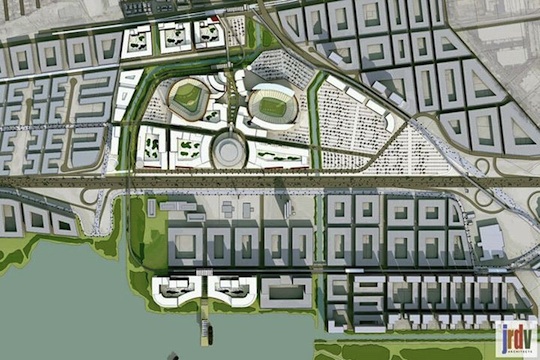
The new version:
coliseum-city1-sm

Coliseum City with third venue

Most of the immediate ancillary development has been moved to in-between the venues and along 880. The scope has gotten much bigger. At 750 acres, the new initiative requires two specific plans, one for each side of 880. Coliseum City (at least the immediate area) is conceived of as three venues plus L.A. Live. It would require all three tenant teams to pony up most or all of the cost for their new or improved venues, with the possibility of ancillary revenue to help pay the bills. City is pitching the concept as having two big advantages over other cities or sites: No EIR required and land already owned by the City. While it’s correct that the environmental process should be streamlined, I think that having a third venue will require at least some form of EIR since planners have to account for the possibility of three events happening simultaneously and the impacts that would occur from that kind of situation. As for land, okay. And? The Coliseum has already been dismissed by MLB, so why pitch it as a feasible site now? Nothing has changed to explain how anyone can (not) pay for a privately financed ballpark there.

When I got word of the Friday event, I was curious, then suspicious. First of all, why do this on a Friday? What was the rush? Obviously, it was a reaction to the news that the Warriors are exploring an arena deal at China Basin. Here’s the irony of the situation: While the Giants are exploring with the Warriors a way to leave Oakland, Oakland has been consulting with the Giants on ways to derail the A’s efforts to move to San Jose. Strange bedfellows, indeed. Oakland’s strategy has turned into having a viable backup plan if San Jose doesn’t pan out, in which case not being able to deliver by 2015 or 2016 doesn’t matter since the A’s have no other choice in the Bay Area.

Very few members of the public were present since there was little advance notice. City could have drafted a resolution that would have been discussed at a future City Council session, but decided not to. Instead it was a short press conference with a short Q&A. That’s what it’s come to. A feeble punt of a letter. Even Quan’s letter ends on an odd note:

We are advocating for the A’s to remain in Oakland because we believe that sports franchises can lead to economic growth. So long as a team creates jobs and enhances economic development in the City, then we will encourage them to remain in Oakland. My advocacy for keeping the A’s is not about baseball or a particular sports franchise, it is about doing what is best for the City. I am convinced that Oakland has the best weather, transportation, fan base and sites available to MLB.

It’s all about what the City gets out of it. It’s not about the franchise. That’s refreshingly honest. Yet in the same paragraph Quan touts the sites, process delayed and shaky as they are, as the best. It’s this kind of fragmented, incongruous argument that melts under even the lightest scrutiny that’s had me so frustrated lo these many years.

With that, we have two big cases of retreating. The A’s know the new economic landscape, what steps they have to take to address it, and what shortfalls they face even if they achieve their immediate goals. Oakland has been flailing with its incoherent strategy, not revealing details or taking important steps. When I spoke to Doug Boxer yesterday, I told him that showing progress on an EIR matters. Milestones matter. He said it didn’t matter since the decision rested with one man (Bud Selig), and that the average fan doesn’t care. I was flabbergasted. What’s the point of having a Facebook operation if the average fan doesn’t matter? Why even have a press conference? He’s right about one thing, that there are no parties involved in this mess with clean hands. I came away saddened and I felt like a little bit of my soul died. Thankfully I had a few beers and nice conversation with LeAndre, then went to a friend’s donation party later that night. I could have drunken myself into a stupor, but I chose to ease up because I wanted to write this long article. Because I’m sick of the bullshit. It needs to stop. We need to move forward. Maybe the end is coming soon, maybe it isn’t. I’m not sure if I want to keep writing this blog if things don’t or can’t change. They say it’s always darkest before dawn, right? It’s pitch black right now.

Meaningless CBA comparison

I had been working on a long post comparing the pros and cons of the various new collective bargaining agreements, but after yesterday’s events involving the Los Angeles Angels of Anaheim and the New Orleans Hornets/Los Angeles Lakers, I realized that it’s pointless. Take a look at the chart below, and comment away if you feel like it.

Considering the new league and scheduling format

Now we can truly start looking in earnest at the future of Major League Baseball in this fashion come 2013:

2013 Divisional Arrangement after Houston's move to the AL

Some national baseball writers have taken a cursory look at scheduling, and have deduced that teams would simply play 18 games per in-division opponent and 6 against the non-division league opponent. However, when you do that and add 6 interleague series (18 games total), you only get to 150 games. Adding a game or series here and there makes things a little weird, though it’s not a fatal flaw. As usual, I’ve given some thought to the new scheduling format permutations. Consider these:

Each tweak of the quantity of games against a different type of opponent has cascading effects.

Explanations:

  • A: It’s actually a good idea to have numerous teams against whom a team would play 7 games, since it naturally forces lots of 4-game series. If teams have nothing but 3-game series throughout the season, the season would automatically be lengthened since it would introduce an off day every week. The occasional 4-game series ensures that Mondays and Thursdays would continue to showcase games. The game total is only 160, which means that two opponents would probably have 8 games scheduled.
  • B: This is what I like to call the “square” option because it’s slightly more balanced than the previous regime and it has even numbers pretty much across the board. It looks good in theory, but I’m not sure how easily it can be pulled off in practice. When you break it down into series, it introduces the possibility there may be too many 4-game series. If that occurs, it would create a lot of “round-the-corner” 4-game series which start on a Friday and end on a Monday. That actually happens in the 2012 schedule on a couple of occasions, but this option could almost enshrine RtC, the same way AAA baseball does. Whether or not that’s actually a big deal is up for debate, it certainly is different. There’s also the possibility that instead of scheduling lots of 4-game series, there could be a lot of 2-game series instead, which the union has fought for years.
  • C: Another step towards having a balanced schedule, this option is intriguing because it reduces the number of interleague games and appears to have a lot of 3-game series. For in-division games, teams would play 8 home/7 road or vice-versa. When broken down into series it comes to 3-3-2 home/3-4 road. As in the current format, some teams would have two series against non-division opponents at home and one on the road (or vice-versa). The most intriguing facet of this is the slight rollback of the number of interleague games, which could be done in exchange for the seemingly more pervasive all-season scheduling of interleague series.
  • D: A slight tweak on C, it sacrifices one game per in-division opponent to add back interleague games. You’ll notice that the total number of games is 164. To get to 162, the “natural rivalry” series would be cut down from 2 x 3 games to 2 x 2 games.
  • E: More shifting towards a balanced schedule, and as a consequence it almost eliminates interleague. It practically limits interleague games to those natural rivalry series and in doing so, more or less defeats the purpose of having interleague play. Technically this option isn’t feasible because there would be too few interleague games to fill the schedule (90 per season out of 2430 total, season is 180 days long).
  • F: And the shift to a balanced schedule is complete. Like C, it has an odd number of games against each in-division opponent, which may not be feasible because there are an odd number of teams playing an odd number of games. So it may be academic.

(Note: I’m writing this fairly early on Saturday morning so it’s possible that not all synapses are firing. Let me know if my math is wrong anywhere.)

In addition, having 15 teams in each league mandates at least one interleague series at all times (save for off days). Depending on the actual number of interleague series played, it’s possible that there could be 3 or 5 series played at once.

The other big shift, which could be enacted for the 2012 season, is the addition of a second wild card team per league. Highly controversial, it creates play-in games for each league’s two wild card teams, the winner facing the highest seeded division winner. In doing this, it appears that MLB is finally getting of the ridiculous requirement that two teams from the same division can’t face each other in the first round. The bad thing is that it’s possible that two teams who are 10 games apart in the wild card race could face off in the play-in game, whose outcome could be entirely dependent on which starting pitchers are toeing the rubber that day. The good thing is that it should motivate more teams to aim for the division crown instead of settling for a wild card spot, since the wild card itself is a major risk point. The play-in winner would be at an additional disadvantage since they would be unable to set up the rotation for a playoff series unlike a division winner (assuming a division winner didn’t squeak into the postseason on their own). I haven’t seen the actual definition of which teams qualify for the play-in games, but I expect it to be the two teams in each league with the best records who haven’t won their respective divisions.

Adding more wild card teams would reduce the possibility of the several-hour, flip-through-the-channels, exquisite timing events of September 28. Then again, perhaps that was a once-in-a-lifetime scenario. Hopefully that kind of drama will be replaced by the drama of numerous teams in tight divisional races fighting to win their divisions and stay out of a wild card spot. I’m cool with that.