Sharks and City strike deal

It looks like something was in the works after all. Despite the Sharks’ objections to the SEIR’s findings and recommendations, they and the City of San Jose agreed on a future location for parking and possible office space (SJ Business Journal, SJ Mercury News).

The terms of the agreement are outlined in pages 68-90 of the June 15 City Council info packet. The section is called “THIRD AMENDMENT TO THE AMENDED & RESTATED SAN JOSE ARENA MANAGEMENT AGREEMENT.” Interestingly, the text of the document points out that because the new parking garage would be an amendment to an existing agreement, the garage would not be considered a new project, and (my interpretation) thus would not require its own separate, new EIR.

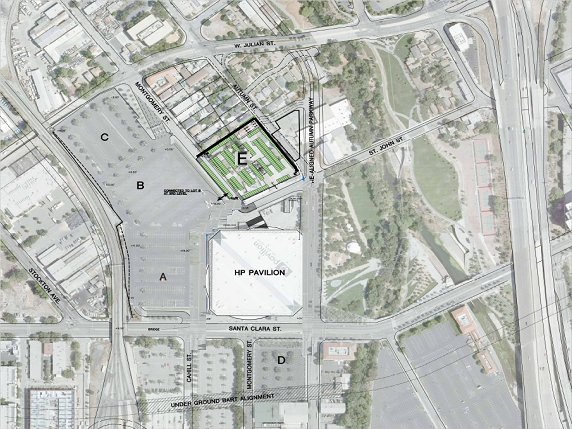
The land for the garage is immediately north of HP Pavilion, on currently zoned industrial parcels housing the decades-old Milligan News educational books facility, a foundry, and two houses on N Montgomery St. Like the ballpark parcels, the garage parcels would be subject to negotiation between the current owners and the City, though the City could invoke eminent domain (yikes). San Jose Arena Management (Sharks/SVSE) would be ultimately responsible for the land acquisition and development costs. SJAM would also take in all revenues associated with operating the garage. The City would reciprocate by funding the completion of Autumn Parkway – with what funds is yet to be determined.

new_garage_sm“>

The key here is that the location is not particularly ideal for either the ballpark or the train station, as it’s over 1/3 mile away from either site (Area E above). A connector bridge over Montgomery Street would connect the new garage to the existing elevated parking lot, and a separate vehicle entrance/exit from the planned Autumn Parkway would be the way to get there.While the location isn’t terribly convenient for train/ballpark users, it does solve the issue of maintaining existing parking while a new garage is built. As a result of this deal, both of the published garage options in the existing EIR are now out of the running, though it’s possible and/or likely that they could be revisited as parking demands rise in the future.

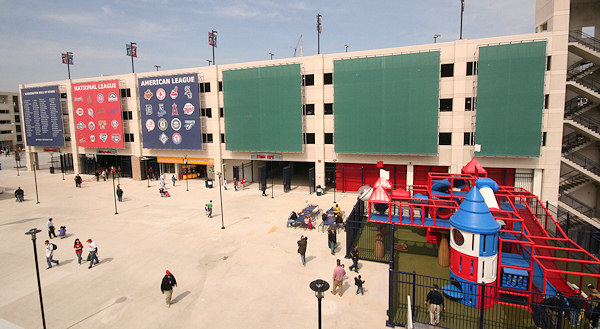
What does this mean for the A’s? For now, it means there’s one less obstacle and 1,000+ spaces of additional parking in the area when a ballpark opens, though again it won’t be the most convenient location. In fact, some lots on the other side of CA-87 will be closer. I think we’re moving closer to the notion that the A’s will look to build their own parking garage on the ballpark site, also with 1,000 spaces give or take. The Nats already know what this looks like.

Three parties appeal EIR certification

Following last week’s certification, three parties have appealed the planning commission’s decision.

The San Jose Sharks, Stand for San Jose (a coalition backed by the San Francisco Giants) and a resident who lives near the stadium site allege that the report, which the commission approved last week, does not adequately analyze or disclose potential impacts from traffic and parking, among other issues.

Chances are that the City Council will move forward despite the appeals. It’ll be up to the various parties to see whether or not a lawsuit is filed. The important piece of news to come out of this is the date of the council’s hearing: June 15.

Supreme Court strikes down NFL’s antitrust bid

As part of the NFL’s ongoing legal battle with former cap vendor American Needle, the league decided to make a claim that it had a “single entity” structure which allowed it to make unified business decisions of all kinds, not just branding. In a 9-0 decision, the U.S. Supreme Court struck down the claim, which if granted would have put the NFL closer to the antitrust exemption that MLB enjoys.

Soon-to-retire Justice John Paul Stevens wrote the opinion, which included the following gems:

“Although NFL teams have common interests such as promoting the NFL brand, they are still separate, profit-maximizing entities, and their interests in licensing team trademarks are not necessarily aligned.”

“Although two teams are needed to play a football game, not all aspects of elaborate interleague cooperation are necessary to produce a game.”

The NFL Players Association, which has been seeking any kind of leverage in its difficult negotiations with the league, thinks it found some in the decision.

“The Court’s decision affirms our belief that the NFL should not be allowed to operate as a monopoly to the detriment of fans, players and the government. In a country where competition and fair play are so highly-valued, the Court wisely declined to give the NFL a leg up by usurping the role of Congress and ignoring both the letter and the spirit of its anti-trust laws.”

Obviously, the league disagrees. In any case, I don’t expect the situation to get much less contentious, even though some observers think that the decision could get the two parties back to the table more quickly. The NFL just did this as a tactic, whereas the actual debate between league and union are about major dollars-and-cents issues, several of which have the two sides miles apart (revenue sharing formula, first round draft pick salaries). As for American Needle? The case now goes back down to the lower courts.

More on the case and issues can be found at SCOTUSWiki, Forbes’ SportsMoney blog, the National Football Post, and the Wall Street Journal.

Wolff says Fremont still not happening

I stand corrected. Warm Springs is a no go, according to Lew Wolff, because of a lack of a residential component as envisioned in the Pacific Commons plan.

“The entire activity in Fremont was based on the ability to sell residential entitlements,” he said.

And Wolff doesn’t anticipate the market supporting the magnitude of housing envisioned in the ballpark village plan. “I think we missed our opportunity,” he said. “We have to be in an existing downtown.”

Oh well. Now that we’ve heard ownership’s perspective, the circle is complete. (Thanks Matt Artz/Argus)

Three’s Not A Crowd: Tesla + Toyota + A’s

In what can only be described as a miraculous turn of events, Tesla and Toyota have worked out a deal to build the upcoming, <$50k Model S sedan at NUMMI in Fremont. Toyota’s providing the shuttered plant and $50 million of funding, Tesla will 1,000-1,200 jobs back to the plant in South Fremont.

Strategically, it’s a great move for both. Let’s look at what each company gets. Toyota gets:

  • Some good PR back from the NUMMI closure
  • A cheap investment on all-electric technology, which is not currently in its portfolio (Toyota has bet largely on hybrid powertrains).
  • A use for the original plant that is compatible without having to pay for cleanup

Tesla gets:

  • Toyota’s legitimacy in the industry
  • An already built facility only minutes from the headquarters
  • Access to a good, capable workforce trained the right way
  • Tax breaks from the state on equipment
  • Rail access, which is important for suppliers

Of course, you’re wondering how this could affect the A’s. According to Argus scribe Matt Artz, it wouldn’t affect a ballpark project much at all. Straight from CEO/Iron-Man 2 cameo Elon Musk’s mouth:

“Tesla doesn’t have any objection as long as it doesn’t impact production of vehicles, which I don’t think a ballpark would.”

Imagine that! A ballpark and a plant may be compatible after all. Wonders never cease. As stated previously, Tesla’s space requirements are far less than what’s available at NUMMI (20k cars/yr vs. 400k cars/yr under NUMMI), it wouldn’t be surprising to see some of the unused plant facility reused as warehousing for suppliers. Tesla also operates on a build-to-order model, so you won’t expect to see large numbers of cars on the massive prep lot. It’s likely that plenty of space on the north end will be available for development, whether that’s offices, retail, or a ballpark – any or all of which could work together with the plant.

Could anyone see this coming? Probably not. It seemed that Tesla was set on a factory in Downey, but this all came together extremely quickly. Whether or not anyone at Fremont City Hall can legitimately claim credit for this, the quick change happened on its watch. A green, progressive business that has the cachet that most cities would kill for? That kind of political currency heading into the next election is, well, priceless.

In my estimation, this news does nothing but make a Fremont ballpark a much more tangible option. Whether or not Wolff/Fisher have made the same conclusion is anyone’s guess.

EIR Certified (San Jose)

Darryl Boyd is doing a brief presentation on the SEIR (“S” for supplemental) process. So far, letters have been submitted by the Shasta/Hanchett Park Neighborhood Association, the San Jose Sharks, and San Jose Giants. Staff recommends certification due to no new impacts after studying the modified project.

Now Dennis Korabiak is giving an overview of the project. Notes that there are 29,000 parking spaces in the downtown area.

So far, two commenters recommend not certifying the EIR, Eloy Wouters on the grounds that parking and traffic analyses are flawed, another because of fiscal responsibility concerns. A member of S/HNPA recommends the creation of a citizen oversight committee, similar to what was done with the arena. Another commenter recommends the 237/Zanker site as an alternative for the ballpark.

The lawyer from Stand for San Jose asserts that the traffic impact analysis for the weeknight 6-7 PM makes no conclusions and does not properly identify mitigation measures. Essentially this is a question of whether or not the SEIR properly states all of the impacts. Cites a couple of lawsuits in LA and Oakland.

A member of the Willow Glen Neighborhood Association is concerned about traffic along CA-87′ though he also says that the ballpark would be a huge economic impact for downtown and San Jose. He wants VTA to make a commitment to provide improved services in the area, based on the success of transit usage in SF.

Michael Mulcahy (Baseball San Jose, friend of the Wolffs) is giving his sales pitch.

Another commenter criticizes the large environmental impact, while the last commenter critiques the traffic study.

Dennis Korabiak summarizes, notes that the project will require a vote due to the land contribution. Council decision to place project on the ballot would occur in June. Commissioner Zito asks if the various mitigations that will be needed have been disclosed. Korabiak replies yes. Commissioner Kamkar asks if the A’s will be paying for the police and traffic enforcement. Answer is that it will have to be negotiated by the A’s and City, with recommendations provided by the Good Neighbor Committee.

Public hearing closed. Now the rest of the planning commission has questions.

PG&E – What happens? No intention to acquire and relocate the substation.

Staff clarifies that the project is not in the “fair analysis” realm, which is often used to create legal challenges for an EIR. I’m not sure if I’m interpreting this right, but it may be because no major new impacts have been identified, compared to the old EIR. If true, that’s huge. Staff also says that regardless of a day or night game situation, there will be enough parking throughout downtown – though I have to say this is a flawed argument given the broad and one-sided definition of what downtown is.

8:33 PM – Motion to certify by Zito. Makes a statement to clarify that certifying the EIR is not about being for or against the project, it’s about whether or not the document itself is complete. Commissioner Jensen seconds. Commissioner Platten will not support the motion but considers it close, thinks there may be a lawsuit. Commissioner Klein thinks all of this could have been done with an amendment instead if a SEIR.

8:38 PM – Vote taken. Motion passes 4-1 with two commissioners absent. See ya in June.

Trib takes Oakland to task

Guess we should’ve seen this coming. The Oakland Tribune’s Editorial page criticized Oakland’s approach towards retaining the A’s, in effect saying that the effort is too little and perhaps too late. The argument is summed up in a simple two sentence paragraph.

With so much at stake, the city should have jumped into the fray with San Jose much earlier and fought much harder to keep the A’s. Having monthly meetings doesn’t cut it.

Those of you who read this here blog frequently know that the writers here feel exactly the same way. Since December, we’ve been looking for something substantive, something that could approach in effort the work that has been done in San Jose and even Fremont. Sadly, the only report we’ve seen is basically a sales pitch to move the A’s to JLS in order to boost the city’s tax revenues and make area development more lucrative.

Don’t believe that last part? In the report, JLS and surrounding neighborhoods are divided into seven areas to gauge potential spillover effects from a ballpark. Area 7 is the Oak-to-Ninth (O29) site, still waiting for development by Signature Properties (the Ghielmettis). On page 57, a table shows that Area 7 would be 100% built out with a ballpark, 85% without. When I read that, I did some quick math and estimated that the difference has to be some $100-200 million. You can guess which business interests helped bankroll the report.

The Future Is Dynamic

Now here’s something you won’t see given to A’s fans for a long time. It’s the Giants’ current ticket pricing list, with different prices set per series or even per game within a series. Don’t worry that the resolution of the table is too low to be legible, here’s the PDF.

ticket_prices

As complex as that is, it’s just the start. All unsold tickets are subject to market pricing, so that higher demand can lead to even higher prices. Here’s the Giants’ disclaimer:

Market pricing applies to all tickets.
Rates can fluctuate based on factors affecting supply and demand.
Lock in your price and location today!

Crazy? Well, it’s the future. Not every team will go to such extremes, but it’s still a way for any team to eek out as much revenue from ticket-buying fans as possible.

Liveblog from Oakland Community Meeting 5/1

This morning I’m at Peralta Elementary School for the community meeting. Jane Brunner is running the show. Here’s a pic of the nice turnout so far. Brunner is explaining how as much of a fan she is, the real reason she supports an A’s stadium is economic development.

Nina from KQED arrived to grab audio of the event, some of which was cut into Cy Musiker’s interview with Neil DeMause today (5/3).

A KCBS reporter is on hand. Don’t see other media. Brunner is explaining recent history, including a brief admission that “we’re partly at fault.” Now she’s talking about the MLB panel. The reason why there isn’t a decision is because of the expanded search to include Fremont and San Jose. If they choose Oakland, that’s when the negotiations will start. She hands over to Eric Angstadt, deputy director of CEDA.

Angstadt further explains the process, including the description of a “matrix” of information required by MLB. (Reminds me of the RFP process.)

Now Angstadt is going into the three JLS sites. Howard Terminal is the biggest, it would require a pedestrian overcrossing (see?). JLS West would be difficult to put together. Victory Court has some city-owned land, and from a development perspective is considered a “hole in the donut.” the study of these sites is important with or without a ballpark. Infrastructure would be required as part of a broader development plan.

Brunner introduces Doug Boxer, who will go over the Let’s Go Oakland economic study. He urges for the community to “continue to challenge us” on the ballpark and other matters in order to get all issues discussed. One of the reasons he’s done this is to “correct the record” regarding the city. He advertises the Facebook group. Makes a connection between the number of members in the grow and the projected size of the stadium.

Boxer emphasizes that the study done by GG+A is very conservative. Also pumps up the economic development angle, just as Brunner did. Cites the $4.7 billion in increased property values, and $930 million in increased property tax revenues as a result. (Important to note that most if not all of the area under discussion is in some kind of redevelopment district.)

He compares JLS to LoDo in Denver. Mentions the guy who was kicked out of a game for carrying an anti-ownership sign.

Brunner: We want Lew Wolff to come to the table, whether MLB decides on Oakland or Fremont/SJ don’t work out. We want to keep a cordial relationship with ownership.

Public comments begin. So far there are no negative comments, though one commenter has rightly asked what the strategy is if the A’s leave. Lots of passion from the commenters, all fans.

One bit of concern: the presenters only lightly went over costs. It’s easy to be for this when there’s no price tag attached for the land acquisition and infrastructure costs. It appears that the stance is that such details will only be discussed or explored if MLB chooses Oakland. Considering what has been made public for the other two cities, that’s at best a double-edged sword.

Just as I was finishing that last paragraph a commenter asks the right questions about costs.

Another asks if the city can make small improvements to make the Coliseum better for fans, such as a TV in Stomper Fun Zone so parents can check the game.

Lots of blame going towards ownership. The requisite Major League reference.

Bobby “510” makes an interesting observation (paraphrasing): I grew up on the streets of Oakland. Me and my friends didn’t get into drugs or gangs because of the A’s. If the effort isn’t spent to keep the A’s, be prepare to spend a lot more on police since the kids will have one less outlet.

About the last paragraph: what the city and Let’s Go Oakland need are more events like this, more town hall situations. I mentioned before how much of a learning experience the health care debate was, when President Obama really started to hit the personal anecdote strategy hard. This is obviously not as broad an issue, but it is probably Oakland’s best strategy right now.

Public comments over. Boxer has the mic again, mentions us and is emphatic in saying that there is a plan. He also mentions San Jose’s referendum requirement, says that Oakland doesn’t need one – though there could be a legal challenge (we know how that goes in Oakland). Angstadt says that all city staff have been asked to be circumspect, not go on the attack.

Angstadt talks money, especially redevelopment. Explains that redevelopment is the core tenet. Difference between this and Raiders deal is the use of redevelopment money, not general obligation bonds. Stadium is a catalyst.

Brunner clarifies, “We don’t have a secret plan. We have the three sites, the Coliseum is out.” Affirms that there are no details because there are no negotiations. We need a willing owner and we’re not going to do this through the papers. Doesn’t want to get into a bidding war with the other cities. If Oakland gets the nod, this will be done through the City Council. This is a business retention deal just like any other. Mentions a certain blogger and his Q&A (coming soon!). Also says that there will have to be an education on the difference between general fund and redevelopment money.

That’s all folks! I’m getting a beer. BTW, while there was plenty of criticism of Lew Wolff, it was quite civil and yes, circumspect.

P.S. englishmajor from AN was on hand to capture all the audio, though I don’t know how much will be used. We spoke briefly when the session wrapped up. I also finally met LeAndre when he approached me as I was just about to drive away. He was a bit pessimistic about the session, though I said that Oakland should be prepared just in case SJ falls through. We both agreed that the city should just pick Victory Court and prep a bid in advance. We also agreed that there’s a decent chance that the MLB panel may not render a recommendation/decision until after the season ends, which is also around the time of the planned SJ ballot initiative. I ended our nice chat with the observation that this may be the only bidding war in which all three bidders are behind the proverbial 8-ball.
Giants want piece of W’s, Russo wants signs back

Two news items that have been building up:

Ray Ratto first wrote in his SFGate blog about the anti-ownership sign controversy last weekend. The NY Daily News, Oakland Tribune, and East Bay Express picked up the story, with Oakland City Attorney appearing as his normally indignant self.

Now Giants beat writer Henry Schulman has more details on the team’s stepping up of their efforts to get in on the big Warriors free-for-all. Once again with feeling, “Remember the Sonics.”

It’s not hard to see why the Giants would be interested. They see the A’s looking at San Jose and A’s ownership is buddy-buddy with the Sharks. The Giants do pretty well with non-baseball events such as the annual bowl game, concerts, and other offseason stuff. Down south, the combination of HP Pavilion, an A’s ballpark, and a Quakes stadium could make for a very competitive situation. Get a fancy new arena near the downtown ballpark gem and you preserve that “entertainment hub” status while gaining booking flexibility in the process. That would leave Oakland/Alameda County with two older venues, though hopefully the arena’s debt will be taken care of with the W’s move. But hey, keep fightin’ the good fight on that sign issue.

Added 4/30 3:14 PM: Zennie Abraham has made a Freedom of Information Act request for all correspondence and documents related to any and all efforts to build and manage sports venues in Oakland. The request has gone out to all relevant city and county offices/agencies. We’ll see how far that goes.