When is BART not BART?

Answer: When it’s being pitched by VTA.

The still-languishing BART-to-San Jose project got a bit of a reprieve today, as the VTA board approved $135 million in additional design and engineering costs associated with the project. Dissenting Santa Clara Supervisor Liz Kniss put out a rather pointed question:

“Are we concerned at all about starting BART without knowing where it’s going?”

This is extremely important, as it gets to the heart of the matter. There is still uncertainty as to how far BART will travel into Santa Clara County, if at all. There’s talk of having BART terminate in Milpitas at the Great Mall, or in San Jose at the old Flea Market, which is 2.5 miles (crow flies) northeast of Downtown San Jose. The mode may not even be BART, as light rail could be used for most of the route up to Warm Springs, where it would meet BART’s new southern terminus. The most expensive part of the entire 16.1-mile project is the controversial 4.8 mile downtown subway, which would burrow under the most heavily-used thoroughfare, Santa Clara Street.
There are numerous alternatives in VTA’s 2001 MIS Report. In addition to the aforementioned concepts, there are possibilities for enhanced commuter rail along the ACE/Amtrak corridor, a separate busway along the planned BART corridor, or even a strange situation in which BART technology would be used throughout, but users would transfer at Warm Springs to San Jose-bound trains.

Personally, I’m warming up to the idea of light rail coming up from the Valley and meeting BART at Warm Springs. It would capture two-thirds of the projected riders taking the BART alternative, but it would cost less than half as much ($1.5 billion for LRT vs. $3.7 billion for BART in 2001 dollars – now $4.7 billion). There would be dedicated routes from Mountain View and Downtown San Jose, with simple transfers from East and South San Jose, and Campbell. Plus with VTA’s fare structure, it’d be quite inexpensive to ride. That’s a double-edged sword since it’s bad for “farebox recovery” but good for ridership numbers.

If you’re from the East Bay, you might be asking how this affects you. It all comes down to feasibility. The rising costs of the BART extension make it more difficult to justify with each passing day. VTA already had to abort an earlier attempt to get federal funding because of insufficient ridership projections, and now there’s talk that they’re inflating the numbers to make it work. If you’re only using BART to go to A’s games, all you want is the extension to Warm Springs and a solid transfer method to get you the rest of the way. If you’re a commuter, the BART extension isn’t a perfect anyway since it sidesteps many of the heavy employment centers in the Golden Triangle and takes a circuitous route to downtown San Jose, likely requiring a transfer in Milpitas.

For those of you in the South Bay, what do you think of a light rail alternative as opposed to BART from San Jose/Milpitas? If you could take a 30-45 minute, $2 ride to Fremont from Mountain View or San Jose and then a short shuttle from there to Cisco Field, would you take that instead of your car?
Fremont-A’s negotiations begin in earnest

The Merc’s Lisa Fernandez reports that the first of probably many biweekly meetings involving the A’s and the City of Fremont was held this morning at Fremont’s City Hall. City Manager Fred Diaz said little about the substance of the meetings, describing this first session as an “icebreaker.”

There was also no discussion of a Nov. 21 A’s letter to Fremont in which team officials offered the possibility of Fremont one day owning the land and stadium, which many see would be a tax break for the team.

This is the first article I’ve seen that acknowledges the tax break option that the A’s are proposing.

Some Fremont details emerge

The Argus’s Chris De Benedetti has a story summarizing a letter dated November 21, from Lew Wolff to Fremont City Manager Fred Diaz. It’s only two pages, so obviously it’s not a proposal, yet there are little bits here and there worthy of further analysis. The letter is PDF (Page 1/Page 2). My comments are in italics.

Project Goals (quoted in its entirety):

It is our desire to create a new home for the Athletics that significantly enhances the quality of life in the surrounding local community as well as the fan experience at the ballpark. Additionally, we seek to have a significant portion of the project funded through the development of the remaining vacant areas surrounding the ballpark. It is our intent to have the majority of this support funded by revenues and resources generated directly from the Ballpark Village development as opposed to receiving substantial direct subsidies outside of the project area (i.e. taxes) typically associated with new ballpark development projects.

Nothing new here.


Ballpark Village will contain:

  • 32,000-35,000 seat ballpark
  • a lifestyle center retail project within a mixed-used development at a level of quality equal to that of the award winning Santana Row project in San Jose
  • a residential community with a majority of multi-family units in a pedestrian-friendly village in proximity to the ballpark

This is the first official acknowledgment of the Village’s resemblance to Santana Row. The idea that the remaining (majority) housing will be separated from the Ballpark Village is good. If well conceived, it’ll provide the convenience that comes with living near an entertainment center, while providing a quiet and safe environment for raising children. That’s a pretty tall order.


Ballpark:

  • Up to $500 million
  • In return for successfully completing the Ballpark Village entitlement approach… along with other real estate related financing tools… the Athletics would agree to enter into a long term arrangement (40 years including extensions) for the team to remain in Fremont for the distant future.
  • The A’s would be responsible for building and running the ballpark, as well as cost overruns.
  • No City or County support required beyond the initial project support
  • If desired by all parties, the City or its designated public agency designee (think of a JPA like the Coliseum authority) could potentially own the land and the completed ballpark under our proposal.


Remember that if the city owns the land and/or part of the stadium, the A’s won’t have to pay property taxes on the city-owned piece.


40-Acre City Parcel (quoted in its entirety):

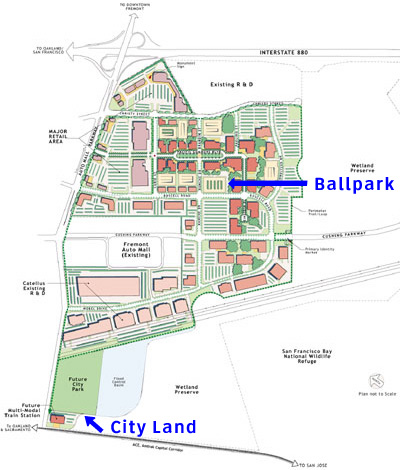
“In order to create the pedestrian-oriented Ballpark Village community and avoid having a typical “sea” of surface parking around the proposed ballpark, we would propose to enter into a lease or other arrangement for a portion of the 40-acre City parcel to the west of the Pacific Commons development. The term of this arrangement for the parcel would be equivalent to that of the Athletics’ commitment at the ballpark. This parcel and other areas would be included in an integrated transit, traffic, and parking program for the new planned Ballpark Village community.”

If you’re wondering where this parcel is, take a look at the map below:
masterplan2


The map is based off the original Cisco development plans. Notice how office buildings are concentrated along a street and parking is on the outside towards the wetlands. The parking lots act as a buffer, and as murf mentioned in an earlier comment, a large buffer may be required. It could become a sticking point. The map also shows the planned Capitol Corridor/ACE station to the west of (below) the city parcel.

To make this work, the A’s will have to designate some of their project land as parkland. That’s going to happen as part of the residential development requirement, so it’s potentially a fair trade. The land is not a great place for a park anyway. Why? The landfill is only a few hundred feet away, across the tracks (I’ll have pictures tomorrow).

40 acres equals 5,000 parking spaces. Couple that with the parking I’ve targeted close to 880 and you’ve got 9,000-10,000 spaces. What will that integrated transit, traffic, and parking program contain?

Newswrap for 12/11

A few worthwhile news items came in over the last week.

Fremont officials and representatives from several public transportation authorities have had three roundtable discussions since August about the challenges presented by the Pacific Commons site. Among the solutions being considered are a system of shuttles, a monorail, or a people mover. I’ll present a people mover option later this week.

Meanwhile in San Jose, the city council approved the last $20,000 to be spent on the mostly dead ballpark study to formally complete it. Some of the environmental impact details, especially research into historic buildings in the area, will be useful for the next project that is planned for Diridon South – whether it’s a stadium, concert hall, parking lot, housing, or anything else.

Last but not least, the Raiders vs. Oakland saga has finally come to an end for now, with the Raiders choosing not to appeal the outcome of a legal decision that struck down a $34 million award to the Raiders. Chip Johnson’s column notes that Al Davis has put a 31% stake (likely non-controlling, of course) in the team on the open market, but so far there are no takers. To get the Coliseum up to the standards of the rest of the league, it will take far more than the $50-100 million or so that could be available from the NFL’s G3 loan program ($150 million is available to teams that are building a new stadium from the ground up). Football has only three two-team markets (NYC, Baltimore-Washington, SF-Oakland), and one of them has a shared facility. Is it time to start thinking that way here?

Stern visits Sactown

Now that the Kings’ and local Sacramento pols’ efforts to build a downtown arena have hit a wall, NBA commish David Stern came to the state capitol to pull a Winston Wolfe. From the Bee article:

Stern arrived in town Monday for a two-day whirlwind schedule of meetings with those in a position to help craft an arena plan, or shed light on why previous efforts have failed.

He said he came with no preconceived notions of what would work, but in meetings Monday he repeatedly brought up the idea of a statewide authority to help finance California sports venues.

Accompanying him was Baltimore sports and entertainment consultant John Moag, who plans to stay in town for at least two weeks to work on the effort.

Moag called the Sacramento arena effort to date “a little rudderless” and said Stern — who officially represents the Maloof family, which owns the Kings — will step into the role usually played by a political leader.

Do the words “statewide authority” sound familiar? It should, because it’s reminiscent of SB 4, the sports facilities bill penned by State Senator Kevin Murray (D-Culver City). Murray, who’s being termed out with November’s election, was hired by super agency William Morris in October.

Should a similar bill try to make its way through the legislature, it could face a similar gauntlet to what SB4 faced in committee review. The net effect of this was to neuter SB 4, which eventually died without getting a governor’s signature, or even a full Assembly or Senate vote.

It’s a good idea to get Stern involved instead of the persona non grata Maloof brothers, but getting public help for the Kings doesn’t look anymore promising than it did a year ago. The passage of Propositions 1A-1E puts the state in the hole $37 billion. Why would it be any easier to get public funds now or even in the near future?

And who could be an ally in the legislature? State Senator Carole Migden (D-San Francisco) just introduced SB 49 (cute), which is specifically targeted at Santa Clara’s efforts to move the 49ers to the South Bay. Considering the gargantuan amount of infrastructure that would have to be built to make the Candlestick Point/Lennar development plan work, she may be game.

Milpitas wants to know

The site of the future Cisco Field may be in Fremont, but that doesn’t mean that only Fremont will be affected. Milpitas officials have expressed their concerns about the project, especially traffic along 880.

During Milpitas City Council’s Nov. 21 meeting, Councilman Bob Liven-good expressed his concerns over how the sports complex would impact Milpitas residents, especially along the I-880 corridor.

“It’s of concern to me obviously because the site they are focused on… is less than three miles from our city border, and as a result has the potential to be an impact on our roadways and on our quality of life,” he said.
Advertisement

Livengood added at this early stage in planning for a stadium, he didn’t know “whether to be a cheerleader of the project or a detractor of it.”

As I understood it, Fremont was going to get Newark and Union City involved because they’d be impacted, so it makes perfect sense to include Milpitas… and San Jose, whose city limits are also only a few miles from Pacific Commons.

How we got to this point

East Bay Express writers Robert Gammon and Chris Thompson have this week’s cover story, a thorough chronology of events over the past several years that led up to the Pacific Commons plan. Even though the full article is available online, I suggest you get a (free) copy wherever you can. I can’t comment on all of the workings of the Oakland political machine, but I can say that the Fremont scenario described in the article played out exactly as I heard it nearly a year ago. It’s definitely a must-read.

Happy trails, Bud

You could see it on his face. He really didn’t want to be there. As commissioner, Bud Selig’s appearance at the A’s-Cisco announcement was perfunctory. His presence was needed to give the event that extra bit of gravitas, though he certainly didn’t lend a ton of charm to the proceedings. Soon, Bud Selig won’t have to fly cross-country to do these events. It’ll be someone else’s job.

It was thought that Selig would retire by the time his current tenure as commish expires at the end of 2007. Recently, he has given hints that he wants to stay on a little longer. With a new CBA in place and record attendance figures year after year, you’d think that he’d want to go out on top, or at least until he really has to face the steroids demon in earnest.

The only reason Selig would conceivably stay on would be that he thought his job wasn’t finished. That’s hard to believe, since Selig navigated MLB through 3 CBA negotiations, while presiding over the opening of 15 new ballparks (with 5 more on the way), and the expansion of the league by 4 teams. He’s also overseen the introduction of the wildcard, interleague play, and revenue sharing. In Andrew Zimbalist’s book In the Best Interests of Baseball? he refers to Selig as the sport’s first CEO.

It would appear that Selig does have some unfinished business as the game’s CEO. Chief among his concerns has to be the Florida Marlins’ situation. By inserting the league office directly into negotiations with local governments in the Miami area, Selig has bypassed the source of much consternation, Marlins’ ownership. The election of former minor league baseball lawyer, Charlie Crist, to the governorship of Florida has given MLB officials renewed hope for a deal. Kansas City was considered a problem area as well, but in April voters passed a package of renovations for Kauffman Stadium and its neighbor in the Truman Sports Complex, Arrowhead Stadium. The Mets and Yankees have broken ground on their new homes, and the Nats are well along on construction of their new ballpark, even if some of the other details are still being fleshed out. The A’s still have a long way to go before groundbreaking, let alone opening day.

So what’s next? National TV deals are set through 2013. Should Florida pan out, there would be one stadium deal nearing expiration: the Angels lease at the Big A. With the home market being LA, it would be in Arte Moreno’s best interest to get something done there, while not completely alienating the existing fanbase. He’s not going to maintain his franchise’s impressive growth in value by moving out of LA.

Perhaps it’s time that MLB truly starts to consider expansion again. Before you start complaining about the watering down of the talent pool, let’s remember that foreign talent has been extremely rich over the last several years and has shown no signs of slowing down, especially in Asia. There will always be marginal players or players of questionable value. Right now, some of them get 5-year, $50 million deals. If you’re really concerned about dilution of talent, turn the 25-man roster into a 24-man roster.

There are numerous ways expansion would help:

  • Having 32 teams makes realignment and scheduling easy. Again, let’s look to the NFL. They have a symmetrical dream system for scheduling, with even numbers of teams per division and conference. They have a fair number of intraconference and interconference games. Plus they kept great divisional rivalries intact. Take a look at this hypothetical MLB realignment scenario:


    The four-team division allows for great flexibility. Teams can devote all of April and September to divisional races since an odd fifth team won’t be left out. And by instituting the unbalanced-but-fair scenario in green above, every team will be guaranteed an equitable number of series with each intraleague opponent. Sometimes it’ll be 6 series (division), 4 series (intraleague “A”), or 2 series (intraleague “B”). No more of that weird home-away-home stuff. The awkwardness that comes from pairing a 4-team division (AL West) with a 6-team division (NL Central) will cease. 2-game series would be mostly limited to divisional play, lessening travel hardships. There are some historical rivalry issues to work out such as Royals-Cards, but that could be accommodated within this revamped framework.
  • Major league baseball should have a team in a primarily Spanish-speaking market. Options include Monterrey and San Juan, or perhaps Mexico City, Havana (post-communism), or an economically stronger Santo Domingo, DR. Frankly, this is long overdue. It’s likely that a team south of the border will require revenue-sharing for its first decade of operation. That’s fine. Take part of the expansion franchise fee and put it into a fund for the team. It would be well worth the goodwill it will bring to MLB. The NBA and NFL are aggressively marketing in Asia and Europe. Why should MLB keep neglecting its fertile backyard?
  • Increasing the number of jobs could push average salaries downwards. The union will love the increase in ML jobs (50). The owners will automatically have some amount of depression in average pay, since more players will be fighting for a slightly larger salary pie. The NFL’s system works largely because over double the players of MLB yet have only slightly larger annual revenues. There’s little chance that MLB will increase active rosters to more than 25 men. It’s possible that adding two more teams could make teams compete more for that fourth outfielder or starting pitcher, but I’d rather have the market play that out.
  • Holding a city for ransom doesn’t work. We’ve seen this already play in Miami, where the city called the team’s bluff, knowing how crucial a market it is to MLB. The Marlins remain in South Florida, and with MLB heading the negotiations, a ballpark deal could be made. I personally am not a fan of the public funding being considered, but I don’t live in Florida. It’s up to Florida residents to decide the merits of the deal. Once ransom is off the table due to zero relocation candidates, then Portland, Las Vegas, and San Antonio can cease being stalking horses. If they’re interested, they can bid on the other expansion team. We’ll know which city has all of the pieces in place: site, financing, ownership group, economics. All three of those markets are somewhat small right now, but in a decade all three could be excellent medium-sized baseball markets. San Antonio could even be a fallback option if a south-of-the-border city is not feasible.
  • It’s almost time. Expansion wouldn’t occur until well into the next decade, perhaps 2015 or so – after the current stadium boom era has officially come to a close. That’s plenty of time between the last round of expansion (1998) and the next. This time, the owners wouldn’t be motivated by collusion or legal difficulties. They’d be focused on actually growing the sport. Rather novel idea, no?

What do you think about expansion?

The Loaiza-Kennedy rule of ownership

Today I’ll pose a “hypothetical,” y’all can debate it.

The A’s are buying up land in Fremont. Some of it will be meant for housing, some for parking, some for retail/commercial, some towards the ballpark, the rest for infrastructure. Here’s how the ownership situation would look:

  • Ballpark: 50% A’s, 50% Fremont
  • Ballpark land: Fremont (A’s would donate land)
  • Retail/commercial: A’s
  • Parking: A’s
  • Residential: Third-party developers (TBD)
  • Infrastructure: Fremont

The infrastructure piece is the obvious no-brainer, the rest are educated guesses. The A’s might want the ability to retain as much of the land for future development as possible. That’s why parking lots/garages would be owned by the team. The land for residential, along with development rights, would be sold early on to housing developers developers to assist in financing the ballpark. The rights might not be sold all at once because pending construction could create a glut of sorts in the housing market. Chances are that the rights would be sold in phases, which is fine if you’re the A’s because all you want to do is service annual debt. The rights would be sold well in advance of a 20-30 year term on privately financed stadium bonds, so that money could be used to either pay off the debt early or to be reinvested. Retail/commercial makes sense for the A’s to own because they’d rake in nice leases from the various new establishments.

As for the ballpark, that’s a less straightforward situation. The immediate response might be, “Doesn’t the franchise’s value go up if they own the ballpark?” Yes, but it would go up just as much if they didn’t own it. All that matters is that the team gets new revenue streams from the stadium. As a bonus, the team would be looked upon more favorably by MLB and financiers if they weren’t saddled with major debt, such as a privately-owned ballpark.

There’s one more motivation that makes the most sense: Lower property taxes. If the A’s owned the ballpark outright, they’d have tax liability over a $400 million building plus some $20-40 million in land. The property tax rate in Alameda County is 1.2%. Look up those timetables, and that comes to $5 million per year, or the ’06 salary of Esteban Loaiza. Sure, depreciation would take a bite out of that over time, but even so that’s up to $100 million left on the table over the life of the stadium. If the A’s are looking to own half of the stadium as outlined above, their property tax hit would be around $2.4 million, or the ’06 base salary of Joe Kennedy. (These figures don’t include special assessments.)

Then again, look at the A’s current situation. They don’t pay any property tax on the Coliseum because it’s also publicly owned. Since the A’s would be moving all of their business ops to somewhere in Fremont, they would be contributing more to the county’s coffers than they would in the current lease at the Coliseum. That gain has to be balanced against the hard and soft costs associated with having an entertainment district.

The $64,000 question has to be:

“Is the opportunity cost for getting a baseball team worth it?”

Let’s look at alternatives for the land:

  • Another office park. That’s what was originally planned for the area, though the original tenant, Cisco, nixed those plans long ago. Fremont’s legacy position of reserving the area for light industrial and commercial use made sense decades ago from a planning perspective, but now that very little is actually manufactured here compared to the Far East, it’s a policy worth revisiting. There are still large swaths of land to the south on Fremont Blvd/Gateway Blvd that are completely undeveloped. Fremont doesn’t have the cachet that the Golden Triangle cities – Santa Clara, San Jose, Sunnyvale, Mountain View – offer for building large corporate campuses. Warehousing/distribution remains a popular land use in the area, but how much additional land does that industry really need locally to function? And is it a growth industry, especially when land costs continue to rise?
  • Another strip mall. That’s not likely because existing Fremont shopping centers, Pacific Commons and the Fremont Hub, already cover this market. In fact, there are very few big box retailers that don’t occupy either of those two shopping centers. The only one I can think of would be Best Buy, but honestly, aren’t there enough Best Buy locations out there? Along Auto Mall/Durham, there’s also Fry’s, Home Depot, REI, and Wal-Mart. They’re pretty well covered.
  • Housing instead of the ballpark/ballpark village. This would run counter to Fremont’s intentions to keep entertainment dollars within city limits, while adding the need for additional services. Not gonna happen.
  • Leave the land undeveloped. Now this is unrealistic. The dirt’s already turned over. The wetlands preserve, which is outside the project land, has already been created. Someone’s going to do something with the project land, whether it’s the A’s, Cisco, or ProLogis.

The endgame is that after 30 years, the city will own the stadium outright. Is this a good deal for the city? For the county?