The Knauss Plan, for now

Clorox CEO Don Knauss has been making the rounds, first on KQED yesterday, then on KNBR this morning, and finally on The Game during the lunch hour. All three are worth consuming, so if you haven’t done that yet, get through all three links, then come back and read the rest of this post. Cool?

Okay. Knauss was very consistent with his messaging, which should be no big deal for a CEO of a high profile public company. The bullet points from his pitch were these:

  • Knauss and other East Bay business interests would like to meet with Lew Wolff and perhaps MLB to discuss options in Oakland.
  • If current ownership (Wolff/Fisher) continues to believe that there is no shot in Oakland, Knauss has put together a potential ownership group with members in the East Bay and others in SoCal that could buy the team, keep it in Oakland, and build a ballpark.
  • The group has identified three sites in Oakland. The preferred sites are the two on the waterfront: Howard Terminal and Victory Court. The Coliseum complex is the third site, though it is not “preferred”.
  • Financing for the stadium would be patterned after the model the Giants used to build AT&T Park. This includes the selling of seat licenses.

During The Wheelhouse, Mychael Urban pressed Knauss for answers about plan specifics and why the group has never directly contacted Wolff. Knauss replied that in the first case, he wanted to at least until after the May owners meetings (though he didn’t say anything would be released at that point), and in the second case, he “wanted to respect the process” MLB has put forth with the commissioner’s panel and so forth.

Well then, how does one go about making it work as the Giants did in China Basin? Thankfully, some very smart economists – John M. QuigleyEugene Smolensky, and Stephen J. Agostini – have gone to the trouble of diagramming the process.  The flowchart below comes from a paper titled Stickball in San Francisco. It’s better known as the San Francisco Giants’ case study in the book Sports, Jobs, and Taxes by noted sports economists Roger Noll and Andrew Zimbalist. Ready? Here’s the secret recipe:
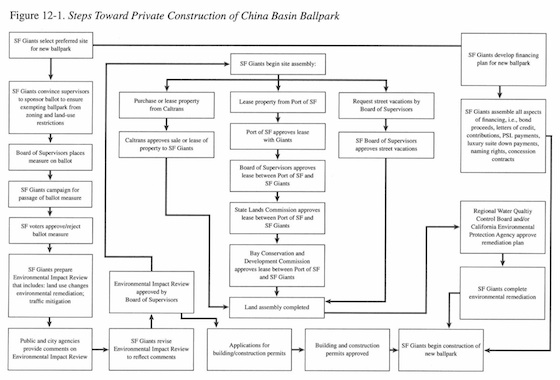
stickball

Step-by-step instructions on how to follow the Giants’ plan.


See? Easy peasy, no sweat right? Sure, there are a few things that are different, such as the need for a ballot measure. Oakland has long claimed that it doesn’t need one. That claim originated from two theories: that either Oakland could leverage redevelopment money or the powers within the Coliseum Authority (JPA). The latter still stands technically. The former? As long as Oakland’s pledge to take care of costs to put the site together stands, and those site costs keep rising (Victory Court was at last count $250 million), the Mayor and City Council are going to have an extremely difficult time convincing the voters that they shouldn’t vote on it. Even in the Coliseum’s case, going without a vote is inherently very risky because many of the people on the JPA board are standing office holders, such as Ignacio De La Fuente and Scott Haggerty. The stench of the Mt. Davis deal still hangs thick and heavy over the Coliseum, and the Authority is having trouble refinancing existing debt at the complex. Does anyone honestly think a $2+ billion megaproject like Coliseum City won’t go to a vote? The project is calling for its own streetcar! Maybe Knauss will don a Harold Hill costume the next time he does a press conference.

Then again, Knauss expressed a preference for one of the waterfront sites. We know that Victory Court is incredibly expensive and that some current landowners aren’t exactly going to roll over for a ballpark, even though they are great Oakland supporters. Maybe it’s time to revisit Howard Terminal one more time. It’s difficult to see how the Howard Terminal site would work. Matson, one of the key corporate supporters at yesterday’s press conference, consolidated operations at HT several years ago. There’s no readily available place to relocate Matson should they give up HT. I suppose it’s possible they could give up a portion, say 15 of 50 acres, in exchange for some kind of break from the Port. Then it just be a matter of dealing with the nearby power plant and prepping the site, which would require completely new pilings/foundation work (just like AT&T Park). Judging from the price tag for SF’s Piers 30 & 32, the cost would be around $80 million to start plus whatever the price is to compensate Matson. Whatever that total is, it’s probably cheaper than Victory Court. (Personally I’d pick HT just because of its proximity to Beer Revolution, but that’s just me.)

Finally, there’s the matter of seat licenses. Knauss and his partners think there’s a market there. Lew Wolff has said there isn’t a market from the beginning. Who’s right? I’ll defer to Wolff, who has access to the season and advance ticket sales rolls and has a pretty good idea of what people are willing to pay for tickets and premium offerings. The Giants’ $255 million financing package included $75 million from 15,000 charter seat licenses. That’s a $5,000 average upfront payment (available in installments, of course). Is the market really there as Knauss claims? Consider for a moment that the 49ers are selling seat licenses right now. The Raiders, if they get a new stadium built at the Coliseum, will require their own seat licenses. They may also be in the mix for whatever venue the Warriors cook up. The A’s would be entering the fray with, if using the formula the Giants used, 20% of the ballpark cost, or $100 million of seat licenses. The A’s don’t have the Giants’ 25,000-strong season ticket roll, or the reputation of having a large number of premium ticket buyers (Green Collar Baseball, anyone?). So you’d have three, possibly four teams selling seat licenses along with more expensive tickets. That’s a good way to oversaturate the East Bay, a market which has historically shown trouble maintaining solid fanbases unless the teams are ultra-successful. These financing terms don’t work unless great support can be maintained through thick and thin, or at least if some of the load can be sloughed off to corporate interests. Otherwise someone has to make up the shortfall, and as we saw from the OFMA debacle, the results can be disastrous. MLB and Selig know this, and they won’t be impressed just because someone says “we can work it out”. Selig will want to see pledges, upfront payments, real tangible proof that seat licenses can be supported and that there won’t be a shortfall that drags down the franchise. The CBA has a provision that the A’s have to come off revenue sharing by 2016, unless they’re still at the Coliseum. MLB is not going to approve a plan that creates huge risk for the team and causes them to stay on revenue sharing even with a new ballpark.

Perhaps the best predictor of how portable the Giants’ financing model is comes from a 2002 AP article which quotes former owner Peter Magowan and  Rob Tilliss, the JP Morgan consultant who put the deal together. Magowan:

“You cannot expect a private ballpark to be built in Cincinnati or Milwaukee, there’s not the economic base there. It’s not the Silicon Valley,” he says. “And we couldn’t do it today. We were very lucky in our timing we had low interest rates and a very good economy.”

Tilliss:

“It definitely is not a one-size-fits-all kind of model.”

Knauss’s argument is that economically, Oakland is closer to San Francisco or Silicon Valley than it is to Cincinnati or Milwaukee. I find that hard to believe.

The enemy of my enemy is my friend, Part Deux

Shortly after Commissioner Bud Selig convened his three-man panel to figure out what to do with the A’s, all sorts of political machinations started happening. That included then-Oakland City Attorney John Russo (now City Manager of Alameda) penning a lawsuit threat against the A’s. I wrote back then:

What recourse do the Giants have, then? They can try to go to bat for Oakland, even though they have no history of doing that previously. Even though, in moving to China Basin, they’ve actively siphoned East Bay fans away from the A’s. Even though they’ve held a regional hegemony for decades. It wouldn’t be hard to posture themselves as saviors of baseball in Oakland – no matter how strange that sounds – as it wouldn’t require much effort and could be done in a sort of stealth mode. It wouldn’t be difficult to get a few letters from prominent pols in order, so no problem there either. The best part is for the Giants is that it works. It paints Wolff as a villain and Oakland as a victim, despite the backstory’s greater complexity.

Eerie, no?

Now we have word from the Trib that Jean Quan has met with Giants ownership. That wouldn’t be the first time. Perhaps it’s completely altruistic, in that they’re instructing her on how to put together an AT&T Park-style stadium deal, the kind that Clorox CEO Don Knauss is pursuing. (Knauss also had a lengthy interview with KQED.) Then again, this is the same Giants ownership group that may have pulled a power play to kill the Piccinini-Dolich group’s chances to buy the A’s, because the Giants didn’t want an Oakland-based group owning the A’s:

More likely, Piccinini suspects the San Francisco Giants ownership had a hand in convincing Selig to make sure the deal never materialized, especially since Selig has called the A’s move from Kansas City to Oakland “a terrible mistake.”

“I can tell you there’s an executive with the Giants, who shall go unnamed,” Piccinini said. “I ran into him at a Warriors game. He said, ‘I hear you’re getting involved with the Padres. We want you in San Diego; we just didn’t want you here.’ “

Speaking of Piccinini, he’ll be available soon if he wants to deal with the struggle to be an owner again. Piccinini is part of the Moorad group who were teased the Padres, only to have the rug pulled out from under them. Moorad won’t be able go after another team, knowing that there are permanent veto votes against him within the Lodge. Much of the rest of the Central Valley base of the ownership group should be available, and they could pull in another frontman – Andy Dolich, perhaps?

If Piccinini’s right, the Giants don’t care for the A’s in Oakland or anywhere else in the Bay Area. That makes it frustrating to see Quan consult with the Giants. The Giants aren’t doing the City of Oakland any favors. Just because they may have a somewhat allied interest (keeping the A’s out of San Jose) doesn’t mean they are allied.

If Quan’s smart, she’ll ask for some of the SF sponsors that Oakland will need because as much as the East Bay wants to puff its chest out , the pickings are slim. The Chron 200 is an annual list of the Bay Area’s largest independent, publicly-traded companies by revenue. Generally these are companies with revenues over $100 million annually. Some private companies, like Bechtel, or subsidiaries, like Matson (Alexander & Baldwin), and nonprofits (Kaiser Permanente) are excluded. Distributed by region, San Francisco has 19 of 200, with 5 in Marin County and 26 in San Mateo County. Santa Clara County has 102, or 51% of the list. Oakland has 3 companies on the list, the East Bay in total has 38.

Chron 200 list by city/county-region

If you combine SF, San Mateo, and Marin Counties, you get 50 companies. That’s not significantly greater than the East Bay’s 38 – or 40 if we include Kaiser and Matson. Straight up it would appear that there’s enough corporate strength in the East Bay to make a privately financed, $500 million ballpark happen. But the Giants’ argument for years has been that they needed the South Bay to finance AT&T Park. If that’s true then there’s a logical incongruence at work. Either the South Bay was required and there’s no other way but to include them, or the South Bay wasn’t required and the strength of the West Bay is enough. So which is it?

Also, check out the imbalance of companies in the Giants’ designated territory and the A’s. The Giants have over 75% of the Chron 200. The A’s have less than 20%.

The secrecy of the mystery ownership bidder is also a bit baffling. Lew Wolff has said that no interested party has asked him directly about selling the team. Instead, whoever’s interested has chosen to use back channels to engage Wolff – once. What is the point of that? If the East Bay coalition’s goal is to first work with the current ownership group to develop a plan to keep the A’s in Oakland, why have they never directly called Wolff once? They’ve gone semi-public twice in the last several months to indicate there’s an ownership group in waiting. Seems to me it’s a lot harder to put together a press conference than to call Wolff or arrange a meeting. For whatever reason, they haven’t done the latter. In the last comments thread, a question was posed, “Why doesn’t Lew listen to what these guys have to say?” I think the answer is that they have to present something to the man first. They’ve presented a plan to MLB three years ago that went unanswered. If they want to work with Wolff, they might want to first try to, you know, work with Wolff instead of posturing. It’s somewhat embarrassing that Mayor Quan has probably spent more time talking the Giants brass than the A’s. If A’s ownership is the enemy, don’t pussyfoot around it or hedge. Declare it and get to work. Otherwise it’s just another exercise in scoring PR or political points. And the only real winner in the end is the Giants.

Oakland Press Conference at Clorox HQ (Updated)

Today at 10 AM, there will be a press conference at Clorox headquarters in Downtown Oakland about efforts to keep the A’s in town.

Clorox is handling the media advisories for the event. That’s all I know for the moment. Since I’m still in San Diego, I won’t be able to attend. I’ll keep an eye out for news as it comes in.

Update 10:30 AM – A tweet from KRON’s Haaziq Madyun:

11:10 AM – From Baseball Oakland’s Facebook page:

Today Clorox CEO Don Knauss has announced continued support by the East Bay buisness community in Keeping the A’s in Oakland. He is willing to work with current ownership, however if that cannont happen he is willing to work with another group that is willing to buy the team and pledge support for them (sic) 

11:30 AM – I just got off the phone with Lew Wolff. He confirmed that the team is not for sale and that ownership has explored all options in Oakland.

11:55 AM – Oakland Mayor Jean Quan has put out a press release.

FOR IMMEDIATE RELEASE

May 3, 2012

Clorox and Other Major East Bay Businesses Join Mayor Jean Quan to Voice Their Support
to Keep the A’s in Oakland

OAKLAND, CA– Chairman and CEO of The Clorox Company Don Knauss, joined by several of the largest companies located in the East Bay, today stood with Oakland Mayor Jean Quan to announce support for keeping the Athletics baseball team in Oakland.

At the event, Knauss stated, “Clorox strongly and enthusiastically endorses the efforts of the East Bay business community and City of Oakland to keep the Oakland A’s here in a new, world-class stadium. As former president and CEO of the Minute Maid Company, I was actively involved in the design of the new Houston Astros downtown ballpark and subsequently secured naming rights to change the name to Minute Maid Park. From that experience, I can speak first-hand to the revitalization a world-class ballpark can bring to a city. Certainly, Oakland would benefit greatly from the jobs, tourism and vitality a new stadium would bring.

“The business community is committed to helping drive an effort to support the current ownership group in their quest for a new stadium so long as they are committed to staying in Oakland,” Knauss went on to say. “However, if the current ownership group is not committed to Oakland, we want to make clear that Oakland and the East Bay business community are ready to step up to the plate to help ensure the A’s stay home where they belong in Oakland. We’re confident we have identified an ownership group with the financial wherewithal to buy the team, keep them here and get a new stadium built.”

Added Oakland Mayor Jean Quan, “I want to thank Clorox and members of the business community for doing what is necessary to keep the A’s in Oakland. Developing a world-class sports, entertainment and business complex as a new home for the A’s will generate thousands of jobs and create economic development opportunities for this City.”

At the event, the East Bay business leaders said they are prepared to work with the City, County and A’s ownership to help secure corporate sponsors in the following areas:

  • Stadium Naming Rights
  • Major Corporate Sponsorship Commitments – Significant anchor sponsorships, including seat licenses and luxury boxes. (A number of the companies have already made substantial deposits into an escrow account to demonstrate their seriousness when it comes to such sponsorship commitments.)
  • Other Regional Sponsorships — Given the size and breadth of the East Bay, home to nearly 2.5 million people, representing one of the country’s strongest economic markets and huge marketing and sponsorship opportunities, the business leaders made clear they would work with the City and the County to identify additional corporate supporters throughout the entire Bay Area and beyond, including Sacramento and Stockton.
  • Reaching Out to Business Partners – Given the size of the companies, many have relationships with business partners who would have a strong interest in supporting the team and the region as sponsors.
  • Identifying Specific Industry Anchor Sponsor Opportunities – Pursuing opportunities for the kind of anchor sponsorship relationships Major League Baseball teams typically have in sectors like the airlines, health care, car manufacturers, beverage and food companies, energy companies and major consumer companies.

Among the East Bay businesses represented today are:

  • Bigge Crane & Rigging
  • Jobs and Housing Coalition
  • Kaiser Permanente
  • Matson Navigation Company
  • Oakland Metropolitan Chamber of Commerce
  • Pandora Internet Radio
  • Reynolds & Brown
  • Safeway
  • Signature Development Group
  • Wendel Rosen Black & Dean
  • World Market

If the team is not for sale, and East Bay backers would prefer new ownership, where does that leave us? No different than yesterday or a week ago, I suppose. The game plan by many of the Oakland-only community has been to wait out the process and hope that Selig denies Wolff the rights to San Jose, then come forward with a new ownership group and stadium plans, which may or may not be tied to Coliseum City. The problem with this is that how do you impress Selig, who according to many of the community is out to get Oakland, without some serious level of detail and planning? They’ve had over three years to put something cohesive and coherent together. Press conferences like these, which seem to occur every couple of months, are good at generating media interest. Beyond that, where’s the substance?

Clorox deserves a lot of credit here. Don Knauss is driving this forward, and as I’ve mentioned before, every stadium campaign needs a champion. Knauss might be that guy.

There’s also one key difference between what’s happening with the A’s and what’s going on with the Sacramento Kings. The Maloofs are broke. The Wolff/Fisher group is anything but broke. The only party who can “force” a sale is Selig, and he’d need a very good case to make that happen.

San Jose lists former redevelopment agency assets for sale

As part of efforts to pay down $4 billion in redevelopment debt, the City of San Jose is listing numerous properties owned by the now-dissolved San Jose Redevelopment Agency for sale. Included are the Jose Theater (Improv), Billy DeFrank Center (LGBT), two separate pieces of land on which the Hilton and Camera 12 sit, and numerous others. Many of the properties have liens on them or are tied into long-term ground leases, making them rather unattractive for speculators.

Notably absent from the list are the ballpark parcels near Diridon Station. Those properties were transferred to the San Jose Diridon Development Authority. The state may try to sue for those properties and put them under the control of the SJRA successor agency, though we haven’t seen indicators one way or another on such a move. For now any property sales have to be approved by the successor agency’s board, which is basically under the county’s control.

The notable property on the list is the $31 million North San Pedro site, also known as the Brandenburg property. It’s under contract with developer Barry Swenson for 600 housing units as well as a one-acre park, plus a rerouting of Julian Street through the area. Tony D. suggested a few weeks ago that the ballpark properties could be “swapped” with the North San Pedro parcels, resulting in a very clear site (10+ acres) for the stadium.

There are several issues with the Brandenburg property that could potentially outweigh any advantages it has in its ease of acquisition.

  • The western edge of the site is less than 600 feet from the approach to the 30R runway at SJC airport. I’ve measured noise in the area, and it’s typically 10-15 db greater than at Diridon when a plane is flying over.
  • Due to its proximity to the airport and landing approach, the FAA is going to put up a fight if any building proposal is higher than the one already approved for the area. According to project documents, the apartment buildings that have been approved for Barry Swenson are at most 76 feet tall. A ballpark will be at least 10-15 feet taller, probably more depending on how the lighting elements are designed and incorporated.
  • At 0.8 miles walking distance from Diridon Station, Brandenburg is at the outer limits of what people are usually willing to walk to get to a stadium.
  • A brand new EIR would have to be done, given the change of location and scope. It could take a year to complete, though the City could leverage some existing work such as the recent traffic study. While the NIMBY element at Shasta/Hanchett would be reduced, new NIMBYs from Ryland Park and the Northside could emerge. On the other hand, support could solidify from former Mayor Tom McEnery, who has several interests in San Pedro Square just two blocks away. San Pedro Square is situated so well that I figure that 60% of fans would end up going through it to get to a Brandenburg ballpark.

I don’t know exactly how the land swap would work. Santa Clara County is supposed to get half of the selling price due to its settlement with the City last year, but other than that wrinkle it’s a cut-and-dried deal. Since both the ballpark and Brandenburg sales are at option stage and have not yet been consummated, it could require recalculation of land prices since the ballpark deal was based on a specific land use. For Barry Swenson, the ballpark land probably isn’t all that attractive unless all of it can be acquired, including the AT&T and AERIS properties. Otherwise the developments would look very disjointed and there would be some potential hazards (high pressure flammable gas, electric substation).

It’s not a great option, but it’s out there if someone got really frustrated with how land negotiations were going. Of course, we’d have to get to the point of land negotiations first.

Dodgers sold, O’Malley looks at Padres

It’s May Day for Dodgers fans. The Frank McCourt era is officially over, as the sale of the franchise was officially closed today with McCourt selling to Guggenheim Baseball Partners. I’m two hours south right now, yet I can hear a din of cheering. Or maybe that’s the exhaust fan in the kitchen.

McCourt’s still in the mix, thanks to his being part of a joint venture with the parking lots surrounding Dodger Stadium. As for running the franchise in any way, he’s gone. And for that, all of baseball can be grateful.

It was expected that some of the losing bidders would latch onto the new opportunity that was created when Jeff Moorad and Company gave up on buying the Padres from John Moores. The first one has surfaced. According to Ken Rosenthal, it’s former Dodgers owner Peter O’Malley. O’Malley, his family, and others with the money to make the deal happen, have requested to look into the Padres’ finances and are looking to wrap up a deal as early as the All Star Break.

That’s all well and good, but O’Malley should know from experience that Bud Selig is not going to allow the sale of the team to the first guy who shows up with a check. Selig wants a bidding war, and there is buzz that three of four other parties are interested in the team. He wants John Moores to get a little extra for his having to wait. The Padres aren’t going to go broke anytime soon. As crazy as this valuation and sale price bubble is, maybe it’s not so crazy to think that Moores could get $700 million, $800 million, maybe more.

If there’s a lesson to take from the last few years it’s this: If you’re an owner, embroil yourself in a scandal – messy divorce, financial, etc. You’ll make out great in the end.

News for 4/29/12

Good stuff:

  • The Kings arena deal was officially declared dead on Friday. Perhaps they were waiting for rigor mortis to fully set in. The team will stay for another year, after that? Who knows? I’m not generally a fan of boycott efforts, but if Kings fans really wanted to stick it to the Maloofs with both a fiscal and PR nightmare, they should boycott ALL games. The family may be struggling enough that a loss of $30-50 million in revenue could really hurt them, and force them to sell the team. That’s what the fans want, right?
  • Many readers are getting a buzz off the news that Angels’ owner Arte Moreno met with AEG recently. As Bill Shaikin writes, they’d have a long way to go before they started doing anything. Moreno’s a good businessman, and as a good businessman should he has to at least hear AEG out and get some kind of dialogue going. It won’t force the City of Anaheim to do anything, so the leverage play isn’t there – at least not right now. I wrote last week about AEG’s business model and goals for the LACC expansion-cum-NFL stadium, and how baseball isn’t really on AEG’s map. AEG has its own somewhat weak leverage play in that they want to push the NFL to make a move on their behalf, but as recent discussions between the two parties have revealed, the league is not easy to budge. The NFL can at any time revive the Roski/City of Industry plan and favor it over AEG’s concept, and it would have every right to do so. The NFL doesn’t care about AEG’s desire to hold the Final Four or BCS championship game there, or about AEG’s interest in expanding LACC. All they want is a new, Super Bowl-ready venue. AEG, on the other hand, would have to strain to make a downtown ballpark work within its convention center plans. Since AEG wants an indoor convention hall, the ballpark would require a retractable dome instead of open air. The field would have to be moved out like University of Phoenix’s field, yet there’s no space for such a field-on-a-tray. Because of the rather bespoke nature of a ballpark, it would be difficult to put in the flexible seating system AEG would need to hold the Final Four. Plus there’s the issue of not having enough seats for large football events. Baseball may provide 81+ annual events, but you can bet that the revenue share for AEG will not be beneficial enough to cover the debt service on the venue. There are few compatibilities between what Moreno wants and AEG’s goals. That makes a downtown ballpark a non-starter.
  • Minnesota lawmakers continue to work throughout the weekend on the tenets of a Vikings stadium plan. The big obstacle may be rank and file Democrats, many of whom who appear to have pledged to vote down any stadium proposal. Financing would come from a appropriations (state) bond, which means that debt would be serviced by an annual appropriation, to be paid back by gambling tax revenues and other sources. It’s certainly a “creative” public financing solution, though one that would never leave the budget committee in California.
  • Barclays Center in Brooklyn putting on an exhibition in October between the Islanders and Devils to test out the hockey configuration, which is suboptimal.

A’s not on May owners meeting agenda

Small item in John Shea’s report today:

Managing general partner Lew Wolff, who attended Tuesday’s game, conceded that the A’s stadium issue won’t be on the agenda at the May 16-17 owners’ meetings, and he wouldn’t guess whether it’ll be included at the next owners’ meetings in August.

As long as Bud Selig keeps leaving the A’s and Wolff twisting in the wind like this, he’s the one who’s going to have to fix it. The A’s lease runs out after 2013. Selig should have to be the one who negotiates any short or long-term Coliseum extension, not Wolff. The Coliseum Authority and Wolff aren’t exactly buddies these days. Then again, Wolff and Selig supposedly are. With friends like these…

AEG looks to add NorCal to its empire

A very clever strategy is emanating from facility operator Anschutz Entertainment Group. It’s a two-pronged affair based in Sacramento and Oakland. The movement draws upon what can be considered serious deficiencies in both markets in their inability to attract certain types of events and visitors. Most importantly, it offers hope to both cities, which are both in danger of losing their respective pro sports franchises.

For San Jose Earthquakes fans, AEG may as well be a four-letter word. The company owned the Quakes franchise as part of its initial MLS holdings. When AEG was unable to forge a new stadium deal in San Jose, the team was abruptly moved to Houston in 2006, making the parent company persona non grata in the South Bay. AEG came back in 2008 with a small move, taking over for Live Nation as the operator of The Warfield in SF.

In Sacramento, AEG is seen as the facilitator for the Railyards Entertainment and Sports Complex. The backing out by the Maloof family has for now killed the plan, though it’s possible that AEG could resurface as a key driver with or without the basketball Kings. Should Sacramento lose the Kings, they’d have the option of building an on-spec arena, similar to former Kings home Kansas City when it built the Sprint Center. That’s a far different scope from Oakland, which is looking to keep three franchises at home via at least two new venues plus a convention center and hotel. Oakland’s model is the AEG-run LA Live complex and LA Convention Center.

AEG is the premier arena operator in the country, with Staples Center as its crown jewel. It has the experience to make cities listen when they come calling, and the weight to make cities cower when threatening to attract a team, as evidenced by AEG’s NFL pursuits. While dangling its own success in front of potential suitors, it forges ahead with its plans to expand its SoCal empire by working on a football stadium-cum-convention hall. While not a short-term likelihood, the threat and possibility remains into the future, and would hugely benefit AEG in two key ways: it would make LACC more competitive with San Diego and Las Vegas for conventions, and it would create the ultimate flexibility for all of its LA venues, which happen to be within blocks of each other.

AEG's Downtown LA operations provide great flexibility and huge traffic

To understand what make LA Live unique, it’s important to look beyond Staples Center. LA Live has two venues of its own: the 7,100-seat Nokia Theatre and 2,500-person Club Nokia, both of which are essentially auditoriums. They slot in below Staples Center for booking concerts, which is necessary because Staples is home to three pro teams and at least 126 home dates per year. In most other cities an arena operator would use a curtain system to reduce capacity at a large arena. AEG doesn’t need to do this sort of “half house” setup with Staples much, instead it can push a show to the Nokia Theatre. Staples famously hosts the Grammys every year, while Nokia hosts the Primtetime Emmys, MTV VMAs, and the finale of American Idol. Club Nokia mostly serves as a venue for up-and-coming and smaller acts. The Convention Center churns plenty of day business and drives demand to local hotels. Both convention and entertainment visitors benefit local restaurants and bars, some of which are in LA Live. It boils down to the equivalent of the population of the Bay Area visiting downtown LA every year, spread out among 2.5 events per day.

Oakland wants this kind of traffic, so they’re looking to drop SMG like a bad habit then partner up with AEG now and into the future. It’s going to be difficult to pull off. A third of AEG’s visitors come from the convention center. To build a competitive center in Oakland, the facility would have to surpass Moscone, San Jose, and Santa Clara in terms of space. It would require at least one, probably two anchor hotels attached to the convention center. A thriving commercial and retail district wouldn’t hurt attracting people and conventions. Oracle Arena is a good, modern arena thanks to the 1996 renovation, and AEG is promising to maximize utilization of the arena to its full potential and provide consulting for the Coliseum City concept.

The inherent risks are timing and cost. AEG built Staples Center prior to the 1999-2000 NBA and NHL seasons. The Nokia Theatre didn’t open until 2007, after Staples as AEG responded to market conditions. Club Nokia opened the following year. For AEG to be that involved and willing to invest in Oakland, it would have to recognize similar market potential and a chance to dominate the market the same way it does in LA. The arena part will be difficult to pull off as Sharks Entertainment will always be competitive with HP Pavilion. The Warriors could build an arena in SF, relegating Oracle Arena in the process. Another Planet Entertainment controls several smaller theaters throughout SF and the East Bay, providing natural competition in the process. There is no proper 7,000-seat auditorium in the Bay Area, pushing shows of that size to the arenas unless AEG sees fit to build one (the Bill Graham Civic, as historic as it is, is really a gym). Plus there is no shortage of 2,500-seat venues in the Bay Area: Fox Oakland, Paramount, Warfield, SF Masonic Auditorium, and the San Jose Center for the Performing Arts. AEG isn’t going to bring a fully-formed Coliseum City on Day 1. It would have to be phased in over many years, with no guarantee that much of what’s being promised will be built.

For AEG, the best part is that in making these deals, it’s getting exclusivity for usually a year or more for a very small price while making a little money to boot. AEG has been willing to invest in venues to some degree as it did with Sprint Center. However, Phil Anschutz is not about giving away the farm, as witnessed by his hardball dealings with the NFL and the contribution cap AEG paid for Sprint Center. Maybe something will happen, maybe not. Either way AEG is the first one in and keeps competition out, while getting a better understanding of how to exploit a particular market. As great as LA Live is, it shouldn’t be considered easily repeatable. Sprint Center is a more realistic and perhaps cautionary example. The arena is the second busiest in America according to Pollstar and is highly profitable by AEG’s standards, though it’s a $13 million annual drain on the city’s coffers. Sprint Center is well integrated with KC’s $850 million Power and Light District development. There remains no major pro team. AEG appears to be happy with whatever business model works best for it whether it’s three teams or none, civic pride not being a great priority.

One other curiosity about AEG: as interested it is in the NFL and as extensive as its holdings are in hockey (LA Kings), basketball (Anchutz’s minority share of the Lakers), and soccer (LA Galaxy, Houston Dynamo), there’s one glaring omission on its resume: baseball. Does AEG care about baseball at all? It doesn’t operate any ballparks, nor does it own a minor league team. It doesn’t seem to have any relevant experience with baseball. Its new AEG Sports division has no baseball interests at all. Judging from AEG’s track record, I have to think its priority list would look like this:

  • Concerts
  • Soccer
  • Conventions
  • Hockey
  • Football
  • Basketball
  • Baseball?

Judging from that, maybe AEG would be more interested in bringing a MLS team to Oakland than in keeping the A’s there. In regards to the A’s, AEG’s presence is similar to Larry Ellison in that certain factions would love for either of them to be interested in the A’s, but neither has shown any sign of interest to date. A clause in the Coliseum management contract dictates that AEG can’t talk to teams about moving, which I suppose might have teeth if a team were bound to a long-term lease (only the Warriors are). It gives a new twist on the Coliseum City exercise being a feasibility study.

What the NFL wants, it gets

You have to hand it to Roger Goodell. He has a playbook for getting stadium deals moving, and by God it works. Goodell lets the team owner come up with a proposal, and if it stalls he comes in with Goldman Sachs in tow and/or a threat to move, implied or otherwise. As a result, Santa Clara put up $900 million in public loans and cash for the 49ers stadium project, while the Vikings – after much debate – are getting a deal crafted in the Minnesota legislature that could provide up to $800 million in public assistance for stay home.

In the Vikings’ case, all it required was a little open-ended discussion about Los Angeles and a sighting of owner Zygi Wilf’s private jet in SoCal. LA Mayor Antonio Villaraigosa has become the Oscar Goodman of football, an outsider but serious power player whose city’s existential threat to other cities forces them to the table. The Vikings deal is by no means complete, but it’s further along than any talks to date, so that has to be encouraging for both Vikes fans and Wilf.

On Thursday, the 49ers officially broke ground on their new home as of the 2014 season. The stadium will undoubtedly be impressive and significantly better than Candlestick Park in just about every way imaginable, except affordability. (I thought I was going to get some pictures of the event but that fell through, sorry.)  Now we can talk in earnest about the Bay Area hosting a future Super Bowl or World Cup matches. It’s pretty exciting, despite my misgivings about the finances.

And it’s with that news that I can sit back, somewhat detached from the plan and say that I’m jealous of the 49ers right now. I don’t want a major handout for the A’s or Goldman Sachs waiting in the wings. I don’t need a stadium that costs more than a billion dollars. I just want a new place where I can take friends, where it doesn’t feel like pulling teeth to ask them if they want to go. A place that celebrates baseball, not merely hosts it at best adequately. Despite what some readers think, I don’t care where it’s built. If that’s Oakland, great. If it’s San Jose, so be it. Even Sacramento I wouldn’t mind so much at this point. My stance has always remained steady all this time – as long as it’s privately financed and I can get to it locally, I’m all for it. On this blog and elsewhere we have these endless debates about what it will take, territorial rights, what resources specific cities can offer, and there will be plenty of time for that later. For now let’s simply look at the leagues.

Mostly, I’m jealous that the NFL can get its stuff together on stadia so much better than MLB. It doesn’t matter that on the whole NFL stadia cost twice as much. The projects should be far riskier because of the expense and the inherent lack of utilization. In the post-downturn, post-redevelopment California, the toughest market to build anything new, the NFL will have beaten MLB by at least two years, maybe more. In the time that Bud Selig has had his panel discussing what to do about the A’s, we could’ve had a fancy (or not) groundbreaking. We could be talking about the future. Instead, we’re treading water as usual. No one can tread water forever.

A Streetcar Named Aspire

Today the commissioner said that the A’s need a new stadium… and that’s about it.

In Billy Beane’s weekly slot on The Drive, he mentioned that the team/ownership is at “the end of the process” and that regarding the recent news “there seems to be a lot of smoke, and where there’s smoke there’s fire”. Not exactly revealing, but at least it lines up with Selig trying to broker a deal between the A’s and Giants.

Added 8:50 PM – Joe Stiglich has more on the negotiations that may or may not be happening that no one officially wants to talk about. 

I did find out something revealing about the Coliseum City project. Turns out that as part of the planning for the project, the City is looking at putting in a streetcar or trolley. The streetcar is not part of the Oakland Airport Connector, which is currently under construction. It wouldn’t go downtown or to Jack London Square. Instead it would be a very short trolley, running around one mile in length between the Coliseum BART station and the Edgewater area on the other side of the Nimitz. I’ve racked my brain and haven’t heard of a streetcar or trolley built for what is primarily a sports complex.

I can only assume that the project’s principals and supporters want this streetcar to improve the project’s attractiveness as a potential corporate and commercial hub, since it would provide a direct link to BART and the other parts of the Coliseum City. What’s not clear is why they’d choose a streetcar. A people mover like the Airport Connector would make more sense. An extension to the Airport Connector from the BART terminus through the complex (creating a “U”) would make the most sense, except that station’s design (see pic below) prevents that kind of alignment.

The Airport Connector's alignment runs perpendicular to San Leandro Street and the BART alignment, making it difficult to extend and turn the system.

The crazy thing about this streetcar idea is that it creates a third, disjointed transit option in this relatively small area. Meanwhile, there are far better places to use resources on a streetcar project, such as Broadway (which is getting yet another separate study). Clearly, if the streetcar option gains traction it’ll add a quarter-billion to the project’s $2 billion price tag. Yet it might be considered a necessity if the City wants to lure a big corporate fish.

As Marin County rejected George Lucas’s long-gestating studio expansion project and then ran back to Lucas in desperation only to be rejected by the filmmaker, Oakland City Councilmember Rebecca Kaplan wrote an open letter to Lucas encouraging him to take a tour of the city. Coliseum City has to be at or near the top of places the City would offer to Lucas. Now, it’s hard to envision any locale in Oakland comparing to the pristine Skywalker Ranch or the wonderfully preserved and adapted Letterman Center at the Presidio. And Oakland’s already tried to push Coliseum City in its bid for the Lawrence Berkeley Lab expansion and lost. But if you’re gonna dream big, you might as well go fully preposterous. I know of at least one reader, native Oaklander, and Lucasfilm employee who would weep tears of joy if Oakland got Lucas’s blessing to build the new studio in Oakland.

I couldn't resist.