Carolina (Panthers) on everyone’s mind

Before you read the rest of this post, head over to Deadspin and read about the Carolina Panthers’ leaked financials from the last two years.

Then read the Charlotte Observer’s piece, which includes a response by the Panthers.

—–

The leaked document came from Deloitte, and there’s nothing to indicate that it’s inaccurate. In fact, the Panthers didn’t deny the report, only saying that the document presented “an incomplete picture” of the team’s profitability. According to the team, the missing context was the uncertainty surrounding the league lockout preceding the 2011 season. It’s not unusual these days for teams to considerably shrink operations during a lockout, establishing a sort of bunker mentality. The consequences can be cruel, as it usually means laying off dozens if not hundreds of “non-essential” personnel. In the Panthers’ case, they decided that they’d be best off reducing player payroll. And so they did with a $77 million roster, $43 million short of the $120 million salary cap set for 2011. Philosophically all of this probably made sense back then, as the team was in rebuilding mode with #1 draft pick Cam Newton and Ron Rivera replacing John Fox at head coach. Newton’s Rookie-of-the-Year campaign juiced the loyal fanbase enough to boost the following year’s payroll to $100 million. Despite that uptick, the Panthers’ record only improved by one win last season. The team finished 3rd in the NFC South, going 7-9. The NFLPA predicts that the 2013 cap will be $123 million.

Carolina Panthers 2011/12 balance sheet from leaked Deloitte & Touche audit

Carolina Panthers 2011/12 balance sheet summary from leaked Deloitte audit

The Panthers are ranked #16 in the Forbes NFL valuations list with an estimated revenue of $269 million for the 2012 season and a valuation of just over $1 billion. Not knowing Forbes’ exact formula and numbers, I imagine that the discrepancy is mostly a matter of accounting, depending on whether partner distributions (profit-taking) and other maneuvers with team revenue are counted. Distributions amounted to $12,228,541 for both years, or roughly a 6% return on the original $206 million franchise price. That leaves a rather large net income amount that they can do whatever they want with.

One of those things they can do with the money is fund the improvements they are requesting for Bank of America Stadium. You may remember that a month ago, the team struck a deal with the City of Charlotte and Mecklenburg County for a package of improvements that would total $300 million. This week the state balked at giving the share it was expected to provide ($62.5 million), and the leak certainly won’t help Panthers owner Jerry Richardson’s case for a handout. It’ll be interesting to see if new pressure mounts to have the local public funding aspect of the deal reversed, since it’s clear that the team can pay its own way. To do so may require scaling things back a bit, but really, why on earth is $250-300 million necessary for a stadium that’s only 17 years old and is one of the better designed and maintained facilities in the league? The Panthers had expected to pay $96 million of the project cost. If the City/County reneg on their part, Richardson could be forced to scale back the project to, say, half the size and cost at $125 million. That amount in a loan for 25 years at 6% runs $9.3 million per year. With what we’ve learned this week, Richardson and the Panthers can afford it. Of course, this news didn’t come in time before Atlanta officials announced that a deal has been struck for the Falcons’ $1 billion retractable dome plan, which will include $200 million in public funding.

—–

What does this mean for the Raiders? Politically, it’s terrible. Not only will the memory of the Mt. Davis debacle not go away, now comes this news that should cast doubt on any team crying poor and looking for a public handout.

Except for one thing. When the Raiders cry poor, they are in fact, poor. Not poor as in sleeping on the street, but poor in terms of losing money on a regular basis. Forbes noted that the Raiders posted losses last year and in 2009. The Oregon professor consulted by Deadspin for the article, Dennis Howard, mentioned that when he looked at league financials a decade ago, the Raiders lost money then. Considering how bad a deal Mt. Davis has been for all concerned parties, it could be the worst all-around stadium deal in the history of sports. Nevertheless, the fundamentals are that the Raiders continue to come up short in the revenue game in Oakland. Worse, they don’t have the cash reserves or cash flow to bankroll a significant new stadium project. Perhaps they don’t even have enough to fund a revamped Coliseum as I’ve suggested. Season ticket rolls going into the new tarped-off Coliseum were lower than another Raiders team – the Texas Tech Red Raiders, who hit over 30,000 season tickets last year – and that’s an also-ran program in the Big 12.

The NFL is giving the Raiders guidance and the Raiders are taking steps to boost revenue, but as we know in the Bay Area, they’re not going to see big returns unless the team starts winning as it did a decade ago. It’s hard to see how this can be turned around as long as the dependency is there. No wonder the NFL is skittish about earmarking G-4 money for a Raiders stadium project. We know that in the short term the Raiders will have two choices: stay at the Coliseum while working out a venue deal in Oakland, or go to Santa Clara for 5-10 years. I wrote a month ago that the costs could prove prohibitive in Santa Clara if they were to pay for the true cost to stage the games, compared to continuing to get a large subsidy from Oakland/Alameda County. Ultimately, the cheapest option may be for the Raiders to limp along in the Coliseum as is while the parties wait for the fanbase to grow as the team improves. Hopefully, this doesn’t also mean that the A’s will have to keep sharing the Coliseum indefinitely. That’s not something that either the NFL or MLB want.

=====

Added 11:00 AM – Deadspin just completed a reader chat with University of Michigan sports economics professor Rodney Fort. Some of it is good reading.
Farmers Field stalling is a short-term win for Oakland, San Diego

Yahoo! Sports’ Jason Cole wrote last night that the NFL is souring on AEG’s Farmers Field stadium plan for downtown Los Angeles. That may sound revelatory, but in reality the landscape hasn’t changed much since he wrote an article in October 2011 claiming that the NFL doesn’t like AEG’s terms for hosting a team (or two) at Farmers Field. With AEG’s future up in the air pending a possible sale, Farmers Field appears to be stalled. But this was to be expected with the sale, so why is this news? It isn’t. That shouldn’t stop us from trying to understand the NFL’s misgivings.

First, let’s start off with the supposition that Farmers Field is to be operated similarly to Staples Center. AEG wants as many tenants as possible using the stadium, taking up dates on the schedule. It also wants the flexibility to hold non-football events, hence the desire for a retractable dome to make the stadium an enormous exhibit hall for the LA Convention Center. There’s the potential for numerous sports events outside of a regular season NFL slate, such as the Super Bowl, NCAA Final Four or regionals, a bowl game, fights, soccer and rugby matches, plus motocross and monster truck raillies. Add a bunch of conventions and the schedule should be full, right?

The problem is that the Staples Center model isn’t congruent with the uses of a large stadium. Staples is famous for being able to hold two events in a single day thanks to its seating flexibility and existing infrastructure. For football, hosting a game takes a full day, and the Saturday and Monday surrounding a game can be expected to be blocked out because of the time required to install and remove a football field. Since the venue will be positioned to go after the largest, most lucrative events, prep time may not be that big a deal. Still, it’s indicative that the Staples model doesn’t exactly scale.

AEG has advertised for some time that the now-$1.8 billion stadium would be fully privately funded, the most expensive stadium ever built. Assuming that AEG would build the stadium without the benefit of low interest, tax-free bonds, the onus is squarely on AEG and its tenants to ensure that the place is paid for. AEG’s model takes a cut of a team’s stadium revenue instead of requiring a rent payment. AEG has apparently backed off its demands of a percentage interest in any team looking to move to Farmers Field. Either way, they’re getting their money upfront or at the back end. Essentially, AEG is taking the place of a large public subsidy, and unlike municipalities they need to make a profit. That’s understandable for everyone except the NFL and interested owners. Roger Goodell’s memo from last summer detailed the process for any team applying for relocation to LA in 2013, suggesting that two teams call the stadium home in order to defray the cost. Again, that would be compatible with what AEG is looking for, but as long as AEG and the NFL are in a stalemate over the terms of the revenue split, there’s no deal.

A stalemate downtown should create better chances for the other LA stadium plan, Ed Roski’s City of Industry stadium. However, Roski is mired in a dispute with the state over TIF that’s earmarked for $180 million worth of improvements to the undeveloped hillside stadium site. The state says that because the project didn’t finalize contracts and measures that were to be taken to fulfill environmental requirements, the deal doesn’t fall under the category of an “enforceable obligation” and didn’t need to be honored by the state. There’s no reason to think the state will lose that debate, so it’s a mystery how that infrastructure will be paid for.

The NFL is actively looking for other potential partners and stadium sites, pursuing the Dodger Stadium site through Guggenheim Partners and Frank McCourt. A discussed site swap to build a new ballpark downtown and a football stadium at Chavez Ravine seems like even more of a pipe dream due to the complexity and cost. That leaves a few sites in further out locales such as Carson. Roger Goodell would prefer more competition and more lucrative bids before seriously entertaining a franchise relocation or expansion (or both). The problem is that as rich as the LA area is, a stadium is so expensive that if there aren’t enough huge money stakeholders to carry some of the weight, that stadium can be termed in a similar state to so many other Hollywood projects: development hell.

For cities with old or “outdated” stadia and teams trying to get better stadia, LA’s struggles represent a bit of a reprieve. St. Louis, still reeling from arbitrators siding with the Rams, doesn’t need to fear the team pulling up stakes immediately. San Diego area interests can go back to working on yet another stadium proposal. And the Raiders and Oakland/Alameda County can continue to try to get on the same page. For the Oakland/Alameda County, the impact is different. If a retractable dome/convention center concept doesn’t work in LA due to the cost, why would it work in Oakland? AEG already operates the Coliseum complex, and if they were to partner on this they’d want the same deal in Oakland that they were offering in LA. If anything, this development is great for the Raiders since they can try to shift the discussion to a new outdoor stadium, which is what they and the NFL really want. The financing part is still severely problematic, but at least the parties could hone in on a singular vision they could all agree on moving forward. The big question is whether the public side (Oak/AC) decides the most cost-effective option is a renovated Coliseum as opposed to an entirely new stadium. If so, they’re all back at square one.

Playing the FUD game

Earlier today, a report from an Orlando sports talk show cast doubt on the Seattle Hansen-Ballmer bid, because according to the report, the $30 million nonrefundable deposit was never paid by the February 1 deadline. The “news” created a minor kerfuffle as fans and media in Seattle and Sacramento tried to make sense of it.

A few hours later, outgoing Kings co-owner Joe Maloof chimed in with his first statement to the media in months: The $30 million deposit was, in fact, paid.

The Orlando talk show host, David Baumann, hasn’t updated his story or tweeted any kind of response to this clarification. By the end of business Wednesday, the focus was on Sacramento Mayor Kevin Johnson’s State of the City speech on Thursday, during which he is expected to reveal names from the local ownership group (a.k.a “whales”).

Wednesday’s histrionics were a classic example of FUD (Fear, Uncertainty, Doubt). Someone misreports something or leaks info that could prove damaging to a competitor. The same thing happened last week with Deanna Santana’s gaffe regarding Lew Wolff’s Coliseum extension letter. Misinformation grabs headlines and spreads throughout the country and industry quickly. Timed strategically in an ongoing campaign, FUD can generate enough negative attention to sink many projects and initiatives.

That brings us to Andy Dolich, who has taken on the role of Comcast Sportsnet Bay Area’s “Business Insider”. As an experienced executive in the NFL, NBA, and MLB, Dolich is well-positioned to speak authoritatively on such matters. He’s seen it all – teams thriving (80’s A’s) and floundering (49ers, Vancouver-Memphis Grizzlies), franchise moves (Grizzlies again), and new venue development (also Grizzlies). He’s extremely well-connected and is still well-networked in the Bay Area, where he maintains his office in Los Altos.

At CSN, Dolich has taken on the role of Doubting Thomas regarding two of his former employers that are seeking new homes in different cities. The Warriors are planning their San Francisco waterfront arena, going so far as to ask for state legislation to help ease some of the red tape they’ll inevitably face on the road to a new venue. The A’s continue to be stuck in Lew Wolff’s quest to move the team to San Jose, dogged by the Giants territorial rights and uncertainty regarding the team’s (and city’s) ability to take all of the necessary steps to make the move. Time and time again, Dolich trots out claims that both projects, just like the 49ers stadium, will be too expensive, too fraught with legal booby traps, too difficult to pull off. He’s probably not intentionally doing this under some unsaid agenda, but what he’s doing right now is spreading FUD. It’s FUD that provides a glimmer of hope to Oakland fans and politicians hoping to keep teams at the Coliseum. Absent any real details for Coliseum City, it’s not difficult to see why some would latch onto negative notions of competing visions as hope.

For years, Dolich has been upfront in his desire to see teams stay in their cities, whether we’re talking about the Bay Area teams or the Sacramento Kings. Strangely, while he willingly presents a case for why a move can’t happen due to various obstacles, he nearly glosses over reasons why a team could stay long-term. Sure, Cisco Field could cost $600 million or more when factoring in all of the prep work. But an Oakland ballpark won’t? Howard Terminal’s costs will be huge and could spiral out of control just like Victory Court. A ballpark at Coliseum City, even if it’s by itself with no other tenants, will have to factor in the $100 million albatross of Mt. Davis debt. That’s not FUD. That’s reality. FUD comes from a vacuum of information related to any particular situation. Dolich even makes the mistaken claim that Cisco Field would require an EIR, even though one has been certified twice by San Jose to cover different capacities and use cases. That heavy lifting is over, with only an addendum required to address the actual stadium in finished form.

Going back to the money issue, that’s where we on this site frequently bang the drum against Oakland. It’s no secret that Oakland itself is an economic weak link compared to the powerhouses in San Francisco and the South Bay. When we talk about the uphill battle Oakland faces, that can be interpreted as FUD. Even so, it’s a consensus view that has been confirmed by city staff as recently as last week. Locals know it, the national media knows it, everyone knows it. It’s incumbent upon Oakland and its supporters to change that perspective – not by talking up the city, but by taking real actions to make people believe in the city. In the end, team owners need to figure out how to pay for their privately funded facilities. To cast doubt on Oakland may seem unfair, but it’s not as if it comes from a position of naïveté. Down in San Jose, we’ve talked about the challenges for some time: redevelopment, lack of city funds for infrastructure, territorial rights, land remaining to be acquired. Daunting as those may seem, they can be overcome via procedural means and nominal investment. That’s different from Oakland, where economic concerns make investors skittish about the market. It all boils down to a simple question: If you’re going to spend $500+ million on a stadium and you can’t depend on a public subsidy, wouldn’t you want to put the stadium in a place where you can ensure you can pay it off? If MLB has concerns about Wolff hitting projections on a San Jose ballpark, what must they think about the prospects of a ballpark in Oakland?

As long as we don’t see ground broken on a ballpark for the A’s, the war of words and FUD will continue. When San Jose Arena was built, the FUD surrounding the project quickly died. Same thing for AT&T Park and now the 49ers stadium in Santa Clara. The only way to kill FUD is to prove that that it’s baseless. By working. By thriving. By building.

Estuary Park Presentation on A’s Fan Radio

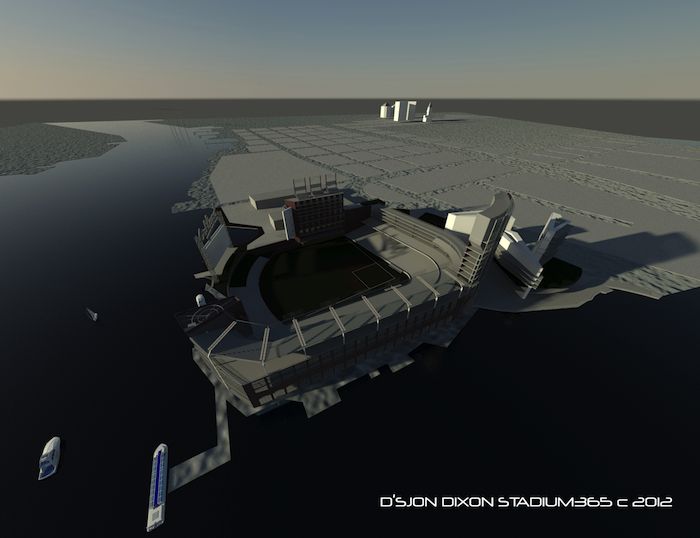
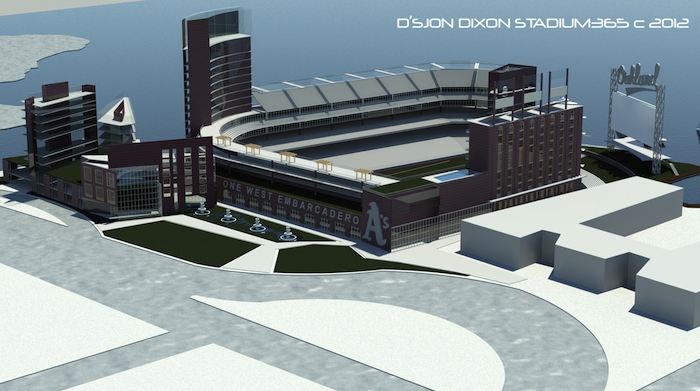
If someone – anyone – discovers a ballpark site is being discussed or presented, and he lets me know about it, I’ll take the time to cover it. Even though ownership is only focusing on one site and the City of Oakland has its own two sites in mind, it doesn’t hurt to be open-minded about others. We may find the best of breed or dismiss something entirely. Either way we’re getting educated and informed about it. I enjoy covering it, and I hope you enjoy reading about it. That brings me to the Estuary Waterfront Project, a ballpark concept by Oaklander D’Sjon Dixon. Dixon, a native East Bay guy by way of the University of Wisconsin (as he pointed out, like Bud Selig and Lew Wolff), is an excellent artist and has some brought some fresh thinking to the often static world of stadia. During his segment on A’s Fan Radio, Dixon frequently talked about his ballpark’s goals of sustainability and its ability to enhance both the waterfront and the city.

EstuaryPark-corner-med

D’Sjon Dixon’s Estuary Waterfront Project would place a ballpark on the site of Estuary Park and the Jack London Aquatic Center along the Embarcadero in Oakland

Over the years Estuary Park has aroused curiosity about its ability to work as a ballpark site. It’s located east of Jack London Square, across the tracks from Victory Court. I’ve gone there multiple times and several people have asked me about it over the years. My immediate answer to them is that it’s too small. The park measures roughly 400′ x 240′ plus some estuary frontage of varying width. The Jack London Aquatic Center, which opened in 2001, is a somewhat triangular piece of land that’s also 400′ long and 300′ wide at its widest point. JLAC has a boathouse with a community room that can be rented out for events. Rounding out the landscape is the old Cash and Carry warehouse, which the City bought through its old redevelopment arm a few years ago. That parcel, including a parking lot, measures 440′ x 340′. In all, the land (which is all city-owned at this point) totals just over seven acres.

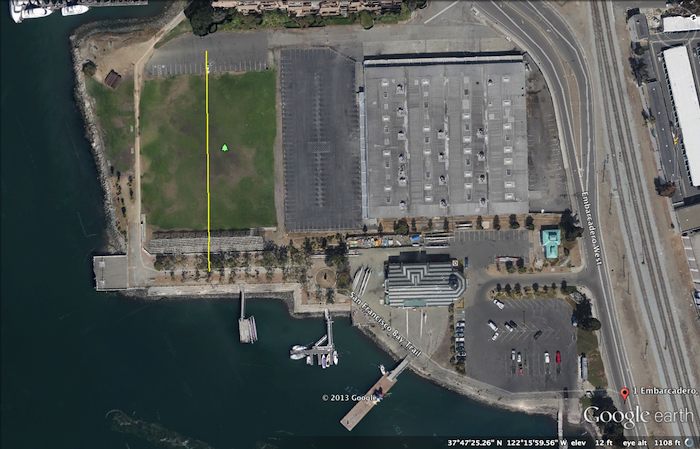
EstuaryPark-overhead-med

Overhead picture of Estuary Park, the Jack London Aquatic Center (bottom right), and the vacant Cash & Carry building. Yellow line across field represents 400 feet.

It’s not small just because of the acreage, it’s small because of a single dimension. In the picture above, the yellow line represents a reasonable buildable width including mandated setbacks and easements for the water and the apartment complex to the west of the land (top). 400 feet is simply not wide enough to hold a ballpark. A grandstand including the concourse will measure around 170 feet deep. Add to that 50 feet from the first row to home plate, and then at least 300 feet for a short porch to right field, and the ballpark becomes 520 feet wide. There simply isn’t room for that kind of structure on the land, unless you do something unorthodox.

EstuaryPark-north-med

Water view shows footprint of ballpark extending beyond existing Estuary Park footprint

To address this, Dixon took two unorthodox approaches. First, he disregarded the Estuary Park limitations and simply built more of the ballpark out into the water. I didn’t notice this until I saw more images on the project website. Notice the second pic’s taper from JLAC to the park, and how that no longer exists with the ballpark. Anyone who has spent any time reviewing CEQA knows that building anything new over what is currently water is for all intents and purposes forbidden in California. Even the Warriors arena is getting a great deal of static for aiming to build on piers, which of course aren’t land. Additional creation of land in the Bay, regardless of purpose, practically requires an act of god to make it happen. Remember the plan to extend SFO’s runways a decade ago? That would’ve required bay fill. It died on the vine. A similar effort for this ballpark, even if it required only a 100′ x 400′ slab (1/2 acre), would be laughed out of committee or ripped to shreds by Save the Bay, Waterfront Action, or the BCDC if it ever got that far. The Bay is what makes our region distinct, and people and groups have shown that they’re willing to defend it endlessly and to the death. The other unusual step Dixon took that baseball fans noticed is that he oriented the ballpark west-southwest, so that it would face JLS, Alameda Point, and in the distance, San Francisco. As we’ve discussed several times, MLB prefers its ballparks to face east or northeast. In some instances such as domes it’s willing to have a ballpark aimed north or south. This is to ensure that the sun isn’t in the batter’s eyes during the day and to provide relatively predictable shadows during the season. Interestingly, Dixon tried to address this by placing an eight-story hotel tower in right field and a big scoreboard in center. Those measures will only work in certain sun-sky conditions. The ballpark could be re-oriented southeast to fix the sun problem, but it would take away from the view. Dixon couldn’t say what the ballpark’s capacity was or explain how much onsite parking would be there. The size of the ballpark would be “up to the developer”, though he also claimed he knew three people who could fund the ballpark. It all adds up to someone who has some great ideas and understands LEED, but knows next to nothing about CEQA. CEQA is the set of regulations that forces environmental review and places restrictions on what kinds of projects can be built in sensitive places. CEQA has led rise to hyper-NIMBYism in California. On the flip side, it has allowed our coasts to remain mostly in the public interest and not full of high-rises and private development. If this ballpark concept ever got off the ground, it would immediately have Bay and waterfront activists, open space and parks preservationists, boating enthusiasts, residents of the nearby apartment complex, and many others lined up to take it down. That doesn’t include the normal anti-stadium types or additional complications such as the PUC and other governmental agency interactions. This is the stuff that Lew Wolff talks about when he says that people can’t just point at a site and say that’s a site. There’s a ton of legwork that has to be done on each proposed site, and even more on the sites that actually get studied as alternatives. There are studies of noise and shade, seismicity and hydrology, cultural and paleontological resources, along with the more common traffic and transportation work. It’s a significant, seemingly endless amount of work, and the crazy thing is that a draft version of an EIR has not been finished for any ballpark site in Oakland: Victory Court, Howard Terminal, Coliseum City, this site or any other site. And it’s telling that Estuary Park, despite its rather prominent position where the Estuary meets Lake Merritt Channel, was never really considered a ballpark site in the past. That’s largely due to all of the issues identified in this post, and probably many more that I haven’t covered. Just a thousand feet across the Channel, HOK studied two sites at the Oak-to-Ninth (O29) site in 2001. That’s not to say that Dixon’s in the wrong. He has some great ideas, and the fact that he put he put his visual skills to use in fleshing them out can help a lot in terms of creating a real vision for Oakland going forward. If the concept ultimately serves as a catalyst, it would be incredibly productive for fans who want an Oakland ballpark and need a unified rallying point. This idea can be moved and modified to work at other sites. Dixon seems to like Coliseum City nearly as much as his own plan, as long as the A’s stay in town. If Save Oakland Sports and other groups can come to a consensus on one site that has energy behind it and has been properly vetted, they have a shot. If they stand by the City’s current vision of multiple sites being equal with no real consensus, there’s nothing to rally behind. They’re just circles on a map. —– Note: As I was writing this in the middle of the night, I did not ask Dixon for permission to use his images. I apologize for that in advance, though I also cite fair use as this is a review.

Save Oakland Sports meeting with Santana, Blackwell (Updated with Oakland apology)

Update 7:20 PM – Around 4:30 today, an article by the Trib’s Matthew Artz indicated that Oakland officials apologized to Lew Wolff for erroneously stating that the City and Mayor Jean Quan didn’t receive the letter. Wolff angrily replied (in ALL CAPS no less) that he did, in fact, send the letter, and later produced a letter of acknowledgment from Quan dated January 2. During the Bucher & Towny show on The Game, Townsend explained that his crew and Phoenix reporter Kevin Curran had launched their own inquiry into the status of this now mythical letter. Curran sent an email to the Mayor’s office asking for the letter since, by law, the City has to file all such communications. This afternoon the story from Artz broke, followed by an email reply from Quan spokesperson Sean Maher explaining the situation. Apparently the original email, which was also sent to numerous media, was buried in the “mountain of (holiday) furlough email” the City received. Because of this, news outlets reported on it first, giving City staff the impression that they didn’t receive it, when in fact, they did. The explanation was also a bit wishy-washy because the Mayor supposedly “eventually” received the letter, giving the impression that she didn’t receive it directly. Statements coming out of the Mayor’s office yesterday continued to press that they didn’t receive the letter. In any case, Oakland comes off highly incompetent at the very least and petty on top of it all, just because Santana decided to lash out at Wolff. That’s simply poor form. Obviously, that led to today’s apology.

—–

Monday’s much-delayed Save Oakland Sports meeting was held at La Estrellita in downtown Oakland. Though host Chris Dobbins was keen to not put City Administrators Deanna Santana and (Asst. Admin.) Fred Blackwell on the hot seat, to their credit the staffers addressed several lingering issues with some degree of frankness and a general lack of spin.

Blackwell gave an update on the state of the Coliseum City studies and EIR. The study work should be awarded in the next month, and documents should be ready by the end of the year. Because of the broad scope of the project, there will be a master plan for the 750 acres on both side of 880 and a specific plan for each side, the big focus being on the sports complex. Blackwell called Coliseum City the most dynamic project in the state in terms of size and transit access.

View from east towards Oakland Estuary. Image: JRDV

View from east towards Oakland Estuary. Image: JRDV

Based on JRDV’s newest renderings, he has a point. Much of the area on either side of the Nimitz would undergo a drastic transformation. While there would be a new football stadium in Lot B and a ballpark pushed up to the corner of Lot A, almost everything else would get torn down and replaced. Chief among the changes is a new arena, which would be placed west of 880, where Coliseum Lexus and another empty car dealership are situated. Low and mid rise buildings would be tightly packed from Oakport to the Estuary and in between the two stadia. Two new pedestrian bridges would cross 880. The BART bridge would be transformed into a huge plaza over the Union Pacific tracks. The only two legacy structures that would remain intact in the vision are the 12-story high-rise office building that briefly housed the Tribune and the newer Zhone building.

Before your eyes roll completely into the back of your head, let’s look at the three venues, starting with the ballpark. Blackwell continued previous talk of Oakland giving Lew Wolff information on Coliseum City and Howard Terminal, repeating Wolff’s continued rejection of both sites on financial grounds. Blackwell flat out said that new ownership may be required to get something done in Oakland, and that a MLB could act on behalf of a team to get a deal done. Of course, Blackwell cited Miami as an example of that working. “Working” meant taxpayers putting up 2/3 of the cost and politicians who approved the deal being run out of office. MLB wouldn’t do that unless it felt it could get several pounds of flesh. In Oakland, there is no flesh to take. The only thing MLB has offered so far is to negotiate the short-term lease at the current Coliseum.

As for the Raiders, Santana mentioned upfront that it took four months to get all of the right people (City, County, Raiders) named and set to negotiate the future stadium deal. Four months? You’d figure an e-mail thread and a conference call or two would take care of that.

In a refreshing bit of candor, Santana and Blackwell talked about the challenges facing the Raiders’ stadium piece. Santana said twice that any new project would have to bake in the $100 million of remaining debt (Mt. Davis). As I’ve mentioned before, any advantages Oakland has because of “cheap land” are wiped away because of this albatross. It also makes financing somewhat unclean, though that would depend on how current and future debt are structured. Right now, Mt. Davis debt is tied to the general fund of both City and County and was refinanced last summer. I imagine it could be complicated to restructure the debt to be paid solely by stadium/project revenues and would drive up the cost of borrowing to boot. Santana also talked about how the defeat of Measure B1 in November negatively impacted funding for Coliseum City to the tune of $40 million.

Blackwell admitted that the NFL may have a hard time giving the $200 million that Mayor Jean Quan is looking for, citing fan and corporate support. Why? The G-3 and G-4 loan programs are dependent on two specific revenue streams: national TV money and club seats. TV money is not that big a deal since it’s highly distributed, but the NFL is wary of teams running into blackouts. The Raiders are a particular high-risk case because even though the stadium doesn’t have a large capacity among NFL stadia, it’s had its share of blackouts and has a relatively low season ticket base (30,000). The recent tarping and pricing moves done by the Raiders are being done to grow the season ticket figure and reduce the chance of blackouts. In future seasons, the Raiders could increase capacity as the roll grows and the team performs better. Corporate support is another matter. Blackwell said that the NFL considers corporate support more important than regular fan support. The 49ers have done exceedingly well selling to businesses, which allowed the NFL to release $200 million for the Santa Clara stadium. Corporate support is not great in the East Bay, and the 49ers may have taken some East Bay business from the Raiders, putting the Silver and Black in a very tough position. Blackwell didn’t offer any answers on this, other than to say that the East Bay will have to step up to show it can support the Raiders in a new stadium. It’s a sobering but realistic view, not one to go rah-rah about.

On the Warriors front, Blackwell laid out the City’s case very plainly: Oakland would wait until W’s ownership got frustrated with the process of building something at Piers 30/32, then welcome the team back with open arms. With the A’s, ownership is certainly frustrated (with MLB and the Giants), not enough to run back to make a deal with Oakland. While working in SF, Blackwell saw the same strategy in place for the 49ers, only to see the team start building in the South Bay.

Things got a little strange with Santana laid into the A’s. Santana accused the A’s of playing games, claiming that the letter Wolff wrote requesting a five-year lease extension was only sent to the media, not to City or County. That’s rather confusing, because as the Merc’s John Woolfork wrote on 12/21:

If Wolff’s letter was discouraging to Oakland Mayor Jean Quan, she didn’t let on, saying in a statement that she was “pleased to receive Mr. Wolff’s letter stating his desire to stay in Oakland for five more years.”

Considering that it took four months to figure out who the players were in a negotiation, I wouldn’t be surprised if the letter was lost somewhere. One thing to keep in mind is that Wolff has already done two lease extensions at the Coliseum during his tenure. If there’s one real piece of stability here it’s Wolff, not the turnover in Oakland City Hall.

The tough part of all of this back-and-forth is that even if Oakland is resurgent as its supporters say it is, it’s not to the scale of SF and SJ. It may never be to the scale of SJ. That makes it easy to make a case against the future of pro sports in Oakland. Without some kind of miraculous public and/or private miracle to really boost Oakland, it’s hard to see how Oakland could get to its rivals’ level. Maybe the argument is that Coliseum City is that miracle. Oakland has had nearly 50 years to show that pro sports is an economic stimulator. There’s no reason to believe Coliseum City, even in its fully realized, pipe dream scenario, is the miracle Oakland is looking for. The track record – in and out of Oakland – doesn’t support it.

—–

More reading:

Note: Look at how different the two Tavares articles are. Editors rule!


Pay Up Or GTFO

We’ve talked a lot in the past year about how the Maloof family is broke and can’t do anything on their own, whether it’s funding their piece of a downtown arena or sell anymore pieces of the Kings without losing control of the franchise. Travel west along I-80, and you can see that Oakland and the Raiders are in the same situation. Oakland has had to rob Peter to pay Paul for the Raiders study, and the prospects for the Coliseum are bleak without some extremely creative (and probably public) financing. Al Davis had his estate structured so that his son Mark could keep control of the Raiders, but the Raiders can’t sell additional shares of the club without giving up control. Overextended as they all are, they’re still under the gun to come up with a future stadium solution that works for both parties, while not adding significantly to either party’s debt load.

That puts the Oakland/Alameda County and the Raiders in very tense dance over how much each side will pay to create an anchor for Coliseum City. Make no mistake, both sides will have to pay something, starting at $100 million depending on how extensive the project will be. If there’s a new stadium, especially one with a retractable roof, up to $200 million could be provided by the NFL. If it’s a redone Coliseum, the NFL will offer significantly less. It’s all based on the scale of the project.

For example, take the deal struck between the Carolina Panthers and the City of Charlotte. They’re partnering on a $302.5 million package of improvements for 17-year-old Bank of America Stadium. The breakdown looks like this:

  • $96.25 million from Panthers (33%)
  • $143.75 million from City of Charlotte/Mecklenburg County via a 1% food and beverage tax hike (47%)
  • $62.5 million from North Carolina (20%, pending state approval)

The actual improvements will cost $250 million, the rest will cover the establishment of a maintenance fund, costs associated with staging City/County events, and other gameday expenses such as traffic control. The stadium, which was privately built by Panthers owner Jerry Richardson, will not get any major structural changes such as the addition or elimination of seating decks. Accessibility will be improved by the addition of escalators. Video boards will be replaced. Obviously those items won’t cost $250 million by themselves, so there will be other buildouts elsewhere in the stadium. Perhaps they’ll expand concourses, build field suites, or create additional premium spaces inside the stadium. BofA Stadium still ranks as excellent in terms of design, sightlines, and amenities, so the new improvements may be what Richardson wants to make the venue a viable future Super Bowl candidate. The Panthers would be guaranteed to stay and additional 15 years if the deal is approved and improvements completed.

Sidebar: It was the enormous success of the Panthers’ initial PSL plan that helped sell the 1995 Coliseum renovation plans to Oakland/Alameda County and Al Davis. The Panthers paid for their entire stadium with PSLs and other private sources, with the City only providing a cheap land lease. Where the East Bay went wrong was in severely overestimating demand.

Earlier this morning, Andy Dolich spoke with the Rise Guys about the Raiders’ tarp news and the prospects of Coliseum City. While he continues to believe that the best place for the A’s and Raiders is the Coliseum, his vision has shifted a bit. In 2010 he talked about a new multipurpose stadium with “technology” that could accommodate both teams. Now he prefers a separate ballpark at the complex and a refurbished Coliseum, which he estimated to cost $300-400 million. My immediate response:

Considering what’s budgeted for the Panthers and the Bills, does anyone think a $300-400 million budget as realistic for what the Raiders and the NFL would want? Frankly, I think that by the time everything got going, $500 million may be undershooting it by quite a bit. Dolich also thinks the Diridon ballpark cost could rise to $600-700 million based on additional costs to get the site ready. I tend to disagree with that, though if this saga keeps dragging on $600 million is an easy reach. Even if the land is free, why would two-thirds of a larger football stadium cost half as much as a nearly half-capacity ballpark?

Also, consider that we explored a Coliseum refurb on this blog back in 2008. It would’ve involved gutting the original bowl and replacing it with a new West stand and a single deck of seats along each end zone.

2008-refurb_d

Colors denote different seating decks or phases of development

The project as described back then would’ve taken two full NFL seasons and about 18 months to complete, with the Raiders playing in a 47,000-seat temporary configuration while construction work progressed, similar to their 1995 season at the Coliseum. Complicating matters is that Lew Wolff wants an out clause in his five-year lease extension request if the Raiders begin this very type of project. That makes sense, since there’s no way the stadium could host baseball during this period.

Let’s say that a refurb could be capped at $500 million. The breakdown of costs by party could look like this:

  • $200 million from Oakland/Alameda County (Coliseum Authority)
  • $200 million from Raiders
  • $100 million from NFL

The Coliseum Authority could get their piece from land leases, new stadium taxes, or other sources. However, they have factor in the remaining $100 million of debt on Mt. Davis since it affects City and County budgets every year ($20 million annual subsidy). The Raiders and the NFL could work together to sell new PSLs, naming rights, etc.

The NFL has two, maybe three $200 million slots in its G-4 program for new stadia, one already claimed by 49ers. Another could be the Vikings or Falcons. In theirs and the Raiders’ cases, the teams have to at least match the NFL spend, which means that they have to come up with $200 million of their own. The 49ers came up with closer to $800 million, though much of that is money borrowed through the quasi-governmental Santa Clara Stadium Authority. Chances are that the Coliseum City stadium project would borrow through the Coliseum Authority.

Oakland pols will want as much private funds going into the project as possible, but the Raiders will be wary of digging themselves too deep a hole. That stands to reason because of poor suite and club seat sales over the years, along with mediocre season ticket rolls. There’s been a lot of talk about Oakland not requiring a vote, none about how much it’s willing to invest besides land and infrastructure improvements. Unfortunately for Oakland, land and infrastructure only gets you in the door these days. How much skin will each side put into the game? The answer won’t be known without a (hopefully public) discussion about what it’ll take to make Coliseum City happen.

Raiders not selling Mt. Davis in 2013

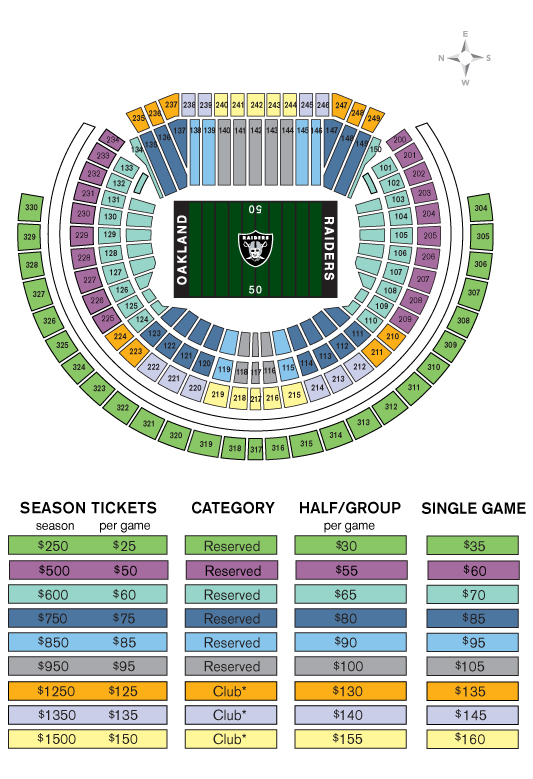
This week the Raiders released a seating map for their 2013 season. The startling revelation from this release is that the Mount Davis upper deck seats have been completely eliminated, as have the outer sections of the original third deck.

13_SEATINGPRICE_MAP2

Sections for sale do not include the outer 4 sections of the original upper deck or the newer Mt. Davis sections

A look at 2012 attendance sheds some light on what the Raiders’ motivation may be. While the first two home games were considered sellouts (for blackout purposes, not complete sellouts), attendance dropped off quickly as an unappealing group of non-division opponents accompanied a six-game slide into irrelevance. Whatever goodwill was earned during the “Oakland Loves Its Sports Teams” rally was squandered by Thanksgiving, with many fans already looking forward to 2013 when the team was forgotten locally as the 49ers continued their surge into the playoffs.

2012_attendance_raiders

2012 Raiders Home Attendance

The stated football capacity of the Coliseum 63,132 64,200 according to the Raiders, already the second (or fifth) smallest stadium in the NFL. If Mt. Davis and the ends of the original upper deck are removed, the new capacity should will be 51,000 53,250, with Mt. Davis accounting for some 10,000 seats by itself. While this would increase the team’s chances of hitting every game’s blackout target, if the NFL approves this change it’s tantamount to admitting that those seats are unsellable, at least while the team remains mediocre. CSN’s Paul Gutierrez notes that there was only one home blackout in 2012 because of the Raiders’ use of the 85% rule, so blackouts may not the issue. Instead, the Raiders may be eschewing the 85% plan altogether, because it somewhat disincentivizes sales above the 85% mark of regular, non-club seats. Per the CBA, revenue from marginal sales above the 85% mark had to be split evenly between the Raiders and the visiting team. If the Raiders presell a ton of the best seats to Raider fans and not invading fans, they might be able to boost the home crowd feel even as fewer seats are available. That was certainly the case for the A’s at the end of the 2012 season and in the postseason.

HNTB, the firm that architected the Coliseum renovation in 1995, was commissioned by the Chargers to examine deficiencies at Qualcomm Stadium compared to other newer stadia. Interestingly, the study included the Coliseum, even though the Coliseum is less than half new. Included in the study was a measurement of the highest, farthest seat at the 50-yard line for each stadium. That seat on Mt. Davis is 336 feet from the 50, the farthest of the 10 venues in the comparison. While the same seat on the opposite side of the field was not measured, given what is known about the bowl that seat is probably 100 feet closer.

If there’s a winner in this, it’s the LA firm that Lew Wolff contracts to remove and replace the A’s tarps every season. Looks like they’ll be getting a new customer right quick. Fans also get very inexpensive seats in the process. Wolff himself is probably feeling rather victorious today. Losers? 11th hour or walkup ticket buyers. There will be a much smaller inventory for the secondary market, which in recent years had tickets on Mt. Davis for less than $10 on StubHub.

Raider fan, what do you think about this? Good/bad move? An admission that the team will be terrible? Sound off below.

We’ve seen this movie before

Think about it. Barely over a year from now, a crew will assemble at Candlestick Point and take down the venerable, unlovable, frequently renamed Candlestick Park. Developer Lennar wants the land clear to redevelop as soon as possible, and that means reducing the drafty concrete bowl to dust. The 49ers’ Santa Clara stadium is moving forward by leaps and bounds, setting aside doubts about its readiness for the 2014 NFL season. As with most big demolition jobs, the ‘Stick’s destruction will have a ceremony for 49ers and Giants fans to remember the old stadium. The Giants moved over a decade ago and haven’t looked back, the 49ers appear to be doing the same in moving two counties south.

There’s time for a proper eulogy when the event actually occurs. For now, let’s look at the events that led up to this point.

It’s easy to forget that in 1997, the Eddie DeBartolo, Jr.-led 49ers proposed a new stadium flanked by a shopping mall and a massive garage (9,000+ spaces) at the ‘Stick. It’s all a very 90’s vision, with a large amount of public financing via sales tax increment, a grossly underestimated construction cost ($200 million added within a year), voting irregularities, and a new outlet mall designed to complement existing SF shopping districts such as Union Square. Voters approved the $100 million set aside for the plan, which languished for years as the 90’s dot-com boom went bust and DeBartolo was caught bribing former Louisiana governor Edwin Edwards $400,000 for a casino license. (Edwards, who is also infamous for his “live boy, dead girl” quote, has a reality show starting this month featuring him and his new wife, who is 50 years his junior.)

The 49ers' Candlestick replacement-cum-mall plan was oh-so-90's

The 49ers’ Candlestick replacement/mall plan was oh-so-90’s

Even as the plan withered and died when DeBartolo’s less spendthrifty sister and brother-in-law took over the team, the $100 million remained there if someone, anyone was interested in taking over redevelopment of Candlestick Point. So when the team started talking with Santa Clara about building a stadium near the team’s headquarters, SF Mayor Gavin Newsom had the plan dusted off and brought in mega-developer Lennar to give it an update. Lennar moved the stadium site from Candlestick Point to Bayview/Hunters Point, dropped the mall idea, and replaced it with various income-level housing developments and an office park. A carveout for the stadium with a green parking lot was envisioned as a fallback plan just in case Santa Clara fell through. Voters in 2007 (10 years after Eddie D’s plan) approved the Lennar plan. The 49ers remained lukewarm to the stadium because of costs to cleanup contaminated land and the cost of a short bridge to bring vehicular traffic from the Candlestick side to the Bayview. Things only got worse when the stadium was pitched as the anchor for a future Summer Olympics hosting effort, the complexity and uncertainty of the bidding process scaring off the 49ers and the league.

Lennar's Candlestick/Bayview/Hunter's Point redevelopment plan

Lennar’s Candlestick/Bayview/Hunter’s Point redevelopment plan

Newsom tried to “warn Santa Clara” not to tie up public funds on the stadium, while State Senator Carole Migden wrote SB 49, a Hail Mary of a bill designed to prevent teams from moving within 90 miles of their current home (within territory). That bill, like the stadium mall plan, went nowhere, leaving SF with no leverage and a still-uncertain plan to keep the team in town. The 49ers and the NFL went on the offensive in Santa Clara, went door-to-door to sell their stadium, and got voter approval in 2010. Since then it’s been all details such as the EIR process and a couple of NIMBY-related lawsuits, bringing everyone to last year’s groundbreaking ceremony and the impressively fast construction work since then.

A footnote to this story is the presence of one Fred Blackwell. Blackwell served as the SF Redevelopment Agency’s Executive Director from 2007 until 2011, then jumped across the bay to take Oakland’s Assistant City Administrator job (also redevelopment). While Mission Bay had most of SF’s redevelopment focus over the past decade or so, the ongoing state of affairs in the southeast part of the city always made it a target area. Mission Bay was always the one with real economic promise. Still, Blackwell oversaw much of the debate between Lennar, SF’s Board of Supervisors, and community groups all looking out for various interests and generally not getting very far very quickly. Eventually, the project’s EIR totaled 7,700 pages and Lennar shelled out millions to nonprofits in the name of affordable housing and other community benefits.

Blackwell may feel he’s in a similar position to 2007. During last month’s Coliseum Authority meeting, it was revealed that the Raiders and the NFL really just want to focus on a simple stadium, not the broad vision that the City of Oakland is considering. Like the scope creep that helped sink the SF stadium concept, a wide ranging and ultimately very complex redevelopment scheme in East Oakland may make it difficult for the Raiders to commit to staying if the vision remains fuzzy and exponentially more difficult to pull off than a stadium-only plan.

It’s easy to see why the Raiders want to narrow their scope. They’re not making claims of a renaissance in East Oakland. The last thing the team or league wants is to see the stadium jeopardized by a dependency on another component of which it has little or no control.

Getting the two visions (one is effectively a subset of the other) together will not be easy. A look at the pattern of NFL stadium development over the past 20 years shows that few have been part of any kind of urban renewal plan, unlike ballparks or arenas. With the limited number of football games in a season, this makes sense. The notable exception to this rule has been Lucas Oil Stadium in Indianapolis, which is not part of any redevelopment scheme, but rather an expansion of an existing convention center footprint. The Atlanta Falcons want to move to a site closer to the Georgia World Congress Center for a similar purpose. In Oakland, the stadium may have a retractable dome, which would inflate its cost significantly but also provide greater flexibility to hold different types of events. Even with ballparks, urban renewal is not a given. The St. Louis Cardinals’ Ballpark Village is finally starting construction nearly a decade after Busch Stadium opened.

Can Blackwell and Oakland pols pull together all of the resources, the financing, and the political will to execute a vision that’s projected to be twice as expensive as the scaled down Lennar-Bayview plan? Not even mighty SF could prevent the 49ers from escaping all of the craziness. It would be hard to blame the Raiders for following a similar, simpler path.

FanFest grows, elbow room still scarce

When the A’s released the map for this year’s FanFest, I was curious as to how traffic would flow in the expanded footprint. Last year, the event was held entirely inside Oracle Arena. The stage was placed on the event floor, with queues at the corners for autographs and other lines along the concourses for photos, the World Series trophies, and other attractions. This time around, the A’s utilized parts of the stadium and the whole of Champions Plaza (between the venues) to create more queueing space. Did it work?

The entry gate was moved from Oracle Arena to the Plaza between the stadium and arena

The entry gate was moved from Oracle Arena to the Plaza between the stadium and arena

For the most part, spreading the crowd out accomplished its goal. Unlike last year, the crowds were much more bearable in the afternoon, with fewer choke points along the lower concourse. But there were still huge jams in the lower club, and the lines to get autographs and the clubhouse tour easily ran 45 minutes at times. The lines are a product of the 10,000-strong crowd, and there may not be much that can be done about it. Even the upper level of the arena was used for autograph lines. In the future, it’s probably best to move the whole thing back over to the stadium side. That may be difficult for the Coliseum Authority to do because the stadium holds the only annual Northern California stop of the AMA Supercross tour. Eventually, it’s all a matter of money.

Navigation signs like this one were badly needed

Navigation signs like this one were badly needed

I arrived at the arena too late to watch the player introductions, which were reportedly quite energetic. A blogger interview session was set up to start at 1, after the regular media interview session. This time we had Bob Melvin, David Forst, and Mike Gallego. We were also supposed to have Jarrod Parker. Unfortunately he was ill. No matter, as Melvin was his engaging, confident self. Forst gave all of us some roster and draft nuggets to chew on (hint: think college players), and Gags had great anecdotes about Loma Prieta and Walt Weiss. (BTW, Gallego is my spirit animal.)

fanfest13-trophies_behind

The line for pictures with the World Series trophies was long for the entire event

One particular advantage of the stadium is that it has two clubs of 20,000 and 40,000 square feet. Even the smaller of those, the West Side Club, is bigger than the two clubs at the arena combined. The one thing the stadium doesn’t have is the auditorium-like setup with the stage and the beautiful new displays at the arena. It’s nice, not a must-have.

There will always be a scheduling conflict regarding the Supercross event as long as it’s held in the stadium. The event has to be held after the last possible home playoff game for the Raiders (seriously), but with enough time for the grounds crew to clear everything out and start planting grass for the baseball season. At the same time, the organization wants to ensure player availability for the event, which can be difficult because players start reporting to camp in mid-February (the ones that aren’t already in Arizona). That leaves about a two-week window for FanFest to be held. The Giants appear to have left Supercross behind, choosing to maximize baseball operations once their bowl game is over in December. Speaking of which, the Kraft Fight Hunger Bowl will be played in Santa Clara starting in 2015. The 49ers stadium may eventually be the best place for Supercross in the future because of fewer potential conflicts on its schedule.

Stage setup had retractable seats folded up, exposing the ice rink footprint

Arena stage setup had retractable seats folded up, exposing the ice rink footprint

The Warriors are on a 4-game roadtrip around the Great Lakes, which explains why there’s no basketball floor visible in the picture above. Also, tomorrow is a scheduled concert by the band MUSE at the arena, so the arena had to be ready for a conversion to the end-stage configuration, in which a much larger stage would occupy the “open” end. This exposes the outline of the ice rink, which extends from the permanent seats on one end to the back of the retractable sections on the stage end. The first row above the retractable sections is row 17, 15 feet or more above the ice surface. If you’re wondering how compromised that would look for hockey, there you have it. Basically, if you’re at the retractable end behind the row 17, you’ll have trouble seeing the goalie or anything happening around the net.

Overall, there was a great sense of excitement and optimism this year that wasn’t present last year. Let’s all hope there’s even more reason for people to come back for next year’s FanFest.

—-

Note – Wonder what the Coliseum looks like during a Supercross? Here’s a peek.

Coliseum Authority raids scoreboard funds for Raiders study

I wasn’t able to attend this morning’s Coliseum Authority meeting. Thankfully for everyone, Steven Tavares of the East Bay Citizen was. And the story he got coming out of there was quite a doozy. The JPA approved a $1 million contract for additional studies on Coliseum City, which we figured would happen given the new pro-development makeup of the JPA board. What we didn’t see coming was just how the study would be paid for.

How the Authority will pay the $1 million in total costs for the two studies also rankled some commissioners. According to Alameda County Auditor-Controller Pat O’Connell, the Authority will “short” a $3.5 million capital improvements fund previously earmarked for a new scoreboard at O.co Coliseum. The Oakland Athletics and the Authority have been in negotiations to replace the out-of-date scoreboards, said Goodwin, and Friday’s decision may negatively impact relations with the A’s, also in search of a new ballpark.

“What’s the message we’re sending to the A’s?” Goodwin asked. According to staff, the A’s estimate the costs of the scoreboards to be $4 million. “Well, it better cost closer to $2.5 million, if we do what we’re about to do,” countered Haggerty. The alternative, said O’Connell, would be to ask the Alameda County Board of Supervisors and Oakland City Council for addition funds, a move likely unpopular on both fronts.

Maybe the shortfall will force the JPA to buy used. Whether that’s enough to get improvements or not, it’s a clear indicator that the East Bay is going forward on Coliseum City, cost uncertainty and other tenant issues be damned.

Worse, the retractable roof concept appears to have gained traction, even though it will surely inflate the project’s price tag. Assistant City Administrator Fred Blackwell was careful to note that all three current tenants would get new venues under the plan, though as usual, how that would all come together was not articulated. Even the Raiders are not a given in terms of paying for their part of the study, as the NFL and team are fashioning their own – for a stadium only with little ancillary development.

Doesn’t this seem like a lot of flailing right now? This is despite having the project under consideration for the better part of three years. Many in Oakland are quite convinced that this is the vision for the city’s future. What of the teams? Aren’t they supposed to be partners in this? Aren’t they paying the freight? Apparently that doesn’t matter, not as long as one great redevelopment plan remains out there for someone to stake their political career to.