Another weekend, another op-ed

Following up on last week’s volley by San Jose booster Larry Stone, Oakland supporter and one-time A’s executive Andy Dolich fires back on the home city’s behalf. He brings up a great point in showing how Oakland has been counted out time and time again, only to emerge as still having its teams. His tack is left a bit wanting, as he repeatedly mines the not-so-recent past for Oakland’s success while not pointing at all to the future, or recent failures. His only hint at the future is a hope that someone will swoop in and buy the A’s out from the Wolff/Fisher group.

The A’s will most likely get their new stadium in Oakland because the A’s will follow the Giants example. In the Giants’ darkest moment, a group came together to keep the team in its rightful place in San Francisco. Oakland elected officials and private, civic-minded business leaders will find a way to build a new ballpark. When fans of the Green and Gold are celebrating their fifth world championship, it will be in Oakland.

I’ve heard this multiple times, yet I’ve never heard it articulated in any meaningful way. Is the idea to wait out the process, hope San Jose fails, Wolff gives up, and sells the team in short order to an Oakland-only interest (that MLB approves of)? It’s not impossible, but it’s not really a strategy. It’s like waiting for your boss to give you a promotion at work even though you’ve been playing Farmville at your desk everytime he drops by. Moreover, is Dolich suggesting that he would be part of the angel ownership group, just as he was part of the Piccinini group? If that happened, then suddenly there would be something concrete. It’s hard to say what other pieces would be part of such an investor group, but at least one would have to be a billionaire in order to carry the weight required to get a new ballpark deal done. Hell, I would love to start that rumor myself, but it would be completely out of thin air.

Speaking of a new ballpark, Dolich cites the Giants the prime example to get something done in Oakland.

It took the Giants 16 years and four failed elections to get their gem of a privately financed jewel at China Basin. It’s a bear to build a new sports venue in today’s California, no matter how much rose coloring you add to your glasses or how much of the owners’ privately funded millions are put into the project.

Point of distinction: When the Giants proposed their “privately financed jewel,” it took only one election to get it approved. The previous three initiatives all involved publicly financed venues in either San Francisco or Santa Clara County. Big difference. Whether in Oakland or San Jose, it’s not hard to envision a ballpark happening once a Yes vote is obtained. Oakland does not have a voting requirement for a stadium, which boosters like to point out frequently, but at the same time it’s remarkably bad form to spend up $50-100 million on land and infrastructure in a budget crunch without getting public approval, especially in light of the Coliseum renovation debacle.

If Oakland and its boosters really want to get citizens of the city and the region out of its collective apathy or disaffection, they need to articulate how this can all be done. It doesn’t have to be done now, but it needs to be done steadily and completely. I’ve received conflicting reports on whether that’s happening, though Mark Purdy, in his latest repetitious plea to Bud Selig, thinks the MLB panel may be working with Oakland interests on such a plan. Personally, I hope that it is happening, whether it’s to perform due diligence throughout the East Bay or to create a viable Plan B if San Jose doesn’t work out. In the constant battling between the two factions, it’s easy to lose sight of the goal of keeping the A’s in the Bay Area. I don’t tire of the posturing since that’s all it is, posturing. Soon, the dog days will be upon us and work will begin anew.

Odds and ends for June 13

Stadium news from all over.

  • For some reason there are lots of empty seats, even sections, at World Cup matches. It may be a distribution problem. Or no-shows.
  • Dave Newhouse reminisces about the Coliseum’s birth. Frank Deford’s piece from 40 years ago is more comprehensive.
  • SJ Mayor Chuck Reed is encouraged by the Santa Clara measure victory while Roger Noll considers trading the East Bay for the South Bay a wash (I agree).
  • The Merc’s editorial page continues its outlook of cautious optimism.
  • Worried about TV blackouts – in New York, no less – the Jets have cut some PSL prices.
  • Speaking of the Meadowlands, online adultery site AshleyMadison.com is offering $25 million for five years of naming rights for the new stadium. The company has been engaging in various kinds of publicity seeking activities recently, and this is obviously one of them.
  • With all of the big sports events happening over a the last month (World Cup, NBA/NHL finals), it may have been easy to overlook the Miguel Cotto-Yuri Foreman fight held at Yankee Stadium two Saturdays ago. The ring alignment was unusual as it was tucked into the rightfield corner, preserving the infield. The fight itself was also one of the better matches of the year so far, with a wholly unusual ending.
  • In case you’re wondering, the Coliseum is the worst ballpark in the bigs for home runs at exactly 1 HR per game. MLB ballparks usually average 2 HR/game. It doesn’t help that the A’s are 13th in the AL in the category.
  • 6/15: Ann Killion has an Inside Baseball article for SI.com. It attacks A’s ownership and praises the 49ers even though they are at different stages and have different business models. It also doesn’t provide a hint of a solution, though you could go with the “If only they hadn’t alienated/victimized Oakland angle.” Astute analysis? I think not.
  • 6/15: Dave Newhouse hails his old boss at the Trib, George Ross, who helped foster the sports scene in Oakland. Interestingly, they have different stances on the A’s moving south:

    Because Ross worked aggressively to get the A’s, is he upset by the idea of their moving?

    “Professionally, no,” he said. “Because when they built the Coliseum (in 1966), they didn’t built it for either occupant. Al Davis prevailed on them to convert it for his needs, and baseball is less at home there than it should be.

    “If the team moves and stays in the Bay Area — in Contra Costa County, Fremont or San Jose — it will still be part of the Oakland-area sports (scene).”

    This is one time I must disagree with the brainy boss who hired me in 1964. The A’s must remain in Oakland, which should make sure that they get first priority on a new place to play over the Raiders, who were rewarded with a renovated Coliseum, at the A’s expense, upon returning to Oakland in 1995.

    The Raiders left town; the A’s didn’t — not yet. Make sure they don’t, Oakland.

    The difference between the two men appears to be a matter of influence. George Ross could exercise it in a fledgling market with a still influential paper, Newhouse is basically left to plead for action while to some unknown hero while writing for the same paper, which 40 years later is a watered down version of its former self.

On a side note, it is a treat to be able to watch WC matches while I’m eating breakfast every morning. Then I can watch American sports in the evening. Totally rad.

Overreaction Central

Having a big laugh over certain reactions to a piece about the 49ers and A’s and their owners in the NY Times. The A’s part comes at the end, in which famed protester/fan Jorge Leon has his long awaited meeting with Lew Wolff – this time in a suite.

For many fans, the teams’ search for new homes has become intensely personal.

On May 9, Lew Wolff , the 74-year-old A’s owner who also owns the San Jose Earthquakes, invited Jorge Leon, a fan, and his friends to watch an A’s game in a luxury box at the Coliseum. Mr. Wolff wanted to explain to them why he was trying to move the team to San Jose. Mr. Leon had been ejected from a game three weeks earlier for holding up a sign that read “Lew Wolff lied, he never tried,” a dig at the owner’s public statements that he had exhausted all efforts to get a stadium deal in Oakland.

That night, the owner told Mr. Leon, a San Leandro lab technician who had “Oakland A’s” tattooed on the inside of his left forearm, that he had wanted to build a stadium in Oakland, but that the city could not come up with the land.

Mr. Leon and his friends talked with the A’s owner from the third inning on, at first hardly noticing that Dallas Braden was on his way to pitching a perfect game. Mr. Wolff left in the seventh inning, pulling on an Earthquakes jacket as he walked out of the suite.

Mr. Leon said he came away from the evening unconvinced by Mr. Wolff.

“I want the A’s to stay in Oakland,” he said. “They bring so much pride to the city.”

Baseball Oakland went on AN and decided to jump on Wolff’s departure from the suite as a sign the he’s not a real baseball fan. Field of Schemes’ Neil de Mause considered it a sign that Wolff is one of the worst owners in baseball. When called out on the idea that Wolff left the suite, not the game, de Mause tried to backpedal and cited a third/fourth-hand report that Wolff left to go to a Quakes game – a game that was actually played the night before.

Now, I’ve been in the owner’s suite twice. I’ve also talked to Wolff about how he likes to attend ballgames. The fact is that he doesn’t like being in the suite unless he has to be there. He only goes there to entertain guests. He shows up in the 2nd or 3rd inning and leaves in the 7th, bidding the guests adieu and allowing the guests (who are generally there to party, game being secondary) to finish eating the free food and drink. I distinctly remember yelling out the suite window at Sean Gallagher, cursing his inability to throw strikes. At the other end, Wolff looked at me and smiled, surprised. I guess he doesn’t see too many bleacher creatures up in the hermetically sealed confines.

Anyway, Wolff would much rather sit behind the A’s dugout, though at times he might be in the Diamond Level or linger behind those seats. He may also head down to the clubhouse if he chooses. The idea that people took a fairly innocuous set of events (leaving in the 7th, putting on the Quakes jacket, everyone not paying attention to the budding no-no) is simply rich. Is that what this has come to? Such is the blogosphere, I guess.

On a tangentially related note, I should mention that among the World Cup hoopla that the Quakes are playing an exhibition against Chivas USA at Raley Field tomorrow. Should I run with that as being a trial balloon to move the Quakes to Sactown? Naw, that would be irresponsible. Oops, I already wrote it.

Trib takes Oakland to task

Guess we should’ve seen this coming. The Oakland Tribune’s Editorial page criticized Oakland’s approach towards retaining the A’s, in effect saying that the effort is too little and perhaps too late. The argument is summed up in a simple two sentence paragraph.

With so much at stake, the city should have jumped into the fray with San Jose much earlier and fought much harder to keep the A’s. Having monthly meetings doesn’t cut it.

Those of you who read this here blog frequently know that the writers here feel exactly the same way. Since December, we’ve been looking for something substantive, something that could approach in effort the work that has been done in San Jose and even Fremont. Sadly, the only report we’ve seen is basically a sales pitch to move the A’s to JLS in order to boost the city’s tax revenues and make area development more lucrative.

Don’t believe that last part? In the report, JLS and surrounding neighborhoods are divided into seven areas to gauge potential spillover effects from a ballpark. Area 7 is the Oak-to-Ninth (O29) site, still waiting for development by Signature Properties (the Ghielmettis). On page 57, a table shows that Area 7 would be 100% built out with a ballpark, 85% without. When I read that, I did some quick math and estimated that the difference has to be some $100-200 million. You can guess which business interests helped bankroll the report.

A Tale of Three Cities

In the world of salesmanship regarding cities and stadia, there are lots of documents. Some are required, such as the environmental impact report. Others, such as economic impact reports, are often little more than glorified press releases. EnvIR’s have well-detailed rules and process, whereas EconIR’s don’t have rules and tend to be written for a particular outcome and audience. They are effectively sales pamphlets, usually forgotten long after their messages served their purpose (or not).

When I started reading Oakland’s EconIR, it occurred to me that instead of dissecting the document, it might be better to compare it to other docs that came before it. San Jose has put out two different reports, though I’ll focus only on the newest report from last September. Fremont had an EconIR for the Pacific Commons, but it also came up with its “conceptual approach” earlier this year as the NUMMI closure approached.

Commonalities
All three cities built their reports on a few basic tenets:

  1. The ~$500 million in construction cost will be borne by the A’s
  2. The city will provide land and infrastructure improvements needed to support the ballpark
  3. Some kind of cheap land lease will be negotiated
  4. Sell the public on the most positive projections, minimize or leave out everything else

To do the comparison, I had to re-read all three EconIR’s, which believe me, is no way to spend a weekend. In any case, I did it and here are the results:

The numbers in the table were given to bolster some kind of development case. For Fremont, it was a “ballpark village” with higher-end retail and new residential units adjacent to the ballpark. In Oakland, it’s thought that the ballpark fills a “hole in the donut” in the downtown/waterfront area, making the ballpark a catalyst for broader redevelopment plans and goals. While these seem similar, there is a major distinction to make: in Oakland the A’s would not be the beneficiaries of projected economic growth, whereas in Fremont they would be. San Jose’s report describes potential for ancillary development, but never makes claims nor targets any specific areas for growth. It’s unclear if MLB is more or less impressed by any of these approaches.

In the community meeting yesterday, Eric Angstadt mentioned a large “matrix” of information that MLB was looking for so that they could sift through the various options. In looking at that, certain options such as a Coliseum ballpark or a ballpark built over I-980 between 14th and 18th Streets were dismissed. That left Oakland with three sites it considers essentially the same, acquisition cost and difficulty notwithstanding. As far as I know, Fremont’s only option is the northern end of NUMMI, and Pacific Commons is not in the discussion. Diridon is San Jose’s only site, since it’s the only one going through the CEQA/EIR process.

I’ll end this post by asking you to read the table again, then post some questions or responses as to how certain numbers were derived in the comments. I intentionally left that analysis out, preferring instead to let the table start the discussion on its own.

Howard Terminal Revisited

Everyone likes trains, right?

This short video was shot yesterday afternoon between Jack London Square and Howard Terminal. There’s no better illustration of the impact of trains through the area. They are the lifeblood of the port’s operations and an important conduit for commuters on Capitol Corridor. Should a ballpark be planned for Howard Terminal, multiple pedestrian bridges will have to be built to span The Embarcadero in order to ensure fan safety. However, that’s not the only issue.

The sign above is your typical underground pipeline warning sign. Many pipelines are found alongside railroad tracks since both are meant to go long distances. In this case, the pipeline has a much more local purpose – the Oakland Power Plant.

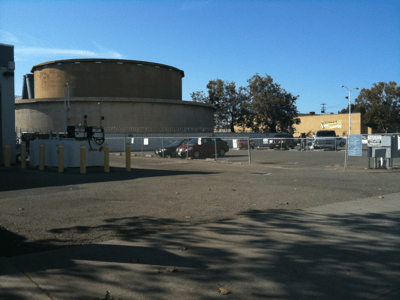
The tank in the upper left of this picture doesn’t hold water. It holds oil for the plant. Nasty, potentially flammable stuff. The plant itself is not operational 24/7, it’s meant to provide peak-demand power when needed. Oakland Power Plant spans 3 blocks and is owned by Houston-based Dynegy, along with the plant in Moss Landing.

The CA Public Utilities Commission and the Port of Oakland have occasionally gotten into skirmishes about the plant. There’s no denying the importance of a piece of power infrastructure like this, but the Port has resisted attempts by past owners to expand the plant. An audit performed two years ago (warning: PDF) by the CPUC revealed instances of lax training and emergency preparedness, though nothing was deemed dangerous within the scope of the plant’s operation.

I’ve been told that with Matson’s long-term deal with the Port, it’s nearly impossible to relocate them. The City has been mum on a specific site in the area, but given the circumstances it may be better to focus on other land nearby. Which is too bad, imagine the building below as part of a majestic concrete/masonry ballpark façade. (It’s part of the power plant.)

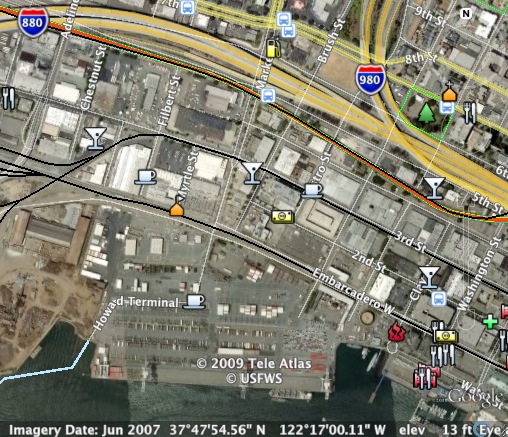
So where to focus? The best place may be the area north of Howard Terminal and the power plant, bounded by the BART tracks/5th Ave on the north, MLK to the east, 2nd St to the south, and Market/Brush Sts to the west.

No, it’s not on the waterfront. It does have a nice view of Downtown Oakland. It’s also a shorter distance to the 12th St BART station, just over 1/2 mile as opposed to 3/4 mile from the station to Howard Terminal. Admittedly, it would be strange to have BART running right past the place even though there wouldn’t necessarily be a co-located station. Fortunately, there is some vacant land that would be perfect for station portals if all parties could get it together. Just as important, it’s a shorter stumble to-and-from The Trappist.

Most importantly, land deals would be done with individual private landowners, not the Port. Port land is really City land, but that doesn’t make it any easier to do a deal given the politics involved. We’re talking about 5-6 blocks, the same amount as Diridon South.

Is this doable? I have no idea. I’m just as in-the-dark about actual proposals emanating from Oakland as many of you.