Dickey and Wolff duke it out in the media

A week ago Glenn Dickey wrote this in the Examiner, among several assertions:

In late 1992, just before he stepped down as head of the group trying to buy the Giants from Lurie, Walter Shorenstein told me there would be two conditions in the new contract: 1) The Giants would have to get a new park within 10 years; 2) The Giants would then have territorial rights to all the counties down the Peninsula and into San Jose. They were looking at Silicon Valley, of course, and money from that area helped build the park.

Well, I guess we can rest assured that the late Walter Shorenstein took that to his grave. If that’s true, why did Shorenstein split from the Giants ownership because he didn’t feel that a privately financed ballpark concept would work out? Did Shorenstein get cold feet?

In any case, A’s ownership would’ve been best served not responding to Dickey, since who reads Dickey or the Examiner anyway? Yet they did. Maybe Lew Wolff felt the need to respond. Maybe PR man Bob Rose was spoiling for a fight. Here’s today’s full press release refuting Dickey:

Setting the record straight: our position

OAKLAND, CA-On March 11, San Francisco Examiner sports columnist Glenn Dickey wrote an article about Oakland A’s Owner and Managing Partner Lew Wolff entitled “A’s Owner Wolff standing in the Way of a New Stadium.” The column featured numerous and un-resourced inaccuracies that need to be clarified.For the record:

  • The Oakland A’s have paid rent to play their games at O.co Coliseum and will continue to pay rent under the current new two-year agreement with the Joint Powers Authority. The A’s are also the only team playing at the O.co Coliseum that directly pays for day of game police protection.
  • The team continues to negotiate with the JPA about a 10-year extension to continue to play at the Coliseum.   Under such an arrangement, the A’s would continue to pay rent and has offered to pay for over $10 million in major improvements to the venue including two HD video scoreboards and LED ribbon boards.
  • It is not “urban legend” that Walter Haas granted territorial rights to Giants owner Bob Lurie so he could explore possibilities in the South Bay.   It is fact and Major League Baseball or the A’s would have confirmed that if either would have been asked.
  • Mr. Wolff did not create “artificial attendance reduction” by tarping off seats in the upper deck of the Coliseum. As a point of reference, the average attendance at the Coliseum in the 10 seasons before the tarps were installed was 21,872-capacity with the tarps installed is 35,067. Attendance in 2013 averaged 22,337. On several occasions, Mr. Wolff has said the team will remove the tarps if there is consistent ticket demand that justifies it. In fact, the team did remove the tarps during the 2013 postseason once ticket sales indicated the need for a larger capacity. However, the smaller capacity with tarps has clearly created a more intimate and exciting atmosphere at the Coliseum, as noted by many of our players, media and fans.

Not sure why Dickey calls the T-rights deal an urban legend. Selig acknowledged it. As I wrote two years ago, when everyone got confused over the history of the Bay Area’s T-rights:

If Bob Lurie had not gone after the South Bay, he wouldn’t have been granted the rights by Wally Haas. After Lurie struck out in SF for the last time and threatened to move to Tampa Bay, Magowan/Shorenstein swooped in to save the Giants. Would Magowan have asked for rights to the South Bay in 1993-96 in order to finance AT&T Park, knowing that he wasn’t actually going to build there but rather in downtown SF?

Remember that in the mid-90’s, the Internet as we know it today did not exist.

As for the stadium negotiations, Wolff is willing to sign a pretty long deal, as long as the A’s aren’t locked in if the Raiders take over the Coliseum complex. That’s only fair, since Wolff needs to have some control over where the team plays. Besides, history shows that Oakland/Alameda County/JPA have bent over for the Raiders, screwing the A’s in the process. The JPA is in the position to do it to the A’s all over again.

Interestingly, there are rumors emanating from the Coliseum that Coliseum City may be too expensive to pull off for the Raiders alone, forget the multi-team/multi-venue dream project. Hmmm

Still, best to avoid Dickey and his rants.
San Jose Muni as a temporary ballpark? Come on, now

The Merc and NBC Bay Area are reporting that San Jose Municipal Stadium is being considered as a temporary ballpark site should the A’s not get a lease extension past 2015.

The idea makes zero sense.

At 4,200 seats, Muni is far too small to work as a temp park. There’s not enough space behind the old grandstand to build the extra seats and a new press box that MLB would require. Even the area beyond the outfield is limited, so little seating could be built there. Muni is set up so that the clubhouses are on the same level as the single concourse, requiring the park to be quickly emptied of fans after every game. The lack of parking and public transit at the site would make it a logistical nightmare for daily 20,000-person crowds.

About the only thing Muni has going for it is that it’s a baseball field with some seats around it. That’s not the expensive part. It’s everything else (additional seats, suites, infrastructure) that’s expensive.

Using Muni makes even less sense when you consider that the City of San Jose inked its own five-year extension with the San Jose Giants only two months ago. While the lease is quite cheap at $25,000 per year, naming rights to Muni are involved and the fact is that the City would have to break the lease to accommodate the A’s.

I understand that Lew Wolff will look at a number of sites and facilities to get a feel for what’s possible. A temporary ballpark at San Jose Muni is more than a little far-fetched.

—–

P.S. – Candlestick Park was also reported to be in the discussion, but demolition is expected later this year.

Why a temporary ballpark is a distinct possibility

Lew Wolff brought up the the idea of a temporary stadium to the SV/SJ Business Journal’s Greg Baumann this week. Wolff looks at the concept as potentially necessary if another extension at the Coliseum can’t work out. He had already expressed concern when MLB pushed the Coliseum Authority (JPA) into a two-year extension through 2015. The thinking in November was that no new permanent home could be built in that two-year span, and if Coliseum City’s phasing and the Raider owner Mark Davis’s preference of building on top of the current Coliseum footprint take hold, the A’s would no longer have a place to play. Combine that with Larry Baer’s comments about allowing the A’s to play at AT&T Park while an Oakland solution was being hammered out, and you can see all of the moving pieces and the complexity therein. Because of that complexity, let’s break the situation down into its basic components.

To start off, there’s the Raiders. The Raiders are the first domino here, because they are the team in some sort of negotiation with Oakland and the JPA. Even though Davis has labeled the talks as discouraging recently, reports coming out of the Coliseum City partnership should bring everyone back to the table in the next month or so. Then Davis can decide how to move forward: either partner in Coliseum City, or decide that CC doesn’t pencil out and look elsewhere. So far Davis has stuck with the idea that the Coliseum is the #1 site. That could change quickly as the numbers are released and parties have to make fiduciary commitments.

The A’s can’t do anything without the Raiders’ move. As much as Oakland waterfront ballpark proponents would love for Howard Terminal to become the apple of Wolff’s eye, the many questions and doubts that hang over the site continue to make HT a nonstarter for Wolff. Coliseum City had the A’s in a new ballpark no earlier than 2022, unacceptable terms for Wolff and MLB. However, if CC falls apart for the Raiders and Colony Capital, the Raiders could leave for Santa Clara, LA, or elsewhere. Wolff could easily call for CC to dissolve and put together a development plan of his own at the Coliseum, one that he would control. It could make room for the Raiders as well, but the football team would end up on the back burner, not the A’s. If Davis were to stay for several years at Levi’s Stadium while gathering up the resources to build anew in Oakland, such phasing could work out. Then again, the Jets spent nearly two decades “temporarily” at the Meadowlands while not working out any new stadium deal in the five boroughs of New York City.

Next, this idea isn’t new. Wolff floated the temporary venue concept in 2012, when he initially tried to get a lease extension. Wolff has reason not to go down such a path due to the expense and amount of upheaval. Should lease talks once again turn difficult, a temporary move becomes more a value proposition than a logistical problem.

If the JPA couldn’t come to an agreement on a new ballpark with Wolff – say, for instance, the JPA chose not to eat the $100 million left in Mt. Davis debt – Wolff would likely go back to MLB and again ask for a decision on San Jose. San Jose brings about one of two temporary ballpark scenarios. The first comes if the A’s are left homeless after 2015 and MLB somehow allows the move south. That’s a long shot at best, but can’t be completed discounted. In this case a temporary ballpark would have to be built somewhere in San Jose for 2-3 years minimum while Cisco Field was being built at Diridon. Besides the process of getting league approval, a temporary site would have to be found. In the Bizjournals article, San Jose Mayor Chuck Reed claimed that multiple temporary sites were available. In all practicality, there are probably only two sites. Many of the previously studied permeant ballpark site candidates are either in the process of being redeveloped (Berryessa, North San Pedro) or face logistical hurdles that make it difficult to ensure that 20-30,000 people could make it in and out easily (SJ Fairgrounds, Reed & Graham cement plant).

Instead, there will probably two or three sites in play: the old San Jose Water Company site near SAP Center (site owned by Adobe), the spare parking lot south of SJ Police headquarters between Mission and Taylor Streets (a.k.a. the Cirque du Soleil lot), or the land adjacent to the under construction Earthquakes Stadium (under control by another developer). The SJWC/Adobe site would be the easiest to convert for a ballpark, is the right size, and has an existing building that could be leveraged for ballpark use. It’s also directly underneath a San Jose Airport landing approach, which could cause red flags by the FAA. The Cirque lot is smallish, though large enough for a small ballpark. There’s lots of parking nearby, and potential makeshift parking on the other side of the Guadalupe River. Light rail is only 2 blocks away. As for the Earthquakes Stadium-adjacent site, there were enough problems getting it prepped for that project that it should give pause to anyone considering even a temporary ballpark there.

That’s not to say that San Jose is the only place for a temporary ballpark. Wolff was quoted as looking at the entire Bay Area:

“I am hopeful of expanding our lease at the Oakland Coliseum for an extended term. If we cannot accomplish a lease extension, I hope to have an interim place to play in the Bay Area or in the area that reaches our television and radio fans — either in an existing venue or in the erection of a temporary venue that we have asked our soccer stadium architect (360 Architecture) to explore. Looking outside the Bay Area and our media market is an undesirable option to our ownership at this time.”

The East Bay is in play for both temporary (if needed) and permanent venues. MLB won’t hand over the South Bay to Wolff, yet MLB has also allowed Wolff to enter agreements with San Jose, so it’s clear that MLB is hedging big time. A temporary ballpark could be built on the old Malibu/HomeBase lots near the Coliseum, in Fremont, or even Dublin or Concord. Fremont’s Warm Springs location could enter the discussion again because the Warm Springs extension is scheduled to open in 2015.

It’s also possible to read into Wolff’s statement the possibility of the A’s playing at Raley Field on a temporary basis, since his description of “area that reaches our television and radio fans” covers CSN California and the A’s Radio Network.

Warm Springs could be in play because CEQA laws that govern environmental review largely don’t affect temporary facilities. Generally, seasonal installations such as carnivals or circuses that don’t create any permanent environmental impact are exempt from CEQA. The challenge, then, is to create a temporary ballpark that can also fit this model. That would be tough because of the large-scale consumption of water, food, and energy during a single game. Still, the A’s are already familiar with major recycling efforts, and if trash can be properly contained there should be little permanent impact. Just as important, Warm Springs remains within the established territory, so MLB wouldn’t have to negotiate anything with the Giants. Finally, if the experience is positive it could provide enough political goodwill to convince Fremont to again consider being a permanent home.

Strategically, the Baer vs. Wolff war of words (what happened to the gag order?) has only gotten more interesting. Baer’s statement is cajoling Oakland, not Wolff, to get its act together. Wolff’s response is to say that the A’s don’t need the Giants’ help, especially if he can get San Jose. Keep in mind that if Oakland fails, the East Bay as a territory loses value, hurting Baer’s argument and supporting Wolff’s. What’s left is for both rich guys to let the processes in Oakland and in the courts play out, and prepare for next steps. At some point, the leagues are going to ask Oakland to either step up or step out ($$$). While some local media types continue to believe that the teams can carry on indefinitely at the Coliseum, at some point the conflicts become too great to bear. For those of us who have been following this saga for so long, it’s good to know that actions are being taken to make new homes for the teams. Even if one of those homes is temporary.

Baer says he’s willing to let the A’s share AT&T with the Giants – with a catch

Giants President/CEO Larry Baer slipped a rather shocking note into the festivities surrounding the spring training opener, when he said that he’d be willing to allow the A’s to play temporarily at AT&T Park.

Of course, there are conditions. From Merc scribe Alex Pavlovic’s article:

“They’ve got to come up with a long-term plan. Once that’s arrived at, then maybe you’ll take a step back and say, ‘Is there something we can do to be helpful?’ As a neighborly thing.

“Obviously, they’ve got to come up with what their plan is and we’ll go from there.”

The A’s have a long-term plan, but that’s in San Jose, the city that Baer is loathe to give up. That means that Baer is perfectly willing to be neighborly, as long as the A’s stay in Oakland.

If you want to read between the lines, you can consider this a memo to Oakland ballpark backers to get off their asses and get something done. He’s willing to be neighborly, up to a point. He’s willing to appear magnanimous in his willingness to share the jewel at China Basin, up to a point. As long as there’s some motion towards a ballpark in Oakland, it helps Baer’s cause.

Strategically, it’s easy to see why Baer is going this route. Now that the Giants have practically paid off their ballpark, they need another rationale for preserving the split territorial rights regime currently in place. They can talk about protecting their fan base in the South Bay, but frankly, the issue is Oakland. Simply put, can a ballpark be built in Oakland? If it can – and it pencils out for the A’s financially – then the current T-rights scheme can remain in place, whether Lew Wolff and John Fisher are the owners or someone else takes their place. If Oakland can’t be done, which Wolff has been arguing, the East Bay itself is done, and MLB will be forced to consider an alternative method of drawing up territories. Immediately that means the South Bay is the only other place in the Bay Area, with Wolff preferring that as opposed to leaving altogether, which Baer has hinted in the past he’d be okay with.

Baer’s little nudge should provide motivation for Oakland boosters, though Baer can’t make it easier to build in Oakland. Nor is it likely that the Giants will help Oakland out monetarily. News coming out of Raiders camp can’t be encouraging, as Raiders owner Mark Davis indicates that nothing is happening with Coliseum City, at least as he sees it. Davis characterized Coliseum City as perhaps Oakland’s last chance to keep the Raiders. By NFL rules, Davis has to make a good faith effort to keep the team in its current market, and Davis has certainly done that so far. If Coliseum City breaks down, the Raiders could leave for LA as early as a year from now, and Roger Goodell can’t say much about it. Sure, the NFL holds the purse strings, but by that point they’ll know full well the challenges of building a stadium in Oakland as much as LA. Like the A’s situation, if it doesn’t pencil out in Oakland, there may not be an East Bay alternative. Already he’s backing away from the Concord Naval Weapons Station and Dublin’s Camp Parks, which makes me wonder if he’s only feigning interest in those sites in order to appear thorough.

Davis also referred to the impact of the Oakland mayoral race, indicating that developers wouldn’t get off the fence until after the election. That runs counter to the idea that the various mayoral candidates could make Coliseum City progress by stumping for it along the way. The project has its own schedule and milestones, with the next big one, the Market Data Analysis, due in March. By spring we’re supposed to find out how feasible Coliseum City is, and by summer teams are supposed to be signed on to be partners – at least according to Mayor Jean Quan. Movement will come from making the numbers work, not magic. Davis is not the only person to wonder what exactly is happening with Coliseum City. We’re going through these phases with CC, where some small amount of progress happens, followed by a huge informational vacuum, then a sobering dose of reality, and then another small step forward. Eventually that cycle will be replaced by real discussions, actual reports, and true political and financial support (or a lack of it).

Going back to the Giants and Baer, I suppose that since he’s offering his place as a 1-2 year airbnb stint for the A’s, we can start talking about what that would look like. That’s for another day. For now, it makes the most sense to focus on Oakland. In the near term, that’s where the only future for the Raiders and A’s lies.

Rams owner Kroenke buys SoCal land, sparking relocation talk

Sam Farmer of the LA Times reported late today that Rams owner Stan Kroenke has purchased a 60-acre parking lot situated between The Forum and Hollywood Park in Inglewood.

Farmer lays out the myriad complications that could arise if Kroenke tried to move the Rams back to Los Angeles. While 60 acres in hand is always good to have, there’s still the question of who would pick up the tab for the $1 billion or more in construction cost. The NFL has had a tepid response to two other NFL stadium initiatives by AEG (Farmers Field) and Majestic Realty (City of Industry), mainly because both developers have wanted stakes in prospective relocating franchises. In the Rams’ case, Kroenke could build it himself with the NFL’s help, though public funding in Inglewood is a nonstarter. It would take an enormous amount of corporate and upfront support to make it work, a recipe that yielded great results for the 49ers. That shouldn’t be an issue in a market the size of LA, but the market is a notoriously fickle place when it comes to pro football. Kroenke could even run into interference from the likes of USC and UCLA, who have the local football landscape to themselves with no pro team as competition.

Speculation about Kroenke’s intentions with the Inglewood land could amount to nothing, as he has substantial holdings throughout SoCal and these 60 acres could by ripe for a shopping center, housing, or other non-sports uses. More plausible is the idea that Kroenke could use the land as leverage to extract the maximum amount of concessions from the State of Missouri and the City of St. Louis, the latter party having already lost an arbitration case over planned improvements to Edward Jones Dome.

The Raiders and Chargers will look at Kroenke’s moves with some interest, as LA remains a potential relocation target for them. Both teams’ owners have prioritized staying in Oakland and San Diego, respectively, but interest from LA remains a phone call or meeting away. It might make the most sense for two relocated teams to share one stadium from a financial standpoint. Such a plan is problematic in execution, as exhibited in the sterile environment at MetLife Stadium. If Kroenke were to declare a move and get sign off from the NFL’s owners, he’d have to play at the LA Coliseum or Rose Bowl for at least a few years while the EIR process and construction were completed.

Land acquisition should put more pressure on Missouri/St. Louis to act. The benchmark there is $375 million provided by Jackson County for improvements to Arrowhead Stadium. That’s well short of the $700 million in improvements the Rams are entitled to as part of their arbitration win. Any team that wishes to relocate has a league-imposed deadline of mid-February each year to declare their intentions. Last year, all three relocation candidates chose to stay. With land in hand, the Rams are for now the best positioned to move.

New Howard Terminal ballpark group pushes for site lease/ENA

Finally.

We may finally have some deadlines. We may have a framework from which important questions can be answered. We may finally find out if Howard Terminal makes sense once and for all.

A group calling itself Oakland Waterfront Ballpark L.L.C. sent a letter to the Port of Oakland last week, asking for an exclusive negotiating agreement (ENA) for Howard Terminal. The ENA would run up to 12 months, allowing OWB to negotiate a long-term ground lease for Howard Terminal. A second period would be used to obtain permits from the City, Bay Conservation Development Commission (BCDC), and State Lands Commission (SLC) as needed. That time would also be used for the environmental studies (EIR, others) that would be required to secure such permits. After that’s done, the actual ground lease would be exercised, potentially leading to the construction of a ballpark on the site – pending club and league approvals and buy-in.

OWB is made up of mostly familiar faces: Clorox CEO Don Knauss, former Dreyer’s CEO T. Gary Rogers, Signature Properties principal Mike Ghielmetti, Baseball Oakland leader Doug Boxer, and a new entrant, developer Seth Hamalian. Hamalian’s planning a high-rise residential building in Uptown.

Howard Terminal’s still in a state of evaluation by the Port, as the Port is considering three other bidders for short-term use as longtime operator SSA departs for Middle Harbor. A group assembled by the Port to study future uses will not complete its work until the end of this quarter at the very least, and the Port is bound by the SLC to ensure that the land is used for maritime purposes as long as possible. A ruling in favor of OWB would help pave the way for a non-maritime use such as a ballpark. It’s possible that maritime uses could be arranged as a temporary use while the details of the ballpark plan are worked out.

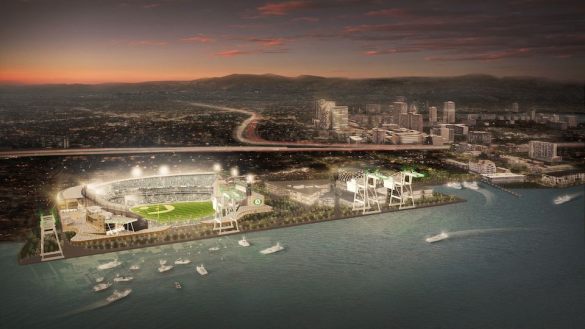
HowardTerminal2a

Rendering of a new A’s ballpark at Howard Terminal

A key item in the letter is the notion that OWB could come in at any time do testing of soil or groundwater at the site. While that’s good, that’s really only a continuation of monitoring that’s already in place by law. The big issue is what happens to the site as it’s modified to accommodate a ballpark (and ancillary development). That includes potential cleanup or contamination that may occur with a breach of the asphalt cap at Howard Terminal.

OWB would be obligated to deposit $50,000 with the Port for the original six-month ENA, with another $50,000 due if a six-month extension is required. If they two sides can’t come to an agreement on the ground lease, the deposit is refundable. OWB would have the right to assign the ENA to current or future A’s ownership if they came around to liking the site.

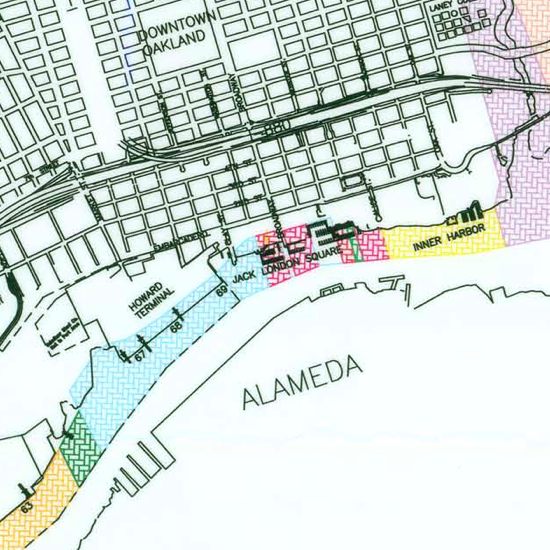
Oakland Mayor Jean Quan, for her part, keeps pushing an idea that zoning should be easy at Howard Terminal because the site was considered for a convention center long ago. It’s a strange claim, we’ll see how well it holds up. At least OWB acknowledges the roles of the BCDC and SLC. Those two bodies are going to impact the scope and final approval on the project, there’s no way getting around it. Among the matters to resolve: Where is the shoreline technically and how close to the shoreline can they build?

tidelands_downtown

Map of Tidelands Trust areas where development is highly restricted

One thing missing from the KTVU and EBX links above is the ever-persistent question of cost. Cost sank Victory Court before ($240 million), and it threatens to sink Howard Terminal. 2001’s HOK study had Howard Terminal’s site cost at $177 million, and that was without any new transit infrastructure such as a nearby infill BART station or a streetcar to bring fans from existing BART stations downtown. A 2004 Caltrans feasibility study commissioned to investigate such options estimated that a new BART station along the West Oakland alignment between Market and Filbert Streets would cost $250-300 million, and that other options at Brush/Castro or Washington Streets were not doable due to the incline of the track, more than the 1% grade required for BART platforms.

Neither OWB nor Oakland has to start a feasibility study or an EIR until the ground lease with the Port is worked out, which is a shame because we’ve been wanting to know the cost for many years. There’s absolutely no reason why such work couldn’t start today, as long as one party budgeted money for it. It’s a chance to delay the reveal until circumstances force a decision, which is the way the mayor’s painting the situation. Quan mentioned on KTVU that the Raiders’ stadium deal at the Coliseum could be done by the summer. That assumes that everything goes well, including the all important determination of how to bridge Coliseum City’s funding gap. The adult conversation comes with many steps. This is a big step.

The stage shifts in 2014

As we bring on a new year and a new baseball season, let’s reflect on the rather tumultuous year that was 2013.

  • January – FanFest was a great event again, though the cramped concourses at Oracle Arena had many fans wishing for the event to be held at the Coliseum instead.
  • The Coliseum Authority raided scoreboard funds to pay for the ongoing Coliseum Study.
  • February – Oakland officials were forced to apologize to A’s owner Lew Wolff for misplacing a letter requesting further lease extension talks.
  • March – The City of Mesa, AZ, approved a renovation plan and 20-year lease for Hohokam Stadium that will bring the A’s over from their longtime spring home, Phoenix Municipal Stadium. 2014 will be the last year at Muni for the A’s, after which the stadium will be home to the ASU Sun Devils. The Cubs, who vacated Hohokam after 2013, are moving to their own mega-complex on the west side of Mesa.
  • San Jose was dealt the first of a series of setbacks when the state rolled back the City’s transfer of the Diridon ballpark site to the Diridon Development Authority. Eventually the City and Santa Clara County worked out the details of a deal, though it remains up in the air for now. In addition, a request to disqualify the Stand for San Jose lawsuit failed.
  • April/May – Kevin Johnson rallied Sacramento and Bay Area interests to put together an ownership group that eventually bought the NBA Kings from the Maloof family.
  • SAP takes over for HP as naming rights sponsor of San Jose’s Arena. Most fans continue to call the building The Shark Tank.
  • The Giants refinance the remaining debt at AT&T Park (originally due to be paid off in 2017) in order to provide funds for their own project in the parking lot across McCovey Cove from the ballpark.
  • Oakland Fan Pledge kicks off a campaign to build a list of fans willing to buy  season tickets (and in some cases PSLs) at a new A’s ballpark in Oakland. Currently there are just over 5,000 pledges.
  • Levi’s Stadium and the 49ers are awarded Super Bowl L in 2016. While the game will take place in the new stadium in Santa Clara, most of the other festivities will take place in San Francisco at venues like Moscone Center.
  • June – San Jose files an antitrust lawsuit against MLB, alleging that the league’s stalling is costing the City tax revenues.
  • A settlement between Howard Terminal operator SSA and the Port of Oakland could help clear the way for a ballpark on the waterfront site. Site proponents call this move “site control.” The Port was also motivated to get rid of an expensive, ongoing lawsuit by SSA over more favorable lease terms given to a nearby rival operator.
  • A sewer main at the Coliseum is clogged, causing sewage to overflow the clubhouse level and requiring the teams to use the Raiders’ facilities (up one level). Eventually a towel or piece of clothing is found to be the culprit.
  • July – A feasibility study for Coliseum City outlines the funding gap (now $400-500 million) that needs to be bridged for a new stadium, along with an explanation of the economic weaknesses of the East Bay market.
  • The Earthquakes’ stadium is further delayed (until 2015) when numerous underground bunkers are found and need to be demolished before building anew. Erection of the stadium bowl would begin in late December.
  • August – Raiders owner Mark Davis starts crowing for a long lease extension at the Coliseum, with the condition that the extension comes with a replacement to the Coliseum, preferably on the same site as the current stadium.
  • MLB and the San Jose make filings in anticipation of an October hearing in their antitrust lawsuit.
  • September – Lew Wolff clarifies that he seeks a five-year lease after the current lease ends after the 2013 season, with flexibility to leave early if impacted by a Raiders stadium.
  • October – A federal judge throws out San Jose’s antitrust complaint against MLB, but allows the City an immediate appeal (Ninth Circuit) and for the state tort claims to continue. The state claims were also thrown out at the end of the year.
  • A private investor group headed by LA mega-hedge fund Colony Capital and Dubai’s HayaH Holdings signs on to be the financial muscle behind the Coliseum City development. The group, teamed up with architecture firm JRDV, is tasked with providing a series of deliverables that will determine the feasibility of the project.
  • Bloomberg estimates that the A’s are worth $590 million, a huge jump over Forbes’ preseason estimate of $468 million.
  • November – With talks between the A’s and the JPA at an impasse, MLB steps in and negotiates a two-year extension for the A’s, resolving an outstanding issue regarding parking taxes. The Raiders receive a one-year extension with a one-year team option, which they would presumably exercise if they saw sufficient progress on the stadium front.
  • December – The Oakland City Council and Alameda County Board of Supervisors hold their first joint session to discuss the pros and cons of Coliseum City. The Supes claim that the City has dragged the County along, and the County has not been sufficiently involved in the process.
  • A court filing in the antitrust case states that MLB denied the A’s proposal to move to San Jose in June, just before the lawsuit was filed. MLB is unwilling to disclose the contents of the rejection letter. Sources inside baseball indicate that the A’s proposal, not the City of San Jose, was denied, opening the door to another proposal that MLB could conceivably accept.
  • Renderings of the Howard Terminal ballpark are released. It appears that the vision would try to avoid the BCDC’s jurisdiction by placing the footprint sufficiently inland. It is unclear if such a move will work. Normal CEQA issues remain, and proper environmental review has not started yet. Meanwhile, the Port solicits bids for use at the vacated terminal per state law.

What can we expect in 2014? A lot of follow-up to many of the issues above. Lawsuits will continue, and short-term leases only kick the can down the road. With the leases temporarily out of the way, 2014 is the year of the election. Both Oakland and San Jose have mayoral races this year. Oakland Mayor Jean Quan finds herself at the top of a list of five declared candidates. The race to replace San Jose Mayor Chuck Reed will also be hot and heavy, with several current council members facing off against a former councilman and current county supervisor. We should expect to see some serious progress on Coliseum City’s feasibility, as several project deliverables are due in the first half of the year. Oakland partisans will continue to flog Wolff, while San Jose partisans flog Mayor Quan. 2014 is also Commissioner Bud Selig’s last full year in his job. The search for his replacement could be interesting, though the favorite is currently COO and longtime MLB exec Rob Manfred. Movement on the antitrust lawsuit is not expected until the spring, and the “forgotten” Stand for San Jose lawsuit continues its machinations. All in all it looks to be a very newsworthy year. Will attendance continue to grow? Will it be an eventful 2014? That depends on whether anything gets resolved. This site has been running for nearly nine years. The stadium situation has never looked more muddled, with no end in sight. Something’s gotta give, right? Right?

The Solomonesque solution that thankfully never happened

When the latest Matier and Ross column featuring Coliseum City and the A’s dropped over the weekend, I wasn’t sure if I should follow-up right away or wait for the proverbial other shoe to drop. Drop it did, with a press release coming from the A’s early today. Frankly, I don’t know what to make of any of it. BayIG (the combined investor/developer group) was supposed to contact the A’s starting in mid-November. Now it’s all a bunch of he-said/she-said. It’s all meaningless in the grand scheme of things, so I won’t bother wasting anymore words on it.

Instead I’ll reference a nightmare scenario that happened almost 40 years ago. It involves a Charlie Finley anecdote that I hadn’t fully heard until I read his 2010 biography some time ago. In the late 70’s, Finley was fighting a personal two-front war, an acrimonious divorce on one side and skyrocketing salaries that threatened his ability to operate the A’s on the other. (He also had other feuds with MLB Commissioner Bowie Kuhn, the Coliseum Commission and numerous players and agents, but I digress.) Knowing his time in baseball was running out, Finley chose to put the team up for sale as soon as 1977. Numerous suitors surfaced, some offering to keep the team in Oakland and other looking to move the franchise out at the end of the 1977 season. The most famous buyer was oil billionaire Marvin Davis, whose family was said to be the model for the soap opera Dynasty. Davis also owned the 20th Century Fox studio for some time before selling it to some Australian named Rupert Murdoch.

The difficult part of the move was the generally ironclad lease the Coliseum had with the A’s. It was a 20-year term, with an expensive buyout if the A’s left. As the Coliseum filed a $35 million lawsuit against Finley, Finley worked with Kuhn and Giants owner Bob Lurie to figure out a solution. Wait, what did Bob Lurie have to do with this?

Kuhn had been convinced that, with both teams showing poor attendance, the Bay Area was only a one-team market. He spoke to pols in both San Francisco and Oakland to work on a compromise, but in the end the Bay Area would be left with only one team. Previously, Lurie had bought the team from Horace Stoneham, saving SF from the prospect of moving the Giants to Toronto. Lurie was brought into the talks to figure out what role the Giants would have in a one-team Bay Area.

The solution, as architected by Kuhn and others before the 1978 season, would’ve been to have the A’s sold to Marvin Davis, which would’ve gotten rid of Kuhn’s nemesis Finley. Then in order to compromise on the Coliseum lease, the Giants would’ve played some number of games at the Coliseum, 25-40 depending on how the final deal was drawn up. In San Francisco the team would’ve been called the San Francisco Giants, while in Oakland the team would’ve been called simply the Giants. Kuhn recalled:

For the next three weeks, the politicians, the baseball administration and the lawyers struggled to find solutions. At last, amazingly, parity was agreed to. The team name would be the San Francisco Giants except in Oakland, where it would be the Giants. Financial payments to the Oakland Coliseum were set at $3.25 million. The internal fight within baseball was difficult when Finley would put up no more than $1 million as his share of the Coliseum payment. Even that we were able to persuade the clubs to accept. But, when we asked him [Finley] to waive claims of any kind against baseball, he balked.

Even though Finley was leaving baseball – forever – he still wanted to keep his right to sue just in case he felt he got ripped off. Finley was no stranger to courtrooms, so this could be expected. Still, you’d think that after all that work (and his building desperation) he would’ve waived that one right in order to finish the deal. The sale fell apart and Finley went into full fire sale mode, finally selling the team to the Haas family in 1980.

Consider the ramifications:

  • The Giants would’ve become the San Francisco Giants/Giants, probably playing most of the Oakland games before football season.
  • The buyout would’ve funded improvements to the Coliseum that Al Davis was seeking, improvements that probably would’ve kept the Raiders in Oakland.
  • From that point forward, the Bay Area would’ve been a one-team town, with a young, growing city like San Jose pursuing an expansion franchise.
  • Eventually, the team-sharing situation would’ve created a race between SF and Oakland to build a permanent home when leases at both Candlestick Park and the Coliseum expired in the late 80’s. Territorial rights would’ve included the “BART counties” plus Marin County.
  • Rickey Henderson, who was drafted in 1976, would’ve spent much of his career in Denver. The same could be said of Tony Armas and Dwayne Murphy, among others. Marvin Davis had the money to bolster the team’s payroll, so the chances of keeping a talented young team intact were very good.

So this Christmas, thank the ghost of Charlie Finley for being so selfish that he had to be able to sue – just in case. Without that, the Oakland Athletics would’ve been a 10 year experiment, a blip on the radar, an historical anomaly.

(h/t Rob Neyer, who referenced the near-sale when the A’s-to-China Basin reports surfaced. I didn’t see his post until after I finished this one.)

Reaction time

It would be silly to devote a post to every single new tidbit that comes out, so I’ll do one of those rare newswraps here.

  • The East Bay Express’s Robert Gammon reported that the previous group showing interest in buying the A’s (Don Knauss, Doug Boxer, Mike Ghielmetti) is back again talking up buying the franchise. This time, they’re not alone. There could be up to three groups, including one fronted by Warriors owners Joe Lacob and Peter Guber. Lacob and Guber were previously associated with the Dolich-Piccinini group in 2001. Lew Wolff continues to maintain that the team is not for sale.
  • Bill Shaikin of the LA Times partly shot down the Warriors connection when he contacted Guber, who said unequivocally that he’s not interested in the A’s. Lacob and others may be interested, though Lacob is not commenting at the moment.
  • BANG’s Marcus Thompson wrote a quite stirring column asking Oakland to act now to save the A’s in Oakland. Thompson also asked many of the important questions about both Howard Terminal and Coliseum City that currently have no answers.
  • SFGate has a new editorial imploring MLB to make a decision, once and for all. In the column is a quote from Wolff claiming that Howard Terminal’s cost would be more than $1 billion.

Pretty heavy news day, huh? Well, not according to KCBS’s Doug Sovern.

Is there actual news to report? Why yes there is!

  • The FCC is moving forward with its proposal to eliminate TV blackouts of sports broadcasts. The proposal mainly targets NFL games, so naturally the NFL opposes it.
  • The 49ers struck a partnership with fellow Santa Clara resident Intel for a major sponsorship & technology deal. Intel will provide a great deal of tech infrastructure while taking control of the big northwest gate.

Finally, Bizjournal’s Nate Donato-Weinstein has been tracking the iStar development and has an update. If you’re not aware, iStar is a developer and land owner tied to the Earthquakes stadium project. While the stadium is going up west of San Jose Airport, the iStar land is in South San Jose’s Edenvale neighborhood. The plan was to take some of the proceeds of various development activities at iStar and funnel them towards the stadium. The numbers:

  • 260,000 square feet of office space
  • 150,000 square feet of retail
  • 720 housing units
  • $10 million would be funneled to the stadium

Those numbers are important because they can provide a comparison to what is being proposed at Coliseum City.

  • 837,000 square feet of office space
  • 265,000 square feet of retail
  • 837 housing units
  • 2 hotels comprising 478 units

iStar went through numerous struggles and iterations as the recession ravaged the real estate market. Now that things are on the rebound, projects like iStar are picking up again. It’s surprising that despite the fairly large scope of the project, only $10 million is being made available. That’s one-sixth one-seventh the $60 $70 million budget for the Earthquakes stadium. Now consider that Coliseum City, whose Area A phases cover comparable development plans (other than the much greater office space) over a very long timeline. How much could the development activity realistically provide? $50 million? $100 million? While revenue sharing formulas will probably be different, there is a practical limit before eating into profitability. The Raiders stadium will cost more than 15 times as much as the Earthquakes’ new digs. Bridging the gap is the foremost issue for these stadium initiatives. Without that puzzle solved, there really isn’t much else to talk about.

Wolff reconsiders the Coliseum – to what end?

If you want to know what I thought immediately when I heard that Lew Wolff is reconsidering the idea of building a ballpark at the Coliseum, well, Ray Ratto beat me to it.

If, on the other hand, you want to entertain the idea that Wolff is being forthright and sees the Coliseum as a real option, I have some ideas about that too.

But first, let’s step back to June 2012, and the Save Oakland Sports meeting I attended. As we were wrapping up, one of the SOS principals (used to be “A’s observer” in the comments) asked me, Do you think Lew Wolff would consider building in Oakland? My response was, Yes, but you have to make it worth his while. He’s trying to pay for a ballpark and make it pencil out, so if Oakland has some mechanisms to make that happen, I think he would be interested.

At the time I figured people would interpret that to mean cash or free ballpark. What I was suggesting was that if Oakland can figure out a way to bridge the gap between what makes San Jose so attractive (corporate interest) and Oakland’s limitations, there could be a solution in Oakland. Can Coliseum City bridge that gap? That’s the billion-dollar question.

Remember that when Wolff was first hired as VP of venue development, he pushed for a ballpark on the Malibu & HomeBase lots, the latter of which was not owned by the JPA. The JPA nixed Wolff’s idea and later bought the HomeBase lot for Coliseum City and the Raiders. Steve Schott preferred a ballpark – if in Oakland – to be in the north parking lot of the Coliseum. That idea was a nonstarter due to potential conflicts with the other tenant teams (Warriors, Raiders) and the area still stinging politically from the Mt. Davis debacle. When Wolff took over as managing partner, he first offered up his Coliseum North vision. The light industrial area includes the old drive-in/swap meet, the now-shuttered Columbo bakery, and several other small businesses. This concept also died quickly, as the City didn’t want to entertain the prospect of buying out businesses and the limited amounts Wolff was willing to offer to seal the deal.

Now there is Coliseum City, which could bridge the gap via third party investor funds. In effect this is a substitute for the normal public subsidy we so often see in the stadium game. The idea is to have Colony Capital and HayaH Holdings take care of some amount of the gap on their own. How much they will be willing to fund for one or more new venues will depend largely on the what forthcoming market study recommends for the project.

BayIG, the combined group of developers and capital, is supposed to have reached out to both the A’s and Warriors in attempts to get them to agree to be involved in Coliseum City. Until now both teams’ ownership groups have shown little interest in partnering with BayIG and the Raiders on Coliseum City as they’re pursuing their own venue plans in San Jose and San Francisco, respectively. However, there is a way I could see Lew Wolff showing interest in CC, especially as a potential funding mechanism.

That way occurs if Coliseum City isn’t feasible for the Raiders. Even though the Raiders are the anchor tenant, there’s a great chance that they’ll have to back out, simply because the costs of building their own stadium are prohibitive. Recently there was talk of a $400-500 million funding gap for the stadium, and with typical football-related sources potentially maxed out, it’s difficult to see how development alone would pay for a large portion. For instance:

Three phases of Coliseum City have ballpark built out at the end of the project

Three phases of Coliseum City have ballpark built out at the end of the project

Phase I doesn’t address any new sources of revenue to fund the project, except the possibility of selling Coliseum land (Property Transfer). Given the remaining debt on the Coliseum of $100 million (and dropping each year by 7-8%) and the cost of infrastructure, it’s likely that any proceeds from land sales would be wiped out by that combination of costs. It’s likely that BayIG and the JPA would work together to create a Community Facilities District (Mello-Roos) or Infrastructure Finance District, whose purpose is to collect various taxes to fund the project. CFDs require majority votes, whereas IFDs require two-thirds supermajority votes. In the case of the 49ers’ stadium plan, a CFD was approved by the public. Historically IFDs are tougher to put together and approve, though some legislators including State Assemblyman Bob Wieckowski (D-Fremont) have been making headway on that front. It’s not quite the new redevelopment as it’s limited to infrastructure, but it’s an important step.

Phase II provides for limited ancillary development next to the football stadium. It could raise a $1-2 million per year, depending on how money is extracted from the condo developments. Hypothetically, if each condo provided $100,000 of its sales price towards stadium construction, that’s still only $83.7 million. Chances are that asking for more than that would either make the units not salable or eat significantly into the developer’s profits.

If the Raiders stadium proves too costly, the A’s could easily slot right in with a much less expensive stadium option that has a much smaller funding gap, say $200-300 million. Plus with only one stadium there instead of two, there would be additional land to develop or reassign as needed. Wolff’s in a good position to wait and see how the market analyses work out for them and the Raiders. Numerous outcomes could be put forth:

  • Coliseum City works financially for all three teams
  • Coliseum City works financially for two of the three teams
  • Coliseum City works financially for only the Raiders
  • Coliseum City works financially for only the A’s
  • Coliseum City doesn’t work financially for any team

I’m sure there are specific benchmarks for each of these outcomes, but we’ll have to wait until April to understand what those are. The Warriors component is even fuzzier than for the A’s and Raiders, since the replacement would be built in Area B of Coliseum City across I-880. To date the arena has not been part of the identified planning phases.

For now, Wolff gets to provide the most tacit support to Coliseum City, while letting the chips fall where they may. If the plan doesn’t pencil out, which I suspect he believes, he’ll have the numbers to prove himself right and to shut his critics up. If it does work out, he’ll be in a good bargaining position to ask for some piece of the pie. BayIG is being asked to get teams to sign on by no later than next summer, so we’ll see if this has legs.

Of course, the last 1,100 words are only believable if you endorse the idea that Wolff is actually considering Oakland in any way. If not, you’ve just wasted a few minutes of your time. Get back to your building your Wolff effigies and altars.