The 2014 MLB TV Windfall

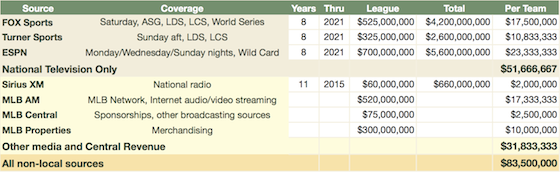
Today’s report from Sports Business Journal’s John Ourand indicates that MLB’s national television deals are just about locked in. We’ve discussed this a couple times now. I’ve done some rough math on it, and the financial picture looks even healthier than I previously projected. Sure, the TV deals will more than double in value, from $660 million to $1.55 billion. But it’s when that figure is coupled with all other sources of national revenue that the picture starts to really brighten.

Come 2014, every team could rake well over $80 million per year without selling a single ticket.

Come 2014, every team could rake well over $80 million per year without selling a single ticket.

The table above reflects rising revenues from every source except for Sirius XM, whose deal was locked in years ago with the money paid in advance. MLB Advanced Media, the internet and broadcasting subsidiary of MLB, admitted last year that it was hitting nearly $500 million in revenue just for 2010. Combine each team’s share with other non-TV sources (adjusted for inflation), and each team comes away with $31.8 million per year. All told, that’s an estimated $83.5 million per year.

That doesn’t even include the dividend each team ownership group gets as an equity partner in MLB AM.

Every team is going to get this windfall, so it’s not as if the A’s or Rays are getting some great competitive advantage. It will allow both teams to be able to confidently offer FA-competitive long-term deals to their own free agents, though $100 million payrolls are still probably beyond reach. To get $100 or $110 million payrolls, both teams will need new stadia. The impressive thing about these bumps is that the A’s will get $10-15 million more via Central Revenue than they get from playing in the Coliseum. Add in local TV/radio and the usual $30 million or so in annual revenue sharing, and the A’s should net $180-185 million per year starting in 2014. Not rich compared to the other teams, but a far cry from destitute.

News for 9/22/12

We’ll start with the lede, courtesy of CBS Sports’ Danny Knobler:

A’s owner Lew Wolff said Friday that he believes his team’s quest for a new ballpark will be settled within the next year.

Does that mean a new ballpark is about to rise in San Jose, Oakland or somewhere far away?

Not necessarily.

“I do think this long trek will be coming to an end,” Wolff said, in an interview with CBSSports.com. “I can’t predict the end.”

Wolff did suggest that he has no interest in either taking legal action or doing something that would lead to legal action from the Giants (who claim the San Jose territory). He also said he’s not interested in either selling the team or moving it out of the Bay Area.

“We’re going to persist in the Bay Area as long as we can,” he said. “It’s not a journey we’re going to cut short.”

Wolff’s latest statements he has indicate less confidence in the process that he has supported all this time. Maybe he has the same resolve as ever about San Jose, but the constant drag by the commissioner isn’t helping. Either way it appears that no outcome is certain. At least there will be an outcome, which is better than the team being in limbo as it has the last three years. One thing’s for certain: at least one group of people is going away from this mess extremely unhappy.

Update 10:52 AM – While in New York to catch part of the A’s current roadtrip, Wolff had a chance to explain further to the NY Times’ Tyler Kepner what he’s trying to build in San Jose. In addition to confirming that he and the rest of A’s ownership has the money to build a ballpark, Wolff also talked about how the high-tech concessions stands would work.

“All of our concession signs will be digital, so when you’re supposed to stop serving beer, you just press a button and it disappears,” Wolff said Friday over lunch at a Midtown Manhattan hotel. “And then if you have extra hot dogs, you can reduce the price.

“I mean, I’m being silly about it, but we’ve had plenty of years to think about this. It isn’t like all of a sudden we get approved and now we’ve got to start thinking about how our ballpark’s going to look. We’re really ready.”

Additionally, Buster Olney hears that Bud Selig is working the room to get enough votes to grant South Bay T-rights to the A’s. (via MLB Trade Rumors)

Other news:

  • The Angels denied a report that they were negotiating with Ed Roski’s Majestic Realty for the NFL stadium site in Industry. Whether the Angels were actually talking or not is moot. Industry is now a potential threat, albeit one that’s not very practical. The site had numerous challenges when the plan was for a 10 games-per-season NFL slate, 80-90 games would turn the hillside location into a second Dodger Stadium from a parking/circulation standpoint. The site, near the junction of CA-57 and CA-60, is also situated on a hillside that slopes down from southeast to northwest. That’s a poor orientation for siting a ballpark. [LA Times/Bill Shaikin]
  • El Paso’s City Council approved the $50 million AAA ballpark deal that could bring the Padres’ affiliate to town by 2014. The combination of rent, a ticket tax, and sworn parking revenues should bring in around $500,000 per year, not nearly enough to pay off the stadium on its own. The final say belongs with El Paso’s mayor, who will have until Thursday to approve or nix the deal. [El Paso Times/Cindy Ramirez]
  • After 10 years of abject failure, the “ballpark village” plan next to Busch Stadium is finally a go, thanks to million in subsidies coming from the State of MIssouri. [St. Louis Post-Dispatch/Elizabeth Crisp]
  • In case you haven’t heard, the NHL is in a lockout. [Yahoo Sports/Nicholas J. Cotsonika]
  • Barclays Center, the first major pro sports venue in Brooklyn since the Dodgers abandoned Ebbets Field, had its ribbon-cutting ceremony on Friday. {NY Times/Howard Beck]
  • Next Friday the 28th, the hearing to compel discovery in the Stand for San Jose vs. City of San Jose lawsuit will be held at 9 AM at Superior Court in downtown San Jose. I plan to observe.
  • Still awaiting the State Controller’s ruling on the legality of the Diridon land transfer.

That’s it for now.

AEG sale could drastically change stadium landscape

Reports started to flood in Tuesday night that billionaire Phil Anschutz was looking to offload AEG, his privately held entertainment and sports conglomerate. The LA Times asked industry experts, who said that the value of the AEG portfolio is around $5 billion. A Reuters article has bidding going up to $6 billion, and that doesn’t include Anchutz’s film studio, Walden Media.

The octopus that is AEG is divided into various overlapping divisions:

  • Sports  – 50% stake in LA Kings, minority share of LA Lakers, 50% of Houston Dynamo, 3 minor league hockey teams, interests in 3 European football and hockey clubs, a minority stake in Golden Boy Promotions, plus the Bay to Breakers, Tour of California, X Games, and other properties.
  • Facilities – Staples Center, Home Depot Center are wholly owned by AEG. The company operates over 100 venues that put on 6,200 events per year, including games for all four major North American pro sports. The list includes major convention centers such as LACC.
  • Live – The concert tour promotion division, with offices and venue control from coast to coast. It also oversees the Coachella and New Orleans Jazz festivals.
  • China – A self-contained subsidiary of AEG, it operates like a miniature version of the big company, within China.
  • Digital Media – Online production and broadcasting for big events

AEG works because it one division can leverage others to lock down deals. Staples Center hosts two teams that AEG owns, benefiting the company by virtue of publicity and revenue. The same model works for live music, where AEG controls booking for many venues and the tours that would fill them up. This sort of vertical integration makes it seem as if the best deal would for the whole shooting match to take advantage of that leverage. Yet there will be many bidders that will find individual pieces extremely attractive, such as the Kings or the venue management contracts. There’s also the issue of finding a single bidder or consortium (in all likelihood) that can put up $6 billion for everything. The bidding process will run well into 2013, and it will be fascinating to observe how all of it works. Some bidders might try to put up a lower overall bid because the transaction could be cleaner and easier to pull off. On the other hand, the total price of all the properties sold separately could eclipse the value of a single complete bid. Even if the whole company was purchased intact, if that bidder were a private equity firm it’s likely that there would be a strategy to part out the divisions in sooner rather than later.

Much of the immediate reaction to the news centered around the prospects of the Downtown LA football stadium. While many felt the stadium deal was in peril, Times columnist T.J. Simers fantasized that a new owner is just what’s needed to bring the Chargers north. LA mayor Antonio Villaraigarosa knew that the sale was coming and kept it quiet. His underlings expressed confidence that the deal would continue without Anschutz, whose purse strings and willingness to accept a minority share of a team were keys to attracting a team. Front man Tim Leiweke is still onboard for the moment, but someone else would have to represent the money needed to fund Farmers Field, which will cost well over $1 billion to construct. If AEG were parted out and sold piecemeal, the strength of the football stadium plan would be severely diminished since there’s no vertical integration to incentivize the effort (the stadium is also meant to be used as an extra large exhibit hall for LACC).

Teams currently in leases with AEG-operated venues are unlikely to see any significant changes. There is at least one other project that could be seriously impacted by an AEG sale: the Coliseum City development. When AEG signed on to manage the Coliseum complex, they also got a contract to provide pre-development services. Oakland Mayor Jean Quan started talking about a convention center and a retractable dome on the Complex, which would be home to an LA Live!-style village. The uncertainty surrounding AEG and Farmers Field creates a very ironic situation in that despite an anti-poaching agreement, AEG would’ve loved to have the Raiders as a tenant at Farmers, yet Oakland could use a successful LA Live! with Farmers as an anchor to help promote a similar plan to its citizens. Without that kind of success under AEG’s belt, the mega-development becomes a harder sell and may force a major change in scope. The alternative could be a normal, outdoor football stadium replacement for the Coliseum, without a neighboring convention center or hotel complex. The problem with that kind of downsizing is that a football stadium and whatever smaller scale ancillary development accompanies it may not be able to generate enough revenue to drive visitors to the complex, and that may be a loser politically. Meanwhile, consider the idea that the 49ers stadium could be completed before studies on Coliseum City are. That’s how deliberative the process is.

Then again, it may be best if Oakland and the East Bay focus on opportunities that are less pie-in-the-sky. Whether they’re talking about a total replacement of the Coliseum or a modernization of the existing Coliseum, it seems much more feasible than a $2 billion convention center and stadium that would have competition not only from other facilities throughout the Bay Area, but also AEG’s own LACC.

The Sacramento Kings could also be affected, since AEG was supposed to be the partner in the Railyard ESC arena plan until the last moment. One of the possible outcomes of a sale is a refocusing and wholesale freeze of development activities, which would hurt both Coliseum City and Sacramento. Other companies could step up, but there is a reason why AEG won bidding in both cities: AEG has a built up an impressive level of experience managing and developing venues over the years. If AEG shifts its focus as the result of a sale, so will many of its clients.

—–

P.S. – One more log to add to the fire: The LA Daily News is reporting that officials that the Angels are talking with Ed Roski’s Majestic Realty about a ballpark at the City of Industry site Roski pitched for his own NFL stadium. Roski partnered with AEG to build Staples Center and buy half of the LA Kings. Surely these talks have gotten the City of Anaheim’s attention. Leverage – that’s how one successfully plays the stadium game.

Fosse talks ballparks

The highlight of Blog Day may have been a 25-minute discussion with Ray Fosse that spanned all manner of subjects: broadcasting, teams he played on. At one point Fosse started talking, unprovoked, about the need for a new ballpark. As a great player and broadcaster, his words carry far more weight than mine ever will. So here’s the snippet of him talking ballparks, which started as a question about comparing the current team to previous teams he played on or covered. Without further adieu:

This group of guys has a chance to be as good as (the 1989 squad), but the thing they have to do is stay together. There’s free agency and arbitration, and lots of money, the most important thing now is that the A’s somehow get a new stadium. Because as soon as a shovel is in the ground, they can keep all of these guys. Because they know what the revenue stream is going to be. Until that happens, they don’t know.

Q: Would you say you’re in favor of San Jose or in favor of a new stadium?

I’d say a new stadium, wherever it is. I don’t wanna upset people here… but unfortunately that monstrosity (points at Mt. Davis) killed us. If you can imagine when you watched games before, you could look out and see the Oakland hills, see the ivy up there.

This is the last remaining multipurpose stadium in all of baseball. Clay Wood does a great job, but he can only do so much. So to think about minimizing foul territory, which you can do when the pitchers are good enough… You can tarp the upstairs, tarp Mt. Davis, people complain – well you fill it up, and they’ll take the tarps off.

I don’t even like talking about excuses about, “Well, if we don’t leave…” Listen. To me, leaving and going to San Jose, if that’s where they go, that’s not leaving, folks. Leaving is going to another state or across the country. Staying in this area and (going to) a downtown – we’re fortunate to go to Baltimore and Cleveland in particular. Of course Boston’s downtown. Seattle. You get a downtown stadium, and what it does to revitalize a downtown area, it’s tremendous. To be honest, I’ve never been to a Sharks game but all I’ve heard are great things about downtown San Jose when the Sharks play. They support the team, it brings everyone out.

He also talked A.J. Griffin, Yoenis Cespedes, Scott Hatteberg, Chef Rodney, and more. I can’t post the audio here per the terms of the media credential (no podcasts), but these subjects and Fosse’s quotes should elicit a good amount of conversation. I’ll leave it at that.

Shaikin on A’s future, Wolff

Hopefully you’ve read LA Times baseball writer Bill Shaikin’s piece on the A’s from last night (I tweeted it shortly after I saw it in Google News). If not, take a few minutes to gather it in and then come back here.

Okay, ready? Let’s do a deep dive into the meaty parts of the column.

There are indications Selig might rule by the end of the year. Yet, rather than say yes or no, Selig appears to be considering a ruling that could challenge both the A’s and Giants to fulfill certain criteria.

“I think there will be an effort to be Solomonesque,” said someone who has spoken with Selig but declined to be identified because of the sensitivity of the issue. “This is not a ‘yes or no’ sort of thing.”

The status quo works just fine for the Giants, but it is corroding the A’s.

Lew Wolff, the A’s owner, won’t say much about the process. But he will say this: If Selig puts conditions on his ruling that require a year or so to fulfill, the waiting game is over.

“That would be a no,” Wolff said. “They might as well just tell us no.”

For instance, the burden could be put on the A’s to guarantee their financial projections. If the A’s move to San Jose, pay to build the ballpark, and come off baseball’s welfare system of revenue sharing, how can the A’s ensure the long-term sustainability of a championship-caliber club?

First, let’s look at the “Solomonesque” effort. For some time, the level-headed among us have espoused this concept. It would mean the Giants wouldn’t be able to extract $200 million from the A’s or whatever the price was they won’t communicate in private or public. And it would mean that the A’s wouldn’t get San Jose for free. There is a price. The actual number and terms are still up for debate, but despite what many think of this arduous process, Selig is at least attempting to resolve this in a fair way. If it’s done right, both sides will come away happy and with something to complain about, as is the case in most big money negotiations.

The status quo item is something we’ve covered ad nauseum here. No need to rehash it now.

Then there’s Wolff’s comment. This is the big one because it shows that he has a limit as to how long he’ll wait for an answer. Shaikin confirms this in a tweet accompanying his column:

Remember that in May, Wolff asked for a vote on the territorial rights issue. That vote did not end up on the agenda for either the May or August owners meetings. That would make the November meetings pivotal for Wolff, if not for Selig or the other owners. With the sale of the Padres out of the way and national TV deals on their way to being sealed, the A’s should be on the front burner again. (I’m not getting my hopes up.)

If Selig asks for more time, the ball’s in Wolff’s court. He could sell, which has to date not shown a willingness to do. Despite the lack of a stadium deal and the A’s being stuck (for the time being) in Oakland, the A’s could fetch $500 million easily, especially if multiple bidders were involved. Selig and the other owners, sympathetic to the Wolff’s plight (Wolff is well-liked in the Lodge), would push hard for Wolff to get top dollar for his patience. If the team were to stay in Oakland, incoming owners would have to show that they had a stadium plan ready to go and funded. The CBA’s stipulation that the 15 teams in the largest markets (which include Oakland) have to stop taking in revenue sharing is all the motivation any ownership group needs. The worrying factor is the possible emergence of a Clay Bennett-type of bidder who seeks to move the A’s out of the area. It would be difficult to pull off, but not impossible, and with the legal issues that will arise with any T-rights battle, the idea could be considered an easier path to resolution than keeping the team in the Bay Area.

Wolff could try to make it work in the East Bay, but it seems like those bridges have been burned so badly that there’s no trust upon which a relationship can be built. I’m reminded of Tom Benson’s situation as owner of the New Orleans Saints both pre- and post-Katrina. At several points it seemed like the Saints were gone, especially as the Superdome was destroyed inside and out in the wake of the hurricane. It took $320 million in mostly federal and state money to bring the Superdome up to current NFL standards. The NFL only funded $15 million of it. It took an act of god to turn the Saints around and to reform Benson’s pariah image.

The last part about guaranteeing financial projections is a fair request. It’s not just a matter of making sure Wolff gets the best deal possible, it’s also about ensuring that if the team is sold down the line it isn’t saddled with really bad debt. If, as Wolff has indicated, the ownership group will put together a lot of upfront equity for Cisco Field, that’s a huge selling point to Selig. It would reduce outstanding debt and would positively impact any future franchise sale, since the team’s interest in the ballpark would be part of the sales price. Look at it this way: while many franchise rely on regular cash calls to fund operations, the A’s don’t have to do that because of revenue sharing and tidy fiscal management. Going out-of-pocket for the ballpark is a one-time, major cash call. Seems like ownership is already leaning in this direction, the question is how much?

Numerous short-term matters will also come into play, such as the Coliseum lease and whatever progress is being made by Oakland on its Howard Terminal effort. Whatever decision Selig and the owners make, it’s better than the uncertainty that has loomed over the franchise for so long. The Lodge owes A’s fans and A’s ownership that much.

News for 9/14/12

First, an advisory for tonight’s game, which will run concurrently with a concert at Oracle by the Mexican band Maná.

On Friday, September 14 the Oracle Arena is holding a dual event beginning at 8:00 p.m. The A’s recommend traveling to the Coliseum by BART. If arriving by vehicle, the A’s recommend early arrival. Parking availability is expected to be limited by game time. Parking gates open at 4:00 p.m. and stadium gates open at 5:35 p.m. Parking is $17 until 7:00 p.m. After 7:00 p.m. parking will cost $35.

The A’s are expecting at least 30,000 for tonight’s game. A really good walkup crowd could make it a sell out. Get there early, folks. Or take BART and avoid the hassle.

And now the news.

  • The Santa Cruz City Council approved the now-$5.4 million arena plan on Pacific Avenue near Laurel, thanks in part to the City applying concessions revenue to the $4.1 million loan. If the Surf-Dubs leave before their seven-year term is up, the team will be considered in default of the loan. The City may try to bring UCSC sports teams downtown to play at the arena, though historically the athletics program at Division III UCSC hasn’t been much for bringing out crowds. [Santa Cruz Sentinel/J.M. Brown]  Note: The “South Hall” tent at the San Jose Convention Center is seven years old this year and is scheduled to be demolished soon as it has reached end-of-life.

View of Santa Cruz tent arena site from east bank of San Lorenzo River.

  • Seattle approved its arena deal with SF hedge fund guy Chris Hansen, holding out until Hansen guaranteed loan repayment, set aside $40 million for infrastructure improvements around the SODO arena site, and threw in $7 million for improvements for what would likely be the tentative venue, KeyArena. No word so far on a NHL team to partner up with the NBA franchise. KFBK-Sacramento’s Rob McAllister thinks that Hansen could buy the Kings from Maloof family for $450 million. The NBA’s relocation fee to Seattle is expected to be around $30 million, far less than the fee for the Kings moving to Anaheim, where the SoCal market already has the Lakers and Clippers. [Seattle Times/Jerry Brewer]
  • Speaking of hockey, we’re less than 36 hours from the beginning of the NHL lockout. Players currently get up to 57% of revenue, owners want 47%, players have countered with 54%. Arena operators have already been told that if the lockout happens, the first month (October) of game dates can be cleared for other events. As for businesses around HP Pavilion, it’s not looking good. [AP/Ronald Blum; SJ Mercury News/Mark Purdy]
  • The 49ers announced that they’ve sold $670 million worth of club suites and suites at the new stadium. 72% of the suites, which cost $100-500k per year to lease in long contracts, have been accounted for. That’s important because I estimate nearly half of the pledges are coming from suites. Three years ago I wrote about the tough task the Niners would be faced with in financing the stadium. They’ve been up to the task, mostly because the premium accommodations are priced as much as double the price of other new stadia. For the Niners that’s a distinct first mover advantage in a largely untapped market, Silicon Valley. It would make sense for the Niners to wait to extend an offer to the Raiders to share the stadium until after certain sales targets are met. The Raiders could benefit from a less onerous lease package, but they’d also be somewhat shut out of Silicon Valley. [Merc/Mike Rosenberg]
  • Save Oakland Sports’ fundraiser was held at Ricky’s in San Leandro last night. Proceeds will go towards either the construction of venue(s) or “community projects associated with” the venue(s). [KRON/Brian Shields]
  • Long term lease talks between the Buffalo Bills and New York State/Erie County broke down, resulting in a one-year lease at Ralph Wilson Stadium. The Bills aren’t seeking a brand new stadium, but they are trying to get around $200 million in improvements to the 39-year-old stadium. The team will miss a deadline to apply for the NFL’s G-4 stadium loan program, forcing the negotiations to move in the short-term direction. NY Senator Chuck Schumer wants the NFL to modify G-4 so that teams won’t have to complete loan payments when a team is sold, a touchy situation considering Bills owner how Ralph Wilson’s advanced age and sensitive health may affect the team’s ownership situation in the near future. [AP/Michael Virtanen; Buffalo News/Tim Graham; The Score/Devang Desai]
  • The independent St. Paul Saints, last at the trough, received $25 million in economic development grants for a new ballpark to replace Midway Stadium. Renderings of the ballpark are unlike other ballparks.

Rendering of St. Paul Saints ballpark in Lowertown neighborhood

Enjoy the game tonight and the fireworks. That other miracle team of destiny is in town. I’d dress in my Boba Fett costume, but that would look pretty stupid as I asked Bob Melvin questions during today’s blogger event.

About Oakland….

I was born in Oakland. This simple fact means that I will always have a fascination with the city. It also means that I will always root for good things to come Oakland’s way.

I regularly visit Oakland. My favorite thing to do in Oakland is impossible to say because there are so many things I love to do in Oakland. I love to see my daughters laugh and have fun at the Oakland Zoo, for example. I enjoy strolling up and down College Avenue and eating at the Crepevine. It goes without saying that I really enjoy spending time at the Coliseum Complex (be it A’s, Raiders or Warriors games). And Rudy’s Can’t Fail‘s $5 shot and PBR isn’t all that bad either (except the whiskey tastes like gasoline, but what should I expect for $5?).

So folks who prefer Oakland stay the home of the Athletics long term, let’s start from a position here of “We agree, Oakland is a nice place.”

There are other things we agree on, as well. One is that Oakland some times gets short shrift in the local papers. Some times the headlines get a little gratuitous (when was the last time you noticed a positive headline?). We all know that Oakland, being the 46th largest city in the country and like many other medium sized and large cities, has certain neighborhoods with crime problems. That has nothing to do with whether the A’s should continue to play in Oakland, it has little to do with quality of life for the city as a whole and repeatedly pointing it out is tantamount to taking “pot shots” at the city.

So, let’s set that aside too. We agree that Oakland sometimes gets pot shots lobbed in its direction and they aren’t always fair.

Now can we have an honest discussion about the things we don’t really agree on? Let’s keep in mind that there is a difference between legitimate critiques and having “a bias against Oakland.” There is a difference between asking fair questions and casting aspersions toward the Bright Side of the Bay. In short, pointing out obvious challenges is not that same as leveling baseless attacks at Oakland or its citizens.

In the early part of this season I read a letter written/signed by some fans dedicated to keeping the team in Oakland and I had to shake my head. The very first point they made about off the field issues (the East Bay has traditionally supported the team by regularly drawing in excess of 2M fans) was an intellectually dishonest statement and symptomatic of the spin campaign that has been waged by Oakland advocates. This is not to say I don’t appreciate their passion, or that I have a personal hatred for them.

“Intellectually dishonest” can come off as fighting words, I agree. So let me clarify. First, by being imprecise with the English language and using a qualifier such as “regularly,” the Oakland boosters allow themselves wiggle room. How do you quantify “regularly?” For me, and I’d argue for most people, that word means “usually.” Which is to say, “often.” How many times have the A’s drawn in excess of 2M fans? If it’s regularly, it has to be at least more than half right? The A’s have been in Oakland for 44 seasons. They have drawn in excess of 2M fans 11 times. I don’t think it is a stretch to call it “intellectually dishonest” to tout something that has happened 1/4 of the time as “regularly.”

And further, who decided that 2M fans was the threshold for “strong support?” That is an arbitrary number. I have been consistent in arguing that the real measure of successful attendance is “How did a given team perform against the MLB median in a given year?” I’ll agree, this is also imperfect. It doesn’t directly account for how wins and losses impact attendance. It doesn’t account for the fact that baseball stadiums come in various shapes and sizes. However, it is a heck of a lot more objective and accurate than picking an arbitrary number. For the record, 2M fans in the current day and age is in the bottom third of all of MLB attendance, below the MLB median. How does that equate to “strong support?”

Many folks in the pro San Jose camp point to things that happened when Jerry Brown was Mayor, or that didn’t happen when Ron Dellums was Mayor, as evidence of historical failures. I agree with you Oakland boosters that these failures are ancient history and irrelevant to the current state of stadium hunting affairs. However, the “slam dunk” you were all heralding at Victory Court turned out to be vaporware without a single peep about how you had been bamboozled. The grand “plan” of Coliseum City worked to convince the Warriors to leave Oakland (“We’ve met with Mayor Quan on numerous occasions,” Warriors owner Joe Lacob said. “We’ve not gotten any definitive proposals from her.”). Next up is the many times visited, and previously rejected, Howard Terminal.

And let me be clear… It is not unfair to point out that Victory Court, once heralded as a viable site, turned out not to be. It isn’t a pot shot at Oakland to point out that Coliseum City (touted as the mega development that would convince the A’s, Raiders and Warriors to stay) is reportedly supported by a single sports franchise, provided the excuse for one to leave and was considered and rejected by the other long ago. It is also not a shot at Oakland to point out that Howard Terminal was the most expensive proposition in 2001 (which means it is still expensive) and has numerous hurdles before it can be built. Pointing these things out doesn’t mean that Howard Terminal couldn’t house an aesthetically pleasing ballpark. Pointing these things out is accepting reality. And really, that’s my biggest gripe with the “Keep the A’s in Oakland” movement, in general.

When is the “look in the mirror” moment? When do the people who want to keep the A’s in Oakland stop with the PR and start with the doing? Where is the outrage and indignation towards the Oakland City Leaders over the whole kabuki theater around an EIR for Victory Court that never happened? How does  whole group of people get so invested in a potential site and then not even make a peep when it comes home to roost that the site was as unrealistic as many critics pointed out? When do the Oakland proponents start pushing the City to begin an EIR for Howard Terminal? When do folks start to actually question if Howard Terminal isn’t just another Victory Court? Why is it the City leaders get a free pass?

Let’s get real. When folks point out that there are many more corporate/business customers available in Santa Clara County, in San Jose or within 21 miles of the proposed Cisco Fields site… Those aren’t attacks at Oakland.  Cisco pledged $120M over 30 Years for a Ballpark in Fremont. Are we really supposed to believe they wouldn’t offer something similar in the heart of their base of operation? No company has made a similar proposal publicly for a stadium in Oakland. Are we just supposed to believe that there is some mythical company that has this covered? 75 CEO’s signed a letter of support for the A’s potential move South and sent it to Bud Selig. Those 75 CEOs were writing on behalf of an organization that represents $3 Trillion to the world’s economy. Conversely, Don Knauss had 11 other companies (some of which are huge and some which haven’t turned a profit) with him at his press conference. It isn’t just a matter of perception. The business customers in San Jose are far more plentiful than in Oakland. Ditto the South Bay as compared to the East Bay.

Combine this difference in corporate sponsorship opportunities, with the paltry attendance numbers and there are legitimate concerns about privately financing a stadium. That isn’t an attack on Oakland. It is a legitimate concern. There has been one fully, privately financed stadium built in MLB since the influx of stadiums began in the 1990’s: AT&T Park. 48% of that private financing depended on advanced ticket purchases and naming rights. To get more granular, 20% of AT&T Park was financed by PSL’s and 28% was financed by a lucrative naming rights deal. Another ~48% was provided in the form of a loan by Chase Bank.

What I am saying is that if you want to get something done, you need to address the actual challenges, not fight perception. Making statements about how great attendance has always been, in the face of evidence to the contrary, won’t get a stadium built. Getting commitments from guys like me, or the 51,000 folks on the LGO Facebook group, to buy season tickets for a brand new Oakland ballpark will.

Arguing with folks that Cisco won’t sponsor a stadium in San Jose, when we all know they will, won’t get a new stadium built in Oakland. Getting Chevron, or Clorox, or some other very large company to agree to a naming rights deal that pays $4M a year over 30 years (and having them shout it out publicly) will.

These things won’t get you all the way there, Oakland proponents. But they can get you 48% of the way to paying for it and that’s a whole lot closer than you have come to date.
 

“Bernie” to throw out first pitch on Saturday

That’s right. The A’s announced today that Terry Kiser, the veteran actor who played the titular dead boss Bernie Lomax in the Weekend at Bernie’s movies, will throw out the first pitch at Saturday’s game as part of “Bernie Weekend“. The versatile Kiser’s film and TV career goes back to the late 60’s, with guest spots on Golden Girls and The Fall Guy among his many credits. Personally, my favorite work of his was his repertory role in Carol Burnett’s short-lived, long-form sketch comedy show, Carol & Company. The rep cast also included Richard Kind (Spin City), Peter Krause (Sports Night, Six Feet Under), and Jeremy Piven (Entourage). Anyway…

If you’ve been under a rock, you may have missed the team’s homage to the Bernie character. The craze was inspired by the song Moving Like Berney by rapper ISA and started on the team by Coco Crisp, Jerry Blevins, and Brandon Inge. Several players can be seen doing the Bernie dance in the dugout after a home run or while celebrating a walkoff win. What is the Bernie, you ask? It originates from the sequel, Weekend at Bernie’s II, and a momentous scene where a reanimated (yes, reanimated) Lomax leads a conga line.

Frankly, I don’t know why the A’s are even doing this. I thought ownership was a bunch of soulless bean counters who only own the team to leverage real estate. Reveling in the team’s winning? Selling tickets to boost attendance? Sharing some fun with fans? Inconceivable. It’s almost as if Lew Wolff enjoys owning a baseball team. Nah, that wouldn’t fit the evil owner narrative. Silly me. /s

Side note – The A’s are pretty good at cashing in these movie tie-in’s.

Earthquakes Stadium Groundbreaking on 10/21

Prior to tonight’s Quakes-Rapids game at Buck Shaw, the Earthquakes announced that the long-awaited, oft-delayed groundbreaking will finally occur on October 21, before the home finale against the LA Galaxy.

20120825-182147.jpg

Quakes President David Kaval makes the big stadium announcement. San Jose Mayor Chuck Reed (in blue) was also there in support.

Knowing how long the fanbase has suffered waiting for the Quakes’ permanent home to be built, the team is making the groundbreaking a big public event. They’re inviting every fan to come to the ceremony and participate, in hopes of breaking the Guinness record of 4,532 simultaneous “groundbreakers” at a similar ceremony in India. Sounds like fun. Will the Quakes have enough hard hats on hand?

Update 7:00 PM – The San Jose Earthquakes have put up a press release for the event, which will be at noon on October 21. Fans can RSVP for the ceremony here.

Sharks ownership speaks out

Two great pieces on Sharks ownership by the Merc’s David Pollak. Regarding the team, lead owner execs Kevin Compton and Stratton Sclavos remain committed to keeping payroll near salary cap levels ($70 million in 2013) despite the ownership group losing money on an annual basis. We don’t have access to their books so we can’t validate ownership’s claims, but they are saying that they regularly make cash calls of the ownership group. If that’s the case then there is something to what they’re saying.

The second piece is a wide-ranging Q&A covering multiple off-field topics such as the possibility of competition in the form of a Warriors arena in San Francisco, a looming lockout, and a reaction to the A’s heading 35 miles south.

On the possibility of the A’s moving to San Jose:

Sclavos: “You can always look at these things as a problem or an opportunity. In our discussions, we’re led to believe there’s probably opportunity there for us. We do a lot of things really well in sports marketing and ticket sales and sponsorship sales. We think those assets could be leveraged other places.”

Compton: “Our big concern would be to see that the fan experience doesn’t change as far as parking and traffic and things like that. We’re not going to compromise on that.”

You have to think that the two ownership groups have been talking a good deal about how to share the sandbox that is downtown San Jose. It’s good to hear, and a stark contrast from the bile spewing from the Giants. Compton also had an honest take on the impact of a SF arena. It hadn’t occurred to me that HP Pavilion is now the 6th oldest arena in the league. It makes me wonder what could done to improve the arena in order to raise revenues. More clubby stuff in the rafters like MSG? Changes to the seating bowl?

Compton’s concerns about parking were partly addressed when the Sharks struck a deal with the City for a garage north of the arena. The approved Diridon ballpark EIR calls for no new parking to be built at the ballpark aside for a small amount dedicated for team use. I’m more interested in what could happen with the old San Jose Water property, since that contains the largest lot in the immediate area aside from the arena lots.

This really makes me hope that there isn’t a lengthy work stoppage in the NHL this season. It would be a shame if the only hockey we had to watch this fall were at the Cow Palace.

There’s also a sidebar listing all members of the Sharks ownership group.