The small market A’s and some serious equity

Like clockwork, the annual Forbes MLB valuations roteere released yesterday, just prior to the start of the regular season. Unlike last year (which I didn’t bother to write about), there were several surprises. The biggest was the Giants’ 100% boost from $1 billion to $2 billion, on the strength of the team’s third World Series win and development potential at Mission Rock.

The other surprise was the huge gains for small market teams, led by the Royals, Indians, and yes, your Oakland Athletics. Forbes awarded the A’s a 46% gain, from $495 million last year to $725 million this year. While many revenue-related factors are responsible, Forbes also chose to up its revenue multiplier in determining the valuations, which had been falling behind actual sale prices in what has been over the last several years a hot seller’s market.

Higher enterprise ratios are being fueled by the stock market’s six-year bull run (which has inflated asset values and created a lot more buyer than seller of teams), baseball’s unmatched inventory of live, DVR-proof content, real estate development around stadiums, higher profitability (which reduces the need for capital calls) and the incredible success of Major League Baseball Advanced Media, the sports’ digital arm that is equally-owned by the league’s 30 teams.

Even the new A’s valuation may be behind the teams a bit. When Bloomberg released its own independently derived valuations after the 2013 season, then-PR man Bob Rose suggested that the number was closer to $700 million based on revenue. Before franchises started going for insane amounts, it was common for franchise owners – including Lew Wolff – to claim that Forbes’ numbers were incorrect, overselling certain aspects of a franchise’s operation. Now we’re starting to approach $1 billion for a team that has at best average TV/radio deals and no new stadium. A 300% return in a decade is pretty impressive, no matter how slice it – though Wolff and John Fisher can’t realize that until they sell the club. They’ve shown no indication that they’re interested in selling, despite how much the stAy crowd clamors for it.

As nice as the new valuation looks, it’s miles from where the Giants, Dodgers, and almighty Yankees ($3.2 billion) are. The Bronx Bombers recorded more than $500 million in revenue last year, confirming a quote from an unnamed Yankee exec in the fall. The luxury tax was designed to dissuade teams from profligate spending, but until recently that hasn’t stopped the Yankees and the Dodgers don’t seem to care one iota about the luxury tax. Redefining luxury tax penalties may become a sticking point in the next CBA negotiations, one that goes hand-in-hand with shifting the revenue sharing model for lower revenue (small market) franchises.

Let’s do a deeper dive into the Forbes figures. First the A’s:
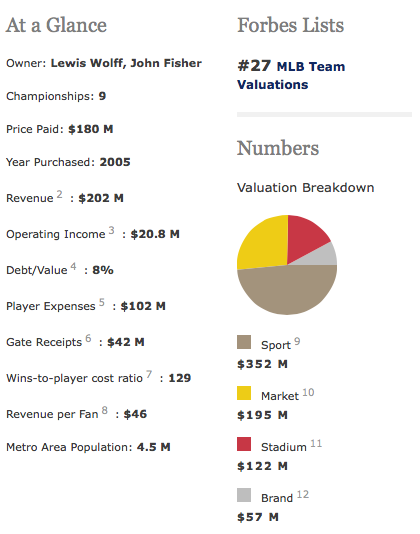
numbers

Forbes breakdown of the A’s valuation


Now the Giants:

Forbes Giants valuation

Forbes’ Giants valuation

In nearly every key measurable, the Giants double or even quadruple the A’s. The Giants hit a perfect storm of on-field success and savvy management, which was parlayed into impressive revenues. The Giants are a money-making machine. They are also a big market club, no doubt. Though they aren’t profligate spenders in terms of payroll, everything else about them is big market, just like the Yankees, Dodgers, and Red Sox.

The A’s, on the other hand, bear all the marks of a small market team. Gate revenues are abysmal compared to the Giants. It’s so lacking that the A’s could untarp all the regular upper deck seats, sell out the entire season, and still only reach 50% of the Giants’ revenue. The flipside to that is that the A’s are a far more affordable, accessible product for baseball fans in the Bay Area. The market itself, which is defined as the East Bay, compares to a lot of other small markets like Tampa Bay and Kansas City. As long as the A’s are pigeonholed to the East Bay, it’s likely they’ll remain small market, or perhaps boost themselves to a medium-sized market if a new stadium comes.

New and improved national media revenues are the tide that has lifted the A’s boat. As big market teams keep getting bigger and bigger annual revenues, the A’s will continue to be a club that receives a nice revenue sharing check, at least as long as they play at the Coliseum. Per the current CBA, they’ll continue to be eligible for revenue sharing until they start playing in a new Bay Area ballpark. So the A’s are in a sort of limbo in which right now they’re considered a small market team in that they receive revenue sharing, but will be redefined as a big market team once they open a new park. That arrangement could continue into the next CBA, or it could change. I suspect that if the A’s build a new park in Oakland, they’ll remain a small market team by definition, simply because they don’t have the same direct access to big sponsors as they would in San Francisco or San Jose.

The other big takeaway from the valuation news is that the A’s debt position has significantly improved from doing nothing. Forbes reports that the A’s debt is now 8% of franchise value, or around $60 million. That leaves an astounding $665 million of equity for the ownership group. Wolff has suggested that he would use equity to help finance a ballpark. He could conceivably cover the entire cost with the team’s equity, but MLB rules about debt load preclude such a plan. The most debt the A’s can accrue without running afoul of MLB is 12 times their operating income if they’re building a new ballpark, 10x if not. If you take the average of income from the last three years you get $25 million. Multiply that by 12 and you get $300 million. The A’s have $60 million of existing debt, but according to MLB rules they can exempt $40 million of that. Combine all of those together and the A’s can in theory finance $280 million of a stadium. Even with the added debt, chances are that by the time the stadium opens it would hit only 35-40% of the franchise’s value, an acceptable amount for a sports franchise.

Naturally, the problem is servicing that debt. $280 million over 30 years at 4% is $16 million a year. To ensure that gets covered and it doesn’t have a deleterious effect on payroll, the A’s would have to get 30-32,000 average attendance per game for several seasons, at much more expensive prices than the Coliseum to boot. Then there’s the combination of suite sales, sponsorships, and maybe even seat licenses if fans are willing to invest. If this sounds similar to what the Giants did, that’s because it is. Maybe there’s a real estate component that can come in to offset that debt service requirement, but Wolff indicated in recent comments that grand development concept such as Coliseum City is not forthcoming from him.

Nevertheless, if Wolff and Fisher want to build, and fans are willing to pay, the path is there. Getting to a deal is the hard part.

P.S. – Speaking of getting to deal, there’s been some noise about wanting Wolff to show his plans. Show a rendering, something to indicate that he actually wants to build in Oakland. To which I say – come on. He just finished opening a soccer stadium, the spring training facility renovation, and is finishing scoreboards at the Coliseum. Are those not indicators of wanting to build?

All of these sentiments, while well-placed, are based on some unrealistic expectations. Fact is that the stadium development process is dog slow. It’s tedious. No premature release of renderings will do anything other than getting a small handful of fans excited. Believe me, I’m one of them. But I’ve also learned over the years is that all of that is sizzle, not steak. If you want real progress, you need rules. You need a framework. Here’s the “framework” for the A’s right now:

framework

That’s not a framework for anything other than random discussions between the A’s and East Bay pols. If the A’s, City, and County are going to work on an actual deal, they need to establish a real framework for talks and for a stadium/development deal. It would help if Oakland or the JPA started by creating an RFP (request for proposal), that would allow the A’s to formally propose something. The A’s are in the process of hiring a person to interface with City/County/JPA. If the Raiders wanted to present their own vision, the RFP could accommodate them too. That is how the Coliseum City process started, and is the proper – not to mention legal – way to do government business. Frankly, I’m past renderings. I want steak. You should too.


Alameda County approves ENA, draws line in sand at public money

Early during the Board of Supervisors meeting, President Scott Haggerty hinted that the assembled gallery could see how the Supes were going to vote, as they all had roughly the same comments during their part of the discussion. Nate Miley said he was going to vote for the ENA, but didn’t support “wholesale” use of public resources (land, money) for the project. Richard Valle called the project an “opportunity for private investment” before affirming his long-held no public funding stance. Wilma Chan felt the same while talking about community benefits. And Keith Carson considered the ENA a prudent step so that they could find out if the project had legs.

That sentiment of limited public support didn’t begin yesterday. It was brought up in public in December 2013, at the joint discussion between the Supes and Oakland City Council. It’s a topic that City and County haven’t been able to reconcile when County wasn’t part of the ENA. Now that they are equal partners, they’ll have no choice. It’s impossible to undersell the impact of this. County has taken a hard line on this, and it’s hard to see how City or Floyd Kephart’s New City will be able to reconcile it. In other words, it’s a potential showstopper.

The public contribution issue is big enough for the County that at the same meeting they commissioned a $200,000 study by CB Richard Ellis to appraise value of the Coliseum complex, land and buildings. Even that proved divisive:

Why would the County want the appraisal so badly? If the County wants to work from the notion that it could sell the complex at fair market value, it would help to understand what that FMV is. That doesn’t mean that they’d actually sell it at FMV. They could do a deal like San Jose, offering land at a discount provided that there was a certain price based on use. If County trends towards FMV pricing, that may be to force a decision on preventing a land giveaway by the City. While there are no deal terms yet, Coliseum City has long operated from the idea that the value of the land would offset sunk cost items like new infrastructure or writing off the Coliseum’s debt. The money saved by not spending it on land could be funneled towards the football stadium’s funding gap.

parcels

ENA covers ~140 acres of Coliseum area land


But if FMV was sought for the land, there’s no redirection of money to the funding gap. How, then, does that gap get addressed? If all three parties are going to have even a rough framework of a deal by the June deadline, they’ll have to come to some serious compromises that satisfy all three. That problem is one of those proverbial above my pay grade type of problem.

Miley made sure to mention his contingency plan of retrofitting the Coliseum instead of building new. While all five Supes approved the ENA, they didn’t express a ton of confidence in the project coming together. Left unsaid was another even more radical option that may prove more viable in time, one that was briefly mentioned in the adult conversation 16 months ago.

What if the City bought out the County?

If the County were leaning in that direction, an appraisal would make even more sense. Then they could start to figure out how to split the property, the remaining debt, and the JPA itself. Divorces are always messy, so don’t expect anything like this to happen as long as talks with Kephart continued. It’s not hard to see Coliseum City’s demise leading to a divorce. After all, if the sports teams are the JPA’s kids, and the kids have all grown up and moved away, what’s left?

Yet another possibility is that the County, which has a good relationship with Lew Wolff, is waiting just like Wolff for Coliseum City to die. Then they can work with the City on ballpark plan at the Coliseum. The no public funding demand would arise yet again, which would scare off many developers – but not Lew Wolff, who is not thinking about developing the Coliseum extensively right now. But that would be at odds with the City, which has grander visions for the Coliseum area than a stadium surrounded by parking.

Going back to the next-six-months-narrative, Friday’s City Council approval had optics that were designed to look good in reporting progress to the NFL. However, the NFL’s LA point man, Eric Grubman, continues to maintain that Oakland is neither “aggressive” nor “specific” about its plans. It’s easy to figure out what he means by “aggressive,” but “specific” appears to be a vaguely coded term. Is that just about Oakland’s desire for a 80,000 dome? That appears to have been put aside in recent weeks, especially by Mayor Schaaf. Does it mean something else? Coliseum City continues to be this amoeba that could contain anywhere from three to zero teams. The next three months are meant to provide some specificity, and the following two months even more fine tuning. The NFL signaled that it may announce or authorize moves during the fall, before the 2015 season ends. That puts Oakland, San Diego, and St. Louis under the gun to resolve their stadium problems, or else become abandoned. Even as it seemed the NFL had lost control of this game of musical chairs, they may have regained it.

Are we having fun yet?

City and County set new targets for Coliseum City ENA

Update 3/19 1:20 PM – Oakland’s City Council has scheduled a special meeting for Friday, March 20 at 11:30 AM to vote on a resolution supporting the ENA. You can find the agenda at the meeting link. In addition to the deadlines set forth in yesterday’s news, there’s also an option to extend the agreement for up to six months if some of the deliverables aren’t met or other holdups. There’s also this:

competing

Nothing about the “alternative proposals” shows up in the resolution, however. Once the City and County both approve the ENA including this facet, the A’s (and Raiders for that matter) could start sending in their own concepts. I expect one at some point from the A’s, but as noted previously, they are under no deadlines to deliver anything as New City and the Raiders are.

Original post:

Yes, we wrote two months ago about how the City of Oakland and Alameda County were coming together to work on Coliseum City. The signs were that both parties were finally on the same page.

Well, we’re hearing the same thing again, though this time it might actually be for real. After some back and forth between the County and Floyd Kephart of New City, the County’s Board of Supervisors are looking to vote on the ENA at the end of this week. Or early next week. Or something. The SF Business Times’ Ron Leuty has the details.

Besides the ever plodding deal machinations, Leuty also picked up the new terms of the ENA. June 21 marks a midterm deadline for New City to provide certain deliverables. The “final” deadline is August 21, with even more deliverables. All told it’s 23 separate items, all important, few minor.

June 21st’s set is all about creating the framework of the deal. It should answer basic questions like How many teams will be involved? and How long will it take to develop?

  • An initial financing plan for a new stadium for the Raiders, including ancillary development and land and infrastructure to support a potential new stadium for the Oakland Athletics. It will include projected sources and types of funding as well as the estimated equity stake from New City, its partners and affiliates.
  • Terms and conditions required to win a commitment from the Raiders, A’s or the Golden State Warriors to Coliseum City. This will include an update on the status of negotiations between New City and each team.
  • Initial site plans for new Raiders and/or A’s stadiums.
  • Financial and market feasibility analyses for various elements of the development other than sports facilities.
  • A development schedule for the sports facilities and ancillary development, including the timing of entitlements for all phases of the project.
  • An estimate of infrastructure cost and a funding plan for the infrastructure, including a list of potential regional, state and federal grant sources.
  • Plans for tax financing districts for infrastructure.
  • A preliminary plan for subdividing parcels, if needed.
  • Proposals for addressing the existing Coliseum debt.
  • Proposed timetables for disposing of land for various parts of the project.
  • An outline contracting plan.
  • An outline community benefits plan for the project.

August 21 is about buttoning up the deal and figuring out all of the little details defined in June.

  • A detailed description of the plan for project development.
  • Refined terms and conditions required to win a commitment from the Raiders and/or A’s and a project schedule for obtaining a commitment.
  • A refined financing plan for Raiders and/or A’s stadiums, including identification of all sources of financing.
  • A refined description of the financing structure for ancillary development and the proposed developers for each element of those pieces of the development.
  • A clearer schedule for development of the stadiums and the ancillary development, including the timing of entitlements.
  • A better estimate of infrastructure cost and a funding plan for the infrastructure.
  • A refined proposal for establishing tax financing districts for financing infrastructure.
  • A clearer plan for subdividing parcels.
  • A refined proposal addressing existing Coliseum debt.
  • Proposed terms for the lease disposition and development agreement and financing for various elements of the project.
  • A refined contracting plan and community benefits plan.

By late April we should expect that the EIR will be certified and the Specific Plan approved, which are their own framework in that it defines zoning. With that zoning component there are no entitlements on which developers can build at the Coliseum.

To date many of the deadlines put forth by the City have been about timing in concert with some important date for the Raiders and the NFL. Previously the ENA was supposed to be completed before the 2014 season over, then before the franchise relocation window opened, then 90 days from that (April). Now the ENA deadline is being pushed to just before the 2015 NFL regular season starts. That itself is arbitrary, and allows for yet another 3-5 months of slack before the Raiders have to make a decision on LA or another possible move. With that in mind, I fully expect Coliseum City to slip yet again past August. The list of deliverables above is daunting. The DDA alone can take months to put together. While everyone’s operating from the notion that once a team signs on everything else will fall into place, there’s little reason to believe that negotiations will be that tidy. This project has a growing number of stakeholders, including housing and jobs activists who will make their stamp on a community benefits agreement. The financing for a project of this size is incredibly complex. And the City and County have to be on their toes to ensure that they don’t get taken by the private stakeholders in the project: New City, developers, and the team(s). Without clear terms done in thoughtful, deliberate manner, you get Mt. Davis.

I haven’t mentioned the A’s or Lew Wolff yet. Wolff has made his position clear in that he has no interest in Coliseum City. The difference for him is that he and the A’s have no deadlines, arbitrary or otherwise. What happened to the idea of allowing competing bids? That appears to have disappeared into the ether. For now.

Tenth Anniversary Edition: A Decade of Running in Place

If you’ve been around from the beginning (you probably haven’t), you may have read the very first post I made to this blog on March 14, 2005. That was ten years ago. Here’s a quick, incomplete list of things that have happened since then:

  • Bud Selig stays commissioner until 2015, is replaced by Rob Manfred
  • Expos move (are bought-contracted-expanded) to Washington, DC
  • Six new ballparks open throughout MLB (in St. Louis, DC, New York twice, Minneapolis, and Miami)
  • Levi’s Stadium developed and opened
  • Warriors get new ownership, declare intent to move to SF, buy land for arena
  • AEG moves SJ Earthquakes to Houston. Team is reborn in 2008, has stadium built for 2015 season
  • A’s propose ballparks at sites in Oakland, Fremont, and San Jose – none are successful
  • Oakland is on its fourth mayor since the blog started

That same day I posted about the A’s potentially building a ballpark south of the existing Coliseum. Pending what happens with Coliseum City, we may be talking about that very same possibility in the future. Weird how things might come full circle, eh?

As we wait for good news on the stadium front, I have some good news of my own. A couple years ago I asked for donations for the site to keep it running. Many of you responded very generously. which helped keep the site and my continuing work going. This site is a labor of love, so I haven’t asked for donations much (twice to my recollection). Back in 2013, I promised those of you who donated that I’d provide a sort of digest of previous posts. I tried many times to compile and curate that digest, but over time I’ve learned that I am a much worse editor than I am a writer (which is already rather questionable). Everything read like filler, not moving the narrative forward. I put that aside for a while and swore to get back to it. It wasn’t until earlier this year, when I put together the timeline feature, that it all came together. I was able to put together all the necessary posts, with additional context inserted where necessary. So I’m proud to announce that I have that “book” ready. The download link is below. Those of you who previously donated have already gotten the link via email. Please take a look at it and provide feedback if you like. If you donated and haven’t gotten the book, send me a note/tweet and I’ll make sure to take care of you. And if you have already donated, you don’t need to do anything else, but if you want to donate again I won’t stop you.

I’ve titled the book:

A Decade of Running in Place: A Digest of Selected Blog Posts from the First Ten Years of Newballpark.org

Book download link (Scribd, PDF)

Donate Button

I’ve poured over a million words, 10,000+ hours, and my entire heart and soul into this site. The A’s getting a new ballpark has been a dream of mine since high school, when I first saw drawings of New Comiskey Park and Camden Yards. I don’t expect anyone to have the same kind of obsession with this topic that I have. I figure that I’ll be the obsessive so that you don’t have to be. Thousands of people read this site every day. About 2% of them have donated. If you value the work here and the process, please consider donating. $10 would be great.

The book weighs in at 210,000 words and 664 pages in PDF format. It’s entirely in chronological order. There are what appear to be section or chapter markers. Those are points at which I think the scene shifts. They aren’t meant to encapsulate the story.

Editing and pagination are rough, mostly having to do with the transition from web to print-ready format. I’d like to take the time to give it a whirl in InDesign, with the ultimate goal of making printed copies. A donated of $25 or more would get the ball rolling.

Since this is the 10th anniversary, I’ve started thinking of other things to commemorate this milestone. What do you folks think? T-shirts? Caps? Stickers and decals? Should I do a crowdfunding campaign? I’m all ears at this point. Some of you readers are creatives of different stripes. Send me your suggestions.

Finally, many thinks to all the readers over the years. I’ve met and become friends with many of you. We’ve broken bread, gotten beers, talked plenty of things besides an A’s ballpark. It’s been a pleasure. It will continue until the day that this blog is no longer necessary. After all this time I still hope. I think many of you do too. It’s what binds us. I don’t know how much longer it will take for the A’s to get a new home. Another 10 years? 10 months? However long it takes, I’ll be here for the ride. I hope you enjoy appreciate it as much as I do.

P.S. – Special thanks to Susan Slusser, who suggested the timeline a couple months ago while working on her own A’s history book (due this summer and highly anticipated). Without that I never would’ve gotten properly organized.

P.P.S. – This is not “the book” that I’ve been talking about writing. That book is still very much in progress.


No dome? Smaller stadium? That’s a start.

BANG’s Matthew Artz continues the Raiders stadium debate with the new old revelation that the Raiders want a smaller stadium, one that would seat around 55,000.

Yes, it’s a familiar story. We’ve heard it before. Fewer seats, fewer suites, slightly less swanky club areas, all of it should contribute to a lower cost solution for the Raiders and the NFL. And finally, the City of Oakland appears to be coming around, instead of clinging to pie-in-the-sky aspects in the Coliseum City plan. At the very least, the idea of a retractable dome is fading away.

The dome made it into several city planning documents, but Mayor Libby Schaaf said last week that it was no longer under consideration, noting that it didn’t make sense to build an enclosed stadium in a city with such a good climate.

That alone should save some $200 million. Dropping 10,000 seats should also save around $200 million. A rough projection today would be $800 million. Or $978 million. Either way it’s way too expensive. If the goal is a less fancy, simpler structure, there’s little reason for the budget to approach $1 billion, even with the higher construction costs in the hot Bay Area market. I showcased two renovation projects in Florida: the recently completed $200 million Citrus Bowl project and the underway $400 Sun Life Stadium plan.

Another good example from the college ranks is the new McLane Stadium at Baylor University. A 45,000-seat venue, McLane Stadium is a pretty, three-decked, partly roofed horseshoe on the banks of the Brazos River in Waco, TX. The stadium was completed for only $266 million.

McLane Stadium facing Brazos River (image from Wikipedia)

McLane Stadium facing Brazos River (image from Wikipedia)

It’s not the cost effective record of $100 million set at Stanford for a new stadium, but it’s impressive in its own right. There are some obvious visual differences between pro and college football venues, such as the expansive use of bleacher seating in college stadia. These stadia also have smaller scoreboards, club lounges, and locker rooms than their NFL peers. McLane Stadium has a total of 860,000 square feet, less than half the space of a new NFL stadium like Levi’s, whose square footage totaled 1.8 million.

Pro football stadia have achieved such girth over the last 30-40 years through the proliferation of suites and clubs, plus greater buildouts at the field level, a place once reserved for locker rooms and plain old storage. The previous generation of stadia may have had 4-5 levels. A modern stadium may have 9 levels thanks to stacks of suites and clubs. Since all these stadia are getting taller, there needs to be more structural concrete and steel, which contributes further to exploding the cost. The end result is a more complicated structure that takes much longer to build than before.

Living in Silicon Valley, since the recession ended I’ve seen so many cranes and buildings under construction it’s dizzying. Unlike the original Valley land rush, developers and companies aren’t building simple one-story tilt-up offices. These are 6-10 story campus affairs as standard, or crazy concepts like Apple’s spaceship campus or the newly reimagined, glass-canopied Googleplex. Apple and Google are perhaps two unique examples of companies building visions that would make the NFL palaces look modest by comparison. Mall giant Westfield is undertaking a $600 million expansion of Valley Fair. Local cheap hotels and motels are frequently at capacity during the weekdays, filled up by general contractors coming from the Central Valley and Southern California. While it’s a great situation for the Bay Area economically, it also means greater competition for labor than ever before.

If Oakland and the Raiders are truly going to come up with a cheaper solution, they’ll need to follow some of the lessons realized in the college process. That means building simpler, and just as important, building faster. Instead of taking 3 years to complete a stadium, it would behoove both parties to figure out ways to cut down the construction time to 2 years or else in order to save on labor, especially union labor here in California. Employing a design-build process to streamline construction and permitting would also help immensely.

Doing all of this would require a level of coordination and competence heretofore not seen in the East Bay. While the county continues to consider the ENA, the ground beneath Coliseum City shifts. Chances are good that whatever gets built there will look nothing like the renderings provided by JRDV and sponsored by the City. That’s standard practice in urban planning, so no one should be surprised. With the clock ticking on LA, it’s probably a good idea to get moving on something everyone can agree on.

John Fisher and the Art of Equivocation

A’s and Quakes co-owner John Fisher was on hand at the Avaya Stadium ribbon-cutting ceremony in San Jose today. He was obviously there to celebrate end of the Quakes’ long journey to their own home. Fisher is known as the “soccer guy” in the ownership group, and Elliott Almond’s article sheds some light on that soccer background.

However, the Merc’s headline writer saw fit to make this about baseball with the title, “A’s owner John Fisher: Baseball team’s turn for new stadium.” Fisher was indeed asked about a ballpark for the A’s, and as you’d expect, he provided no new information. Instead he said this:

The Bay Area deserves great facilities. We live in the greatest area in the world and we have incredible teams that have performed tremendously well.

Whether you think Fisher was being intentionally vague or simply choosing to focus on the accomplishment at hand, it was Fisher’s first real statement about anything as part of the ownership group. That in itself is pretty big. I don’t necessarily expect more from him or a more visible role, though his presence at an earlier meeting with Libby Schaaf is perhaps promising. Keith Wolff was also at the Avaya Stadium ceremony, while Lew Wolff has been in Mesa for spring training activities.

Now take a look at these quotes.

This has been my biggest thing, ingress and egress for the (venue) and the parking are the two most important things to me.

In these focus groups we’ve had in there in the last week or two, the first question seven out of eight groups asked is, ‘Where is the parking?’

They’re showing all this grand building, a baseball stadium, there’s a football stadium there’s the arena, there’s all these residential things. And there’s no parking.

Did that come from Mark Davis? Or Lew Wolff?

And this one:

Parking is a key issue for us. We want surface parking surrounding the (venue) wherever we build it unless we’re in the heart of a downtown.

Davis? Or Wolff?

Now consider the the reaction to these quotes. The first set received little blowback at the time. The second had a lot of negative reaction. The content and sentiment were essentially the same. They have problems with how Coliseum City is conceived because it could cause problems with the way they operate their respective franchises. Then why such dramatically different reactions?

With Davis, many assume that either he’s more-or-less earnest about most everything: his handling of the stadium issue, his management of the Raiders, right down to the establishments he chooses to patronize. (That shouldn’t be confused with success.) Wolff, on the other hand, is considered forever the schemer looking for any excuse to leave. He’s the absentee owner, even though both guys are based in LA. Wolff has the anti-Oakland track record. His timing is spectacularly bad at times. Davis is Tommy Boy, all about honoring his dad. Whatever indiscretions or failures Davis has can be chalked up to being the family black sheep. He’s not really supposed to be here.

It just goes to show that even when two men have the same message, the prevailing narrative takes over. At some point these men will have to make deals, and those narratives will fade away. Or maybe they’ll be reinforced.

Wolff wants surface parking over garages and development at Coliseum

Here we go again with that nasty word: infrastructure.

Lew Wolff told Matthew Artz today that not only was he not interested in Coliseum City, he felt there isn’t enough space at the 120-acre Coliseum for development the City desires and the surface parking the team needs. That’s a major revelation because Wolff’s vision not only precludes other development in what’s considered a potentially high-density transit hub area, it goes against the City’s goals for the Coliseum.

There’s a lot that’s being unsaid by Wolff, who demurred on questions about financing and multiple venues. Let’s focus on what he said.

The only way it could work, Wolff said, would be to build multilevel parking garages, but that would leave fans waiting in long lines to exit the garages and begin their drives home.

‘Parking is a key issue for us,’ Wolff said. ‘We want surface parking surrounding the ballpark wherever we build it unless we’re in the heart of a downtown.’
‘We said it before he even came on the scene that we are going to 100 percent control our own destiny, period,’ Wolff said. ‘We don’t need a third party involved.’

First off, let’s be clear about how much land is available: 141 publicly owned acres in the area bounded by 66th Ave, Hegenberger Rd, 880, and Damon Slough. Take away 18 for the existing Coliseum or its replacement, and 8 for the arena if it stays. There’s other stuff like the sewer interceptor and power lines, but we’ll leave that out for now. The remaining land totals 115 acres.

As Andy Dolich notes in the same article, garages are ill-suited because they’re expensive and don’t get utilized well. Parking garages cost around $20,000 per space to build. ROI can be difficult to achieve unless those garages can be filled nearly everyday. But the City is supposed to fund infrastructure like garages at Coliseum City, so why is this such a big deal? The surface parking requirement, which Raiders owner Mark Davis has also communicated at times, stands in the way of the City’s plans for Coliseum City, whether you’re talking 120, 200, or 800 acres. The Coliseum City plan has 13,000 event parking spaces in it, only 4,200 of which are surface spaces mostly in the south lots out to Hegenberger.

Blue and dark gray are garages, medium gray is surface parking

From the Coliseum City Specific Plan: Blue and dark gray are garages, medium gray is surface parking

Shouldn’t 4,200 (or maybe 5-6,000) spaces be enough for most A’s games when taken with a few thousand new garage spots?  Especially if the TPMP (Transportation & Parking Management Plan) were conceived in a way to manage traffic from these various lots and garages? Especially if it’s only a single venue such as a ballpark? Let’s say that the A’s average 30,000 in attendance at a new ballpark. According to BART, 15-20% of fans take the service. Let’s make it 20%. That means 24,000 will come in cars. At 3 per car, the A’s would need 8,000 spaces. So they’d need some 2-3,000 additional spaces, maybe half of those in garages, the rest in a remote lot on the other side of the complex where people would have to walk through the retail/commercial area to get to the game. That way you have everyone covered:

  1. Fans who want direct access to the ballpark and the quickest in-out (4,200 surface spaces adjacent to ballpark, south)
  2. Fans who want to have dinner/drinks at a restaurant nearby (3,000 garage spaces, perhaps with validation, center)
  3. Fans who want cheap parking and don’t mind walking through the business district (3,000 remote surface spaces, north)

If you look at the parking depiction above, it’s not hard to see how that would come together. Put the ballpark where the football stadium is and the remote parking where the ballpark is and you have the basic concept. The idea presupposes that the arena is no longer there either.

The problem, as ever, is that no one wants to pay for any infrastructure like parking. A 2,000-space garage is bad enough, and it’s merely a piece of the $300 million of infrastructure. Wolff has suggested that he’d take care of the Mt. Davis debt, but if he has to pay for infrastructure too it starts to become too much. The City has suggested a slew of taxes that would pay for it through huge Mello-Roos and infrastructure financing districts, but that isn’t certain. Some of those taxes would eat into A’s revenues, so again it becomes a question of cost-benefit for the A’s.

In the end, if the A’s and the City/County are going to make this work they’ll have to come to a compromise. Whether the A’s claim a large piece of the land for ballpark and parking and leave the rest for the development, or the A’s control development rights to the whole thing, they’ll have to come half way. That also means the City will have to dial down its pie-in-the-sky dreams of a bustling second downtown anchored by multiple sports venues for something a little less ambitious. There probably is a way to accommodate both Wolff’s and Oakland’s goals. It’ll take a lengthy negotiation, which I should remind you, hasn’t happened yet. In fact, we’re not even close to negotiating yet.

P.S. – Would you believe that until last year, there were no major pro sports venues in the Bay Area with adjacent or nearby garages? It’s true. The Coliseum, which houses three teams, obviously has no garages. Neither does AT&T Park, which has surface parking across Mission Creek from the ballpark. SAP Center has multiple surface lots, including an elevated lot next to the arena that some might mistake for a garage. Candlestick Park had a small peninsula of parking next to it.

That changed when Levi’s Stadium opened last year. As part of the deal, an 1800-space garage was built directly opposite the stadium on Tasman Drive in Santa Clara. That garage has been notorious for excruciatingly long waits to leave, thanks to its single point of entry/exit. Wolff knows this because his Earthquakes opened Levi’s last summer, Quakes fans as guinea pigs. As we saw with the Sharks-Kings Stadium Series game over the weekend, parking and transportation is still a puzzle that hasn’t been figured out by the 49ers, Santa Clara, and VTA.

Other ballparks in suburban locales (Dodger Stadium, Angels Stadium) also don’t have garages. PETCO Park, Chase Field are downtown ballparks with attached garages that work well in concert with other nearby parking options. Coors Field has practically all surface lots available as parking. Downtown ballparks not only have garages or plenty of nearby parking infrastructure, they have the proper street grids and built-in traffic management needed to support large events. The Coliseum City plan is not set up like a new downtown with many ways in and out. It’s essentially the same plan as before, which has led to poor level of traffic service (LOS) grades in the Coliseum City EIR. It’s natural for Wolff to want to avoid the Levi’s situation.

Dolphins show off $400 million renovation project

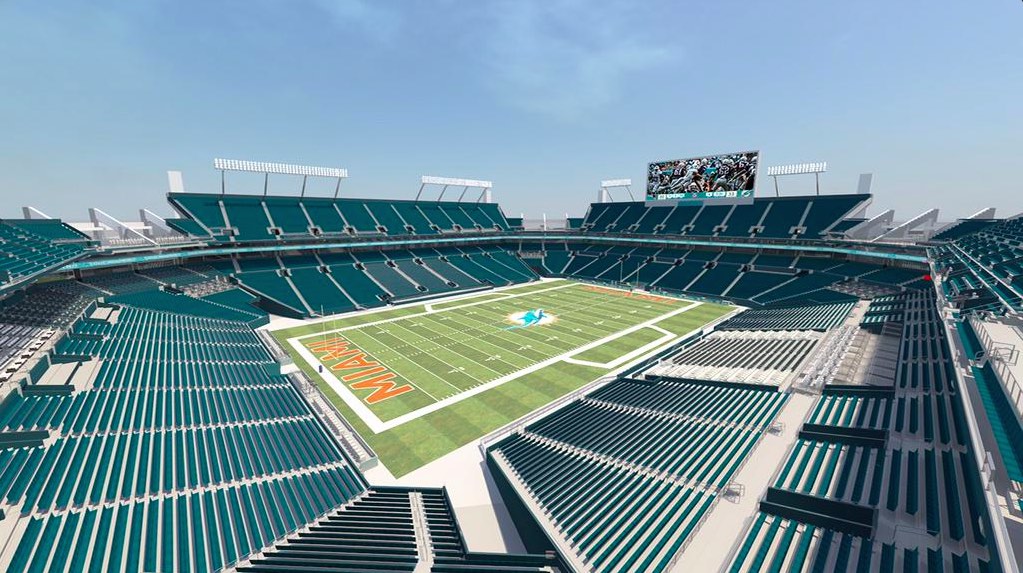
Not long after the Orange Bowl was played on New Year’s Eve, the Dolphins embarked on an ambitious, $400 million plan to rip apart about one-third of Sun Life Stadium. Dolphins President Tom Garfinkel has been regularly posting photos of the progress.

The plan is being carried out in two phases. The first takes off the upper corner sections permanently, leaving the structural raker beams behind. The lower sideline sections are also being removed, to be replaced with new sections that will eventually bring the first row 24 feet closer to the field than before. All of the seats will be replaced with bigger, all-turquoise versions. The lower deck renovation will allow the Dolphins to offer new luxury seating types between the usual club seat and suite choices. Some will be mini suites at midfield, others will be behind the end zone. Concourses are also being redone.

First phase renovations to be ready in time for 2015 NFL season

First phase renovations to be ready in time for 2015 NFL season

Second phase improvements include new scoreboards in the upper corners where the seating sections used to be, and the big reason for the project: a huge open air canopy that will cover virtually the entire seating bowl and outdoor concourses. Given the often rainy and hot weather in the first half of the NFL season, this was considered a necessary addition. The canopy is also a must for the NFL if future Super Bowls are to be held there (the last was held in 2010).

sunlife-2016-outside

Final renovations including seating canopy

Final capacity is projected slightly above 65,000, a cut of 10,000 seats. Despite the reduced seat count, the venue is better positioned to bid for the Super Bowl and the College Football Championship game, which is up for bid separately from the normal bowl rotation (the stadium already hosts the Orange Bowl).

Most importantly, this project is being financed privately, mostly through luxury seat/suite sales, not through bonds, PSLs, or other unsavory means. Stephen Ross campaigned for public funding for the better part of 2 years, threatening that the Super Bowl wouldn’t come back without yet another South Florida giveaway. He eventually gave up his quest, seeing that it would be better to get started on the project and get the Super Bowl. Finally, Miami-Dade County held firm and wasn’t ripped off the way they were by the Marlins and Heat.

In May I covered the much more modest, $200 million renovation at Orlando’s Citrus Bowl. While that project lacked much of the luxury amenities being added to Sun Life, the actual teardown and rebuild was more extensive, gutting and replacing the entire lower bowl. I wondered why the Raiders weren’t pursuing this path at the Coliseum. I can say the same now that the Dolphins are going down a similar, albeit more NFL-appropriate path. A Raiders renovation would be a sort of hybrid of the two, not as swanky as Miami nor as basic as Orlando. Over time I ballparked the cost at $500-600 million, basically the same amount as the funding gap the team and Oakland/Alameda County face at Coliseum City.

So why is no one talking about a Coliseum renovation? Maybe the image of the Coliseum is beyond repair even with a renovation. Maybe the fact that the field is 20 feet below sea level makes it a bad choice for forward-thinking CEQA guidelines about sea-level rise or storm-related flooding. Neither of those is a good excuse. If everyone involved in wanting to keep the Raiders (team, government, fans, investors) isn’t merely about playing games, there’s no reason why this kind of option wouldn’t be investigated thoroughly. It’s cost-effective, proven, and preserves the very site that so many Raiders fans hold dear.

P.S. – While we’re at it, why didn’t the 49ers incorporate some of these amenities into Levi’s Stadium? We’ve already seen these put into arenas and some stadia over the past few years.

P.P.S. – The Dolphins are applying for $50 million in sales tax revenues. A decision to provide that funding along with funding for other sports venues has been delayed by the Florida legislature. Even if that’s approved, Ross is funding $350 million of the project, a better ratio than most American stadia. At least Ross dropped the charade and got started on the project.

Manfred talks Coliseum ballpark

MLB Commissioner Rob Manfred made a few comments about the A’s and the Coliseum. The comments are in the 2nd item of Susan Slusser’s daily spring training update from Monday night.

In addition to confirming that the Coliseum is the best site for the A’s (as opposed to Howard Terminal, which was not mentioned), he also spoke out about the Raiders’ and the NFL’s role in the Coliseum drama.

‘I think that there is a lot of activity that could clarify the situation, and I’m not going to go beyond that, that I think could create an opportunity to move things along in Oakland. I think the A’s are willing to explore Oakland if they can find a workable arrangement and it’s always been our preference to keep clubs where they are.’

My immediate reaction was to read into his quote a little:

Slusser agreed with my assertion, as did Howard Bryant. Ray Ratto cautioned against reading too much into Manfred’s quotes, as he’s just starting his gig and lacks to power base to make any major decisions. But that’s kind of the point of the Raiders-leave-and-A’s-take-control scenario, in that MLB doesn’t have to make a decision. They effectively back into a solution for the A’s without having to do anything. They wouldn’t even have to take a vote. Follow the Twitter thread and it becomes a fun little discussion about this ballpark business, including replies from John Shea, Wendy Thurm, and the LA Times’ Bill Shaikin.

While it’s pretty good reading, no one should get any ideas that the A’s are about to get the keys from dad. There’s a long way to go until that happens, and the A’s housemates will have something to say about it before long.

M&R: 30 days or bust for Raiders in Oakland

It’s a short article and a rather incendiary headline from Matier & Ross, but it’s not like we haven’t seen this coming.

‘If we don’t have significant progress within the next 30 days, I’d say one party or the other will call an end to it.’ That’s how one source close to the Raiders stadium negotiations in Oakland characterizes the on-again, off-again talks.

Okay, I guess. This doesn’t mean that Coliseum City is dead. There’s a lot of context we don’t have here. Is the anonymous source only talking about the new stadium, or does the lease extension also have something to do with it? Remember that as of now, the Raiders have nowhere to play for the 2015 season. If the only issue is the stadium discussion, that’s an awful way for the Raiders to go about things. Besides not having a place to play and no approval from the NFL to make a move, there’s little concrete evidence that the framework of a deal can be reached in 300 days, let alone 30. Maybe, as Larry Reid said, the work is 90% done. So what’s keeping the rest of the 10% from being done? The Raiders? Maybe. New City? Floyd Kephart said that the ENA runs through April. The ever-balking Alameda County? Who knows?

To me it sounds like yet another bluff. Last week’s reveal that the Raiders and Chargers are working on their own plan was characterized as a bluff by many. Scratch the surface and you’ll see that the Carson site is nearly ready to go after a great deal of cleanup, according to the State. Again, there are so many moving parts here with all the different players and deliverables that it’s hard to know what progress really is. Frankly, if this is coming from the Raiders, I’d like to see what happens if they leave the table. It’s always been up to the Raiders to make the first move. Mark Davis may actually have the courage to push that first domino. And if that happens, expect everyone else – the public sector, the A’s, the NFL and MLB – to start moving in kind. Eventually.