The Miner and the Bomb

I have had the opportunity to talk to a few folks from Oakland over the past week about ballpark related items. It all started when I got a message to my facebook account that said something like, “There is a site in Oakland that no one is talking about.”

I made a few phone calls, spoke with a few folks (very excellent, forthcoming people who shall remain nameless as I have promised) with varying degrees of information and I came away with one conclusion. Oakland is playing Stratego while Oakland Boosters think they are playing chess.

Oakland’s strategy has three main points:

  1. Wait out MLB. Obstruct and keep from having a decision on TR’s made in San Jose’s favor.
  2. When Lew Wolff grows tired of waiting/TR’s are reaffirmed, recruit Larry Ellison to buy the team.
  3. Pledge public funds for a ballpark at Victory Court.

I know, I know. I teased you all with a “plan,” implying specific tactics, and came back with a high level “strategy.” Let’s delve into each of the points above a bit, shall we?

Territorial Rights Affirmation

To a man, everyone with knowledge I talked to said, “There is no way MLB will let the A’s into San Jose.” Almost that direct quote, almost like it was being read off a card.

“Why?”

The answer? Various versions of, “because the Giants owners told us so.” The main argument is that San Francisco floated bonds to fund 5% of AT&T Park based on the Giants existing territory (As Dennis Herrera said when threatening a law suit). They claimed there was a contract between MLB and San Francisco. I can only assume they are referring to the letter from former National League President, Leonard Coleman, sent in 1997. That is what Herrera referred to in his shot across the bow (PDF).

Recruit Ellison

I’ll be honest, this one baffles me. From what I can tell… the idea hasn’t been broached with Larry Ellison. It is an assumption that has been made by those who want a new owner. Larry Ellison wanted to buy the Warriors and lost out. The Warriors are in Oakland. Therefore, Larry Ellison wants a professional sports team based in Oakland.

It sounds crazy. The thing is, multiple people told me that Ellison is the guy that Oakland will try to persuade to buy the team. They didn’t say, “We will find a new local owner.” They said, “We will try to get Larry Ellison to buy the team.”

I am not sure if they realize Ellison also tried to buy the Seattle Sonics and move them to San Jose, before he tried to buy the Warriors. I am not sure if that is important.

As you can probably tell, this part seems really unrealistic to me. But what do I know?

Victory Court

We have all assumed this already, right? Victory Court is the site that Oakland refuses to confirm as the site. There are some challenges though, and I wonder if avoiding a spotlight on said challenges is the real reason for all the subterfuge.

Newballpark.org has obtained a series of letters from nearby neighborhood associations, most notably the Jack London District Association, urging the City of Oakland to consider an alternative to the alternatives presented to MLB. Here are the reasons as stated in the letter:

It is far too soon to actually endorse this plan vs. any other option, but the preliminary assessment is that it would create far less disruption to existing businesses and residents and create an environmentally preferable commute for many of the workers at the facility, who could walk from their West Oakland and downtown homes. In addition, there would be far fewer environmental mitigation issues, compared to the frequently toxic environmental conditions in much of the Port and Jack London District Areas. This new site proposal also has the advantage of requiring far less land acquisition, reducing cost and potential litigation, when compared to other suggested sites.

Those near Victory Court are concerned with a one thing in particular, in addition to those called out in the paragraph above. Traffic.

Even with BART about a quarter of a mile away, most folks will come to baseball games via automobile. Should only half of all spectators come by car there will be thousands of cars that aren’t normally there. The freeway infrastructure around Victory Court, and the surface streets in the area are not set up to handle a great deal of cars. There are basically two approaches, one coming West on Oak Street, which requires use of an off ramp with a sharp 90 degree turn. Or, coming up from the South on Embarcadero, which requires crossing train tracks. The combination of an inadequate off ramp and trains, that frequently pass through the area, have the potential to create a huge traffic nightmare. How huge? We won’t know until someone way smarter than me does a real traffic study for an EIR.

If my sources are correct, and I believe them, MLB has told Oakland that it will come up with a loan of about $150M for a ballpark in the city, if it is in the right place. That would leave Oakland CEDA on the hook for an estimated $150M for property acquisition, business relocation and environmental remediation. There is another $400M to be found somewhere in this calculus.

I am told, that some portion of this money is expected to come from City issued Bonds. Raiders, anyone?

In Summary

When I used to love to play Stratego, my favorite part was figuring out where to set my bombs and using my miners to defuse my opponents bombs. It was a slow, and painful progression at times. Sometimes, it worked and I captured the opponents flag. Sometimes it didn’t and before I defused enough bombs they had my flag. It seems to me that the City of Oakland is doing something similar. Lying in wait, watching the progress of San Jose from afar and banking on too many bombs blowing up in their path. Leaving Oakland with the only clear path to the flag. Is it a good strategy? I guess time will tell, but I can think of a better one.

This started with someone reaching out to me about a different potential site in Oakland, didn’t it? And didn’t the letter from JLDA above mention an alternative to consider?

Those are one in the same. Stay tuned….

Reaction to the SVLG letter

Before we get started, our thoughts and prayers go out to the victims of the San Bruno Crestmoor fire. I have relatives that live on the other side of the fire from 280, and they’re okay. Those affected were not so fortunate.

A few articles have come out in the last 24 hours since the soft pitch to Selig.

I’m in agreement with Ratto on the “MLB won’t be rushed” argument, but I’m not with him on how San Jose needs to show money and shovels. The City has already laid out its process for Selig. It acquired half the site, had the vote lined up for November, which would authorize eminent domain for the rest if negotiations got to that point. But Selig asked for a delay, which means that MLB is the party that needs to get its ducks in a row, not City.

Furthermore, Ratto is one of the few Bay Area writers who believes that the T-rights negotiation is a relatively trivial matter:

Oh, and whole you’re not wondering about that blue-ribbon committee, stop wondering about territorial rights, too. Territorial rights were, are, and will be a simple negotiation about how sizable a bribe the Giants will need to shut up. And if the Giants want to get cranky about it when the other owners are ready to move the A’s, they can be de-legged with a simple 29-1 vote. You know, the kind Bud specializes in at big moments like this.

While I think that a vote will probably come out 29-1 or 30-0, it’s getting to that point that’s the hard part. If, as Ratto argues, City and the A’s need to show more money and shovels, there’s a problem. A company like Cisco has already stated what it’s willing to do. Does Selig want to risk losing Cisco to the 49ers, who’d love to poach them for their own naming rights deal? By including the A’s in SVLG, they’ve created a sort of corporate solidarity. It’s up to Selig. The more he draws this out, the more he risks pissing off SVLG and its members. If he wants their business, it’s as much up to him as it is them, an argument from the letter that was made in an oh-so-subtle manner.

Update 9/13 11:00 PM: The CEO’s of SunPower and Brocade have reinforced the SVLG letter with their own opinion piece in the Merc.

SVLG makes plea to Selig

It’s best that I just post the contents of the letter sent by SVLG to Commissioner Selig today (Merc article), so without further ado…

September 8, 2010

The Office of the Commissioner of Baseball
Allan H. (Bud) Selig, Commissioner
245 Park Avenue, 31st Floor
New York, NY, 10167

Dear Commissioner Selig,

The Silicon Valley Leadership Group strongly supports a new home for the Athletics baseball team in downtown San Jose. We were encouraged to learn of San Jose Mayor Chuck Reed’s positive conversation with Major League Baseball President Bob Dupuy regarding the timing of a possible election next spring should the A’s be granted approval to pursue the construction of a baseball-only state of the art Ballpark in downtown San Jose.

By way of background, the Silicon Valley Leadership Group was founded in 1977 by David Packard and has grown to become the largest organization of its kind in Silicon Valley with more than 300 member companies. Combined member companies employ more than 250,000 local workers – nearly one of every three jobs – and generate more than $2 trillion worth in global revenue.

We, the undersigned CEOs and senior executives, are committed to bringing jobs, revenue, a rich culture, and a thriving business climate to Silicon Valley. We believe that an intimate state of the art ballpark located on a prime downtown San Jose parcel, close to mass transit and major highways will be a catalyst for economic development in our region. We also believe downtown San Jose offers a compelling location for the advancement of Major League Baseball in the 21st Century. Silicon Valley is well known throughout the world as the cradle of innovation and the leading incubator of new ideas and new possibilities for human kind. There is no better location than San Jose, located in the heart of Silicon Valley, to advance the Major League Baseball brand on a global basis.

San Jose is a world-class community, and the ballpark proposal not only secures a quality Major League Baseball team for America’s 10th largest city, but also creates jobs, strengthens our economy and enhances the cultural opportunities for our workers and their families. According to an economic study commissioned by the City of San Jose, a new ballpark will generate thousands of construction jobs and permanent positions at the ballpark and surrounding area.

The Silicon Valley Leadership Group, along with other respected and diverse organizations, stands ready to offer any support needed to move this important project forward. The Silicon Valley Leadership Group is comprised of both devoted A’s and Giants fans and we will continue to enthusiastically support both teams. We strongly believe that both teams will thrive in a vibrant two team market anchored by San Francisco and the Bay Area’s largest city, San Jose. Today, the Bay Area is the only two team market in Major League Baseball where the teams don’t fully share their common geographic territory. The divided territory was imposed at the request of San Jose baseball boosters in 1992 in a previous attempt to secure a Major League Baseball team. We can only hope moving forward that the Bay Area can be restored to a shared marketplace for the two teams in a manner similar to Chicago, Los Angeles and New York.

It is integral to our mission that we support and promote opportunities to improve the quality of life for families who live and work in Silicon Valley. A new A’s ballpark will provide a great entertainment and community asset that will capture the essence of Silicon Valley. It will be a tremendous benefit to our region, with a wide appeal that can help to promote Silicon Valley – and Major League Baseball – on a national and international level. The new venue will be a great source of pride for our innovative region, and deserves your consideration and approval to move forward.

Please call on us to help make this decades old dream to attract a Major League Baseball team to Silicon Valley a reality in the near future.

John Chambers
CEO, Cisco Inc.

Carol Bartz
CEO, Yahoo!

Tom Werner
CEO, SunPower

John Donahoe
CEO, eBay

Mike Klayko
CEO, Brocade Inc.

John Doerr
Partner, Kleiner Perkins

Carl Guardino
CEO, Silicon Valley Leadership Group

Shantanu Narayen
CEO, Adobe

Other signatories include Lew Wolff, former mayor Ron Gonzales, the publisher of Silicon Valley/San Jose Business Journal, the presidents of Santa Clara University, UC Santa Cruz and Foothill-De Anza Community College District, the CEO of Palo Alto Medical Foundation, and the head of Goodwill Silicon Valley, who happened to be head of the Valley’s largest beverage distributor a couple years ago. Just about everyone else on the second page is either the head of a tech firm or a bank. Including the main heavy hitters, that’s 75 companies and organizations, and the vast majority of them are not small businesses.

The crux of the letter is the request to share the Bay Area the same way New York, Los Angeles, and Chicago are shared. My guess is that this won’t happen because of certain long term implications. Unlike those other three markets, the Bay Area is uniquely set up for a game of franchise musical chairs once any lease ends and a team wants a new stadium. The others aren’t. If a T-rights compromise were to occur, the definitions would look much more like Washington-Baltimore just because of the decades of history there (and here) that can’t be easily wiped away. That said, the letter’s soft pitch does have one statement that has some hidden teeth.

We strongly believe that both teams will thrive in a vibrant two team market anchored by San Francisco and the Bay Area’s largest city, San Jose.

Something’s missing from that declaration.

Marine Layer’s Cisco Field Analysis

When the first images of the new Cisco Field @ Diridon came out, I decided to sit back and watch the reaction. Same thing went for the official images, released through Baseball San Jose. My initial thoughts haven’t changed: it’s quite radical. Now, I haven’t talked to anyone at 360 Architecture, Baseball San Jose, or A’s ownership about the images, so my thoughts are not influenced by anything or anyone. With that out of the way, let me explain what I mean by radical.

Let’s start off with where the field is placed within the site. First up, here’s what I drew up a couple of years ago.

newballpark1-export-sm

In my sketch, the RF wall hugs the Autumn Parkway contour. The aesthetic effect of that is that fans are confronted with a large wall when walking along Autumn. Additionally, the field is pushed up further north to have more “back of the house” space. By doing this, I effectively put a cap on the number of seats. That isn’t necessarily the case with this new drawing.

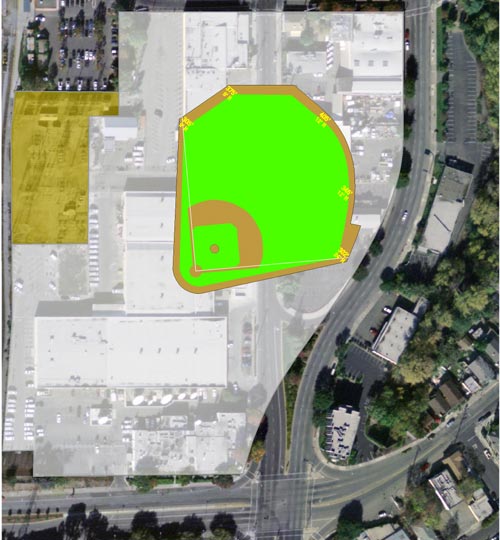
Assuming that the remaining land acquisitions go as scheduled, including a small land swap with PG&E, the field is likely to be situated as you see below, give or take 20 feet north or south (north is up). That orients the field pretty close to true northeast. Prevailing winds tend to come from the northwest, so they should move from the left field foul pole to its counterpart in right on a regular basis. At times, the winds will shift to NNW or WNW. However, the winds in San Jose tend to not be particularly strong, generally topping out at 10-15 mph. Oakland and San Francisco are generally more prone to onshore and offshore movements.

Now for the new 360 layout:

ThreeSixty1-export-sm

The way that Autumn Street/Parkway is contoured, it removes almost all of the RF corner from what would normally constitute a grandstand. And we can’t do an analysis without discussing those field dimensions, with the very short porch in right and a shallow corner in left. Neither of those dimensions are entirely necessary. You can see that there is some space to lengthen both of those out, and I figure that some version of Cisco Field has more “standard” dimensions in place.

Of course, standard dimensions aren’t possible in right if that “thing” is there. What is that thing, anyway? Well, I’ve searched far and wide for some context. It’s not an arcade as in San Francisco, as it doesn’t have arches. Instead, to me it’s, for lack of a better term, a contemporary take on a classic colonnade. To wit:

In classical architecture, a colonnade denotes a long sequence of columns joined by their entablature, often free-standing, or part of a building.

Normally, we think of colonnades as freestanding, such as those used at old LA Forum and Soldier Field. In this case, they house multiple levels of what appear to be minisuites. That’s the first radical step I noticed from the Fremont plan. At Pacific Commons, the minisuites were only 15 rows from the field along the infield. Now they’re part of the colonnades. I suspect the team reached out to potential minisuite holders to see what effect this would have on their interest. If the idea survived this long, the effect must have been minimal.

Depending on what the treatment for the colonnades is, they could become the signature element of the ballpark. There’s no other eye candy in the outfield besides the video/scoreboard, which lines up flush with the top of the colonnades and the roof. I don’t expect to see a neoclassical look, as in the two examples cited previously. Instead, it will probably be more modern and perhaps subdued.

Several sections of outfield seats jut out from the colonnade, creating the crazy 345-foot dimension in right-center. Either they really needed to get those seats in there, or it’s an affectation of sorts. Frankly, it’s unnecessary. The best thing to do would be to take off a few sections, chop off several rows of those seats and turn it into a family or picnic area. The resulting right-center length would be 360 feet or more.

Over in the LF corner, the line could be further extended, eating into more seats and creating a higher wall as a result. I don’t really have a problem with it. Every team should have a righty dead pull hitter who hits frozen ropes down the line. If they get an extra 10 HR that way, so be it.

Features

diagram1-sm

After my 2008 trip to the East Coast and the more recent trip to the Midwest, I came away with one absolute must-have: a majestic plaza for fans to enter the ballpark. AT&T Park has this behind the plate, but the ballpark itself turns its back to the plaza so there’s a sense of separation from the action. At Nationals Park and Target Field, the plaza is integrated into the outfield (Nats Park in left-center, Target Field in right), making the journey to the park all the more momentous. There’s something viscerally stimulating about seeing the grandstand and the field get larger with each step. It’s a reminder of what we had prior to Mount Davis, when the BART bridge walk brought a certain level of excitement. The plaza is large enough (nearly an acre) to hold the family-oriented entertainment options.

The third deck is the other major radical move. Notice how the seats in the first two decks are not defined or articulated, appearing to be benches. Obviously they’re not a bunch of bleacher planks, but the third deck has the same large yellow chairs with side tables next to each seat, just like the minisuites. This appears to be the club level. If so, that’s a marked departure from the club levels we’ve come to expect from most venues. There’s no expansive, separate concourse. There’s scant room for a bar. It’s not indoors. It’s not entirely behind the plate. Instead, it’s three rows of seats, served up with tables and drink rails. This is where I expect Cisco to make its mark. I expect each seat will have video and in-seat concessions ordering, making every seat in the club have diamond level-like wait service. There remains the possibility for a club restaurant down the LF line, and a perhaps another gathering area behind the plate. The seats themselves are at the same height and distance the Coliseum’s suites are, except with more baseball-friendly sightlines. The club will also have the benefit of a roof over the seats, whether it’s the mesh roof from the Pacific Commons version or something different. In moving in this direction, they’re trying to create distinct, separate markets and price points for premium seating that don’t exist elsewhere in the Bay Area, or even in baseball. At the same time, they’re doing what the Red Sox did at Fenway – put the premium stuff at the top of the stadium. It’ll be interesting to see how this pays off.

diagram2-sm

The field is sunken, just how I’d prefer it. One of the issues associated with building close to the bay (China Basin, Candlestick, Coliseum, any JLS site) is that to avoid the water table or keep from drainage issues, any stadium pretty much has to have its field at sea level or higher. Diridon is around 90 feet above sea level. There’s still the water table to deal with, but that’s largely an engineering issue that shouldn’t be a problem as long as digging doesn’t go too deep (in the area, the floor of HP Pavilion is also below street level).

The bullpens are sunken below the field and placed at CF. Makes sense to me. It explains why the fence is slightly taller at CF, as opposed to LF. Hell, the Giants should’ve put their bullpens there – oops, they forgot about the pens when designing the place.

The LF corner is where it gets weird. I count 4 different seating angles. First, there’s the normal grandstand. Then there’s a brief 2 sections that run 60 degrees against the grandstand. Slightly beneath that is the start of the outfield section, which follows the outfield wall. Finally, those seats straighten out and run parallel with San Fernando Street. A building in the LF corner houses party suites, and perhaps the aforementioned club restaurant.

I would be remiss if I didn’t point out that the two-deck grandstand would be the shortest in the majors by far. On the 3B side, the grandstand doesn’t go beyond 240-250 feet at best. On the 1B side, Autumn causes a tapering effect that puts the topmost upper deck or club seat just barely beyond the edge of the infield. To compensate, surely there will be more rows of seats in both decks, though it’s not clear how many.

More impressions:

  • The colonnade creates one more aesthetic positive: a net in RF won’t be needed. I figure the height of the roof will be 90 feet in the outfield, making it like a Tiger Stadium/Comiskey Park situation – if someone can get it out of there, he earned it.
  • One thing that’s missing is a view as you exit Diridon Station. I would’ve liked to have seen that. Will transit users have a gate there? Will they go to the main plaza? Or will they use that notch in left-center that lines up with Montgomery Street?
  • I’m still not sure how much of an impact columns in the grandstand will have on views. Columns in the grandstand appear to be recessed into the concourse, not in the seating bowl.
  • With the PG&E substation change, a new access road has to be established. That will probably come from Park Avenue, running by parking lots and/or garages.
  • The tight grandstand all the way around should seal in noise well.
  • 75-degree angle in the grandstand refers to the angle between the first and third base sides. Often in new ballparks, the initial angle is 85 or 90 degrees, with a kink on one or both sides to pull the seating bowl further in. The most severe example may have been old Yankee Stadium, which had a 55-degree angle. Foul territory down the lines was almost non-existent, but the implementation caused the distance from the plate to the backstop to be extraordinarily long (72 feet).
  • The Eric Byrnes sighting. It’s probably nothing, in that they used the first image they had lying around. Or it could be a sign that this thing has been in the oven for a while.

All that said, one question remains: Do I like it? On a scale of 1 to 10, I’d give it a 7 right now. The field dimensions need to be addressed, which is not easy since the only person who has spent more time looking at the land besides 360 and the A’s is probably me, and enlarging the field is a real head-scratcher. I like the back-to-basics design. I’m not sold on how the premium seating all fits together, but I’m not a customer for those so it isn’t my concern. I’m also not clear on what the façade will be. Brick is more commonplace in the Diridon area than just about any other material, yet Lew Wolff has said in the past that the design will not be retro, which should rule out brick. Will it be some marrying of the two?

Most importantly, this will surely be the most intimate major league ballpark built in the last 90 years. Unlike the swept-back HOK/Populous designs which are meant to be essentially inoffensive, this one’s not going to win everyone over. Some will think it’s too small. Others will not like how it’s set up. I suspect that once people get in the seats – perhaps the first open house or walk through – opinions will change quickly. They’ll wonder why the seats at AT&T, which they once thought were the best, are so far away from the action. Skylines are good. Bayviews are nice. San Jose doesn’t have outstanding versions of either, which means the A’s are turning to the original selling point – baseball. I don’t see that as such a bad thing.

Rebecca Kaplan Sports in Oakland Chat

I was able to get to the Linden Street Brewery near JLS just a minute or two before mayoral candidate Rebecca Kaplan started her speech on sports in Oakland. Mike Davie, who is a fairly prominent Keep the A’s in Oakland figure, is volunteering on Kaplan’s campaign and introduced her. The speech lasted about 25 minutes, after which I had to leave. Here are some of the nuggets I got from it.

  • She’d like to keep the A’s in town, have a rebuilt Coli be the home for both NFL franchises, bring a WNBA team to town, and attract more international soccer matches.
  • Kaplan talked up the potential of TOD developments, citing the Coliseum as a distinct site with potential. She joked about the BART bridge being a “walkway of chain link doom.”
  • She did not say it specifically, but I inferred that she would push for a A’s ballpark solution at the Coliseum, with new ancillary development around it to make it feel like a proper urban ballpark feel.
  • She did not mention any of the JLS sites. She tried to make a distinction between what she called the “Possible Dream” (something that is feasible) and the “Impossible Dream” (something that people simply keep talking about in circles). Does this mean that she’s not a shill for the JLS-area developers that want/need the ballpark to boost their ROI?

That’s what I got from it. About 50 people attended. I felt like a media person, so as much as it pained me I didn’t partake in any beer (big fan of Linden’s version of steam beer) or freshly grilled hot dogs. We’ll see if any of the other candidates hold a similar forum.

Regionality II: Verticals

Last week I speculated that perhaps MLB teams were changing the way they thought about their Territories. Specifically, I was referencing the San Diego Padres push to have a Triple A team in their territory. The Braves recent move of their Triple A franchise to within 30ish miles also serves as evidence. In a more generic sense, I was talking about Verticals.

I reasoned that minor league franchises could become a revenue stream for big league clubs by allowing them to stretch their TV viewership in outlying areas of their territory and/or extended media markets. The minor league teams also could help the bottom line by reducing the cost of minor league operations. But a recent development has me thinking of another potential revenue stream and verticals.

All of these new stadiums cost a lot of money. To go to any number of games, you have to have a bit of a bigger bank account than I do, at least if you are paying your own way. So what do I do? How do I expose my family to the kind of memory building experiences that I want them to have? I mean, now that we built a snowman and all, baseball is all that’s left. It’s a question everyone keeps hitting on here at New A’s Ballpark, just packaged differently. If the new stadiums are mostly for rich folk… then we ask:

“Who will serve the common man?!?!?!?”

I see an answer! Well, an answer for Sonoma County fans, that is.

The Town of Windsor, a suburb of Santa Rosa (just north on 101), is conducting a feasibility study to evaluate the potential economic impact of a privately financed Single A type baseball stadium. While there is no team identified as a potential tenant, any number of teams could be potential targets. The Town Council only seems to be specifying that any minor league team that plays in the hamlet, on land purchased with RDA funds, have a major league affiliate (excluding the Golden Baseball League, thanks for coming!).There was no mention of where a stadium site might be, though I can imagine some very cool looking possibilites adjacent to the Town Green.

Just to paint a picture, let’s pretend the A’s are in the market for a Single A team and they decide that they want their new investment to play in Wine Country. There are several ways this could work to enhance the fan experience for the average suburbanite, but the team will be thinking about ways to increase ticket sales.

How would minor league teams, seemingly competition for the ticket dollar, benefit big league team’s ticket sales? It seems kind of counterintuitive, I admit.

An example of how this might work in the not so distant future: You live in Santa Rosa and you love the A’s. You’d love to have season tickets, but they are way too steep and you live far enough away that going to the game is an undertaking and expensive (especially since by now they are either in JLS or at Diridon, we hope). What if you could get a cheap package where you could go and watch a game (on the cheap) on weeknights, close to home , and a few times in the season, off in the big city?

The adventurous could even mix in a weekend or two in Sacramento. Mix the idea of consumer choice with demand based pricing and there are any number of ticket packages that can be thrown together for numerous types of budgets up and down the ticket buying market. Now imagine the minor league teams are much closer to the parent club than Windsor is to Sacramento or either is to Oakland. What if the team is in Walnut Creek, Pleasanton, Concord, Livemore, Fremont, Milpitas, or anywhere else in the metro area? How would time and distance from the parent club impact the effectiveness of this approach? What is too close? Should the team be on the edge of the metro, or more towards the centers of population? These are questions without answers, but I am sure someone is trying to answer them in at least one of 30 MLB team’s front office.

With the right ticket packages in place, there is a real opportunity to expand the market. There would need to be a few more dominoes to fall (starting with the TR decision from Bud) before this scenario could really play out.

Assuming Bud’s decision doesn’t rip a gaping gash in the fabric of the space time continuum (highly unlikely), and MLB’s teams are mostly unaffected by the A’s v Giants settlement (or lack of a…) of 2010 the next step would be more MLB teams investing in the business side of minor league teams. The MLB teams could pull the Gap model and own each of the brands targeted at specific demographics. For each and every A’s/Banana Republic full season ticket holder/khaki pant buyer, you find 10 Windsor Ausprey/Old Navy partial ticket buyers/khaki pant buyers.

Or teams could choose to establish separate ownership groups, like the Padres have done in their pursuit of the Portland Beavers, and create a partnership. Or, they could just sign joint marketing agreements, or invest in a small portion (around 10%) of the minor league team, sort of like Daimler Chrysler once did with Hyundai, in the early part of this decade, so they could both profit from the top to the bottom of the market. For every Benz driving full season ticket holding Padres fan you have 5 Elantra driving Solana Beach Sharks partial season ticket holders, or so the analogy goes. Again, any number of combinations could be worked based on supply and demand across the entire market, top to bottom.

However they get into the minor league game, I don’t doubt that the trend will continue. Not when you consider that Windsor is looking into buying land to lease to have a Single A stadium and selling it as a stimulus like plan. If you consider MLB owners sharks (which I don’t), then you can consider this sort of development as blood in the water. No longer do they have to build mega stadiums with $500 Million. No more pushing hard for huge public checks. Instead, pushing small governments for smaller checks. Sure there is less upside, but with less upside comes less volatility. Think of the minor leagues as the twisted equivalent of  bonds to the big leagues stocks.

The teams already own the players rights and have a fixed payroll. They already run the baseball side of the operation. How much larger of an investment would it take to make the minor league system, at least partially, a profit center instead of money drain? I am pretty sure several teams are crunching the numbers on this as the stadium boom, media explosion and league expansion money making programs are less of a boon and more of “been there, done that.”

Again I have to ask, “Is the process legitimate?”

Monte Poole has a column out tonight calling San Jose the “underdog,” which by extension would make Oakland the “favorite.” Which is fair, considering the amount of work that has to be done to get any team to move, let alone the A’s. There is something in the column around which I’d like to center the discussion.

“I’ll admit, 16 to 18 months ago, the team seemed on its way out of Oakland,” says Doug Boxer, vice chairman of the Oakland planning commission and co-founder of Let’s Go Oakland, a group formed to keep the A’s in the city. “We saw it as a ‘check the box’ process.

“But it has become apparent this is a real process. There has been correspondence with the commissioner. Oakland is providing relevant and real data showing the A’s can make it work here.”

Poole doesn’t say whether or not he thinks the process is legitimate. Boxer deserves credit for believing that it is.

However, there are lots of pro-Oakland folks who either believe that the whole thing is rigged and Oakland is doomed, or that it’s legitimate and Oakland will win out due to its work and difficulty in getting a San Jose deal to happen. The thing is, you can’t have it both ways. As outlined in my chart, if Oakland is deemed incapable of hosting the A’s long term, they will be out the door, by hook or crook. It may take several years, even a decade. An ownership change wouldn’t matter, since the problems would be related to the market, not an owner. Put it this way: the Giants got a lot of crap for financing $170 million for China Basin. Do you think MLB would approve a new pro-Oakland ownership group knowing that it would have to fund $350 million or more (after naming rights) for an Oakland ballpark, even if it felt that the regional support wasn’t there? Not likely.

The only way this works out the best for Oakland is if:

  • A) The process is real and legitimate
  • B) MLB rules that Oakland and the East Bay are enough to support the A’s
  • C) Wolff/Fisher are so frustrated that they sell instead of waiting it out until after the 2017 season, when debt service for AT&T Park would end

That’s a lot of “what-ifs” to hinge your hopes on. If this is all legitimate, that’s what you have to believe. You can’t have it both ways. You can’t say, “I trust MLB to do the right thing” and then claim that it’s rigged if the decision doesn’t come out your way. If it’s fair, you should be prepared to live with the ruling, good or bad. And if it isn’t, you should be calling B.S. on the whole thing from when the charade started in March 2009. Otherwise, your so-called principles don’t amount to a hill of beans.

News for the week of 8/1

This may be the only post of the week from me. I’ve got a lot of work to cram before I head out on the trip.

And now for the news:

The Merc’s Scott Herhold analyzes the political calculus of San Jose’s efforts of the last week.

Matier and Ross report on AT&T playing hardball with San Jose on the $12 million Diridon property.

City Councilman Sam Liccardo, whose downtown district includes the ballpark site near Diridon Station, says it’s troubling that a company “that depends so heavily on public good will” would attempt to “rake taxpayers over the coals.”

Nonsense, says AT&T California spokesman Ryan Rauzon. He says the center – which employs more than 100 people and serves as a maintenance and storage yard for a fleet of vehicles – is vital “to making sure we take care of our customers.”

“The land obviously is not for sale,” he said.

Councilman Liccardo might be better served finding a suitable landing spot for AT&T. I’ve mentioned before that I’ve been in work centers like the one that’s in question here. They are not central offices, so they don’t have tons of expensive switching equipment. They are, ironically, offices, with training facilities and conference rooms. More importantly, they have large parking lots to hold the various trucks that run around the service area. San Jose will either have to put resources into finding another centrally located spot with enough parking to make it work, or use eminent domain, which would be approved with the March vote. Note: AT&T is a sponsor of both the A’s and Giants, so it’s not a situation where the company is beholden to one team or another.

Over at The Biz of Baseball, Maury Brown’s covering the Rangers’ ownership debacle like a champ. There’s coverage of Mark Cuban and FOX perhaps being bidders on Wednesday. Get your popcorn ready. There are even threats that the Rangers would lose Josh Hamilton and Cliff Lee if the Greenberg-Ryan group were not the winner. Whatever, given the incredible job that FOX did owning the Dodgers, GOOOOOOO FOXXXXXXXX!!!!!

If you didn’t catch it last week, ESPN has a feature on health code violations by stadiums in the US and Canada. Bay Area facilities tended to perform among the best in the nation, though the Coliseum was the worst at 34%.

FWIW, I’m bringing in food tonight.

Reed pulls measure from November ballot

The press release in its entirety is quoted below.

Mayor Reed Pulls Proposal to Place Downtown Ballpark Measure on November Ballot

Decision comes after Major League Baseball offers to help cover the added cost for a possible special election and hints that a decision on territorial rights may come in time for a spring vote

San Jose, Calif. – Mayor Chuck Reed has announced that he is pulling his request that the city’s Rules Committee place a downtown ballpark initiative on the November 2, 2010 ballot, following a discussion with A’s owner Lew Wolff. The decision comes after Major League Baseball (MLB) President Bob DuPuy, speaking on behalf of MLB Commissioner Bud Selig, also agreed to help cover the taxpayer cost if a special election is required in the spring.

“I pursued a November election because I believe the citizens of San Jose deserve to have their voices heard.  We have strong community support to build a privately-funded ballpark, which would be a catalyst for thousands of jobs and millions of dollars in revenue to fund vital city services,” said Mayor Chuck Reed.  “After discussing our options with Lew Wolff, other elected officials and members of Pro Baseball San Jose, we have decided to forgo a November ballot measure.”

Mayor Reed will still be asking the City Council to adopt a resolution of support for allowing the Athletics to move to San Jose that incorporates the Mayor’s proposed amendments to the city’s ballpark Negotiating Principles.

Lew Wolff praised the strong leadership of Mayor Reed. “I’m grateful that San Jose has shown a gritty determination to help us build a new ballpark for our franchise. We appreciate the strong leadership of both the Mayor and Commissioner Selig,” Wolff said. “We look forward to a final decision from the Commissioner, and will vigorously pursue an election next year if that decision is a positive one,” he added.

Since April 2009, city leaders have been working in partnership with the Athletics on a possible relocation to San Jose. In that time, the city has developed a set of negotiating principles for a new stadium, completed an economic analysis and environmental impact review for a downtown ballpark, and met with members of a special MLB Committee formed to study ballpark options for the Athletics. However, city leaders have been waiting for a response from MLB regarding territorial rights that currently prevent the Athletics from moving to San Jose.

“The initial push to hold a November vote sent a strong signal to league officials that San Jose is serious about attracting a Major League ballclub and that it’s time to move forward with the process,” said San Jose City Councilmember Sam Liccardo, who represents downtown. “The Commissioner’s offer to help pay for a possible election in the spring was the first indication that the league is inching closer to a decision on territorial rights.”

Mayor Reed and Councilmembers Rose Herrera, Sam Liccardo and Nancy Pyle had originally proposed placing the San Jose Downtown Ballpark and Jobs Measure on the November 2010 ballot to avoid the added expense of a special election. Placing a measure on this November’s ballot would have cost several hundred thousand dollars while holding a special election is estimated to cost more than one million dollars.  Specific estimates are set by the Santa Clara County Registrar of Voters when a measure is submitted for placement on the ballot.  Voter approval is required to use city land or funds in conjunction with a downtown ballpark, and after this November, the next regularly-scheduled election in San Jose is not until June 2012.

Background:

The San Jose Downtown Ballpark and Jobs Measure required that the A’s would be responsible for 100% of the cost of building, operating and maintaining a new Major League Baseball ballpark. No new taxes could be raised to bring baseball to San Jose.

Ballpark Economic Impacts

A September 2009 Economic Impact Study commissioned by the City of San Jose states that the estimated $490 million private investment in a new downtown ballpark would bring positive economic benefits to the City:
–          More than 2,000 annual jobs (full, part-time, seasonal) of which 970 would be new jobs in San Jose as a result of the project
–          $2.9 billion total economic output for the local economy over a 30-year period
–          128 million in annual net economic impact as a result of direct spending on operations (that is partially re-spent in San Jose)
–          $5 million in annual revenues for local governments, including approximately $3 million to the City of San Jose’s General Fund and Redevelopment Agency

Following a discussion with Athletics owner Lew Wolff, Mayor Reed informed MLB President Bob DuPuy of his decision this morning and will rescind his request that the Rules Committee place the ballpark ballot measure on the agenda for the August 3 City Council Meeting. The Rules Committee will still decide today whether to place the proposed ballpark Negotiating Principles amendments on the August 3 agenda.
The Rules Committee will still meet today to discuss four other proposed ballot measures:
1. Reforming binding arbitration for police officers and firefighters;
2. Instituting a tax on medical marijuana;
3. Raising the sales tax by ¼ percent; and
4. Changing minimum benefits and contribution formulas for employee pensions

Now I can have lunch.

A session for concessions

As was advertised last week, San Jose Mayor Chuck Reed met with MLB COO Bob DuPuy to clear the air about the City’s move towards a November vote. What came out of it was an urging by DuPuy and his boss, Commissioner Bud Selig, to delay the vote until next March, which MLB promised it would partially fund. The idea is that Selig’s panel would complete its work and then allow him to render a decision which would allow San Jose to move forward (or not).

Unfortunately, no one in my household was a fly on the wall for the proceedings, so we have no idea what was said outside of the statement. What was said (and not printed) is the real story. Thing is, you could fill in the gaps there largely based on your own A’s worldview, framed by a simple question:

Is this process truly legitimate?

(I started out with some paragraphs explaining this, then scrapped them in favor of a table.)

Chances are that you fall into one of the green or yellow cells, depending on which city you are leaning towards. In organizing views in this manner, there is no obvious middle ground even though there are many that fill the “keep ’em in the Bay Area” crowd. The point of the table is that if you spend enough time analyzing the issues and assigning values to the various challenges and benefits each city carries, you’ll probably see yourself on one side of the fence or another. You may waver from time to time depending on the news cycle, which is perfectly acceptable given the lack of real insight the public has into the situation. If there’s anything we’ve learned throughout all of this, it’s that city governments have the transparency of an eggshell, whereas MLB has that of a brick wall.

(Note: Contraction is off the table for now. That doesn’t mean it couldn’t be revisited by 2013, though I’m sticking with my thought that it’s too expensive to pull off for MLB – for the owners and legally for the league.)

All right, so I’ve set up everyone’s relative worldview. Whatever your thinking is, it colors the way you view today’s news. In the immediate moments after the Mayor’s press release, I checked to see what the fallout would be here and in the media. SJ Councilman Sam Liccardo was quick to spin the news as positive for the city, in that it forced MLB to act. Mark Purdy just came out with a column in agreement with the councilman. And late last week, Oakland Mayor Ron Dellums and City Council President Jane Brunner jointly released a letter to MLB outlining the steps that the City has taken to retain the A’s. Here are the bullet points of the letter (made available to BANG late today):

  • Met with your Committee extensively over the 16 month period Identified three waterfront sites which each meet the physical and infrastructural needs for a 21st Century ballpark as identified by your Committee Generated detailed diligence materials on each of the three sites regarding
    o environmental conditions
    o infrastructure conditions
    o transportation access
    o parking studies
  • Generated a detailed land-use plan identifying key milestones and reviewing Oakland’s entitlement processes
  • Demonstrated that the City/Redevelopment Agency has the financial capacity to uphold its end of any negotiated transaction
  • Generated over 130 letters of support for keeping the A’s in Oakland from members of the East Bay private sector including business, labor and community leaders
  • Secured over $500,000 in deposits from 35 corporate entities expressing interest in luxury suites, sponsorship opportunities and, most significantly, naming rights for a new waterfront ballpark
  • Organized a grass-roots effort through Facebook with over 40,000 members committed to keeping the A’s in Oakland (see http://www.facebook.com/letsgooakland)
  • Commissioned and published an Economic and Fiscal study which found that a new waterfront ballpark in Oakland would generate thousands of jobs, generate $2.6 billion in economic activity, increase property values around the ballpark by $4.7 billion, and generate over $240 million for Oakland’s general fund

When you add up the avalanche of press releases and responses, the picture starts to become clear. The horserace that wasn’t supposed to happen, that MLB was supposedly trying to avoid, is here. And now’s when it gets interesting. It’s a mistake to read too much into the little machinations that occur. For instance, MLB offering money for a spring 2011 election is nothing as it’ll come out of Selig’s enormous discretionary fund. It just means that the pro and anti-ballpark forces will have 6 more months to add to their campaign warchests. It’s also a mistake to think that either Oakland or San Jose are in an advantageous position relative to each other.

What’s going to happen? Well, first I expect the SJ City Council to put off the vote, as suggested by Selig/DuPuy. And yes, they’ll take up the offer because it’s free money for what could be a one-issue special election. At the same time, Oakland will get its shot to put together the JLS ballpark deal. The schedule probably won’t be kind, maybe 12-18 months. Maybe as little as 9 months. It may or may not be enough to complete and certify an EIR. More important, they’ll be asked to line up those sponsors and business interests, as referred to in the Dellums/Brunner letter. It’ll be imperative that they execute on this, though I expect that if Don Perata is elected Mayor, his willingness to get in the machine will help. (It should be pointed out that the keeping the A’s is not a plank in any of the leading mayoral candidates’ platforms.) As a concession, MLB may ask Oakland and the Coliseum JPA to add 1-2 years to the A’s lease, which is due to expire after the 2013 season. This would have several cascading effects:

  • The A’s could move into an JLS ballpark in 2015 or 2016 if necessary. Or a San Jose ballpark if it doesn’t work out.
  • The Raiders would suddenly be in a pickle, as they probably don’t want to stay in the current Coliseum config for 2 more years beyond their lease. They could either move to Santa Clara if the 49ers’ stadium is built, or they could play hardball with the JPA and push for a revamped/new Coliseum. Then Oakland and the JPA would have to choose between the two teams.
  • Discussions with Oakland/East Bay-based sponsors, which until now have been under wraps, will have to be more public. Especially the naming rights sponsor, which would probably have to replace Cisco (I’d expect them to go with the Niners stadium instead).
  • Oakland interests could no longer claim that MLB hasn’t given The Town a shot.

None of that is good news if you’re Lew Wolff or a Baseball San Jose booster. Assuming that the process does have integrity, it’s the best way to be above reproach. However, Oakland will have little time to get everything together, a process that has taken San Jose fits and starts totaling 5 years. Oakland pols will have to somehow avoid the idea that they’re ramming a stadium deal through, in a city that is already enormously sensitive to bad stadium deals and doubly sensitive to huge budget cuts. Make enough early mistakes and MLB could kill the contest early. Keep in mind that as nice as 35 corporate sponsors and $500k in deposits sounds, Oakland’s going to need a lot more than that to make the math work on a $450 million ballpark, perhaps $20 million a year in commitments. For now a good first step would be to authorize an EIR. Some of the pledged sponsor money redirected towards the EIR would be a good gesture as it wouldn’t hurt the City fiscally.

Of course, if you think that MLB is prone to cronyism or otherwise rigged this, the endgame is quite different. Rigged for what, though? After all, the whole time San Jose will still be there, sitting and waiting for Oakland to fail, with MLB given a few more months to come up with a T-rights settlement between the Giants and A’s.