San Jose approves Draft Diridon Station Area Plan

As expected, the San Jose City Council approved the Draft Diridon Station Area Plan, which seeks to transform much of the area around the current transit hub into a destination district anchored by HP Pavilion and Cisco Field. Next up is an EIR for the entire 240-acre vision. Projected impacts will probably force a scaling down of the vision, especially because of limited future redevelopment funds.

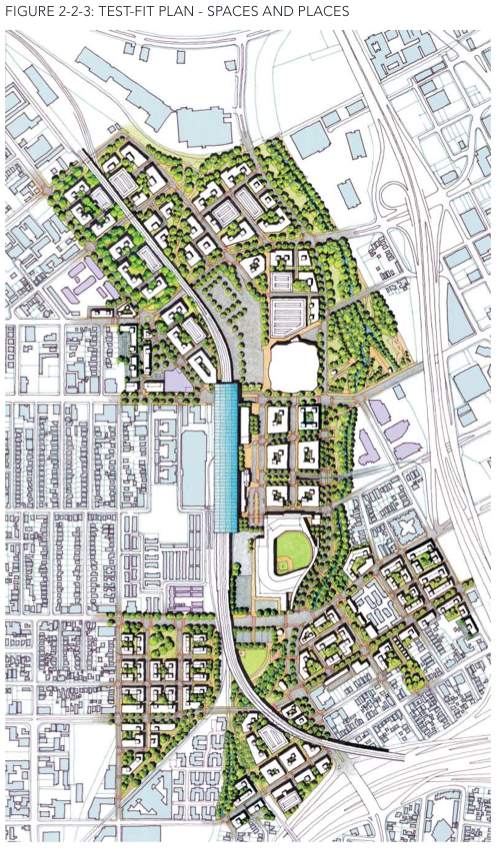
Full buildout. North of the arena is the industrial/commercial sector. South of the ballpark is residential. Retail/commercial is between the ballpark and arena. Autumn Parkway is completed through the area.

Tracy Seipel’s article makes mention of the potential need for a master developer, as was the case for Mission Bay (Wilson Meany Sullivan) and the Kansas City Power and Light district (Cordish). The same strategy was employed during planning for the Fremont ballpark, with Gensler as the master developer. While such a strategy could properly unify what would probably be disparate elements of the plan, threats to redevelopment make such a broad scope less realistic. As long as the plan sets out proper guidelines for how development should occur (which it does), the spirit of the area plan should be fairly easy to uphold. Just about everything larger than a single family house will require an EIR on its own.

Lew Wolff said in the past few months that he wouldn’t have anything to do with developing the critical Central area framed by the train station, arena, and ballpark. Knowing how the city fathers have failed time and time again in trying to turn the original downtown into a viable retail district, current civic leaders and developers should not have grand designs on proceeding down a similar path with this. There are three key reasons:

  • No free parking. I don’t mean validated parking, I mean unfettered free parking. Valley shoppers are too used to it and won’t react well to not having it, even if it’s a good idea to charge from a multimodal planning standpoint. Even though Valley Fair and Santana Row are logistical nightmares during the holiday shopping season, people deal with it. A big reason for this is free parking.
  • Inflexibility with events at the arena and ballpark. Parking and access will be heavily impact on event days, especially days when events are happening at both venues. It could create an environment in which locals stay away from the area while events are on. Locals want convenience, and events make convenience difficult to achieve.
  • Market conditions. Development could stretch out over a decade after the project begins thanks to the timing of the BART and HSR projects. That could make it difficult for developers and retailers to gamble on moving in as long as the area remains in a seemingly perpetual state of upheaval.

Historically, San Jose has sought to bring in high-end brands to attract the more well-heeled. The Pavilion downtown failed miserably in that regard, and stopped being a mall over a decade ago. Santana Row opened with numerous tony boutiques. Several years later, most of them have been replaced by typical mall stores.

None of this is to say that the Central area can’t be successful. There is one brand that could conceivably defy San Jose’s jinx and make things work in the end: Apple. Apple could open a store in a toxic waste dump and it’d be successful. They’ve looked at opening stores at or inside highly trafficked transit hubs, including Grand Central Terminal. So if there’s one tenant that the developers and landlords should pursue, it’s the Cupertino tech company. But wouldn’t it be ironic if this district, which at 900-feet long is less than a block shorter than Santana Row, stole business from the San Pedro and SoFA neighborhoods? I could see it.

Strength in numbers

Since Let’s Go Oakland and the City of Oakland made their pitch to Bud Selig’s panel last year, there has been a curious talking point emerging from that camp, “We have enough corporate support.” The argument is that Oakland’s geographic placement between San Francisco and the growing East Bay (if not Oakland) makes it well suited to capture corporate clients for premium seating and sponsorships. To that end they’ve listed about two dozen companies, many of whom are not headquartered in the East Bay, who could sign on with a new Victory Court ballpark. It sounds reasonable on the surface. Scratch that surface a little and it looks a little weak.

For Oakland there is a “checkbox” problem. Oakland partisans frequently cite Clorox, Kaiser Permanente, Dreyer’s, and Cost Plus, plus Chevron if they extend the reach a bit. If Oakland has Cost Plus and maybe Ross Stores, San Jose has Orchard Supply Hardware and Fry’s Electronics – and those latter two companies have proven track records sponsoring sports in the South Bay. These are the low hanging fruit of the corporate game. Every team has official sponsors and partners for which there are exclusive deals. For instance, Kaiser Permanente would be a fantastic official health provider/insurance of the A’s and the new ballpark. It is huge, national, and is a major presence throughout the Bay Area. However, there are multiple available substitutes who would love to have regional market exposure, yet the exclusivity part restricts them to radio or something else. Right now the A’s have Washington Hospital Healthcare System, a Fremont-based partner whose deal goes back to the Pacific Commons concept days. Maybe the price of such a sponsorship will be too high to renew with a new ballpark, maybe the location (if it isn’t Fremont) won’t prove attractive given Washington Hospital being Fremont only. If Kaiser doesn’t sponsor Cisco Field it leaves a competitive opportunity for one of the other large HMO’s (PacifiCare, Aetna, Anthem Blue Cross, etc.) to swoop right in, along with another hospital network.

Along the same lines, there are numerous other official sponsors who should be there regardless of where the ballpark is. Chevron signed on with the A’s a couple years ago after several years with Valero instead. There will be an official fuel sponsor regardless. There will also be an official soft drink provider (Pepsi), beer (Budweiser), broadband provider (Comcast), mobile phone carrier (Verizon), and newspaper (BANG). These are the easy gets because in many cases there are other related deals in place, such as CSN’s broadcast rights or Pepsi’s pouring rights. Chevron could choose not to go with a San Jose ballpark, but that risks losing exposure in the company’s backyard.

It’s when you get past the checkbox deals that it starts to become difficult. It’s not going to be hard for the A’s to get those deals above. Nine-figure naming rights deals are hard. Suite deals can be challenging, especially if they don’t involve one of the vaunted sponsorship slots. That is where the comparison between what Oakland and the rest of the East Bay can muster up vs. what San Jose and Silicon Valley can provide ends.

The second problem is one of competition. The team will need to do more than just sign Company X to some deal. They need to extract maximum dollars upfront to pay down the large debt service that will come with new digs. That means that getting 32 or 33 companies, as Doug Boxer suggested, isn’t enough. There needs to be a real market situation that can propel those revenues. Without that demand and those commitments in place it’ll be harder to put together the financing piece. If you look at SVLG’s letter from last September, you see a lot of competitors in the same industries signing on. Wells Fargo and Bank of America. Cisco and Brocade. HP and IBM. Three different venture capital firms. Numerous competing chip manufacturers. It’s creating a situation where there have to be winners and losers, and that’s good because it should create mini bidding wars. That’s what you want – no, need – if you’re MLB and the A’s and you have $25-30 million in debt service every year.

The Mercury News has an index of local publicly traded companies called the Silicon Valley 150. The combined market cap for those 150 companies is $1.55 trillion, and well over $1 trillion just for the top 50. The list below (all figures FY 2010) omits companies outside of Santa Clara County and nearly every company beyond #60, yet it remains impressive.

There are some companies who I wouldn’t expect to be involved in a major way with Cisco Field, such as Google and Apple. Neither company has done much in the past in terms of sports sponsorships, and their focus tends to be global instead of local. Maybe they’ll get a suite or club seats to use as employee perks, maybe not. Whatever they do, it’s reassuring to know that so many other companies stand ready to fill in the gap. Interestingly, many of the companies will have a motivation that only applies to the Valley and has since the dot-com boom. Top tier software engineers are in extremely short supply, and competition is so fierce among various tech companies that they are throwing crazy money at the so-called rock stars of the industry – not just to sign, but to stay. The market has effectively exploded after a DoJ investigation that uncovered a “no poaching” gentleman’s agreement among the biggest, most well funded tech companies. Now that there are no restrictions, self imposed or otherwise, the market for engineers and C-level talent is unfettered and extremely competitive. The billboards along Highway 101 aren’t selling for millions as they did in the 90’s, but they still serve an important purpose for tech companies looking to catch the attention of talent. Signage at HP Pavilion and commercials on Sharks broadcasts serve the same purpose. Even now, Rambus has an aggressive ad campaign running during Sharks games on CSN California. Rambus doesn’t sell anything to consumers. It barely sells things to companies. Much of Rambus’ revenue comes from patent licensing and awards from lawsuits against patent violators. What the company wants is new engineers to create the next big advance in memory technology that could create the next patent licensing gravy train. Those engineers are predominantly in the Valley.

Multiply Rambus’ efforts by 100 and you have the potential for Cisco Field. The A’s are well positioned to take advantage, as they could lock a high bidder into a 10-year deal if the market is competitive enough. Those long-term agreements are what made China Basin possible. It’s what Oakland will need to get a ballpark built, since they and we know that the A’s would have to pay for it in the end. For Oakland it’s a much bigger challenge because its accessibility from the Valley and the Peninsula is not great and will be worse if they move to Downtown Oakland. Oakland simply cannot replicate those market and network effects. There are burgeoning industries, such as green tech, where several Oakland companies are out in front. Unfortunately, few of those companies are as yet profitable and many require massive government subsidies to keep them going, which is not a bad thing for the nation moving forward towards energy independence but puts those companies in a position where bidding wars for suites and signage doesn’t make much sense. Another indicator is media coverage. The East Bay Business Times, which contacted me almost six years ago shortly after this blog was started, folded in 2008 and was merged with the SF Business Times. Sister publication San Jose/Silicon Valley Business Journal remains in print and relevant, and is one of the companies in the SVLG letter.

Let’s be clear. Oakland and surrounding East Bay cities have corporate strength. Some of it is homegrown, some of it is from subsidiaries of larger companies. To compete with the South Bay it will need every bit of that strength. Since we don’t know what LGO’s list of commitments consists of, we can’t say whether it makes Victory Court more or less feasible. As long as the there is such a vast disparity between the East Bay and the South Bay, questions about that feasibility will linger, fair or not. The campaign needs to be much more than “We’ve got enough.” Because what you consider enough may not actually be enough for those who make the loans and the others who have to pay them off. Sacramento put together $10 million in commitments in the span of a few weeks. Sacramento is coming strong. That’s what needs to be done to convince MLB that Oakland can work in the long run. That’s not hate. That’s reality.
Nuggets from the Boxer and Reed interviews

I recorded the two interviews using TuneIn Radio (really worth getting on your smartphone platform of choice), so I had a chance to listen to them again. I picked up on a few things that I thought would be interesting to discuss. First, the Boxer portion.

  • Boxer mentioned that the suite requirement for Victory Court was 32-33 boxes, not 40 (which is what Wolff is aiming for). Perhaps this would explain why the capacity is greater (39,000), to make up for the reduced suite requirement. Maybe this is a realization of how difficult it is to sell suites in the East Bay with the corporate environment.
  • Since Boxer left Oakland’s Planning Commission in February, he hasn’t been as plugged in regarding the EIR process. That’s a shame when you consider that there’s such a vacuum when it comes to real information right now.
  • Townsend was bit miffed when he tried to get Oakland Mayor Jean Quan on for the segment. Her office referred him to Boxer instead. That’s not to say that Boxer wasn’t good – he was, especially because he talked for an hour – but it shows there’s a disconnect. They want to say that they’re operating within a gag order, but that gag order should be extended to San Jose Mayor Chuck Reed, so why was he available while Quan wasn’t?
  • People jumped on Boxer for misstating attendance and Townsend for naming the wrong company for the ballpark, to which I say, “STOP.” None of that matters. You’re getting distracted by the most insignificant details.
  • The Coliseum has been effectively deepsixed as any kind of ballpark site by MLB.
  • Boxer admitted that if redevelopment goes away, getting the plan going would be very challenging. He notes that some development powers should be enshrined in a successor agency, though it’s unclear how far-reaching those powers would be. What’s going for Oakland is that CEDA/ORA has bonding capacity for further land acquisitions and infrastructure improvements.
  • Boxer also mentioned that the EIR process takes the better part of a year to complete. While he was probably referring to the entire process (it usually takes longer), a draft shouldn’t take anywhere near that long.
  • Boxer alleges that Schott/Hofmann didn’t pursue the Uptown site because if they committed to it, they feared that the franchise’s value would drop. Curious. Update: The franchise value would have dropped because the team would have been less attractive if it were locked into a new stadium.
  • Boxer mentions in passing that Wolff may have violated the contract with the Coliseum Authority by talking to San Jose in the past. That again? If that’s a problem, then just sue already, stop talking about it and do it. Before John Russo escapes to Alameda.

Now for the Reed segment, which was much shorter.

  • Reed hasn’t had any direct contact with Bud Selig. He and his team have been working solely through Selig’s committee. Reed thinks the work is finished, though it’s hard to tell at this point.
  • As in recent print interviews, Reed is palpably frustrated.
  • Reed’s not giving up on the ballpark as long as Wolff is optimistic.
  • No word on whether Reed would try for this November’s election. I’m guess no unless word comes down from on high.
  • Reed referred to the new joint powers authority (San Jose Diridon Development Authority) as carrying on the ballpark development work as SJRA shrinks or disappears.

What did we learn today? Not much. There will be some pro-Oakland folks who are happy that Boxer was on for an hour, which was good. However, the fact that no new information came out was highly disappointing. Hope can’t live on words alone.

P.S. Really great work by Chris Townsend today. There’s been more stadium talk in the last week than in the last five years on all of the sports and talk radio stations combined.

Boxer, Reed on with Townie Monday

As mentioned in the previous post, there will be stadium talk on Monday on The Chris Townsend Show. It kicks off with Let’s Go Oakland’s Doug Boxer from 1-2 PM. That’ll be followed up by a presumably non-stadium segment with Jose Canseco. At 2:45, San Jose mayor Chuck Reed will be on. Boxer will be taking questions from callers, which will be great. It gives him an opportunity to feed the Oakland faithful with news, hopefully about a forthcoming Draft EIR, even though most of them won’t read it (most of the people in San Jose didn’t read theirs either). I won’t be calling in, but if you are and you need some ideas for questions, here are a quick ten:

  1. When will the Draft EIR be released/distributed?
  2. Are there any great renderings, illustrations or site plans to accompany the EIR?
  3. How long do you think it’ll take to get the EIR approved and certified?
  4. Are there any alternate ballpark sites in the EIR besides Victory Court?
  5. Will there be an alternative that only includes land up to Fallon Street, or is it still everything west to Oak Street?
  6. Have any additional Victory Court parcels been acquired yet?
  7. Is the plan to have the ballpark face the Estuary (SE), Lake Merritt (NE), or Downtown (N)?
  8. Why is the plan to have 39,000 seats?
  9. We know that you’ve been working with MLB. Has there been any communication with the A’s and Lew Wolff? If not, is that by design?
  10. What do you think of what’s happening in Sacramento with the Kings right now?

I’m sure you readers can come up with plenty more good questions. Can’t wait for Townie to do his thing.

Isaac and Suke to take ballpark issue on today

Listening to the end of the Monty show, Isaac and Suke came on to tease that they were going to talak ballpark during some part of their 10-1 slot. Monty weighed as an Oakland-backer, saying that the team won’t be the same. Isaac talked about the difficult choices to be made about revenue for the future. Should be interesting, coming up.

Update 10:50 – Awesome call Jeffrey. BTW, still no Victory Court EIR.

Update 11:40 – I’ve liked the discussion so far. Isaac and Suke admittedly don’t know everything about the subject, but they’re giving everyone a shot to give their two cents. If they have people going with the crazy talk on the station’s Facebook page like “These guys are being paid by Wolff” they’re covering it well. It’s not an easy topic to cover and people tend to act more from emotion than pragmatism. Also – good call about the impact of redevelopment. It’s the lengthiest discussion on the radio about the A’s stadium issue ever, and I couldn’t be more pleased. Also, thanks for the plugs callers.

San Jose City Council Session 4/28 Agenda

An agenda for the April 28 (9-12 AM) City Council Special Session was posted recently (PDF) at the City of San Jose website. The relevant stuff:

Note one of the focus items: HP Pavilion. Undoubtedly, the City and the Arena Authority are looking at what’s transpiring in both Sacramento and Anaheim and they’re using that information as a guide for a future NBA team pursuit, if/when the opportunity arises. Honda Center has more square footage than HP Pavilion due to having three concourses, but its footprint is slightly smaller than HP Pavilion (though there’s more room to expand in Anaheim). Should Anaheim get the green light for the Kings/Royals, the cost baseline will be set by the final, league-approved agreement between the team and arena operator.

Beyond that, the City Council is looking to approve the Draft Diridon Station Area Plan. The most recent version was released this month, so if you’re interested in the vision it’s worth a look. Keep in mind that this new transit hub vision isn’t going to get built until at least after the end of the next presidential term. With that in mind, the discussion is expected to be long-range, though there may also be some mention of the impacts of federal transportation funding cutbacks and $4-per-gallon gas.

There are a ton of interesting details in the plan, which if approved would be subject to a lengthy CEQA review.

  • The six-block area between the ballpark site and arena has a 130′ building height limit. That would make it higher than both the arena’s roof and probably higher than the light standards at the ballpark. The area remains small, but having 10-story buildings could make up for that somewhat. All of the development there would be commercial in nature.
  • The Central Zone, which includes the ballpark site and the six blocks between the ballpark and arena, would be slated for up to 140,000 square feet of retail, 1.14 million square feet of office space, 250 hotel rooms, and 920 spaces (all in garages).
  • Montgomery Street is the designated retail corridor and would be closed off to vehicular traffic for special events. Those scenes on Autumn Street outside HP Pavilion during Sharks games? They’ll be moved to Montgomery.
  • The only new venue-specific parking would be the garage north of HP Pavilion that was approved by the City last year. Additional mixed-use parking may be available should new office development occur in the industrial areas north and west of the arena. Total parking for both: 6,832 spaces, almost all of them in garages.
  • Residential development would be confined to the Southern Zone, south of Park Avenue.

It’s probable that much of this stuff won’t get built. The EIR process may dictate lower building heights, and the market for office space and retail may not warrant extensive building even a decade from now. Changes to the redevelopment may curb the scope of development in the area. Even so, city and community have been shaping this for the last three years and if San Jose is going to be less car-centric city, this is a huge step forward. That’s the point of defining a vision.

SJRA’s party ends, SJDDA’s begins

Wary of Governor Brown’s intent to dismantle redevelopment and weary of budget woes, the San Jose Redevelopment Authority laid off nearly half of its staff and is ready to cut almost all of the rest, according to the Merc’s Tracy Seipel. Some city backers feel SJRA’s work is unappreciated and unfinished, while redevelopment detractors consider the agency a bloated, wasteful example of government overreach. SJRA has been winding down its work over the past year, with only a few projects remaining.

Other than a much-hoped-for baseball stadium in downtown San Jose, a 700-plus-unit housing development in the area north of downtown’s San Pedro Square and infrastructure improvements within the agency’s 21 project areas, there isn’t much left on the agency’s plate.

Of course, there’s the fact that the City created the San Jose Diridon Development Authority last month. This “Son of RDA,” as I coined it then, will have the power to do virtually everything that SJRA can do now, except that it will be restricted to a specific part of downtown San Jose including the ballpark site. The lawsuit by the county that threatened the newborn agency? Settled. SJDDA currently has no website, no specific projects, and no end date. For now its only limitations are what the City and various public and private interests dream up for the district. That includes a ballpark, San Jose’s “Grand Central Terminal,” a small mixed-use development, just about anything.

So while Dandy Don Meredith may be singing while SJRA head Harry Mavrogenes turns out the lights, it’s likely that some of the agency staff, including Mavrogenes, will end up with similar jobs at SJDDA. Mavrogenes was a signatory to the joint powers agreement.

Redevelopment is dead. Long live redevelopment. Especially if the City makes it happen.

Update 4/8 2:10 PM – The first payment made by the City to the County as part of the settlement was made on schedule, with additional payments forthcoming. When you have to make a $21 million payment with only a few weeks to spare, costcutting measures such as layoffs have a good chance of happening.

Deal struck between San Jose and Santa Clara County

It took until the very last minute, but Santa Clara County pulled back from its lawsuit against San Jose when the two parties struck a payments and land deal. As reported by the Merc’s Karen de Sá and John Woolfork, the key is the City relinquishing its old City Hall north of downtown to the County. A smallish, dated postwar relic, the old City Hall could work fine as additional office space for the County. There are also suggestions that the County could turn the land around to a housing developer, which isn’t exactly promising given the land’s proximity to San Jose’s Main Jail. The property is right next to the Civic Center light rail station, which might make it attractive (It’s not really the Civic Center anymore – shouldn’t the station be renamed?). Talks about the transfer have been happening pretty much since the new City Hall opened. It’s a good deal in one sense for the County, as the corten-steel Government Center is next door so consolidation of the bureaucrats can begin in earnest. Or, if the hint in the document is correct, demolition can begin in earnest.

Additionally, the City would pay the County $21.5 million by March 30 and $5 million by May 15. Hopefully that money can address county services that would otherwise face cuts. Part of that money will come from 50% of the proceeds from the North San Pedro (Brandenburg) sale. Five payments of $4.756 million each (plus interest) will be due by the end of each of the 2014-18 fiscal years.

The upshot is that the San Jose Diridon Development Authority will remain intact, depending on the endgame of RDAs. Existing tax increment passthroughs would continue to be applicable at Diridon. Sometimes it takes a crisis to bring about results.

News for 3/14/11

Today’s hearing for Santa Clara County and the City of San Jose may set the stage for a proper settlement between the two parties over $62.9 million in redevelopment funds owed to the county. The Merc’s Karen de Sá has the details, including this bit from County Supervisor Dave Cortese, who has long been a ballpark backer:

“This is what we call a straight breach of contract, it’s not that much different than if somebody got behind on their car or house payments — you gotta settle up,” said board president Dave Cortese. “The difference is, this isn’t money for a car payment, this is money that needs to go toward all the services the county provides, everything from emergency rooms to a regional park service, libraries and courthouses. There’s no end to the hardship that would result in us being out of pocket $63 million.”

City Attorney Rick Doyle is among those who believe a deal can be reached by Wednesday, which is when the State Legislature is supposed to hear the new budget proposal.

Santa Clara is set to wrap up its work to protect RDA funds for the 49ers stadium project tomorrow.

San Diego is considering a Diridon-like transfer of 135 RDA-owned properties to the City.

Longtime NY Times baseball writer and anti-blog curmudgeon Murray Chass keeps up the weekly trickle of nationally-sourced articles pushing for the A’s to move south. This one follows a widely used AP piece last week. I sense a strategy in there… Chass’s column comes two years after a similar entry at his site, the difference this time being the appearance of Bill Neukom on the scene.

Jonah Keri’s new book about the Moneyball-style rise of the Tampa Bay Rays is out. The book is titled The Extra 2%: How Wall Street Strategies Took a Major League Baseball Team from Worst to First.

Added 3/15 1:00 AM – In Sunday’s edition of the Chronicle, Matier and Ross reported that Denver attorney Paul Jacobs was hired by Oakland to be its lead negotiator for the Victory Court project. The $455 per hour hiring, which wasn’t publicized immediately because it was done in closed session, is a big deal because Jacobs is prominent in the Western US for working on stadium deals. His biggest claims to fame are his role in putting together the resources that eventually created the Colorado Rockies, and the ballpark and land development deal around PETCO Park. As is often the case in the stadium game, Jacobs isn’t batting 1.000. More recently he worked on the aborted Pacific Commons project in Fremont and was retained by the City of Oceanside in its efforts to figure out a football stadium deal for the Chargers. One thing I’m curious about is whether or not the firm Barrett Sports Group was brought in. The last two links include mentions of Barrett Sports Group, the “other half” to Jacobs, with both hired as a package deal of sorts. Jacobs handles the real estate stuff, while BSG takes care of facility planning and financing. BSG counts A’s and Giants ownership as two of its many current or former private sector clients.

Getting ready just in case

KCBS radio reported yesterday that an online construction bidding service, bidclerk, has a new or updated listing for an A’s stadium San Jose (paid subscription required). The value of the project is $400 million, less than what we’ve frequently discussed as the cost of the ballpark. Start date is listed as January 2013. The project description goes as follows:

New construction of an athletic stadium in San Jose. Preliminary plans call for the construction of a 32,000-seat baseball stadium. The stadium will include concession areas, restrooms, ticket boxes, V.I.P. areas, locker rooms, a medical facility and offices.

This project is contingent upon approval from Major League Baseball and the city. Construction is scheduled to begin no earlier than the first quarter of 2013.

The listing dates back to 2006, when the A’s were looking in Fremont. Strangely, the included documents are two of the now outdated Pacific Commons renderings alongside one recent San Jose rendering. Listed as project contacts are Lew Wolff and 360 Architecture principal Brad Schrock. There isn’t much information right now other than a heads up to interested contractors. Should the project be approved by MLB and SJ, activity should increase appreciably.

Wolff’s Maritz-Wolff development company also lists the Earthquakes’ stadium project. Some light-oriented schematics are included, and the project description indicates how much further along the project is compared to the ballpark:

Site work and new construction of a mixed-use development in San Jose. Schematic plans call for the construction of a 20,000-seat soccer stadium.

This project is currently in the financing stage, and construction is tentatively expected to begin in spring 2011.

In both cases, they are accurate reflections of where the two projects stand. That leaves the January 2013 start date for Cisco Field the one truly speculative item. Should it start at that date, construction would have to be completed in 27 months to be done prior to Opening Day.