Larry Stone speaks, some won’t like it

KCBS Radio did one of their In Depth interviews with Santa Clara County Assessor Larry Stone (MP3 download). Stone has, of course, been a active, constant proponent of bringing MLB to the South Bay, and has used his easily won public office as a bully pulpit. Stone was asked about the history of now 24-year effort to get this done, plus fielded questions about whether his roles as assessor and developer are conflicts of interest. If you’re a South Bay partisan, you’re going to think what he’s saying is gospel. If you’re an Oakland partisan, your ears may bleed profusely. It’s over 27 minutes long and well worth the listen (thanks, I.C.).

Among the morsels from the interview:

  • Within the first two minutes, Stone makes the claim that the A’s can’t survive in Oakland.
  • Stone is (IIRC) the first public figure to say that the Giants are trying to drive the A’s out of the market. When challenged on this, his response is, “Anybody would try to do this.”
  • Apparently the Earthquakes are not considered a major pro sports team, at least according to Stone. He must’ve forgotten them.
  • He thinks the Giants could spend $2-3 million to defeat the spring ballot measure.
  • Stone dances around the idea that some of the owners might feel threatened by another team invading their respective territories.
  • SJRA has the money set aside for the last two parcels (AT&T and Aegis).
  • Stone claims that when he talked to Schott some time ago, Schott had 75% of the owners lined up for a vote for a move south.
  • Stone speculates that Selig gave the Giants a “10 year head start” for the SC Co. t-rights, in effect protecting the county for a decade.
  • Interviewer Jane McMillan characterizes the Diridon area as “suburban” in comparison to what would normally be considered urban areas for other ballparks. Where does urban end and suburban begin?
  • McMillan also asks if a deal is done, but unfortunately says that the ballpark will be shared with the Quakes (which it won’t), which got Stone’s response moving in the wrong direction.

It’s a good listen, though if you’re on the SJ bandwagon you’ve already heard many of the talking points.

BTW, on an unrelated note, the Rangers secured a 20 year, $3 billion extension to the current TV rights deal with Fox Sports Southwest. $150 million a year (Maury Brown thinks the numbers could be off). Guess they won’t have that big debt problem that could keep them from re-signing Cliff Lee and extending Josh Hamilton.

San Jose City Council approve resolutions to support A’s move

Update 9/21 7:40 PM – Resolutions (city and redev agency) passed unanimously. Mayor Reed says that he’ll be talking to MLB COO Bob DuPuy soon to get some direction, and that he’s cautiously optimistic that he’ll get a resolution soon.

Tomorrow night, the San Jose City Council will vote on another set of resolutions (city and redevelopment agency have slightly different versions) in support of a move south. From what I can tell, the only significant language change was the recognition of recent statement of support by SVLG and 75 of its constituent CEO’s.

I will not be attending the session, but I will be monitoring it remotely. Action on the resolution is slated to be early in the agenda. If you’re interested, here’s the newest language:

RESOLUTION NO. ____

A RESOLUTION OF THE COUNCIL OF THE CITY OF SAN JOSE:
(A) REAFFIRMING THE NEGOTIATING PRINCIPLES PREVIOUSLY ESTABLISHED AND AMENDED BY THE CITY COUNCIL; AND (B) SUPPORTING THE EFFORTS OF THE OAKLAND ATHLETICS OWNERSHIP TO MOVE THE TEAM TO SAN JOSÉ AND THE ASSISTANCE OF THE SILICON VALLEY LEADERSHIP GROUP AND OTHER LOCAL GROUPS IN THEIR EFFORTS TO BRING MAJOR LEAGUE BASEBALL TO SAN JOSE

WHEREAS, on April 7, 2009 and August 3, 2010, the City Council and Agency Board affirmed its interest in supporting the efforts of the Oakland Athletics’ ownership to move the team to the City of San Jose; and

WHEREAS, on May 12, 2009, the City Council and Agency Board established Negotiating Principles for the development of a stadium in the Downtown for a Major League Baseball team, which were subsequently amended by Council on August 3, 2010; and

WHEREAS, on September 10, 2010, through the efforts of the Silicon Valley Leadership Group, a letter from seventy five (75) of Silicon Valley’s leading CEOs was sent to Major League Baseball urging Commissioner Selig to approve the Athletics’ move to San Jose; and

WHEREAS, various local organizations, including the San Jose Silicon Valley Chamber of Commerce, the San Jose Convention and Visitors Bureau, the San Jose Sports Authority and Baseball San Jose, have all expressed their support for the Athletics’ move to San Jose, and Lew Wolff, the Athletics’ owner, is also on record as indicating he would prefer San Jose as the new home of the Athletics; and

WHEREAS, the Council desires to reaffirm the following previously-approved Negotiating Principles that will guide the City’s efforts in bringing a Major League Baseball stadium to San Jose:

1. No new taxes are imposed to fund ballpark-related expenditures.

2. The City must determine that the ballpark development will generate a significant economic benefit to the City and have a positive impact on City General Fund revenues.

3. No public funds shall be spent to finance or reimburse any costs associated with construction of the ballpark or construction of any on-site infrastructure or improvements needed for the ballpark.

4. No public funds of any kind are spent to finance or reimburse any ballpark operational or maintenance costs related to activities conducted by or under the authority of the baseball team that uses the ballpark either at the ballpark or in the streets surrounding the ballpark.

5. No public funds shall be spent to finance or reimburse the cost of any traffic control, street cleanup, emergency or security services within the ballpark site or within the streets surrounding the ballpark that are related to activities at the ballpark conducted by or under the authority of the baseball team.

6. If the property is leased for a ballpark, the baseball team must be willing, at the end of the term of the lease, either to purchase the property at fair market value or to do one of the following things at the City’s option and at no cost to the City or the Redevelopment Agency:

a. Transfer ownership of the improvements to the City or Redevelopment Agency; or
b. Demolish the improvements and clear the site to make way for other development.

7. The entity that builds or operates the ballpark must be willing, if the City deems it appropriate, to make the ballpark available to the City during baseball’s offseason for up to 10 days per year for community-related events, at no rental charge to the City.

8. The name of the baseball team must include San Jose.

NOW, THEREFORE, BE IT RESOLVED THAT THE COUNCIL OF THE CITY OF SAN JOSE:
(a)  Reaffirms the negotiating principles previously established and amended by the City Council; and
(b)  Supports the efforts of the Oakland Athletics ownership to move the team to San José and the assistance of the Silicon Valley Leadership Group and other local groups in their efforts to bring Major League Baseball to San Jose.

I don’t expect this to change unless MLB makes its own announcement, after which the resolution would be amended again. This is what we can expect until the spring election, if it occurs.

Some choice quotes from public speakers at the session tonight:

Michael Mulcahy: I’m not a San Francisco Giants fan, but I’m rooting for them to make the playoffs so that we can see how that transforms a city.

Former Mayor Susan Hammer: I’m getting a little impatient with the snail’s pace of Major League Baseball.

If You Got Any Money Left Over, Buy Yourself Something REAL Nice, Clark.

The headline is a quote from one of my favorite movies of all time, National Lampoon’s Christmas Vacation. It is spoken by Cousin Eddie as he loads up a shopping cart with dog food that his Cousin-in-Law, Clark Griswold, is expected to pay for. At this point in the movie, Clark is telling Eddie that he wants to make sure Eddie’s children have a nice Christmas and that he is willing to buy them some gifts if it will help. Eddie’s “gratitude” is clear when he pulls out a prepared list of things his children want for Christmas. What the heck does this have to do with the A’s and a new stadium?

The elephant in the room, the one everyone seems to be ignoring, is that the details of any financing plan for a new Bay Area stadium are murky, at best. We all hear “privately financed” bandied about in media reports. But what does that really mean? After all, with rare exceptions, MLB has played Cousin Eddie to just about every city that has seen a new stadium go up in the past 25 years.

The only real exception, though it was not entirely privately financed, is AT&T Park. Using this park as an example, 96% was privately financed, we can back into what “privately financed” actually means. Roughly half of that funding was provided through corporate support,  or the combination of naming rights (Pac Bell) and Charter Seat sales. The other half was in the form of a loan provided by Chase Bank, secured with MLB’s help. It seems clearer and clearer that this is, mostly, the model that MLB has in mind for the A’s.

So what evidence do we have that a ballpark in either Oakland or San Jose will follow a similar model? For one, we have the report that MLB has discussed a loan of $150M with folks in Oakland. We have the letter from Ron Dellums and Jane Brunner talking up deposits from 35 companies (amongst other things). We also have a recent letter from Silicon Valley power players to Bud Selig supporting a move down 880. Now we have the follow up Op Ed in the Mercury News, authored by two of those power players (Mike Klayko of Brocade and Tom Werner of Sun Power) pretty much restating the original letter. The key line from the Op Ed is:

Along with other respected and diverse organizations, we stand ready to offer any support needed to move this important project forward.

And from the SVLG 75 CEO/Other Important People Open Letter (Fourth paragraph, first sentence):

The Silicon Valley Leadership Group, along with other respected and diverse organizations, stands ready to offer any support needed to move this important project forward.

On the surface, these are clear statements meant to persuade Selig. In part, they are meant to show that the corporate support needed for both long term viability and a private financing scheme is there, in both cities. This is where the similarities end.

In the San Jose case, There are a few other Easter eggs that are not getting much mention.

I think MLB’s propensity for being Cousin Eddie, to (Insert City Name Here)’s Clark, is part of what the letters and Op Ed are about. Or, in other words, these messages are not only intended to allay Bud Selig’s fears (assuming he has them). They are also a signal to let citizens know that their “Corporate Citizens” are ready, willing and able to buy Charter Seats and sponsorships as part of any plan. We already know that Cisco is going to play Pac Bell’s role in a San Jose version of San Francisco’s funding scheme.

Another part of this message is, Miami is mad at you MLB for playing Cousin Eddie while the Marlins weren’t really living out of an RV, as they had claimed. If you come to San Jose, you don’t have to worry about that. We, the SVLG, will be Clark instead of the tax payers.

Additionally, there is the repeated mention of Giants fans within the SVLG communiques. This is meant to let Bud Selig know that there won’t be a mass exodus of Corporate support up in Baghdad by the Bay. That the Giants won’t become destitute, as Larry Baer wants us all to believe, provided the A’s move south. To undercut Bill Neukom’s argument for locking MLB out of San Jose.

There is one other thing hidden in the subtext. Watch this video, the important part comes up at 5:05.   When you combine John Chambers’ message (We won’t put our name on a Stadium in New York because we are in San Jose) with the fact that the SVLG letter and the Brocade/Sun Power Op Ed go out of their way to avoid mentioning the word “Oakland” and “new stadium” in the same context, the message is pretty clear. Bud Selig, we want the A’s in San Jose and will buy sponsorships and ticket packages for both the Giants and A’s if it gets us a stadium in San Jose. Not so much in Oakland.

I think it is fair to say that this what the messages are, don’t you?

What we don’t know, what the letters don’t tell us, is how much of any new stadium will be financed by corporations/presales and how much by loans, exactly. In the San Jose case, if 60 of those 75 companies bought some bundle of seats and advertising, and Cisco maintained $130M in naming rights, they would each need to pledge $1.7M of their Selling, General and Administrative budgets to Cisco Field in order for the combination of naming rights and Corporate sponsorships to cover half of the projected construction costs. As a point of reference, Yahoo’s S, G and A budget last year was $1.8B, which means this overly simplified $1.7M number represents less than one tenth of a percent of the budget where it would need to come from. There is a similar situation with Cisco ($9B), Brocade ($500M), Ebay ($3.6B), and so on and so forth.

Of course, we know that SVLG has well over 75 members and more members might be willing to chip in (while others, like the San Jose Giants, won’t be). I am guessing Bud Selig knows this, too. This is the biggest thing going against the possibility of Clorox Coliseum. If Oakland isn’t pledging public dollars for construction, how does the thing get paid for? If Oakland really is pledging pubic dollars (as I have been told) for construction, how long before pitch fork wielding citizens show up at City Hall?

The answer to this question (How does stadium construction get paid for?), not Larry Ellison’s attempt to buy the Warriors, not Bill Neukom’s Anti-Trust case won/loss record, and not 15 years of back and forth between the A’s and Oakland is what will, ultimately, decide where the A’s will play.

In short, it is “tradition and history” v. “a clear source of funding.” We can handicap this however we want, but it is what it is. I don’t know which will win out.

****(I am adding a table that shows the split between private and public funding at the most recent 21 MLB ballparks built for all of our info. It originally came for  the San Jose Economic Impact Analysis)

Funding Mix Private v. Public

Reaction to the SVLG letter

Before we get started, our thoughts and prayers go out to the victims of the San Bruno Crestmoor fire. I have relatives that live on the other side of the fire from 280, and they’re okay. Those affected were not so fortunate.

A few articles have come out in the last 24 hours since the soft pitch to Selig.

I’m in agreement with Ratto on the “MLB won’t be rushed” argument, but I’m not with him on how San Jose needs to show money and shovels. The City has already laid out its process for Selig. It acquired half the site, had the vote lined up for November, which would authorize eminent domain for the rest if negotiations got to that point. But Selig asked for a delay, which means that MLB is the party that needs to get its ducks in a row, not City.

Furthermore, Ratto is one of the few Bay Area writers who believes that the T-rights negotiation is a relatively trivial matter:

Oh, and whole you’re not wondering about that blue-ribbon committee, stop wondering about territorial rights, too. Territorial rights were, are, and will be a simple negotiation about how sizable a bribe the Giants will need to shut up. And if the Giants want to get cranky about it when the other owners are ready to move the A’s, they can be de-legged with a simple 29-1 vote. You know, the kind Bud specializes in at big moments like this.

While I think that a vote will probably come out 29-1 or 30-0, it’s getting to that point that’s the hard part. If, as Ratto argues, City and the A’s need to show more money and shovels, there’s a problem. A company like Cisco has already stated what it’s willing to do. Does Selig want to risk losing Cisco to the 49ers, who’d love to poach them for their own naming rights deal? By including the A’s in SVLG, they’ve created a sort of corporate solidarity. It’s up to Selig. The more he draws this out, the more he risks pissing off SVLG and its members. If he wants their business, it’s as much up to him as it is them, an argument from the letter that was made in an oh-so-subtle manner.

Update 9/13 11:00 PM: The CEO’s of SunPower and Brocade have reinforced the SVLG letter with their own opinion piece in the Merc.

SVLG makes plea to Selig

It’s best that I just post the contents of the letter sent by SVLG to Commissioner Selig today (Merc article), so without further ado…

September 8, 2010

The Office of the Commissioner of Baseball
Allan H. (Bud) Selig, Commissioner
245 Park Avenue, 31st Floor
New York, NY, 10167

Dear Commissioner Selig,

The Silicon Valley Leadership Group strongly supports a new home for the Athletics baseball team in downtown San Jose. We were encouraged to learn of San Jose Mayor Chuck Reed’s positive conversation with Major League Baseball President Bob Dupuy regarding the timing of a possible election next spring should the A’s be granted approval to pursue the construction of a baseball-only state of the art Ballpark in downtown San Jose.

By way of background, the Silicon Valley Leadership Group was founded in 1977 by David Packard and has grown to become the largest organization of its kind in Silicon Valley with more than 300 member companies. Combined member companies employ more than 250,000 local workers – nearly one of every three jobs – and generate more than $2 trillion worth in global revenue.

We, the undersigned CEOs and senior executives, are committed to bringing jobs, revenue, a rich culture, and a thriving business climate to Silicon Valley. We believe that an intimate state of the art ballpark located on a prime downtown San Jose parcel, close to mass transit and major highways will be a catalyst for economic development in our region. We also believe downtown San Jose offers a compelling location for the advancement of Major League Baseball in the 21st Century. Silicon Valley is well known throughout the world as the cradle of innovation and the leading incubator of new ideas and new possibilities for human kind. There is no better location than San Jose, located in the heart of Silicon Valley, to advance the Major League Baseball brand on a global basis.

San Jose is a world-class community, and the ballpark proposal not only secures a quality Major League Baseball team for America’s 10th largest city, but also creates jobs, strengthens our economy and enhances the cultural opportunities for our workers and their families. According to an economic study commissioned by the City of San Jose, a new ballpark will generate thousands of construction jobs and permanent positions at the ballpark and surrounding area.

The Silicon Valley Leadership Group, along with other respected and diverse organizations, stands ready to offer any support needed to move this important project forward. The Silicon Valley Leadership Group is comprised of both devoted A’s and Giants fans and we will continue to enthusiastically support both teams. We strongly believe that both teams will thrive in a vibrant two team market anchored by San Francisco and the Bay Area’s largest city, San Jose. Today, the Bay Area is the only two team market in Major League Baseball where the teams don’t fully share their common geographic territory. The divided territory was imposed at the request of San Jose baseball boosters in 1992 in a previous attempt to secure a Major League Baseball team. We can only hope moving forward that the Bay Area can be restored to a shared marketplace for the two teams in a manner similar to Chicago, Los Angeles and New York.

It is integral to our mission that we support and promote opportunities to improve the quality of life for families who live and work in Silicon Valley. A new A’s ballpark will provide a great entertainment and community asset that will capture the essence of Silicon Valley. It will be a tremendous benefit to our region, with a wide appeal that can help to promote Silicon Valley – and Major League Baseball – on a national and international level. The new venue will be a great source of pride for our innovative region, and deserves your consideration and approval to move forward.

Please call on us to help make this decades old dream to attract a Major League Baseball team to Silicon Valley a reality in the near future.

John Chambers
CEO, Cisco Inc.

Carol Bartz
CEO, Yahoo!

Tom Werner
CEO, SunPower

John Donahoe
CEO, eBay

Mike Klayko
CEO, Brocade Inc.

John Doerr
Partner, Kleiner Perkins

Carl Guardino
CEO, Silicon Valley Leadership Group

Shantanu Narayen
CEO, Adobe

Other signatories include Lew Wolff, former mayor Ron Gonzales, the publisher of Silicon Valley/San Jose Business Journal, the presidents of Santa Clara University, UC Santa Cruz and Foothill-De Anza Community College District, the CEO of Palo Alto Medical Foundation, and the head of Goodwill Silicon Valley, who happened to be head of the Valley’s largest beverage distributor a couple years ago. Just about everyone else on the second page is either the head of a tech firm or a bank. Including the main heavy hitters, that’s 75 companies and organizations, and the vast majority of them are not small businesses.

The crux of the letter is the request to share the Bay Area the same way New York, Los Angeles, and Chicago are shared. My guess is that this won’t happen because of certain long term implications. Unlike those other three markets, the Bay Area is uniquely set up for a game of franchise musical chairs once any lease ends and a team wants a new stadium. The others aren’t. If a T-rights compromise were to occur, the definitions would look much more like Washington-Baltimore just because of the decades of history there (and here) that can’t be easily wiped away. That said, the letter’s soft pitch does have one statement that has some hidden teeth.

We strongly believe that both teams will thrive in a vibrant two team market anchored by San Francisco and the Bay Area’s largest city, San Jose.

Something’s missing from that declaration.

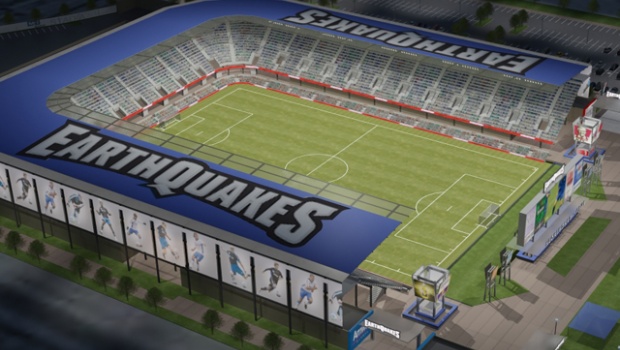
360 Architecture does package deal for A’s & Quakes

A while back, I had postulated that construction of both the A’s and Quakes’ stadia would be done together, sequenced to take advantage of lower combined materials costs and labor. Little did I know back then that this sort of packaging extended to stadium design as well. That’s exactly what has happened as Wolff/Fisher put out a press release revealing the combined effort.

The timing of the release is obviously to capitalize on 360’s involvement as principal for New Meadowlands Stadium, which is due to have its first regular season NFL game next Monday. Print media reviews should be flooding in over the next several days, allowing for further mentions of 360’s past and future projects, the latter of which should include whatever they’re doing in the Bay Area.

Beyond the possible PR mini-coup, I figure that this was also a smoke signal sent up to say, “Hey, we’re still here and we’re working on it.” In fact, they’ve been working on it for a while. While we figured that ownership had 360 on retainer while all the political mess was sorted out for the ballpark, it was expected that Rossetti would be the firm of choice for the soccer stadium, since they had done several others over the past decade. And since the Quakes’ renderings are basically the same ones from last year’s EIR draft, it’s clear the 360 has been working on the Quakes project for some time.

Try as they might, however, this doesn’t mean that MLB is any closer to getting anything done. Even if that were the case, we wouldn’t hear about it until at least November or the winter meetings.

Stadium4

On the technical side, the Quakes’ stadium and the A’s ballpark are a study in contrasts. The Quakes have their club seats at field level, whereas the A’s have theirs at the top of the stadium. The A’s will have luxury suites, the Quakes may not have any to start. The Quakes will have a planned development right next to their stadium. Something like that at Diridon for the A’s is much further down the road, and the A’s may have little to no control over it. The Quakes will have plenty of parking on the premises. The A’s won’t.

I suspect that this is by design. By offering certain amenities in one facility and not in another, they’re inviting the public to experience both in a mix-and-match fashion. If you’re looking at it from the perspective of a corporate seat buyer, you may have the ability to pick from different combinations of accommodations. It would take Jeffrey’s regionality idea and give it a twist, in that it bridges multiple leagues from a selling standpoint, not just business operations. And if the Quakes are still struggling to get corporate sponsors to commit to the Quakes stadium, it would make sense to leverage the A’s ballpark as a valuable selling point in the form of a package sponsorship deal. Combine that with, say, a future investment in the teams by the Sharks’ ownership group (SVSE), and the potential for further integration is huge. Now, I have no idea how the accounting would work with all of that, but we’re talking about an accountant as the managing partner – he probably has a few ideas. If you’re the Giants, this is most certainly something to watch. The Giants would love to be able to grab additional revenue streams by building a new SF arena for the Warriors, and this kind of flexibility has to be part of the game.

Diridon Capacity Estimates

While the Diridon renderings left many wondering about the little details, one major item we had no inkling about was the stadium’s capacity. Only vague mentions of 35,000 or 45,000 have been floated, but only briefly. So I figured that, absent a press release or backing documentation, I’d deconstruct 360’s model to determine the capacity. Keep in mind that this is my interpretation of what I’ve seen, so take it with several grains of salt as it is not gospel.

In doing this, several assumptions were made.

  • Regular seating is normally 19-inch, 20 per row, with 2-4 inches on each side to accommodate standards. Aisles are at least 4 feet wide. A switch to 20-inch seats would reduce capacity.
  • All seats are chairs with backs, no benches.
  • Club seats are at least 24 inches wide with or without side tables, plus drink rails.
  • Although not illustrated, a reduction in seating due to dugout placement is taken into account.
  • ADA requirements nowadays recommend a dispersal of accessible locations, not just behind a section (this is why you see front row accessible sections in many stadia). This is not taken into account. However, I’ve been aggressive about providing ADA locations, so a reduction of seating as part of making such accommodations would be minimal.
  • Bullpens are in center field.
  • The field is sunken 25 feet.
  • There are 40 suites and 40 minisuites. Club seats are up top. A club area in the grandstand behind the plate would reduce capacity slightly.
  • Reduction of seating due to columns has not been calculated. Neither has a number of potential obstructed view seats.
  • The press box has also not been factored in. It could displace up to 400 seats in the balcony.
  • Terminology: Grandstand (lower level from foul line to foul line), Balcony (upper level from foul line to foul line), Outfield reserved (lower level left field), Outfield Balcony (upper level left field), Bleachers (lower level right field)
  • The 1,500 figure for standing room comes from San Francisco’s maximum SRO limit for AT&T Park.

In my previous analysis, I had mentioned that I thought both decks would need more rows to make up for their limited length. To flesh this out, I’ve plotted two models. One has 40 rows in the lower deck and 24 in the upper deck. The other has 40 rows in the lower deck and 20 in the upper deck. In the second model, the last 4 rows have been eliminated in the main balcony level and the outfield balcony as well. The point of this is to illustrate how much of a difference capacity lopping off a few rows makes – in this case, almost 2,300 seats. Update 9/7 2:43 PM: Table updated to include an alternative with only 32,000 seats.

In the comparison, a third model is included. In it, the controversial right field bleachers, which in the 360 concept cut into the playing surface and reduce the RF power alley to a short 345 feet, have been significantly reduced. The result is that nearly 600 seats have been removed, but the alley is now 376 feet, though it quickly becomes 368 thanks to the cut-in of the bleachers.

Below is the original model.

Now here’s the modified version.

One thing mentioned in the comments is the lack of a service entrance to the field for vehicles and such. Since the field is sunken, there isn’t a way to incorporate a simple access ramp from right field. If the design moves forward, I would expect an entrance to be placed in the LF corner, where the multi-angle seating is situated. That would create a loss of up to 150 seats, but it would be space efficient and would allow for access from either the north (San Fernando Street) or south (Park Avenue) via the event level (field) service tunnel.

Note about the field dimensions: the original model’s quasi-rectangular shape (compared to a regular baseball field) would appear to be appropriate for fitting a soccer or football field. Unfortunately, the LF corner would cut into any such field layout, and the seats in the LF corner are terribly angled for either sport. Basically, this can be considered a baseball-only park.

Last item: the field dimensions show a 25-foot height in RF. However, this may actually be much higher if the home run lines are to be believed. The wall could be as much as 40 feet high, which would make it higher than both Fenway’s Green Monster and a similar, slightly taller wall called Arch Nemesis at Sovereign Bank Stadium in York, PA.

So, are you surprised by the capacities? What other questions or comments do you have?

Diridon Walking Tour

Here in front of Diridon Station. Jeffrey, fc and Sam are on hand, along with Dennis Korabiak and Kip Harkness from City. Michael Mulcahy as well. 40-50 in total.

Someone just asked when the ballpark would open. Korabiak replied, “2015.” More on that as it comes.

Korabiak just said that the renderings will be officially released by City tomorrow.

Harkness mentioned that the water table is 14 feet below the street.

Mulcahy finished off the tour with a brief speech about supporting the plan.

At least two people asked about what happens if baseball doesn’t come. It’s way off in the distance, say Harkness and Korabiak. Developers won’t make a move until they know baseball and BART are coming.

Them’s fightin’ words

A brief article in the Merc (with grafx) compares the San Jose and Oakland ballpark plans, such as they are. Bruce Newman has the Oakland side, while Tracy Seipel covers the San Jose angle (with a Fremont tidbit for good measure). In the broader piece is a choice quote from SJ booster Michael Mulcahy:

Yet it’s San Jose’s downtown proposal that Wolff has dubbed his best option, with the city contributing the land and Wolff building the stadium. After 17 months of study by an MLB committee, Wolff and others wonder if Oakland’s 11th-hour pitch is truly credible.

“Oakland’s effort is entirely smoke and mirrors,” said Michael Mulcahy, co-founder of the grassroots group Baseball San Jose. “There is no political will and no corporate community to mount a serious effort.”

Oakland disagrees, though the city has not yet committed any money to a stadium deal. Still, boosters have recruited 35 companies that have pledged a total of $500,000 in future sponsorships, naming rights and luxury suites.

As much as Oakland boosters tout Facebook supporters and emergent economic clout, I still get the sense that several parties there aren’t on the same page, at least when it comes to the A’s.

Disclosure: For this article I was contacted by the Merc about some of the 3-D sketches I put out a while back, especially in reference to Oakland. When asked for similar drawings, those in the know in Oakland didn’t have any. Not that hard to get a volunteer or two to learn Sketchup, Oakland boosters. I would’ve gladly provided sketches if asked, even improved on what I had previously done. At least it would’ve helped people visualize the potential.

Marine Layer’s Cisco Field Analysis

When the first images of the new Cisco Field @ Diridon came out, I decided to sit back and watch the reaction. Same thing went for the official images, released through Baseball San Jose. My initial thoughts haven’t changed: it’s quite radical. Now, I haven’t talked to anyone at 360 Architecture, Baseball San Jose, or A’s ownership about the images, so my thoughts are not influenced by anything or anyone. With that out of the way, let me explain what I mean by radical.

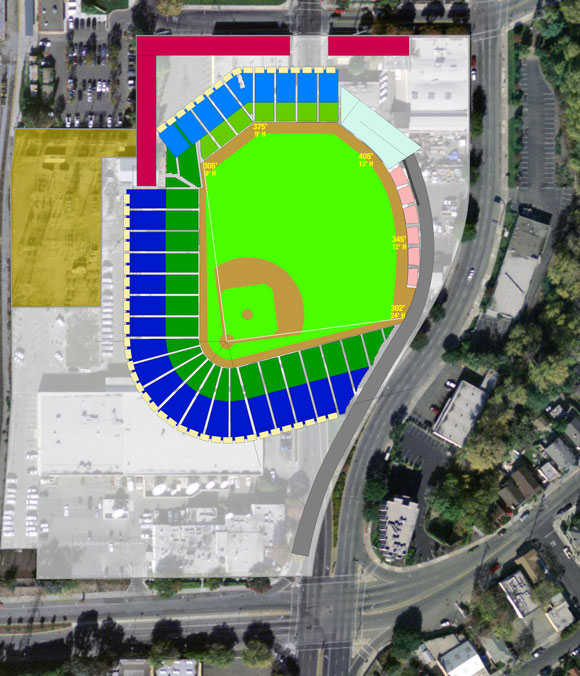
Let’s start off with where the field is placed within the site. First up, here’s what I drew up a couple of years ago.
newballpark1-export-sm

In my sketch, the RF wall hugs the Autumn Parkway contour. The aesthetic effect of that is that fans are confronted with a large wall when walking along Autumn. Additionally, the field is pushed up further north to have more “back of the house” space. By doing this, I effectively put a cap on the number of seats. That isn’t necessarily the case with this new drawing.

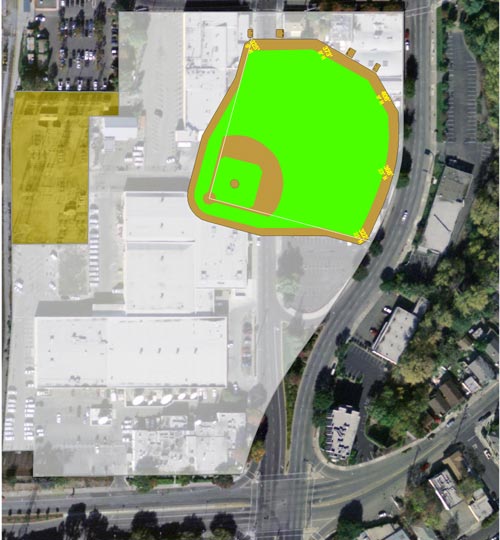
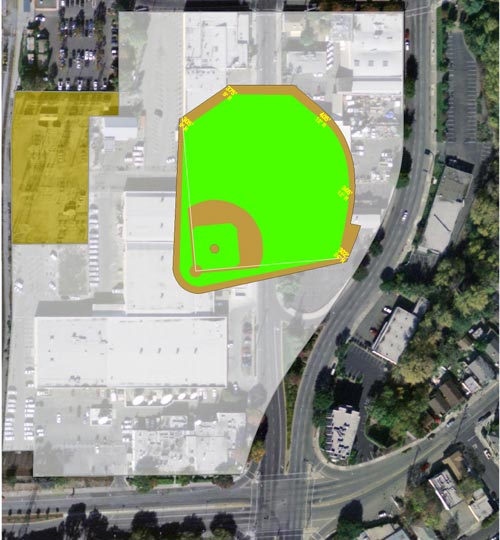
Assuming that the remaining land acquisitions go as scheduled, including a small land swap with PG&E, the field is likely to be situated as you see below, give or take 20 feet north or south (north is up). That orients the field pretty close to true northeast. Prevailing winds tend to come from the northwest, so they should move from the left field foul pole to its counterpart in right on a regular basis. At times, the winds will shift to NNW or WNW. However, the winds in San Jose tend to not be particularly strong, generally topping out at 10-15 mph. Oakland and San Francisco are generally more prone to onshore and offshore movements.

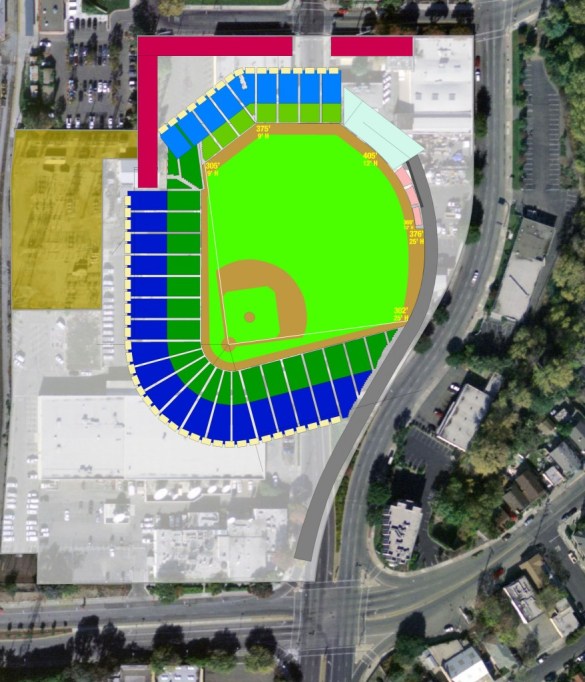
Now for the new 360 layout:
ThreeSixty1-export-sm

The way that Autumn Street/Parkway is contoured, it removes almost all of the RF corner from what would normally constitute a grandstand. And we can’t do an analysis without discussing those field dimensions, with the very short porch in right and a shallow corner in left. Neither of those dimensions are entirely necessary. You can see that there is some space to lengthen both of those out, and I figure that some version of Cisco Field has more “standard” dimensions in place.

Of course, standard dimensions aren’t possible in right if that “thing” is there. What is that thing, anyway? Well, I’ve searched far and wide for some context. It’s not an arcade as in San Francisco, as it doesn’t have arches. Instead, to me it’s, for lack of a better term, a contemporary take on a classic colonnade. To wit:

In classical architecture, a colonnade denotes a long sequence of columns joined by their entablature, often free-standing, or part of a building.

Normally, we think of colonnades as freestanding, such as those used at old LA Forum and Soldier Field. In this case, they house multiple levels of what appear to be minisuites. That’s the first radical step I noticed from the Fremont plan. At Pacific Commons, the minisuites were only 15 rows from the field along the infield. Now they’re part of the colonnades. I suspect the team reached out to potential minisuite holders to see what effect this would have on their interest. If the idea survived this long, the effect must have been minimal.

Depending on what the treatment for the colonnades is, they could become the signature element of the ballpark. There’s no other eye candy in the outfield besides the video/scoreboard, which lines up flush with the top of the colonnades and the roof. I don’t expect to see a neoclassical look, as in the two examples cited previously. Instead, it will probably be more modern and perhaps subdued.

Several sections of outfield seats jut out from the colonnade, creating the crazy 345-foot dimension in right-center. Either they really needed to get those seats in there, or it’s an affectation of sorts. Frankly, it’s unnecessary. The best thing to do would be to take off a few sections, chop off several rows of those seats and turn it into a family or picnic area. The resulting right-center length would be 360 feet or more.

Over in the LF corner, the line could be further extended, eating into more seats and creating a higher wall as a result. I don’t really have a problem with it. Every team should have a righty dead pull hitter who hits frozen ropes down the line. If they get an extra 10 HR that way, so be it.

Features

diagram1-sm

After my 2008 trip to the East Coast and the more recent trip to the Midwest, I came away with one absolute must-have: a majestic plaza for fans to enter the ballpark. AT&T Park has this behind the plate, but the ballpark itself turns its back to the plaza so there’s a sense of separation from the action. At Nationals Park and Target Field, the plaza is integrated into the outfield (Nats Park in left-center, Target Field in right), making the journey to the park all the more momentous. There’s something viscerally stimulating about seeing the grandstand and the field get larger with each step. It’s a reminder of what we had prior to Mount Davis, when the BART bridge walk brought a certain level of excitement. The plaza is large enough (nearly an acre) to hold the family-oriented entertainment options.

The third deck is the other major radical move. Notice how the seats in the first two decks are not defined or articulated, appearing to be benches. Obviously they’re not a bunch of bleacher planks, but the third deck has the same large yellow chairs with side tables next to each seat, just like the minisuites. This appears to be the club level. If so, that’s a marked departure from the club levels we’ve come to expect from most venues. There’s no expansive, separate concourse. There’s scant room for a bar. It’s not indoors. It’s not entirely behind the plate. Instead, it’s three rows of seats, served up with tables and drink rails. This is where I expect Cisco to make its mark. I expect each seat will have video and in-seat concessions ordering, making every seat in the club have diamond level-like wait service. There remains the possibility for a club restaurant down the LF line, and a perhaps another gathering area behind the plate. The seats themselves are at the same height and distance the Coliseum’s suites are, except with more baseball-friendly sightlines. The club will also have the benefit of a roof over the seats, whether it’s the mesh roof from the Pacific Commons version or something different. In moving in this direction, they’re trying to create distinct, separate markets and price points for premium seating that don’t exist elsewhere in the Bay Area, or even in baseball. At the same time, they’re doing what the Red Sox did at Fenway – put the premium stuff at the top of the stadium. It’ll be interesting to see how this pays off.
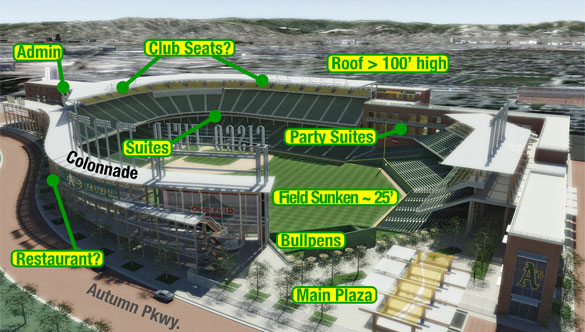
diagram2-sm

The field is sunken, just how I’d prefer it. One of the issues associated with building close to the bay (China Basin, Candlestick, Coliseum, any JLS site) is that to avoid the water table or keep from drainage issues, any stadium pretty much has to have its field at sea level or higher. Diridon is around 90 feet above sea level. There’s still the water table to deal with, but that’s largely an engineering issue that shouldn’t be a problem as long as digging doesn’t go too deep (in the area, the floor of HP Pavilion is also below street level).

The bullpens are sunken below the field and placed at CF. Makes sense to me. It explains why the fence is slightly taller at CF, as opposed to LF. Hell, the Giants should’ve put their bullpens there – oops, they forgot about the pens when designing the place.

The LF corner is where it gets weird. I count 4 different seating angles. First, there’s the normal grandstand. Then there’s a brief 2 sections that run 60 degrees against the grandstand. Slightly beneath that is the start of the outfield section, which follows the outfield wall. Finally, those seats straighten out and run parallel with San Fernando Street. A building in the LF corner houses party suites, and perhaps the aforementioned club restaurant.

I would be remiss if I didn’t point out that the two-deck grandstand would be the shortest in the majors by far. On the 3B side, the grandstand doesn’t go beyond 240-250 feet at best. On the 1B side, Autumn causes a tapering effect that puts the topmost upper deck or club seat just barely beyond the edge of the infield. To compensate, surely there will be more rows of seats in both decks, though it’s not clear how many.

More impressions:

  • The colonnade creates one more aesthetic positive: a net in RF won’t be needed. I figure the height of the roof will be 90 feet in the outfield, making it like a Tiger Stadium/Comiskey Park situation – if someone can get it out of there, he earned it.
  • One thing that’s missing is a view as you exit Diridon Station. I would’ve liked to have seen that. Will transit users have a gate there? Will they go to the main plaza? Or will they use that notch in left-center that lines up with Montgomery Street?
  • I’m still not sure how much of an impact columns in the grandstand will have on views. Columns in the grandstand appear to be recessed into the concourse, not in the seating bowl.
  • With the PG&E substation change, a new access road has to be established. That will probably come from Park Avenue, running by parking lots and/or garages.
  • The tight grandstand all the way around should seal in noise well.
  • 75-degree angle in the grandstand refers to the angle between the first and third base sides. Often in new ballparks, the initial angle is 85 or 90 degrees, with a kink on one or both sides to pull the seating bowl further in. The most severe example may have been old Yankee Stadium, which had a 55-degree angle. Foul territory down the lines was almost non-existent, but the implementation caused the distance from the plate to the backstop to be extraordinarily long (72 feet).
  • The Eric Byrnes sighting. It’s probably nothing, in that they used the first image they had lying around. Or it could be a sign that this thing has been in the oven for a while.

All that said, one question remains: Do I like it? On a scale of 1 to 10, I’d give it a 7 right now. The field dimensions need to be addressed, which is not easy since the only person who has spent more time looking at the land besides 360 and the A’s is probably me, and enlarging the field is a real head-scratcher. I like the back-to-basics design. I’m not sold on how the premium seating all fits together, but I’m not a customer for those so it isn’t my concern. I’m also not clear on what the façade will be. Brick is more commonplace in the Diridon area than just about any other material, yet Lew Wolff has said in the past that the design will not be retro, which should rule out brick. Will it be some marrying of the two?

Most importantly, this will surely be the most intimate major league ballpark built in the last 90 years. Unlike the swept-back HOK/Populous designs which are meant to be essentially inoffensive, this one’s not going to win everyone over. Some will think it’s too small. Others will not like how it’s set up. I suspect that once people get in the seats – perhaps the first open house or walk through – opinions will change quickly. They’ll wonder why the seats at AT&T, which they once thought were the best, are so far away from the action. Skylines are good. Bayviews are nice. San Jose doesn’t have outstanding versions of either, which means the A’s are turning to the original selling point – baseball. I don’t see that as such a bad thing.