Quakes draw team-record crowd at Stanford

.

Most of the crowd stuck around for the fireworks show

The only thing that tempered last night’s joy on the Farm was the occasional defensive lapse by the Quakes, which led to a 2-2 draw. For fans of that other San Jose team, defensive lapses aren’t exactly rare. Danny Miller, who does PA work for both the Quakes and Sharks, announced a crowd of 41,028, the third largest in team history. More importantly, it was the largest crowd in which the Quakes weren’t playing the undercard to a larger international exhibition match.

A bigger stadium and bigger grounds all around made the whole event much more festive than the typical Earthquakes game at Buck Shaw Stadium. I arrived early to see a food truck extravaganza set up in the javelin-throwing area adjacent to the track stadium. Lines were ridiculously long for many of the trucks. I chose to wait in line at one of the gates so that I could enter the stadium at the 6 PM opening time. (I won’t bother reviewing the stadium experience, since I did that five years ago after the rebuild.) On Friday I bought a general admission ticket for the Supporters Section(s) on the south side of the stadium. Around the time I bought the ticket, the Quakes announced that the lower bowl (21,000 seats) had been sold out, with 30,000 seats sold in total.

About two-thirds of the crowd were in Earthquakes regalia. Nary a Red Bulls fan could be found, which is important because it means that the 41,028 was almost all homegrown, not visiting – unlike what happens for a game against the hated L.A. Galaxy. The rest of the crowd appeared to be other locals who came partly for the game, partly for the fireworks display. It’s important to note that this is the first such display in Palo Alto in several years, making the event quite a novelty. Some locals who weren’t interested in the game chose to hang out at Palo Alto High School, where a good view of the show was guaranteed.

The hidden factor for many may have been the lure of $15 general admission tickets. There were actually three different GA sections: supporters (south, where I sat), family (north), and upper bowl. Together they accounted for some 20,000 tickets on their own. The great thing about playing in a stadium five times the size of your regular home is that you can afford to charge less for tickets. I was helping some friends move earlier in the day and I told them about the game. One friend’s biggest complaint about the Earthquakes is that their tickets are too expensive ($20-50) for what you get. Yet you drop the price under the $20 mark and put the game in a freshened venue and suddenly he’s interested. If I had organized a group outing instead of deciding the day before to go, I probably would’ve ended up bringing 4-6 more people.

The lower deck of Stanford Stadium holds 21,000. Maybe that's the right amount of seats for the Earthquakes.

Then again, you can’t get past the simple fact that Stanford Stadium is a really nice place to watch a game of futbol or football. It’s clean, comfortable, intimate, and friendly. There’s even a sort of karma that comes with the way it was built inexpensively and efficiently, yet with clear nods to the past. Clearly everyone from longtime Quakes season ticket holders to curious Paly residents were enjoying themselves. The difference between atmospheres at Stanford and Buck Shaw could not be more stark. Buck Shaw will always feel temporary no matter how it’s dressed up, the same way the Coliseum feels cold and uninviting after Mt. Davis. That’s not to say the venue or even the team are enough. Until the Harbaugh era Stanford’s football team has historically been a bad attendance draw, thanks partly to the school’s low undergrad enrollment (>7,000) and international alumni base.

That makes it difficult to gauge what the real support for the Quakes is. Obviously, 41k is an outlier for a team that doesn’t quite sell out its regular digs and one game is too small a sample size for comparison. But it’s clear that there is a pent-up demand for the Quakes to play in a really nice venue. The team has always played in someone else’s venue: SJSU’s Spartan Stadium, SCU’s Buck Shaw, the A’s/Raiders’ Coliseum. Is the 15,000-seat stadium at Airport West enough? Judging from the Quakes’ attendance history going into yesterday, I’d said it was a bit on the small side but with additional standing room admissions (2,000+) it was probably enough. From witnessing last night’s game, I’m not so sure anymore.

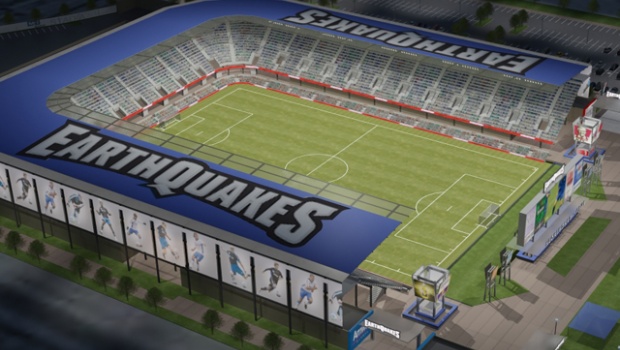
New Earthquakes Stadium. Capacity: 15,000 seats with limited expansion capability.

I estimate that each additional row at the top of the Earthquakes Stadium during conception would add 800 seats. Cost is difficult to establish, perhaps $2 million per row depending on the materials used. An extra 5 rows would bring capacity to 19,000, slightly larger than Kansas City’s Livestrong Sporting Park. If Lew Wolff and David Kaval went with the same construction techniques employed at Stanford, the cost may be more manageable. 19-21,000 would seem the sweet spot for the Quakes. Is it worth the cost? I’d like to think it is. There’s one way to find out: play another regular season game or two at Stanford without the fireworks to see what kind of crowds they draw. There isn’t much time to do it before the football season starts, but it’s worth a look this year and next year.

More reading: Kaval outlines the vision at Airport West.

News for 7/1/11

Despite the bittersweet tone of yesterday (thanks for the memories Ellie), there was a little humor to be found before the game (via the Chronicle’s John Shea):

Clubhouse blaze: Before the game, a fire broke out near Brian Fuentes‘ locker, the result of an overcharged battery for the reliever’s remote-control airplane. Several players rushed to put it out, as did Isao Hirooka (Matsui’s PR guy), equipped with a five-gallon container of drinking water.

In a smoky clubhouse, managing general partner Lew Wolff sat at a table, sipped on a root beer float and cracked a couple of jokes about how this could have been his ticket to a new ballpark, playfully chiding his players for extinguishing the flames.

Clubhouse manager Steve Vucinich approached Wolff and whispered, “Nobody saw you set that, did they?”

Briefly: Wolff expects to meet with Oakland mayor Jean Quan, who has thoughts for a new Oakland ballpark, in the next month but said, “Don’t read too much into it.” …

Several hours after the A’s late rally fell short, Oakland passed its budget with Quan as the deciding vote. The budget includes the sale of HJKCC, funds the public library system, and is heavily dependent on approval of concessions by the police union, which are to be voted on next week.

Craig Calcaterra feels our pain.

Bankruptcy hearings for the Dodgers are set to stretch out until next January. Bud Selig will be deposed by Frank McCourt’s lawyers in two weeks. That should be fun.

Do you believe David Stern’s line that 22 teams in the NBA lost money going into the lockout? Think again.

Saturday’s Earthquakes-Red Bulls contest will be played at Stanford Stadium, to be followed by a fireworks show. Coincidentally, the A’s play the Snakes at the Coliseum at the same time, also to be followed by a fireworks show. Even though I already have a ticket for the A’s game, I may ditch it to go to the Quakes match instead solely because I’ve never seen a soccer match at Stanford since it was rebuilt.

China’s 800+ mile (roughly Seattle to San Francisco) high speed rail train between Beijing and Shanghai launched last week. After a decade of planning, the line took three years to construct. A one-way fare from Beijing to Shanghai costs as little as $85 and takes less than five hours to complete the run.

P.S. – I wanted to add a commentary item to chew on as we head into the weekend. Over the past few days there have been renewed calls on the blog for alternative sites, such as 980 Park, Fremont, or Dublin/Pleasanton. Let’s consider the process before putting these out there. Selig’s panel spent an unspecified amount of time looking at sites, not just in Oakland, but throughout and beyond the specified stadium territory for the A’s (Alameda/Contra Costa counties). For whatever reason, in 2009 four Oakland sites, three centered around downtown, were presented. Those were whittled down to the Victory Court site. Now I’ll repeat this again: Out of the entire A’s territory. This may be because of political forces in Oakland pushing it to stay in Oakland and the panel going along with it (some were upset when the 2001 HOK study included Fremont and Pleasanton). Or it could be the panel said they preferred a downtown site and no other site within the territory provided that. Whatever the cause, Victory Court is the choice in the territory. 980 Park is an EIR alternative, but there’s no indicator as to whether or not MLB takes the site seriously. I think it’s safe to say that with the Coliseum being dismissed early on and no implicit desire to seek a suburban locale, for Oakland and the A’s existing territory it’s Victory Court or bust. That may be why the search was formally expanded to include San Jose, since there’s a downtown there too. I don’t know, I’m just trying to make sense of it.

Getting ready just in case

KCBS radio reported yesterday that an online construction bidding service, bidclerk, has a new or updated listing for an A’s stadium San Jose (paid subscription required). The value of the project is $400 million, less than what we’ve frequently discussed as the cost of the ballpark. Start date is listed as January 2013. The project description goes as follows:

New construction of an athletic stadium in San Jose. Preliminary plans call for the construction of a 32,000-seat baseball stadium. The stadium will include concession areas, restrooms, ticket boxes, V.I.P. areas, locker rooms, a medical facility and offices.

This project is contingent upon approval from Major League Baseball and the city. Construction is scheduled to begin no earlier than the first quarter of 2013.

The listing dates back to 2006, when the A’s were looking in Fremont. Strangely, the included documents are two of the now outdated Pacific Commons renderings alongside one recent San Jose rendering. Listed as project contacts are Lew Wolff and 360 Architecture principal Brad Schrock. There isn’t much information right now other than a heads up to interested contractors. Should the project be approved by MLB and SJ, activity should increase appreciably.

Wolff’s Maritz-Wolff development company also lists the Earthquakes’ stadium project. Some light-oriented schematics are included, and the project description indicates how much further along the project is compared to the ballpark:

Site work and new construction of a mixed-use development in San Jose. Schematic plans call for the construction of a 20,000-seat soccer stadium.

This project is currently in the financing stage, and construction is tentatively expected to begin in spring 2011.

In both cases, they are accurate reflections of where the two projects stand. That leaves the January 2013 start date for Cisco Field the one truly speculative item. Should it start at that date, construction would have to be completed in 27 months to be done prior to Opening Day.

News for 3/3/11: Quakes site demolition + Redevelopment

A couple of A’s business-related items from the Silicon Valley Business Journal:

  • Neil Kraetsch was named the team’s general counsel. He had previously been assistant general counsel. His predecessor left to take a similar position with the Tampa Bay Buccaneers.
  • Darrin Gross, who spent more than a decade with the Sacramento River Cats, was hired by the A’s to become the Senior Director of Corporate Partnerships.

Today’s a pretty big day for Quakes fans, as a ceremony for the demolition of the remaining FMC plant will happen at noon. The entire demolition process should take 12 weeks, including cleanup, and should be followed by groundbreaking shortly thereafter.

Articles in the Oakland Tribune and the San Francisco Business Times go over Oakland’s challenges in saving redevelopment.

The Merc’s Tracy Seipel reports that as the Cinequest Film Festival begins in San Jose, the City’s redevelopment agency must decide if it should subsidize over $800k in rent for operator Camera Cinemas on the Camera 12 multiplex, which is owned by Forest City. Absent that freeze, the multiplex would probably shut down and remain vacant for years, just as it did when UA vanished over a decade ago. The Camera 12 is the flagship venue for Cinequest and it would be a shame for downtown if the Camera 12 closed.

An almost hidden item in the article above is San Jose’s interest in creating a joint powers authority that would hold the Diridon ballpark land in case Sacramento wanted to seize or liquidate it. That’s different from the successor agencies that other cities have been creating, and I’m curious as to why they’d move in this direction. I’d also like to know what the joint powers would be (two or more public agencies) and what its “powers” would entail. Frankly, I don’t like where this is headed. Next Tuesday’s City Council meeting should explain this further.

Demo to begin at Quakes stadium site

Better late than never. On March 3rd, a demolition ceremony will be held at the site of the future San Jose Earthquakes stadium. The 15,000-seat venue, whose design is not yet finalized, is will replace SCU’s Buck Shaw Stadium, which was only meant to be a temporary home. Most of the site known as FMC/Airport West is already cleared, save for a large plant that is a remnant of its history as a large defense contractor facility. I’m not up enough on the history of the FMC plant to know if this building is where the once ill-fated Bradley Fighting Vehicle was built.

Old plant sits on stadium footprint

The site already has the Quakes’ practice field. Other redevelopment nearby has already been completed, including a shopping center with a Lowe’s and In-n-Out. It is also near the Santa Clara Caltrain Station, the far-off Santa Clara terminus for BART, and coincidentally, Stephen Schott Stadium on the SCU campus.

Practice field

No date for groundbreaking has been given, and it could happen at any point given the mild, construction-friendly weather we typically experience every year. In the past I have posited that the construction schedules of the Quakes’ stadium and an A’s stadium may be linked as part of a package deal. Now I’m not so sure since MLB’s schedule seems to be in flux.

2010 rendering

Despite the fact that the design is not finalized, I don’t expect it to vary too much from the renderings released last year. The only major changes could be if the bowl were fully enclosed or a bunch of suites were added at the last moment, and I don’t think that the financials have changed enough to merit such changes. Then again, if Quakes president David Kaval has sold the concept well, I may be eating my words in short order. Either way, I expect that the stadium should be ready by the beginning of the 2013 season. No pressure, of course.

As the developer turns


Maybe the thing that plagues Lew Wolff the most is an extraordinarily bad case of timing. Exhibit Z: The Merc’s John Woolfork reports that the City of San Jose is considering a second break for Wolff’s purchase of the Airport West (FMC) property, on which the future San Jose Earthquakes stadium would be built. Last year, Wolff and company were granted a $43 million discount, from $132 million to $89 million. The new break would involve extending the deadline to buy the land to 2015, with the option ($2-4 million) used to apply towards the purchase price.

If Wolff were only looking to build the Quakes stadium in San Jose, this would have been a done deal. However, I’ve speculated in the past that if both teams were to play in San Jose, the stadium deals would be linked. Forced to scramble for cash to help finance both projects, Wolff has to be looking at the Quakes’ funding mechanism as something to tap for Cisco Field. Making things more difficult is the value of Airport West, which multiple sources in the article indicate has dropped below the renegotiated $89 million price tag. It’s possible that Wolff pushed for the outright land purchase, but given the wasted investments in Fremont, he (or his partners) may be a bit gunshy.

The irony of these delays is that they affect the Cisco Field project. Wouldn’t $89 million be more than enough to buy the remaining Diridon ballpark parcels and fund area improvements? The City has halted future land purchases until MLB decides, which puts the onus back on Bud Selig and his panel. As this saga drags on, it only becomes more difficult and costly for all parties.

No World Cup for USA in 2022

Sorry 49ers/Raiders, if you were hoping for a future World Cup bid to help pay off/showcase your new stadium(s), that argument has gone out the window. Incredibly, the United States’ bid for the 2022 tournament was beaten in the final vote by the tiny, oil-rich nation of Qatar. As small as it is (1.7 million residents), Qatar has a unique history that might make it the best – and perhaps only – place to host the World Cup in the Middle East. Incidents of terrorism are far more rare in Qatar than in many of its neighbors. Yet it’s strange that in an era when many countries are pulling together for bids (Japan-South Korea in 2006, Spain-Portugal bid in 2018), a nation as small as Qatar can actually pull it off. The scope will be even smaller than the country, as the bid specifies that half of the venues, including the biggest ones, will be built or expanded in the capital, Doha. It’s like awarding the World Cup to Santa Clara County, and having half of the games played in San Jose.

Currently, only Doha’s Khalifa International Stadium has a capacity large enough (50,000) to hold a WC match among Qatar’s existing stadia. To accommodate the large crowds, seven new stadia are planned, all with a capacity of 40,000 or more. Five other stadia will be expanded. Some will have temporary upper decks which could be dismantled and sent to developing countries to help build their own sports venues. Most of the facilities will not be domed, but will instead have extensive roofs covering the seating areas, as is done in Europe. To address the desert heat, some kind of fancy new cooling technology will be in place:

Qatar has employed a number of experts to work on new technology that will keep the temperature of spectator areas to 18C, and the temperature on the pitch to 27C.

The technology has been designed using solar technology so that the cooling systems will be carbon-neutral, according to the bid committee.

Are they being intentionally coy as to what the technology is?

In any case, it’s a lot of money to spend on a month-long event. A new international airport is under construction, and a metro rail project will begin shortly.

BTW, Russia won the 2018 World Cup, beating out England, Belgium-Netherlands, and Spain/Portugal.

Half a world away, a similar tale

Across the pond, there is a soccer team that bears some resemblance to the Oakland A’s. Although they don’t wear green and gold, Tottenham Hotspur is a scrappy team that manages to compete despite not having the unlimited financial measures of the Big Four teams: Arsenal, Liverpool, Manchester United, and Chelsea. They are so well-liked that the Fisher-Wolff-Beane troika headed over to Tottenham to get some pointers on stadium building, and along the way forged a partnership between Spurs and the San Jose Earthquakes. Earlier this summer, some of the English club came here and played a friendly with the Quakes, the result of which (0-0) foretold how the early Premier League season would go for Tottenham Hotspur.

Like the Quakes and A’s, Spurs play in what’s considered an old, antiquated venue, White Hart Lane. The compact, 111-year old stadium was built in stages, as many of the older stadia were, and currently seats a cozy 36,310. Unlike their new stateside partners, Spurs almost always sell out. Not only do they sell out, they have a season ticket waiting list of 34,000. Imagine having a waiting list so long that you could fill two of your own stadia. It’s a severe understatement to say that it’s an enviable position in which to be.

Knowing that demand is so strong, Tottenham Hotspur management has been aggressively looking for a new venue. A plan to build a new White Hart Lane at the current site has had its cost estimate escalate significantly, creating doubt within the team as to whether or not the plan could be pulled off, especially without massive public funding. Called the Northumberland Development Project, the plan would have a new, 56,250-seat White Hart Lane as its centerpiece, along with 200 affordable housing units, a 150-room hotel, a supermarket, and a public square. Current estimates run at around £450 million (US$718 million) for the stadium alone, much more for the complete 20-acre development. Tottenham head Daniel Levy explained the situation.

“We have made no secret about the fact that the cost of (planning) consent will be extremely high. The revisions to the plans, to meet stakeholder approval, has added in excess of £50m to a development that could well cost in the region of £450m to bring to fruition.”

Levy said that extra costs nearing £50million had been accrued in a bid to preserve English Heritage sites close to the Northumberland Development Project, bringing to total projected cost to around £450million.

None of that money has been offset by public funding – a revenue source that both the revamped Wembley and Arsenal’s Emirates Stadium were able to utilise – a state of affairs that clearly rankles with Levy.

He continued: “Had we not made these changes to retain historic buildings then English Heritage indicated that they would have no option but to advise that the application be called in and that permission would be refused.

“Meanwhile this development has not attracted a penny of public money.”

As the plan worked its way through the political realm, a government entity called English Heritage raised concerns. English Heritage objected to the plan on the account of demolition of several historic buildings within the plan area. That forced Spurs to submit a new plan that would have scaled back the vision significantly, preserving threatened historic buildings. The plan was approved by the Borough of Haringey, and all seemed well and on target. Right?

Fast forward a few weeks to mid-October, when rumors of a major move started to circulate. Spurs saw the escalating cost, resistance in the process, and it’s inability to secure public funding for the project, and started to look elsewhere. The new target is now the 80,000-seat Olympic Stadium, which would be reconfigured to work as a 60,000-seat, modern Premier League venue. We’ve seen this happen successfully in Atlanta with Turner Field, so the precedent is there. Whether or not it’s a prudent move is up for serious debate.

Assuming that the Olympic Stadium reconfiguration moves forward, it wouldn’t be available to Spurs until the 2013 season at the earliest. The site is only 6 miles east of the current White Hart Lane, a distance which might make you wonder why anyone would complain. But this is London, where neighborhoods are much more pronounced than we’re used to in the States. Imagine that MLB had just 20 teams, and all of them played all league play exclusively in an area 1/3 the size of California, from San Luis Obispo to Sacramento. Suddenly you can see how identifying with a part of a city, not just the city proper, might make sense. Tottenham is a rather diverse part of London, with a sizable black population. It is also poor and crime-ridden. Yet that doesn’t stop Spurs supporters from packing White Hart Lane, even though many of them come from well outside the immediate area. A move to Stratford, where the Olympic Stadium is located, is considered unconscionable by some fans and locals, while others consider the location of the stadium little more than a site to visit only for games and not much else, like the Coliseum. It would move the team from North London to East London and break up the North London derby, which pits Spurs against local rivals Arsenal. Stratford is also diverse and poor, though it benefits from not being built up the way Tottenham is, and from ongoing redevelopment work being completed to create the Olympic Park.

But really, six miles? That’s the distance between the Coliseum and the West Oakland BART station. If little-to-no public help is forthcoming, and there’s an opportunity to re-use a brand new venue six miles away, shouldn’t it be explored at the very least? It would seem that the line between emotional ties and practicality has no fence to sit on, which sadly is an all too familiar struggle in our neck of the woods.

Ah, but there are even more complications to this. West Ham United has also shown interest in the Olympic Stadium. There was also a promise made by the UK that when the Olympics were completed, the stadium would have its capacity cut in half with the idea of keeping it a track and field facility. Spurs and their possible stadium partner, AEG, want to remove the track and make the stadium a more intimate soccer venue. Early on there was talk that Spurs’ interest in the Olympic Stadium was a mere negotiating ploy to squeeze out some public funding for White Hart Lane. However, the talk of moving has only gotten more serious since then, as the time for the club to determine its future draws nearer.

You can’t blame Tottenham Hotspur from wanting to maximize its potential. After all, even though they sell out practically every match, their average attendance ranks as only slightly more than the league average. They’re leaving a ton of money on the table – money that could help them be more competitive with the likes of the Big Four. It may all come to a head in the coming months, and it will be interesting to see if it plays out anything like what we’re seeing in the Bay Area.

More end of season tidbits

Let’s roll it out, shall we?

  • New Twitter update (and article) from A’s beat writer extraordinaire Susan Slusser (@susanslusser): Beane feels optimistic about prospects for new stadium. He says team expects news sooner than later.  #Athletics. More on this from MLB.com’s Jane Lee.
  • The Quakes named David Kaval as its new President. Kaval replaces Michael Crowley (the one who owns a piece of the A’s, not the journalist), who will be bumped up to Managing Director. Kaval’s previous gig was at the independent Golden Baseball League. Quick analysis: the Quakes need to make more headway with sponsorships, and Kaval’s experience indicates he knows the angles.

  • Target Field ended the regular season with the 3rd worst home run rate (1.35 HR/game) of any MLB ballpark, just behind Safeco Field (1.22) and yes, the venerable Oakland-Alameda County Coliseum (1.33). Some of that may be attributable to the half-season absence of Justin Morneau and Joe Mauer‘s almost inexplicable power dropoff, from 28 to 9 HR in one year. Mauer should be able to adjust, as David Wright did at Citi Field (10 to 29 HR from 2009 to 2010).
  • The Twins are criticizing the T-Wolves for placing a large ad sign at Target Center that will be visible from Target Field and Target Plaza. Seriously?
  • Home runs are down slightly at New Yankee Stadium, but it’s still the most HR-producing park in the majors.
  • MLB instituted new sky ground rules at Tropicana Field for the playoffs. The upper “A” and “B” compression rings/catwalks that hold up the dome are no longer in play, as balls that hit the rings are now automatic dead balls. Previously, balls that hit the rings were in play, and were ruled fair or foul based on where they landed. The lower “C” and “D” rings are home runs if balls hit them in fair territory.
  • Matier and Ross report that the 49ers are getting ready to open a sales office for their planned Santa Clara Stadium. The office will be in the Tech Center, which is adjacent to the Santa Clara Convention Center, which itself is across the street from the stadium site. No seat license prices yet, of course.
  • Mesa, AZ voters are mulling over Prop 420, a proposal to replace HoHoKam Park with a new city-owned ballpark complex with a bunch of ancillary development to help pay for it. If you’ve ever been to HoHoKam, you’ll know that the only thing ancillary to the park right now is a cemetery.
  • Firing up stogies in the clubhouse to celebrate the Reds’ first division crown since they opened their new ballpark is apparently verboten.
  • The nonprofit group that runs the Memphis Redbirds (AAA, Cardinals) has been struggling financially, causing them to consolidate a bunch of debt in an effort to stay afloat. What hurt them? The arrival of the Memphis Grizzlies, a blip of excitement for U of Memphis basketball when John Calipari was there, and bad projections for attendance at AutoZone Park. The team and ballpark will probably be sold in the near future.
  • The Giants are getting the late game slots (6:37 PM PT) for their first two home NLDS games, which is great for West Coast viewers, not so great if you’re a young Braves fan who has to go to school Friday morning. The Rangers are getting the crappy day slots that we as A’s fans have been rather familiar with.
  • Attendance at yesterday’s Raiders-Texans game was a scant 32,218. There are often comments about how whether or not the Bay Area is a two-team baseball market; are we sure it holds up as a two-team football market? They could’ve saved some money and left the tarps on!

Update: Tonight’s fresh articles by Susan Slusser and Jane Lee have done a better job of clarifying where management’s position is going forward than the quotes Slusser got from Lew Wolff last week. From Lee’s article:

“I was talking to one free agent last year, trying to tell him to concentrate on the field, that we had the best playing facility in the league, the best groundskeeper in the league. He said, ‘You’re right — until August.'”

“I think we’re going to be planning a new stadium at some point soon,” Beane said. “That’s just my own gut feeling. We have to at some point. I’m an optimist.

“I think it will allow us to start to plan around some of these guys here from a long-term standpoint. Hopefully, it’s not a revolving door, like it’s been the last decade. Hopefully, we could do some long-term planning, which we really haven’t been able to do. I think it would be pretty invigorating for everybody involved, and I think everybody would sort of be relieved having a direction for the franchise.”

Thing is, if MLB rules in Oakland’s favor, there’s an immediate quandary because I don’t think the owners have been planning on staying in Oakland.

360 Architecture does package deal for A’s & Quakes

A while back, I had postulated that construction of both the A’s and Quakes’ stadia would be done together, sequenced to take advantage of lower combined materials costs and labor. Little did I know back then that this sort of packaging extended to stadium design as well. That’s exactly what has happened as Wolff/Fisher put out a press release revealing the combined effort.

The timing of the release is obviously to capitalize on 360’s involvement as principal for New Meadowlands Stadium, which is due to have its first regular season NFL game next Monday. Print media reviews should be flooding in over the next several days, allowing for further mentions of 360’s past and future projects, the latter of which should include whatever they’re doing in the Bay Area.

Beyond the possible PR mini-coup, I figure that this was also a smoke signal sent up to say, “Hey, we’re still here and we’re working on it.” In fact, they’ve been working on it for a while. While we figured that ownership had 360 on retainer while all the political mess was sorted out for the ballpark, it was expected that Rossetti would be the firm of choice for the soccer stadium, since they had done several others over the past decade. And since the Quakes’ renderings are basically the same ones from last year’s EIR draft, it’s clear the 360 has been working on the Quakes project for some time.

Try as they might, however, this doesn’t mean that MLB is any closer to getting anything done. Even if that were the case, we wouldn’t hear about it until at least November or the winter meetings.

Stadium4

On the technical side, the Quakes’ stadium and the A’s ballpark are a study in contrasts. The Quakes have their club seats at field level, whereas the A’s have theirs at the top of the stadium. The A’s will have luxury suites, the Quakes may not have any to start. The Quakes will have a planned development right next to their stadium. Something like that at Diridon for the A’s is much further down the road, and the A’s may have little to no control over it. The Quakes will have plenty of parking on the premises. The A’s won’t.

I suspect that this is by design. By offering certain amenities in one facility and not in another, they’re inviting the public to experience both in a mix-and-match fashion. If you’re looking at it from the perspective of a corporate seat buyer, you may have the ability to pick from different combinations of accommodations. It would take Jeffrey’s regionality idea and give it a twist, in that it bridges multiple leagues from a selling standpoint, not just business operations. And if the Quakes are still struggling to get corporate sponsors to commit to the Quakes stadium, it would make sense to leverage the A’s ballpark as a valuable selling point in the form of a package sponsorship deal. Combine that with, say, a future investment in the teams by the Sharks’ ownership group (SVSE), and the potential for further integration is huge. Now, I have no idea how the accounting would work with all of that, but we’re talking about an accountant as the managing partner – he probably has a few ideas. If you’re the Giants, this is most certainly something to watch. The Giants would love to be able to grab additional revenue streams by building a new SF arena for the Warriors, and this kind of flexibility has to be part of the game.