Day 12: Portland (A Eulogy)

Take a good look, because it’s the last time you’ll see this beaver.

Originally, the last city on this trip was supposed to be Seattle, where hopefully the M’s would’ve gotten their brains smashed in. Sadly, they were scheduled to be in New York, making a it difficult to justify going so far for just a tour. Instead, I looked south to Portland, where MLB was at best a flirtation, pro baseball has happened in fits and starts.

Worst of all, when the city’s much loved USL-1 soccer franchise, the Portland Timbers, was granted promotion to the MLS in 2009, it was clear that the AAA Portland Beavers’ days at venerable PGE Park (née Civic Stadium) were numbered. In the last 18 months, every effort by Timbers/Beavers owner Merritt Paulson (son of former US Treasury Secretary Henry Paulson) has come up for naught. As mentioned in Jeffrey’s recent articles (I/II) on the subject, the Beavers will almost certainly leave Portland, probably south to either the San Diego suburbs or Tucson. With pro baseball shut out from PGE Park because of a soccer-specific renovation and no new venue in sight, it’s unclear if or when pro ball will return to Portland. Knowing this, I had to visit the old park in Goose Hollow one last time.

Built in 1925, Civic Stadium was always meant to be a multi-purpose stadium, and it shows. Its expansive wooden roof was intended for weather protection for fall and winter football games, not summer baseball (psst – for those that don’t know, Portland’s really nice in the summer). The J-shaped seating bowl offers suboptimal sightlines along the third base side, along with Coliseum-like foul territory. The field itself is field turf. Renovations to modernize the place with new suites and seating helped bring a third version of the Portland Beavers to life. Changes for the Timbers have started and the place will be cleared out in week, the last series to be played on Labor Day weekend.

Four-story stack of suites behind the plate.

It’s really amazing how things can change. Six years ago, Portland was considered a frontrunner to land the wayward Montreal Expos. $150 million in state funding was lined up, as well as a solid business plan and support from the business community. Little did Portland supporters know at the time the shell game that was about to be perpetrated in order to facilitate the Expos’ eventual move to Washington, DC (thanks a bunch, Detroit schools slasher Robert Bobb). In the end, MLB-to-PDX lost, momentum died, and it’s not clear what form pro baseball will take when it returns to Portland.

Image of Timbers-friendly PGE Park renovation.

Backstory aside, I was determined to enjoy myself at the game. After my long train ride from Minneapolis, I freshened up at the hotel and headed out. After a stop at The Kennedy School for some lunch and beers, I went downtown.

Getting there

Portland has one of the best light rail systems in the nation. It goes nearly everywhere you’d want to go in Portland, and within the downtown area it’s free. That’s right, within the downtown core and out to the Rose Quarter/Convention Center, riders don’t pay to ride the MAX or the Streetcar. The MAX stop for PGE Park is just barely outside the zone, but nobody really checks that close, do they?

It’s a good thing that public transit is so readily available near the ballpark, because parking is almost non-existent immediately around it. You could park at the Fred Meyer nearby, but that’s not nice to the shoppers who actually need the parking. You could also park downtown and walk 10 minutes to the ballpark, which is a much better choice. Downtown is not a particularly large area, so a walk from one of the many bars or restaurants in the Pearl district to PGE Park is not stressful in the least. A walk from the Deschutes Brewery to PGE Park took about 15 minutes.

I walked up at 5:30 PM and got myself a nice seat, 8 rows behind the plate, for $15.50. Had I gotten there earlier, I could’ve gotten a $5 general admission seat. Oh well. As with most minor league games, the atmosphere was relaxed. The results don’t carry as much weight as in the majors. While the Beavers have underperformed recently at the gate, this game was the last scheduled fireworks game of the year, bringing out an announced crowd of 9,983.

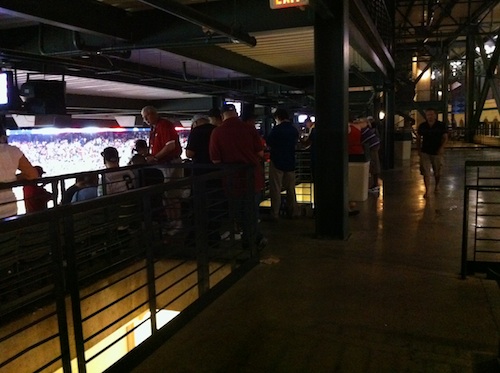
Most of the seats are covered by a large wooden roof. The football/soccer press box is tucked underneath the roof. Both are held up by columns along the walkway separating the box seats from the general admission benches.

Concessions

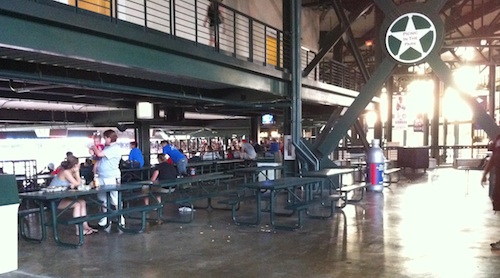
An 85-year old stadium, even with a revamp, isn’t likely to have wide concourses. True to form, PGE Park doesn’t. Even before the game, the concourse was jammed with fans in line at concession stands, creating serious traffic jams. That dissuaded me from getting anything at all from there. A better choice is usually the Widmer Beer Garden down the RF line (pictured above), though the lines for that place can be long as well.

Circulation

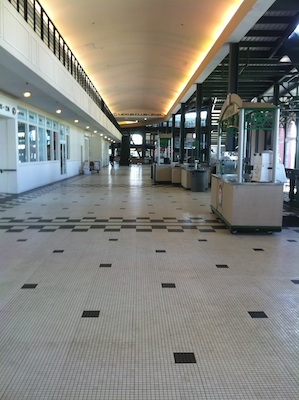
This picture is pretty much self-explanatory.

Other observations

When you get off the MAX from downtown, if you walk left instead of right, you’ll soon be walking along the open left field area. Cheapskates can watch the game here from behind a fence. Savor it, because when a new 4,000-seat eastside stand is built, that view is going away.

Even though they’re getting rid of the baseball configuration, they’re still keeping artificial turf. Why? The Portland State University football team plays there.

Wrap-up

I’d say it was really tragic if Portland didn’t have other kinds of entertainment to rely on. Still, the lack of effort on the city’s part to help the Beavers will surely not sit well with MLB if Portland were to ever engage in a new effort to get a team. The Blazers and some preservationists blocked a bid for a AAA stadium on the site of the old Memorial Coliseum. Several sites that were considered as potential MLB ballpark sites have already disappeared. The best one, the USPS facility near Union Station, is slated for different types of mixed development. PGE Park was important because it could’ve been a good transitional facility. Now there’s no telling how a franchise move could happen, so it’s probably expansion or bust. And while I’m an advocate for expansion (mostly for scheduling and realignment concerns), I’m one of the few and I have no pull. With that in mind, good luck, Portland. I hope my next summer pubcrawl there includes a baseball game. But I’m not counting on it.

Day 11: Target Field

8/16. Game time- 7:05 PM
Attendance: 40,702
Weather: 78 degrees, overcast
Matchup: Chicago White Sox at Minnesota Twins
Pitchers: Gavin Floyd vs. Francisco Liriano
Result: MIN 7, CWS 6, W- Manship (1-0) L- Floyd (8-10)
Ticket Purchased: Standing room only, $22
Beer of choice: Summit Extra Pale Ale – $7.50
Food: Pork chop on a stick ($7.25), Corn dog ($3.50)
Travel cost: $6 for a Day Pass, $4 for a Six-Hour Pass
Other: None
Total spent: $46.25

To understand the average Twins fan is to tell the story of a caged bird. Understand that Minnesota is a place where seasons are felt and appreciated, even endured. Contrast that with the average Bay Area citizen, who only knows wet and dry seasons, some of those wet seasons being not so wet at all. Don’t get me wrong, I love the mild, dry climate that is so great for nine months of the year, the other three being quite bearable. We just have a tendency to take such pleasures for granted.

The Hubert Horatio Humphrey Metrodome was a place where seasons couldn’t be felt. Sure, there were plenty of institutions built in the Twin Cities to protect citizens from the harsh winters, such as the Skyway and Mall of America. The Metrodome was different, as it belied every natural instinct any kid playing baseball grew up with. So when Target Field opened, it quickly became a celebration of baseball and of the rites of spring and summer. To that, I toasted with many a Minnesotan over their new jewel.

Getting there

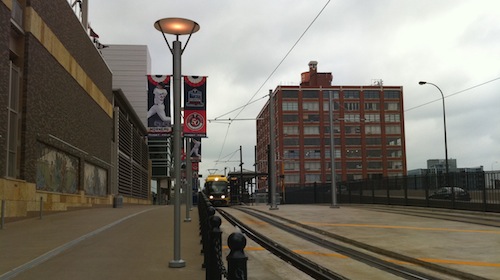
Target Field may be the most transit-friendly ballpark in the nation. It was designed as both a ballpark and a transit hub, with a light rail station alongside it, a commuter rail station underneath it, and weatherproof bus platforms adjacent to it. It’s an extremely clever and convenient arrangement, which paid off for me in a big way.
The local Amtrak station is called Midway, a location considered halfway between downtown Minneapolis and St. Paul. The cheap hotel where I stayed was three blocks away. A frequently running bus route which serves the University of Minnesota got me from Midway to Target Field in 25 minutes for $2. The major airport also links to the ballpark and the Metrodome via the light rail line. Parking at several garages within a few blocks of the ballpark ran only $5.

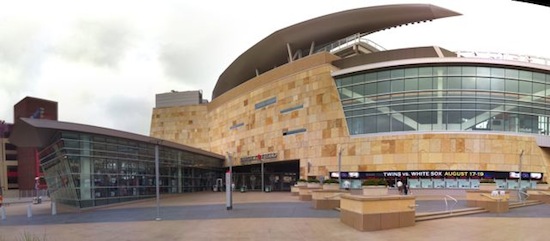
All of the buildings in the downtown area are connected by the Skyway, a series of elevated pedestrian bridges used by workers and shoppers to escape the snow. While the Skyway doesn’t connect directly to the ballpark, it does take fans to Target Plaza, which to me is the most dramatic entrance to a ballpark in MLB. Target Plaza has been likened to an arm reaching out to the city, which it most certainly is. Instead of blocking off vehicular traffic to make the plaza bigger, traffic is routed underneath while the plaza tapers to become a sheltered sidewalk underneath Target Center, the local arena. The mass of fan movement is entirely visible along 6th St N, as is the entrance to the stadium, which beckons fans to come inside. As much time as I’ve spent describing the experience, it doesn’t come close to what it means to experience it in person.


Ticketing

I had gotten to the ticket booths by 11 AM to see if I could take the tour. Alas, the Twins don’t hold tours on gamedays. Discouraged, I asked about tickets for the that night’s game against the second place White Sox. Only $22 standing room tickets remained, the seller said. That was fine with me, as I was going to spend most of my time roaming around the ballpark anyway.

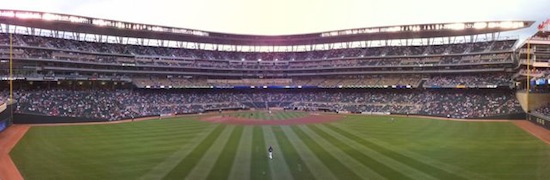
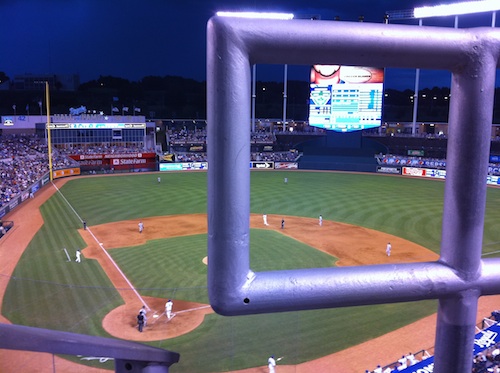
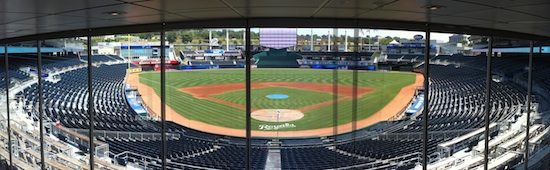
I returned to the ballpark at around 5:30, making sure to use the Target Plaza entrance as many others were. Once I had taken in the scene in the RF plaza, I walked along the 1B main concourse, where the views of both the ballpark and the city as a backdrop got progressively better. Amazingly, the concourse was 45 feet wide, not including the designated standing room and wheelchair areas. Then I took the escalators to the upper deck. I ascended to what I assumed to be the worst seat in the stadium, LF corner, last seat, top row (see top for panorama). The seat was better than what I had at Busch a few days earlier, in large part because of the diminished height.

Walking along the upper concourse, a few things stood out. The three-part columns that hold up the “floating” roof and upper deck differ from those at most other recent ballparks, which usually employ a column/beam/truss design. The roof is made of metal strips and holds the field lights and the speakers for the upper deck. That makes for a very clean implementation, though fans don’t get the benefit of heat as the lower deck folks do in some of the public areas. One way the Twins addressed the cold issue is to put an indoor bar, or rather a series of small bars, behind home plate along the upper concourse. If you and your friends have SRO tickets and get there early enough, you can set up a perch with a great view of the game, a drink rail, and a very convenient bar within a few steps. One of the bars even has the ballpark’s organist playing in the middle of it!

In their effort to keep the revenues at this smaller facility up, the team made a few unusual design choices. On television you’ll see a curved set of outfield seating sections in RF. Those seats, along with some signage, disguise a large parking ramp. A three-deck structure in LF is somewhat reminiscent of a similar structure at old Metropolitan Stadium and provides a few thousand seats. Along with the bars on the upper concourse, there are other spaces built out along the 1B line that belong to the Twins. Essentially, the team chose to move their stadium operations staff up there instead of making a larger press box along the mezzanine. By doing this, the team freed up more room for suites.

Concessions

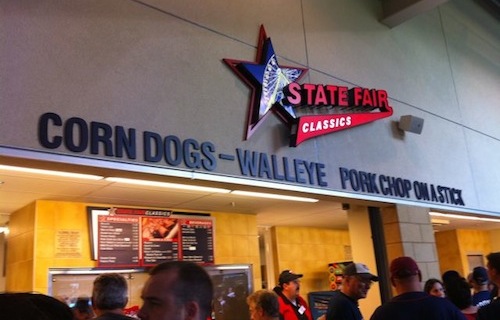
The stands of choice are the State Fair stands, which have a bunch of items you won’t find elsewhere, such as walleye or a pork chop on a stick ($11/7.25 respectively). Cheese curds ($4.75) are said to be popular, and I saw at least one person with a $9.75 turkey leg. 16 oz. domestic beers are $7, while premium beers are $7.50. I chose a Summit Extra Pale Ale, perhaps the most popular local craft brew, for the small 50-cent premium.

Everywhere, ice cream and gelato stands were packed, even though it wasn’t a really hot day. The lower concourse has its own Asian stir fry station and carvery, both of which were placed right next to each other and caused serious traffic jams. Most of the regular stands were quite efficient upon observation, which helped make the concourse look even better as a result.

Circulation

Ramps are not a prominent feature in terms of circulation, as the 8-acre footprint did not allow for large or sweeping ramps. Several people who wanted to descend from the upper to lower levels thought they could use elevators along the 3B side. They waited futilely for a while before using the hidden stairs nearby. Most everyone uses the escalators. The lower concourse has 360-degree view of the field, including the batter’s eye. Like Camden Yards’ wall in RF, it’s not for the vertically challenged. Still, I managed to peer over the top and catch a good view from dead center.

One demerit has to be charged to the PA system. While I was at the batter’s eye, I couldn’t hear the PA at all. Even in other spots along the seating bowl, the PA was more than a little subdued. It’s bad enough that the announcer is a tad bland. Somewhere along the line someone decided that they didn’t need volume, which sounds strange given Twins fans’ prior experience with the now passed announcer at the Metrodome, Bob Casey. Even on TV, Casey’s somewhat shrill delivery (“KERR-BEEEEE Puckett!”) added character to a largely character-less place. It couldn’t hurt to have more energy at Target Field.

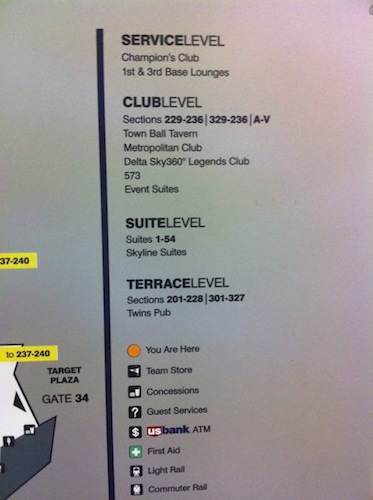
Another oddity is the naming of the sections. Here is another case where the neighborhood concept goes a bit awry. Along the Club level are 200-sections, but there are also non-Club sections named S through Z. Go up to the upper deck and there are both 200- and 300- numbered sections. What? If that doesn’t sound confusing enough, try to make sense of the legend below.

Other observations

  • I had mentioned the bars and the stadium ops buildings on the upper concourse. There appears to be room for additional buildout on the 3B side if they wanted. Access to the upper half of the deck is arranged via two sets of stairs and a catwalk. If there’s one thing I’d like to see stolen and put into Cisco Field, this is it.
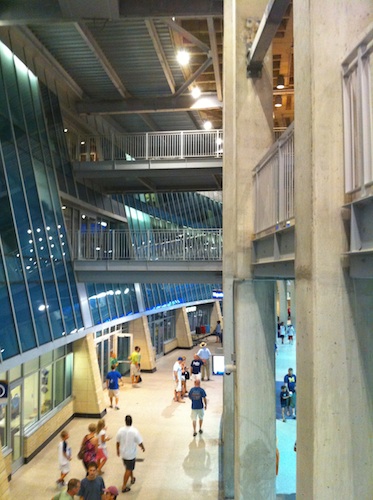
  • The part of the Skyway that leads from Target Plaza to the downtown core actually runs through the Target Center arena. It even has its own gate for access to the arena, plus a view into what appears to be a practice gym.
  • Along the north edge of the park’s footprint is a queuing area for the light rail, bounded by a fence. That fence has a long series of mesh screen images of notable Twins in chronological order. That side is also open to the infamous garbage burning facility, H.E.R.C. I didn’t smell burning garbage while I was there.
  • Three bronze statues greet you along Target Plaza as you walk through it: Rod Carew, Harmon Killebrew, and Kirby Puckett. Players also have entry gates with their number. The Target Plaza gate is Gate 34. Kent Hrbek’s gate is Gate 14, with a sports bar inside it to boot.
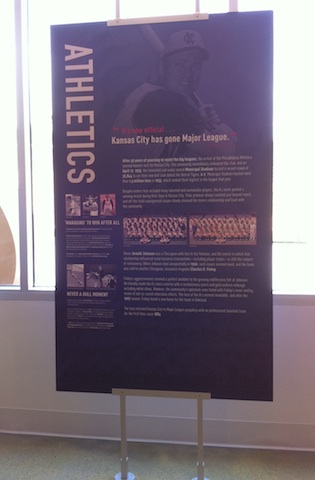
  • I love how the ribbon board is organized, with a proper balance of advertising and game information.
  • The limestone facade is good, especially because it’s locally sourced limestone, but Populous did this kind of treatment before with Petco (sandstone), so no novelty there. If anything, PNC Park’s limestone treatment is much more substantial.
  • Along the parking garage wall facing Target Plaza is a kinetic sculpture by Sebastopol artist Ned Kahn. It is a series of hung “chain mail” panels that undulate with the wind, and is mesmerizing to watch. A similar installation can be seen at SFO’s BART station, attached to the International Terminal.
  • It would be nice if there were more places to sit on the concourses, but again – 8 acres. Not much room.

Wrap-up

Bill RIgney

There’s nothing fake about this place. It’s a ballpark, not an amusement park where baseball is played. Even with the new love affair with the Twins playing outdoors, I was asked by one fan how long the honeymoon will last, whether the glowing impressions of Target Field will be sustained over the long run. There’s still a palpable sense of wondering whether it was worth it, the natural Scandinavian sense of pragmatism, even austerity. I explained that the monetary value of an investment like this can only be measured many, many years down the road, and while I don’t like how the public financing part was arranged, it may well pay off for the public. As for the ballpark itself, a good place has good bones that stand the test of time. Target Field has good bones. Ride the wave and enjoy it, I suggested to him. Also, remember that Joe Mauer is a big reason this is here, and that this will be the reason Joe Mauer will stay here. By that measure, the Twins have already won many times over.

Day 10: Wrigley Field

8/16. Game time- 7:05 PM
Attendance: 36,814
Weather: 77 degrees, partly cloudy
Matchup: San Diego Padres at Chicago Cubs
Pitchers: Kevin Correia vs. Tom Gorzelanny
Result: SD 9, CHC 5, W- Correia (10-7) L- Gorzelanny (6-7)
Ticket Purchased: Upper reserve outfield- $29.25 including fees
Beer of choice: Choice? What’s that? Budweiser 16 oz. – $8
Food: None
Travel cost: $5.75 for a Metrorail All Day Pass
Other: None
Total spent: $43

If you’re a true baseball fan, and you’re self-sufficient enough to foot the bill, you’ve probably already seen Wrigley Field at least once. If you were lucky, it was a day game, which in the baseball world is an almost transcendent experience. If you haven’t, you’re missing out. It’s the complete opposite of the Cowboys Stadium experience. It’s not showy or flashy. It’s pure. It anchors a community. Even with the redone bleachers and the addition of electronic signage, that purity hasn’t been lost.

Wrigley’s pleasures are not evident at first glance from outside. The exterior treatment is bland gray with metal fences and little color to accent it other than green beams. The red marquee is its most distinguishing feature. It’s funny that the two surviving old ballparks, Wrigley and Fenway, are not known for the façades or exteriors. Everything fans love about them is on the inside.

Getting there

For the love of everything holy, do not drive to Wrigley. If you must drive, head over to the DeVry University parking lot, which is 2 miles west of the ballpark. Parking is $6 and the Cubs operate a free shuttle to ferry everyone to and from Wrigley. Or instead of driving, take the “L” Red Line to the Addison stop and walk one block west with the streaming throng of Cubs faithful. The Red Line runs north-south from near Evanston to the Washington Heights, past US Cellular Field and the Loop downtown. Fares are $2.25 each way, or $5.75 for an all-day pass. For an even cooler experience, head down to Wrigleyville well before the game. Several sports bars and pubs call the area home, including Cubby Bear and Goose Island.

Ticketing

The Cubs have a perverse ticketing system that chooses to penalize people who want to sit in what are supposed to be some of the worst seats in baseball: the bleachers. Yes, the bleachers feel more like a crowd at a high school football game hanging out instead regular baseball bleacher bums. If you really want that, though, why not just go to a high school football game? It’ll be a lot cheaper than the 40 bones you’ll shell out for a bleacher ticket. Even with that $40, you’re still shut out of the rest of the park, and vice-versa. I’ve sat in the bleachers once, 14 years ago, for a day game. Marvelous. Also, $16, still overpriced but not grotesquely so. Things really didn’t get out of hand until a couple of years later, when the Sosa-McGwire saga brought fans back from the strike.

I got a $20 Upper Reserved seat along the first base side, half way up. The upper deck is split into two parts, box upfront and reserved in back. Some of the UR seats are truly obstructed view, whereas other seats behind them will also have obstructed views yet not be marked as such. Should the Wolff/360 vision for Cisco Field move forward, view obstructing columns will be a source of great debate. Many, perhaps most, will feel that there is no place for columns in a modern ballpark with modern building and engineering techniques. Some purists argue that fans in new ballparks are too far back from the action, so the use of columns to bring them closer is a welcome change.

In reality, there may be a much more banal reason for the introduction of columns: cost. If you look at the picture of one of the columns from the new Busch Stadium and compare it to one at Wrigley, the difference seems exponential. Wrigley relies and columns and a spiderweb of truss work to hold up the roof and upper deck. 100 years later and beefy I-beams are responsible for doing the lifting. Updated building code requires materials that can handle substantial earthquakes, but I suspect that in going with columns the team will save millions on structural steel, hopefully not so much as it will appear that they are cutting corners.

Concessions

I took one look at the lines and passed. As I always do here. I’d prefer to, I don’t know, not waste half the game in line for a hot dog. Instead, I waited in my seat for a beer vendor, who poured my a 16-ounce Bud for $8. Food variety has apparently improved over the years, and now there is a restaurant in the batter’s eye and a club area sponsored by PNC Bank (this is starting to become a theme).

Circulation

Ramps, ramps, and more ramps. Want to get to the upper deck? Take a series of ramps. Need food? Take a ramp. Potty break? Ramp. At first, it may seem like you’re in a M.C. Escher drawing, but after a while it starts to make sense. One thing that gets lost is that there is only one full concourse at Wrigley. Ramps connecting to the upper deck do not a concourse make. There is a small area behind the plate along the upper level with two concession stands and some carts. That’s it. And as the Cubs pursued even more revenue with the bleacher rebuild, they still didn’t make it possible to walk all the way around the ballpark from the inside.

Other observations

  • There is an in-game display below the old hand-operated scoreboard, though it only shows the batter and ads. LED displays are now down the lines. The display down the 1B line is longer and shows all pertinent in-game info, whereas the opposite display only serves up ads.
  • The batter’s eye is not as bad as I thought it would look in person, but it serves to highlight how way off the dimension markers in the park are. The 400 feet sign is well into right-center.
  • Generally when the Cubs suck, as they do this year, fans only stick around until the 7th inning stretch (and the guest rendition of “Take Me Out To The Ballgame”) are done. This night was no exception.
  • I snuck down to the front row of the upper deck by the 5th inning. From that vantage point, columns are welcome at Cisco Field.

Wrap-up

As much history and character Wrigley has, perhaps the best thing that could be said about it may be that it’s not going anywhere. When the Cubs were up for sale, there was talk of decoupling the team from stadium, mostly for financial reasons. Thankfully, it is part of the price Tom Ricketts paid for the team. So if you haven’t gone to Wrigley yet, there’s plenty of time.

Day 9: Miller Park

I have to admit that on my way back from Milwaukee, I was caught speeding by an Illinois State Trooper. I was going 82 in a 65 zone. I explained to the officer that I was coming back from a Miller Park tour, though I also neglected to mention I was also coming back from a Miller Brewery tour (no, I was not drunk in the slightest). Stopped on the I-94 shoulder, the officer asked why a guy from California with Michigan plates was in such a hurry. I replied that I was going to a game at Wrigley tonight, and while I didn’t expect any sympathy, I hoped that a brief local sports chat would loosen things up a bit. Thankfully, it did the trick, but not before the following exchange:

Officer: So how was Miller Park?
Me: Eh, it’s okay.
Officer: Just okay?
Me: I felt that it lacks the kind of intimacy you’d like in an outdoor park. The dome really dominates everything.

The officer turned around and walked back to his car, where he finished writing up my warning. I was curious about his reaction to my opinion, but I never got the chance to ask.

No doubt, Miller Park has far more to it than its predecessor, utilitarian County Stadium. It’s much bigger and luxurious, stays warm in the early months of the baseball season, and represents a signature architectural piece in area that lacks them. Still, one can’t get over the sense of sheer excess that went into creating the place. Driving towards the stadium, one can’t help but get the feeling that it overwhelms its landscape. Once (if) one gets past the sheer size of it, what remains is a very competent ballpark, one that is more than equipped to keep up with the big market teams.

Getting there

I figured the trooper as a Cubs fan, which made him likely to be one of thousands of Northsiders to enjoy heading 90 miles north every season to take in a game or a series at Miller Park. The Brewers get a good number of fans through the turnstiles this way, just as the A’s benefit from Giants, Red Sox, or Yankees fans invading their turf. Traveling to the park was simple enough, although a trip to make a midday tour is not the same as rush hour traffic to make a game. The stadium has its own freeway exit off I-94, making ingress and egress a breeze. Large parking lots around the facility celebrate the long history of tailgating in Milwaukee, accompanied by plenty of local brew and sausages. A few buses run by the ballpark, but it’s abundantly clear that this is a place for cars, not transit.

Ticketing

I had previously seen a game at Miller Park a couple of years after it opened. Impressions are much the same. Sure, the stated capacity is a bit shy of 42,000, but that didn’t stop the Brewers from spreading everyone out in nearly every dimension imaginable. The ballpark has four complete decks in foul territory 2 separate club levels, 2 suite levels, and multiple levels in the outfield. The fan-shaped roof has dual large columns at its pivot point, creating an unfortunate obstructed view situation in the upper deck ($1 seats helps make up for that). No wonder the Cubs fans come. If Wrigley Field feels like cramming people into a clown car, Miller Park feels like stretching out in a Town Car. Comparable tickets also cheaper, especially since there’s no insane premium attached to bleacher seats.

Then again, even with the roof and windows open, it still feels like it’s indoors, only someone left a door open to let in a draft. The often cool climate creates a situation where the team is more worried about heating the ballpark, not cooling it.

At nearly 10 years old, Miller Park has proven to be somewhat overbuilt, though not to the negative effect of Coors Field (too many seats). Suite demand fell off over the years, so the team responded by taking 4 suites on the third base side of the upper suite level and converted them into a separate club area.

Concessions
Renovations being done during an August off week indicate that the Brewers are quick to respond to market changes and new customers. The week that we took the tour, we informed that PNC Bank (yes, that PNC) will sponsor the mezzanine club level. New logos and rugs were already in place to celebrate the new sponsor.

Since I did not get to attend a game, I missed out on one of the legendary bratwursts with the secret sauce. I’ve had it before, and I have to say that while the sauce may be overrated, the freshness of the brat made it outstanding. When you turn over that many brats every home game, things are bound to be fresh. Beer selection has improved, with stuff other than Miller on tap. The Friday’s Front Row grill, which is open to the public year round, has two sets of 6-7 taps, one side for big domestics and the other for smaller and craft brews. I partook in Horny Goat’s Hopped Up and Horny, a not overly hoppy IPA. In any case, selection is better than at Busch, that’s for sure.

Circulation
Navigating four levels can be a pain, which makes that numerous ramps and escalators very useful. Concourses may be the widest of any domed ballpark, so getting around and queueing for concessions is easy.

Other observations

  • The real Bob Uecker seat in the broadcast booth is quite nice.
  • Did you know that ESPN broadcasts a national game, they require the use of 3 auxiliary press booths, often squeezing out alternate language broadcasters?
  • Behind the home plate gate there a touching monument to the three fallen crane operators, from whose accident construction was delayed.
  • Further out in the parking lot is Helfaer Field, a small diamond sited where County Stadium used to be. It came about as a result of a $3 million donation by the Helfaer Foundation, thus the name.

Wrap-up

The picture at the top of this article shows a blank pedestal, similar to ones built to hold bronze sculptures of Hank Aaron and Robin Yount. It is expected that this third one will contain a similar statue of one H.R. “Bud” Selig. While the team was handed to Selig’s daughter Wendy Selig-Prieb’s hands, it would be foolish to think that the commissioner’s power didn’t extend into how Miller Park was built, especially given that he moved the commish’s office to Milwaukee. While Selig has crowed often about a new or renovated ballpark in 28 of 30 MLB cities, this is surely the one that makes him proudest. In a sense it’s wholly appropriate. Miller Park is massive like the sluggers of the steroid era, when the venue was built. Whatever machinations went into getting it built, the end justifies the means. While Brewers and Cubs fans can luxuriate in the stadium’s opulence, it’s hard not to feel a bit awkward about the whole thing. For that, thanks Bud. It is truly in your image.

Day 8: US Cellular Field

Those of you who follow the site’s Twitter feed found out on Sunday that the train I was taking from St. Louis to Chicago accidentally hit a car on the tracks a few miles south of Joliet, IL. It happened shortly after 11 AM at a crossing with no gates to prevent cars from roaming onto the tracks. The driver, a young woman, was the lone occupant in the car. It took 19 minutes to extract her from the vehicle, after which she was airlifted to a local hospital. I haven’t heard anything about the story since, but I was told that her vitals were good, which seems almost miraculous given that cars and drivers don’t normally do well in such accidents.

Not to sound shallow, but the hour-plus delay pretty much killed any chance I had of making the White Sox game that day. When I finally got there it was the bottom of the 5th and the Tigers appeared to be on the verge of blowing out the White Sox. Lo and behold, the Sox mounted a major comeback to pull ahead 8-7, but the Tigers came back themselves and finished the Sox off 13-8.

Downcast from the day’s events, I still went to The Cell to take some exterior photos, if not check out the interior, which I had done more informally a decade ago. My initial thoughts then were that it was a larger, newer, yet worse version of Kauffman Stadium. Since I didn’t enter the ballpark, I can’t appraise the changes that were made a few years ago. For all intents and purposes, this day and ballpark review were shot.

Getting there

One thing that hasn’t changed is transportation access. The “L” Red Line runs along the Dan Ryan Expressway (I-95) and stops one block from the LF corner gate. For $2.25 each way, it’s a steal. The Red Line also runs through the loop downtown, and also stops near Wrigley Field and Midway Airport. Skip the $23 parking and go with the “L.” It just works.

Ticketing

Nothing to report.

Concessions

Nothing to report.

Circulation

Okay, I can write about this. The original vision for the New Comiskey Park was to be an updated version of Kauffman Stadium, with added luxury amenities. Access would be severely restricted, as is the case in Dodger Stadium. It took 15 years for the team to correct much of these mistakes, which they did by lopping up several rows of the upper deck, installing a proper metal roof, and putting in some kid’s entertainment in the outfield. The place is still somewhat segregated, which can’t be helped given the three-story wall of club seats and suites dividing the lower deck from the upper deck. The seats up top are still much too steep.

Other observations

  • The limestone exterior has held up well in the last 20 years. It’s easily the most handsome feature of the ballpark.
  • I tried walking around the entire exterior of the ballpark but ran into a fence behind centerfield. There’s certainly enough room to do it. The fencing and security here is rather aggressive, in keeping with a location in the South Side.
  • sdffsd

Wrap-up

Historically, US Cellular Field has been overshadowed by the retro trend leader, Oriole Park at Camden Yards, since that ballpark opened in 1992. Now that the retro fad has faded, it’ll be interesting to see how long the trend of building more modern ballparks lasts. The Cell might have received some praise – if they hadn’t retroed the place up in the meantime. Oh well.

Day 7: Busch Stadium (III)

8/14. Game time- 3:10 PM
Attendance: 46,313
Weather: 94 degrees, sunny
Matchup: Chicago Cubs at St. Louis Cardinals
Pitchers: Carlos Zambrano vs. Chris Carpenter
Result: CHC 3, STL 2, W- Zambrano (4-6), L- Carpenter (13-4), S- Marmol (20)
Ticket Purchased: Upper reserve outfield- $42.75 including fees
Beer of choice: Choice? What’s that? Budweiser 16 oz. – $8
Food: None
Travel cost: $7.50 for a Metrorail All Day Pass
Other: None
Total spent: $58.25

St. Louis was the last of those classic baseball towns with a multipurpose stadium. Busch Stadium was easily the best of breed, as the baseball Cardinals had the luxury of having the football Cardinals move to Phoenix in the late 80’s. That allowed the baseball team to make incremental changes and improvements to the old stadium, making it more baseball friendly. That parallels with the A’s to some degree, but in 1995 everything that went “right” for the Gateway City went wrong for Oakland. The LA Rams, a vagabond team in its own right, went to St. Louis and a new domed stadium. Oakland chose to fix up the Coliseum for football, alienating the incoming Schott-Hofmann group and destroying the Coliseum as a somewhat pastoral, if not altogether charming, venue for baseball.

Back to St. Louis. As part of the football-free renovation the carpet was ripped out and replaced with grass. The seating bowl was redone for baseball with 8,000 seats removed as part of the process. A friendly deep green (here we go again with the green) was part of the makeover, making the Busch Stadium II the best of the old cookie cutters. Moreover, the stadium was also privately owned. When the Rams moved to STL, their stay at Busch was only temporary and was the impetus to lengthen the life of the old girl. Those improvements proved to last another 18 years, until the team moved into the new baseball-only stadium fans currently enjoy.

That good history for the stadium meant that the team and HOK could draw on recent history of ballpark building, while not reacting too adversely to bad experiences at the old stadium (since that largely didn’t exist). For instance, the Tigers had Comerica Park designed as a polar opposite to Tiger Stadium, as it had almost all of its seats in the sun and a really huge lower deck, which only served to punish those in the upper deck. Did they really need to go that far? Not really. It’s best to start with a clean sheet and aim for the best fan experience, without worrying about having to address specific past grievances. It tends to get their eye off the ball, as it were.

For the most part, Busch Stadium gets it right. There are aggressive cantilevers on the upper decks. The outfield sections have a party atmosphere. Most of the suites are arranged behind the plate. Concourses are more than adequate. Yet there’s something odd about the place, and for me it took a while to understand what it was. The problem is “neighborhoods.” I’m not referring to the area where the ballpark is located. The issue is the marketing term as it relates to how the seating is arranged. Seating decks are broken up and somewhat isolated to create their own sort of intimacy. Lew Wolff has hinted at this at Cisco Field on more than one occasion, and it’s likely that visits to his old hometown confirmed this notion. Right now I’m going to use this platform to caution Lew and Keith Wolff not to go too far with this. It’s one thing when neighborhoods within stadia are built over time with expansion, as was often done in past eras or in European soccer stadia. To manufacture it into a new ballpark is, well, artificial. Neighborhoods are not created by assigning price points to blocks of seats, they’re fostered by generations of fans who attend regularly and buy decades worth of season tickets. That isn’t happening in the Bay Area, at least not with the A’s right now. Some segmentation is not bad if a sense of community is the goal, but don’t do it just because the Coliseum looks like a round toilet, or because Busch II looks like an ashtray. The effect at Busch III is somewhat jarring and a little confusing when it comes to walking around the place.

Getting there
The game was held on a Saturday, which made things easy. I traveled from my cheap hotel near the airport to downtown via the Metrorail service, which was a 30-minute ride. If I drove it would’ve only cost me gas, as on-street parking on weekends downtown is free on the weekend. Some people choose to overpay for the various lots, and I don’t understand why. After the game there were two other major events in the area: a Rams exhibition game at Edward Jones Dome and Black Eyed Peas at the Scottrade Center, both within blocks of the ballpark. Keep in mind that while the now rundown downtown is large, a city of 400,000 is able to handle three big events and 120,000 visitors in one day. Are you paying attention, San Jose?

Ticketing
Tradition is great when it comes to cultivating a fan base. You know what it really means, right? It’s a license to print money. The upper deck ticket down the RF line that I had to purchase in advance because it was a Cubs game had a $34 face value, plus $8.75 in tickets.com fees. That ticket should never cost more than $25 anywhere, and probably less than $20 in most cities.

Price aside, the seat I had was not bad. Busch Stadium follows the recent trend of having its upper deck split into two, to allow for a view from the concourse and additional ADA wheelchair spots. It also makes navigating to one’s seat easier as there are fewer rows to climb. Two really nice touches are how the landings from the stairs are bowed out to allow for greater room, and the sets of three seats by themselves above the vomitories. It’s like having your own little box, if you’re into that sort of thing.

Concessions
I had taken a train from Kansas City in the morning, which got me in 2 hours before first pitch. That gave me time to eat lunch, and as a result I didn’t eat anything at the ballpark. The only beers I saw on tap were – surprise! – Bud and Bud Light. Same thing for vendors with cans in the stands. Not that I expected anything more.

Circulation

In recent years, there’s been talk about a new style of cookie cutter ballpark, the main culprit being HOK (now Populous). While certain aspects of ballparks from the 90’s and the early 2000’s applies, Busch Stadium and Philadelphia’s Citizens Bank Park take a bit of a departure. CBP has a square block footprint, while Busch has its neighborhoods.

Traveling between the decks hasn’t changed much among the HOK designs. Ramps are large and easily accessible. There are escalators along each base line, though it took four escalator segments to reach the upper deck. That ensures that anyone in the upper deck is pretty high up there.

The main concourse is not open, as the Cards chose to stick an extra level of suites behind the plate and additional seats down the lines. The seats are similar to what I described at Rangers Ballpark, except that the sections are somewhat sealed off from the concourse. The exception for this is the wide openings down the line on either side. Even then, the Cards decided to spite fans by putting up what look like large baby barriers at the entrances to the seating sections, thereby discouraging people from using the areas as standing room. In the corners this isn’t as bad, and the back/upper sections are sufficiently elevated above the walkway to allow for standing room patrons.

Other observations

  • Look at that steel column and compare it to the size of the guy on the right. That’s strength.
  • It seemed like there were party suites everywhere.
  • Perhaps one-third of the crowd were Cubs fans. I’d never been to one of the rivalry games, and I was expecting much more tension. Then again, these are the Cubs after all.
  • The picture at the top is what’s supposed to be the Ballpark Village, the multi-use project that remains in development hell. It’s also where the old Busch used to stand.

Wrap-up
The new Busch Stadium suffers from a timing issue. The private financing that took care of half the cost came later than expected, making certain that Busch III rode the coattails of other ballparks. Innovations here were done in the service of marketing concerns and to put in more than 45,000 seats, which can be a bit tricky. The ballpark village isn’t there yet, forcing fans who want a bit to eat to go to restaurants named after the insufferable duo of Joe Buck and Mike Shannon (the laziest radio play-by-play man there is). Still, it works well and will serve the good Cardinal fan base for decades to come. That’s all anyone can really ask for.

Day 6: Kauffman Stadium

8/13. Game time- 7:05 PM
Attendance: 30,680
Matchup: New York Yankees vs. Kansas City Royals
Pitchers: Dustin Moseley vs. Kyle Davies
Results: KC 4, NYY 3, W – Davies (6-7), L – Moseley (2-2), S – Soria (32)
Ticket purchased: Upper Box Infield ($22)
Beer of choice: Boulevard Pale Ale ($7)
Food: BBQ Pulled Pork Dog ($6)
Travel cost: $10 in gas, $10 parking
Other: Kauffman Stadium All-Star tour ($20), Negro Leagues Baseball Museum/American Jazz Museum tours ($10)
Total spent: $95.00


The footage above was captured by my iPhone as part of the Kansas City Royals Hall of Fame’s 14-minute video introduction to baseball in Kansas City. It is splendid. It is magnificent. It manages to make no mention of Arnold Johnson. Not that it matters, the presentation rocks – in particular because the technology used is not a projector but rather a large LED display, or a scoreboard/video board in layman’s terms. The colors are so vibrant, the video so crisp, the screen so wide, that it’s a visual feast. Every team, every major league city deserves this kind of tribute. I fortuitously got this clip as it has some relevant history for A’s fans.
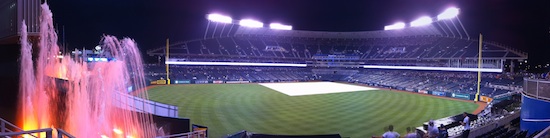
017-Fountain_Pano-sm
No matter where I travel, I maintain a place in my heart for Kansas City. Maybe it’s the barbecue. Or the shared history with the A’s. Or the general friendliness I always encounter. Whatever it is, the city’s Kauffman Stadium has always been lauded for being a postmodern relic that has managed to stand the test of time. No need to couch the praise anymore, as Kauffman is as good as any of the new ballparks built in the last twenty years.

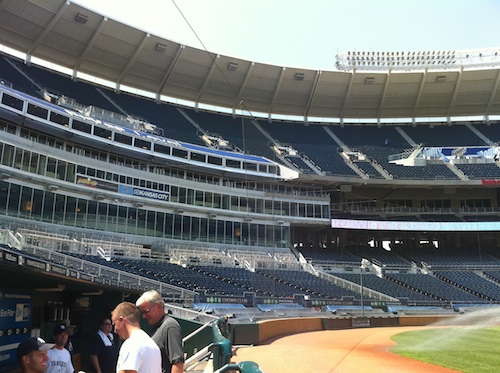
Every single thing a modern ballpark has is now in place. A concourse that allows fans to walk completely around the stadium? Check. Wider concourses with weather protection? Check. New press box? Check. Multiple clubs and restaurants? Check. Improved suites? Check. A museum? Check. Incredible video board? Check. It was always a comfortable place to watch a game. Now it’s comfortable and up-to-date. Sadly, a refreshed stadium is not the same thing as a new ballpark in terms of fan perception, and the revamp can’t fully cover for a crappy team, as 2009’s attendance didn’t surpass 1.8 million and 2010 looks to be a drop from that.

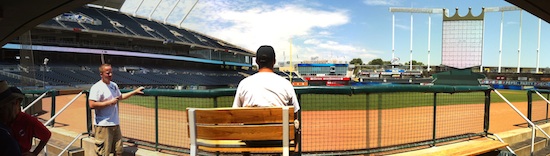
006-Dugout_Pano-sm

Getting There

As part of the post-war sprawl trend, the Truman Sports Complex was built in the middle of nowhere. 40 years later and it’s still in the middle of nowhere. You want in, you gotta drive. Parking is $10 and there’s plenty of it. Prior to the remodeling of the ballpark, local business interests spurred an effort to bring the team downtown. That effort went nowhere as the Royals’ interest was tepid at best.

Ticketing

Back Camera

I figured that a Yankees game might be somewhat impacted. Silly me. I was able to score a $23 seat in the front row of the upper deck. The deal proved too good to be true, as the ticket seller neglected to inform me about this:

Back Camera

Then again, it started raining shortly after I took my seat, so I headed back to the concourse to get some cover from the rain coming through the area. That’s when the improvements at the stadium really started to shine. Simple things, like better traction on the steps and a weatherproof coating on the concrete, combined with a large, high roof covering the concourse made things bearable. It used to be that the only thing that helped previously was the back of the upper deck cantilevering over the concourse, which really wasn’t much protection at all.

After the 2 hour, 15 minute rain delay, it was easy to find a good seat as two-thirds of the crowd cleared out. I didn’t even stick around for the whole thing as I needed to take an early train the next day. I wiped off a seat about 22 rows up on the third base side, and that’s when the place felt familiar. The seating bowl’s signature contours are still there, and the layout hasn’t fundamentally changed other than the outfield.

I left in the middle of the 7th, rain cleared out but constant thunder and lightning in the distance. My biggest regret was not being patient enough to capture lightning on camera as it lit up the ballpark. During the rain delay, I stopped at a picnic table to tap out the Day 4 post. Several other people were there, waiting out the rain. Two young girls from Wichita asked me what I was doing, and showed them the iPad’s MLB app. They asked if I they could see some highlights from the Wichita minor league club, I replied that it’s not ready yet. As the concourse filled up, the view to the field was blocked and I could no longer see if the grounds crew was working with the tarp or not. I scooted over to make room for an elderly gentleman. I asked him about the tarp and he ignored me, or so I thought at the time.

Turns out that the man and his wife were both deaf. As he saw me showing the MLB app to the kids, he started scrawling on a scrap of paper, which he laid in front me. It read, “Cardinals 6, Cubs 3. Box Score.” I quickly tapped the STL-CHC score, and the newspaper like box score opened in front of us. I quickly gestured to him how he could navigate the app, and he started smiling. Apparently he was really looking for Adam Wainwright’s line for the game. After he was done, he explained to me that he had season ticket to the Cards and was in KC visiting family. We “talked” some more and exchanged pleasantries. Okay I lied, I have one other regret, that I wish I had let that one girl I was dating in college teach me ASL.

Concessions

Seems like all over the Midwest ballparks are doing the gourmet dog thing. It’s a good way to charge an extra two bucks for a dog, a suppose. I figured I should try it once, and it was okay, not worth $6 but okay nonetheless. It was washed down with a Boulevard Pale Ale, KC’s most famous craft brewer. Strangely, the Pale Ale that cost $7 on the main concourse cost $7.50 on the upper concourse.

Circulation

Back Camera

The tour enters the ballpark at the main level. Behind home plate on the main level there is the Diamond Club, which despite its name is not the most exclusive club in the park. That honor would go to the BATS Club for the 100 or so seats directly behind the plate. Branding has gone way up since the last time I was here, over 10 years ago.

Now there’s proper room for escalators and those familiar circular ramps. Even with 20,000 people fleeing for the main concourse during the rain delay, it never felt cramped. The team administration building is physically separate from the rest of the ballpark, linked by a series of footbridges at each level. In doing this they allowed more natural light and air into the space. Very smart move.

The outfield area, which was once off limits, is now vast and spacious. There are special bars, a team store, frozen custard stand, fried chicken stand, play areas, and even a couple of mini golf holes. The piece de resistance is the Hall of Fame, which is tucked into the LF corner. It’s really lovely, covers over 50 years of baseball history without sounding bitter, and when coupled with a trip to the Negro Leagues Baseball Museum near downtown, makes for a really fun and educational day trip that also happens to include a major league game. If you go to KC, do all three. You’ll get the video, you’ll get a sense of justice, you’ll feel good about humanity.

001-Kauffman-PressBox-sm

Other Observations

  • Billy Butler was in the cage behind the dugout and taking extra BP. It must’ve worked because he hit the winning home run that night.
  • As impressed as I was by the Cowboys Stadium video boards, the single huge board at Kauffman rates nearly as high. The vertical orientation allows for an uncompromising combination of video and text information. It proved extremely useful during the rain delay as well, because it has plenty of space to support two simultaneous video feeds: the Red Sox-Rangers game and Chiefs-Falcons exhibition.
  • The bad seat I had was due in part to the way the new press box cut into the original upper deck. I’ve incorporated such a feature into some of my sketches. Now I know what to watch for.
  • Maybe BBQ is old hat in KC, maybe not. Whatever the case, it wouldn’t hurt to have one of the well known pit masters have a stand of their own in the ballpark, whether it’s Arthur Bryant’s or Gates. I had an Arthur Bryant’s “sandwich” before the game, and it heaven wrapped in butcher paper.
  • The team offers four different grades or levels of tours, based mostly on access. The cheapest tour offers basic info and access. The tour I took at $20 provided a free Kauffman Stadium hat, team magazine, and a longer running time. The most expensive tour allows fans on the field to watch batting practice.

Wrap-up

Kauffman Stadium rocks in many ways, even if the team doesn’t. If you’re planning a ballpark trip or even have already been there prior to the remodel, it’s worth going. It’s not garish or overstated, it’s family friendly, and it’s a great educational opportunity when coupled with the Negro Leagues Museum or even the American Jazz Museum, which is in the same building. This is my first true endorsement on the trip, and it’s a full one.
Back Camera

Day 5: Cowboys Stadium


On paper, the differences between Houston’s Reliant Field and Arlington’s Cowboys Stadium aren’t vast. Both have retractable roofs. Both have hundreds of luxury suites and thousands of club seats. Both are meant to act as extremely large arenas via flexible floor use plans. Yet the biggest difference can be summed up by my initial experiences in touring both. The day I visited Cowboys Stadium, I was among the last of thousands of people doing the same thing. At Reliant Field, I was the second of a grand total of two visitors for the 2 PM tour, before I stopped the tour guide to allow three latecomers in at the last moment.

Reliant Stadium is not inferior from a technical standpoint. It even has one major winning feature over Cowboys Stadium, in that it has actual grass, as opposed to the new generation of artificial turf that has been taking hold in many other NFL stadia. However, the public is well past the point of novelty wearing off for Reliant Stadium, which when coupled with a lack of tradition that comes with an expansion franchise, makes it difficult to capture the public’s imagination. Cowboys Stadium has the Ring of Honor, the big star at midfield, and a roof design that mimics the old hole-in-the-roof at now demolished Texas Stadium. Not only does it share the team’s legacy, it has taken that legacy and made it its own, the same way New Yankee Stadium has for Yankee fans. Who knows what would’ve happened had Reliant Stadium been built for a Houston Oilers team instead?

Much has been made of the opulence Jerry Jones has lavished on his new stadium. In all honesty, there’s no better word for it. Everything a fan can see or touch is high quality, often polished to a mirror finish. Sure, the center-hung video board is ginormous, but what about the thousands of other flat panels throughout? So much leather, wood, and metal trim, you’d think you were in a 1/4-mile long Maybach? Polished concrete floors everywhere? As impressive as Reliant Stadium was almost a decade ago, it looks absolutely spartan in comparison.

Getting there

Again, this is a major sore spot. There are always warnings about the traffic around Arlington when a Cowboys home game is being played, which made me reluctant to get there just prior to game time. In addition, this was a preseason affair, making it about as exciting as watching paint dry. Worst of all, parking near the stadium can cost up to $75! As I started thinking about how I was going to do this without killing myself for a parking pass, I wondered why I bought a ticket in the first place. I realized that it would be best if I missed most of the first half, then drove there to watch the second. I went to a bar and relaxed for a bit, then headed on over to the stadium. The plan worked out perfectly as one of the lots had no attendants at halftime, allowing me to sneak in and get a pretty close parking spot. Somehow I managed to go to two sporting events in Arlington without paying for parking for either one. At least for Cowboys games, the City of Arlington is supposed to receive a whopping $7 per car, to help offset its $300 million investment. To that I say: Marine Layer 2, Arlington 0.

Ticketing

The cheapest seat in the place is $75, way up in the upper deck corners. These are among the only seats which don’t require a PSL. I didn’t even want to spend that much, so I got a “Party Pass” ticket, which is essentially a $29 glorified SRO ticket. The Cowboys have the ability to sell more than 30,000 of these things per game, bringing the stadium capacity to over 100,000.

It’s a good thing I took a tour the previous day, as it allowed me to find some good places to camp out. Unfortunately, all of the places on my list were already packed. Looking around the seating bowl, I noticed that there was already a steady exodus by those who wanted the beat the traffic and didn’t care much for 4th string guys battling it out over the 53rd roster spot, so I quickly headed to the upper deck to see if I could get a prime spot there. I was easily able to get a good seat on the 35-yard line, and by the 4th I was at midfield. The Camatic seats whose virtues I had extolled last year were sturdy and comfortable, and the rail mounting system is just genius.

You’re probably asking, “Why’d you go to the upper deck?” Well, ever since I had seen the initial sketches for Cowboys Stadium, I wanted to see how bad the upper deck seats would be, and whether the video board could make up for it. Some of you may be purists who prefer to just watch to live action and would consider the video board a distraction. I was in that camp before. Now I’m convinced that the upper deck is actually a very good experience.

The seats themselves are higher than the upper deck at Mt. Davis due to the inclusion of two additional suite levels. The view, however, feels very similar. Just as in most new NFL stadia, the upper deck is a view way down. For someone with poor vision, it could be very unsatisfactory. For me it was just fine. I could also switch to the video board, which was at eye level with the upper deck. The hardest thing was reconciling the live action with the video, which was obviously shot at a different angle. Once I got past that, it was easy to switch back and forth.

Still, the video board can be a distraction. I was constantly bombarded by messages in between plays, and constant cutaways to the cheerleaders didn’t make it any easier to take my eyes off the screen. The sound system is incredibly loud. It appeared that canned noise was being piped in when a “Make Noise” message was displayed. The whole package can be assault on the senses. The experience reminded me of a phase I went through playing sports video games ten years ago. I’d often have a game on in the background while I played a fake game on a PC.

Concessions

I won’t devote much time to the food or beverages here, as I didn’t buy any of those. Needless to say, Miller Lite is a charter sponsor, so you know what to expect in terms of beer variety. The video wall in the above picture is exactly how I’d like to see all concession stands progress in the future. Video and graphics are fully customizable, with multiple displays available for showing the game, statistics, ads, and so forth.

Circulation

For a venue that requires a journey of five flights of stairs to get from the main level to the upper level, it’s not bad. That’s especially the case if you’re in the end zone area, where each landing facing the field provides a unique view. The landings are large enough that fans often lean on the railings and watch from there. It’s an interesting contrast in that American stadia are trying to incorporate more and more standing room areas, whereas their European brethren are going away from standing “terraces” and building so-called “all-seater” venues. Ramps and escalators are in place, but not prominently featured. Concourses are as much as 65 feet wide, not counting the large end zone plazas.

If Cowboys Stadium reminds me of anything, it’s an airport terminal. The outside is fritted glass and transparent glass. The inside is concrete, cinder block, and displays. I expected more images of the team’s history to flood the concourses. Instead, it’s almost a blank canvas, with only the occasional colorful sign to provide contrast. Perhaps Jones is keeping that open for even more commercialization opportunities. Even the Ring of Honor is subdued with its silver background. Its predecessor in Texas Stadium was a more pronounced blue.

Other observations

  • The tour starts at the Pro Shop (team store), where you go up to the second level, only to descend multiple confusing staircases in order to gain access to the field.
  • Jones has indicated that he wants to hold events as diverse as future World Cup games and a US Olympic swimming event. He’s already had the NBA All Star Game and a 50,000-spectator Manny Pacquiao fight, so why not?
  • It’ll be interesting to see what happens if Cowboys Stadium gets to host some World Cup games. Would they use a tray system like the one used at Reliant Field, or previously used at Giants Stadium for the 1994 WC? I suspect that the artificial surface, which has plenty of seams and uneven spots, may not be sufficient.
  • The Press Box is split into two parts, sandwiching a set of suites. This puts the press in the corners, which is unusual to say the least.

Wrap-up

It’s impossible not to be blown away by the monumental excess on display at Cowboys Stadium. Like Staples Center a decade ago, this is the trendsetter, even as the New Meadowlands Stadium gets ready to open. Cowboys Stadium is the class of the league, and Al Davis must have been green with envy as he surveyed its expanses. It’s a phenomenon that’s only really possible in football-mad Texas, with a bombastic owner like Jerry Jones. The 49ers stadium is already awash in ways to cut costs, and that will only deepen over time if/when it gets built. As for just purely watching a game? Lambeau Field is still the big winner, hands down.

Day 4: Rangers Ballpark

Back Camera

8/11. Game time- 7:05 PM
Attendance: 48,676
Matchup: New York Yankees at Texas Rangers
Pitchers: Javier Vazquez (9-8) vs. Cliff Lee (10-5)
Result: NYY 7, TEX 6, W – Wood (2-4), L – Feliz (3-3), S – Rivera (24)
Ticket purchased: $15 Standing Room Only
Beer of choice: Ziegen bock (Anheuser Busch)
Food: Brought in 2 bananas – $0.50, $0.50 bottled water
Travel cost: $5 in gas. Parked at nearby Wal-Mart for free (normal parking rates are $12 for remote cash lots)
Other: Minute Maid Park tour – $10
Total spent: $31.00

All day long, I had tried to steel myself for the inevitable heat and humidity that I would face at the ballpark that night. The schedule dictated that I would do the Cowboys Stadium tour the same day as the baseball game, and the following day the Rangers Ballpark tour with the football game. The football stadium tour proved to be a godsend, as it was all indoors (more on that in a future post). I strung out the self-guided tour as long as I could, wrapping it up after six before walking over to the ballpark with a short detour to grab some water and two bananas.

Getting there

Arlington is infamous for being the largest city in the US without public transit. With 380,000 residents, it’s just slightly smaller than Oakland, and when you think about it, it’s about as different from Oakland as night and day – politically, geographically, amenities, etc. Not having public transit meant that I’d be driving these two days, which didn’t turn out so bad when I found out that the car rental location ran out of small cars and was forced to give me a Cadillac CTS. Oops. The key, then, would be to figure out where to park. A large Wal-Mart SuperCenter was located across the street from Cowboys Stadium, which itself is 1/4 mile from Rangers ballpark. I figured if I got to do a late stadium tour and bought the food items at Wal-Mart, I could justify my parking there. Which is what I did.

Ticketing

Local sports radio was hyping up the game, going so far as to have it approach the Cowboys’ deity-like popularity (local cable broadcasts for the Yankees series on FSSW rated an impressive 8.0 rating). Plus I got a standing room only seat. Problem there is that I knew that the places I could stand in the ballpark were places I had no intention of standing in for long. The minute I entered the home plate gate, I started looking around the field level for a place where I could stand that wasn’t so hot or affected by the sun in the first 3 innings. In addition, since this was a Yankee game, it was destined to blast past the three-hour mark, which it did (3:48). While sneak down opportunities were scarce due to the near sellout and close game late, I still wanted to find a place to simply sit and relax, even for an inning or two in between my shutterbug sessions.

Fortunately, I was able to find a hidden gem of a spot in the back of the 100-series sections, which are really the back of the lower deck. The way the place is constructed, the concourse gives access to Row 28 of the lower deck. Another 10-12 rows are set up behind the first 28, with a large platform behind the last row above the lower concourse concession stands. The view of the game is somewhat restricted because of the overhang and columns, but if you find a decent spot it’s a great place to stand. Or even sit, if you know where to look.

Lightly used picnic area with suite level above, 100-series sections in front

Having something like what is shown above solves the problem of having limited SRO space, since this wouldn’t cut into the regular concourse. The tradeoff here is that patrons standing in line on the regular concourse wouldn’t be able to see and feel the game, though if their backs are turned, what does that matter anyway? The trend towards open concourses makes this kind of design decision difficult to pull off.

Concessions

The place is littered with portable stands. I was tempted to get funnel cake but passed. Lines were generally short as the stands were very well staffed, as could be expected for a crowd of near 50,000. The beer selection tonight was a Anheuser Busch clone of Shiner Bock called Ziegenbock. It’s a reasonable facsimile, though I suspect it hasn’t caught on that well because I haven’t seen a bar that serves it, as opposed to its more popular competitor. All of the facilities in Texas have extremely poor beer selection. I paid my penance by going to The Ginger Man in Dallas.

Circulation

This being Texas, there’s never a worry about having room to roam. Rangers Ballpark is a large rectangular box with all of the various ballpark bits baked inside. Ramps, which in other parks are often placed outside a ballpark’s facade or hidden from spectator view, are featured here in their full erector set glory. Naturally, the seats, beams, and columns are painted green, “Ranger Green” according to the tour guide. This had me shaking my head because any team that does not feature green in their team colors shouldn’t be allowed to appropriate their own shade of green for their own purposes because they’re afraid to use their own colors in the design. Ridiculous.

Anyway, the concourses inside are tremendous. There’s plenty of room to walk around, hang out, sit at a picnic table, or smoke if you are so inclined. In many places they are some 60-80 feet wide, allowing the Rangers to move around numerous portable concessions carts as if it were the Texas State Fair. And that’s how it feels. The regular concession stands are built below the seating bowl, cutting off the view of the game for those on the concourse. Unlike the two previous parks, there’s still an open air feel to the venue, so at least the crowd doesn’t sound muffled.

The club and suite levels are also open air. This creates a dilemma when the time comes to improve the stadium. Lately, there’s been some talk about having a retractable roof or some kind of shade placed over the ballpark. Estimates for this run from $70-330 million, depending on the complexity of the solution. A movable shade, such as one used in some European soccer stadia, would be cheapest and could reduce temperatures for affect fans some 10-15 degrees. It doesn’t really help temperature on the field that much, and it’s not a great improvement for premium seat holders. A rolling roof like that used at Safeco would be a better solution, but it allows ambient outside air to circulate in and out, making it still quite hot in the summer. A full enclosure of the ballpark, with glass walls and air conditioning everywhere, would be the most expensive solution and not cost effective, especially now that the incoming ownership group has paid $100 million more than they wanted for the club.

Other observations

  • People in the CF offices stuck around after work for the marquee matchup.
  • The suites are much smaller than I expected – about the size of the Coliseum’s original suites – they could be a future ADA issue if they aren’t already.
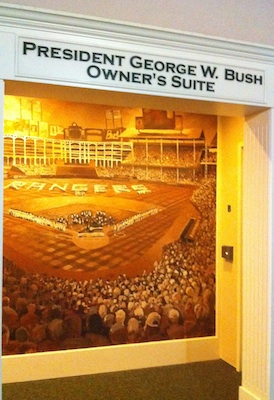
  • I got a peek at the famed owner’s bunker suite. Meh.
  • Cowboys Stadium is oriented so that its east end is directly facing the ballpark, almost as if it will eventually destroy it with lasers or lift up off the ground and consume the ballpark.
  • There were once grand plans to develop this part of Arlington, with lackluster results. There’s a Siemens building, the City of Arlington City Hall, and a convention center. Precious little new private development has occurred, probably because of the need for parking. Cowboys Stadium makes that exponentially worse.
  • There’s a simple explanation for the missing donation bricks: they fell apart in the sun over time. The plaza in front of the home plate gate has been paved. Another brick monument remains in the team hall of fame walk, which only lasted until 1997 as it too deteriorated badly. Future years would not be enshrined in this manner. There is now an indoor Texas Rangers Hall of Fame where the Legends of the Game museum once stood. The following pic couldn’t be more telling. It was closed, and I don’t think I’d be all that interested in checking out the Toby Harrah exhibit.

Wrap-up
It’s Texas. What do you expect? This area’s residents are certifiable for football, no matter how well the Rangers do. The Greenberg-Ryan group have to decide whether their once superior ballpark, now in the middle of the pack in MLB, is worth major upgrades. Ryan has indicated that a major change isn’t in the cards right now. Then again, maybe Arlington will throw another $300 million at a sports franchise instead of getting a rudimentary transit system in place. I’m not holding my breath on either count. Note: the day after I’m there, ownership announces a series of major price cuts for fans, even though they’re not suffering for attendance. Looks like they’re following the Arte Moreno model. BTW, a value menu such as the one the D-backs have would help.

008-Rangers-Field_PanoLFOutfield1-sm

Day 3: Minute Maid Park


8/10. Game time- 7:05 PM
Attendance: 34,155 (est. 10,000 no-shows)
Conditions: 73 degrees, roof closed (95 degrees outside, high humidity)
Matchup: Atlanta Braves at Houston Astros
Starting pitchers: Jair Jurrgens vs. J.A. Happ
Result: ATL 4, HOU 2, W – Venters (4-0), L – Lindstrom (2-3), S – Wagner (28)
Ticket purchased: $1 View Outfield ticket (Sec 407, Row 8, Seat 25; req. Powerade purchase – $1.83)
Beer of choice: None
Food: Monster chicken nachos – $8.75
Travel cost: $2.50 roundtrip on METRORail from Reliant Park (30 min. ride)
Other: Minute Maid Park tour – $9, $1.50 1L bottled water brought into park
Total spent: $23.08

10 minutes into the 10 AM tour of Minute Maid Park, the tour guide proudly proclaimed Houston the most air-conditioned city in the world. Some time later, I bent down to tie my shoes and noticed an outbreak of heat rash on my lower legs. If there were ever a city that needed all that A/C, it’s Houston.

Just as in Phoenix, a roof is a necessity in Houston. After pioneering the domed revolution with the still-upright-but-decaying Astrodome, Harris County built two domes, one for the Astros and one for the expansion NFL Texans. The Texans would play 300 feet from the Astrodome at the new Reliant Stadium, while the Astros would move downtown on the site of the old Union Station. While passenger rail service in Texas went into serious decline thanks to airline deregulation and the aggressive moves of Southwest, the old rail depot was preserved and integrated into the ballpark as a multi-use lobby, conference center, and team store.

Tributes to the history of rail in Houston abound throughout the ballpark, from the train in LF that runs when a home run is hit to the more subtle cues found within the interior design of the suite level. As a rail fan it’s a heartwarming gesture, especially knowing that in the future a new rail station and transit center will be built on the north side of downtown to replace the very utilitarian building now being used as a depot.

Getting there

While it’s convenient that Minute Maid Park is downtown, there isn’t much in downtown. It’s chiefly one of those places that’s much more lively during the day because of the office buildings in the area. There are restaurants, of course, but little retail. I had to walk several blocks just to find a bottle of Powerade, which seems extremely out of character for a central business district.

As in Phoenix, a new light rail line runs through Houston. It heads briefly north to the University of Houston’s downtown campus, and south past Reliant Park, home of the Astrodome and Reliant Field. A single ride costs only $1.25, though there’s no way to get a pass unless you sign up and send for a smart card type of pass. Parking is among the cheapest I’ve seen at a downtown ballpark, with numerous third party downtown lots within only 2-3 blocks offering spaces for $5, another sign that downtown is no cultural hotspot. Either way, it’s easy to get in and out, making traveling to and from the ballpark a mostly pleasant experience.

Ticketing

While I was waiting for the ballpark tour to begin, I headed to the ticket booths to score a ducat for later that night. Looking over the seating chart, I decided on the $7 View Outfield seat. I was stopped before going further, as the friendly ticket seller showed me a stack of plastic labels from Powerade bottles. He told me that if I could bring him one of the labels, I’d get a seat for a buck as part of the Double Play Tuesday promotion. When I had time after the tour, I headed to a local Asian market (a small Asian retail enclave is only a few blocks away) and got a bottle plus a Vietnamese sandwich. Happy with the bargain, I bought a ticket, then headed over to Treebeards and had lunch.

Concessions

Still full from the late lunch, I figured that I wasn’t going to eat at the ballpark until late at the game, if at all. As I perused the upper concourse unsatisfied, I saw the occasional Blue Bell ice cream stand, which was notable for the toppings bar opposite the concourse from each stand. I ended up getting a much too large bucket of nachos for $8.75, of which I was only able to finish a third. This was chosen over a “gourmet” hot dog, which could be had for $6. Should’ve chosen the hot dog. I didn’t get a beer as I was at that point running on empty, having arrived in the city at 4:40 earlier in the morning and going non-stop until I got to the game. Shiner Bock had a bar on the upper level, where they were pouring out of bottles.

Circulation

Outside the main Union Station gate, the concourse has a bank of three escalators, two going up and one down at the beginning of the game, the reverse at the end of the game. Ramps and stairs are hidden all over. Concourses are more than adequate, though the separation between the upper concourse and the seating it feeds is more prominent here than at any ballpark I’ve visited. This is because there are no openings from which anyone on the concourse can view/feel the game. Add in the glass windows facing out towards greater Houston, and the effect is that the place feels more like an arena than a ballpark on the upper concourse. The lower concourse and mezzanine level in RF are open and don’t have this problem. The seating layout is typical early-2000 HOK/Populous, with a 40-row lower deck, a 12-row club mezzanine, a suite level, and a split upper deck (6+18 rows). Like AT&T Park, the press box is split into two distinct levels, broadcast at the club level and writers at field level.

When it comes to air circulation, I was a bit disappointed. The effectiveness of the air conditioning system varied wildly depending on where you went. In the seating bowl, I rarely felt any air, and although the stated temperature in the stadium was 73 degrees, it felt much more like 83. Much of this was due to the ever-present humidity in the area, so constantly cooling the playing field and thousands of spectators in such a massive space is a big challenge. On the concourses, where the volume of air to be cooled was much less, there was no such problem. Contrast this with Chase Field, where I felt little variance wherever I went thanks to the dry air there being much easier to cool. When asked by a British tourist how the HVAC system worked, the tour guide explained that for night games, the roof closes at 3, with the system cranked up at that point to make the place comfortable. The cost to cool Minute Maid Park is around $1,300 in electricity per game. Physics might keep them from spending more, as the humidity probably exposes diminishing returns in terms of blasting the A/C.

While we’re comparing Chase Field to Minute Maid Park, I should add that the steepness of the Juice Box is not crazy ridiculous, it’s pretty standard. In fact, I found myself climbing all over the upper deck as if it was a jungle gym. You might too if you saw this:

A secondary roof, separate from the retractable system, holds the lighting system. For some reason, the designers chose to put supports in the seating bowl along the first base line, instead of hanging it off the back of stadium. This creates the retro effect we all know and love, obstructed view seats. At least three sections have these seats. You can even go over/under some of the support beams if you like. The curious effect of this design, whether or not you are obstructed, is that at the top you are very close to the roof, with the only thing separating you from the roof being a large A/C duct. As I walked around, I found several people camping out in front of vents, giving them their own private cold air (smart!). I found one for myself and hung out for an inning before moving on.

Other observations

  • The Harris County Sports Authority has held off on doing a mass upgrade of the video and scoreboards for now. The only thing recent is a set of small full color ribbon message boards. If they’re playing Keeping Up With The Joneses, the place is overdue.
  • While I got in for $1, the Astros like to point out that every game has dollar seats, usually for kids in the area where I sat. Kudos to the team for continuing this tradition.
  • The Coca-Cola and Minute Maid branding was much more restrained than I expected, which was nice considering the fact that the company owns a sizable piece of the team. I only found one remaining Enron logo on an original sponsor plaque inside Union Station.
  • Inside the Diamond Level club, what used to be a team interview room was transformed into a private dining room because players complained about walking 100 extra feet out of the way.
  • The broadcast booths were open to the air, save for rollup clear plastic windows. Why did they use the windows? Pigeons. I did not see any birds in the facility, BTW. I did see one bird inside Chase Field.
  • Brett Wallace’s night: 1-3 with a bunt single, 2 strikeouts, lifted for pinch hitter in 7th
  • Braves fan presence: At least 1/3 of crowd

Wrap-up

Drayton McClain and Tal Smith wanted quirky, and quirky is what they got. Other than the roof, Minute Maid Park doesn’t feel outwardly modern and gleaming, as did its predecessor once upon a time. It hides its modernity reasonably well, making the experience much more authentic than the Astrodome ever was. Still, there are signs that the Juice Box is showing its age, and it’ll be interesting to see how quickly major changes such as new scoreboards or expanded luxury seating can be implemented. The Astros are going through a rebuilding phase, making it difficult for them to extend their hand right now. Until then, the team should be able to get by.