FAQ/Talking Points

While everyone’s focused on the economic impact report (and rightly so), the City of San Jose managed to slip in one other document under the radar. This one’s a Frequently Asked Questions (PDF) document, which seems to be timed specifically to provide ballpark proponents two new weapons for their arsenal. You can download the document from the provided link, or simply read on for the whole shebang.

Potential Ballpark
Frequently Asked Questions
1. How will the City of San Jose and the South Bay benefit economically from having a ballpark?
People throughout San Jose will benefit from the $2.9 billion in economic output from the Ballpark.
Employees will benefit from thousands of new job opportunities created by the construction and operation of the Ballpark.
Residents will benefit from City services supported by the additional $1.5 million a year in General Fund revenues from the Ballpark.
Local business will benefit form the $130 million annual economic output driven by spending from new visitors to downtown, and the spending of the team itself for their business operations and service providers for the operation of the ballpark itself.
The entire local economy will benefit from the stimulus of new spending and investment during a time of global economic downturn.
2. How many new jobs will the project create?
The Ballpark would generate almost 1,000 new jobs a year, once in operation, on top of some 350 new construction jobs in San Jose for each of three years. These jobs include full, part time, and seasonal positions.
3. Who is paying for the new ballpark? How much will the ballpark cost the public?
The Major League Baseball team to be responsible for the cost of constructing and operating the ballpark facility.
4. Is there a plan to deal with the increase traffic and noise?
The Mayor and City Council have directed the initiation of a community engagement process and the formation of a Good Neighbor Committee for the Diridon Station Area (the area around the ballpark site). The purpose of this committee is to provide a forum to work collaboratively in addressing the issues and opportunities that arise from proposed projects in the Diridon Area, including a Major League Baseball ballpark.
5. Why was the Diridon site chosen as a potential ballpark site? Why not another (existing) site?
The site was chosen because it is the only identified site in downtown San Jose that is large enough for a Major League Baseball facility that is readily accessible by freeways and major public transportation facilities including Caltrain, VTA bus and light rail.
Access to the project will be further enhanced with the planned BART and High Speed Rail connections at Diridon Station. With the addition of BART and High Speed Rail to Diridon Station the site represents one of the best development sites in the entire Bay Area.
6. What is the timeline for the project?
There are many milestones to accomplished for a project like the baseball stadium to constructed and opened. The first step is for Major League Baseball to come to a conclusion on territorial rights. Pending a favorable conclusion, a vote by the citizens of San Jose will be necessary. It is anticipated that this will be necessary. It is anticipated that this will occur in 2010. If all goes well, the earliest a ballpark would open is Spring 2014.

SJ Economic Impact Report

I’ll get into the nitty gritty later tonight. For now I’ll make a few observations on the new Economic Impact Report:

1. The firm used for this version, Conventions Sports & Leisure, is the same one used by the City of Santa Clara for their 49ers stadium study. I will be looking carefully for unrealistic projections.

2. Cost of the 32,000-seat ballpark is projected to be $461 million in 2009 dollars, $489 million in 2011 dollars. Ballpark would open in 2014.

3. The City’s projected impact is ~$1.5 million in additional general fund revenue, net of increased city service costs ($45k). The A’s would pay for all gameday police, emergency and traffic expenses.

4. Projected 2.1 million in attendance plus 3 non-baseball events.

5. 50% of attendees would not be from
San Jose and would be coming in solely for an A’s game.

6. Jobs – 350 during construction period, 980 net new jobs including 138 ballpark-specific jobs. I’ll get into why I’m skeptical about this later.

7. There are hints about what kind of deal could be struck within the numbers. Think property taxes.

8. An alternative development scenario projects just over 1 million new s.f. In office space. It could produce nearly 3x the number of post-construction jobs but yield $300k less tax revenue annually. The difference here is that completion of the construction would occur some 20 years after a ballpark due to commercial market conditions.

9. Yes, there is a section devoted to indirect impacts, which I will largely ignore.

10. This is the first official analysis from the City which refers to the A’s by name (88 instances).

Oklnd.com

Might as well post this before someone puts it in a comment.

A new site, oklnd.com, is selling baseball-style shirts with traditional Oakland A’s colors, but sans the “A’s.” Part sociopolitical statement, part middle finger to management and baseball. Some will say it’s clever, some will say it’s pointless. To me it looks like a rip-off of CSN California’s ad campaign.

The site is run by SF-based Typebox, LLC. Typebox is fronted by Mike Kohnke, who is “best known for his innovative type designs.” (see Wikipedia page and history)

On a tangentially related note, I’m reminded of Oklahoma City sportstalk host Jim Traber, who grilled (MP3) OKC Thunder power forward Nick Collison for saying how nice the weather was in Collison’s offseason (and former in-season) home of Seattle.

Howard Terminal Revisited

Everyone likes trains, right?

This short video was shot yesterday afternoon between Jack London Square and Howard Terminal. There’s no better illustration of the impact of trains through the area. They are the lifeblood of the port’s operations and an important conduit for commuters on Capitol Corridor. Should a ballpark be planned for Howard Terminal, multiple pedestrian bridges will have to be built to span The Embarcadero in order to ensure fan safety. However, that’s not the only issue.

The sign above is your typical underground pipeline warning sign. Many pipelines are found alongside railroad tracks since both are meant to go long distances. In this case, the pipeline has a much more local purpose – the Oakland Power Plant.

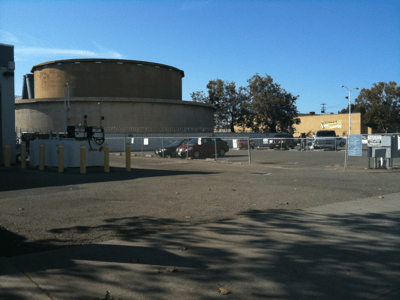
The tank in the upper left of this picture doesn’t hold water. It holds oil for the plant. Nasty, potentially flammable stuff. The plant itself is not operational 24/7, it’s meant to provide peak-demand power when needed. Oakland Power Plant spans 3 blocks and is owned by Houston-based Dynegy, along with the plant in Moss Landing.

The CA Public Utilities Commission and the Port of Oakland have occasionally gotten into skirmishes about the plant. There’s no denying the importance of a piece of power infrastructure like this, but the Port has resisted attempts by past owners to expand the plant. An audit performed two years ago (warning: PDF) by the CPUC revealed instances of lax training and emergency preparedness, though nothing was deemed dangerous within the scope of the plant’s operation.

I’ve been told that with Matson’s long-term deal with the Port, it’s nearly impossible to relocate them. The City has been mum on a specific site in the area, but given the circumstances it may be better to focus on other land nearby. Which is too bad, imagine the building below as part of a majestic concrete/masonry ballpark façade. (It’s part of the power plant.)

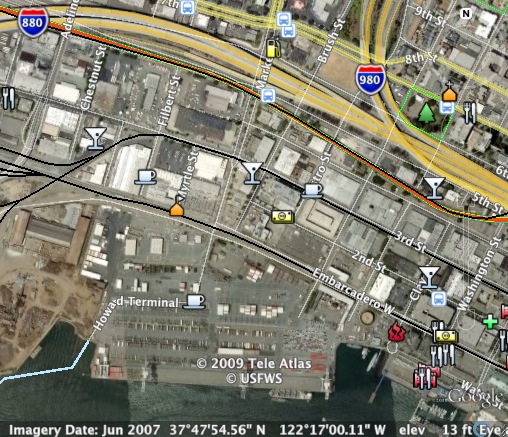
So where to focus? The best place may be the area north of Howard Terminal and the power plant, bounded by the BART tracks/5th Ave on the north, MLK to the east, 2nd St to the south, and Market/Brush Sts to the west.

No, it’s not on the waterfront. It does have a nice view of Downtown Oakland. It’s also a shorter distance to the 12th St BART station, just over 1/2 mile as opposed to 3/4 mile from the station to Howard Terminal. Admittedly, it would be strange to have BART running right past the place even though there wouldn’t necessarily be a co-located station. Fortunately, there is some vacant land that would be perfect for station portals if all parties could get it together. Just as important, it’s a shorter stumble to-and-from The Trappist.

Most importantly, land deals would be done with individual private landowners, not the Port. Port land is really City land, but that doesn’t make it any easier to do a deal given the politics involved. We’re talking about 5-6 blocks, the same amount as Diridon South.

Is this doable? I have no idea. I’m just as in-the-dark about actual proposals emanating from Oakland as many of you.

BART to Warm Springs construction to begin

After securing a bid 45% lower than originally estimated, the tunnel portion of Warm Springs extension has been given the go-ahead by BART. The tunnel will extend southeast from the existing Fremont BART station, underneath man-made Lake Elizabeth, before turning south to occupy the former Western Pacific rail right-of-way. The only station to be built is Warm Springs, which will also be the future southern terminus until construction on the extension to San Jose/Silicon Valley begins. Another station in the Irvington district is currently unfunded. The complete estimated cost for the 5.4-mile extension is $890 million.

It’s odd that one of the reasons for building the Warm Springs station at the planned location, NUMMI, will probably not be around for the opening in 2014. It’s also likely that nothing will have replaced the auto plant by the time the station opens. Lew Wolff has rejected any idea of revisiting Fremont for the time being.

Recap of walking tour

This was the second walking tour put on by the City. Leading the way was SJRA’s Kip Harkness, along with several others from the City. The walk started out inside the station depot, where we were informed that the tour would take an hour. Bottled water was graciously provided (your tax dollars at work).

We quickly moved outside in front of the station, where Harkness explained the expanded station vision. The “Grand Central” concept was brought up, though any expansion would be done within the context of preserving the existing depot. As shown in previous materials, the expansion will provide connections to future HSR and BART, along with additional space for other uses. BART will run underground, while HSR could run either underground or above ground. One attendee asked if HSR could run under the ballpark. Harkness replied that it might be possible, but dealing with the area water table could prove difficult, especially if the ballpark were sunken – as it is in some conceptual drawings. He cited an example in The 88, a recently opened high-rise residential tower located downtown. Three floors of underground parking were in the plans, but construction crews struck water only 1.5 stories down, forcing a major pumping/rework effort. 20 million riders are expected to go through the expanded Diridon Station per year. Like most, I’m skeptical of the figures.

Next topic was the area plan. The various agencies whose projects will impact the area have been in contact and are contributing towards the plan. There is a window in which the area will be torn to shreds in order to accommodate the BART cut-and-cover operation, new foundation work for midrise (up to 130′ tall) buildings, and the Autumn Parkway construction project. Guidelines will be part of the updated Diridon Area Specific Plan, from building heights to setbacks to streetscapes. Parking is the big unknown, since it’s going to take some time to properly formulate the right mix of short and long-term parking.

Then we walked past some of the property recently bought by SJRA along W. San Fernando St. The only building not empty was Patty’s Inn, which has a lease through 2011 (hint-hint?). A rep from Parks talked about the Los Gatos Creek Trail. It looks like the City is getting ready to buy the land on the western bank to build the trail. The fire training site south of the ballpark will not be used for a parking garage, as was drawn up in the original EIR. Housing has designs on the land, but that use is not politically feasible given the amount of neighborhood uproar it would cause.

In order to make the new Autumn Parkway streetscape the way it’s being envisioned, the City may ask the state to relinquish the State Highway designation (CA-82) for Autumn and Montgomery Streets. Since those streets are state highways, they are subject to state design and maintenance rules, which would either have to be eased or modified to accommodate the changes the City wants to enact. The same goes for The Alameda, which area residents have long wanted to transform into a pedestrian-friendly, tree-lined boulevard.

Next up were the old KNTV studios (acquired) and the AT&T site (not acquired). There was talk of preservation of some kind. There could be some reuse of materials or façades if possible. I would at least expect some monuments to commemorate the historic value of the sites.

The PG&E substation situation proved interesting. The City and PG&E acknowledge that the existing layout is not exactly space efficient, so they are looking at ways to reconfigure the site in a more compact manner. It seems more likely that reconfiguration will occur than a substation move, partly due to lower cost, partly because a 32,000-seat ballpark may not require a substation move.

We then hoofed it back to Diridon Station, under the tracks and out to Cahill Park, which is west of the station. Mostly this was to show how good, community-driven TOD can be built. Keep in mind that there’s a good chance that zero housing will be built in the planned area. Finally, we congregated on the Alameda, across the street from the site of the always six months away Whole Foods site. Not much to say about that. I asked about the state of the revised ballpark EIR. Harkness said that it’s still in process and that no date has been set for its release, though 60 days is a pretty good guess. Those who want to be notified should head over to SJRA’s ballpark page to get on the mailing list.

Questions? Fire away, and try to keep it on topic.

Upcoming San Jose calendar

A bunch of planning/ballpark-related activity is on tap for the next month+ in San Jose, including tonight’s Diridon site walking tour. The full list:

  • Wednesday, August 19, 6 PM: Walking tour of development area at Diridon Station.
  • Saturday, September 12, 9 AM-12 PM @ Parkside Hall, Room B (180 Park Ave., next to the Tech Museum). Meeting notice (PDF).
  • Thursday, September 24, 6 PM @ TBD. Good Neighbor Committee Meeting. Tentative agenda items include A) Major League Baseball 101, B) Proposed Major League Ballpark Economic Impact Analysis

I’ll report back from the walking tour later tonight. I may even test out the blog’s new Twitter account while on the tour (@newballpark).

Wolff backs off 2012 Quakes opening

The Merc’s Elliott Almond interviewed Lew Wolff on the state of the Quakes stadium effort, and the news was not good. According to Wolff, the problem is sponsorship revenues.

“You can’t do it out of magic,” Wolff said. “There’s no sense building a stadium unless you have some flow of revenue.”

The club, Wolff said, needs about $5 million a year in sponsorship for a 15,000-seat, no-frills stadium. It has secured 20 percent of that so far.

“We’re trying to get to the edge of the diving board,” he said. “Before jumping into a pool we want to make sure there is water in it.”

When Lew and I spoke earlier in the spring, we spent a little time discussing the Quakes project. Unfortunately, he said many of the same things at that point, which makes it dismaying to know that things haven’t improved. We are in a recession/depression/what-have-you, so it’s difficult to see that light at the end of the tunnel.

The problem doesn’t appear to be the naming rights sponsor. It’s more of a problem with the smaller sponsors whose ads appear on rotating and fixed signage throughout the stadium. MLS and the Quakes aren’t blessed with rich TV and radio deals, so every bit of sponsorship revenue, right down to the jerseys, is important. Wolff mentioned an unusual financing angle that involved partnering with local building trade unions so that they could get their skin in the game on something they were building. That idea went nowhere.

What makes it worse is that some of the teams who would normally provide some competition locally for sponsor revenue aren’t even around. The SaberCats aren’t playing this year and may not play for a while, if at all. The Stealth indoor lacrosse team bolted for Seattle. A new women’s soccer team, FC Gold Pride, sort of competes with the Quakes but also co-exists somewhat symbiotically.

While the six major sports teams (A’s, Giants, Raiders, 49ers, Warriors, Sharks) are reasonably healthy despite the state of the economy, an on-again, off-again team like the Quakes will naturally have difficulty attracting sponsors even if they’re located in the rich Silicon Valley. Unveiling drawings of the new stadium, which to date have been a closely guarded secret, should help sell the concept. Really, it comes down to the venue. Seattle and Toronto are cited as new success stories, and both are buoyed by pent-up demand while playing in sparkling new facilities. The Quakes play at the jury-rigged albeit cozy Buck Shaw Stadium, convenient but not compelling. It may be that Wolff/Fisher will simply have to place faith in the fans and potential sponsors to come out of the woodwork when a new stadium opens. It’s not the most ideal position to be in, that’s for certain.

Phew

Cooler heads seemingly have prevailed as BART and its unions came to a tentative agreement on a four-year CBA. It’s important to note that the agreement is indeed tentative as rank-and-file members have yet to vote on the deal later this week.

Hopefully a done deal will make the following table little more than trivial:

Not pretty, is it? It’s actually a simplified version of something I was working on in case of a BART strike. As I started looking at train, rail, and ferry schedules provided by various transit agencies, palpable dread came over me. Not only would it be inconvenient and time-consuming to even attempt to use many of the alternatives listed above, some like Capitol Corridor are a good deal more expensive.

When we talk about transit to the Coliseum, bus service is never mentioned. Ever wonder why that is? Maybe it’s because buses don’t have as varnished an image as rail. Maybe it’s because of a bus’s lack of perceived permanence. From looking at AC Transit’s maps and schedules, it may largely be a routing issue.

AC Transit has a series of backbone lines, 72/1/99. Line 72 runs from Richmond to Downtown Oakland, #1 from Downtown Oakland to Bay Fair, #99 from Bay Fair to Fremont. These lines make fairly long distance trips possible without numerous transfers, while routing in many cases within a few blocks of a BART station. However, one major exception is Line 1, which runs along International Blvd/E. 14th for most of its route. In doing this, it makes its closest stop to the Coliseum Complex nearly 3/4 mile away. Local loop buses have to provide feeder service. Not exactly convenient. While it makes more sense for local residents since the current routing serves more of the local population, it doesn’t make things easier for event goers.

Amazingly, it seems to be easier if you’re coming from San Francisco. That alternative to BART includes one transfer. The trip would take 75 minutes, but at least it’s straightforward. I looked for a clean ferry-based route but it didn’t exist. The Oakland and Alameda Ferry Terminals don’t link directly to buses that run near the Coliseum, forcing additional transfers or a lengthy walk to Downtown. Alameda’s Harbor Bay Ferry looks like a good route since it actually connects to a bus (Line 50) that runs to the Coliseum. Unfortunately the ferry itself only runs during weekday commute hours, making it incompatible with baseball crowds.

It stands to reason that the major value propositions for affected fans either would be to choose to drive or simply not attend because of heavier traffic, estimated to be at least 30 minutes in additional travel time when going to the game. Still, I wanted to put this post up to show how bad the backup system is. Of course, if you chose to drive during a BART strike, you might feel perfectly entitled to park at the Coliseum BART parking lot, since there wouldn’t be BART users parked there. Then again, many already park there without needing an excuse…

California Redwoods. WTF?!?!?!?!

It’s a bad sign for the UFL when none of the Bay Area daily papers had a story from Tuesday’s unveiling of the San Francisco California franchise team name and colors. Just as well, though, since they would have been blinded by this:

SF Weekly’s Joe Eskenazi was brave enough to potentially harm his own lenses and a digital SLR’s, all of which apparently came away unscathed. The color combo is indescribably awful, except to say that it looks like Paul Pelosi consulted with Proctor & Gamble’s laundry detergent department to hone in on that special mix of hues. You can even now download a uniform guidelines doc (PDF) showing exactly which Pantone colors you’ll need to match if you want to make your own custom Femi Ayanbadejo jersey.

BTW the team will be called the California Redwoods. According to NBC Bay Area’s late sports report, home games will be played at AT&T Park. Previously, it was expected that games would be split between SF and Sacramento. Why else would they use the California moniker? The Las Vegas team also claims the Los Angeles market, which means that some home games will be played at Home Depot Center. Whatever the reasoning behind all of this, tickets go on sale later today at 10 AM. I won’t be scrambling to get tickets, but I am curious enough to attend a game at some point if they actually start playing.

Blue blocker sunglasses are a necessity, though maybe not at the inaugural home game, which is scheduled for the night of October 17 (yes, that October 17), I suppose, to avoid potential conflicts with the Giants’ postseason schedule.