Magowan out? + Aramark responds to violations report

Matier and Ross have jumped on special meeting of the Giants’ ownership group scheduled for Friday, during which managing partner Peter Magowan is expected to exit stage left. The rumor, originally reported in a rather innocuous matter by former Merc and now Chicago Tribune scribe Mark Gonzales, has many wondering why. Surely the stress of the Bonds situation and the minute possibility of a world championship could have provoked the move.

The real question is: who will replace Magowan? Matier and Ross point to former Apple/Pepsi CEO John Sculley, who will always have a place in my heart for his championing the Newton. Also mentioned is William Neukom, best known as Microsoft’s general counsel during their most predatory, anti-competitive days. As high-profile as both men are, it’s unlikely that whoever replaces Magowan will be as prominent as the former Safeway head. Such a role is no longer necessary, considering the Giants’ future financial security was guaranteed by Magowan’s dealing (China Basin and CSNBA). The Giants are a turnkey franchise with a modicum of young talent. No need to pump things up right now. Also, I don’t expect them to do anything in regards to territorial rights. They have a massive competitive advantage over the A’s right now in the Bay Area market. Any concessions, including a payoff for territorial rights, would border on charity.

I find this interesting:

Some partners privately complained that Magowan’s management style was autocratic – and, indeed, it may have contributed to some early powerhouse investors such as Walter Shorenstein, Don Fisher and Charles Schwab eventually pulling out, observers say.

Does John Fisher have the same aversion to autocratic management styles as his father? Makes one wonder how large Fisher’s role is within the A’s ownership group. Lew Wolff has always presented himself as a genial consensus builder. Another observation: Look at those names above. Those are some big-time heavy hitters that came in to help keep the Giants in S.F.


On the other side of the bay, there’s been a dustup over a Condé Nast Portfolio report about health code violations at major league ballparks. The Coliseum, or rather its vendor, Aramark, came in second worst to Angel Stadium, home of the postgame landfill. When asked to comment, the A’s passed the buck to Aramark, who responded in a typically corporate manner:

David Freireich, spokesman for the Pennsylvania-based Aramark, confirmed the company received notice of the 493 violations. He said the violations were corrected immediately and he offered the following statement:

“It’s our top priority to ensure the food served at McAfee Coliseum is of the highest quality and prepared in the safest environment possible. We take all violations very seriously and take the necessary corrective action to address the issues identified by the health department.”

Aramark is an enormous food service company that is no stranger to complaints about their practices. I can only say that I’m glad I normally bring in outside food and tailgate. Though some of that may have been prepared in questionable conditions as well.

Brisbane: A good 49er alternative

Matier and Ross reported on Saturday some communications between 49ers CFO Larry MacNeil and Brisbane officials. Good idea for the team to hedge their bets considering the expense of the future stadium, even though the city and the team have done a good job weakening the opposition in Santa Clara (the November vote is non-binding, for instance).

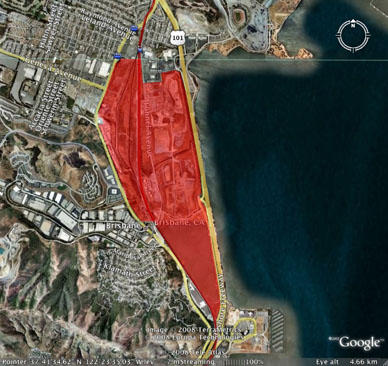
Brisbane, for those not from the Bay Area, is a hilly enclave along the bay, just south of San Francisco. The site in question is called Baylands, a 660-acre area sandwiched between U.S. 101 and Bayshore Blvd. (formerly U.S. 101 decades ago). The industrially-zoned land (shaded in red below) is comprised of a large railyard to the west of the Caltrain right-of-way, landfill area to the east of Caltrain, and a tidal lagoon at its south end.

The site has a number of advantages over both Candlestick/Hunters Point and the Santa Clara site. Freeway access is pretty much a no-brainer as it can be served by two exits on Southbound 101 (Candlestick Park and Sierra Point Pkwy.) and three exits on Northbound 101 (Bayshore Blvd., Sierra Point Pkwy., and Candlestick Park). Those using I-280 can cut over using Geneva Ave. The aforementioned Caltrain runs right through the heart of the site and has its Bayshore Station at the north end. Muni’s T-Third light rail line also its southern terminus at Sunnydale Ave. Both are just a short walk from the Baylands site. High-speed rail would also run through the site, though there are no plans for a station at the site.

Baylands may well be converted into its intended purpose: a green industry zone. Until then, it’s a good idea to have city leaders consider a 49ers stadium there. Obviously, there will be issues involving financing of the stadium and site cleanup, but from a site availability standpoint it’s as good an option as the two already under consideration.

Get a cable sports network for (almost) free

Come 2010 or shortly thereafter, the A’s may find themselves in a very good situation, and they won’t need to do anything to make it happen.

All of the local (non-NFL) teams other than the Giants are due to have their current agreements with Comcast SportsNet Bay Area (formerly FSNBA) expire around the end of the decade. That will put the Sharks, Warriors, and A’s in situations that could allow for partnerships or competition. The natural awkwardness of having the Sharks and Warriors on the same network will likely end. Therefore, one will probably stay with CSNBA and one will leave. Where does that leave the A’s?

An opportunity may arise that could fit perfectly for the A’s. It would be a different channel, one that already exists pretty much everywhere in Northern California. That channel is…

Comcast SportsNet West

What is this channel, you ask? It’s the home of the Sacramento Kings. As you can see from the table below, its availability is pretty much on par with CSNBA (except for the Bay Area, where it’s on digital cable only).

CSNW’s ownership situation is similar to that of CSNBA in that the marquee team (Kings as opposed to Giants) owns a share of the network. It would be easy for the A’s to talk to both the Kings and Comcast about carriage on CSNW, which could make for a more comprehensive broadcast rights deal that ensures more games throughout the region. They could even severely limit over-the-air broadcasts (TV36) more than their current deal and move the vast majority of games to CSNW. That would prove beneficial to CSNW since they’d get a greater amount of programming (outside of the Kings’ season it’s sparse to say the least).

The future of the Kings, unfortunately, is uncertain. While the Maloof brothers have publicly stated that they want to work out a deal in Sacramento and have reportedly been talking privately with Sacramento officials about a new arena deal, it’s definitely an uphill battle – especially with a mayor’s race this year including former Suns and Cal point guard Kevin Johnson. The Maloofs don’t appear to be willing to privately finance much of a new arena, and they didn’t support the two 2006 ballot initiatives to publicly finance an arena on the railyards near downtown.

Meanwhile, last August Harrah’s and AEG announced a plan to build a 20,000-seat arena just east of the Vegas Strip, behind Paris and Bally’s. The arena will be built on-spec, in other words it doesn’t have a marquee tenant. AEG and Harrah’s say that they should be able to fill up the venue with numerous acts, but they are aiming for either a basketball or hockey team to call it home 41+ times a year starting in 2010. AEG already has another built-on-spec arena under its management, Sprint Center in Kansas City.

Both David Stern and Gary Bettman have been actively working on moving or adding a team to the Las Vegas market. Stern’s done a good job putting the Tim Donaghy scandal to bed, and Vegas mayor Oscar Goodman may prefer the NBA over the NHL due to its higher profile (money, ratings). So while the Maloofs say the right things, an arena is going to rise that fits their needs (that they don’t have to finance) and allows them to stop using the corporate jet to attend games in Cowtown.

Should the Kings leave for Vegas, they would have to divest themselves of CSNW. Who would be in a great position to step into the Kings’ ownership stake? The A’s, of course. That would put the A’s in the position they’ve wanted for so long: their own network with few startup costs and no need to jostle for position with the Giants and the other Bay Area teams. They can create further tie-ins with the Rivercats and their broadcasts while fostering growth throughout all of NorCal. And they could create a partnership with or bid for broadcast rights from either the Warriors (who are showing signs of wanting to leave CSNBA) or the Sharks (who could also benefit from some elbow room).

Now I know what you’re asking. First, wouldn’t the Kings leaving be awful? Of course it would. The team has been the soul of the state capital for over two decades. ARCO Arena is a charming and intimate setting. It’s also woefully outdated and was built on the cheap. If Stern and the owners are willing to allow the Sonics to be ripped out of the Seattle community, don’t think they won’t hesitate to do the same to a city whose team has only been present half as long. Second, what about the A’s moving to Sacramento? I’ve already given plenty of reasons why that won’t work, the least of which is: If Sacramento can’t figure out a way to share the burden on a new Kings arena, how would they get it done on a larger and more expensive baseball stadium (sorry, expanding Raley Field won’t cut it in the long run).

What we have right now is a waiting game. The A’s are waiting out the EIR process in Fremont. They’re waiting out the end of their CSNBA contract to make a move on their own. The NBA and the Maloofs are waiting out this new arena in Sin City and political dealings in Sacramento to determine the Kings’ fate. AEG and Harrah’s are waiting out two leagues and various teams to see if one will fill their new arena. None of this can be determined right away. Come 2010, expect to see these parties move quickly.

Update 5/10: Cal Expo and the NBA have announced a plan to build a new arena for the Kings on the Expo Fairgrounds, which would be financed by proceeds coming from the development of the Fairgrounds area. On the surface, the deal appears to be structured similar to what the Tampa Bay Rays are planning with the Tropicana Field site. On May 21, the Expo board will decide whether or not to move forward with the plan. While I like the fact that David Stern, who took over from the Maloofs in negotiating with Cal Expo, timing appears to be rather late considering the state of the economy – and especially the real estate market in Santa Clara. There’s plenty of time to figure out how long it will take and the contingencies they can build in. It’s definitely a more difficult plan to pull off than Cisco Field and the baseball village, but if there’s one person in sports I wouldn’t bet against, it’s David Stern.

Props 98 & 99 – Competing Eminent Domain Measures

On June 3, two propositions will be on the ballot. They are Propositions 98 and 99, a pair of competing initiatives. Both claim the same main goal: to ban state and local governments from using eminent domain to acquire land for private uses.

The differences are in “protections.” Prop 98 also seeks to phase out rent controls in California. Prop 99 does not, but it also bans only eminent domain seizures of owner-occupied homes, not apartments or rental homes, or other private property. Prop 99 also contains a provision in which it would supersede Prop 98 if both passed but 99 had a greater number of votes. There have been a large number of attacks from both sides. Prop 98 supporters point out that the state’s Legislative Analyst says that passage of Prop 99 will have little fiscal impact on state and local governments, which means they’d continue to operate status quo. Prop 99 supporters say that Prop 98 is a sneaky way to include anti-consumer rent control changes into legislation.

Does either proposition accomplish what you think should be done to protect property owners from eminent domain? Read for yourself and decide. For more info on these confusing propositions, check out the following links:

The use of eminent domain has been and always will be controversial. It has been used to create massive redevelopment districts in many cities. Eminent domain has allowed many stadia and arenas to be built, as well as numerous private developments. It was used to acquire land for the Oakland Uptown project, HP Pavilion (née San Jose Arena), and for the new ballparks in Minneapolis and Washington, D.C.

The campaigns have been overshadowed by national coverage of the Democratic Presidential Primaries, but the issue still resonates. Thankfully, Cisco Field and the baseball village are to be built on land that wasn’t acquired via eminent domain, but rather through normal negotiations.

May Day = FAQ Day

It’s only occurred to me recently that I’d do well to have a Frequently Asked Questions file here, considering that this site is now three years (!) old. So without further ado, here’s the very unofficial New A’s Ballpark FAQ:

Overview
1. What is the current state of the ballpark project?
The project is currently undergoing environmental review, which started in December 2007. The process is expected to take 12-18 months. It was thought that the period could be shortened due to portions of a previous EIR (environmental impact report) being available, but that is no longer the case.
When initially conceived, the ballpark was projected to open in 2010. That has slipped twice, with the projected opening in 2012 or later.
2. What is the project called?
The ballpark will be named Cisco Field, after the naming rights sponsor, Cisco Systems. The residential and retail portions of the development are as yet unnamed and are referred to generically as the “baseball village.”
3. What happens after the EIR is completed?
A draft version will be distributed to Fremont’s city council and the public, upon which there will be an official comment period. Changes may be made during this period. A final EIR with public comments will be presented to council for approval/ratification. The council’s vote probably won’t occur before December 2008.
4. Will a public vote be required?
A referendum is not required, nor is it supported by the majority of the current council.
5. How much will the ballpark cost?
Current estimates have construction at $450 million.
6. What’s Fremont paying for the ballpark?
As it stands, nothing. Fremont’s role is to approve land rezoning that the A’s want (industrial-to-residential/commercial) to build 3,000+ homes on land previously owned by Cisco and ProLogis. The increase of property value for the land (225 acres) would mean increased profits from the sales of housing rights. A portion of those profits would be used to pay for the ballpark.
There is some amount of additional infrastructure that needs to be built to support the project: a school, public park(s), possible pedestrian paths, trails, or bridges. It is uncertain what the cost of such facilities will be or who will bear the cost. The cost of building streets, sewers, and running utilities is typically borne by the developer.
Cisco also has a 30-year, $120 million naming rights and technology deal with the A’s for Cisco Field.
7. How big will the ballpark be?
32-35,000 seats, not including standing room. The design calls for only two seating decks, with the press box on top of the second deck, a la PNC Park.
8. What features does the ballpark have?
The ballpark is expected to have all of the modern amenities that other new stadia and arenas have, including luxury suites, club seats, separate concourses, and a large variety of food options. One of the claims made by the A’s is that Cisco Field will be the most intimate ballpark in MLB, which stands to reason because it is so small.
The video/scoreboard in centerfield will be two-sided, which will provide views of the action from a small park just beyond centerfield.
The original project announcement mentioned a baseball museum of some sort, but this hasn’t been mentioned since.
The ballpark’s spec contains 40 luxury suites and 40 mini suites, which four or six-person boxes which are grouped three or so and share a common area behind the seats. Mini suites are being offered as an option for smaller firms or companies who can’t justify leasing a large suite yet want more privacy than a club seating section offers.
9. Who are the architects?
360 Architecture, a Kansas City-based architecture firm that opened an office in San Francisco largely for the Cisco Field project. 360 previously designed several multipurpose indoor arenas. Gensler, a large San Francisco-based firm, is the master planner for the whole development.

Retail/Commercial
10. What is the “baseball village?”
The baseball village is an adjacent, 37-acre lifestyle center with high-end retail, additional restaurants, and 600 condos and lofts, plus additional residential development to the south and west of the ballpark. A movie theater is expected. The list of retailers has not been released, but it is expected to be along similar lines to those located at San Jose’s Santana Row or Palo Alto’s Stanford Shopping Center.
11. How many housing units will be built?
2,900+ units are planned for the residential neighborhood south and west of the ballpark. Most of these units would be townhomes or flats of varying sizes. Expected average price of a unit: $675,000. They are expected to be phased in over a ten-year span.
12. Will it be a gated community?
No, but it will be more private than public. The plan’s pocket parks are expected to be owned by the community, with their maintenance paid for by HOA dues.
13. How is the housing crisis affecting the project?
At least one section of land is may have more flexible zoning than the rest. That’s because more commercial uses may be expected there: office space, an extension to the Auto Mall, other shopping centers, etc.
14. What about the school?
The A’s and Fremont Unified School District are hammering out the details of what will likely be a public elementary school within the residential section. This has proven to be necessary as district officials have projected at least 600 students. To accommodate growth, FUSD is looking for a school that can handle up to 1,000 students with future expansion. The A’s have provided their vision: a compact, multi-level urban school similar to Horace Mann School, located in downtown San Jose.

Transportation/Public Transit
15. Will BART run to the ballpark as it does to the Coliseum?
No. The closest current station is the Fremont station, which is the southern terminus of the system. It is approximately 5 miles from the ballpark site. There is a planned station, Warm Springs, near the NUMMI plant, approximately 1.25 miles east of the ballpark site. Buses or shuttles would have to run from either station to the ballpark.
16. What is the Warm Springs BART extension?
It is a 5.4-mile extension that would run south from the Fremont station to Warm Springs. It was initially part of the BART-to-Santa Clara County extension, but was decoupled due for funding and political reasons. The Warm Springs extension is not expected to be built unless the BART-to-Santa Clara County extension is also built. The latter extension faces a funding shortfall at the moment, and it is not clear how that will be made up.
17. Will other rail options be available?
Amtrak and ACE currently run on the Union Pacific line approximately 1.25 miles west of the ballpark site. There is no current station there, but a station was previously planned and would likely be built should the ballpark project move forward. A tram-style shuttle would bring train riders and fans who park in the planned adjacent parking lot to a drop-off point near the ballpark.
The state’s High Speed Rail project, if approved, would not have Fremont along its initial planned route. A Regional Rail option is possible after the first phase if funding is available. That may allow for a station at Warm Springs, alongside/in place of the planned BART station.
18. Could VTA light rail service the ballpark?
Such a line or extension is not in VTA’s plans.
19. Could a private rail solution be built between Warm Springs BART and the ballpark site?
Cost for such a solution would be at least $100 million not including land acquisition. It’s not likely.

Traffic

20. How will existing traffic problems be affected by the ballpark?
On days the ballpark is used, expect up to 10,000 cars in addition to the expected new traffic generated by the retail and residential developments. Those cars would be coming from four different freeway segments and Fremont/Newark surface streets. The most heavily impact segments would be northbound 880 and 680 leading up to the ballpark. Southbound 880 and 680 near the ballpark are not heavily impacted in the weeknight rush hour period. A percentage of fans may also come from the Peninsula over the Dumbarton Bridge. They would be dealing with commute traffic as well.
Considering the wide geographical spread of A’s fans, it’s safe to assume traffic will be spread fairly evenly among the freeway segments, with the less congested southbound 880 getting the most. The traffic/transportation study hasn’t been released, but it’s reasonable to roughly project the following:
880 South: 3,500 cars (may include some Dumbarton traffic)
680 South: 2,500
880 North: 2,500
680 North: 500
Fremont/Newark/Milpitas surface streets: 1,000 (may include some Dumbarton traffic)
Note that these would be peak figures (sellouts), and would drop proportionally with actual attendance at the ballpark.
21. What’s being done to improve 880?
A series of interchange improvements were done in the last decade or so in South Fremont in order to help area manufacturing and warehousing/distribution companies. The last piece of this is the Mission/880 interchange, which is expected to be completed in 2009. Previously, all north and southbound traffic ran into this bottleneck, which only had three lanes in each direction and no carpool lanes. When completed, the interchange will have better separated traffic from 880 to Mission/680, plus a continuous carpool lane down to Milpitas and up through San Leandro. Additionally, traffic from one side of 880 to the other will be better managed by the addition of the new Warren Avenue exit/interchange. Previously, traffic from west of 880 had to mix with commute traffic get to the area east of 880. Lastly, the new Kato Road bridge was built to better route truck traffic bound for NUMMI.
22. That won’t completely alleviate congestion, will it?
No it won’t, but A’s fans traveling in groups will find things easier with the fully extended carpool lanes. The commute nightmare is also largely a one-way affair for those on 880 and 680 north headed towards the Tri-Valley area and exurbs Tracy and Stockton.
23. What about those coming from north of 92?
Work on the biggest bottleneck, the 880/92 interchange, has begun. The project will replace two of the “cloverleaf” sections (92 West-880 South and 92 East-880 North) with flyover ramps. When completed, the interchange’s capacity will be much greater, easing the transition for affected drivers. The interchange is expected to be finished in late 2011. Unfortunately, carpool lanes aren’t expected to be built through Oakland anytime soon as 880 in the area needs seismic retrofitting and widening before carpool lanes can be built.
24. What about surface streets?
Fremont doesn’t have a typical straight grid layout among its north-south corridors. Fremont Blvd and Paseo Padre Pkwy are four-to-six lane drags that are meant to handle city traffic. Auto Mall Pkwy, the main exit near the ballpark site, was widened as part of the 880 interchange projects. It may be widened again if it’s chosen as a carpool alternate route between 880 and 680. Mowry Avenue east of 880 just got a new long lasting asphalt overlay, while Stevenson Boulevard was widened to six lanes. Boyce Road (Fremont)/Cherry Street (Newark), which together are used as an alternate route to/from the Dumbarton (84), is a four-lane road that is meant largely for industrial traffic. Cushing Pkwy, which is Boyce Road south of Auto Mall, was extended over the newly created wetlands preserve as part of the previous development agreement between ProLogis and the government. Cushing runs south to Fremont Blvd and empties into 880 south. Fremont Blvd will be extended from its southern dead end to Warm Springs Blvd and the county line, providing a complete alternate route west of 880.
Mowry, Stevenson, and Fremont will be taxed as a result of shuttles running between Fremont BART and the ballpark site. What is unknown is exactly how many shuttles will be in service pre/post-game.
25. Will there be enough parking?
The A’s project at least 10,000 spaces when the ballpark opens and have pledged to replenish spaces lost due to other construction. This will likely be part of agreement between the team and the city. An additional 10,000 spaces will be constructed for residential and non-baseball commercial use. In addition, the team will encourage fans to come early by offering validation in conjunction with patronage at one of the village’s restaurants, which would mean parking in non-ballpark spots.
In addition, spaces at other nearby office parks may be available at each company’s discretion. It is unknown how much of this parking may become available. The A’s, ProLogis, and tenants at retail and office developments are working on a gameday parking plan that preserves each group’s respective parking areas.
The Coliseum’s 10,000-space lot handles A’s crowds well, although up to 20% of fans may use BART and several hundred cars park at the Coliseum BART lot during games.

Environmental Concerns
26. What is the wetlands preserve?
As part of the deal to develop over 800 acres of land at Pacific Commons in Fremont, Catellus (once the real estate arm of Southern Pacific) agreed to create a new, 440-acre wetlands preserve at the south end. To foster its growth, a large amount of earth was moved from the preserve section to the commercially developed portions. The moved earth elevated the Auto Mall and nearby business district, while the preserve was intentionally created lower to make it prone to tidal flows. The aforementioned Cushing Pkwy was extended in the form of a causeway to encourage tidal flow.
The preserve appears to be thriving. Migratory and native birds are present, as are rare plants. The tidal flow system is working as intended. As part of the EIR, long term effects of the preserve’s creation will be measured and compared against initially projected effects. From this, a strategy will be created that will help preserve the wetlands. Opponents including the Sierra Club have come out against the Cisco Field project, saying that residential development next to the preserve will irreparably damage the wetlands.
27. I heard the ballpark site is in an area that is prone to future rising sea levels due to global warming/climate change. Is this true?
No. The site is very close to a large estuary within the bay and flood control channels, which could make it prone to flooding if exceedingly heavy rains are combined with rising sea level. However, the predictive model assumes a uniform one meter rise all over the world, when it is more likely that there will be a greater rise at the equator and less rise as one gets further away from the equator. The ballpark is at least 1 mile away from the projected shoreline created by the sea level rise.

Economic Impact
28. How much will the ballpark improve the A’s financial situation?
Depending on how well the ballpark sells out, I’ve conservatively projected they could net an extra $24 million per year in revenue over their current situation at the Coliseum. A recent article on the new Twins’ ballpark has a comment from a Twins official indicating that the team will gain $40 million per year once their stadium opens.
29. Will the financial boost allow the team to compete with the Red Sox or Yankees?
Not by itself. The big market teams have huge amounts of TV and radio revenue along with their revenue-producing ballparks. Unless the A’s were to move towards buying or building their own media properties, there will continue to be a major disparity in revenue between the big market teams and everyone else.
30. Will the project be as beneficial for the city/county as is being claimed by its proponents?
Claims of economic benefit have to be taken with several grains of salt. Let’s be clear. The party that clearly wins in this type of deal is the team. They get a brand new stadium without having to use much of their stadium-generated revenue to pay for it. The city wins because it doesn’t have to raise or levy new taxes in order to get it done, plus it gets a fancy new source of sales tax revenue in the process plus the prestige that comes with having a team call it home. That said it removes a major piece of valuable industrial-zoned land from availability within Silicon Valley. It also adds residents and visitors, which adds strain to an already stretched-thin city.
Jobs will come most immediately in the form of concrete construction and are not permanent. 300 housing starts a year will be a boon for homebuilders. After construction is completed, there will be a number of retail and hospitality jobs, plus stadium operations and concessions. Many of the ballpark-based, non-construction jobs will be low paying. The situation there will be close to zero sum, since those job will simply be moving from Oakland to Fremont. A number of public sector jobs – police, fire – will be added due to the development’s impact on existing city resources.

Miscellaneous

31. Has the team released any documentation about the plan?
They’ve released an economic impact report and the preliminary site plan. A traffic and transportation study will be released as part of the EIR.
32. How long is the A’s lease at McAfee Coliseum?
In 2006, the A’s and the Coliseum Authority converted three option years (2008-10) into a hard lease, adding 2011-13 as option years. The Raiders’ lease ends with the 2010 season.
33. What kind(s) of architecture will be featured?
The A’s have made frequent reference to older East Coast neighborhoods, especially those with brownstones. They have not released information or pictures about the ballpark’s façade, though it is likely the façade will be well-integrated into the neighborhood’s overall theme. One particular type of exterior material is not expected to be used: stucco.
34. What will be the team’s name after the move?
The A’s have held this close to the vest, only saying that the team will be the “_____ Athletics at Fremont” or something to that effect. Principal owner Lew Wolff has hinted that the name in front of “Athletics” may be leveraged for additional investment. Considering the amount of Silicon Valley power and money behind this, it’s not a great leap in logic to think the team may eventually be named “Silicon Valley Athletics at Fremont.”
2008 FCI – WTF?

The A’s are off the charts, folks.

I’m not referring to the team’s popularity or TV ratings, nor is it an attendance phenomena. Remember this chart?

This year’s Fan Cost Index by Team Marketing Report has the A’s average ticket price for 2008 at:
$29.20
It’s way off the above chart, a whopping 22.3% increase over 2007 ($23.88). That’s good enough for third highest in MLB, behind the Yankees and Cubs.

The increase contributed to an overall FCI of $206.80, 11.5% over 2007 and good for 10th in baseball. That’s higher than most teams with recently built ballparks, including the Nationals ($195.50), Padres ($201.72), and Giants ($183.74). The Giants actually posted a FCI drop of 0.7% relative to last season – but only because they were allowed to go back and adjust prices after the season was over.

But is $29.20 right? Compared to last year, several seating sections received $4-6 ticket hikes, whereas roughly one-third of the stadium has only a $1 increase. There’s premium game pricing for the Yankees, Red Sox, and Giants, but that’s only 11 out of 79 games (Tokyo doesn’t count). There’s also the addition of the all-you-can-eat seats, but even that only equates to a $1-1.50 hit. (I’ve sent Team Marketing Report a request for clarification but have not received a response.)

If one were to follow simple supply-demand rules, a ticket price hike (whatever the final number) would appear to be a major cause for the significantly reduced attendance this year (see sidebar). Reduced expectations and a revamped roster with few big names haven’t helped, neither have the oddly cooler temperatures observed for A’s homestands as opposed to Giants’ games. Now that the team is leading the division and Frank Thomas has returned, there should be some uptick from the bandwagoners and youth, along with warmer weather. However, I don’t think they’ll catch last year’s total or eclipse 2 million unless they go on a massive winning streak or run away with the division – thoughts that were unheard of in the winter.

Dodger Stadium improvement plans announced

Dodgers owner Frank McCourt announced his long-awaited plans for Dodger Stadium. McCourt was assisted by a Vin Scully-narrated promotional video. 3-D models and renderings abound.

The largely outside-the stadium project will cost $500 million on top of the $250 million spent inside the stadium over two years ago. They have the buzz words down, talking up the Stadium’s transformation into a “lifestyle destination for all of Los Angeles for all twelve months of the year.” Also emphasized is a change in the way the venue is operated to a more environmentally responsible one (no mentions of specifics other than a nod to technology).

Among the improvements:

  • Dodger Way – A new “front door” to the stadium in center field framed by a tree-lined walkway. The center field plaza would connect to a promenade featuring shops, restaurants and a Dodger Experience museum.
  • Green Necklace – A landscaped, tree-lined perimeter surrounding the stadium. Fans will be able to access their seats and concessions via the Green Necklace.
  • Top of the Park – Behind the highest point of the park behind home plate would be a a outdoor plaza with views of the Los Angeles skyline, Santa Monica bay, the San Gabriel mountains and the field of play inside Dodger Stadium

In addition, the Dodgers plan a “transit plaza” (read: bus station) with a dedicated bus lane and garages to replace terrace parking lost to construction. Two of the garages are on the left and right edges of the above rendering. Additional parking will be underground. As for extending rail-based transit, McCourt left that up to the city to figure out. Even though MTA’s Gold Line has its Chinatown stop just slightly over 1/2 mile from the stadium, it’s also a 300-foot vertical climb. Perhaps they could use a funicular like Pittsburgh’s Duquesne Incline or the incredibly cool Katoomba Scenic Railway in Scenic World, west of Sydney, Australia. Half-seriously, they could even contact Six Flags when Magic Mountain inevitably closes for their funicular. They’ll need to figure out how to enhance pedestrian access as well.

What’s going to pay for the Dodger Stadium improvements? Scuttlebutt is that McCourt will sell off development rights to pieces of surrounding land. As much as the Dodgers are advertising the great views from the stadium, some of those views will be undoubtedly altered by the stadium’s ancillary expansion, as well as the presence of condos all over the nearby hillsides.

Forbes new valuations out: A’s worth $323 million

For a commissioner, Bud Selig makes a pretty good CEO.

League revenue is up again, this time 9.3% over last season. That’s actually down from the last three seasons, when they typically had 14% gains. Revenue is still impressive and will only go up through the end of the current CBA. Yield like that would be an excellent investment for those looking for a mid cap. Of course, MLB is entirely private so no one outside the Lodge could entertain such notions. Regardless, it’s impressive.

The A’s experienced an 11% jump, from $292 million to $323 million. They continue to ride the revenue sharing gravy train, as local revenue pales in comparison to most of their brethren. The welfare check should only become bigger next season as early attendance figures from the first two weeks portend a low season-end total. Forbes’ summary of the A’s financial situation is incorrect in that it identifies TIF as a funding mechanism for the ballpark. TIF requires bond money be raised. They’re not doing that in Fremont. Instead, privately generated proceeds from the sale of housing rights will help foot the bill.

I’m surprised that this year’s edition didn’t cover the debt issue. Quite possibly, the toughest task for Selig was to whip owners into shape by getting them to spend less. Over the last four years, teams have dropped from a collective 39.7% in debt to 32.7%, and that includes the two new stadia being built for the NY teams.

click for a larger chart

Look at the values on a team-by-team basis, and you’ll see a major trend downward for most of them. The old 60-40 debt rule may be obsolete, but it still informs club executives on how to run their teams, just as 50-60% of revenue is comfortable salary “guideline” for the teams.

Nowadays, there’s a simplification of the debt rule: teams can’t be in hock over 10 times the average EBITDA over the past two seasons. Notice that the A’s current valuation is exactly 10 times that of their average operating income from that period? I doubt it’s a coincidence. Moreover, the first $36.5 million in debt grandfathered from previous years doesn’t count, so if you’re Fred Wilpon or Frank McCourt and you borrowed heavily to buy your teams, it’s not that bad. And as an incentive to upgrade to new digs, any team incurring stadium debt gets to bump up to 15 times EBITDA for up to 10 years after the facility is complete. The difference between 10 and 15 times doesn’t sound like much. It’s only $75 million. Since income is expected to rise thanks to the massive payroll drop, so will that debt ceiling. Look for this:

  • $30 million in earnings each year in the two years prior to the ballpark opening
  • Multiply that figure by 15 to get max debt load, $450 million (which equals the projected ballpark construction cost)

There is, of course, the matter of player salaries. They’re the biggest expense and so they factor in. However, that fat $36.5 million deductible comes in handy, especially as a team’s payroll drops to approach that figure. Again, the rule is not a hard and fast rule like the NFL’s salary cap, with Selig or Bob DuPuy getting all punitive every winter. Referring back to the chart, it appears to be set up so that when teams are forced to go into major debt like the Yanks or Mets, the other fiscally responsible teams help soften the blow. In that sense, MLB and other leagues are akin to conglomerates, with each team acting as a single business unit. When a major profit center (Yanks/Mets) has to invest to invest in a new plant (stadium), the other units tighten up in response. After all, it’s the company’s overall health, not a business unit’s, that gets trumpeted by Selig. As the new plants open and become amortized, others take their turns.

Call it MLB’s “Circle of Life.”

Opening Day pushed back to at least 2012

A new article by the Argus’ Matthew Artz confirms a circulating rumor: the environmental impact review process will go the whole nine yards, pushing its completion until the end of the year. Nothing can proceed until the study is completed, reviewed, and voted upon. Tack on the normal construction time, and it makes 2011 unlikely. The A’s were hoping that portions of the previous Pacific Commons study could be used, but the presence of the old document makes the review more complicated, requiring a comparison of projected changes to actual changes.

Those of you looking for a political angle may look at the study’s availability after the November general election, when incumbent Bob Wasserman will face off against four-time former mayor Gus Morrison and councilman Steve Cho. Without even a draft, there isn’t much substance to debate. That’s not to say that Morrison won’t feature the anti-ballpark stance prominently, it’s just that he won’t have any specifics to point to unless he wants to put together his own independent study. Meanwhile, proponents will have the Economic Impact study from last year as ammunition, which I covered in several posts last spring.

A simple economic angle also can’t be dismissed. By pushing the opening back a year, investors may be hoping that they’ll be an additional year removed from the recession and the housing market drop.

The teams need elbow room on TV

Last week, we hit one of those so-called “perfect storm” situations that can occur with scheduling. On the main CSN channel, the A’s and Jays were locked up in a tight, late inning battle in Toronto. Waiting in the wings was the first playoff game between the Sharks and Flames. And the Giants were playing the Padres on the side stage, CSN Plus.

The A’s game ran a not-so-tidy 3:31, forcing the Sharks game to start without a TV broadcast. Instead of doing a picture-in-picture or split screen, CSN chose to keep the A’s game on while providing delayed updates on the Sharks game. Even though there was no HD broadcast of the A’s game while the Sharks game was to be in HD, the Sharks game could not be carried in HD until CSN switched feeds. Only after Bobby Crosby’s bases-clearing double and the final A’s out in the top of the 9th did the switch occur. Just as the switch happened, the Ryan Clowe scored for the Sharks over six minutes into the first period. Unfortunately, the Sharks were down 2-0 leading up to that point. It was quite a debacle as angry Sharks fans called CSN to vent their frustration.

There are really three issues here. First is the production choice made. AFAIK it’s pretty much the same staff from the FSN days with some promotions and attrition thrown in, but it mostly feels the same. Hopefully they’ve learned from this. Second is the HD problem. If there is an SD away baseball game and an HD home hockey game, why can’t they split it so that the HD channel carries the HD broadcast? I’m not up on the technical side but it doesn’t sound that difficult. At least the folks with the HDTVs – the bars and the regular folks who’ve plunked down a couple grand for a flat panel – can be taken care of. There is a long term issue of having only a single HD channel to begin with, but I’ll get to that later. Third, and most important, is that the juggling act that CSN does with the four area teams needs to stop. It was confusing from the first day that FSN Plus launched with its dozens of different channels on different systems. I’m sure that Comcast is attempting their best given the circumstances. But the situation as it stands is untenable. If you’re a subscriber of Comcast’s digital cable service or the sports packages on one of the satellite companies, you’re paying a premium for this. It’s just not a good way to do business.

If you’re wondering how the Bay Area fares compared to other similar markets, you might be surprised to find out that we are entirely unique in that in this market there is a single regional sports network, majority owned by the predominant local cable provider. So it shouldn’t surprising that when the Giants bought a stake in the new CSNBA, someone would object – the Warriors and owner Chris Cohan. Especially because Cohan in a previous life was a local cable operator, which probably means he knows something about the business.

Take a look at the chart below. I’ve mostly included other markets with two baseball teams, because they’re the only ones with similar scheduling dynamics. In LA, there are two full-fledged channels with exclusivity agreements for the three major teams there, leaving the lesser teams to battle for scraps. It’s not a perfect situation, but at least it lends stability for Angels, Dodgers, and Lakers fans. In NYC there are no less than four independent RSNs, all of which are owned in large part by their respective teams. While this makes it tough to push cable providers to include all of these RSNs in their limited space, at least it allows the market to determine the outcome. In Chicago, the two baseball teams are helped enormously by splitting games on the Superstation WGN and CSN Chicago. And in a still-puzzling, archaic move, the Wirtz family continues to not broadcast the majority of Blackhawks home games, freeing up space on the local RSN. In Baltimore and DC, MLB and O’s-created MASN carries the two baseball teams, while the local Comcast RSN sued MLB and the O’s because they felt they had the right to negotiate a deal and were blocked from doing so when MASN was launched. Currently, CSN Mid Atlantic carries the winter sports.

Comcast appears to be addressing the Bay Area’s logjam by adding yet another CSN Plus channel, called CSN Plus 2. There’s currently a placeholder for it at channel 412 if you’re on digital cable, plus DirecTV and Dish also have it. Perhaps they’re waiting to broadcast on it until next season or until more of the smaller cable systems pick it up, which is not a given. Having yet another Plus channel is only going to create more confusion.

That leaves one major issue looming: What about HD? Having two standard definition Plus channels does nothing to add HD offerings when in the coming years the local teams will do nothing but expand their HD schedules. This is a real quandary for Comcast, as they are stuck with real bandwidth limitations that restrict how quickly they can add HD channels. The normal convention is that on what we would consider an analog channel, there is space for two HD feeds and even an additional SD feed should Comcast choose to compress the signal a bit. For instance, the HD feeds for both KPIX and KTVU are carried on channel 78, while KBCW and KNTV are on 79. Contrast that with a possible 10 SD channels that can be placed in that same space. Comcast is stuck with this until the analog-to-digital switch is done and the old bandwidth is freed up. For them, the switch won’t all happen next February as consumer concerns will draw out the transition another year or two.

As recently as yesterday I said that the best situation for the A’s would be to team up with the Sharks on their own RSN. In light of the Warriors’ frustration, perhaps they are a better partner. Consider that there’s only a two-week overlap in regular season schedules between MLB and NBA, and the fact that both leagues’ postseasons are carried exclusively on big national networks. They could easily work around any potential conflicts. They would need Comcast to get a taste in order to get Comcast to carry the channel. At least with a new RSN, it’s a stable home and a chance to build a brand, as opposed to being just another part of the Bay Area sports menagerie. Obviously, I’d be remiss if I didn’t mention that the A’s would be in more control over their own finances and advertising revenue.

Change is afoot. Hopefully we won’t have to wait too long to see it.