How non-binding is non-binding anyway?

The Santa Clara City Council approved adding a plebiscite on the 49ers’ stadium proposal to the November ballot. However, the vote is non-binding, as in the City Council doesn’t have to base its decision on the results of the vote. Even with that,

“I will follow the vote of the people, and that is binding,” said Mayor Patricia Mahan.

Such statements are cold comfort for stadium opponents. Even so, the City and the team have to agree to a deal before the proposal ends up on the ballot. I doubt that they won’t come to some kind of agreement, so expect the period from July to November to be an all-out PR blitz on the citizens of Santa Clara.

Because of the non-binding nature of the vote, I’m moving my opinion of the 49ers stadium project, which was previously a 50-50 shot, to 60% likely.

Please fix your gaze on our nation’s capital

Apologies in advance to those outside the United States.

Something’s stirring in DC. I’m not referring to the continuing Clemens-Waxman staredown, or the purported stonewalling of Arlen Specter by the NFL. There’s a new ballpark in the District, and it’s causing more than a little upheaval.

The still-unnamed, $611 million, publicly-funded stadium is getting its finishing touches prior to its opening, which is only one month away. There’s a good deal of apprehension about what will happen when the Nats start playing ball in their new digs, and for good reason. It appears that the Nats will be getting by with the bare minimum of parking at the site while leveraging the excellent but potentially overtaxed Metrorail system to get up to 50% of all stadiumgoers to and from the ballpark.

For those not familiar with Metro, it’s a third-rail based system that’s about the same length (trackwise) as BART, but with more standardized equipment (standard gauge tracks) and cool modern station design (platforms actually light up as trains approach). It also has three times the riders of BART, many of whom come from the Maryland and Northern Virginia suburbs to work in the District daily.

The Navy Yard station is only one block from the northern edge of the ballpark, though it’s serviced by only one Metro route, the Green line. The west entrance to the station is being expanded and new escalators have been added to accommodate up to 15,000 people per hour. Previously, the entrance could handle only 5,000. Getting everyone in and out on trains shouldn’t be too difficult as WMATA has plenty of experience with crush crowds from their previous work with RFK Stadium and Verizon Center. It promises to be somewhat time-consuming as each trainset is only a pair of cars holding up to 350 total including standees (DC riders please correct me on this if I am mistaken – I’m recalling from memory).

Metro promises to be full of fans who park at or near a station further away and take the subway in. That’s a pretty good plan since parking is going to be scarce around the ballpark. Two garages, holding a total of 1,200 spaces, have had their spaces signed away to the team and its highest of high-roller customers. The Nats are working on an additional 4,000 spaces in the vicinity. The catch? Those spaces are only being promised to season ticket holders. Area residents have their own on-street parking restrictions (PDF map). Casual fans will either have to endure a frustrating hunt for expensive parking, or park and take a shuttle from RFK, which is over 2 miles away through what will probably be gnarly traffic. At least parking and the shuttle are supposed to be free.

Speaking of shuttles, the RFK shuttle won’t be alone. WMATA is beefing up buses to handle fans who want to use a non-subway alternative to Union Station and other more central locales. Still others who are looking to avoid the crush at Navy Yard may take a different line to another station about a mile away from the ballpark, then hoof it in.

As the area around the ballpark gets more developed parking options should increase. For the time being managing this situation on a daily basis should be at the very least quite challenging. There’s one interesting indicator of how difficult it could be: the Nats don’t have a single midweek day game at home on this season’s schedule.

Updated Ballpark Transit Comparison

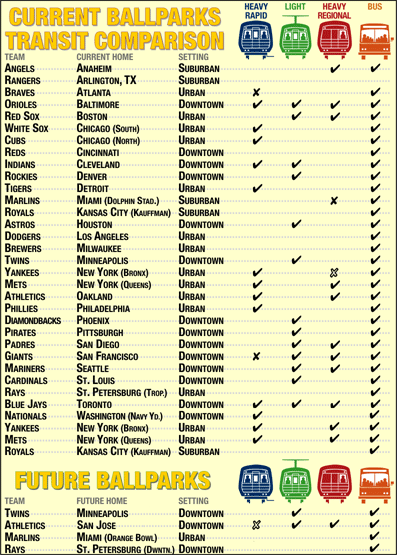
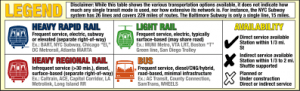
Some of you had been asking what happened to transit comparison table I put together a year ago. Well, I inadvertently deleted it during the summer while doing some site maintenance. I took the recent down period to construct a new version of the table, so here it is in its renewed glory:

The legend above doesn’t have an explanation for the “Setting” column. I left it off to cover it in the post. I think it’s important to make certain distinctions regarding the various environments that the different ballparks inhabit. In doing this, I came up with three specific categories: Downtown, Urban, and Suburban. Here’s what they mean:

  • Downtown: Refers to a specific neighborhood within a city that serves as its CBD, or Central Business District. A downtown usually includes an already pre-existing dense, vibrant neighborhood that serves as a central focal point for retail and entertainment. Downtown will usually have a major transit hub or similar facility within walking distance of the stadium. This is important as the locale and its proximity to the transit hub may reduce the need for transfers on public transit. The ballpark site may have limited parking immediately adjacent but other independently operated facilities serve the public, filling demand.
  • Urban: Covers a large and somewhat disparate group. In all cases, the site is somewhat centrally located within a market or region. However, the ballpark is not located within the designated downtown area, which usually means a transfer is required for a sizable portion of the fanbase. In some cases, an extensive parking facility may be onsite or adjacent (examples: US Cellular Field, Oakland Coliseum, Miller Park). Alternately, there may be an active legacy neighborhood for which the ballpark serves as an anchor (Wrigley Field, Yankee Stadium, Fenway Park).
  • Suburban: This type of venue is usually surrounded by many acres of parking. Public transit availability is not generally a major factor for its fanbase. The site is often far from an established CBD or other established neighborhood, making trips the ballpark an in-and-out affair. Some ballparks straddle the line between Urban and Suburban due to their location (central to the populace), and (re)development occurring in the area adjacent to the site.

As Cisco Field and the ballpark village are completed, we may see new proposals elsewhere that mimic the A’s efforts. If so I may add a new category called quasi-urban, which denotes a facility that has urban traits but is in a decidedly suburban location.

The hollow X’s indicate transit options that are planned or are under construction. In Phoenix, the first leg of its light rail line is due to open this December. Seattle’s light rail is scheduled to open in 2009. Fremont’s Warm Springs BART station would open a few years after Cisco Field and would require a shuttle for access. The south Fremont train station may be up and running sometime before that, it would also require a shuttle.

According to VTA, BART service to Downtown San Jose is not scheduled to start until 2018 at the earliest.

Stepping up in Florida

In a recent St. Pete Times update on the Rays’ downtown ballpark proposal, I noticed the following passage:

The money would come from a private team loan, Rays senior vice president of development Michael Kalt said. The Rays previously had planned to pay the city $10-million a year in rent payments to cover a third of the $450-million stadium cost.

Changes in Major League Baseball revenue and accounting rules allowed the Rays to reconsider how they paid their part of ballpark construction.

This caught me off guard. I’m trying to find out more about this. UPDATE: I got a clarification from the writer, Aaron Sharockman. MLB now allows teams to pay teams to put in their contribution against revenue sharing upfront. My take on this is presumably, a team could choose to amortize this over several years so that it hits as part of the “stadium operating expenses” revenue sharing deduction.

On the other side of the swamp, details are trickling out about the Marlins’ ballpark financing plan. The Sun-Sentinel has come out in favor of the plan, its argument being, “If it doesn’t get done with this deal it won’t get done at all.” Now that’s a sales pitch for ya.

Anything new? Not really

Between commercials on the Ronn Owens Show (archive), the banter between host and guest and the Q&A bits with callers felt like a simple PR exercise, something of a Hey! We’re still alive and working! session. There were nearly as many calls from fans wanting answers about the offseason personnel moves as there were about the ballpark.

As expected, Owens didn’t challenge Wolff much, preferring to follow up when callers gave their questions. One caller in particular asked Wolff why the A’s would leave Oakland for Fremont if they were clearly getting a better stadium deal in Oakland. Wolff replied that the team would in fact be getting a better deal in Fremont because, as stated here previously, the revenue from the ballpark village would help pay for the ballpark. I don’t understand why the detractors continue to have difficulty comprehending this.

A few San Jose-based callers chimed in. One was so bold as to suggest that Wolff pull an Al Davis and simply move the team to San Jose, territorial rights and MLB be damned. Of course, we’ve seen what happened when Steve Schott tried to do that exact thing – it didn’t end in success. The issue of MLB’s antitrust exemption came up, and when Owens challenged Wolff to explain what it was, Wolff demurred.

Other “highlights”:

  • Wolff said that the development team and city officials are in talks everyday regarding the traffic management plan, which is part of the EIR. When asked by a caller about a BART solution, he surprisingly didn’t mention yesterday’s good news regarding the Warm Springs extension. Instead he gave the same pat answer as he’s done previously.
  • Owens asked Wolff if the residential portion would be a gated community. He said it would not. The initial conceptual drawings seem to confirm this.
  • Wolff showed Owens a new concept noisemaker that looks like a baseball and when opened, sounds (and looks) like a trumpeting elephant. Owens commented that it wasn’t annoying enough. I sense a jump-the-shark moment for noisemakers…
  • The name issue is still up in the air, and Wolff again suggested that financing may help decide the name. While I certainly don’t think it will mean a corporate-named team (AFAIK this is not allowed under the ML Constitution) there’s still a great possibility of “Silicon Valley” or “San Jose” due to Valley powers throwing their support behind the project.
  • Speaking of San Jose, Wolff said the city is encouraging the Quakes to move forward with the FMC site. The Quakes are back this season, with SCU’s Buck Shaw Stadium serving as their main temporary home. The Quakes will also play thrice at McAfee Coliseum during the 2008 season.

In hindsight, maybe they should have rescheduled so that it wouldn’t run opposite the Clemens hearings, which were fantastic theater if nothing else.

Wolff on Ron Owens show tomorrow + BART Warm Springs closer

Tomorrow, Lew Wolff will make another appearance on KGO host Ronn Owens’ show at 11 a.m. (correction: originally had this at 10 a.m.) A link for the streaming archive and a dissection of the discussion will follow.


Good news on the BART front (thanks James): The Argus’s Matthew Artz reports that the $747 million Warm Springs BART extension is closer to fruition, thanks to some generosity among local transportation agencies and local lobbying.

The combined $160 million would significantly close the project’s $225 million shortfall. The remaining $65 million could come from state infrastructure bonds approved by voters last year, city officials said.

“BART to Warm Springs is closer to reality right now that it’s ever been,” Councilmember Bob Wieckowski said. He was in Washington, D.C., last week lobbying Bay Area representatives for an extra $30 million to cover expected cost overruns.

If all goes according to plan, the extension would open in 2013, 1-2 years after the expected opening of Cisco Field. Of course, there would still be the issue of getting fans the remaining 1.25 miles from the Warm Springs BART station to the ballpark, but that’s a lot easier to figure out than 5 miles to the existing Fremont station.

Maybe we really live in Missouri

The Silicon Valley/San Jose Business Journal has a piece this week covering the A’s strategy of selling season tickets at the Coliseum in order for fans to secure rights at Cisco Field. Skepticism abounds, as this excerpt illustrates:

While longtime season-ticket holders have some discretion over choice of seating, those with the most fan capital often choose seats in the immediate infield behind first base, says Aaron Dragomir, an inside sales supervisor for the A’s.

Still, some potential South Bay seat holders are skeptical and “want to see a shovel in the ground” in Fremont before they’ll commit to buying tickets in Oakland, Dragomir says.

“We have a big contingent of fans who are literally waiting for us to break ground,” he says.

A’s fans from all over the Bay Area and twice-stilted South Bay baseball aficionados remember recent history all too well, which explains public reticence about the ballpark. Sounds good but show me, is what they’re saying. And they’re absolutely right.

Winter 2008 Progress Report

As the skies cleared up earlier this week, I got a quick glance of the light dusting of snow on Mount Hamilton and the hills east of San Jose. I figured that was my cue to dust off the progress graphics and post them anew. With no further ado, here are the five non-New York projects in motion and their relative statuses.


The EIR is in full swing and the site is acquired and largely cleared. Nothing else to report right now.


How’s this for confusion: A
report released a week ago by the District of Columbia shows that the Nats ballpark is $43 million over budget, whereas a report released yesterday by a local labor union claims that the project is on time and on budget. The difference? Rising land acquisition costs thanks to eminent domain actions. Nevertheless the ballpark will, despite my misgivings, open April 7, less than two years from the original groundbreaking. That’s good news for the A’s, since they’ve got a shot to finish construction in a similar or even lesser timeframe – important if the approval process is extended for one reason or another. The big problem facing the Nats: Parking. Even though they expect up to 50% of the fanbase to use Metro to the nearby Navy Yard station, the team has counted only 5,000 parking spaces in the vicinity.


Construction of the downtown, open air ballpark began last May. Aside from squabbles about the price of the ballpark’s land (sensing a theme here?), they appear to be on schedule. The Twins were, in a sense, winners in a game of public financing roulette. They and the University of Minnesota football team were able to score new venues last year, leaving the Vikings out for the time being. Both the Vikes and Twins were frequently considered relocation threats in the past, now only the NFL franchise is a candidate. Last year’s bridge collapse appears to have squelched any talk of a new stadium for the Vikings. It’s just too bad that the Twins “needed” a sales tax hike to fund their new digs, a point of regression when it comes to stadium financing. They also did an endaround past a normally mandated public vote in the process.


Next Tuesday marks a crucial step in the Marlins’ quest for a stadium at the Orange Bowl (not their first choice of sites). That’s when the city of Miami and Miami-Dade County may vote on a binding agreement to build a stadium with the team (the vote has been twice delayed already). The agreement may or may not be ready in time for the vote. While the pols scramble to get the deal in place, the deal faces greater scrutiny as it’s only part of a massive $3 billion development plan. Former Philadelphia Eagles owner and longtime area businessman Norman Braman
filed a lawsuit against the city and county over the plan, claiming that the scheme misappropriates millions of taxpayer dollars while not involving the public in the process.


Speaking of public scrutiny,
various St. Petersburg-area groups are all taking a look at the Rays’ downtown St. Pete plans. The Rays, chained to a watertight lease at Tropicana Field, have offered to get the land at the Trop developed, if the proceeds can help them escape the lease and move to the site of their spring training home, Progress Energy Park (a.k.a. Al Lang Field). The old park would be demolished and it its place would rise an open air stadium with a sail-like retractable roof to protect fans and players from the elements (well, except Florida heat). Concerns are coming in from downtown business and residents who worry about parking, and environmentalists who are concerned about extending construction into Tampa Bay, thereby threatening a manatee habitat. So far no local pols have visibly approved the plan, which seemed to come out of nowhere in late November.

Coliseum redux, football style

As the 49ers continue to pursue their preferred Santa Clara site, the Raiders have been focusing mainly on the Coliseum, despite their brief (and largely fruitless) discussions with Dublin officials. Regardless of what anyone thinks of the Coliseum deal, Al Davis, or the politicians involved, the Coliseum remains the most feasible place for the Raiders to get any kind of stadium deal done. Here’s why.

  • LA can’t get it together. Numerous groups with billionaires at their respective helms have cropped up from time to time to declare their viability for an LA expansion franchise. Often their talk would result in further discussions with LA pols, which would result in nothing. At times there would be two groups competing simultaneously. Multiple sites would come up as well, all of which would end up dead thanks to cost or pre-existing political conditions. While the NFL would love to place a team in LA, there’s no indication they’d be willing to foot the bill any higher than what was required to get the NY Giants/Jets stadium going. That would leave any LA stadium woefully short of any real cost. At the same time, any team that wanted to move to LA would need the league’s financial assistance, forcing such a team to bow to the league’s desires. Right now the league is perfectly fine with the increased TV revenues they get from a blackout-free market such as LA.
  • Al Davis ain’t selling or dying anytime soon. Davis has proven to be the NFL’s version of Rasputin. He has survived legal battles. He has outlived nice guy owners such as Lamar Hunt, Wellington Mara, and Jack Kent Cooke. He continues to command from his throne, as evidenced by the current controversy involving head coach Lane Kiffin. He may be showing Nero-like tendencies, but like it or not, he’s still there.
  • A refurbished Coliseum is far cheaper than a new stadium. The Mount Davis addition and additional renovations, which included the Westside Club and a new baseball/football press box and all new seats, cost $120-140 million depending on who you ask. New NFL stadia being planned or under construction have price tags of $800 million at the very minimum. No renovation plan should have a cost more than half that.

coliseum_redux1-sm

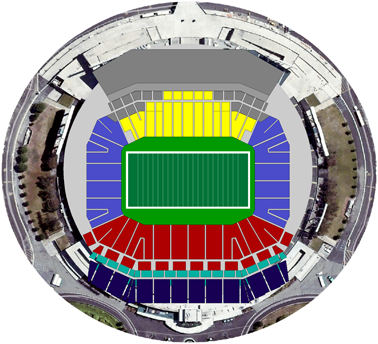
Renovation has many advantages that stem from cost. The site, once the original bowl is demolished, is already excavated and ready to build. New piles may have to be driven because the new western structure would be far taller and more complex than the old bowl. It would likely mimic Mt. Davis to an extent, though it would also include team facilities such as locker rooms and offices, a new press box, and an even more lavish club facility. The end zones would have limited seating, reducing the stadium’s footprint.
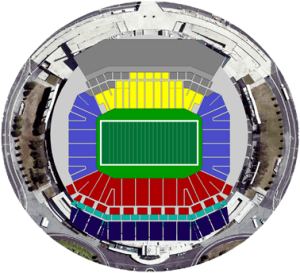
coliseum_redux2-sm
The new structure would look similar to Heinz Field in Pittsburgh. The overlay above keeps the old Coliseum structure to show how odd the sightlines are for football from the old bowl. The only advantage it has over any new stadium its low profile. The design could eventually evolve into something more like what the 49ers are proposing, though having nearly 100 suites in the eastern section defeats the purpose.

It’s hard to say how long it would take to build. Certainly not three or four years as new stadia typically take. Not 10 months as what happened with Stanford Stadium. Probably 24 months thanks to the site’s readiness. Process should be quicker too because any EIR work would reflect the same use as the previous structure. That hidden process time and cost cannot be underestimated.

It would be difficult to conceive of the Raiders playing in the Coliseum in the interim. Demolishing the old bowl while leaving Mt. Davis intact would leave only 22,000 seats in place, and to make construction faster builders couldn’t be interrupted by the occasional game or other events. It was doable for the 1995 construction, but not for a project this massive. The Raiders won’t be welcome at an old or rebuilt Memorial Stadium on the UC Campus. No chance of playing at Stanford Stadium, and Spartan Stadium’s far too small. So are the area ballparks.

That leaves Candlestick as the only venue large enough to hold the Raiders. Sounds blasphemous to be sure, but as both the 49ers and Raiders move forward with their plans, they may find themselves in the unusual position of needing each other. The Santa Clara site has at best a 50/50 shot since it will likely need a true citizens’ vote in November, not an “advisory” vote that the 49ers were gunning for. Should that proposal lose, the team would be forced back to SF, only to face a city that has no public funds to pledge for a new stadium.

Meanwhile, the NFL will at some point tire of California’s inability to get a new stadium built anywhere in the state. Unlike the situation in LA, it can’t allow another exodus of teams because there aren’t new stadia in other markets just waiting for football teams to move there. It can help the teams’ relative plights by encouraging both teams to work together and by pledging a junior version of the Meadowlands plan for a renovated Coliseum. It’s a proposal that won’t tax the other 30 owners much, and it would allow the league to focus its resources on the remaining three potentially itinerant teams, the Chargers, Vikings, and Bills. From a local practical standpoint, both teams would have a far easier way to pay off the requisite bonds since both teams’ stadium revenues would contribute.

There is, of course, a matter of pride. Both teams and their fans would have to come to grips with major territorial issues. The Raiders would have to deal with playing in the ‘Stick temporarily, while the 49ers would deal with a far more permanent transition. That said, there is a point where pride has to give way to more practical concerns. Those who really want to see their teams stay in the area in the most financially responsible manner should consider such a plan.
Grand plans abound

When Ray Ratto’s Sunday column was published, I had only one immediate response posted at AN. It was short and at the time, I felt it was sufficient. Since then there have been numerous comments here I’ll address it further.

There’s nothing wrong with having contingencies. While Fremont appears to be moving along now that the process has gotten underway in earnest, one can’t always see all of the things that could derail a project. So it doesn’t hurt to continue to have an understanding of the Bay Area and even markets outside the Bay Area if Fremont doesn’t come to fruition.

My confusion over Ratto’s column comes from the highly convoluted machinations that would have to occur for it to even be feasible. Consider what would have to happen:

  1. Fremont plan would have to fail either by city council action or applicant withdrawal. Earliest time for that to happen would be a year from now – January 2009.
  2. Santa Clara (city, not county as Ratto suggests) 49ers stadium plan would also have to fail. We’ll know this in November of this year. Don’t forget that the Niners have threatened to take their headquarters with them wherever they go.
  3. Bud Selig would have to seek out punitive measures against the Giants. Ratto suggests conceding Santa Clara County territorial rights. That action would have to be taken by the owners during the next owner’s meetings following points #1 and #2 above. This is despite the fact that the Mitchell Report recommends against punitive actions for “the past.” ETA: Who knows?
  4. Santa Clara would try to pick up the pieces and negotiate with the A’s on some land deal, which may or may not include the hotel tax pledged by area hotels. Santa Clara has in the past felt burned by former A’s owner Steve Schott when news reports circulated that he was considering selling to Mandalay Sports Entertainment. That news irritated then-mayor Judy Nadler and others, who felt that Schott was not on the level. This effectively ended future talks. To get Santa Clara on board again, the city would have to set aside any residual bad feelings and be willing to slog through another political war – and another vote – to get any kind of ballpark deal in place. ETA: At least 18-24 months after #1 and #2.
  5. If San Jose were to be involved in any manner, they would have the Diridon South site and its EIR to fall back on. But that would means potentially being in a bidding war with Santa Clara. What would happen if either city required county support? Who would get it and why?

Not to be forgotten in all of this is money. No other sites could be considered unless some financing scheme were in place. Don’t think that A’s ownership is going to suddenly become magnanimous and offer to pay for the bulk of a ballpark out of their pockets just because it’s in San Jose or Santa Clara. Some public or private financing method would have to be identified, and if it’s the typical methods we normally see, it’s going to be an uphill battle to say the least. The housing crisis has rendered the A’s ballpark village financing plan not particularly portable, meaning it wouldn’t work in Las Vegas or Sacramento. Portland – maybe if there’s a sufficiently large enough piece of land to do so.

I could start to believe the above twists and turns if they didn’t so thoroughly violate Lew Wolff’s prevalent m.o., which is to take the path of least resistance. At Fremont he has the site, the financing method, and he’s gathering the necessary political will. Just about everywhere else he’s going to require public votes, massive changes to the financing, or something else that will draw out the process considerably. Lew’s joked about getting this done before he dies, and his references to his own mortality are borderline creepy. However, I sense there is an element of truth to it. It may be as strong a motivator as any other factor.


The Giants have their own plans for the parking lot across McCovey Cove from AT&T Park. Their plans would allow for a similar amount of parking from the lot as they have currently, while introducing additional shopping and entertainment options. They’ve even teamed up with Cordish, a development firm working on the St. Louis ballpark village concept. The anchor for the plan would be a 4-5,000-seat concert hall. The closest similarly-sized venues are the outmoded Bill Graham Civic Auditorium, the outdoor Greek Theater on the UC Berkeley campus, and the SJSU Event Center. That is, of course, unless others come up with their own plans for such a venue, such as Santa Clara County or even the 49ers. The Giants will be openly bidding against many other developers, who may have different designs for the Port-controlled parcel known as Lot A. If it’s working for the Red Sox and it just might work for the A’s, more power to the Giants if they can pull it off.