Stone hints at SJ ballot measure?

In today’s Merc, it was revealed that the Quakes’ soccer stadium initiative will be pushed back a couple of weeks due to a heavy agenda. Later in the article is a quote from Baseball San Jose leader and Santa Clara County Assessor Larry Stone regarding a joint soccer/baseball facility initiative:

“I wouldn’t mind frankly having them go jointly to ballot at the same time and capture two professional sports franchises,” said Santa Clara County Assessor Larry Stone, a leader with Baseball San Jose. “But if the lower-priced soccer ballot measure preceded a baseball measure, it would doom major league baseball in this area for a long time.”

The interesting thing about the separate soccer and baseball efforts is that they both have a smaller chance of passing if they remain separate than if they’re combined. It’s hard to conceive of voters approving funds for an expansion MLS team after one just skipped town. It’s also difficult to understand why voters would vote for a ballpark when the A’s haven’t officially declared their interest.

The key, then, is Lew Wolff. Wolff is supposedly going to meet with MLS commissioner Don Garber sometime this month to discuss Wolff’s interest in Earthquakes 4.0. Wolff isn’t interested in building the soccer stadium on the Diridon South site; he wants to make the fire training site work. To refresh your memory as to how it would work, he’s the graphic I drew up 3 weeks ago:

As much as Wolff isn’t going to officially say that San Jose is a potential A’s site, it would be crazy for him to interfere with the ballpark process and eliminate San Jose prematurely, especially if Oakland doesn’t work out. I’m not going to say that it’s been Wolff’s grand plan all along – there are too many variables at play – but it’s a potentially compelling option to explore for numerous reasons.

Courting Vegas

I’ve put off writing much about Las Vegas since this blog’s inception. This is not because of any opinion about whether Vegas is a viable relocation candidate or not. Instead, real information about Sin City’s plans has been scarce. Now that the Marlins are in active discussions with potential relocation candidates including Vegas, some details are starting to come out that give a better picture of what’s happening inside the head of flamboyant Las Vegas mayor Oscar Goodman.

Political Landscape
Before I get into the details, it’s important to understand the relationship between the City of Las Vegas and Clark County. The City is the county seat and all of the county’s administration offices are downtown. However, most of what visitors see when they visit Las Vegas isn’t technically within Vegas city limits. The section of the Strip that holds all of the enormous new casinos is part of an unincorporated section of Clark County called Paradise. Despite this, all of the businesses within this section have Las Vegas addresses. This is due to rules set up decades ago to encourage development on the Strip without the taxation associated with setting up in the City. In return, Clark County funded and built some impressive amounts of infrastructure for that area and has tons of cash to build and maintain its schools and other services.

Goodman officially presides over the City’s portion of the Strip, which includes older casinos such Binion’s, where the World Series of Poker is played. This is considered downtown Las Vegas, and in the past it has suffered, living in the shadow of its glitzier neighbor to the south. Tens of millions have been poured into redevelopment over the past two decades to improve the image of downtown. The biggest project so far has been the Fremont Street Experience, a huge overhead light show that serves to visually connect numerous businesses along the street. The area has managed to lose its dingy reputation, but it’s difficult to keep up with billions of private dollars being invested in the construction and renovation of the big casinos down the street.

Inside the city limits, downtown is basically defined by a redevelopment zone, first created in 1986 and expanded twice since then. The creation of such a zone is crucial to raising funds for various public works and public-private projects. Public funds for such projects can be raised without a referendum, and in some cases eminent domain can be used. Below are an aerial view of downtown and a map of the redevelopment zone (in tan/brown), with the dotted line at the bottom representing the southern city limit.

vegas-unionpark1

The green section above is a 61-acre parcel called Union Park. It isn’t actually a park. Instead, it’s an empty tract of land that fills Goodman’s dreams. There are various models of what this blank slate will look like throughout City Hall. Plans currently call for an Alzheimer’s research center, which will break ground in a month or so. City Hall may move there. High-rise condominium development is scheduled for the block in conjunction with ground-level retail, a performing arts center, and public space in a sort of self-contained village concept. The new World Market Center furniture showcase and exhibition space had its first phase opened last year to resounding success. It sits kitty corner to the southwest, and expansion is planned for the area just to the west of Union Park.

Goodman’s vision wouldn’t be complete without a ballpark. One variant of his plan has the ballpark on 18 acres of Union Park. Goodman hasn’t revealed how exactly the ballpark would be financed except to say that it has to be done creatively. Some redevelopment funds can be made available, but probably not for an entire ballpark. Since Las Vegas is not known for its pleasant desert summers, any ballpark would have to have a retractable dome, adding $100 million to its cost. That could push the cost to $400-500 million even if the land were thrown in for free. It’s possible that a ballpark could be an extension of the World Market Center or some other flexible convention space, now that technology is available to move a natural grass field either on rollers (Arizona Cardinals new Glendale, AZ stadium) or in pieces (Millenium Stadium in Cardiff, Wales). A typical field covers nearly 4 acres (160,000 square feet), making it a potentially compelling, wide open (no columns) exhibition space with plenty of amenities attached (clubs, restaurants, suites). This is all speculation, of course, but it makes sense for a city bent on dominating the convention market. Having the space available would also help pay the bills during the baseball offseason.

In September a large national developer, Related Cos., backed out of a deal to build condos at Union Park. Related is focusing on the Las Ramblas project, which is fronted by George Clooney among others. Vegas is experiencing a high-rise condo-building boom, so it wasn’t long before numerous other builders stepped to the plate. The eventual “winner” was Newland Communities of San Diego. Newland has an option to buy up to 7.6 acres of land at Union Park, with the ballpark’s 18 acres potentially available for other development if a pro sports team is not negotiating with Vegas on a stadium deal in one year. This is all contingent upon Newland breaking ground in the next year on its development work. Other land in the area could be made available outside Union Park, but that may require more complex dealing, especially if casinos become directly involved by providing land near the Strip. This development is extremely important because it’s the first time that Goodman has played the deadline card. Over the past several years MLB frequently used Vegas as its #1 relocation target. Vegas was considering a compelling candidate for the Expos until it became clear that moving to DC would provide MLB significantly more money than a move to Vegas or Portland. Goodman’s tired of allowing Vegas to play the mistress; he evidently wants a real commitment from MLB. We’ll see if MLB responds in kind or is a mere tease.

Casino Paradox
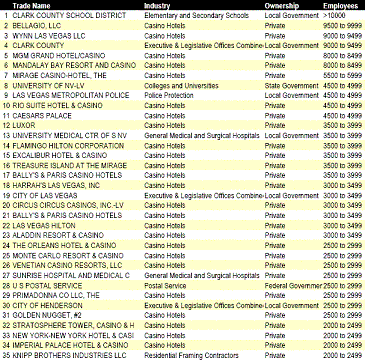
The table below shows Clark County’s 35 largest employers as of Q2 2005. It should come as no surprise that casinos make up almost 70% of the list. Public entities cover almost all of the rest.
vegas-employers2

The State of Nevada has been pushing hard to bring in other industries with mixed degrees of success. Nevada has several advantages over California when it comes to taxes and incorporation, but so far the corporate exodus from California predicted when the dot-com crash and recession hit hasn’t really happened. Southern Nevada’s explosive growth means that it’s just a matter of time before it starts to innovate and land other industries. Casinos still have the lion’s share of potential corporate interest for a ballpark, and judging from the number of San Diego-area casinos that had suites at Petco Park (all of them), selling suites and club seats to casinos would be like shooting fish in a barrel. The casinos would in turn comp their high rollers and dignitaries in their suites, writing it off as the cost of doing business and adding it to their portfolio of available entertainment.

As interested as the casinos may be, some major gaming interests have expressed displeasure at the idea of a ballpark being built with public money. Their argument is that they invest their own money in their facilities without expecting handouts. They also pay taxes, an idea that has been lost in the recent era of stadium building, with PILOTs (payments in lieu of taxes) often used as a method to help finance construction. Goodman said in a recent USA Today article, “Major League Baseball needs us more than we need them.” That’s only half of the story. While the Marlins, A’s, and Twins are less moneymaking franchises than some others with new ballparks, it’s not as if MLB is hemorrhaging red ink by allowing them to operate. The other half of the Vegas story is this: The casinos don’t need baseball, but baseball in Vegas definitely needs casinos. Goodman’s posturing aside; it’s obvious that he wants to get a MLB team to earn Vegas its Major League City merit badge.

Sports Betting
The argument about gambling poisoning pro sports may have made sense twenty years ago, but it doesn’t today. Professional players and teams make such astronomical amounts of money that it doesn’t make sense for them to risk their livelihoods to shave points or throw games. Still, MLB reeks of the stench of the nearly century-old Black Sox scandal and Pete Rose’s addictions. It would make sense for MLB to distance itself as much as possible to avoid the appearance of impropriety. However, a gray area already exists by virtue of Indian casinos buying suites in states where they operate. Who actually operates those casinos? The big corporate gaming interests, of course. Sure, the jobs and some money go to the tribes, but it’s the gaming industry that provides the know-how and capital. It wouldn’t be too difficult to connect the dots.
Nevada is the only state in the union with legalized betting on sports. With all of the intertwined money and the encroachment of gaming interests closer to major metropolitan areas, at some point the bellyaching may all become moot. The pro sports each want the casinos to take their respective leagues off the sports books to eliminate any concern about impropriety. That’s a hard sell considering that the industry makes billions every year on sports betting. Would they simply agree to kill a revenue source just to improve the image of their hometown? The casinos already provide image to spare and Vegas really doesn’t need any help in that department.

Where are the fans?

We know that Oscar Goodman is a fan. An influential fan, too, as the recent visits by Marlins officials to Vegas indicate. But where are the prospective seat fillers – the hardcore and casual fans who are expected to regularly go to games by buying season tickets? The answer to this question isn’t clear. Vegas’s growth puts the metro at 1.8 million residents and climbing. That’s not exactly huge since it’s only as big as Santa Clara County and smaller than the combined East Bay (Alameda/Contra Costa Counties). Many of the area’s transplants work in the gaming industry, which presents two problems. Many of the jobs are low-paying, leaving a large part of the population out of the preferred demographic. Since Vegas is a 24/7 city, one-third of the place is working at all times, further reducing the pool of potential fans. Sparse attendance at AAA Las Vegas 51’s games is cited as a negative, but the experience there is nothing compared to a game in an air-conditioned, retractable dome stadium.

Goodman’s argument is that some percentage of his city’s 40 million visitors will see a baseball game there. How much? One percent? Five? It sounds like a flawed premise, especially when you consider that the vast majority of visitors already come from markets with major league baseball. The argument may have worked a decade ago, when Vegas was still in its “family” phase and trying to attract everyone regardless of income level. These days, Vegas has decidedly gone with a more upmarket approach with the ultra-lux casinos like Wynn Las Vegas, with higher-class entertainment and restaurants. Many visitors come from Southern California (27% according to some estimates), the Bay Area, New York, and Chicago. Those markets are already saturated with major league baseball. There’s a potential niche in Goodman’s approach in that for instance, a Chicago-based businessman and lifelong Cubs fan might be attending a convention in Vegas while the Cubs are in town for the weekend, prompting him to grab tickets. Even that is a crapshoot because of schedule incompatibilities. Some stadium junkies like me would go just to check out the ballpark, but that’s typically a one-shot deal and the novelty will fade very quickly.

My biggest concern for Vegas is that it lacks a grassroots organization, like the Oregon Stadium Campaign or Baseball San Jose. These groups are vital for many reasons, including the fact that they automatically gauge and foster support. By conducting petition drives and surveys, they can quickly assess the public’s interest in baseball from hardcore and casual fans, families and corporations. They can raise money for pro-stadium ad campaigns should a stadium come to a vote. They often are comprised of numerous local civic and business leaders who can put their considerable weight behind a campaign by supporting it. Most importantly, these groups can keep the issue in the forefront of the region’s consciousness. It could be argued that Goodman is filling this role now, but what if he runs for Nevada’s available U.S. Senate seat or for the governorship this spring? Suddenly there will be a vacuum with little in place to fill it as Goodman spends much of his time campaigning for a different office. Perhaps Hall-of-Famer Reggie Jackson, who lives in Vegas and has long advocated bringing a team to Sin City, could become the face of the effort. That could work in terms of rallying public support, but it may backfire when dealing with MLB, whose club-like mentality may not have any interest in making room for an outspoken maverick like Reggie.

Conclusion
The clock is ticking for Vegas. If it’s going to happen, MLB will have to do the proverbial “sh*t or get off the pot.” The mayor isn’t messing around anymore. He’s playing for keeps. That should concern fans of the A’s and Marlins, since both of their leases are going to end soon and there’s no telling what Goodman will do to make a deal with MLB. There are major challenges with the MLB-to-Vegas effort, but as I’ve said before, it’s all about the deal. Wolff’s aborted baseball village concept may not be feasible in the Bay Area due to its size, but could it be done in Vegas? We can argue until we’re blue in the face about one the viability of baseball in Las Vegas, but if something were to occur to give a team and MLB a sweetheart deal, it may be impossible for baseball to say no. That would prove that the more things change in Sin City, the more they stay the same, eh? Then again, there’s little reason to believe that Vegas has a ton of cash lying around somewhere just waiting to be spent on a stadium. Once real financial details are available, look for an analysis here. Until then, the mayor has some pretty models to play with.

Plan B: Two new sites and a different financing plan

From the Chronicle: Chip Johnson’s Friday column substantiates the rumor from a couple of weeks ago in which Wolff scrapped his original vision for something smaller. That’s the good news. The bad news? He’s not funding the project entirely himself.

The City of Oakland came up with the two site alternatives, both of which amount to 30 acres each.

The sites:

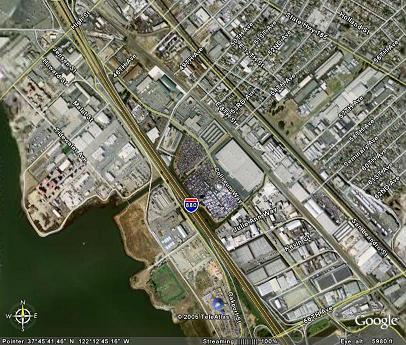
  • Coliseum North Jr.: Between 50th and 66th Avenues along I-880/San Leandro St. I am coining it Coliseum North II because it essentially is a smaller version of Wolff’s original site. It may be pieced together from land in which the City found willing sellers. What’s not known is how the site is situated along that industrial stretch. Its proximity to Coliseum BART will be key. The site is in the lower right quadrant of the picture below.
  • Tidewater/Oakport/High St. Estuary: This is essentially across the Nimitz (I-880) from Coliseum North. It’s an industrial area with one intriguing fact: 11 acres of it is owned by the East Bay Regional Parks District. PG&E has a 15-acre facility across the street. The site is obviously not very close to BART. The site is in the upper left quadrant of the picture below.

newplan2

The financing:

Here’s where it gets tricky. These two sites’ size makes the idea of private development being used to completely foot the bill for stadium construction not feasible. Wolff has proposed that the City/County/Coliseum Authority acquire the land, while the A’s would put at least $25 per square foot towards the cost. That equates to $1 million per acre, which is below market value for industrial land in the Bay Area. The hope is that surrounding development could help pay for land acquisition and construction, but there’s no illusion that it will provide all of the necessary funds.

Wolff’s new plan sounds reminiscent of the DC ballpark plan, in which the District acquired the site, designated a portion of it for the ballpark and the rest for developers. In its haste the District controversially went the eminent domain route, which I wouldn’t expect for this effort, especially during an election year. The hard part is figuring out how much public money has to be raised for it, which someone at the City Center will have to figure out. Having local pols back the plan is another issue altogether.

Of the two sites, the Tidewater site looks the most intriguing. It’s waterfront, there are fewer property owners, and one large piece is already owned by a public agency. The EBParks land won’t be free – Oakland/Alameda County/Coliseum Authority would have to buy it – but if a deal could be worked out that provides open space or parkland, it could be beneficial to all parties. The PG&E site’s a different story. It’s not a substation like the situation in San Jose. It’s a local operations center, complete with a vehicle yard, dispatch, and customer service. If the City can find a large, suitable piece of land on which PG&E can relocate, it could work, but the costs associated with that land acquisition/swap and relocation costs have to be factored into the total cost of the plan.

One last interesting factoid: Coliseum North is in Larry Reid’s district, while Tidewater is in Ignacio De La Fuente’s district.

Oakland: Let’s try Plan B

Not surprisingly, the City of Oakland and Coliseum Authority officials have admitted that efforts to get the land deal for Wolff’s 100-acre Coliseum North development are going nowhere. And for the first time, Wolff has become upset over the process.

So what’s Plan B? Building on the existing Coliseum parking lot, of course. As indicated in Trib reporter Paul Rosynsky’s article, there are several issues with that arrangement, starting with the elimination of parking for the other tenants (Raiders, Warriors). The kind of aggressive development strategy that Wolff is considering to finance the stadium may not be feasible with a Coliseum-based ballpark. Coliseum South appears to be available, if anyone’s interested, though it’s not nearly as large as Wolff’s plan.

Wolff has made comments to the effect that he is willing to consider other sites. If it comes down to the Coliseum parking lot being the only alternative, someone’s going to have to get extremely creative about the financing plan. Since the Raiders are able to leave cleanly after 2010, Oakland/Alameda County may find themselves in the extremely uncomfortable position of being forced to choose between the Raiders and A’s.

As for Wolff’s request for a three-year extension to the existing Coliseum lease? Don’t be surprised if it comes with a price tag – perhaps a MOU or letter of intent, something that indicates that “everyone’s on the same page.” Same goes for the Raiders.


The Fremont Argus is also backing a Fremont site should efforts in Oakland fail. Fremont has started up a stadium task force, of which I am a member.

MLB explains why DC isn’t progressing

MLB COO Bob DuPuy wrote an opinion piece in today’s Washington Post. In it he describes the trials and tribulations that the DC government has gone through in getting the Navy Yard/Anacostia ballpark project off the ground. Since it is his piece and he is representing MLB, one can assume a certain amount of bias. Once one gets past the bias, it starts to appear like DuPuy is arguing for a new deal. Take this excerpt:

Because the Nationals will generate $250 million for the District in sales taxes and rent payments generated at the stadium (large businesses pay the rest of construction costs), baseball has input into the new stadium’s design and construction, but government officials make the decisions. D.C. planners chose the stadium’s architect. The city government, not baseball or the Nationals, decided what the Nationals’ new stadium will look like and what material will go into it, from the type of concrete used to the types of seats in the suites. Government workers selected the stadium’s construction companies, and these same governmental employees will oversee the construction work.

But now, some members of the D.C. Council have asked baseball to pay for any stadium cost overruns, even though city personnel will control the variables that cause the stadium to be built on budget or run over cost. Asking baseball to pay for overruns when D.C. government officials are in charge of the stadium’s design and construction is like MasterCard telling you to pay your credit card bill even though MasterCard gets to do all your shopping. No consumer would agree to such a provision, and neither will Major League Baseball.

Then juxtapose that with this (from earlier in the piece):

When teams are in charge of design and construction, any savings go to them and any cost overruns are borne by them. That’s what was done with new ballparks for the Detroit Tigers and the San Francisco Giants. That’s also how MCI Center was built. On the other hand, when a government agency is in charge of design and construction, the benefits and risks are covered by the city. That’s what happened in Baltimore at Camden Yards and in Cleveland and Pittsburgh as well.

It’s obvious that MLB is blaming DC for its inability to properly manage the project and its stakeholders. But it also appears as if MLB is suggesting that if the current agreement were torn up and one were drawn up where the District stepped aside, things would be moving along much more smoothly. The ballpark matter is bound for arbitration in the near future, and it is unlikely that an arbitrator will give MLB that kind of control. Stranger things have happened, however, and as the tide continues to turn against the existing project and its escalating costs, just about anything’s possible.

We can only hope that Wolff maintains his position of privately building the ballpark, thereby controlling costs and employing more efficient methods, such as design-build.

On a related note, a DC contractor group wrote to the Post as well, arguing that cost overruns at many ballparks are to be blamed on bad labor (read: union) contracts. I’m not touching that argument.

The future of stadiums?

ESPN’s sports business reporter Darren Rovell penned a neat article on the use of technology and automation in enhancing the fan experience. A single smart card with RFID could one day act as a complete ticketing and purchasing system for parking, entry, concessions, and merchandise. Not only would the system speed up transactions, it could be used for security purposes as well. There are obviously issues to work out regarding data security and encryption. It will also be a challenge to change patrons’ thinking to the idea of prepaid or rechargeable smart cards instead of cash or credit/debit cards. Incentives can be given to those who subscribe, and it can be said that the “rewards card club” memberships many teams have introduced the past few years are a mere stepping stone to a more comprehensive approach. As a person who works for a company putting out leading edge technology, I wholeheartedly endorse the concept.

Petco Park tour

I’ve spent the last week in San Diego visiting family, and while I was there I took in a tour of Petco Park. It proved to be a highly educational experience, especially when trying to look at the venue from the perspective of a team owner such as Lew Wolff. Wolff likes several features of Petco including its “neighborhoods,” or areas of regular or season ticket holders. One potential positive in the concept is that the community feel created by neighborhoods could be a factor in subscription retention in years to come, particularly when the novelty effect wears off.

As the tour guide led us through and pointed out many of the unique design elements of Petco, I made some of my own observations:

  1. Revenue-generating opportunities are more diverse at Petco than at SBC Park. The Western Metal Supply building alone has a restaurant, bleachers, and several party suites. The only significant party area at SBC is the concourse behind center field, which is sometimes roped off when it’s reserveed for group gatherings.
  2. The Sony Dugout Club, which is reserved for the 150 or so ticketholders immediately behind home plate, is fantastic. It’s ostentatious with its huge leather booths, granite tables, and multiple plasma televisions, but if you’re a corporate guy looking to impress a client, it’s a can’t-miss venue. It also has a great view of the Padres’ batting cage.
  3. The bleacher concept is only flawed in the sense that the risers descend to the field with the fence partially obstructing some views. Other than that, it’s fantastic. The “beach” area will be expanded slightly when the fence is pulled in before the start of the season. BTW, the individual plastic seats on the concrete risers are the Colosseum-Two model made by Dant Clayton, a highly reputable bleacher manufacturer out of Louisville, KY.
  4. The standing room areas are brilliant, perhaps too brilliant. Since the standing room option ($5) has become so popular, seatholders immediately in front of the SRO drinkrails have gotten annoyed at the occasional spilled drink – so much that the Pads are taking out an entire row in front of the drink rail. A nice side effect for the team is that it will create a little more ticket scarcity since a couple hundred seats may be removed from inventory.
  5. The Toyota Terrace has separate club seating and suites. The tour guide pointed out the fact that several Indian gaming interests have suites. Sycuan even holds regular tribal meetings in their suite. I’ll expand on this in an article on Las Vegas that will be posted on Friday.
  6. With 17 acres to work with, HOK and architect Antoine Predock had a large space on which they could place buildings, plants, and architectural elements. With an A’s ballpark, 17 acres may not be available because of costly land acquisition (5 acres = $30+ million). The acreage was used effectively, as much of the ballpark is recessed from the street, minimizing visual impact.
  7. The use of differing sizes of squarish and rectangular sandstone was a nice touch. It really softens the facade while paying homage to Aztec architecture, albeit with a modern twist.
  8. Ramps are hidden while stairs leading up to the main concourse are prominently featured, which is reminiscent of an Aztec temple. There are 18 elevators and a few escalators, but they are also hidden away.
  9. The stadium appears to be built quite high when looking at it from the field, but that’s only because of the proximity of the mezzanine and upper decks, which are both cantilevered well over the lower deck. It would be lower if not for the two levels of suites and club lounges, which effectively add 25-30 feet to the height of the stadium. From the streets lining the outfield, the stadium facade is some 30 feet high when it meets the sidewalk. Look straight up and you’ll see the upper two decks. The field is not significantly below the street (~6 feet).
  10. The Park at the Park is a great concept. It’s one I think can be integrated into an A’s ballpark that could be a big community asset if executed well. It doesn’t beat McCovey Cove and the Promenade, however.
  11. The Giants went a little cheap on the video/scoreboard solution deployed at SBC Park. They signed a huge package deal with Panasonic, who not only provided the scoreboard and video board (dubbed Astrovision), but also the TV’s in the suites and concourses and the distributed audio system. At Petco, the Padres partnered with Cox Cable and Sony, which meant that HDTV and Sony widescreens are everywhere. There are also little scoreboards above each concourse that have static signage attached. Of course, the Pads had a nice little financial and political delay which allowed them to get the HD stuff in house, which the Giants didn’t a few years back. That just means that when it comes time for the Giants to do some upgrades, they won’t be cheap. Memo to Lew: 1080p LCD! And Meyer Sound – because nobody does it better!
  12. I counted four different Hussey Seating seat models in use at Petco. The exposed suite seats were covered with tarps. Leather rolling chairs were pulled into each suite. The first tier club seat holders got nice, wide chairs with padded inserts for both the back and seat. The high-roller Sony Dugout Club seats were a high-back variety with fold-out tablets, like those found in a university auditorium. The regular seats were the old-school looking Legend model.

For those who happen to be in San Diego in the near future, I fully recommend the tour. An adult ticket costs $9 with discounts for seniors and kids. The tour runs about 90 minutes.

Purdy connects the dots

Update 12/22 09:00 – David Pollak has a wrtiten an article on the complexity of the soccer-baseball relationship.


Ever the ballpark advocate, Mark Purdy’s new column in the Merc builds on the theory that a soccer stadium initiative will sprout into something containing both baseball and soccer facilities. From this there is one glaring question: Is the pursuit of a soccer stadium an end-around to a ballpark?

Yes and No. Yes in the sense that it’s an extremely clever way to get the facilities on the ballot. Separately, they’re much weaker than they are together. There’s no commitment from Wolff to bring the A’s to San Jose, but there is a pretty clear threat should a ballot initiative be approved. No because territorial rights are still a major problem, but the thinking may be that the offer is so good for Wolff (and by extension MLB) that it would be foolish for the commish to pass it up.

So what would it look like? Try this:

The key to the idea, as I’ve said before, is the inclusion of public park space. There is a lack of courts and playing fields in the Midtown-Downtown area, and by including them in the package, stadium proponents could get a crucial ally that may otherwise be a NIMBY foe.

The 22-25,000-seat soccer stadium sits on top of what is now Park Avenue. To get the right amount of space, Park Avenue would have to be closed down. It actually works out quite well, since any excavated ground can be used to fill in the underpass leading to the railroad tracks. Close down Park west of the tracks for about a block, and the neighborhood will have 4-5 acres of park facilities linked together by an underpass. There would be plenty of room for the following:

  1. A public park situated west of the ballpark with picnic areas and unique landscaping
  2. A multi-purpose playing surface for a youth soccer field or sandlot
  3. Basketball and tennis courts west of the ballpark
  4. A pedestrian-only plaza or paseo between the two stadiums
  5. A single vehicle access ramp for both facilities and other shared infrastructure

There’s more to the concept including ballpark specifics, but this is all I’ll release for now.

34,179

That’s the new capacity of the Network Associates Coliseum now that the A’s have announced that the upper deck won’t be sold at all in 2006. Since the initial news came out that View season tickets weren’t for sale a few weeks ago, it wasn’t certain if the seats would be sold at all, or only for certain high-demand games. The former is definitely the case. In the accompanying press release, A’s President Michael Crowley even confirmed that it’s part of the trial balloon to understand and transform demand for A’s season, advance, and walk-up tickets:

“Our goal is to create a more intimate ballpark atmosphere and bring our seating capacity in line to what we have proposed for our new venue.”

The team also makes a claim that the decrease in capacity is being done to improve the fan experience, citing a survey that indicated views from the ironically named View level seats were among the worst in baseball. One observation I have to make is that the A’s failed to explain exactly how they were going to improve the fan experience on than the closing of the upper deck. They should have explained how access to concessions and restrooms should or will be improved, which it almost certainly will be. Otherwise it won’t appear as more than an experiment.

One thing should be explained about this move: the A’s probably won’t get higher revenues this season as a result. Say the A’s sold 10,000 View level seats per game against the Yanks/Red Sox/Giants and account for $10 per person in concessions revenue, the gross revenue for those 12 games would be $2.4 million. That’s not that much in the grand scheme of things. Lost revenue from View tickets sold at other games would be made up by selling tickets for Plaza level seats. While it appears from the outside that the A’s are just interested in selling a bunch of higher-priced seats, it’s more about getting that predictable demand curve in place with season tickets and advance sales. Diminished walk-up sales should no doubt contribute to a flatter curve.

Oakland makes up with Raiders, rebuffs A’s

Following up on a story that surfaced last month, Oakland City Council approved the settlement that will kill once and for all the Raiders’ disastrous PSL system and hand full control of football ticket selling operations to the Raiders. Two articles have shown up so far on this:

What wasn’t known in November was the type of concessions the city and Coliseum Authority might need to make to get the A’s to go along with the deal. That was finally revealed last night as A’s officials and local pols said that the A’s wanted a three-year extension on the existing lease. That request, along with a similar extension request by the Raiders, was denied.

In light of the difficulty seen in getting the Coliseum North project off the ground, one would think it would behoove Oakland/Alameda County to sign the A’s for three more years. That time could be used to work on alternate sites or reshape Wolff’s proposal into something more feasible.

The only thing I can see that may have made Oakland balk at the concession was if the lease terms were merely three additional one-year extensions with the same buyout terms the A’s currently have in the 2008-10 years. That would not help Oakland in the least, since it would give the A’s a longer safety net as they pursued other options out of town.

If the lease extension was a lock-in, where the end of the long-term lease agreement was pushed out from 2007 to 2010, it doesn’t make much sense for Oakland to reject it. It’s possible that Oakland is calling the A’s bluff and holding a hard line so that the A’s can be forced to make a decision by 2010. It might also net better lease terms for Oakland. Still, those are tenuous supporting arguments for a decision that can only be termed as baffling. More to come on this.