House eminent domain bill passes

In a rebuke of this past June’s Supreme Court decision ruling eminent domain for private entities legal, the House just passed a bill (H.R. 4128) that would deal out severe penalties to states and municipalities that would choose to use eminent domain in that highly controversial fashion.

The bill passed with astounding 376-38 tally, which meant that it received significant bipartisan support. The big penalty here is that the federal government would be able to withhold economic development funds for two years from local and state governments that used eminent domain for private projects. There are limitations in the law: private property owners have up to seven years after their property was seized or condemned to lodge a complaint, and the law will not apply to seizure or condemnation completed or in progress prior to the enactment of the law. If the constitutionality of the law becomes a question, it’ll be interesting to see whether the Supreme Court upholds its previous decision or not. Justice Sandra Day O’Connor was not the swing vote in the Kelo vs. City of New London case, so appointing a conservative successor wouldn’t make a difference. Justice Anthony Kennedy, in a bit of a surprise, was the swing vote in favor of the city and its developer partners, though given the chance to rule based on a broader law than a single case, there’s a good chance he’d swing the other way.

Among the projects that in all likelihood won’t be affected: the new Washington Nationals ballpark along the Anacostia River in D.C., and the new Arlington, TX football stadium being built for the Cowboys. For a new project like an A’s ballpark, eminent domain would not be an option – at least not without severe consequences.

The bill is bound for the Senate, where it will probably pass. President Bush will probably sign it as well, though he actually supported eminent domain to seize property that eventually was used to build The Ballpark in Arlington.

Sometimes it pays to read…

Surprisingly, there is a blurb in the terms of the agreement between the Raiders and Oakland/Alameda County that has something to do with the A’s. The Trib posted a three-page excerpt alongside their story. Here’s the text (verbatim):

2g. Subject to the Authority reaching a mutually agreeable agreement with the Oakland Athletics, the Raiders may sell and retain all revenues from specified fixed advertising inventory in the Stadium on a year-round basis. The parties acknowledge that the Authority has made a good faith representation that the Athletics are agreeable to such an arrangement and the Authority will use its best efforts to finalize such an agreement with the Athletics. Additionally, Raiders shall be permitted to sell and retain all revenues from temporary advertising (banners) during football games provided that sponsors do not conflict with current Athletics exclusivity arrangements. The Raiders do not share any advertising revenue received by the EBEs.

In short, the A’s won’t be receiving revenue from much of, if not most of, the advertising in the Coliseum. From the looks of things, the only revenue they’ll get is from the baseball-specific signage: the rotating board behind the plate, tarp covers, dugouts, and the outfield fence. The Coliseum has no dazzling ribbon board on the plaza level facade, and the signage panels next to the scoreboard are smaller than those at other parks. Why would the A’s agree to this deal? There are a few possibilities:

  • The revenue the A’s realized was fairly inconsequential, and to help the public entities out (and to curry favor with them as well for a future ballpark), they decided to forego the revenue.
  • The A’s want to be able to point to the limited advertising revenue as another one of the Coliseum’s “deficiencies.”
  • Tha A’s want to limit revenue, which could mean a lower payment into the revenue sharing structure and higher revenue sharing receipt.
  • The A’s were simply being magnanimous.

Since there are no charity cases in these kinds of deals, I think we can dismiss #4 out of hand. #3 is unlikely because the amount probably is inconsequential. So the truth probably lies in both #1 and #2, though there may be other motives at work. In the end, whatever money they don’t get can’t be blamed on the A’s not signing Paul Konerko or Brian Giles. However, it does look like the deal greases the skids for a clean Raiders’ departure in 2010. Imagine that scenario: It’s 2011, and there are no tenants at the Oakland Coliseum. The thought gives me shivers.


Update (11/3, 11:03 AM): A little historical context is in order. A three-year-old article from the East Bay Business Times covers a lawsuit brought by the Raiders (of course) against the A’s for allegedly withholding advertising revenue. Though I haven’t seen any news items related to the suit after it was filed, it appears that the A’s giving the Raiders the ad money may settle the matter. The baseline revenue the A’s had received was $3.9 million per year, with the Raiders and A’s splitting money above that amount. It’s definitely nothing to sneeze at, but it’s also not enough for the A’s to score a big-time righty slugger, either.

Raiders kill PSL’s – The lessons learned

The Raiders have officially declared their ill-conceived PSL system dead. Unfortunately for Raider fans, they’ve had to endure 10 years of high prices, walk-up fans that can get seats just as good as the PSL holders without paying for PSL’s, and television blackouts that result from poor ticket sales. Under the new arrangement, the Raiders will take over all ticket sales and marketing operations from the Oakland Football Marketing Association, which will now take its rightful place alongside such flops as the Titanic and the Ford Edsel.

This doesn’t mean the concept of the seat license is dead. While Lew Wolff has acknowledged the lack of popularity for the maligned PSL, it’s still hard to imagine a new stadium being built these days without some kind of sale. Advanced PSL sales can account for roughly 10% of total financing, which is no small number. Combine that with naming rights and other marketing deals, and the upfront share can easily reach $100 million without an owner having to spend a single cent out of pocket. The Cardinals have more than sold out their seat licenses for next year’s edition of Busch Stadium, and the Yankees will likely do the same with the new Yankee Stadium. Maybe Wolff can fund the project without having to resort to selling seat licenses, but I’m skeptical.

The real lessons to be learned from the Raiders/OFMA debacle are:

  • Make sure the demand is there.
  • Have the subscriptions be lifetime subscriptions, not renewable ones.
  • Instead, lock in the ticket prices associated with a seat license for a set number of years, then let the consumer decide if he/she wants to renew and lock in price controls again.
  • Make sure the licenses are transferable via sales or bequest.

As painful as this ordeal was for the taxpayers of Alameda County, other cities and teams learned much from the Raiders’ cautionary tale, and made sure that their efforts didn’t repeat the same mistakes as those committed in Oakland.


Another note – I have reluctantly added the “word verification” feature to comments in order to combat the spam-bots that occasionally make comments on the posts. Not a big fan of it, but sometimes it’s necessary.

San Jose site acquisition continues

Update (10:50 PM): San Jose City Council is expected to vote on the acquisition next Tuesday (November 8).

The City of San Jose is set to buy a key property on the proposed Diridon South ballpark site. The property in question is the former Stephen’s Meat Products factory, which is distinctive for its “dancing pig” neon sign that greets drivers going south on Montgomery Street. The 1 acre site could cost up to $5.7 million.

Unlike what’s happening in DC, the properties at Diridon South are expected to sell for actual market value through negotiations, meaning eminent domain isn’t expected to be used. That should also ensure that there are no lengthy legal battles over the value of the land. That issue has ensnared the DC acquisition process enough to cause some waffling over the plan, even putting the projected timeline in jeopardy.

The downside is that the total cost of the land will be high – somewhere in the neighborhood of $60 million. So far, the money has come from the sale of other properties, notably the Brandenburg/North San Pedro site, upon which new residential towers will be built.

Stadium foes such as Kathy Chavez-Napoli have criticized the acquisition because they believe that it violates the city’s own laws which dictate that no money can be spent on the building of a sports facility without a vote. The city’s redevelopment arm (SJRA) may have an out because the land is being acquired with no specific purpose yet. It could be used for housing (per the Diridon/Arena planning document), a ballpark, or other commercial uses. The city’s legal counsel has signed off on the legality of the acquisitions, though it does appear pretty clear what the greater purpose is. Whatever your take is on the subject, San Jose is well on their way to acquiring the site prior to a November 2006 ballot measure.

The leading question is – how is San Jose going to arrange its proposal? Will it offer to sell the land to a developer who can then build the ballpark? Or will it keep the land and arrange a long-term lease for the ballpark developer (the Giants/China Basin deal)? And what of surrounding parcels, some of which are also ripe for development of anything from parking structures to office towers to mixed-use residential development, such as a ballpark village?

A’s radio up in the air

The Chron’s radio reporter, Steve Kroner, wrote in Friday’s edition about the many issues that the A’s face in their broadcasting future. Not only does A’s VP Ken Pries have the impossible task of filling the seat of the late, irreplaceable Bill King, but he also has to to broker a deal to get the A’s on some kind of flagship station (AM-preferred) prior to the start of the 2006 season. Among the other open issues:

  • Who will be the A’s television play-by-play guy(s)?
  • Will Hank Greenwald return? If so, how diminished will his schedule be?
  • What will happen to fill-in radio play-by-play man Steve Bitker?

Based on various media reports, there are a few quality “free agent” broadcasters out there, including Ted Robinson (most recently of the Mets) and John Rooney (White Sox). Rooney would be my choice just because of his smooth baritone, but Robinson is perfectly competent – he’s even worked for the A’s in the past. Another possibility is Doug Greenwald, Hank’s son, who has spent the last couple of years broadcasting for the Giants’ Fresno (AAA) team. Greenwald has worked for nearly every California minor league team, and he at least deserves a shot at the gig. He previously auditioned for the open Giants radio position that eventually went to Dave Flemming, another young upstart.

Not to be lost in all of this is the news that after initial discussions, neither KQKE-960 nor KNEW-910 will broadcast the A’s next season. That eliminates two more candidates from the already short list of potential radio homes for the A’s. November is usually negotiation time for such matters, so we should hear more then.


Following up on initial reports in early October, the Bay Area Radio Digest confirmed that Cumulus Media is buying Susquehanna’s radio properties, which include KNBR-680 and 1050.


Thanks Rob for the heads-up on the A’s radio article.

CoCo Times: The nascent bidding war

The headline may be a bit too sensationalistic, but we may find that in a year it’s right on target. The Contra Costa Times editorial page acknowledged the interest by Fremont and San Jose, even Sacramento and Las Vegas. Wolff’s Oakland plan has both merit and challenges. Should Opening Day 2006 pass with little progress on the Oakland front, there’s a good chance that multiple suitors will emerge with formal proposals, perhaps including cities in Alameda County that have been silent so far. Portland, OR remains a possibility just because the financial plan there remained in place even after they lost out in the Expos bidding war.

Exit car dealerships, enter… ballpark?

Update (10/26, 3:05 PM): Today I pitched the idea to Ignacio De La Fuente and Nancy Nadel. Councilwoman Nadel, in whose district the site resides, has been receptive so far. She’s passing the idea along to Redevelopment. We’ll see what happens from there.


According to an article in Sunday’s Trib, some of the dealerships on Broadway Auto Row have expressed interest in relocating to a new “auto mall” concept at the old Oakland Army Base. Reasons given are the location’s proximity and visibility from I-880, the fact that it’s a little closer to San Francisco, and lower land costs/leases.

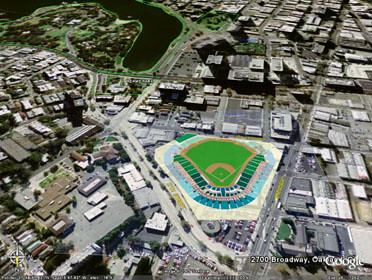
There are already plans to build various types of housing in the area based on available zoning and planning resources, but even with those plans, there exists at least one site where a ballpark could be built. The site is at the intersection of 27th Street and Broadway. It’s roughly the shape of a triangle, and is just about the perfect site to shoehorn a ballpark in. Broadway Ford, a used car lot, and some other auto-related businesses currently occupy the area. I counted 2-3 houses and small apartment buildings as well.

These residents and businesses would obviously have to be relocated, and other land in the area would have to be acquired to fulfill Wolff’s concept of surrounding development paying for the ballpark costs, but the site has several advantages, including its ideal downtown/uptown location and access to BART. There would also be neat views of the Oakland skyline and Lake Merritt (presumably from the upper deck). It even has a slight downward slope that’s conducive to building a ballpark. Keep in mind that the idea of a building a ballpark on the site isn’t mentioned in the article, but if Wolff’s looking for an appropriate site, this one may just work.

What would it look like? Compare the image above – the land as it currently exists – with the image below, which has a conceptual design on it. (Please note that the images were created with the wonderful Google Earth application.)

That’s Lake Merritt and Adams Point in the upper left hand corner. The nearest BART station is the 19th Street Station, about 5 blocks away from the right field corner. The entry to the BART station is actually at 20th and Broadway. It wouldn’t be possible to build a closer station because BART’s tunnel makes a westerly (left) turn just past 20th Street before it aligns with I-980/CA-24.

San Jose looks to acquire PG&E substation

Barry Witt’s report in today’s Merc covers San Jose’s efforts to get PG&E to study moving a substation located on the Diridon South site. The substation could either be reconfigured or moved. A potential site is the fire training center on the other side of Park Avenue.

The substation is wedged between the old Stephens Meat plant (which closed down last month) and the Union Pacific/Amtrak/Caltrain tracks, towards the northern end of the trapezoid-shaped lot. I have been told that substation, which is roughly the shape of a square that juts into adjacent properties, could be reconfigured to run parallel to the tracks. If that’s the case, it would be the most cost-efficient option since it may be possible to move without rerouting the high-tension transmission lines that run above the property.

One more property acquisition may be required for the ballpark to work properly. A small parking lot just north of the substation is used as long term parking for Amtrak riders. If the ballpark were to have a southeast orientation, there might not be enough space put in a proper field without this space. That is, unless the designers want yet another bandbox.


Update (10/26, 10:44): Another article which quotes Santa Clara County Assessor Larry Stone is on the CBS-5/KPIX website.

San Jose – Renovate Muni or Pursue A’s?

San Jose has, for lack of a better term, found itself in a bit of a pickle. The city’s oft-forgotten Class A San Jose Giants play in the historically rich but otherwise decrepit Municipal Stadium. An article in this week’s San Jose Business Journal reports on the Giants’ parent team, the San Francisco Giants, giving a 2007 deadline to renovate the stadium or the S.J. Giants will move. Towards the end of the article are a few nuggets about MLB’s territorial rights issue.

Of course, many of the San Jose politicos are focused on “bigger” things like their downtown ballpark site, which is being bought by the city’s Redevelopment Agency in hopes of prepping the site for the A’s. Still, there’s a vocal group of S.J. Giants supporters and preservationists that want to get Muni up to par with the rest of the California League. Considering the resounding success of Stockton’s Banner Island Ballpark, Muni pales in comparison.

Complicating matters is a plan to redevelop much of the area, which also contains Spartan Stadium, Logitech Ice (where the Sharks practice), Spartan Village to the north, and Kelley Park to the east. The plan would convert the area, which I’ve at times called a “black hole,” into a large mixed-development concept with new retail and medium-density housing. The plan also calls for changes to Spartan Stadium, which the San Jose Earthquakes are looking to upgrade if they don’t relocate first. City Council member Cindy Chavez, who is considered the frontrunner in the 2006 mayoral race, supports this plan. The biggest issues with the plan are the costs associated with rebuilding two stadiums (which have to be voter-approved) and other ancillary costs, which may include cleanup of a Superfund site south of Spartan Stadium. There’s also the problem of light rail, which is a prohibitive mile west of the area along CA-87.

Where would the S.J. Giants go if they left San Jose? Try Napa or Sonoma, or maybe Contra Costa County.

In the end, it may come down to a debate about getting a major league team at the expense of losing a piece of history (Muni and the Giants – though the Giants have only been around since 1988). As the campaign moves forward, the candidates, including Chavez, Chuck Reed, and pro-major league candidate Dave Cortese will have plenty of opportunities to convince San Jose voters why their respective vision is best.

R.I.P. Bill King

I remember this routine I had as a child. As a typical latchkey kid, I’d come home with my twin brother to an empty house. During baseball season, my brother and I would have time to watch the dynamic duo of G.I. Joe and Transformers. After the cartoons ended, my brother would head to a neighbor’s house. I’d stay home and go straight to the radio. If the A’s were playing on the East Coast, the cartoons would lead up to an East Coast 4:35 start.

I’d move from the family room to the living room, where the old Sears console stereo sat in corner. The console was multi-functional, as it served as a real piece of furniture that happened to have speakers and an analog dial. I had long ago broken the record player after repeatedly playing an old floppy red Sweet Pickles record one too many times. As part of the routine, I pulled out my homework, math first, and laid it out on the console’s table area. I didn’t realize it then, but this was my first experience with multitasking, and it would serve me well in later years.

Bill and Lon often alternated responsibilities to keep things fresh. One would do the lineups and the first half-inning, the other would do the next two innings. Both did TV back then, so it wasn’t uncommon to hear only one of them during the broadcast at times while the other did TV, but it was pure magic when both were in the radio booth trading barbs and stories. Bill’s feisty nature was a perfect foil for Lon’s laid-back, dry humor. Sometimes I felt as if I had this set of invisible grandfathers in the console, teaching me about the game, about the meaning of a word donnybrook (which they only used for high-scoring games). I remember:

  • John Shulock’s enormous ego and hot temper
  • How Dave Kingman was virtually useless in the field but was still entertaining just because of his swing
  • The optimism in their voices about the 1986-87 teams, which were young and talent-rich
  • The explanation of TLR’s “Village Idiot” comment
  • Exasperation at Luis Polonia’s glove size and his Byrnes-like routes to the ball
  • Bill deferring to Lon in the 9th inning of Game 4
  • Not knowing about Bill’s brilliance in working basketball play-by-play until I heard archived broadcasts some years later
  • How Bill cherished the challenge that broadcasting baseball brought. Not to belittle hoops, but the action on the court was plentiful enough to get a rhythm going and coast it all the way through. Baseball required a different skillset, one of frequent metaphors and similes and the occasional bit of alliteration. It’s why he stopped doing TV.
  • Bill’s complete dissatisfaction with interleague play, Bud Selig (who was sardonically coined “our brilliant leader” once, IIRC), and The Ballpark in Arlington
  • Bill’s love of New York, Boston, and Seattle
  • How on more than one occasion, another broadcaster recounted (Lon, Ray, or Ken) picking Bill up from his hotel room, only to be greeted by either the smell of raw onions or thick cigar smoke.
  • Bill’s recent attempts to inject his “street” knowledge, especially of hip-hop music, into some broadcasts.
  • Bill phoning into Gary Radnich’s show a few weeks ago to tell a story about the first spike he saw in the NFL (the Raiders’ Hewritt Dixon) and how Bill’s trademark handlebar moustache was non-conformist, forcing the TV network to hire two schmos to do pre and postgame work while Bill, unseen, did the play-by-play telecast.

Wikipedia has already acknowledged Bill King’s passing today.

I’ll miss Bill more than anything. Three years ago, longtime colleague Chick Hearn passed away, ironically while recovering after hip surgery. Maybe they’ve already donned their headsets to work play-by-play in heaven. But not before Bill stopped to have a chat and a drink with Wilt Chamberlain and Billy Martin.