How to negotiate a ballpark deal without giving away the farm

If you haven’t heard, the City of San Jose finalized a five-year lease extension with the San Jose Giants this week. Talks were somewhat contentious for several months, as it was Giants ownership (San Francisco Giants) that spearheaded the Stand For San Jose-vs.-City of San Jose lawsuit two years ago. The relationship was so sour that the SJ Giants had to remove themselves from the lawsuit in order to repair the relationship with the City. The Giants, usually at the tops of the California League in attendance, had things pretty good with a favorable lease and a vast array of corporate sponsors to choose from.

In fact, it wasn’t that long ago that the Giants took the City for granted. In 2007 they even played the old stadium ransom game, threatening to leave if they didn’t get as much as $8 million to renovate Municipal Stadium. City let the San Jose Arena Authority manage the situation, so renovations on an annual basis were kept reasonable, a little over $1 million from that point until now.

So when the time came for the two sides to talk, you can imagine how uninterested the City was with the Giants’ sales pitch. The S4SJ lawsuit involved the Giants’ law firm, Pillsbury, and from what I heard, City was happy to let the Giants twist in the wind a little. Eventually cooler heads prevailed, resulting in the five year extension through 2018.

The lease remains dirt cheap at about $25,000 per year. In addition, the City is for the first time granting the sale of naming rights to Muni. Money from any naming rights deal will go into a capital improvements fund. The important takeaway is that the City is no longer responsible for general upkeep at Muni, nor will it be pushed into funding other improvements at Muni as the Giants had previously requested. In a related move, a deal to share parking with Sharks Ice next door was also reached.

With the coffers running low to fund ongoing facilities improvements, City has used naming rights successfully to take care of various small projects. Most recently, the venerable Civic Auditorium received a name change to the awkward sounding City National Civic, after City National Bank. And of course, there’s also SAP Center, which changed from HP Pavilion in a rather quick manner after the CEOs of HP and SAP talked it over. City National Civic’s deal is worth $240,000 a year, within the range of single-A ballpark naming rights deals. It remains to be seen if Muni will fetch more because of the Giants’ name and the size of the market or less because Muni’s elderly condition. In either case, there should be a number of local sponsors who should be expected to bid, Adobe and Orchard Supply Hardware to name two.

Or, if the parent SF Giants wanted to get really snarky about it, they could rename it Giants Stadium. Talk about planting a flag. The Sharks took over the naming rights to their practice facility from Logitech, and have been expanding that brand ever since with rinks in Fremont and uptown Oakland.

Reaction time

It would be silly to devote a post to every single new tidbit that comes out, so I’ll do one of those rare newswraps here.

  • The East Bay Express’s Robert Gammon reported that the previous group showing interest in buying the A’s (Don Knauss, Doug Boxer, Mike Ghielmetti) is back again talking up buying the franchise. This time, they’re not alone. There could be up to three groups, including one fronted by Warriors owners Joe Lacob and Peter Guber. Lacob and Guber were previously associated with the Dolich-Piccinini group in 2001. Lew Wolff continues to maintain that the team is not for sale.
  • Bill Shaikin of the LA Times partly shot down the Warriors connection when he contacted Guber, who said unequivocally that he’s not interested in the A’s. Lacob and others may be interested, though Lacob is not commenting at the moment.
  • BANG’s Marcus Thompson wrote a quite stirring column asking Oakland to act now to save the A’s in Oakland. Thompson also asked many of the important questions about both Howard Terminal and Coliseum City that currently have no answers.
  • SFGate has a new editorial imploring MLB to make a decision, once and for all. In the column is a quote from Wolff claiming that Howard Terminal’s cost would be more than $1 billion.

Pretty heavy news day, huh? Well, not according to KCBS’s Doug Sovern.

Is there actual news to report? Why yes there is!

  • The FCC is moving forward with its proposal to eliminate TV blackouts of sports broadcasts. The proposal mainly targets NFL games, so naturally the NFL opposes it.
  • The 49ers struck a partnership with fellow Santa Clara resident Intel for a major sponsorship & technology deal. Intel will provide a great deal of tech infrastructure while taking control of the big northwest gate.

Finally, Bizjournal’s Nate Donato-Weinstein has been tracking the iStar development and has an update. If you’re not aware, iStar is a developer and land owner tied to the Earthquakes stadium project. While the stadium is going up west of San Jose Airport, the iStar land is in South San Jose’s Edenvale neighborhood. The plan was to take some of the proceeds of various development activities at iStar and funnel them towards the stadium. The numbers:

  • 260,000 square feet of office space
  • 150,000 square feet of retail
  • 720 housing units
  • $10 million would be funneled to the stadium

Those numbers are important because they can provide a comparison to what is being proposed at Coliseum City.

  • 837,000 square feet of office space
  • 265,000 square feet of retail
  • 837 housing units
  • 2 hotels comprising 478 units

iStar went through numerous struggles and iterations as the recession ravaged the real estate market. Now that things are on the rebound, projects like iStar are picking up again. It’s surprising that despite the fairly large scope of the project, only $10 million is being made available. That’s one-sixth one-seventh the $60 $70 million budget for the Earthquakes stadium. Now consider that Coliseum City, whose Area A phases cover comparable development plans (other than the much greater office space) over a very long timeline. How much could the development activity realistically provide? $50 million? $100 million? While revenue sharing formulas will probably be different, there is a practical limit before eating into profitability. The Raiders stadium will cost more than 15 times as much as the Earthquakes’ new digs. Bridging the gap is the foremost issue for these stadium initiatives. Without that puzzle solved, there really isn’t much else to talk about.

Wolff reconsiders the Coliseum – to what end?

If you want to know what I thought immediately when I heard that Lew Wolff is reconsidering the idea of building a ballpark at the Coliseum, well, Ray Ratto beat me to it.

If, on the other hand, you want to entertain the idea that Wolff is being forthright and sees the Coliseum as a real option, I have some ideas about that too.

But first, let’s step back to June 2012, and the Save Oakland Sports meeting I attended. As we were wrapping up, one of the SOS principals (used to be “A’s observer” in the comments) asked me, Do you think Lew Wolff would consider building in Oakland? My response was, Yes, but you have to make it worth his while. He’s trying to pay for a ballpark and make it pencil out, so if Oakland has some mechanisms to make that happen, I think he would be interested.

At the time I figured people would interpret that to mean cash or free ballpark. What I was suggesting was that if Oakland can figure out a way to bridge the gap between what makes San Jose so attractive (corporate interest) and Oakland’s limitations, there could be a solution in Oakland. Can Coliseum City bridge that gap? That’s the billion-dollar question.

Remember that when Wolff was first hired as VP of venue development, he pushed for a ballpark on the Malibu & HomeBase lots, the latter of which was not owned by the JPA. The JPA nixed Wolff’s idea and later bought the HomeBase lot for Coliseum City and the Raiders. Steve Schott preferred a ballpark – if in Oakland – to be in the north parking lot of the Coliseum. That idea was a nonstarter due to potential conflicts with the other tenant teams (Warriors, Raiders) and the area still stinging politically from the Mt. Davis debacle. When Wolff took over as managing partner, he first offered up his Coliseum North vision. The light industrial area includes the old drive-in/swap meet, the now-shuttered Columbo bakery, and several other small businesses. This concept also died quickly, as the City didn’t want to entertain the prospect of buying out businesses and the limited amounts Wolff was willing to offer to seal the deal.

Now there is Coliseum City, which could bridge the gap via third party investor funds. In effect this is a substitute for the normal public subsidy we so often see in the stadium game. The idea is to have Colony Capital and HayaH Holdings take care of some amount of the gap on their own. How much they will be willing to fund for one or more new venues will depend largely on the what forthcoming market study recommends for the project.

BayIG, the combined group of developers and capital, is supposed to have reached out to both the A’s and Warriors in attempts to get them to agree to be involved in Coliseum City. Until now both teams’ ownership groups have shown little interest in partnering with BayIG and the Raiders on Coliseum City as they’re pursuing their own venue plans in San Jose and San Francisco, respectively. However, there is a way I could see Lew Wolff showing interest in CC, especially as a potential funding mechanism.

That way occurs if Coliseum City isn’t feasible for the Raiders. Even though the Raiders are the anchor tenant, there’s a great chance that they’ll have to back out, simply because the costs of building their own stadium are prohibitive. Recently there was talk of a $400-500 million funding gap for the stadium, and with typical football-related sources potentially maxed out, it’s difficult to see how development alone would pay for a large portion. For instance:

Three phases of Coliseum City have ballpark built out at the end of the project

Three phases of Coliseum City have ballpark built out at the end of the project

Phase I doesn’t address any new sources of revenue to fund the project, except the possibility of selling Coliseum land (Property Transfer). Given the remaining debt on the Coliseum of $100 million (and dropping each year by 7-8%) and the cost of infrastructure, it’s likely that any proceeds from land sales would be wiped out by that combination of costs. It’s likely that BayIG and the JPA would work together to create a Community Facilities District (Mello-Roos) or Infrastructure Finance District, whose purpose is to collect various taxes to fund the project. CFDs require majority votes, whereas IFDs require two-thirds supermajority votes. In the case of the 49ers’ stadium plan, a CFD was approved by the public. Historically IFDs are tougher to put together and approve, though some legislators including State Assemblyman Bob Wieckowski (D-Fremont) have been making headway on that front. It’s not quite the new redevelopment as it’s limited to infrastructure, but it’s an important step.

Phase II provides for limited ancillary development next to the football stadium. It could raise a $1-2 million per year, depending on how money is extracted from the condo developments. Hypothetically, if each condo provided $100,000 of its sales price towards stadium construction, that’s still only $83.7 million. Chances are that asking for more than that would either make the units not salable or eat significantly into the developer’s profits.

If the Raiders stadium proves too costly, the A’s could easily slot right in with a much less expensive stadium option that has a much smaller funding gap, say $200-300 million. Plus with only one stadium there instead of two, there would be additional land to develop or reassign as needed. Wolff’s in a good position to wait and see how the market analyses work out for them and the Raiders. Numerous outcomes could be put forth:

  • Coliseum City works financially for all three teams
  • Coliseum City works financially for two of the three teams
  • Coliseum City works financially for only the Raiders
  • Coliseum City works financially for only the A’s
  • Coliseum City doesn’t work financially for any team

I’m sure there are specific benchmarks for each of these outcomes, but we’ll have to wait until April to understand what those are. The Warriors component is even fuzzier than for the A’s and Raiders, since the replacement would be built in Area B of Coliseum City across I-880. To date the arena has not been part of the identified planning phases.

For now, Wolff gets to provide the most tacit support to Coliseum City, while letting the chips fall where they may. If the plan doesn’t pencil out, which I suspect he believes, he’ll have the numbers to prove himself right and to shut his critics up. If it does work out, he’ll be in a good bargaining position to ask for some piece of the pie. BayIG is being asked to get teams to sign on by no later than next summer, so we’ll see if this has legs.

Of course, the last 1,100 words are only believable if you endorse the idea that Wolff is actually considering Oakland in any way. If not, you’ve just wasted a few minutes of your time. Get back to your building your Wolff effigies and altars.

Initial renderings show Howard Terminal ballpark outside of BCDC jurisdiction

Howard Terminal ballpark backers are looking for solutions to get past the BCDC. In their case the solution appears to be to build the ballpark outside the area the BCDC regulates. Say, what is the BCDC’s jurisdiction, anyway? Glad you asked. From the website (emphasis mine):

The open water, marshes and mudflats of greater San Francisco Bay, including Suisun, San Pablo, Honker, Richardson, San Rafael, San Leandro and Grizzly Bays and the Carquinez Strait.

The first 100 feet inland from the shoreline around San Francisco Bay.

The portion of the Suisun Marsh-including levees, waterways, marshes and grasslands- below the ten-foot contour line.

Portions of most creeks, rivers, sloughs and other tributaries that flow into San Francisco Bay.

Salt ponds, duck hunting preserves, game refuges and other managed wetlands that have been diked off from San Francisco Bay.

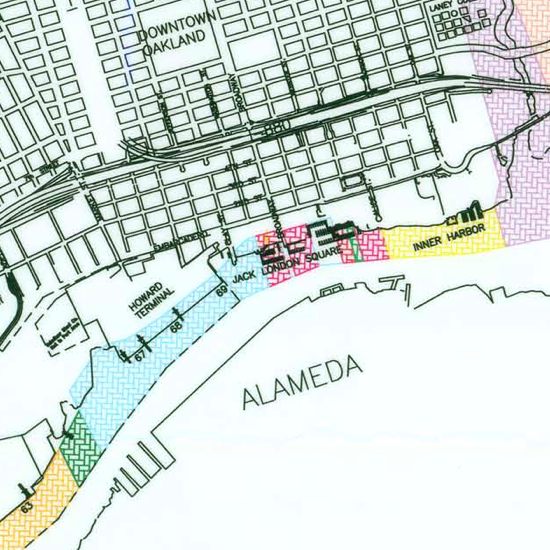
At 50 acres in size, Howard Terminal is a large enough property that plans can be drawn up to move structures around so that they can avoid the BCDC. Ah, but it isn’t quite that simple. Part of Howard Terminal is a pier built over the estuary, so that area is considered tidelands and is in all likelihood within the BCDC’s jurisdiction. Waterfront Action has a map showing where various Tidelands Trust lands lie along the Oakland Estuary.

tidelands_downtown

Map of Tidelands Trust areas where development is highly restricted (note Victory Court’s location in upper right)

If you look at the Howard Terminal section, the Tidelands extend inland past the cranes, as much as 300 feet. Add another 100 feet to cover the BCDC boundary and you have the defined area that escapes the jurisdiction. That means that there could be as much as 400 feet from the water’s edge to the outer wall of the ballpark, the length of home plate to center field at the Coliseum (sorry, no splash hits folks). The BCDC could rule that the shoreline starts at the water’s edge, which would allow the ballpark to be built closer to the water. It will probably take the BCDC and the State Lands Commission to sort all of that out. The recently closed RFP for Howard Terminal explains this further:

Tidelands Trust Compliance

Howard Terminal is currently encumbered by the Tidelands Trust. Uses of the property are therefore generally limited to water oriented commerce, navigation, fisheries, and regional or state-wide recreational uses. Approval from the State Lands Commission would be required for any uses of the property that are not Tidelands Trust compliant. Many non-maritime activities are not considered Trust compliant uses and thus may require lengthy negotiations with the State Lands Commission, and potential legislation, before the Port could proceed with such non-Trust uses for the property.

Howard Terminal ballpark on west end of property

Whatever the final ruling is, filling in that empty area would be open space, which partly explains the presence of the cranes. The crane supports currently at Howard Terminal are nearly 120 feet deep from front to back. A promenade and open space fills that area, which is a good idea (you basically can’t get anything big developed in coastal California without providing open space these days).

Entirety of Howard Terminal with Downtown Oakland in background

A side effect of this placement is that the ballpark would actually be closer to the West Oakland BART station than the 12th Street Downtown Oakland station by a few hundred feet (4,800 vs. 5,100). In either case it’s a pretty lengthy distance and would be best bridged by shuttles.

Despite the placement of the ballpark in hopes of avoiding the BCDC, work done on the waterfront parts of the site would fall under the commission’s sway, even the conversion to open space. That’s because there is a land use covenant in place that is also highly restrictive, preventing all manner of structures from being built there without significant cleanup plans.

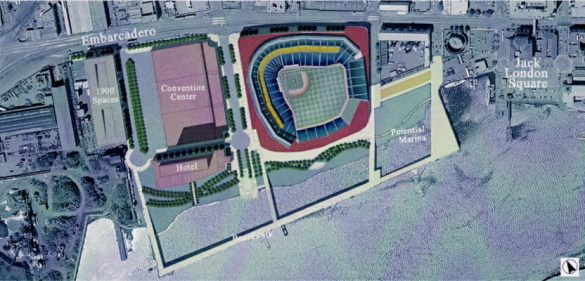
Now let’s look at one more picture. It’s an old one from the 2001 HOK study – the one that had Howard Terminal finishing among the worst with $177.5 million in needed infrastructure and other costs.

hok-2001-ht

2001 HOK study rendering of A’s ballpark at Howard Terminal

Note the differences between this image and the newer ones. In the newer renderings the ballpark is on the western half. In the older vision the ballpark’s on the eastern half. There’s also a convention center, hotel, and 1,900-space parking garage here. Mayor Quan referred to Howard Terminal as being zoned for a convention center, but was that an actual result of this study or similar efforts? I’ve seen no record to indicate this happened. In addition the 2001 HOK plan shows the original shoreline as reclaimed, but with a promenade extending out as connected piers, presumably to acknowledge the site’s 100 years as an operating port facility.

With these renderings, there are a few questions to carry forward.

  • It’s not at all clear how much control the BCDC has over the site. Where is the true BCDC jurisdictional boundary?
  • Given the site’s use as a port, how much say will the State Lands Commission have in lieu of the BCDC?
  • How much do the land use covenant’s restrictions affect the cost to build here?
  • Will a full cleanup be required, or can Oakland get away with limited cleanup if only certain uses are realized?

I’m sure there will be more questions to come. Those can be answered with a feasibility study and an environmental impact report.

Quan touts regulatory-sidestepping Howard Terminal vision

UPDATE 12/16 12:00 AM – Matier and Ross finally have their column on Howard Terminal. The retention of the shipping cranes is a nice touch, even though they would be largely ornamental. Judging from the rendering, the right field fence would be 150-200 feet from the waterfront.

Howard Terminal ballpark on west end of property

What’s missing? Any explanation about how the City/Port could get around the BCDC and CEQA.

—–

Original post:

There are some days when you feel your work is validated. This is one of those days.

Oakland Mayor Jean Quan appeared at Save Oakland Sports’ year-end event last night, talking up a plan that, according to East Bay Citizen, “allows it to skip some regulatory hurdles.” Quan repeated something we heard from the summer, that Howard Terminal was zoned for a convention center. The only citations I can find from the City’s archives mention a possibility of a convention center from the 50’s, well before CEQA and modern land use initiatives. Currently Howard Terminal is zoned for industrial and maritime uses. While a zoning change is normally a simple City Council resolution item, the fact is that the Port itself identified numerous obstacles to making that change, namely the issue of maintaining maritime use at the site.

To that end, the Port of Oakland received three proposals for ongoing Port use at Howard Terminal. Two involve local concerns: Phil Tagami’s plan to use the site temporarily for either bulk or break bulk cargo, and Schnitzer Steel’s expansion plan, which is not explicitly a maritime use. The third plan comes from Kentucky coal mining company Bowie Resources Partners, in partnership with Dutch oil shipper Trafigura. Bowie’s an interesting proposition, as they export a great deal of their coal from the Port of Stockton. According to this press release, Bowie was in talks with the Port of Richmond to create a secondary shipping facility. Howard Terminal could work in a similar manner, though the precautions associated with shipping coal are enough to give one pause. Nevertheless the Port has to consider these options, since they need to figure out a way to offset the $10 million per year the Port will lose by idling Howard Terminal. A decision on how Howard Terminal will operate in the future is expected in the spring.

Ballpark proponents seem to be willing to play the long game here, with site readiness not coming for perhaps several years. Any continued use of the site for shipping purposes would potentially delay that readiness, unless a plan was put into place that allowed a ballpark to be built on a shut-down part of the site. At 50 acres in total size, there should be ways to make this happen. Developing the entire 50 acres would be another story.

Quan said that the to-be-released plan would be able to sidestep various environmental requirements, including some from the BCDC. However, that contradicts the Port’s own language from its Howard Terminal RFP:

11. Land Use and Permitting

In addition to any environmental regulatory oversight resulting from contamination, the Site is subject to the Tidelands Trust, consistent with the grants affecting the property with oversight from the California State Lands Commission. The San Francisco Bay Area Seaport Plan of the San Francisco Bay Conservation and Development Commission (“BCDC”) designates the Site for Port Priority Use. The Site is located within the City of Oakland, and is designated as General Industrial/Transportation Uses in the City of Oakland General Plan. Any proposed change of use or any proposed construction, maintenance or new development at the Site will be subject to environmental review pursuant to the California Environmental Quality Act (“CEQA”).

The BCDC’s role has become more well known, as the fate of the Warriors’ Piers 30/32 arena plan is in the BCDC’s hands. However, note that the loudest clamoring over environmental impacts is not coming from the BCDC itself. Instead the noise is coming from opponents of the arena, who are using rules set by the BCDC and CEQA to invite greater scrutiny over the arena. While Howard Terminal lacks the picturesque quality of SF’s Embarcadero, it is still subject to BCDC regulations and should invite scrutiny on its own. The southeast corner of Howard Terminal is built on piers over water, just like Piers 30/32. Exactly what measures the City could use to get around CEQA and the BCDC are a complete mystery. I, for one, am looking forward to hearing it out.

The City had another waterfront site at one time in Victory Court. It was sold as a transit-friendly, partly publicly-owned, easy-to-acquire site that should cost less than $22 million to acquire. In keeping with that estimate, Oakland and East Bay business interests were willing to pledge up to $100 million to acquire and prep the site. At the time Mayor Quan touted Victory Court more vociferously than she is Howard Terminal now. Exploding costs ($240 million final site cost estimate) and the demise of redevelopment (downplayed as a factor as it was happening) effectively mothballed Victory Court, with no real public statement made by the City about what happened.

Whether you want to read this site as objective, slanted, or both, it’s important to get tough questions raised. That’s why I feel good about what Quan said yesterday. It’s proof that we’re doing our job well, that we’re asking the right questions, questions that need legitimate answers. Without this blog asking the tough questions, who will? East Bay media appears to be fine playing cheerleader. The City has been working behind the scenes to get site control, while not getting an EIR or even a feasibility study for Howard Terminal going.

So in the spirit of disclosure, let’s see the plan, Madam Mayor. Given her track record, the real situation is not expected to be as rosy as she often paints it. Matier and Ross supposedly got an exclusive on the plan, so we may see some real information as early as tomorrow.

Judge Whyte allows antitrust claims to go to 9th Circuit, state claims to proceed

UPDATE 1:30 PM – Thurm’s report from today is now up. As is Mintz’s report.

I’ve been following the Twitter timelines of both Fangraphs’ Wendy Thurm and the Merc’s Howard Mintz as they covered today’s case management conference. From the looks of things, MLB didn’t exactly get what they wanted.

MLB’s strategy had been to call for a delay in the San Jose-v.-MLB case until the land option issue in the Stand for San Jose case was decided. They also wanted Whyte to grant a summary judgment against San Jose. Instead, Judge Ronald Whyte allowed for the state claims to proceed in state court, while the federal antitrust claims, which were previously denied by Whyte, can now go to the Ninth Circuit Court of Appeals. San Jose lead attorney Joe Cotchett indicated that the appeals court filing could happen ASAP.

Assuming that San Jose’s refiling occurs shortly, it’ll be a few months before MLB makes its own filing in response. If anyone was hoping for a swift resolution, it’s not happening anytime soon. Links and more coming soon.

I wasn’t there, but an courthouse observer told me that on the way out, Cotchett kept talking up the Supreme Court loudly for everyone to hear.

Montreal’s cost to lure back MLB: $1+ Billion

A feasibility study gauging the prospects of bringing baseball back to Montreal has been released, and while the numbers are a touch sobering, proponents continue to have hope that the Expos (or some other team) will be reborn. Led by former Expo player Warren Cromartie, the study indicates that the total cost would be over $1 billion to buy a team and build a ballpark. The study was written by Ernst & Young.

Why $1 billion? It’s assumed that some group will have to either buy an existing team (leading candidate: Rays) or pay an expansion franchise fee. Nevermind that franchise valuations continue to escalate, making a $525 million cost seem already outdated. Seven years ago Ted Lerner paid $450 million to take the Expos/Nats off MLB’s hands. A 36,000-seat, open air ballpark built in a similar model to Target Field would cost approximately $500 million, and would be two-thirds publicly funded. Montreal Homerun Project (the proponents) have followed the Target Field/Twins plan closely, calling it the “MLB Hybrid model” to act as a label for a public/private partnership.

montreal-hybrid_model

The complications of going with a public/private partnership model

At the end of the presentation, Cromartie makes a plea for a deep-pocketed champion to make Montreal baseball a reality again. At least one columnist thinks that champion could be telecom giant Bell Canada. The reasoning is that Bell, whose TSN recently lost NHL national TV rights to rival Rogers Sportsnet, could make a baseball investment to bolster its carriage portfolio. Rogers already owns the Blue Jays and the former SkyDome.

While the study is fairly thorough, I think it severely lowballs cost estimates, which have exploded the last several years. There are some other estimate oddities:

  • 47% of ticket sales would come from corporate sources. Considering this blog’s coverage of a corporate support-poor franchise like the A’s, the number seems rather high.
  • Attendance would be between 27,000 and 32,000 per game, and could drop to 22,000 as the honeymoon factor wears off. In the Expos’ last 21 years at Olympic Stadium, they averaged over 22,000 only twice.
  • The Montreal franchise would receive nominal revenue sharing, even though it’s supposed to be one of the top 15 markets.
  • Proponents claim that stadium debt would be paid off in only eight years.

The last claim seems awfully rosy, and ventures into extremely dangerously territory. Plenty of stadia have paid off their debt loads long before they were expected to, but that usually involves outside revenue sources such as hotel and car rental taxes. In this case, revenues would come directly from the ballpark.

I applaud Montreal for getting moving on this, and they could be well positioned down the road for a future team. But it would require a current owner selling at below market or moving away from his preferred market. With A’s ownership focused on staying in the Bay Area and Rays ownership locked into a lease at the Trop, there would seem to be no immediate path to a team for the Montreal group. At least they’re getting prepared. All they need is a sugar daddy.

The false horse race narrative

Mark Purdy has a new column. It’s designed to get San Jose supporters to buck up, keep a stiff upper lip, hang in there, what have you. It has a bunch of quotes from the likes of San Jose Councilman Sam Liccardo and A’s managing partner Lew Wolff that trash Oakland. It’s a counterpoint to Marcus Thompson’s column from over the weekend that was meant to breathe life into the Keep-the-A’s-In-Oakland movement. Purdy laid odds, a generally weak tool to use for complicated situations like this:

Odds of the 2020 Athletics playing in a new Oakland ballpark: 25-1.

Odds of the 2020 Athletics playing in a new San Jose ballpark: 10-1.

Odds of the 2020 Athletics playing at AT&T Park: 50-1.

Odds of the 2020 Athletics playing in another part of the country: 80-1.

Odds of the 2020 Athletics still playing at decaying O.co Coliseum, with everybody still arguing about where they should move: 2-1.

Perhaps Steven Tavares from the East Bay Citizen spent too much time at Oakland’s City Council session tonight (the A’s lease extension was approved, BTW), but something in Purdy’s column flipped Tavares’s wig, leading to a litany of entertaining, rant-filled tweets. Among them:


You see, here is the problem. You have one guy laying odds, and another characterizing one party as in the lead. The brutal truth is that this type of narrative is completely useless. It’s bullshit. If you scratch the surface even a little bit, any oversimplified telling like this crumbles to dust. And there’s a simple reason for this.

There is no race.

We know what a horse race looks like. The showcasing of the Expos when MLB bought the team out from Jeff Loria is proof of that. Las Vegas and Portland were used in the process, and DC was taken. We’re not seeing that here. That’s not to say that MLB and either Commissioner Selig or his replacement will end up choosing between Oakland and San Jose at some point. They well could. The problem is that MLB doesn’t like either city’s plan, so it’s not going to choose either city. You can’t have a race when the judge thinks the two competitors don’t qualify. MLB would rather intervene only when it has to, say, when the A’s lease extension talks hit a snag. Then it can breath a sigh of relief, stretch it out a couple more years, and hope that a solution materializes.

Guess what? Oakland and San Jose pols are hoping for the same thing! Oakland is hoping that Wolff gives up and MLB kills off San Jose, so that they’re the only horse left. San Jose hopes that Oakland exposes itself as incapable of getting a deal done, forcing MLB to deal with San Jose. (At least San Jose is trying to force the issue with the lawsuit, but that’s a long shot at best.) None of these rather similar hope-based strategies are predicated on getting a site and pulling together financing.

Unless San Jose and Oakland provide something MLB wants ($$$ or an equivalent), MLB doesn’t have to listen to either one. When MLB negotiated the Coliseum extension, it didn’t set a deadline for Oakland to get a deal done. Selig didn’t tell Oakland to get Howard Terminal ready ASAP – hell, he didn’t do that for Victory Court either. If any substantive talks for a new ballpark are going to take place, MLB will have to be at the table brokering everything because of the intense mutual distrust between Oakland and A’s ownership. That’s exactly what happened in Miami (hello again, Loria!), and we know how badly that turned out. Yet do you hear about something like that happening in Oakland? Nope.

Now maybe MLB’s hand will be forced if Oakland decides to go with the Raiders’ preference of demolishing the Coliseum and leaving the A’s with no obvious place to play. Then it could support Wolff and say to Oakland, you made your choice. It could explore Howard Terminal further, though I suspect it has plenty of information on which to base a decision by now. It could go to San Jose, which would mean it would have to untangle the mess made by the Giants – who I hear have spent eight figures on legal work trying to derail the A’s and San Jose so far. As far as the A’s are concerned, MLB probably views them as an unstable Third World country on another continent. It would rather not get involved.

So until MLB actually decides to give a damn, let’s dispense with this horse race narrative. It’s not helpful and it only provides false hope to fans on either side of the divide, or even those who don’t particular care for a city and just want to keep the team in the Bay Area. It’s not fair to fans, and it’s a total distraction.

Cactus League Grid Schedule

Today I booked my flights to/from Phoenix for Spring Training. I’ll be there March 13-16, taking in at least 4 games. For your convenience, I’ve constructed a Cactus League grid, similar to the regular season grid that I construct every fall. The grid is laid out from Northwest to Southeast in the metropolitan area, so you can see which games are close to other games. Games typically start at 1 PM everyday, though some teams schedule 7 PM night games on occasion (noted in bold). The grid is also split into western and eastern sections relative to Downtown Phoenix. Nine teams cover five ballparks in the more spread out west, whereas six teams hold five ballparks in the more compact east.

Cactus League ballpark map

  • Camelback Ranch: White Sox & Dodgers
  • Goodyear: Reds & Indians
  • Cubs Park: Cubs
  • Maryvale: Brewers
  • Peoria: Mariners & Padres
  • Phoenix Muni: A’s
  • Scottsdale: Giants
  • Surprise: Royals & Rangers
  • Tempe Diablo: Angels
  • Salt River Fields @ Talking Stick: Diamondbacks & Rockies

And now the schedule (click image for PDF):

cactus_league_2014

If you plan to be in the Valley of the Sun around the same time I am, let me know and we can plan something. It’s the last hurrah at Muni, so get out there and enjoy  it if you can.

The Proposal

The last public statement Bud Selig made on the A’s-San Jose lawsuit was at the beginning of the World Series, when he held court for the assembled national media. The session included the obligatory question on the A’s situation, which included Selig’s reflection on the lawsuit because Judge Ronald Whyte had recently thrown out many of San Jose’s claims in the case. Here’s what MLB.com’s Paul Hagen wrote then:

A judge, ruling on a lawsuit filed by San Jose against Major League Baseball, recently upheld MLB’s right to determine when and where franchises may relocate, but left open the question of whether the city of San Jose may sue for damages. Selig said, however, that this doesn’t impact the timetable for a resolution.

“I wouldn’t say so. We were very pleased with the decision, obviously. But nothing has changed,” Selig said. “We’re working on details. Look, I know everybody says it’s taking so long. But the more our group has gotten into it, the more complex it is. If people really understood all the complexities, they would understand. But it’s a situation that needs to be dealt with.”

Selig was asked if the complexity was the San Francisco Giants’ claim that they have territorial rights to San Jose.

“The complexities are all the parties,” Selig replied.

A month earlier, Selig went on John Feinstein’s radio show to complain about the A’s and Rays’ stadium problems. At the time Selig referred to the state of the Coliseum.

“It’s a pit,” Selig said. “It reminds me of old County Stadium and Shea Stadium. We need to deal with that. I’ve had a committee working on it for two or three years, and there’s no question we’re going to have to solve that problem.”

But hasn’t the committee been working on it for a long time? What’s the hold-up?

“We have, John, but I’ll tell you it’s far more complex,” Selig said. “Look, you have one team that wants to move and the other team doesn’t want them to move, and it’s a very complicated situation. Before I leave, I’m satisfied we’ll work out something.”

Now let’s pivot to the most recent revelation of a letter “formally” rejecting the A’s proposal to San Jose. MLB didn’t release the letter with the recent court filing, so we’re left to guess as to what the letter truly contained. The filing characterizes the letter as a final decision on the A’s move request. Since the news broke, several reporters have gotten unnamed sources to characterize the letter as a rejection of the proposal as written, but not a rejection of San Jose. Selig’s statements above – made three and four months after the rejected proposal letter – don’t sound like any decision, final or not, has been made.

Since we know nothing about the proposal, we can only speculate on its terms. Some of the discussion on this blog has been about the need for a greater public contribution. That may be the case, but I suspect that MLB wouldn’t focus on stadium deal terms that far afield. There’s always the matter of negotiation with between the team and the city when it comes time to write a DDA. Instead, I’m certain that the issue boils down to the overarching issue at play: territorial rights and compensation.

From the start of the San Jose talk in 2009, the Giants have never publicly stated a price. Lew Wolff has joked that he’d prefer to pay the same amount the Giants paid for Santa Clara County in 1992, which was $0. Since then, Wolff has hinted that he’d be willing to pay compensation based on actual demonstrable losses suffered by the Giants, not a big lump sum payment. Given that the Giants sell out regularly, demonstrable losses could be difficult to prove. If anything, MLB wants a serious compromise between the two sides, and isn’t satisfied with Wolff’s definition of compensation. While Wolff may be loathe to pay anything to the nemesis Giants, ponying up something is probably the only way to get down to San Jose.

At the same time, the proposal has to work within other written (and unwritten) rules MLB has set forth. Consider these additional issues at stake:

  1. How much additional debt does the club have to take on to make the ballpark happen?
  2. If the land encumbrance issues at the Diridon site can’t be resolved, what backup sites are being considered?
  3. Does the proposal involve the A’s staying on revenue sharing for some period of time?
  4. Are the A’s sticking to the small, 32,000-seat concept, or will they move to 36,000 or higher?

While all of these are legitimate concerns, I still think that it all comes down to the compensation issue. In February, Bill Shaikin reported that MLB gave the A’s temporary guidelines in order for Selig and the owners to approve the move. If there were guidelines given to the A’s, then it’s up to Wolff and John Fisher to comply with those guidelines. Otherwise they’re just spinning their wheels. Shaikin wrote then that compensation was not “among the list of matters for the A’s to resolve.” Sure, as long as the A’s are in compliance. If they proposed a different form of compensation or different terms, suddenly that issue is front and center.

If MLB convinces Judge Whyte to grant a stay in the discovery phase of the lawsuit, we probably won’t find out the substance of that letter or proposal. That would be, to put it mildly, unfortunate.