Forbes ranks A’s 28th in team valuations at $468 million

For me, when the Forbes MLB valuations are published every March, it’s like Christmas nine months early. Forbes goes to the trouble of sleuthing around baseball even as team financials are meant to be heavily safeguarded. It provides this blog and others with that last bit of off-the-field news just before the season starts in earnest. Thanks to Mike Ozanian and Kurt Badenhausen for putting the 2013 edition and previous editions together (full list).
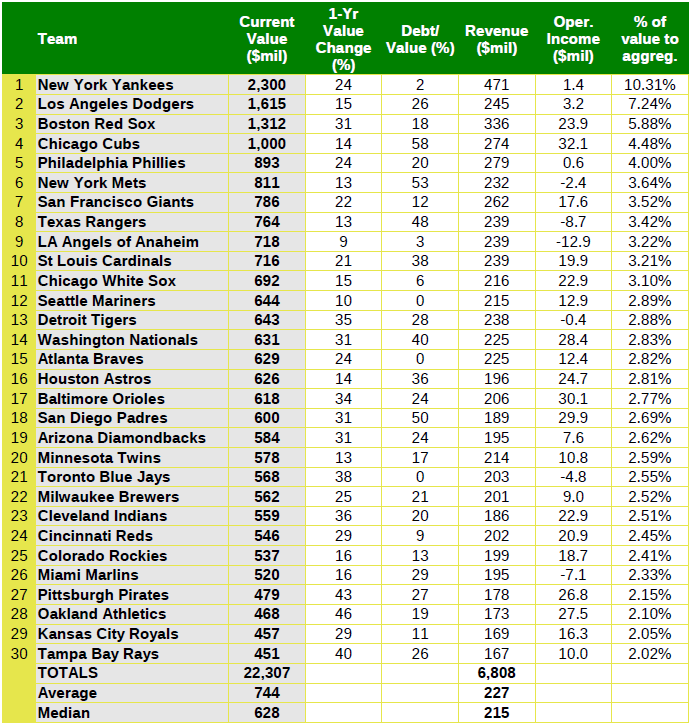
2013_valuations

2013 Forbes franchise valuations with some additional extrapolation

As expected, the combination of the Dodgers ($2.1 billion) and Padres ($600 million) sales plus new TV contracts on the horizon pushed franchise values up. Way up. No team has a valuation lower than $450 million. Credit also goes to MLB Advanced Media, whose expanding product line includes MLB.tv, the At Bat apps for phones and tablets, and Tickets.com. Forbes estimates that if it were public, MLB AM could be worth $6 billion on its own. Slow, deliberate baseball is not the kind of enterprise one thinks of when looking for examples of startup culture, yet the success of MLB AM is undeniable and felt in every owner’s pocketbook every year.

These new valuations result in an aggregate $3.5 billion rise over last year. The A’s, who were last in 2012 with a $321 million valuation, are now 28th with a $468 million valuation. That’s a whopping 45.8% gain, all without negotiating any lucrative new media deals or the benefit of new ballpark revenues. $468 million is reflective of the new national TV deals that MLB will receive starting with the 2014 season. Even with the increase, the A’s are $160 million below the media franchise value and $276 million below the average valuation. For reference, the big market Giants got a $143 million boost and moved from 9th to 7th place. As we observed last year, the bubble is real. Thanks to baseball’s solid, diverse revenues, the bubble is also not going to burst anytime soon.

Debt that the A’s are carrying appears to be unchanged at around $90 million. This is no surprise because haven’t signed any big contracts since Yoenis Cespedes. By staying put, the debt-to-value ratio has gone down from 28% to 19%. That’s important because if Lew Wolff is going to build a new stadium in the next several years, it’s best to keep debt relatively low and operating income high so that they can borrow big for a ballpark. The downside of that conservative approach is that much of the A’s young talent could be out the door sooner rather than later, as we’ve seen frequently over the years.

Forbes also explained a little of their methodology this go-around.

Our team valuations are enterprise values (equity plus debt) and are calculated using multiples of revenue. Thus while teams value MLBAM and BELP on their balance sheets on a “cost basis,” which understates their true value, we incorporate market value estimates for those assets. Two more significant ways our accounting differs from the P&L statements of many teams: we include revenue teams keep from concerts, soccer games and other events at their ballparks; and we deduct from revenue stadium debt payments that are paid with stadium revenue. In short, our team values are meant to reflect what a buyer would be willing to pay in an arms-length transaction and our operating income measures are meant to indicate how much cash is generated.

Basically, Forbes is making the distinction that their numbers are reflective of how each team is run as a business, as opposed to P&Ls reported to baseball which may be products of arrangements designed to hide or minimize secondary revenue sources and expenses. While commissioner Bud Selig and the owners will downplay or write off Forbes’ figures, we can feel a little more confident in their soundness based on what they’ve dug up and the new industry information that has come in over the last two years.

Wait, what’s that BELP thing? BELP stands for Baseball Endowment Limited Partners, a sort of internal baseball hedge fund. It was started when the owners collected the franchise fee for the Washington Nationals into another partnership called Baseball Expos Limited Partners. The owners and Selig decided to reinvest that $500 million instead of distributing it to each ownership group. The strategy has literally paid dividends for the owners, because once money from BELP I was rolled over into BELP II, baseball started getting major profits from the fund. BELP was first exposed a few years ago when Deadspin received leaked financials from several teams, but the kinds of investments BELP chose to venture into were kept under wraps. In the past, I’ve put BELP in the category of “Other” when accounting for Central Revenue. I’ll probably break it out going forward, though that will be based entirely on estimates since BELP isn’t public.

The main article ends with a few notes on the A’s, which is somewhat unusual. It’s pointed out that the A’s got another fat revenue sharing check of over $30 million, and an attendance boost coinciding with the team’s division crown. Local revenues continue to lag, so revenue sharing and central revenues are (more than) keeping the team afloat. That’s a double-edged sword, as it gives critics of Wolff and John Fisher ammo to say the team is again being “cheap” with regards to how it runs the team. Now that payroll is taking up less than 40% of revenues, it’s worth asking if the team is saving money – perhaps for a ballpark. If the marginal cost per win in terms of talent is difficult to justify (see: $11 million/year for Kyle Lohse), filling the piggy bank for a ballpark wouldn’t be a bad way to go.

Of course, there’s another side to the revenue-payroll debate. With all of the money that’s coming in, Wolff, Fisher, and the other partners would have to be absolutely nuts to sell the team. They’ll only get more money next year, which they can invest in one of their cornerstone players. The windfall also makes it even more difficult for interested East Bay parties such as Don Knauss to get the team. Last year, as the Dodgers and Padres sales happened, I predicted that the A’s value would hit at least $500 million. They haven’t that number yet, but they’re almost guaranteed to hit it in 2014. So again, that puts the cost to keep the A’s in Oakland at $1 billion: $500 million for the team + $500 million for the ballpark. Good luck with that.

Sacramento City Council approves arena term sheet 7-2

Mercifully, the dozens of public speakers at tonight’s Sacramento City Council meeting were done by 9. That left an hour for the City Council to discuss last Saturday’s term sheet on its merits. The evening culminated with an expected 7-2 vote to approve the term sheet, which the City and the ownership bidding group will present to the NBA in New York next Wednesday, April 3.

The two dissenters were Council Members Kevin McCarty (District 6) and Darrell Fong (District 7). McCarty was concerned about the lack of detail about the economic impact of the plan, and wanted to see a real report to that effect. Fong was harsher, asking for the same and also questioning some of the revenue backfill assumptions. Both wanted to see a deal more along the lines of what Seattle was offering, which is a roughly 40% public share. The Sacramento deal rates at 58% public, though if the $70 million in outstanding loans being repaid can be counted as a private contribution, it’s closer to a 50/50 split. Fong also cited San Diego as an example where as part of the deal, Padres owner John Moores was committed to developing much of the surrounding area in the Gaslamp Quarter. The whales have promised to make some further investments downtown and in Natomas if the construction moratorium is lifted. It’s up to the City to hold ownership to that promise.

The vote was almost upstaged by news from Monday that Qualcomm CEO Paul Jacobs is joining the ownership group, making him the fourth “whale”. I figure that Qualcomm will get first dibs on a naming rights deal, which makes some sense if the Chargers eventually move into a newer stadium in San Diego or some other market. New head whale Vivek Ranadive brought Jacobs in. So if you’re tracking it, the white knights coming to save Sacramento come from Silicon Valley, LA, San Diego, and the East Bay (which Mayor Kevin Johnson was quick to point out). When including the local minority shares, practically every part of the state is “represented” within the group.

Sacramento City Treasurer Russ Fehr came out strongly in support of the deal terms, repeatedly saying that backfill revenue estimates were conservative and weren’t based on radical changes such as huge parking rate increases. While some parts of the plan such as the 5% ticket surcharge can be achieved comfortably, there was still a very vague explanation on the parking revenue passthrough that should net $3 million. CM Fong also pointed out that no one had consulted the county on the possessory income tax part of the backfill, only saying that the projected $898,000 comes from an estimate tied to last year’s Railyards proposal. Detailed financial terms will undergo much greater scrutiny when the time comes, and the term sheet is nonbinding (as opposed to Seattle’s binding proposal), so things can and will change just as they did for the 49ers stadium project in Santa Clara.

Opponents to the term sheet were all grouped to speak first and were severely outnumbered by supporters, most of whom wore white “Crown Downtown” T-shirts. They all raised their arms in the air, which – no, was not some Nazi deal – was the group mimicking KJ when he got the phone call that the deal was done.

Arena supporters rise in unison to celebrate the vote and Mayor KJ

Arena supporters rise in unison to celebrate the vote and Mayor KJ

What’s next? The Seattle and Sacramento groups will make presentations a week from today, followed by the NBA’s Board of Governors meetings two weeks later. All along, I’ve said that NBA commissioner David Stern played this to perfection. He may have even played it too well, getting two cities to pony up at least $200 million for arenas in states where only a few years ago, this was considered impossible. Now the other team owners have the tough task of determining which bid is the most sound and beneficial to the league as a whole. That won’t be easy.

The more I look at this, the more I think that the real wildcard in this debate is something that isn’t even being discussed: local TV deals. Seattle’s a larger market, but a NBA team will be the fifth pro franchise in the area which could limit TV money. Seattle’s predominant RSN is ROOT Sports Northwest, run by DirecTV/Liberty Media. Sacramento is technically a mid-market (#20) based on size, but historically has lagged in terms of local TV revenue from Comcast SportsNet California. It wouldn’t surprise me if both bidders had already established talks with their respective RSNs to figure out how much more revenue they can get. If Seattle can get $10-20 million more per year or Sacramento can keep it competitive, that might be the deciding factor. All these histrionics, and it could come down to a factor that isn’t much in their control. Sounds about right.

—–

P.S. Readers who are following my articles about the Kings here or my tweets covering the news may think I’m needlessly slagging the Sacramento plan. I suppose it comes from a relative place of security. The A’s are not in danger of moving out of the Bay Area anytime soon, and if Bud Selig intended to create the kind of bidding war situation now on display in Seattle and Sacramento, he’s failed miserably so far. I’d like to see more cities hold fast to the idea of minimal public contributions and let more teams pay for the majority of new stadia. It seems like with the Kings arena and the 49ers stadium we’re regressing from earlier progress with AT&T Park and Staples Center. I certainly don’t want to see Sacramento lose the Kings, but I also think they should be able to secure the best deal possible, whatever that is. There have been plenty of privately funded arenas built over the last several years (Staples, Nationwide Arena in Columbus), yet time and time again it’s the leagues that have the leverage.

HP out in San Jose, SAP in?

All Things D’s Arik Hesseldahl reports today that Valley tech giant HP is in talks to end its naming rights deal at the San Jose Arena. The current deal runs through 2017, with HP pushing to end it as early as this summer. CEO Meg Whitman, who previously helmed another San Jose tech firm, eBay, is apparently reevaluating HP’s marketing efforts, and that means curtains for sports naming rights. It’s too bad that HP is pulling out, though given the company’s struggles the past few years, some restructuring is certainly in order.

hp_pavilion-ncaatourney

HP Pavilion main entry during last weekend’s NCAA tournament

HP didn’t originally negotiate the current naming rights deal. It was inherited when HP merged with then-rival Compaq of Houston. At the time Compaq already had naming rights to the old Summit arena in Houston, which created the need to distinguish the two venues by locale. Shortly after the merger, the arena took on the seemingly synergistic HP Pavilion name (“Pavilion” is a longstanding name of HP’s consumer desktop PC line), though it’s unclear whether the name association actually helped sales.

SAP may be stepping into the void created by HP’s departure. The enterprise software company already has had its name on the annual ATP tennis tournament held annually at the arena (which is moving to Rio de Janeiro starting next year), and SAP chairman Hasso Plattner just finished acquiring up to 90% of the San Jose Sharks. Plattner may have carte blanche to make the deal as he pleases, but shareholders may be wary of a move considering that SAP lost nearly $4 billion last year. SAP may push for a lower cost naming rights deal since they could be considered San Jose’s “preferred partner”.

I imagine that if the naming rights deal transfers from HP to SAP, the arena will simply be called SAP Arena or SAP Arena at San Jose. Of course, the arena already has its own nicknames, “The Tank” and “Shark Tank”, that locals and hockey fans will continue to use until the arena is eventually replaced.

—–

P.S. One of SAP’s biggest competitors is Oracle, who has naming rights at the Arena in Oakland. A copyright trial between the two companies is ongoing, as a judge considered a $1.3 billion damages award to victorious Oracle excessive. I doubt that this will make Larry Ellison more or less likely to extend the Oracle Arena naming rights deal – especially if the Warriors leave for San Francisco – but it’ll probably chap Ellison’s hide to know that every time he flies one of his private jets into SJC, he’ll see the SAP logo on the large arena rooftop below. It wasn’t that long ago that rumors had Ellison bringing a NBA franchise such as the Kings or Grizzlies to San Jose. There’s absolutely no chance of an Ellison-helmed NBA team coming to San Jose as long as SAP wields the power at the arena.

P.P.S. – Given Ray Ratto’s repeated butchering of the name “San Jose” to “San Azzay”, I suppose that for Ratto SAP could mean “San Azzay Pavilion”.

Earthquakes release seating bowl comparison

As the San Jose Earthquakes continue their drive towards a new stadium for the 2014 MLS season, team President David Kaval has been keen to release little bits of information every so often to tease fans about what they’ll soon be getting. Last fall, a brochure was distributed that showed suite options. Suites subsequently sold out. Now it’s cutaway drawings of the unique (for MLS) seating bowl, which also show some architectural elements that should get Quakes fans talking.

Buck Shaw Stadium, the current home of the Quakes, is small, quaint, and old. The intimate setting there creates a nice home field advantage, but it isn’t the best venue in terms of sight lines and comfort. The pitch of the bleachers is not particularly steep, making it hard to see the action over the heads in front of you.

To remedy that problem, and to create a stadium that didn’t look like other MLS venues, the still-unnamed Earthquakes Stadium will have a single seating deck with a 30° angle. To put that in perspective, that’s slightly steeper than the original upper deck at the Coliseum (~28.5°). With a vertical clearance of around 19 inches from one row to the next, seeing the entire field all the way to the touch lines shouldn’t be a problem. The suites and club seats are located at field level, and the bowl sits above them in a horseshoe shape. The steep seating arrangement will make the bowl rise rapidly, so much that it’ll look bigger than it really is. The comparison document emphasizes how close the first row is to the action, though it should be made clear that what they’re referring to is the first row of the suites or club seats along the sidelines. The supporters sections behind the southern goal should also benefit from being very close to the field.

02-quakes_kcsporting

The Earthquakes’ seating bowl arrangement creates a much smaller footprint stadium, which should be more intimate and less expensive to build.

Other MLS stadia frequently have a 21° pitch, which translates to a 12-inch rise per 33-inch row. That’s steeper than the Coliseum’s very gradually pitched lower deck (11°), and slightly less angled than the plaza level.

01-quakes_homedepot

Truss system supporting the seating deck also includes a beam that carries the load for the roof, which should result in a less expensive cantilever.

In the cutaway comparisons, it’s easy to see how much smaller the footprint of the stadium will be compared to others throughout the league. Cleverly, the architects at 360 put together a truss system that supports the seating bowl and the roof. They accomplish this by taking an angled beam and extending it through the top row up to the center of the roof. The roof itself covers the entire bowl, which the Quakes say should help contain noise. There is a gap between the top of the bowl and the roof, but I expect that to be filled in by a press box and perhaps additional suites at some point. I haven’t run the numbers to determine the distances yet, but I figure that sitting in the top row at midfield will be similar to the experience of sitting in row 12 of section 217 at the Coliseum for a Raiders game – still a very good seat. Sure, Buck Shaw’s worst seat is technically closer. Buck Shaw is also barely half the size of the new stadium.

Finally, the truss system also creates a façade that juts out over fans as they enter the stadium. The cover image of the document shows a corner of the stadium, not covered by vinyl signs or cladding. Instead, the treatment used is a series of metal ribs that run horizontally. This is a brise soleil, a façade built to provide sun protection while allowing indirect sunlight in. A similar element was built to control sunlight coming into the San Jose City Hall rotunda, which has a large glass dome. Chances are that something – maybe signs – will go up there to give the stadium more color and a distinct image. Even if it doesn’t, the façade is better than chain link or overdone glass curtainwall. It’s unlikely that many of the elements in use for the Earthquakes Stadium would make it to an A’s ballpark, simply because the viewing angles are less demanding for baseball than for soccer. That’s just as well, because it’ll be good to have a unique look for a stadium that no one else has besides the Quakes.

Comparing the 2012 and 2013 Sacramento arena deals

It took an extra couple of days, but the City of Sacramento finally released its arena term sheet. The document was supposed to be made available late Thursday, in order to give the public and the City Counsel the customary three business days to review it. The Saturday evening release gives 72 hours of lead time in advance of Tuesday’s City Council meeting, which will have the term sheet on the agenda.

I’ve taken some time to review the document, live tweeting observations as I went. Field of Schemes’ Neil de Mause also made notes on Twitter, going straight into the financial aspects of the plan. In the term sheet is a comparison of the deal to the 2012 deal negotiated by the City, Maloofs, AEG, and NBA, the same deal that the Maloofs backed away from weeks later.

comparison

Comparison of 2012 and 2013 arena plans

A big immediate takeaway is that the price has gone up $56.5 million, which City Manager John Shirey attributes to inflating materials costs. A 14% increase? Probably not. Instead, either the 2012 estimate was not sound and prone to cost creep, or the Ranadive-Mastrov-Burkle (RMB) group pushed for better finishes or features in the arena. It could be a little of both. The amount of the public contribution is the same, though the public percentage of the project is smaller due to an increased private share. AEG is not onboard this time around (yet), so the private share is listed solely as a Kings ownership responsibility.

Just like the last plan, the bulk of the public share ($212 million) will come from the sale of parking revenues. The difference in this plan is that the City is not selling the revenue rights to a private parking operator. Instead, the City is going to the trouble of creating a nonprofit, quasi-governmental corporation to control the revenues and distributions. The corporation will contract out with private companies to manage the lots and garages. The reason for this change is simple: it allows the City to refinance debt for existing garages ($50+ million) by continuing to use tax-exempt bonds. Under the previously negotiated arrangement, the City risked losing tax-exempt status on the bonds. The corporation would control parking revenue on all downtown lots except for Downtown Plaza, the arena site. Those revenues would stay with the Kings.

Despite the added complexity in the parking revenue arrangement, projections are fairly similar. The City receives $9 million annually from its downtown lots, which is being pledged towards the arena. The task is to find sources to adequately backfill that $9 million. The City projects $1 million in profit from arena operations, $3 million in new parking revenues, and a possessory interest tax payment of nearly $900,000 every year. Due to the lack of granularity, I’m naturally skeptical of these figures, as they seem like placeholders for a much more thorough accounting later. For now, the incremental $3 million is highly suspect, as the expected increased revenues from arena events are different line item altogether. If revenues fell short, the City could use hotel taxes to complete the backfill. The term sheet is nonbinding, as the deal is subject to CEQA and other approvals. Sacramento’s City Council will have to come back at a later date and approve the whole deal including the financing and the DDA, just as Santa Clara did for the 49ers.

2012’s aborted deal had the Kings locked in for 30 years. 2013’s plan has the team in place for 35 years to start, plus two 5-year options. Capacity and estimates for premium accommodations were carried over from 2012. RMB will handle cost overruns, plus ongoing maintenance and capital costs via a $1/ticket fee. Another carryover is the noncompete clause at Sleep Train Pavilion once the downtown arena opens. In conjunction with that, the City is selling 100 acres of land near STP for future development purposes.

One item lightly addressed was the fate of the $75 million the Kings still owe per the 1997 purchase/leaseback of the STP land in Natomas. The City indicated its willingness to refinance those bonds in order to get the arena deal done, but exactly how that would occur is left completely wide open. Mastrov and Burkle appeared to have erred when submitting their bid by factoring in that debt. The NBA didn’t factor it in and asked the bid to be raised to reflect a value without a discount.

Assuming the City Council approves the deal on Tuesday, this term sheet will be part of the submission to the NBA in 10 days.

Is this a good deal? I’m inclined to say no for taxpayers, yes for the NBA and the Kings. For Sacramento, it’s an enormous price to pay to keep the Kings in town, though it isn’t as bad as fully funding an arena with taxpayer money as is frequently done outside California. RMB generated a good deal of PR by pledging up to 1.5 million square feet of ancillary development at Downtown Plaza. Unlike the arena’s projected completion date of September 2016, no date was given for any ancillary development completion. Clearly that will only be done with regard to market conditions, which in downtown Sacramento have been spotty.

If we’ve learned anything from past attempts to use arenas as part of a grand urban renewal scheme, results are mixed at best and many of the successes come in established cities with properly targeted transition areas (United Center in Chicago, Staples Center in LA, Verizon Center in DC). Most of the time, arenas and ballparks bring visitors from within the region on event days only instead of creating the oft-desired 7-days-a-week metropolises many cities aspire to become. Cleveland, Phoenix, and yes, San Jose are prime examples of this phenomenon. If you live in Sacramento and you support this plan, don’t lose sight of what this is really about: basketball. Over the last month I’ve seen social media campaigns about the arena being bigger than basketball. That’s nice from a campaigning standpoint, but it’s not reflective of what’s really at stake. Even if the Kings leave, someone will buy and operate Sleep Train Pavilion, bringing in concerts to help pay for it. Sleep Train Amphitheater will continue to operate during the summer. Concerts will be held in the area because the region’s large enough to demand them. Basketball, on the other hand, won’t come back if the Kings leave. Is basketball worth the $258 million public cost? It’s funny, the people who desperately want the Kings to stay are sometimes will to pay any price to make it happen. Those opposed to an arena couldn’t care less and think pro sports are close to worthless. It can be hard to establish a middle ground between those extremes.

San Jose files motion to disqualify in S4SJ lawsuit

Update 3/23 1:30 AM – Pillbury made its own motion in response. They’re aiming to “augment the administrative record; memo of p’s and a’s” (points and authorities), so they’re providing their defense of their behavior in the case. I’ll try to get a copy of the motion ASAP.

—–

There’s a fairly new term being used in baseball talk on the internet these days: TOOTBLAN. It’s short for Thrown Out On The Bases Like A Nincompoop. It’s very popular on Twitter, and its lineage dates back to some misadventures on the basepaths by Ryan Theriot, who naturally was on the Cubs when the term was coined. When it comes to baserunning, Theriot is the polar opposite of Coco Crisp, whose recent profile by Grantland’s Jonah Keri elevated Coco to ninja-like levels between the bags. Still, Theriot has two World Series rings in the past two years, so who’s the nincompoop now? Well, it’ll forever be Theriot. Sorry dude.

The City of San Jose committed its own TOOTBLAN in the Stand for San Jose lawsuit. During the suit’s discovery period, the City inadvertently released several documents that clearly should have been protected by attorney-client privilege. When City attorneys found out, they asked S4SJ’s attorneys at Pillsbury to return the documents. Instead, Pillsbury held onto the privileged docs and sought to augment their own case with the documents. That forced the City to file a temporary restraining order against Pillsbury, which was granted by a judge in January 2012. Suspecting that Pillsbury lawyers would use the information anyway, last week (3/11) the City filed its own motion to disqualify counsel (read the PDF for the blow-by-blow), saying that Pillsbury’s conduct during discovery should force them off the case. From the motion:

By this motion, respondents and real party in interest seek disqualification of Pillsbury Winthrop Shaw Pittman LLP (“Pillsbury”) from further involvement in this case. Pillsbury attorneys closely examined and attempted to use nine privileged documents inadvertently produced by the City of San Jose. Pillsbury was ethically obligated not to review these documents any more than necessary to determine they were privileged and to immediately notify the City of its possession of the documents. In derogation of these obligations, Pillsbury not only reviewed the privileged documents in their entirety and failed to notify the City that it possessed them, it refused to return the documents after the City discovered the inadvertent production and requested that the documents be returned. Instead, Pillsbury affirmatively sought to incorporate the documents into the administrative record in this case and use the information in them to support petitioners’ claims, threating a motion to augment the record if they were not included. The City was forced to bring a TRO and preliminary injunction proceeding, which resulted in an order requiring Pillsbury to return the privileged documents and all copies. The documents contained highly confidential attorney/client communications and attorney work product bearing directly on the issues in this case. Pillsbury’s possession of this information prejudices the defense of this case, and there is no effective remedy short of disqualification.

I consulted with some folks who have a better grasp of the legal issues here. Apparently the motion to disqualify counsel is not something that is successfully granted often, and any such claims have to pass a fairly stringent test to force such an action. At the same time, the inadvertent release of privileged or confidential information during discovery isn’t all that uncommon, given the reams and boxes of documents that have to be made available for a trial. Still, this is an embarrassing moment for the City and it seems like they want to be rewarded for making a pretty big mistake.

The documents in question include marked up versions of the EIR, analyses and comments from the City Attorney’s office, and to my surprise, a draft of a Disposition and Development Agreement – effectively the lease terms for the ballpark and/or land. Frankly, I want to see this information and the public should have the right to see it. For now, records requests may have to be filed to gain access, and that may not happen until after a trial ends. Regardless, it’ll be interesting to see how Judge Hubner rules on this next month. Just like last fall’s motion to compel, this is a long shot at best, but Pillsbury’s conduct could result in sanctions if not disqualification. If Pillsbury were thrown off the case, S4SJ would be forced to bring in new counsel and prepare a new case, creating considerable delay. Plus the new legal team wouldn’t be the Giants’ own firm. Considering how the Giants may have pressured the Controller’s office to take actions against San Jose in the ballpark land rollback, just about anything’s fair game at this point. The hearing will be at Santa Clara County Superior Court on April 12, 9 AM. I expect to be there for the proceedings.

—–

Note: I spent a couple of fruitless hours at the Superior Court trying to get a copy of the motion, because it hadn’t been properly filed yet. I strolled a few blocks over to City Hall and went to the City Attorney’s office to request a copy. I received it via e-mail within an hour of the request.

Sacramento reels in another whale from Silicon Valley

The City of Sacramento was supposed to release its arena term sheet today. Hourly delays turned into postponement as City Manager John Shirey explained that the document was still being hammered out. Release has been rescheduled to Friday, and now we have a good reason for the delay: Warriors minority partner/VP and tech industry veteran Vivek Ranadive is now onboard as part of the Mastrov-Burkle group. The news is even bigger than that, since Ranadive will take over Mastrov’s role as leader of the group. If the Ranadive-Mastrov-Burkle group is approved by the NBA, Ranadive would take the CEO role and be a Governor at league meetings and votes.

My immediate reaction to the Ranadive news was that it’s good that the Sacramento group has more financial ballast to take on the Seattle bid. Ranadive is not a billionaire, but his status as a current minority owner and a guy who is in with David Stern and Wizards owner Ted Leonsis can be nothing but good for the bid. On the other hand, this is a major piece of 11th hour upheaval that fundamentally changes how the bid works. Ranadive bargained hard to become the controlling partner, and it’s likely that when Stern visited the W’s two weeks ago, the commish pushed Mastrov to relinquish that stake. That’s a huge role to give up if that’s been your goal for several years, if not longer. Maybe in the end it’ll help Stern streamline ownership approval if Seattle is denied. Regardless, it looks like some serious desperation on Sacramento’s part.

Ranadive’s emergence as potentially the first Indian-born owner of an American major pro sports franchise would be a major win for the NBA. It was Ranadive who introduced the W’s Bollywood night themed games, and I’d expect some serious South Asian outreach the same way the NBA has aggressively courted China and East Asia. Moreover, Ranadive continues a trend of the NBA bringing in tech-based owners. Consider the current list of owners with tech backgrounds:

  • Paul Allen, Microsoft (Blazers, purchased in 1988) 
  • Mark Cuban, Broadcast.com/Yahoo (Mavericks, 2000)
  • Dan Gilbert, Quicken/Quicken Loans (Cavaliers, 2005)
  • Ted Leonsis, AOL (Wizards, 2010)
  • Joe Lacob, Kleiner Perkins (Warriors, 2010)
  • Robert Pera, Ubiquiti (Grizzlies, 2012)

That’s more than the other three leagues combined and signifies what the NBA thinks of the nouveau riche tech world: they like it. The NFL and MLB have the least turnover, with plenty of multi-generational old money mixes with real estate tycoons and media companies. Now we’re seeing a proliferation of hedge funds and tech money infiltrating the ranks. Oil money has made major inroads into the Premier League. The economy has changed thanks to the internet and globalization. It’s good to see team ownership reflect that. For the most part, the days of the singular owner are over. The money’s bigger, as is the risk, so it makes more sense to team up to build an ownership group that can provide both the fun and the returns investors are looking for.

State rolls back San Jose ballpark land transfer

Update 7:30 PM – Added link to Controller’s report.

Yesterday we got word that the 49ers and Santa Clara prevailed in its lawsuit to reclaim $40 million in redevelopment funds. Today comes the news that the State of California has ruled that land transfers from the City of San Jose to the Diridon Development Authority were ruled illegal.

The Controller’s ruling on the ballpark land seems to hinge entirely on the fact that the City/RDA didn’t enter into a sale agreement with A’s ownership until November 2011, after the June 28, 2011 cutoff when AB 1X 26 took effect.

The RDA made unallowable asset transfers of $29,137,727 to the San Jose Diridon Development Authority (Authority), a joint powers authority made up of the City and the RDA. All of the property transfers occurred during the period of January 1, 2011, through January 31, 2012 and the assets were not contractually committed to a third party prior to June 28, 2011.

The graf above comes from the 12-page report released today, a draft of which was sent to the City on November 15, 2012 to allow for a response. The City argued that “there is no statutory or legal support” for the 6/28/11 cutoff to no avail. The Controller disregarded this argument and directed the land be turned over to County-appointed Successor Agency, whose oversight board will make the final determination of what to do with the land. City has cutely shortened “Successor Agency” to SARA and for good reason. What does SARA stand for?

Successor Agency to the Redevelopment Agency of the City of San Jose

If the Diridon Development Authority is the “son” of revelopment, SARA is the daughter. What does SARA make of this mess?

Ordering the City to return the assets to the Successor Agency only to have the Oversight Board direct that they be returned to the City is simply form over substance and wastes valuable time, energy and resources to arrive at the same result.

Regardless of what happened with the Controller’s decision (which was expected) the City still feels that the land will end up with the A’s. If they had inked the sale agreement in March 2011 instead of November, the transfers would’ve been in the clear. Now they could sue the State the same way the 49ers did, but since that would be even more costly and the City and County are already working on a proper land disposition agreement, that seems like a terrible idea.

What will happen next? My guess is that the land won’t actually be sold. Instead, the parties will work on a lease agreement that would allow the A’s to build on the public portion of the ballpark site while the A’s buy the rest over time. The alternative is to sell the land for “market value”, with a yield large enough to be approved by the Controller. The purpose of this is two-fold: get a sale so that funds can be sent to the state, and ensure that the land is assessed at a value high enough to get adequate proceeds to the state, county, and schools. Mayor Chuck Reed, who is on the SARA oversight board, released a statement in response to the ruling just a few minutes ago.

I am disappointed in the findings made by the State Controller regarding certain properties transferred from the San Jose Redevelopment Agency to the City of San Jose, San Jose Diridon Development Authority, and City Housing Agency.

The properties transferred to the City include assets that serve a civic or government function, and likely will fall under the government use provisions of the new redevelopment dissolution law and my expectation is that the Oversight Board will make the same findings.

With respect to the Diridon Development Authority properties, the State Controller failed to recognize an Option Agreement validly entered into between the JPA and the Athletics Investment Group. Any transfer of these properties to the Successor Agency would be subject to the contractual rights of the Athletics Investment Group as required under state law.

The City Council and County Supervisors have both made their desire to have a ballpark built on the site known through formal resolutions in the past. My expectation is that we will continue to work together to bring the Athletics to San Jose regardless of the ultimate ownership of the JPA properties.

Coincidentally, an oversight board meeting is scheduled for tomorrow morning at City Hall. While this news came too late to make the meeting agenda, I would expect the matter to be discussed. I’ll attend and report back.

Judge rules State’s seizure of 49ers stadium funds improper, freezes funds anyway

A strange and very tentative ruling came down from the Sacramento County Superior Court regarding the $40 million in redevelopment funds earmarked for the 49ers stadium. Judge Allen Sumner ruled that the contract signed by the City, former Redevelopment Agency, and 49ers is legal for a simple reason: the 49ers are a third party. The State’s argument and the law passed in 2011 was such that agreements between a municipality and its redevelopment agency were not so-called enforceable obligations, where tax increment revenue was pledged to pay for a project or debt. Since the 49ers are a party to the agreement, the contract is, in fact, an enforceable obligation. Moreover, the judge wrote that the 49ers aren’t a mere third party beneficiary, they are also a direct party to the agreement since they loaned the money upfront in the first place as RDA funds were on shaky ground during that period.

Despite the judge’s ruling, $15 million in currently frozen funds will not be freed up for the 49ers or schools per last fall’s deal. Instead, Judge Sumner chose to let Santa Clara’s Successor Agency (son of RDA) figure out the repayment schedules (ROPS) for the 49ers and the schools. Until that is determined, the money will remain frozen. This is clearly a victory for the 49ers and for other private parties who have made deals with cities in the run-up to the death of redevelopment. In making this ruling, the judge was clear in that the court had no business redefining what an “enforceable obligation” was.

Reading this ruling’s impact beyond the scope of the 49ers stadium, it won’t necessarily help San Jose or the A’s since they completed their land deal for part of the Diridon site in October 2011, well after the law took effect. Then again, Santa Clara and the 49ers didn’t have their DDA finalized until December 2011. I guess we’ll have to wait for a court to rule on the A’s land deal, whenever that happens.

Santa Clara sells the farm to win Super Bowl

As the cities of Santa Clara (+ San Francisco) and Miami get closer to the NFL’s May awarding of Super Bowl L to an official host city and stadium, one city is struggling to get its ducks in a row whereas the other is taking care of its final bid details. Miami’s bid is flailing as funding for a major upgrade to Dolphins Stadium remains in limbo. Meanwhile, Santa Clara’s City Council is prepared to approve a series of concessions to the NFL that should sew up the game for the South Bay, while creating a risk that Santa Clara will run in the red in the process.

To help pay off the 49ers stadium, the Stadium Authority has several revenue streams tied to taxes and fees employed for every Niner home game and other events. The NFL requested that such fees be waived for the Super Bowl, and apparently the City is more than happy to comply. Fees being waived include the following:

  • 10% NFL Ticket Surcharge – At a conservative set price of $500 per SB L ticket, the $50 surcharge would yield $3.75 million with an expanded capacity of 75,000.
  • $0.35 Ticket fee – Meant to fund some senior and youth programs. A cap of $250,000 per year is imposed on this revenue source. If the 49ers play at least one home game, it’s likely that the 49ers would hit the cap, rendering additional collection of this fee moot.
  • Hotel tax – A Mello Roos district was created to provide some stadium funding, backed by a hike in the transit occupancy tax from 9.5% to 11.5% in the stadium’s immediate area. The NFL asked for its share (350 rooms for an unspecified number of days) to be waived. Assuming that the NFL needs 350 rooms for the full two weeks, the City would forego some $70,000+ in hotel taxes. The City notes that it expects to make up this loss via taxes collected on additional room bookings.
  • Off Site Parking fee – The City has imposed a $4.54 fee per space for event parking. That too will be waived. This appears to be for all Super Bowl activities, not just the game itself. The City notes that the fee is meant to offset the cost of traffic management.

The non profit San Francisco Super Bowl Committee is supposed to reimburse the City for the cost of services rendered by the City (and other jurisdictions). The committee is not going to backfill the City’s lost revenues. Strangely, no estimates of this impact were disclosed, even as the City touts $300 million in additional economic activity for the region. Much of that major economic impact will be felt in San Francisco, where the majority of non-game events will be held. The key will be the layout of the Super Bowl hub surrounding the stadium. If attractions such as the NFL Experience are staged at Moscone Center instead of the Santa Clara Convention Center, real economic impact for Santa Clara will be limited outside of Super Bowl Sunday.

A year ago I wrote about what it would take to host a Super Bowl in the Bay Area, and despite Santa Clara “taking one for the team”, there is a burgeoning sense of excitement about the possibility of hosting the big game. It’s just too bad that the City Council, knowing it had at least a little leverage with the knowledge that Miami is struggling so much, hasn’t considered driving a harder bargain with the NFL. Maybe next time – if there is a next time.