There used to be a Bay Bridge Series featuring the two Bay Area MLB franchises, the Giants and A’s. It served as a ceremonial bridge between Spring Training and the long regular season. That’s gone, probably for good. It was replaced this year by some warmup games in Sacramento featuring the Giants and their AAA affiliate, the Sacramento River Cats. The A’s played out their Cactus League string in Arizona before starting the regular season on the road in Seattle.
Meanwhile in Oakland, the Coliseum hosted the Roots’ home opener against fellow USL Championship side San Antonio. The match brought in 26,000 fans who filled both the field and plaza levels. Next week’s game will have a much smaller crowd based on what sections are being sold. At least the sports-starved in the East Bay got a taste. And while there’s no longer a Bay Bridge Series, the San Jose Giants will host the Oakland Ballers in “Battle of the Bay 2.0” at Excite/SJ Muni on April 2nd. So there’s that.
Going back to Sacramento, the main question going into this season concerns the ability of Sutter Health Park’s grass field to withstand the nearly daily pounding of baseballs and baseball cleats.
The previous field was ripped out after the final River Cats game last season, replaced by a very high-tech solution called AirPAT from The Motz Group. AirPAT uses a combination of irrigation and aeration to the grass surface and roots to make for ideal outdoor maintenance conditions. The high-tech part comes from the use of various sensors and drones to monitor surface temperatures, hydration, and drainage. Coincidentally, a spring storm is blowing through California right now just to give the new field its first real test. The forecast calls for the rain to end shortly before first pitch, so we’ll get to see both the field and the grounds crew tested. Motz has a blog post explaining how their system works, though it’s curious that much of the expertise involves artificial turf fields – experience that maps better to Vegas or the original plan to replace grass at Sutter Health Park with a turf system. Motz isn’t bereft of grass experience, as they constructed the field at the Braves’ Truist Park.
Also I know many were curious about the field itself. “The installation of AirPAT technology will optimize root zone oxygenation, improve moisture management, and regulate subsurface temperatures – ensuring a healthier, more resilient playing surface year-round.” pic.twitter.com/3iJldu80J1
In any case, the first half of the 2025 is somewhat frontloaded with A’s games, 51 out of the scheduled 81. They won’t come back to West Sac until July 28, a full two weeks between home games. The River Cats will have nine games during that span, so they’ll get to break in a potentially resodded field just like they broke in the new field last weekend. If there are rainouts, they’re more likely to occur during this first opening series with Cubs than at any other time. That makes August and the first two weeks of September the crucial period for the grass to survive. The second half schedule has nine mutual off days to schedule makeup games if needed, though that may be more necessary for games on the East Coast. Should AirPAT work as advertised, the grass along the river will stay lush and green while much of the surrounding area turns brown.
Truth be told, I’ve been putting off writing this post for weeks. Something always came up. First I was going to comment on Sutter Health Park reverting to grass instead of a turf field in 2025. Next I was going to talk about the Athletics stripping any city designation from their team name during these three or four interim years. The election removed Sheng Thao as Oakland mayor, followed by at least two interim mayors. The A’s dipped into the free agent market to snag Luis Severino to fill a rotation spot*. Then we were hit by the sudden death of Rickey Henderson (RIP GOAT), which made the social media rounds for a nearly 24 hours before an official acknowledgment, apparently at his family’s behest, and finally the announced departure of A’s team president Dave Kaval, who spent most of the last eight-plus years navigating political corridors, eventually arriving on the Vegas Strip. After the Kaval news struck I realized that everyone would be best served with a year-end recap that could also serve as a coda to the Oakland Athletics era.
The Oakland A’s were effectively the middle child among the three major pro sports teams that called Oakland home (the Seals and Invaders were too short-lived to count). As the middle child they experienced many highs and lows and were proportionally ignored within and outside the Bay Area. They were the second team to come to the Coliseum complex and stadium. They were overlooked when it came time to upgrade the facilities, screwed as East Bay leaders desperately brought back the Raiders at the A’s expense. The A’s were also the subject of mostly half-hearted and ultimately failed attempts to keep the team within city limits. So the fact that they ended up staying the longest of all three teams is less a testament to A’s ownership’s resolve than a lack of options. If not for the Giants, the A’s would already be in San Jose. Or perhaps Fremont or somewhere else in Alameda County. Or even Oakland if the parties involved were reasonable about the process. What got lost is a simple practical reality of major pro sports: Cities play for 25-30 years, not forever, and they have to renew and rebuild to keep their teams.
Alas, 2024 is not the year of reason in California. Neither was 2023, 2022, or 2021. With Oakland not agreeable to the A’s terms in mid-2021, the A’s looked to Vegas and announced they were on parallel paths. For whatever reason, neither Thao nor her predecessor, Libby Schaaf, looked at parallel paths as a competitive situation, which set Oakland on its own path to oblivion. You could say that Oakland chose to compete by going along with John Fisher’s grandiose plans for two sites, the Coliseum and Howard Terminal. That worked for a short period when everything seemed to be economically healthy in the Bay Area. After the pandemic hit the money well went dry and Oakland was left with an incomplete process and little to show for their efforts.
Contrast that with what happened recently in St. Petersburg. As recently as spring 2023, St. Pete was considered an also-ran, with the Rays running out the clock on their lease at Tropicana Field. After looking across the bay in Tampa for several years, the Rays and St. Pete started working on a ballpark deal at the Trop site in September 2023. Progress came in fits and starts thanks to uncertainty about the site’s prospects and the Rays’ willingness to build there. Yet St. Pete stayed in the game, got their ducks in a row at the City, County and State levels, and got something done despite an actual hurricane that destroyed the Trop’s roof, leaving the Rays homeless. The eventual face of the effort was Pinellas County Commissioner Chris Latvala, who spent eight years as a State House member before terming out and running for the County post. Latvala brought a perspective that is entirely foreign to the A’s efforts in that he’s a Republican who made his name as a fiscal conservative. He’s also a big Rays fan as evidenced by last week’s interview with Locked on Rays. Latvala was against the Rays ballpark and redevelopment plan at first, then came around when he saw that the future of the Rays in Tampa Bay was at stake. In choosing to support the ballpark, he cited Rob Manfred’s support, which may very well prove a terrible mistake. At least now the onus is on the Rays to follow through on their end. Stu Sternberg has to come up with the money, like John Fisher pledged to do in Vegas. Oakland never got to the step of putting the ball in Fisher’s court. They equivocated, hemmed and hawed, and repeatedly sounded out of their depth when trying to deal with baseball. As the last two Oakland mayors have been women you may think that’s a sort of misogynist, old-boy take on things. It’s more about knowing ball and understanding what the ball club, which is a major constituent, needs to be successful. Without a proper grasp of that, any proposal is likely to turn into a big grab bag of initiatives that is fragile enough to fall apart like a house of cards. Latvala and others in St. Pete even pointed to the Vegas deal as an example of something more fleshed out that should be done in St. Pete, a completely alien sentiment for Oakland. Towards the end of the Oakland era, pols and fans were left to pull stunts to try to get Manfred’s attention. They knew what would it would really take.
In hindsight, it was probably best for all involved that Oakland and the A’s didn’t come to a deal. Because given the state of affairs now, how exactly would they come up with their hundreds of millions of dollars for infrastructure or other promises like community benefits? A bunch of the money meant for the Port has already been assigned to other projects and was never fully pledged towards the Howard Terminal project. Oakland’s current fiscal dire straits is going to involve some painful cost-cutting, which would undoubtedly come at the expense of a not-quite-finalized ballpark project – that’s how clawbacks work. And that would cause the A’s to look for a reason to escape Oakland for good, not that they weren’t already looking.
Times like this I’m reminded of one of my favorite bands of the last twenty years, The Civil Wars. A country duo that started out as a Nashville songwriting partnership, The Civil Wars went on to make two incredibly passionate, perfectly written and produced albums before breaking up (and breaking many fans’ hearts along with it). They were good enough to co-write a song with Taylor Swift to be included on the Hunger Games soundtrack. Whatever the reasons for their breakup, the situation seems as likely for a reunion as the A’s coming back to Oakland. In 2012, when the video below was recorded, everything still felt hopeful for Oakland, The Civil Wars, the world. Worlds can fall apart fast though. At the very least some fans got a year to appreciate the A’s before they were gone.
Note the date of the recording: October 1, 2012, the Monday before Game 162 of the A’s 2012 season
What’s next for Oakland? Hopefully the Ballers will keep playing at Raimondi Park for some time to come. The Ballers didn’t get the happy ending they wanted when the other team that was brought in to prop the Ballers up, the Yolo High Wheelers, won the 2024 Pioneer League championship, then folded their tents to move to a hopefully more permanent home in Marysville. That wasn’t in the script! The Roots are finishing their soccer transformation of the Oakland Coliseum, their sights still set on an interim park next door at the Malibu site, a new interest in Howard Terminal now that the A’s won’t be there, or most likely, a protracted stay at the Coliseum when the other two options prove infeasible or too costly. It’s better than having to crash couches like they’ve been doing for a few years. In Neil Young parlance, is Oakland burning out of fading away? We won’t know the answer for some time. Until then, I hope Oakland can get its act together. There’s nowhere to go but up.
—
* – The Severino contract was obviously done to pull up the A’s payroll to a minimum amount based on their increased revenue sharing receipt. That’s the system right now, and if you’re looking for a floor/cap system to make things more fair, nothing’s going to keep Steve Cohen or the Yankees/Dodgers from running circles around any A’s payroll, whether in Vegas, Oakland, or Timbuktu. Baseball still pays proportionally less to its players than the other sports that have caps and floors, so they are fine through the current CBA’s expiration in 2026. And now they are deferring the crap out of huge money deals to the point that they’re creating Bobby Bonillas left and right. All on Manfred’s watch nonetheless.
In the wake of Hurricane Milton I watched the news feeds closely to see what would happen to Tropicana Field. The fabric dome (an early form of PTFE) had a usable life expectancy of 25 years. The Trop was already 34 years old at the end of the 2024 MLB season, so it would seem that the facility was on borrowed time. Sadly, but not surprisingly, Mother Nature had its own plans for that roof.
The morning after #HurricaneMilton, one of the questions is, “Where will the Rays play?” Let’s go over the options. [1/x] (video from @Ry_Bass)
[2/x] The simplest, though not cheapest, option is to build a new roof at the Trop and play there. Assuming there are no additional structural problems, this is a likely path since the Trop itself is insured. It’s like getting a crappy insurance payout after your car is totaled.
[3/x] The Rays can’t play at the Trop without a roof. Nothing under the dome was properly weatherproofed for outdoor use. In the baking heat and frequent storms of the future it would rapidly degrade. So roofless is not even a short-term solution.
[4/x] Next options are local. There are plenty of spring training facilities – basically AA/AAA quality – where the Rays could play. Their own in Port Charlotte is small and 2 hours south. The closest/largest is George Steinbrenner Field in Tampa, same size as Sutter Health Park.
[5/x] As these are outdoor facilities they will be subject to weather. Everyone in MLB (players, other teams) will have issues. It’s too unpredictable to hang a schedule on. So it’s probably out except for some April games before heat really kicks in.
[6/x] Miami has a retractable roof stadium where the Marlins’ schedule should run roughly opposite the Rays’. That makes it a contingency plan in case the Rays can’t stay local. It would sacrifice any attempt at attendance. I’ve driven Alligator Alley. Miami/Tampa are not close.
[7/x] That leaves other markets outside of Florida. Nashville & Charlotte have AAA parks and desire expansion teams. Oakland has a MLB park and the A’s – who vacated it – playing 90 miles northeast. San Antonio has an old football dome with a baseball configuration. And Montreal.
[8/F] None of those markets are desirable unless they have new MLB ballparks in them. Stadia are too expensive to build on spec these days. So it’s a Catch-22, ironic since Tropicana Field (aka Florida Suncoast Dome) was built on spec. IMO it all leads back to the Trop. For now.
Another thing to consider is that MLB under Manfred is clearly separating East Coast teams like the Rays from West Coast teams like the A’s. They’re not to move between coasts as that affects divisional scheduling and travel.
—
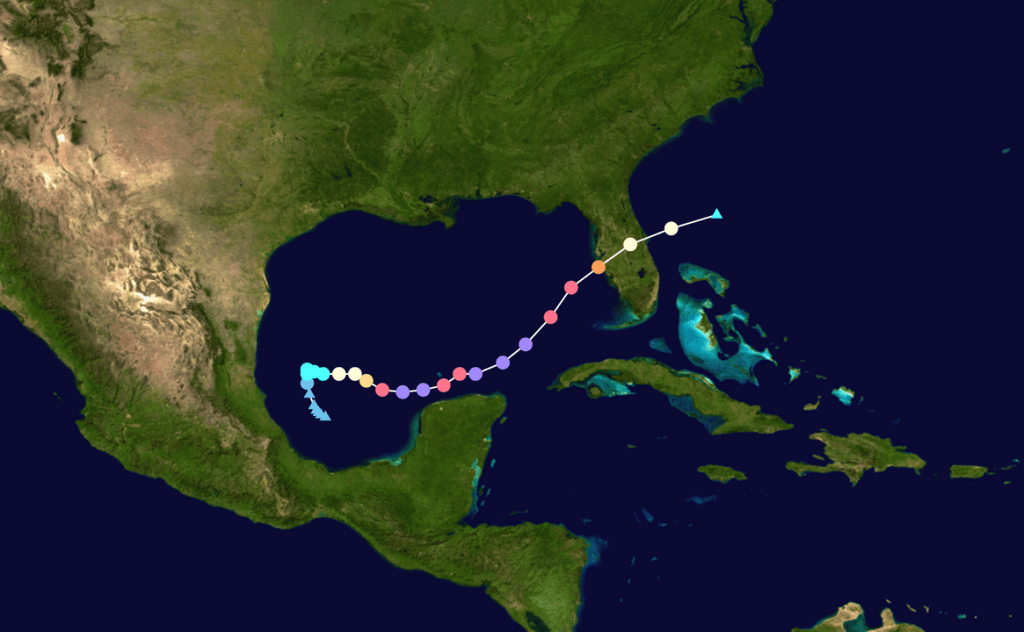
It’s worth briefly discussing how terrifyingly awesome a storm Milton was as it ravaged Florida, not just from the usual torrential rain, wind, and storm surge that comes with a hurricane, but also from a record number of tornadoes that spun up in South Florida and the Atlantic coast well away from the eye of Milton. It started in the Gulf of Mexico off the coast of Veracruz, thanks to the combination of extremely warm Gulf water to fuel the nascent storm and nudges from remnants of another storm from the Pacific. After Helene hit Florida’s Big Bend area and barreled north through southern Appalachia, I was curious about the path the new storm would take.
Milton technically became classified as a hurricane less than a week ago on October 5.
After churning as it made its way northeast, Milton took a slight southerly detour and hit landfall south of Sarasota instead of the Tampa Bay direct hit. Tampa Bay was not spared significant destruction, as shown by the damage done to the Trop’s roof.
In response, the Rays are taking an open approach to dealing with the Trop, saying that a proper damage assessment could take weeks to complete. If the facility was 4 or 14 years old instead of 34, the team would work more urgently to repair the roof and make the place playable again. The Trop is near its practical end-of-life and there is already a plan underway to replace it with a newer dome next door, so you may ask what the point is. Could the Rays and Pinellas County simply roll an insurance settlement into the next project? Presumably, yes. However, I have a feeling the depreciation is going to work against both parties, limiting the payouts to some degree. Still unknown at the moment is the extent of any flood or structural damage, so perhaps patience is in order.
Then again, there is the question of value. On Twitter yesterday I kept pointing to the Metrodome, which had a serious puncture in its inflatable roof that eventually justified a complete replacement two months after the storm damage. Replaced for $18 million, the work was done by August 2011, in time for the next Vikings season. Of course, the Vikings only played at the Hubert Horatio Humphrey Metrodome for two additional seasons as they planned their own dome successor on the same site, US Bank Stadium. The Twins already vacated for Target Field on the other side of downtown Minneapolis, and the University of Minnesota Golden Gophers football team left for the on-campus TCF Bank (now Huntington Bank) Stadium.
That makes the question of refurbishing the Trop largely one of value. This isn’t like the post-Katrina Superdome, which had nine figures of FEMA and state aid poured into it in order to keep the Saints from moving to San Antonio. Tropicana Field should be treated like a short-term case where the facility has a clear expiration date. Will the repairs cost $30 million? $50 million? $100 million? The Rays can’t throw some tarps and FlexSeal over the dome and call it a day. This will be expensive, and yet, clearly not enough.
-=-
P.S. – Al Lang Field, once a Spring Training venue and now the home of the Tampa Bay Rowdies soccer club, is being discussed as a temporary home. Other than it being a really small site, I can’t see anything wrong with it other than the usual weather concerns and the ridiculous “sail-like” roofed concept from over a decade ago. I loved that silly idea, so I will take any opportunity to include it in a post.
Amazingly this Olympic Stadium-lite concept wasn’t even air-conditioned.
Last fall, when the 2024 schedule was released in preliminary form, I immediately circled May 8 on my calendar. As you probably saw on Wednesday, on May 8 the baseball version of an eclipse took place: a natural doubleheader. Not a doubleheader that included a makeup game from a previous rainout, or the dreaded day-night or split doubleheader that requires two separate admissions. No, this was old school single ticket double-dip, the second game coming thirty minutes after the first game ends. For me, it offered a satisfying coda to my time as an Oakland A’s fan. My first A’s game was itself a doubleheader in 1988 in which the A’s dominated the Cleveland Indians. And while the 2024 A’s is not the dominant force the Bash Brothers-era A’s were, they are showing promise after a couple of severe rebuilding seasons.
I left my house in Glendale at 6 AM, bound for a 8 AM flight to SJC. I chose to fly into SJC instead of OAK because I wanted to capture the experience of taking my old route from the South Bay. If BART was running all the way to Santa Clara, that would’ve been the choice. Alas, the downtown San Jose extension is still in turmoil, so I went with the Capitol Corridor train out of the Santa Clara station instead. As usual that experience was quite smooth, including a few lovely moments on the platform with an elderly woman who was traveling to Sacramento. I got off at the Coliseum station and took a few pictures of the old haunt from the Amtrak BART ramp. I also noticed an A’s security person stationed at the top of the ramp as it met the BART bridge. That didn’t strike me as particularly notable, but as I found out later, was something to consider as the season progresses.
Warm weather and a double dip are perfectly good excuses to head out to the yard
A half hour before first pitch, there was a good stream of fans headed to the game. I didn’t expect a very large crowd even with the doubleheader, but it was nice to see some turnout. The announced crowd was 8,320. It was clear that there were plenty of no-shows because of the muted reaction to some of the announced groups that supposedly purchased tickets. On the other hand, there was a 2-for-$20 promotion on the field level which brought a number of casual fans, and there was actually a line for walkups at the BART plaza ticket window.
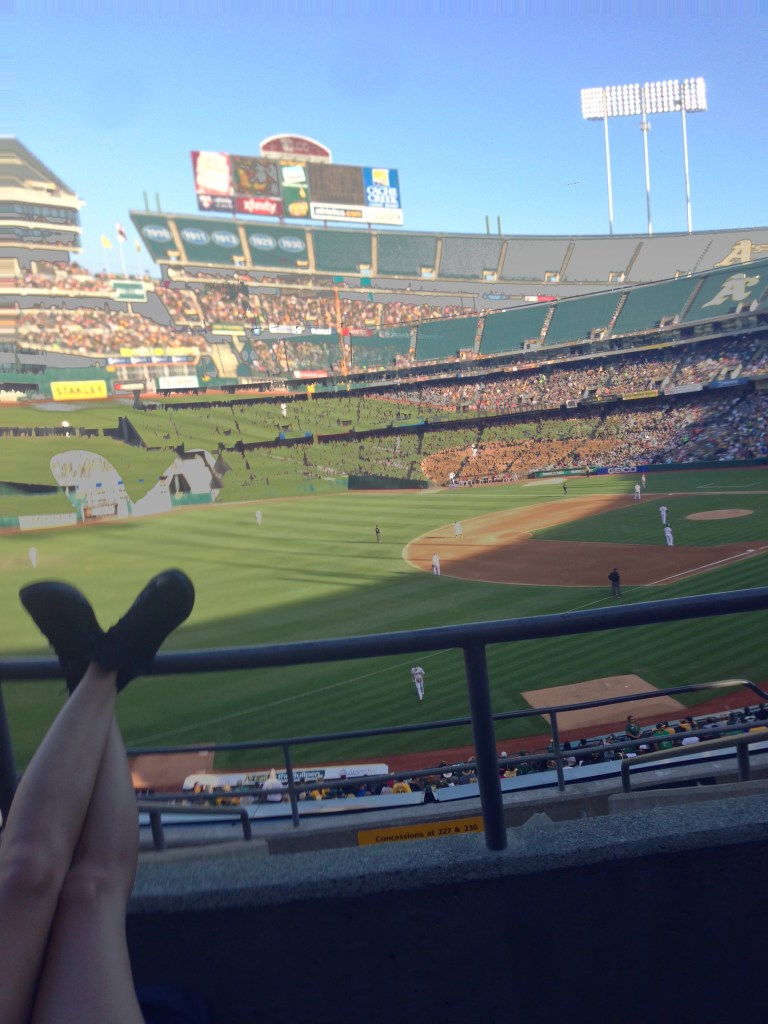
I figured I had plenty of time to get concessions if I was hungry, so I went straight to my seat in 119, next to the Diamond Level section. I was perched above the A’s batting circle, with a great view directly down the first base line. That afforded me a “great” view of Mount Davis, which got me thinking about how the A’s announced a series of giveaways throughout the season, culminating with a replica model of the Coliseum on the final regular season home date ever in Oakland on September 26. Which version of the Coliseum will be given away? The 1966-1995 version with the ice plant in the outfield, or the 1996-present version with the hulking 10,000-seat eyesore? I decided that I wasn’t going to travel all the way to the Bay Area to get the crappiest version of the thing I loved so much. I wasn’t going to proudly place that thing on a mantel or shelf for posterity. While that game will allow for a sort of wake for the club’s time in Oakland, I’ve personally done enough grieving over the years.
Try as you might to minimize it, Mount Davis is immense and unavoidable
To understand my stridence about this, you’ll have to consider my past as a young man covering his childhood love the A’s and the Raiders in the media when the Raiders first came back in 1995. I was working through college, hired by a freelance Bay Area photographer to provide rudimentary copy along with pictures he sold outside the normal wire services. I read enough of the great columnists and the young upstart reporters in the Bay Area papers to provide a reasonable facsimile, so I eagerly took the gig, a wide-eyed 19 year-old sitting in the back row of every press box, but with an assigned seat and a printed name plaque nonetheless (shout out to the greats Al LoCasale and Debbie Gallas, btw). Those first couple of years were a whirlwind, as the Coliseum was in a constant state of upheaval. Were you aware that there were two seating configurations for Raiders games depending on whether the A’s season was still on? During the baseball season, the football field was configured to run from home plate to center field to limit field damage by the temporary football seats. After October, the field was reconfigured to run from foul pole to foul pole in order for the bank of football seats to be installed in the baseball outfield. That was never the most ideal situation for either team, so I was curious what the renovated Coliseum would look like. A month ago, Travis Danner posted a page from the A’s magazine touting the improvements:
Found this bit of 90's ad copy on my 10 year old retired laptop. Is it just me or was Mt. Davis intended to be less tall than it ended up?
In case you can’t read the bullet points, I listed them below
Two large family and corporate picnic areas
Additional rest rooms and specialty food service stands
New BART walkway and entrance plazas
New ticket box office and retail areas
20,000 square foot family entertainment center concourse
Center field corporate club with outfield seating
New outfield seats to replace benches
New computerized matrix scoreboards
Two new high resolution video screens
Improved access to the upper deck
Additional plush Luxury Suites and renovated Suites
Diamond level seats in two areas adjacent to dugouts
New club seating – premier seating in an outdoor setting
20,000 square foot private air-conditioned baseball club with dining areas and two-story bay windows overlooking the field
Six new elevators to all levels
New and enlarged press box and enlarged media elevator
All new armchair seating throughout the entire stadium
Television monitors under overhangs for instant replays
Improved sound system
Premium catering for the Clubs and Luxury Suites
Enlarged clubhouse for A’s players
Refurbished visitor locker room
New media interview room for players
Indoor batting tunnel and pitcher warm-up mounds
Enlarged weight room
Expanded field storage
Club concourse connecting eastern addition with existing stadiums
In hindsight it’s easy to see how the A’s and A’s fans were so thoroughly screwed by these largely football-centric improvements. More seats, more suites, and more clubs in the wrong places, plus no mention of how the baseball experience would be compromised, it was soon to be disastrous for everyone involved from the pols to the teams to the put-upon fans. Back in 1995, that wasn’t so obvious. The retro ballpark craze had just started with only four such ballparks open by the start of the season (Camden Yards, Progressive Field, Coors Field, and New Comiskey if you want to count that). At that point, the retro craze was still a nascent one. It wasn’t until the millennium approached that the trend became a craze.
Back in 1995, I still believed in the utility of the multi-purpose stadium. SkyDome was conceived as a multi-purpose dome (MLB & CFL) and was huge and glitzy. Mostly I was mostly excited that the Coliseum would get an expanded press box. During that early period the auxiliary football press box was set up in one or both of the open Loge areas beyond the original luxury suites in the outfield. There was still overflow press seating for baseball, such as the repurposing of section 317 for visiting writers during the postseason. For the most part, the bigger press box was an enormous improvement – and it wasn’t yet overrun by critters. I saw the image in the A’s magazine and thought that they were fully enclosing the stadium like some of the cookie-cutters (Busch II, Riverfront, Three Rivers). Unfortunately, fans and press were bamboozled. Even when Opening Day 1996 came we didn’t see the full effect of what would become known as Mount Davis, as they hadn’t fully poured all of the concrete for the upper deck. Remember, the A’s had to spend the first week of the season at Cashman Field in Vegas. The video below captures the mix of joy and unease that came with seeing the monstrosity looming over everything else. (Among the other notable things from that video: it was Charlie Finley Day with Monte Moore handling the proceedings, and the otherwise infallible Roy Steele mispronouncing Jeff Reboulet’s name). As Mount Davis fully rose, all A’s fans got were some security guards doing the YMCA dance late in the season.
All of my coverage on this blog and elsewhere has been viewed through the lens of someone who witnessed first hand the short and long-term effects of Mount Davis. I’m aware of how ironic it is that I got my shot through covering the Raiders coming back and that someone else recognized something in me. I’m not now and never have been a Raiders fan, though I had no reason to hate them up to that point. Nearly thirty years later, the Raiders are obviously THE catalyst for killing pro sports in Oakland because the East Bay never properly recovered from the experience, even after the Warriors’ dynasty. I’m often viewed as an enemy of the East Bay, at least on social media. In fact, Steven Tavares wrote an article about it. Criticizing Oakland is not the main focus of this site. Instead it became a chronicle of the litany of missteps and strategic errors made in trying to get a ballpark for the A’s built, by both politicians and ownership. Some were in Oakland, others in San Jose or Fremont, more are destined to come in Las Vegas. In the end, I look at all of these moments as simple matters of timing and execution. Oakland got an AFL franchise because the AFL needed a second West Coast location, and Oakland pitched itself as a good landing spot. Similarly, the A’s came to town because Finley saw more opportunity in the Bay Area than he did in Kansas City. The Warriors were nearly doomed to barnstorming by Franklin Mieuli until the gleaming Oakland Coliseum Arena was built. When East Bay power brokers brought back the Raiders and didn’t tell A’s ownership, baseball noticed but they couldn’t do anything about it. The early 2000’s birthed a renewed effort to give the A’s a proper home. The timing was poor there because there was no support by then-mayor Jerry Brown. Subsequent mayors lacked either the gravitas or the drive to see a ballpark project through, or they were somehow convinced that they could accomplish the same thing at the Coliseum 40 years in even though prevailing trends were pushing teams away from each other. At the same time, post-Haas ownership groups were often focused anywhere but Oakland, to the point that Oakland’s only legitimate shot to retain the came only 6-7 years ago.
Think I’m blowing the Mount Davis effect out of proportion? Take a look at the dwindling number of Coliseum-themed collectibles that are available for sale on eBay or MLB Shop. Posters and photos often set their perspectives to minimize the visual effect of Mount Davis as much as possible. It remains an ugly reminder of how failure can last generations. It’s impossible to deny how East Bay stadium proponents were cowed from making big public investments asks as they squandered all of their political capital on both the Raiders (horrible deal) and the Warriors (a good deal that had a rough ending). That made any and all Oakland efforts focused on the A’s a race against time, a test of MLB’s patience. It’s not that the East Bay suddenly got religion about the folly of publicly-funded stadium projects. The problem was that they knew they couldn’t ask. It’s like trying to fight with one arm tied behind your back.
–
Mason Miller retiring Marcus Semien to end Game 1
After the A’s won the first game (including a surprise Mason Miller six-out, non-save exhibition of dominance), I made my rounds throughout as much of the Coliseum as I could. I traveled both the field and plaza concourses, went up to the View level, visited the Hall of Fame area, the bleachers, everything except the closed upper decks of Mount Davis. And that’s just fine. I used one of the trough urinals. I used a regular urinal behind left field, though I noticed that entire wall of urinals there hadn’t been flushed. Everything seemed darker and dingier than I remember in previous visits. On the bright side, I noticed that outside one of the concession stands there was a dispenser of various sealed cups of dips and sauces. I immediately thought that was a brilliant bit of convenience. Then I realized that if more fans were here those dispensers would be cleaned out by the second inning. It’s just human nature to take free stuff because it’s there. I have no idea what the vibe will be on September 26, the final game at the Coli. I can imagine that a lot of stuff that isn’t properly bolted down will quickly become souvenirs. That’s more than fair in a sense. Taxpayers paid for this, they might as well get something back. After all, the Coliseum’s not going to need all of those seats for an occasional Ballers or Roots/Soul game. The Coliseum is destined to go the way of RFK Stadium, which was finally cleared for demolition only last week. Then again, DC might bring the Commanders back from the wilderness in Landover/Raljon. Is a major team coming to Oakland anytime soon? Maybe, but first Oakland will have to spend some time in the wilderness. Brooklyn eventually got one, so it’s possible.
—
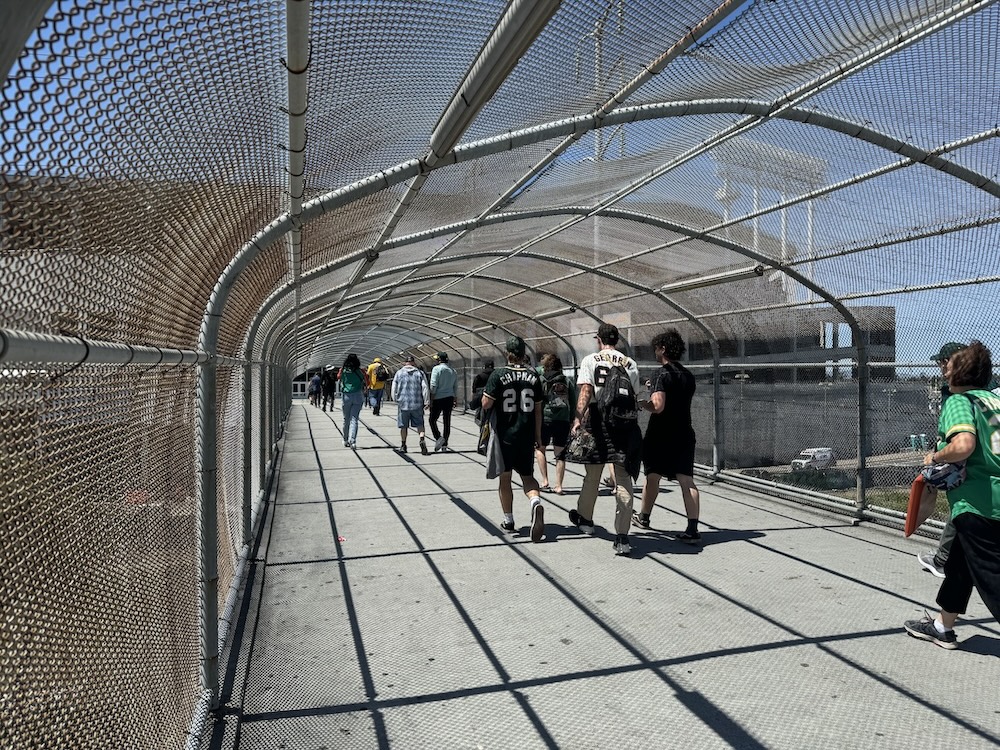
P.S. – On the way back to the BART station I noticed a pile of trash strewn on the BART bridge. In 36 years of going to the Coliseum I’ve never seen that. That brings me back to the A’s security guy I saw at the Amtrak ramp. It used to be there were either A’s staff at the BART station entrance, sometimes with a golf cart to take mobility-impaired fans in either direction. I saw golf carts circling the Coliseum itself as one of the drivers nicely offered me a ride, but none on the bridge. The Coliseum is not the epicenter of the Bay Area’s apparent doom spiral. The way things are going, it can’t help but get caught up in the cycle.
Saw this on the BART bridge as I was about the enter the station for the airport connector. This was for me the most disturbing image of the day because it’s an indicator of the kind of neglect facing the #Coliseum area. #Athleticspic.twitter.com/YdNZMOT8oH
D GateHonestly, how often are you going to a trough urinal in the wild?Bangeliers having a record dayYou can’t steal all of the free sauce when there isn’t anyone around to take itMount Davis, minimized in a poster
Bad public news usually comes out after on Friday afternoon after the markets are closed. Bucking that tradition, this weekend Bay Area media got wind of an upcoming City of Oakland lease extension proposal to the A’s, which will be presented this Tuesday. The City is asking for the following:
$97 million from a 3-5 year lease term from the A’s ($19.4 million/year minimum)
A’s pay for field conversion costs for the Roots and Soul when they play in the Coliseum
Oakland is also asking for the rights to the Athletics franchise name and team colors, as well as a one-year exclusive agreement for Oakland to secure a potential owner for an expansion franchise or the purchase of the A’s.
Let’s take those last items first. With no sign that John Fisher plans to reverse course on the Las Vegas move or sell, any pitch for an A’s sale can only be characterized as the kind of Hail Mary not even Al Davis would have loved. The expansion promise is pointless, as no one actually believes Oakland will be able to put together real deal terms in only a year, including a billionaire willing to subsidize an Oakland team indefinitely while all of the details for the elusive dream ballpark plan come together. Besides that, who would be crazy enough to ink an exclusive negotiating agreement with Oakland, whose track record on such agreements is downright dreadful. ENAs can be a tool as long as they lead to real, measurable progress. Those ENAs are basically paper tigers, little more than talking points that act as a way to kick the can down the road. The City apparently has backed off these requests as an acknowledgment that they don’t have a strong hand in asking for any kind of team with Oakland in as bad of financial shape as it is, and that MLB pumped the brakes on expansion recently as bigger economic issues are resolved.
Asking for $97 million (or $19.4 million/year, non-negotiable) amounts to a 12x annual increase over the current lease. Not only that, the A’s already pay for field maintenance at the Coliseum, so having to foot the bill for the conversions will ultimately be more costly than regular field maintenance, which itself is costly. Conversions currently are a responsibility that the Coliseum Authority previously took on without question for Raiders games and concerts, and were so costly the JPA scheduled them to occur as infrequently as possible, twice during the football season and after a Monster Jam or SuperCross event after the football season ends.
If the A's and the Roots/Soul share the Coliseum in 2025, the soccer field will probably be set up much like the occasional Quakes game there. Via @wikipedia: pic.twitter.com/CUwd5rChgp
By now you’re probably aware that the only reason for the A’s to keep pursuing the Coliseum in any capacity is that their TV deal with NBC Sports California only pays around $70 million per year if the team stays in the Bay Area. When they go the Vegas it’s gone. If they play in Utah the deal breaks. Sacramento is a gray area currently under discussion, because the A’s wouldn’t be entitled to a full payment, maybe half or $35 million.
For their part, Sacramento is ready and willing to be a temporary A’s home for 3+ years while the Strip ballpark is under construction. Mayor Darrell Steinberg threw in his support, and River Cats/Kings/Sutter Health Park owner Vivek Ranadive is eager to lend a helping hand to his friend, John Fisher. Many in NorCal view this as a betrayal of Oakland and a hypocritical move to grease the skids for the A’s out of Oakland permanently. Ranadive, who is from the Bay Area and once held a minority share of the Warriors, now has control over Sacramento’s sports and event space outside of soccer and summer concerts in Wheatland. The combined public-private pitch is not just to the A’s, but also to impress MLB for a future expansion bid. And that, regardless of how this particular short-term agreement works out, is the real play. Because once Vegas has a team, expansion opportunities out west will be limited.
Salt Lake City remains in play thanks to its flexibility (two ballparks) and distance from the NorCal mess. From a ease-of-transition standpoint it’s by far the winner since no existing teams have to be displaced, and the A’s or whomever is helping them won’t have to face angry fans at every turn. The major caveat is that the A’s will have to forgo their NBCSCA TV rights check in exchange for a much smaller streaming and local TV revenue pool from a cobbled-together network of local affiliates. The A’s would presumably upgrade the new South Jordan ballpark to MLB clubhouse and training standards, which they could hand off to the AAA team in a few years. I’ve read that SLC’s biggest problem is a logistical one in that Sundays are effectively off limits since games aren’t played on the Sabbath. Frankly, the Salt Lake Bees have been playing on Sundays for years so I have no idea where that misinformation comes from.
Neither the Sacramento or Salt Lake City hosting gigs will put either city over the top in an expansion franchise bidding war. It would give them a leg up over other candidates in terms of showcasing each respective market’s viability to leagues and to the corporate and ticket-buying clientele they’re trying to impress. Given the scarcity of opportunities like this, it would be foolish not to bid for the A’s if the capital outlay to bring them in isn’t too high. Beyond that, you have to start thinking about the future of MLB: post-RSN, post-Rob Manfred, post-boom. If MLB is going to expand to 32 teams as they should, they will probably do so with an idea towards completing the consolidation they’ve been doing over the past few decades. Think about it. The American and National Leagues used to have their own league presidents, interleague play, umpiring crews, ways of counting attendance, and yes, the designated hitter in the AL. Over time all of those issues which gave the leagues district identities were streamlined away in favor of a more homogeneous baseball product. That leaves a handful of arcane issues to deal with, such as the curfew rules and realignment, which makes sense in a 32-team league which can be arranged in 4 divisions of 8 teams or 8 divisions of 4.
Realignment is where things truly get interesting, at least to me. Most fans don’t want to hear about something as mundane as multibillion-dollar franchises saving a few bucks by realigning to cut travel costs, but it’s a huge motivator. Consider how Fresno once had a AAA franchise, then lost it not because of its fairly new ballpark. Fresno lost AAA because it was too expensive to fly teams in and out of the Fresno-Yosemite airport, relegating the city to a California League (A) franchise where travel is mostly limited to buses within the state. The same fate is headed for MLB teams, which want nothing more than to limit the number of cross-country flights and total seasonal air miles, expenses which are all incurred by the parent MLB clubs regardless of movement elsewhere in their respective organizations. This also explains the culling of minor league teams and wholesale reorganization of the minors during the pandemic. In the long run it may further marginalize baseball in the eyes of the public. For the owners these are merely costs to cut.
2030 MLB realignment along purely geographical lines
With that in mind, take a look at this table of a future realigned MLB with 32 teams. The American and National Leagues are reconstructed along geographical lines like their counterparts in the NBA and NHL. Going from 30 to 32 teams requires the addition of two franchises. Conventional wisdom had Nashville and Las Vegas as the leading expansion bidders, but with Las Vegas getting the A’s, one spot remains out west to go along with Nashville. Or does it? Nate Silver took a stab at this over the weekend, coming up with some odd regional switches thanks to the strict geographical groupings he put together while maintaining the current AL/NL regime.
I took these a step further by ditching the current AL/NL distribution of teams and realigned as an Eastern-based National League and a Western-based American League. While exploring this, I ran into the problem of figuring out how to put 16 teams in the AL (West). It works best if the West includes the Chicago teams, Milwaukee, and St. Louis to keep the Cubs-Cards and Cubs-Brewers rivalries intact. That leaves 14 teams in the much more compact NL (East) plus two expansion teams in Nashville and either Charlotte, Raleigh-Durham, or Montreal. Those teams couldn’t occur before 2030, or at least not before the A’s and Rays stadium situations are determined. One of Rob Manfred’s remaining charges before he retires is to set the table for this long-awaited expansion round. MLB will have to think long and hard before diving into 32 teams, because there is no easy expansion or contraction once they reach that point. As the NFL found out, 32 is logistically the perfect number of teams to maintain rivalries, invigorate interest in wild card playoff runs via expanded playoff pools, and mitigate travel costs (except for Seattle, they’re always going to be screwed).
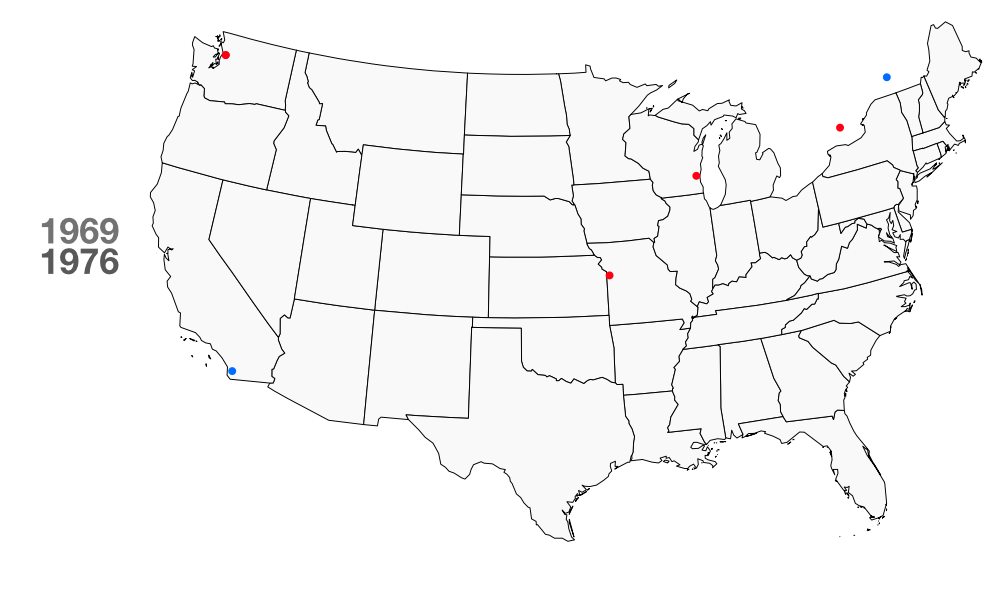
It’s possible that that the 32nd team could be a massive contest between the aforementioned Eastern cities and Western cities like Sacramento, Salt Lake City, Portland, and even Oakland. For now I’m going to posit that with the A’s bound for Vegas, MLB is done expanding in the West. If that sounds extreme, consider how expansion as progressed since 1967, when the A’s played their last season in Kansas City and MLB only had 20 teams. Then look at how it progressed to 1968 with the A’s move, 1969 and 1976 with arrival of six expansion teams (Seattle twice), and the current 30-team distribution. Viewed through that lens, there aren’t many holes left to address in the map once you get to 32 teams as I suggest in 2030. I told you folks last year that MLB viewed the A’s move a lateral one. So for any city to merit the 32nd team, they’re going to have to earn it. No shortcuts or giveaways. If you want in the Lodge, come strong or don’t come at all. Bring well-funded ownership bids and a publicly-funded stadium deal. That’s all.








 newballpark.org