Buildup to Tuesday

ESPN’s Buster Olney had an Insider article (subscription required) with a bit of ballpark speculation in it:

Fremont, Calif., is going head-to-head with Oakland in its effort to get the Athletics. Heard this from some sources within major league baseball: The perception within the industry is that if Oakland doesn’t commit to a new ballpark for the Athletics, commissioner Bud Selig will step in and have to negotiate a territorial rights deal between the Giants and the Athletics. And if there is a deal, it will be very, very lucrative for the Giants, given the circumstances, along the lines of the Orioles’ deal to permit the Nationals into Washington.

Over at the Sacramento Bee there’s a profile of Let’s Go Oakland and its leader, Doug Boxer. At the Facebook page, Marty Glick is asking for Oakland business to commit to pony up for suites and advertising.

Fremont’s conceptual plan

Odd terminology Fremont’s using there. It’s not a plan or even a concept, it’s a “conceptual approach.” By being purposely vague, there’s a lot of room for modification, whether it’s brought on by the City Council and Mayor, Alameda County (if it chooses to be involved), or the citizens of Fremont. If you remember from when we first explored the Warm Springs site, most of the land on which a ballpark could be placed is currently undeveloped. NUMMI’s aversion to a ballpark was due to a fear of interruption to its operations, which are supposed to be 24/7. NUMMI was able to control costs by not having a large onsite parts operation, choosing instead to have suppliers ship parts rail and truck in a just-in-time manner so that parts arrived just prior to assembly. In choosing to close NUMMI, Toyota felt that suppliers were often located too far from plant, making transportaion costs higher than they are for other plants. The closure of NUMMI could run in a few directions. Fremont could take no action in the near future and choose not to create a redevelopment plan, in hopes of Toyota reopening the plant at some point or selling to some other interest who might see the plant as a major asset for its own manufacturing operations. That’s not likely as Toyota neither wants to reopen the plant given the aforementioned rationale nor keep it indefinitely and pay nearly $2 million in property tax on dead weight land. Instead, what will probably happen is that Fremont will work with Toyota on a redevelopment plan that could allow for construction on the undeveloped sections while maintaining the plant for manufacturing from other industries. As the parties start doing soil samples on and near the plant, they’ll probably find enough contamination accumulated over several decades to create a brownfield situation. In that case, Toyota will be responsible for the cleanup, though the federal government would be expected to step in and contribute something towards the effort as well. Assuming that the mess isn’t too bad at the ballpark site, it could be primed and ready-to-go in a fairly short period. According to City Manager Fred Diaz, who spearheaded the renewal of the ballpark plan, redevelopment is expected to happen at NUMMI whether or not a ballpark is built. The City has identified $62 million of onsite infrastructure spending and $15 million of offsite infrastructure spending that would have to be done to make the conceptual approach complete.

  • Northwest Parking (next to ballpark) – $16.883,686
  • Rebuilt South Parking (NUMMI vehicles lot) – $21,118,644
  • Pedestrian Promenade (links BART to ballpark) – $12,741,727
  • Frontage and Landscaping (area is barren right now) – $6,950,409
  • Site Utilities Infrastructure (power, sewer) – $4,459,185
  • Fremont/Grimmer intersection expansion – $1,035,000
  • Auto Mall/Grimmer intersection expansion – $350,000
  • Mission/Warm Springs intersection expansion – $350,000
  • Auto Mall/Osgood intersection expansion – $3,450,000
  • Warm Springs Rd/Ct signaling – $380,000
  • Ramp widenings from I-880 & I-680 – $985,000
  • New pedestrian bridge from Warm Springs BART station over tracks – $8.47 million

In addition, the City identified other pieces of infrastructure that have been built the last several years that can contribute to the feasibility of a ballpark at NUMMI. The ballpark, if/when completed, would look something like this:
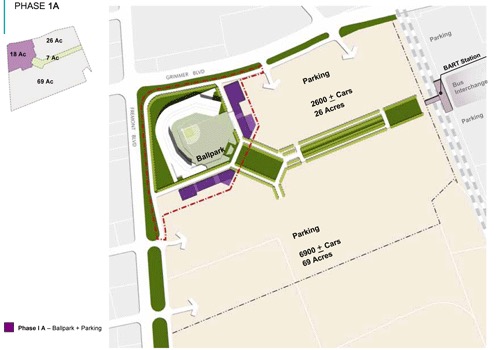
nummi-phase1

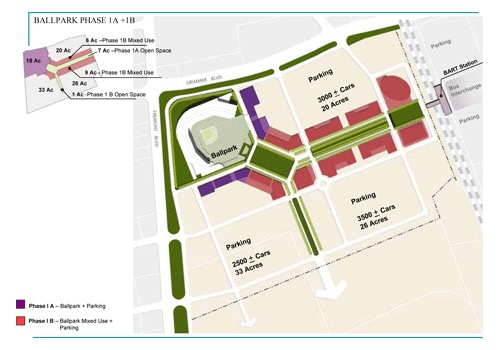
The distance along the new pedestrian promenade would be around 1/4 mile. The City expects BART parking on the other side of the station to be used for the ballpark, so the station and bridge would be constructed in a manner that allows for walking through the station without having to enter a paid area. The vision doesn’t end there. The drawing above is considered Phase 1A. Phase 1B would involve the construction “of approximately 920,000 square feet of land and building area devoted to office, retail, and restaurant development along the promenade.” Should that come to fruition, the area would look more like this:

nummi-phase2

Phase 1B is essentially a reshaping of the ballpark village concept. Similar design cues exist, especially that public square beyond centerfield. The Pacific Commons setup was more of a quadrant extending from the ballpark.
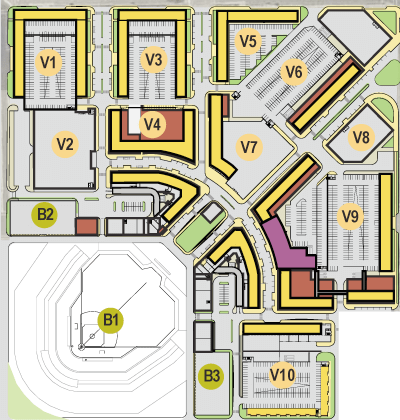
ballpark-village-1

Once again, having the A’s in Fremont will come down to an age-old debate among residents over their vision of the city. Is it a sleepy albeit large bedroom community cobbled together from five towns decades ago, or a city that aspires to having more a cosmopolitan feel? Over at the Tri City Beat, a comment by former mayor and ballpark opponent Gus Morrison sums up one side of the debate:

We don’t have much of a night life, but every time, every time, someone brings some fancy idea for a entertainment venue of some kind, it turns into a disaster, sooner or later. People open nice restaurants and we don’t go to them, and they close. We are what we are – a city built for families. We ought to be proud of that. Cities around this country, bigger and smaller than us, envy us. If we are going to change that, it ought to happen only after a lot of public input. Not 72 hours.

Something tells me this struggle will go on well after my generation is too old to care anymore.
The return of Fremont

Some of you have already taken to the Fremont news in the previous thread. There’s a lot to go over here, so for now I’ll just give a brief overview of what Fremont’s doing.

In July, I wrote about the challenges that Fremont faces with NUMMI. At the time, the winds were blowing cold for the plant and only a month later, Toyota announced plans to close the plant. Knowing the future it faced with the loss of a major employer, Fremont snapped into action. The documents the city has made available are a culmination of nearly three years of EIR work. There’s the traffic and transportation study that we’d been looking for, lots of valuable ticket sales data furnished by the A’s, and more. Here are some handy links if you want to dive in:

Here’s how I understand this would work:

  • Fremont and perhaps Alameda County via a JPA would buy 120 acres of NUMMI land at the north end of the plant for the ballpark and parking.
  • The 36,000-seat ballpark would be located roughly 1/2 mile west of the future Warm Springs BART station.
  • The massive lot used for assembled vehicles would be the main parking lot, with 8,920 spaces. 2,000 spaces would be off-site.
  • City expects 10% of fans to use public transit, plus a fairly high number of charter bus users.
  • The next three years would be spent prepping the legal stuff including zoning and entitlements changes.
  • Construction would start in March 2013
  • Opening Day would be in April 2015, coinciding with the projected start of BART service to Warm Springs in late 2014.
  • Ballpark land lease would be $1 million a year
  • City would get a $1/ticket fee
  • Parking revenue splits would be 75% A’s/25% Fremont

Before some of you start laying into Oakland for not having something like this ready, keep in mind that much of this data was already available for Fremont, so it’s not like there were additional expenditures or lead times for reports.

One of the biggest issues for Fremont is figuring out how to acquire the land. Fremont doesn’t have a massive redevelopment agency like San Jose and Oakland, and it doesn’t practice land banking as a method to cover the cost. NUMMI is also not in an established redevelopment zone, so if the City were to move forward with this, they’d have to go through the process of making NUMMI such a zone (which makes sense ultimately – still it’s a hurdle).

Of course, I would be remiss if I didn’t mention the NIMBY factor, which helped sink the previous plan. The difference between this location and the oft-considered location in the aborted Warm Springs plan is not great, only 1/2 mile. I imagine that many of the concerns expressed then will still be concerns now. We’ll see if the economic change – both local and national – seen in the last year affects perspectives.

Dissect this

Since the regulars are all willing to debate numbers this week, I’ll put up a simple table for you to interpret. It’s a list of counties followed by two sets of numbers: the breakdown of fans from the 2008 Sorenson survey, and the breakdown of advanced ticket sales from the A’s 2005 season.

distribution

The only commentary I’ll provide is that the combined 18.6% of sales coming from outside the Bay Area is very comforting. Many of those sales will come from tourists, visiting business people, and loyal A’s fans who can’t make it more than a few times per year (if that) due to distance. As much as we argue over who and where the A’s fanbase is, that 18.6% is a solid figure that should only grow with a new ballpark, wherever it is.

As for the rest of the table? That’s for you the reader/commenter to figure out. Some questions to consider moving forward:

  • Why do some areas have large discrepancies between the survey and ticket sales percentages?
  • Are some areas over/underperforming? If so, why?
  • Is there a common thread in these numbers?
  • How could these figures be affected by a ballpark located in (insert city name here)?

A couple of rules. No trashing of cities, politicians, ownership, or other commenters. Let’s keep the focus on the numbers and why they appear as they do. As Andy Partridge once sang, “Let’s begin.”

8:05 AM – I noticed in this SF Business Times article that the A’s are going to offer free parking on Tuesdays this upcoming season. The price of parking doesn’t get discussed much since there are multiple “free” options nearby. Still, this could bring extra people out on Tuesday nights.

Roski wants Bills or Jags, not Chargers

The list of relocation candidates for a future LA football stadium may be long, but Jacksonville and Buffalo appear to be way ahead of the rest. California’s three existing teams are on the backburner due to ongoing stadium efforts for each. The two eastern teams are both small market, making LA’s potential a built-in selling point for the NFL and other team owners.

Neither Jacksonville nor Buffalo have new stadia on the horizon, and it’s not clear if new digs would actually help them. The Jags have had constant trouble selling out the old Gator Bowl, enough that several upper deck sections have been tarped off. The Bills sell quite well in western New York and have frequently placed in the upper half of the NFL’s attendance figures. Their trial balloon of playing at Rogers Centre in Toronto hasn’t panned out the way they’d envisioned, leading some to think that the CA$78 million being paid to Ralph Wilson for a mere 8 games over 5 years is just a money grab (average ticket cost: $51 in Buffalo vs. $183 in Toronto).

Regardless of who’s being targeted, the real news here is Ed Roski’s change in his required ownership stance. To wit:

Semcken also said Majestic chief executive Ed Roski’s preference is to find owners willing to sell their franchise to a consortium of investors that he would lead, rather than buying a minority stake in a team that would move with its existing majority owner at the helm.

A few weeks ago, the thought was that Roski would be able to get in with just his stake in the stadium while the entire ownership group could enrich themselves with the ancillary development that could happen over time. Now that he’s pursuing a more traditional ownership model, the hill for Roski and supporters of future team in LA just got steeper.

First astroturf, now push polls!

Thanks to A’s Fan for picking up the link.

Over at Watch Dog Silicon Valley, a good San Jose voter passed along notes taken while he/she was surveyed by an obviously Giants-backed firm. Here’s the subject matter captured by the surveyee:

Major topic areas:
– Economy
– Greedy team owners
– No promises for mitigation for impacts
– Giving away land

Take a look at the blog post to get the rest of the scoop. This quite obvious push poll – not a real survey – is thoroughly astounding, reminiscent of dirty campaign tactics used during the ’08 presidential campaign.

To paraphrase Joseph Welch, “Have you no sense of decency, Giants, at long last?”

This year, I resolve to have extra glee in angry Giants fans calling in to KNBR, complaining that the team’s front office can’t won’t pony up for a bat. Those on King Street can have their push polls, I’ll have schadenfreude.

Quick postscript: In many stadium efforts, the pro-stadium campaign usually overwhelms the anti-stadium forces thanks to fundraising, the backing of the business community, and better media links. In this case, it’s possible that campaign spending will be fairly close on both sides thanks to that SF ballclub and its proxies. I know that the San Jose boosters have been quietly raising money for some time, including a sort of war chest for future endeavors. Sounds like they’ll need every penny of it and then some.