Maybe the 49ers should’ve built a dome instead

Remember the famed groundbreaking for the 49ers stadium in 2012? It was a joyous regalia, with red carpet for VIPs and an artificial turf field where the grass field would eventually be placed. Little did the 49ers and Santa Clara know that the fake grass would end up being the best-looking field all the way through the stadium’s first year of existence.

If they only knew how it would work out 30 months later...

If they only knew how it would work out 30 months later…

Tonight, a crowd resembling an late-April A’s game at the Coliseum “filled” the seats at Levi’s Stadium for the Foster Farms Bowl. Despite being local, Stanford’s small student body and alumni base was not going to buy the team’s 9,000-ticket allotment. Maryland, having jumped from the ACC to the Big Ten (oops, B1G), is not a great football power whose fanbase travels well. Add to that the thoroughly abused field, plus blustery winds and a chill that were far more reminiscent of the ‘Stick than of sunny Santa Clara (remember how fans were frying in the seats in September?), and the optics more than a little disappointing. The only notable thing, other than the Cardinal’s offense actually looking cohesive, was Foster Farms’ sponsorship of the whole affair, punctuated by animatronic chickens singing 80’s karaoke favorites during the commercial breaks. The bowl’s executive director expressed hope for a Cal-Michigan matchup next year. I’ll go out on a limb and guess that Meeeesh-igan, for some reason, won’t end up as low as 6th (thereby qualifying for the game) in the B1G next season.

Somehow, nearly everything about Levi’s Stadium has ended up disappointing in 2014. The field has been bad enough to be planted five separate times. A stadium that loudly touts its LEED Gold certification can’t properly grow grass. That should change for 2015 with new dirt and sod, if not the roof deck may have heads on pikes as featured attractions. The late summer heat chased fans to the concourses, leading to empty seats. The 49ers were shut out in their first home preseason game. As the team continued to disappoint on the field, novelty and public curiosity wore off, leading to even more empty seats and a lot of head-scratching about the venue. The Pac-12 championship game was poorly attended. The Foster Farms Bowl was even worse.

Was Levi’s Stadium too luxurious? Yes. Did it lack character? Absolutely. Was it worse in ways you wouldn’t anticipate going in? Sure. Can it be fixed? Perhaps not to the degree everyone would like.

The irony of all this disappointment is that considering the >$1.2 billion spent on the stadium, they could’ve put a dome on the thing and fixed a good number of those problems. An enclosed stadium with a roof fixes the summer heat and tonight’s wind, and it could be done without needing climate control, a la Safeco Field. It probably fixes the grass problem, since the stadium would have either Field Turf or a grass tile system like in Houston, so no grass debacle. Yes, a retractable dome would kill the open feel of the stadium. The flip side to that argument is that the footprint would have to be more compact, with fans closer and a more intimate setting.

And like other domes, which attract Final Fours and multiple Super Bowls without weather worries, a domed Levi’s Stadium would be a more flexible venue overall. I recognize that a dome – retractable or fixed – is anathema to building in the Bay Area, where the very site on which Levi’s Stadium sits was once part of the incredibly fertile “Valley of Heart’s Delight.” If anything, we’ve found out that the environment, and human reaction to the environment, are much more fickle than we’re initially willing to admit. An add-on dome is not a realistic option for Levi’s Stadium, considering the limited space around the stadium to support it and the way it was built in the first place. Seat licenses make midfield ticket holders just as likely to retreat to the clubs or not show up at all if they don’t feel it’s worth it. There’s little the 49ers can do at the moment to fix it, though I expect them to experiment a lot on different types of service going into next season.

Levi’s Stadium inaugural season hasn’t gone the way Jed York would’ve wanted. Neither has the team’s collapse. Fixing the 49er fan experience means more than merely providing new amenities to escape to. It means providing value for every fan in every seat location, everywhere throughout the stadium. Providing solutions for that problem will require some Silicon Valley ingenuity, but more importantly it will require swallowing some pride and getting back to basics. That’s innovation that not many companies get right, whether in tech, sports, or hospitality. I’ll write more about what that could entail – for football and baseball – in the new year.
Could cities use eminent domain to acquire teams? Don’t hold your breath

Field of Schemes‘ Neil deMause has an intriguing article at VICE Sports today positing the idea of teams buying teams via eminent domain. It’s not an entirely original idea. You see it on a message board every so often, and the City of Oakland famously tried to use ED to keep the Raiders from moving to LA (it failed). deMause doesn’t consider any eminent domain proceedings to be a slam dunk, as their efficacy could vary wildly based on jurisdiction. Instead, deMause looks at the ED threat as a cudgel to use against another threat, the move threat teams often wield over cities. Whether or not teams actually talk about moving to other markets, the possibility of being tied up in court, having to open the books, etc., might make team owners think twice about it.

As for eminent domain actually having teeth, it’s difficult to argue for it. California already has two cases on the books that support teams and leagues over cities, and of the teams that have recently built or are looking to build new venues, none are using that extortion weapon – except perhaps for Arte Moreno against Anaheim.

The Green Bay Packers are often touted as the model for publicly-owned sports franchises. The franchise was stabilized nearly 90 years ago when they became run as a public corporation, with real stock sales. Once issued, shares cannot be resold except back to the franchise, and the stock doesn’t offer any sort of dividend or significant voting rights, so they’re mostly for stadium improvements or for financially supporting the team, which struggled through the Great Depression.

Let’s say Raiders fans wanted to try such a model in Oakland. They’d have to raise $1 billion, or 10 million shares at $100 each. A new stadium would also cost around $1 billion, so make that 20 million shares. If the NFL was amenable to the idea (they have disallowed publicly owned franchises except for allowing the Packers to be grandfathered in), it might work. 20 million shares at $100 with no tangible returns is pretty hard sell, though cheaper than Coliseum City when you think about total costs. deMause floated the idea of cities using eminent domain, then raising bonds for the team purchase. Cities don’t have the cash to competitively outbid private parties in today’s escalating franchise sales wars. If eminent domain were considered legal for this purpose, it’d probably be the only way a city could buy a franchise.

You may consider the concept of cities attempting to own sports franchises a serious overreach of government power and responsibility. On the other hand, you might see it as a reasonable alternative to the increasingly money-driven, greedy ownership model we currently see. A third way might be the public stock offering, which worked in Green Bay and is also in use to a much greater degree in European soccer. Whatever your take, the very rich men who plowed nine or ten figures into their sports franchise investments have zero desire to change the current ownership model. If that is legitimately threatened, you can be sure that they’ll fight to the bitter end to protect those investments. While I wouldn’t expect it to happen, challenging the status quo can often be a good thing. I’d like to see what happens. It’s not my retainer, after all.

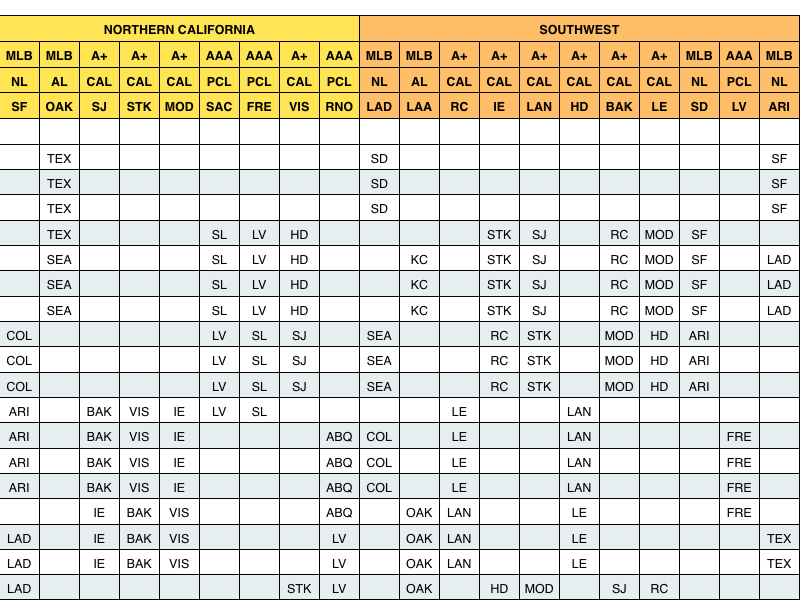
Holiday offering – a schedule of every major and minor league game in 2015

I’ve been working on something on and off for the past few weeks, and since it’s Christmas and I’ve gotten it done early, I figured this was a good time to offer up a piece of it.

sample-2015

Sample of schedule

It’s a travel grid of every regular season major and minor league baseball regular season game everywhere in 2015, from Miami Marlins to the Vancouver Canadiens, from the Portland Sea Dogs to our very own Oakland Athletics. Download it, marvel at it, have your eyes glaze over, remix it, and send me some feedback via email or the comments if you feel like it. I’ve checked it many, many times over, but I can’t guarantee that it’s completely error-free, so if you see something amiss please point it out to me.

Links:

Have a safe and happy holiday, wherever you are.

P.S. – I just noticed that the PDF, if it were printed on a single sheet, would be 93 inches by 55 inches in size.

With LA off the table for 2015, what will Oakland and the Raiders do?

The Chargers chose to stay in San Diego last week. Over the weekend, word surfaced that the NFL would not approve any LA relocations for 2015. So for now, St. Louis, Oakland, and San Diego have year’s reprieve. So despite the fact that Coliseum City doesn’t have a deal in place, Oakland’s self-imposed deadlines will come and go with nary a penalty.

Yet it’s little more than cold comfort, as the delay was either caused by the NFL’s and AEG’s need for more time, or perhaps just as likely, certain teams’ need for more time. Either way, the process is not driven by anything happening within the current home cities. All three cities are looking at huge nine-figure subsidies, with little actual desire to deal with the reality of it. Even if the cities give away land, it’s still a tangible asset that’s being given away.

Incoming Oakland Mayor Libby Schaaf will have a number of options available to her and the City Council. If the City likes Floyd Kephart’s work in salvaging the project, they can extend the deal for another 6-12 months, which may be enough to get the Raiders and investors on board. Coliseum City’s EIR work can continue unabated, and there’s no longer any immediate pressure to make a deal. As mentioned previously, shrinking the project from 800 acres to 200 is nothing but good for its feasibility. No need for new bridges across the Nimitz, a new arena, or a trolley. Conversely, it also means that “giveaway” resource of land is more scarce. At the very least it allows for better focus on what can and should be done.

Schaaf beat Jean Quan and Rebecca Kaplan with her cheery pragmatism. That will be put to the test once talks start up anew. It would be safe to assume that with the A’s not in jeopardy, any alternative plans Lew Wolff has for the Coliseum area can be safely placed on the back burner by letting Coliseum City play out. The JPA still needs to hire a GM/Exec Director to lead negotiations whether they’re facing Floyd Kephart or Lew Wolff, so that’s the JPA’s biggest priority. Schaaf has maintained in interviews that she sees the impact of 82 baseball games as much greater than 10 football games. That said, perhaps she could be swayed towards some flexible aspects of the Coliseum City proposal, especially if there’s a retractable dome involved.

That brings me to the fundamental problem facing Oakland: How much stadium do they want to build? If they want to build a flexible venue that will bring in a Super Bowl and a Final Four and other indoor events, the potential price tag will easily surpass $1 billion, perhaps reaching $1.5 billion by the time it’s completed. And with every $100 million over the current $900 million cost estimate, that’s another $100 million added to the still-unresolved funding gap. It adds up in a very painful way.

Despite the uncertainty surrounding the team, Raider fans feel they have one over on 49er fans thanks to Levi’s Stadium’s inauspicious debut. The Raiders getting over on the 49ers two weeks ago is practically Super Bowl-worthy in the Raider Nation, and the 49ers’ turmoil, highlighted by Jim Harbaugh’s impending departure, only serves as a second helping of schadenfreude. Of course, if the Raiders and Oakland get the Coliseum City stadium deal done, they’ll face the same problems the 49ers faced. Longtime season ticket holders will be displaced and relocated to less desirable seat locations as preferred spots go to corporate interests. The crowd will change in noticeable ways, just as it did for the Giants, Jets, 49ers, and Cowboys. The Raiders don’t have to worry about burning through a season ticket waiting list, making tickets less of a seller’s market.

If there’s a lesson to be learned, it’s that right-sizing the stadium has huge benefits. As the second team to official tarp off Mt. Davis, the Raiders didn’t suffer through the constant PR war the A’s have. Regardless, it’s hard to argue with the results. The Raiders have a nice consecutive games sellout streak, few embarrassing empty crowd shots (unlike Santa Clara), and a compact stadium feel that’s difficult to duplicate anywhere outside of Green Bay. A place that’s downright cavernous feeling for baseball is intimate for football. Think about that.

It’s no secret that I’ve advocated for different types of Coliseum renovations for the Raiders instead of a new stadium, simply because they’re cheaper and more feasible. It also needs to be said that if a renovation is done properly it can conserve that atmosphere, instead of letting it weaken by attrition. The Bears’ controversial rebuild of Soldier Field may have killed the stadium’s landmark status, but it preserved the atmosphere and improved the facility immensely, which was a win-win for the Bears and Bears fans.

Citrus Bowl as of mid-December

Citrus Bowl as of mid-December

In May I pointed to the renovation of the Citrus Bowl in Orlando, a $200 million project that gutted 90% of the stadium and modernized it in every conceivable way. The stadium reopened last month with a college football game. Next week it will host two bowl games on the 29th and New Year’s Day. The Citrus Bowl won’t run into any grass problems because it has artificial turf. The turf is unfortunate but understandable, given the cost of maintaining a grass field all year round when its big events occur in December and January. Other than that, the stadium looks practically like a NFL venue, with 60,000 seats, large club areas, party decks, and a completely new bowl with new seats installed throughout. All for $204 million. How was it only $204 million? While it’s hard to isolate specific reasons, a nine-month construction timeline certainly helps. As for the Citrus Bowl venue, it sure looks like an NFL stadium.


No teams + No developer = No deal

BANG reports tonight that Floyd Kephart, who has been leading the effort to keep the struggling Coliseum City project alive, will not meet this weekend’s deadline to deliver a commitment from one of the Coliseum’s teams, namely the Oakland Raiders. Kephart described the situation in a manner we should all be familiar with.

It’s a complicated land situation; it’s a complicated team situation; and it’s a complicated Oakland situation. There is nothing simple here.

Kephart also revealed that he wasn’t ready to name a developer for the project. Whether that means the developer is under wraps or simply doesn’t exist is up to interpretation. Chances are that any developer’s commitment is contingent upon at least one team anchoring the project, which obviously hasn’t happened yet.

The 90-day deadline set in October was already going to be extraordinarily difficult pull off, so at least Kephart deserves credit for coming through on some of the other deliverables, such as necessary reports and studies (which to my knowledge haven’t been made public). The big stuff, however, is what counts. In the end Kephart won’t get credit for merely trying and he knows that. We’re still 31 days from the final deadline, and it’s worth asking whether or not Oakland should continue this process by extending the ENA another 30, 60, or 90 days. It’s unlikely that any potential partner (teams or developers) will suddenly commit just because the calendar flipped a couple pages. The fundamentals are still shaky at best.

The big takeaway is the Kephart revised the plan down to the 200 acres including the Coliseum and other pieces of public and private land immediately surrounding the complex. That makes for a much more feasible project in terms of acquiring and packaging the land, limiting infrastructure costs, and working out the regulatory aspects. The Coliseum City EIR is written so that the entire 800-acre plan area is the full scope, with the “Reduced Alternative” lowering densities within the full project area, not a smaller plan as a 200-acre project would require. It’s unclear if the final draft will include a 200-acre alternative, but it would seem that if Kephart’s plan moves forward such a major refocus would have to occur.

Lew Wolff has consistently said he’s not interested in being part of the project. He’d rather promote his own vision with no third parties (or perhaps his own) attached. If Coliseum City goes away and Wolff’s plan gets traction, the shoe would be on the other foot as the City, JPA, and Wolff would have to figure out how to accommodate the Raiders, as opposed to a Raiders-focused plan trying to accommodate the A’s.

Meanwhile, murmurs have been getting louder that the NFL will punt on LA for 2015. Hope remains in St. Louis for an 11th hour plan to build a new stadium for the Rams, which might give NFL the chance to extend its wait-and-see posture an additional year. The Chargers are staying in San Diego through at least next year. That leaves Oakland.

The Raiders will have to start negotiating a new lease with the JPA in the new year. Mark Davis prefers a single year or at worst a year-to-year arrangement for maximum flexibility. Davis pushed for the 1-year lease because he thought it would further the process at Coliseum City, which hasn’t happened save for the EIR. The JPA and City want a multiyear deal, which I wouldn’t expect Davis to sign. I’ve heard some strange rumors about backup venues Davis is calling about, which frankly is his right. The Raiders face severe limitations on where they can go, or rather, where they are welcome. We’ve already heard about the LA Coliseum and Rose Bowl slamming the door on the Raiders. There are also issues with Bay Area venues:

  • Levi’s Stadium has been ruled out by Davis. Even if he was interested the 49ers would require a multiyear commitment to pay for finishing construction on the second home team locker room.
  • California Memorial Stadium has a contractual ban on NFL games. Any deal to host the Raiders would run into an immediate legal injunction.
  • AT&T Park could host games, but is small and not ideal from a league perspective.
  • Stanford wants no part of the Raiders.
  • The ‘Stick is being dismantled per a development agreement with Lennar.

Even if the league owners got past Jerry Jones’ and Bob McNair’s objections, they wouldn’t approve a short-term stay for the Raiders in San Antonio. They want long-term stability and certainty. That’s also the problem in LA. Dodger Stadium could provide a short-term home, but the NFL and AEG have to work out a very complex deal for whatever team(s) commits. AEG asked for its own 6-month negotiating extension for Farmers Field. Given the complexity of arranging a temporary venue that it doesn’t control along with planning for the new stadium, getting it all done in 6 months is a tall order. That said, the NFL has assigned Eric Grubman to work on LA among other options, so it’s not like the league isn’t controlling what it can. The NFL may punt on LA for now, and punting is something Raiders fans are all too familiar with this year.

As for the A’s – they’re in a good spot. They have a lease that provides security. They’re working on a CC alternative that should be ready to go if Oakland drops CC. They can wait out the Raiders’ and Oakland’s indecisiveness, at least for a while.


St. Petersburg City Council votes 5-3 against MOU allowing Rays to explore Tampa

The Rays and St. Petersburg appeared to have a deal in place that would allow the team to look at potential ballpark sites in Tampa for a price. Tonight, St. Pete’s City Council voted against the MOU, 5-3. Both sides of the issue were well argued. In the end the Council believed the City was getting a raw deal, with no assurances that the Rays would continue to work with St. Pete, while also tying up the Tropicana Field site for future development while they stayed there.

For much more complete coverage, go to Noah Pransky’s Shadow of the Stadium site.

At this point I’m more interested in next steps by baseball and the Rays. Last week Rays owner Stuart Sternberg indicated that he would sell the team to an owner who would definitely move them out of the region if the Tampa exploration agreement didn’t happen. Now that the Council has rejected the deal, we’ll see if more threats, lawyers, or other tactics come out of the woodwork. I fully expect Rob Manfred, who is no stranger to playing the heavy, to start wielding a large stick aimed at St. Pete toot de suite.

The Rays are still stuck at the Trop for the near future, but it’s easy to see how MLB and Rays ownership (Sternberg or not) could try to test the strength of the Rays’ use agreement (technically not a lease) at the domed stadium.

Somewhat ironically, the Council also approved workshopping a new ballpark study somewhere in the St. Pete city limits. How that happens with the team they just rejected is anyone’s guess.

Chargers elect to stay in San Diego through at least 2015

Late statement from San Diego Chargers special counsel Mark Fabiani:

On February 1st of every year since 2007, the Chargers have been eligible to terminate the team’s lease for Qualcomm Stadium. And each year since 2007, the Chargers have announced that the team will not exercise the termination clause and instead continue to work toward a permanent stadium solution in San Diego.

Today, the Chargers are making the same announcement that the team has made each year since 2007: The team will not be exercising the lease termination clause and will keep working to find a publicly acceptable way to build a Super Bowl-quality stadium in San Diego. Calendar year 2015 will constitute the team’s fourteenth year of work on a San Diego stadium solution.

The Chargers aren’t fundamentally closer to a stadium deal now than they were at this time last year. If they had chosen to terminate the lease, they would’ve had to pay $17.6 million to the City of San Diego to leave. Without clear short-term and long-term stadium solutions in LA, it makes some sense to wait especially if real money is at stake. That isn’t the case for the Rams and Raiders, who face no penalties if they leave their current homes.

On Monday, the New York Times reported that the chances of any team moving to LA were dimming. We’re still a couple months from the window officially opening, and if LA interests such as AEG are truly interested, I imagine they’ll take that time to work out a deal with the NFL (and perhaps Dodger Stadium).

What say you, Rams and Raiders?

“The Selig Experience” is coming

Anyone can write an autobiography. Getting a hagiographic museum, however, takes chutzpah.

Brewers announce new fan experience honoring Bud Selig at Miller Park
Attraction will honor the legacy of the Milwaukee Brewers founder

Press Release | December 15, 2014

MILWAUKEE – The Milwaukee Brewers today announced the construction of a new fan experience at Miller Park, a state-of-the-art attraction to honor retiring Commissioner of Baseball and former Brewers Owner Allan H. (Bud) Selig.

Known as the “Selig Experience,” the exhibit will be located on Miller Park’s Loge Level in the left field corner. A highlight of the attraction will be a multimedia presentation that tells the story of Selig’s role in saving Major League Baseball in Milwaukee, his successful efforts to bring the Brewers to the city, and his tireless efforts to promote and grow the game in his hometown.

Miller Park already is known as a premiere destination for baseball fans, and the Selig Experience will take that to the next level. It will serve as a year-round attraction, adding another extraordinary enhancement to the overall fan experience.

“Commissioner Selig is the one person who ensured that the city of Milwaukee would continue as a Major League city, even when virtually all others had lost hope,” said Brewers Chief Operating Officer Rick Schlesinger. “We want to mark his legacy with much more than a museum, and we believe the Selig Experience will tell his story in one of the most unique fan attractions in all of sports.”

The exhibition space totals approximately 1,400 square feet, and will include authentic artifacts from Selig’s tenure as the Brewers owner. It will celebrate the fans’ love of the game, as told through the story of the Brewers founder.

The main multimedia show builds to a surprising 3D encounter with the Commissioner himself inside an authentic reproduction of Selig’s County Stadium office, using a technology found in only a handful of exhibits around the world. After the show, Milwaukee fans will be delighted to take a sneak peek into Selig’s office for themselves.

The design and production of the Selig Experience is being led by BRC Imagination Arts, an experience design firm that turns brands into destinations. For more than three decades, its masterful storytellers have been chosen by iconic brands and cultural attractions all over the world to inspire and engage their audiences.

“This exhibit is as much a celebration of the passionate Milwaukee Brewers fans as it is an homage to Commissioner Selig,” said Brad Shelton, Creative Director at BRC Imagination Arts. “We’re telling an emotional story of how the Brewers’ first fan brought professional baseball back to his friends and neighbors. Whether they take a quick tour between innings or spend more time examining every detail, this is an immersive experience that no Brewers fan will forget.”

Selig’s dedication to baseball has paralleled his love of his hometown of Milwaukee. His first significant move as an executive was to return Major League Baseball to Milwaukee in 1970, when he founded the Milwaukee Brewers. In its first decade, the Brewers featured some of the great teams of that era, which eventually led to an American League pennant and World Series appearance in 1982.

During his tenure as Brewers owner, Selig earned United Press International’s 1978 Executive of the Year award, and the franchise was honored with seven “Organization of the Year” awards.

In the 1990s, Selig began his efforts to build a new ballpark in Milwaukee to replace the aging County Stadium, and Miller Park opened for its first season of play in 2001.

“I am humbled that the Brewers will chronicle the remarkable journey of the franchise through a fan experience at Miller Park named in my honor,” said Commissioner Selig. “The story of the Brewers revolves around the great sports fans of Milwaukee and Wisconsin, whose passion drove me to work toward bringing the National Pastime back to my hometown. Given my affinity for history, I believe this exhibit will illustrate the extraordinary sense of community that the Brewers have always inspired.”

Earlier this year, the Brewers also announced that the Club will retire uniform #1 in Selig’s honor, signifying his role as founder of the franchise. The retired number will be displayed in time for Opening Day. Additionally, he was honored with a statue at Miller Park, which was unveiled on August 24, 2010.

Uihlein-Wilson Architects is also contributing to the initial design of the space for the Selig Experience.

I look forward to the special “Blue Ribbon Commissions” exhibit. It will disappear for months on end, and when it appears you won’t be able to see its contents. Also – the statue of Selig outside isn’t enough?

For Davis it’s all about #1

Mark Davis explained where he stands vis-à-vis the A’s now and into the future during an interview with Tim Kawakami.

As I’ve said, I’m not against the A’s, I’m not for the A’s, I (sic) just for whatever’s best for our organization.

I don’t think anything else needs to be added here.

JPA board looks for new exec director candidates as Houston is voted down

A vote on former Assemblyman and Dublin mayor Guy Houston’s candidacy for the vacant JPA executive director position was postponed last month. The vote was finally taken yesterday and, as expected, Houston was rejected. Reasoning mostly centered on Houston’s anti-labor stances, with many eyebrows raised at fraud charges levied at Houston a few years back. Robert Bobb’s consultancy is on board with the JPA, leaving a rather gaping hole in the org chart below.

Org chart supplied by The Robert Bobb Group

Org chart supplied by The Robert Bobb Group

The job may go to former Rose Bowl head Scott McKibben, or someone else willing to slum for the measly quarter of a million the JPA will pay to whoever accepts the position. Regardless of candidate, the job should be filled in the next few months if the JPA is going to start negotiating with New City, Lew Wolff, or others looking to develop the Coliseum. It’s no small task.