Mark Davis revises his Coliseum “vision”

In a fairly lengthy interview with ESPN’s John Clayton yesterday, Raiders owner Mark Davis held court on his team’s stadium issues. While much of it was a rehash for those who have been following this saga intensely, it was good for casual fans and observers to get even the tiniest bit clarity. In any case, the Raiders saw fit to republish it on their own website so it must have the boss’s approval.

What caught my attention was a change in how he saw the Coliseum being developed. While continuing to call for the Coliseum’s demolition, Davis dreamed out loud of a dual-stadium concept in the old venue’s place (emphasis mine).

One of the challenges we have with that is that we share the stadium with the Oakland A’s. The Oakland A’s have a 10-year lease to remain in the Coliseum. One of the plans that they’re talking about is, is us building the stadium in the corner of a parking lot and then once our new stadium is built, then they would rip down the stadium and build the new one for the A’s and build housing and all of that stuff. That just isn’t a situation that I want to get us into. I would like for, if possible, the Raiders and the A’s to stay on that site and that the Raiders and A’s vacate the Coliseum for the next two or three years. We build a brand new football stadium and a brand new baseball stadium on the site and then we’d come back and begin playing in two brand new stadiums without construction going on around us, in brand new stadiums.

The desire to avoid construction zone headaches remains steady for Davis. Plus in this concept Davis would preserve surface parking, a goal shared by A’s owner Lew Wolff. Wolff doesn’t think the place can properly support more than one stadium project, so how could something like this be done? It’s nothing like Coliseum City, which has planned phases. Both stadia would be done simultaneously, like Arrowhead Stadium and Kauffman Stadium in Kansas City. Let’s imagine a timeline for Davis, assuming no legal, logistical, or financial obstacles (follow me on this).

  • End of 2015 – Coliseum City is scrapped. Raiders play their last game at the Coliseum in December. Raiders and A’s hammer out stadium development deals with Oakland/Alameda County. Partial demolition begins (ironically) with the newest part of the Coliseum, Mt. Davis, returning the venue to its 1995-96 state – but with the Oakland Hills back in full view. That occurs from November 2015 to March 2016.
  • 2016 – A’s play their last season in the old Coliseum in reduced facility. A’s lease is revised (with no penalty to anyone) to reflect this. Raiders and A’s finalize their financing plans for their respective venues.
  • November 2016 – Demolition of rest of the Coliseum begins, which should take 6 months to complete including grading for new venues (use drawn out Candlestick Park demolition for reference).
  • April 2017 – Construction starts on both stadia, with a planned completion of Spring 2019 for the A’s, Summer/Fall 2019 for the Raiders. Both teams use smaller footprint, simpler plans and Levi’s Stadium-style incentive/penalty system to execute those accelerated schedules (24 months for A’s, 28 months for Raiders).
  • 2018-2019 – Warriors vacate Oracle/Coliseum Arena for San Francisco. Decision is made on whether to keep arena or demolish it to make way for other development.
  • April 2019 – A’s ballpark opens
  • August 2019 – Raiders stadium opens

The finished product(s) would look like this:
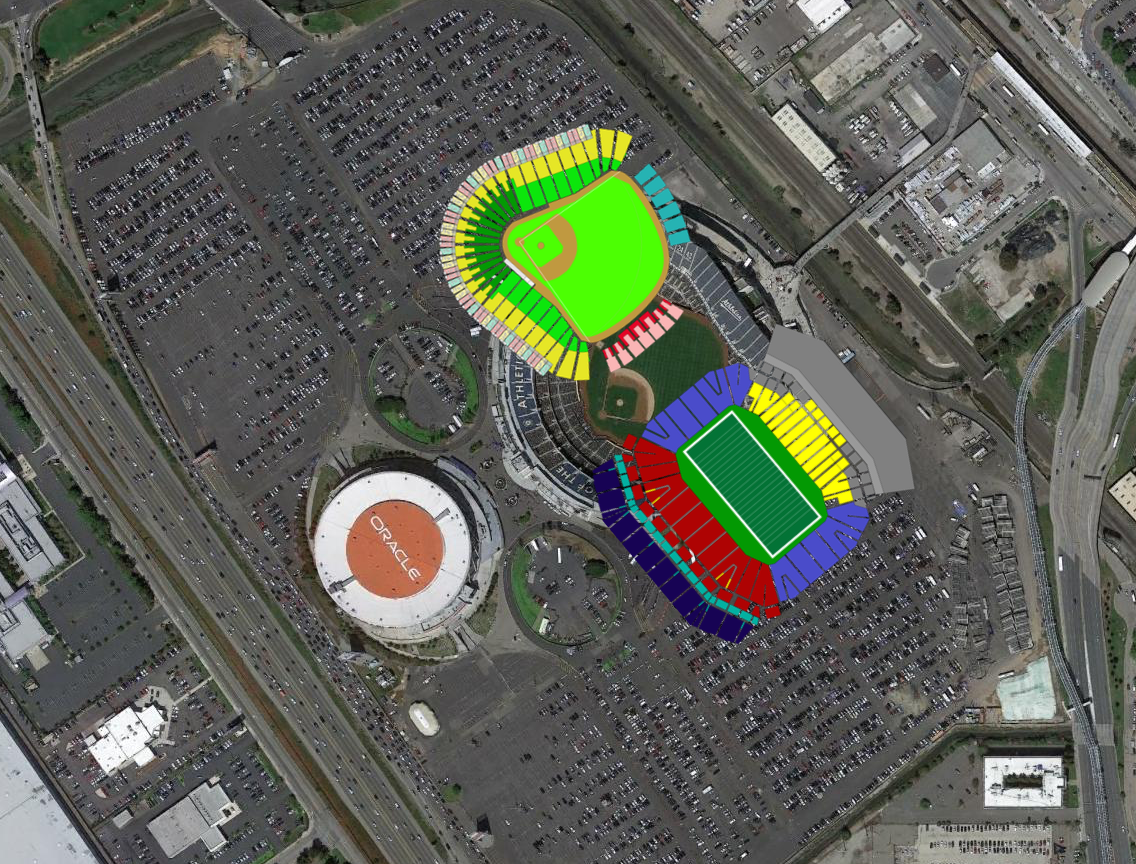
Two new venues on a slightly larger footprint than the original

Two new venues on a slightly larger footprint than the original

The Raiders would have to play at a temporary facility for three seasons, the A’s for two. AT&T Park would have to be a considered a frontrunner for both, oddly enough. Memorial Stadium remains off limits to the Raiders thanks to a legal agreement between UC and the City of Berkeley, and Stanford Stadium is a nonstarter for both the university and City of Palo Alto. Davis doesn’t want to play at Levi’s Stadium for his stated reasons, though it must also have something to do with the 49ers’ desire to have a tenant for at least a decade in order to pay for the second home team locker room.

That brings me to the real problem in all of this, the financing. Tallying up all of the associated costs, we come to:

  • $900+ million – Raiders
  • $600+ million – A’s
  • $100 million – Remaining Coliseum debt including interest
  • $65 million – Remaining Arena debt in 2018

Final total, not including the planned work on the Coliseum transit hub, is $1.665 Billion. Obviously, much of that would be covered by the teams, the NFL, and perhaps third parties, but the gap for the Raiders remains, and the need to retire the legacy debt from project sources without hitting either Oakland’s or Alameda County’s general funds means that the public sector would have to give up something. For now it’s unclear what that is since the Coliseum’s land is not going to be that public contribution.

Price tag aside it’s a tantalizing vision for fans, and one that runs counter to planning and growth goals for Oakland and Alameda County. From a broad perspective, the public sector wants housing of different kinds and price ranges to ease the current crunch. Pols may see this as nothing more than doubling down on the stadium deals of 20 years ago, which brought only fiscal pain and little real security with regards to the teams staying in Oakland. The people who might like it the most are workers at the Coliseum complex and businesses west of the Nimitz who thought their livelihoods were being threatened by Oakland’s sweeping zoning change proposals. As for East Oakland residents, well, how much has this hulking pro sports complex improved their lives in nearly 50 years?


Adventures in NFL stadium financing, San Diego edition

We’re still several months from the NFL and its constituent owners making any decisions on team relocations, yet the league and Roger Goodell are getting exactly what they want. San Diego and St. Louis are bending over backwards to make please the kings, Carson and Inglewood are having their own battle over the presumptive single Los Angeles stadium slot, and Oakland is, well, treading water I guess.

San Diego’s CSAG (Citizen’s Stadium Advisory Group) released its plan in time for the owners meetings in San Francisco. As expected, it focused on building at the current Qualcomm/Mission Valley site instead of the downtown site the Chargers preferred in prior years. The cost is expected to be $1.4 billion, broken down into various revenue sources:

sd-financing

The plan proudly proclaims no new taxes, which is technically true, but it neglects to mention that it’s carrying over an ongoing operating subsidy, split equally by the City and County, that was negotiated to keep the Chargers at Qualcomm. So right off the bat that’s $242 million in present value subsidy, plus the sale of 75 acres at the stadium for $225 million. Field of Schemes has the total subsidy at $647 million, I’ll call it $467 million as I won’t count the various rents as subsidies (you might) or . $500 million would come from the Chargers (60%) and the NFL’s G-4 fund (40%) in the plan, though the Chargers’ recent disinterest in the deal may indicate a dissatisfaction in their $300 million piece. Since PSL revenue ($150 million) would be limited and is already accounted for, the Chargers would have to come up with $200-210 million on their own from non-PSL sources like tickets, concessions, and some luxury seating proceeds. That translates into a $12 million/year of revenue required of the Chargers along with $10 million/year for rent, assuming that San Diego hits its fundraising targets for PSLs. For reference, the 49ers pay roughly $24 million/year in rent at Levi’s Stadium. To help offset that cost to the team, the Chargers would have control of naming rights. A $12 million/year naming rights deal for 30 years (both optimistic projections) would effectively cancel out the $300 million team contribution.

A special infrastructure financing district would be created to allow for future ancillary development to take place. That would be worth $116 million, though that money wouldn’t go towards construction of the stadium. Another $40 million come from future hotel taxes to fund a hotel next to the stadium. To many stadium advocates, hotel and car rental taxes are not considered a true subsidies since they aren’t levied on locals. They’re still taxes.

Two parts of the plan struck me immediately. $225 million from the land sale may well be appropriate for the area, which has a trolley station that could anchor some transit-oriented development. The more important takeaway is that $225 million now sets a bar for Coliseum City, in that San Diego is now offering up land for free to fund the stadium’s construction, so Oakland and Alameda County will be expected to do something similar. This is despite the fact that the NFL has recently frowned upon real estate development acting as a funding source in favor of less speculative revenue streams – as if PSL sales aren’t speculative.

The other question mark is operating costs. CSAG claims that based on examples like AT&T Stadium in Dallas, revenue from a year-round event schedule would make the stadium self-sustaining. I find this assertion highly optimistic at best. The fact is that a stadium will cost $7-10 million per year to operate just for the NFL games. If that isn’t accounted for, why should anyone believe that revenue from other much smaller events will make up for that operating cost, not to mention the cost associated with running those smaller events?

The total cost of the project is $1.4 billion with a $1.1 billion construction cost, so perhaps that “buffer” will take care of the subsidy. If it doesn’t, chances are taxpayers will foot the bill, adding another $121+ million to the public side of the ledger.

I’ll do a proper comparison of San Diego vs. St. Louis and the two LA plans plus Oakland when those come out. For now I encourage you to assess San Diego’s plan on its own merits. CSAG’s plan appears meant to be in line with the stadium financing structures for Minneapolis and Santa Clara, at least in terms of public share. If that’s the case, the NFL should be able to pivot and align with the plan they way the same are posturing to do with St. Louis. Is it a good deal? Not really, but this is the NFL we’re talking about. As usual, they hold the cards.

Davis affirms desire to tear down Coliseum

As the NFL owners meetings get underway at the Ritz Carlton in SF, KTVU reporter Noelle Walker caught up with Raiders owner Mark Davis, who made it abundantly clear that he wants the Coliseum complex for himself:

Davis confirmed that if a Coliseum City plan goes forward at the current Coliseum site, he wants the old stadium demolished before a new one is built.

‘If we’re going to build on that 120 acre site, we would have to tear down one stadium to build another one in that same place,’ Davis said. ‘I don’t want to build a brand new stadium and then have it be in a construction zone for next two, three, four years.’

Davis doesn’t want a construction zone around a new stadium. Wolff put in the A’s lease terms that would give the team an out if their operations were impacted by the Raiders’ stadium (construction taking out parking). If by now you haven’t come to terms with the need for Oakland to make a choice (or else have a choice made for them), make yourself a pot of coffee in the morning and breathe in its aroma deeply.

In her report Walker termed the dilemma Oakland’s “Sophie’s Choice.” Call it that, a Catch-22, Kobayashi Maru, Hail Mary. whatever construct you like that doesn’t exactly fit but helps explain the dilemma. Oakland has chosen to try to juggle both teams. In the process it has looked indecisive. The NFL disapproves. And so Oakland’s best hope is in that very same NFL keeping the Raiders from moving because it deems Oakland’s proposal at least compelling, if not altogether sufficient. Might need to throw in an Act of Contrition on top of that Hail Mary.

SC County Judge declares A’s-San Jose land option illegal

Just in from Santa Clara County Superior Court: Judge Joseph Huber, who has presided over the smaller Stand for San Jose-vs.-City of San Jose case for a few years now, has called the land option agreement between the City and the A’s against the law. Wrote Huber:

“The city is and has been in violation of (the law) for several years and it does not appear it will comply with the terms in the foreseeable future.”

Combine that with the blows that San Jose has received in federal court, and you have to think that any chance of a ballpark happening in the South Bay is toast, short of a miracle. Yet it all comes down to some serious strategic errors on San Jose’s part that could have strengthen their case, in this local venue and the federal one.

Remember that it was former mayor Chuck Reed who wanted to go to the ballot box in November 2009 (!), then March 2010. The deal would’ve set up the possibility of a voter-approved stadium deal in San Jose. Instead, he had a discussion with former MLB president Bob DuPuy, who relayed then-MLB commissioner Bud Selig’s desires to keep the deal on the shelf. Reed complied, there was never a referendum or initiative, and San Jose’s position has looked significantly worse ever since. All San Jose has right now is a prayer for SCOTUS to take the case, which isn’t likely. Throughout all of the various legal battles, at different levels, the weakness of the option agreement has been cited. The A’s have little vested interest in San Jose, and the City is no closer to putting together a deal than it was six years ago.

Now that even Lew Wolff has for all intents and purposes given up on San Jose, the spotlight is on Oakland, where that city faces an uphill battle at Coliseum City and could entertain an A’s proposal should the football stadium plan fizzle out. That brings to mind three scenarios.

  1. If Oakland can’t get Coliseum City done and the NFL doesn’t allow the Raiders to move to LA, the Raiders would either be forced to limp along at the Coliseum indefinitely or consider a move to either San Antonio or even St. Louis. The former would be a continuation of the awkward status quo, with no new venues in sight for either the Raiders or A’s.
  2. Should the Raiders vacate, they would clear the path for the A’s to build a new ballpark at the Coliseum, infrastructure or other public contributions to be up for significant debate. Or maybe no new infrastructure (no baseball village) because no one has figured out how to pay for it.
  3. If Oakland gets Coliseum City to work out with only a football stadium (the NFL’s and the Raiders’ preference – no one sane is buying into the multi-venue fantasy at this point, right?), the A’s are pushed out (per lease terms) and have no obvious backup plan. Would MLB direct the A’s to start looking in the East Bay and maybe the broader Bay Area for ever diminishing land opportunities, or start playing hardball and making threats as it does with so many other markets? How does a stifled San Jose factor in? And what of the Giants?

It’s just as well, we’re so overdue at this stage for a stadium that San Jose will soon have to deal with Sharks owner Hasso Plattner on his designs for a makeover at the 21-year-old arena that bears his company’s name. And if the goal is to get on par with the best new hockey arenas, it won’t be cheap. That discussion is for another day.

P.S. – The scant output over the last month was an intentional move on my part to see what would happen if I chose not to be swayed by every little gesticulation in the media over the A’s or Raiders. While readership was down a little, I felt it was the right move because there was no need to blog about mostly vague details or the rumor mill. Therefore I’m getting to stick to publishing 2-3 times a week while using Twitter to get out quick notes or retweets. If you haven’t already, follow the feed. Things should pick up again in June with the next set of Coliseum City deliverables is expected to be released.