New CBA approved including possible revenue sharing rollbacks for A’s

MLB and MLBPA burned the midnight oil the last couple of days to get a CBA approved before tonight’s midnight deadline. Though the talk did not include the same kinds of contentious items other leagues normally argue over (salary cap, players’ percentage of revenue), the sides still worked hard to avoid any kind of work stoppage. As of this post, both sides are touting a tentative agreement with much of the fine print to be worked out over the coming weeks. Like the last CBA, the new one will run for five years through the 2021 season. Major items that were up for grabs, such as the international draft and 26-man rosters were left by the wayside in order to get the deal done. What did apparently get through was a tweaking – if not an overhaul – of baseball’s revenue sharing system.

That news got started by Jeff Passan:

And was built upon by Ken Rosenthal:

Okay, let’s start with the Rosenthal scoop. As a way to “motivate” the A’s to build a new ballpark, they will be phased out of revenue sharing. This was the plan under the last agreement too, except that the A’s were given an exemption as long as they continued to play at the Coliseum. Since that didn’t net a change in the A’s venue, the owners (with the union’s help?) may have decided to light a fire under A’s ownership to build that. Nevermind that the A’s would already be in a new home in San Jose if MLB actually supported the A’s plans in 2012, that’s water under the bridge. Now John Fisher has the reins of the efforts to build in Oakland. And by phasing out the A’s revenue sharing check over the life of the CBA, the A’s won’t realize up to $90 million over the five years. That’s just as well for many A’s fans and rival owners who believe ownership has been pocketing those checks for years. The A’s weren’t spending it on payroll anyway.
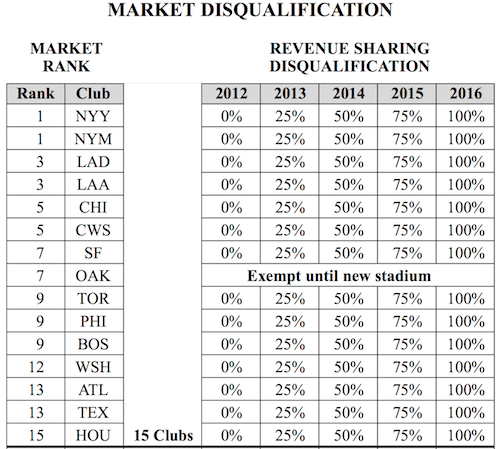
disqual

As you can see from the table above, the previous CBA called for revenue sharing to be phased out for all of the Top 15 “Big Market” teams. The A’s are in a big market, but they are a relatively low-revenue franchise thanks to the dilapidated Coliseum. MLB carried over the last agreement while it also more-or-less imposed a deadline to complete the ballpark of 2021 or 2022. There’s always another side to the story, which makes me wonder what MLB will offer to the A’s to make the stadium project worth Fisher’s while. After all, if Fisher’s going to take all the risk while not getting monetary help from either MLB or the City of Oakland, what’s in it for him? The A’s aren’t guaranteed to get a

Rob Manfred called for the A’s to be more proactive in the stadium pursuit. The recent ownership change and other moves indicate that the A’s are serious. Still, the Raiders are the biggest obstacle to getting the Coliseum site as well as a competitor for scarce infrastructural funding should both teams get Oakland projects going. MLB’s pitch to Fisher may be “Once the Raiders and Warriors leave you’ll have the East Bay all to yourself. We’ll throw our weight behind your plans when that happens.” Will MLB provide funding to the A’s to get through lean years? Will Manfred finally play the heavy when it comes time to negotiate with the City?

Now about that performance factor. Performance factor is a key feature of the revenue sharing scheme. There are two parts of the scheme, the 34% straight pool Base Plan and the (14%) Supplemental Plan.  The Base Pool plan is simple: every team contributes 34% of their local revenue after deductions regardless of how little/much that is. All teams above the average (mean) amount lose the difference between the mean and their contribution. Those below the fold receive the difference between their respective contributions and the mean.The Supplemental Plan takes the aggregate of 14% of local revenue for all teams, pulls from the Top 15 teams based on each team’s Performance Factor and sends that to the Bottom 15 based on their PF’s. It’s unclear whether MLB got rid of the Supplemental Pool altogether or calibrated revenue sharing by folding the Supplemental Plan into the Base Plan. That would make the whole plan a 48% straight pool Base Plan, one that would penalize rich teams for being rich less than before. Elements of the new plan may be released in the coming days. Eventually we’ll know what it is and what the A’s have to deal with.

A’s brass were hoping revenue sharing would stay intact, but the writing’s on the wall. The business model should stay intact, in that they plan their payroll limits and roster makeup based on regularly-sourced revenue (stadium, TV/radio, streaming) not including the revenue sharing receipt, which is received in December after the usual rash of free agent signings. I always figured that if the A’s needed that last piece for a championship roster, they’d dig into that receipt. Now Fisher will have to make a cash call to himself. The dynamic of trying to field a more competitive team to hopefully help sell a new ballpark vs. the need to save pennies for the ballpark by reducing costs is plenty fascinating on its own. Which way Fisher will turn will show us what his priorities are.
Oakland near ready to approve Raiders stadium framework

Last week, Oakland Mayor Libby Schaaf declared that the City was close to approving a framework for a potential stadium deal for the Coliseum. The framework would allow for Oakland’s exposure to be limited, while bringing in a big money financier to bridge the lingering (and growing) funding gap.

Today, media were assembled to cover yet another closed session of the Oakland City Council to further discuss the deal. The thought was the Council would come out of the meeting announcing the approval of the framework. What happened?

Okay, there’s always next week. Regardless, Council members sounded confident, especially Noel Gallo. Soundbites sound practically ebullient, despite the fact that the Raiders aren’t a participant in these talks. So what were they ready to pop the corks over? Matier and Ross revealed an outline of the framework (a more tenuous-sounding description is hard to come up with). I’ll summarize:

  • Total cost of the project is $1.3 billion
  • $600 million would come from Fortress Investments of New York, the group brought in by Ronnie Lott
  • $300 million from the Raiders
  • $200 million from the NFL’s G-4 stadium fund
  • $200 million from the Oakland and maybe Alameda County, mostly to cover infrastructure

The inflated price of the project is due to the inclusion of 35 acres of ancillary development (retail/commercial). As usual, costs tend to rise over time thanks to inflation and other factors. What I like is that the whole project’s cost is being considered, an improvement over previous proposals with lots of hidden public costs.

The stadium remains a venue with a projected capacity of 58,000 or so, too small for the Super Bowl, right-sized for Mark Davis in Oakland. Davis remains committed to the Las Vegas stadium project, his sugar daddy being MGM Sands mogul and LV Review-Journal owner Sheldon Adelson. Whether Vegas is approved or Davis is forced to go back to Oakland with his tail between his legs, he will require a benefactor to effectively subsidize the stadium over the short term. Long-term, Davis will either have to give up a piece of the team or a percentage of stadium revenues. Otherwise, Davis and the Raiders are a charity case. Most of the time the taxpayers are the benefactor as their tax dollars subsidize that gap. The NFL even prefers that kind of arrangement as the municipality acting as an equity partner, even though they see little in the way of event revenue.

If you saw how the Vegas stadium was rammed through various levels of government over the course of two weeks once it was drawn up, you can appreciate how, well, different Oakland operates. Oakland is mostly working the process on its own, the pace and work has been less than impressive and for all but the most faithful Raider fans, not particularly inspirational. Even the celebratory tone taken by the Council feels more like bravado than actual confidence. They “got it done” according to CM Gallo, but what exactly did they get done? While Coliseum City suffered through its own bouts of stuttering and stalling, the City has gone silent this round, scrambling after the last sugar daddy, Egbert Perry, embarrassed Lott by going behind Lott’s back to make a lowball offer on the Coliseum complex. We should see more details in the coming days, though we’re still talking about a framework, so most of the details we might want to scrutinize won’t be worked out. The play is to wait for Vegas to get rejected, present the plan to Davis, and have him work out the private-side details with Fortress and Lott, with all parties believing they have leverage over the others.

That’s about as forward an approach as Schaaf can take given her previous statements about not putting any public money towards construction – which given the paucity of information, we should still believe to some extent. Infrastructure, if that’s where the $200 million is destined, is technically not stadium construction, though it goes right up to the line. Will that satisfy the NFL owners enough to vote in Oakland’s favor? Unless they collectively have an overwhelming desire to keep the team in Oakland, probably not. They didn’t like how the pie was getting split in St. Louis, so why should they like Oakland’s less committal plan? If the idea for Schaaf and the Council is to present a united front and declare that they putting their best foot forward, they can celebrate. To keep the Raiders, the NFL’s gonna make you take more than a step or two.

Wolff, Crowley step down for Fisher, Kaval to take over

To call today momentous would be an understatement. For now I’ll post a bunch of links, with commentary to follow.

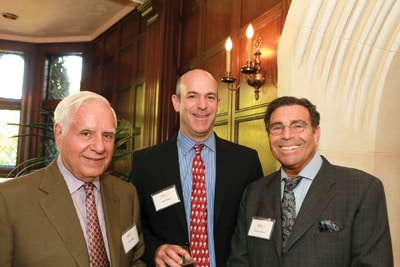
The tenure of Lew Wolff (left) has come to an end, John Fisher (center) will replace him

The tenure of Lew Wolff (left) has come to an end; John Fisher (center) will replace him

Susan Slusser first broke the news that Lew Wolff would step down and sell most of his stake in the A’s. John Fisher is taking over as the control person (managing partner) of A’s ownership, a.k.a. the Athletics Investment Group, LLP. Fisher was approved to day as control person by MLB during the owners’ meetings in Chicago today. Wolff will maintain a small share of the team and a Chairman Emeritus title. Mike Crowley is also stepping down as team president, to be replaced by Earthquakes president Dave Kaval. Crowley will remain a senior advisor, while Kaval will continue to run both the A’s and Quakes. Now the links:

A’s shakeup: Wolff, Crowley out as team redoubles stadium efforts (Susan Slusser, Chronicle)

A’s: Wolff exits, more change coming; may bode well for future in Oakland (John Hickey, BANG)

Lew Wolff would not be stepping down if he was 20 years younger (Joe Stiglich, CSN)

Purdy: Wolff outlines reasons he stepped aside, predicts Fisher will decide on A’s ballpark site soon (Mark Purdy, BANG)

Earthquakes, A’s promotion increases profile of new soccer GM (Elliot Almond, BANG)

Will A’s ownership shift hit stadium plan out of the park? (Ron Leuty, SFBT)

New A’s president Dave Kaval focused on stadium, community (Susan Slusser, Chronicle)

New A’s man Kaval tasked with performing stadium-sized magic (Ray Ratto, CSN)

And the A’s press release:

This is not moving the deck chairs, as Bruce Jenkins would suggest. Nor is it clearing the decks, as Fisher is still the money man and majority partner in shifted ownership group. What matters is Fisher’s commitment to the ballpark effort and the presence of Kaval, a gifted salesman/marketer who was a key player in completing Avaya Stadium. Kaval is bringing over many of the tools he used during his Quakes tenure: social media, accessibility through regular office hours, and thinking outside the box. That said, the Quakes bear one very similar operational trait as the A’s: a resistance to big expensive player contracts. That’s despite a new stadium and a league salary cap designed to prevent profligate spending by teams. MLB’s a few levels up from MLS economically, so that could potentially be different for the A’s, but it will all depend on revenue in the short term, and projected boosts if the A’s get an Oakland ballpark deal done. Still, there is much greater hope for a ballpark than there has been in several years. Kaval is an engaging, smart guy who knows how to read a room. Just the fact that he’s much more approachable than Wolff, Crowley, and especially Fisher should help the A’s standing in Oakland. It can’t hurt. The A’s will need strong community support to build their ballpark. Maybe, just maybe, we’ll see a plan in the coming months. Wolff and Fisher have experienced success with Kaval running point. They’re hoping he can repeat that success with a much tougher project.

More tomorrow.

Baseball’s pretty great

So here’s what happened. I got home and the power was out. While reporting the outage, I jumped on a bus to head into Old Town (<5 minutes, no driving tonight). Got off and went over the Jack’s, a nearby sports bar. When I got to the door I found out that Jack’s had closed two weeks ago. So I walked further into downtown Scottsdale, settling upon Scapegoat, one of my favorite bars. The goat reference was coincidental, yet I took it all the way. I ate a lovely sandwich called ‘The G.O.A.T.’ If the bar had Celebrator I would’ve loaded up.

When I entered it was still largely an after-work crowd with a handful of Cubs fans watching the game. Scapegoat is not a sports bar and only has one TV. It’s also a quite small bar, so when a crowd of 20 people come in they can practically take over the place. So I chatted up a bunch of Cubs fans that came around the 5th inning and a couple Indians fans, me being the neutral observer. As the tension rose the Cubs fans got more jokey (a well-developed defense mechanism I have seen elsewhere), but still desperately hopeful. Even as the Cubs lost the lead the fans didn’t get depressed. They saw the prize in the near distance. And as Kris Bryant smiled while fielding the last grounder and threw to first for the final out, I sat there and watched the gathered fans. I realized that I’ll never truly appreciate winning like they are right now. The fans have been down for so long, so much failure and disappointment, and now the ultimate in sheer joy. It was beautiful.

As I left I shook hands with them and said, “Enjoy this. Next year the Cubs will be hated by America like every other team.” I’m sure they enjoyed it to the fullest. I walked home.

Baseball’s pretty great, indeed.