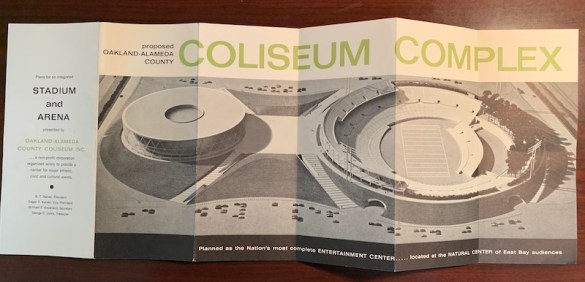
Original Coliseum pamphlet provided by Peerless Coffee’s George Vukasin, Jr.
Do you remember the name Egbert Perry?
No?
Perry was the money-partner with Ronnie Lott for a short-lived 2016 offer to buy the Coliseum complex, including both the stadium and arena, plus the additional parcels purchased extending to Hegenberger. Then just like that, the City of Oakland nixed the offer. Vegas interests and the Nevada continued to work with the Raiders on site plans for the football franchise’s move, and the Raiders have been running out the clock in Oakland ever since.
The A’s weren’t part of the Lott-Perry plan, which may have spurred the City’s decision. The offer was for $167.3 million and was made prior to a reappraisal of the complex, completed later in 2016. It was that appraisal that provides the basis for the A’s offer on the Coliseum property, a half-interest (Alameda County) for $85 million. Do the math to buy out the City’s share, and you have $170 million, remarkably close to the old appraisal. A mere two weeks after the offer was made, the offer was retracted and Perry was out after a purported double-cross.
Previously, Floyd Kephart’s New City group offered $116 million in 2015. That also didn’t get far. Which makes the news that the City is suing the County over the sale of the County’s half-interest of the Coliseum land not surprising in the least. Let’s be honest about this. Modern politics in Oakland has been shaped – for the worse – by frequent, almost constant litigation. It’s practically the only way the City knows how to operate. As reported by the Chronicle’s Phil Matier:
The suit took on added significance Tuesday when Alameda County Superior Court Judge Frank Roesch issued a temporary restraining order on the sale and set a Nov. 14 hearing on the lawsuit.
“We were very close. This will put a chilling effect on us being able to close the deal,” Kaval said following the judge’s order.
A’s CEO Dave Kaval expressed shock at the lawsuit. In his professional and personal time in the Bay Area, he surely learned some local political history, especially about Oakland and California as a whole. Kaval is the last person that should be surprised by this. Kaval (and John Fisher) were shocked by the Peralta blowback. You’d think they would’ve braced themselves for City-County political tensions. After all, Oakland and Alameda County spent the better part of the last 40 years mired in tensions. Everything you see, from the original Coliseum to Mount Davis, is a product of those tensions, along with the truly unquenchable thirst for pro sports that keeps being displayed.
Now that the A’s (and MLB) have Oakland to themselves, they can start squeezing. So it was on the day of the AL Wild Card game that MLB commissioner Rob Manfred started the squeeze. I opined at the time that I didn’t expect him to start this early. Manfred, via the Chronicle’s Susan Slusser:
“I made it clear that it’s time for the city of Oakland to show concrete progress on the stadium effort,” Manfred said. “It’s gone on too long, and things need to fall into place to get a new stadium here. The fans here, as demonstrated by the 55,000 here tonight, are great fans and deserve a major-league quality facility.”
We’ve seen this movie before. If the City folds on the lawsuit, Manfred will back sometime in February to praise City leaders for “coming to their senses.” If the City keeps on, we’ll start hearing louder murmurs about Portland. Or Nashville, Charlotte, Las Vegas, or maybe Salt Lake City or Sacramento. Probably not San Jose, as that ship has sailed. But don’t put it past Manfred to tighten the squeeze on Oakland, even if MLB’s apparent leverage is debatable. I wouldn’t discount the concept of Manfred taking over negotiations from Kaval and Fisher, using a team of negotiators to do the dirty work. Or Manfred could go the same route as he did with the Rays. In that case he started by granting the ability for the Rays to look at the City of Tampa/Hillsborough County. That resulted in the Ybor City domed ballpark plan, unveiled in June 2018 and dead by the end of the year. That was followed by the announcement of a potential split season situation, half in St. Petersburg and the other half in Montreal. Montreal backer Stephen Bronfman even showed up in Oakland last night, the better to get the Tampa denizens thinking.
Here’s the tough part. Oakland has barely stepped onto the legal battlefield. The EIR is supposed to be released before the end of this month, and that will bring its own lawsuit. Whether it’s from port operators, transportation companies, or Schnitzer Steel – or all three – it’s almost guaranteed to tie things up. Fortunately, the exemption the A’s lobbied for in Sacramento limits lawsuits to 270 days prior to certification. From the perspective of the A’s, it makes sense for them to prepare for that particular legal onslaught.
But the City getting on the same page with the County? They probably figured they had that in the bag. In May 2018, I saw a lot of remarks about how so many key figures were in the same room singing praises of the A’s plans.
The problems, as I pointed out back then, relate to the complexity of the projects. That’s right, projects – plural. As you know by now, there is the Howard Terminal part, the actual ballpark, located on the waterfront near Jack London Square. Then there’s the Coliseum, which will keep its arena (if anyone can afford to run it) and an amphitheater where the old stadium currently stands. Around that redone complex are a sizable urban park, commercial and residential development, plus some additional community facilities. It’s a way to throw a bone to East Oakland for leaving.
The plans also provide for some amount of affordable housing to be built and either or both locations. Just how much is the big topic of negotiation, as City Council President Rebecca Kaplan cited the state’s Surplus Lands Act in trying to put the kibosh on the sale. The main issue is the percentage and number of affordable housing units to be built:
…if the disposed land will be used for residential development, at least 25% of the total number of units in the development must have rents or sale prices that are affordable for persons and families of low- or moderate-income.
Of course, over the post-recession period, the Bay Area has been plagued by an inability to build affordable housing. Call it a perfect storm of rising construction costs, the ridiculous never-ending seller’s market, and the loss of decades-long affordable housing subsidies when former governor Jerry Brown killed redevelopment. There are perfectly reasonable arguments to be made on both sides of the debate. From the City’s angle, surplus land is an extremely limited resource that shouldn’t be handed out without a competitive bidding process. For developers including the A’s, having to bake in an allowance to accommodate a greater amount of affordable housing will undoubtedly cut into the profitability of the project. In the A’s case, it could impact the feasibility of both projects, though the A’s launched their own PR offensive to counter such notions.
Thing is, the A’s haven’t done a very good job of explaining how the two projects aren’t connected. They did a media tour of Howard Terminal a couple weeks to reaffirm their stance. From reading the Community Engagement document available at the A’s Ballpark site, the two efforts appear to be directly related, if not joined at the hip. That’s a tough position to be in, because once you decouple the two projects, it’s easier to argue that one doesn’t need the other.
The explanation is not that difficult. If the A’s are approved to build at Howard Terminal, they plan to build the ballpark in the first phase, hoping for a 2023 Opening Day. The ancillary development at Howard Terminal, whatever form it takes, will take place after the ballpark opens and will take perhaps decades to complete. That makes the A’s ballpark village next to Jack London Square part of the long tail. Meanwhile, the Coliseum is already approved for some 3,000 housing units right now. That makes the Coliseum a sort of bridge financing for the ballpark. Fisher and Lew Wolff employed this to success at the separate Avaya Stadium and iStar developments in San Jose, the latter helping the finance the former. What’s being attempted in Oakland is the same thing on steroids, except for one big difference. iStar, located in South San Jose near where IBM built the first disc drive, was largely undeveloped in its previous form. To date, Avaya Stadium is in its fourth year of operation near SJC Airport after breaking ground in 2012. Some commercial and residential development has been done at the iStar site, though we’re coming to the end of 2019 and not one single-family home has been completed. In San Jose, they built a stadium and a separate subdivision on separate parcels miles apart. In Oakland, they want to do something similar, except that they’ll move the sports-related jobs from the Coliseum to Howard Terminal in the process.
The sales pitch for the Avaya Stadium/iStar package didn’t arouse much debate in San Jose. The stadium was set to replace a former military vehicle manufacturing plant. San Jose’s historic sprawl had plenty of room for 25 acres of new housing, especially after the recession brought construction to a halt. Ten years later, the housing crunch is far more acute, reaching every part of the Bay Area. Collectively, local governments did a poor job of planning to add to the housing stock, including forecasting and accommodating affordable housing. If Oakland officials want to take nearly 200 acres in two high-profile locations and hand it to the A’s to finish the job, they and the A’s should prepare themselves for the lengthy debate to follow. Manfred, who played the nice guy until Wednesday, now gets to play the heavy.
—
P.S. – Please don’t tell me how no developers want any part of East Oakland. Besides the A’s interest, the JPA had two unsolicited bids for the land in 2018, Tesla and a group trying to build a soccer complex and stadium at the complex. What developers want is Bay Area land for relatively cheap. Interest from previous developers for Coliseum City, the 2018 bids, and the eventual exclusive negotiating agreements for the A’s shows how much people want to take advantage of the Coliseum. It doesn’t hurt that the land has freeways and a transit hub right next to it. East Oakland has no potential? Perhaps if you’re stuck with a 1968 mindset.
P.P.S. – Read J.K. Dineen’s piece in the Chronicle for an extensive description of one property owner’s CEQA-related shakedown and how it affected both San Francisco and Oakland. Then take a look at that Community Engagement document and try to understand what kinds of partnerships are being forged, and what remains to make a similar one with the City. Keeping any sports team in Oakland is/was going to cost something. The City is thankfully over direct subsidies, but the ambitious nature of these two projects has me thinking that the final price tag will approach eleven figures including cleanup, community commitments, and new infrastructure. That might be what it takes. No one is publicly talking about costs yet. That’s what truly concerns me.
P.P.P.S. – None of the oft-mentioned relocation candidates deserve more than a cursory look unless they approve or start building a major league-ready ballpark. These days that might mean 30,000 seats or less. It probably also means those 30,000 seats will be quite swanky with pricing and amenities to match. The new AAA parks in Las Vegas and Nashville are exactly as advertised – nice AAA parks. They’re not meant to handle MLB crowds temporarily given the greater requirements these days. If someone wants to ink a deal with Henderson, Nevada for a billion-dollar domed ballpark 10 miles from the Strip, good luck.




 newballpark.org