After the release of the Howard Terminal Draft EIR, I waited for the compiled comments to become available. Beneath the pleas from transit agencies and housing groups, there was a video provided by none other than Union Pacific (UPRR). The well-produced video comment is not much longer than a typical music video and comes with a highly professional voiceover.
Video illustrates hypothetical train parked in front of Howard Terminal
Union Pacific continues to raise concerns over the project, saying that it will impact its operations. The chief problem is that when a train stops at UPRR’s yard to the west of Howard Terminal, it will often be stuck there for 10-45 minutes as a long train is effectively split into three parts to fit it into the tracks at the yard. After that switching activity is completed the train can be loaded or unloaded. Presumably, the train has to be reassembled to some extent in order to begin its next journey.
Okay, we knew that going in, nothing new, right? Ah, but there’s a twist. UPRR acknowledges that despite its concerns, the City of Oakland could plow ahead with the project anyway. If that happens, UPRR is prepared to make demands. The big ask, which I heard from PMSA’s Mike Jacob in a discussion with Zennie Abraham yesterday, is that UPRR will request that all construction traffic be grade separated from the active rail line before construction on the rest of the project begins.
Block or charge? You make the call
It’s a reasonable request from a safety standpoint, one that I could see the Federal Rail Administration, Caltrans, and Amtrak supporting. If you’re going to reduce the risk of train-automobile or train-pedestrian/bike interactions, putting in a grade separation at Market Street (location not finalized) makes sense. The problem with that what we’re really talking about is putting in a big concrete bridge at Market, a piece of infrastructure that the A’s have been hesitant to commit to. As UPRR’s Robert Bylsma wrote in May:
Of course, a fully grade-separated entrance to the site that can handle trucks and heavy iron won’t be cheap. It’s not a showstopper, since if that’s the cost of doing business at Howard Terminal, that’s the cost of doing business. It does push a major project cost to the front of the line where it would compete with other line items. Plus there’s the visual issue of an eyesore bridge going up before the ballpark or anything else along the waterfront. During last week’s session, City staff still considered the vehicular grade separation an alternative, not a requirement.
Kalb brings up grade separation including the pedestrian bridge. Maybrun cites transit hub on 2nd Street as a mitigation measure. The vehicular grade separation would be near Market/Brush, is listed as an alternative, not a requirement. #oakmtg#HowardTerminal
With the separate vehicular and pedestrian bridges added to the project, the grade separation cost alone threatens to run into the $300 million range. There’s no surprise there. Good quality infrastructure costs money. When HT was considered 10 years ago for a ballpark, guess how much a new BART station at Market or Brush streets was estimated to cost? $250-300 million. I guess in hindsight I can see why A’s ownership is being so tightfisted about an item as fundamental in 2021 as affordable housing. Even if your budget is projected to hit $12 Billion, every $300 million counts.
It’s the early morning of July 8. In less than two weeks, the City of Oakland is scheduled to vote on a term sheet, which despite it being a non-binding document, could play a major role in determining whether the Oakland A’s remain the Oakland A’s. Will it be the term sheet submitted by the A’s? A term sheet written by City staff? Or a compromise version that incorporates key principles from both parties? Or will the parties reassess this mess of a situation, and punt?
Towards the end of today’s study session, Council Member Dan Kalb, who chairs the Community and Economic Development Committee, offered his assessment of how Howard Terminal has progressed since the beginning of the year:
Kalb: Prior to April 2021 I thought City staff and the A’s would present the proposal together for the Council to approve. Term sheet and what City had were very different. What efforts are the A’s willing to make to ensure that both are on the same page? #oakmtg#HowardTerminal
Tonight I’m hearing from the optimists that this all smacks of negotiation in one form or another. Looking at it through Kalb’s (and the other City Council members’) prism, the view is much more chaotic. We are now to believe that the A’s provided their term sheet in January with every intention of getting it approved with minimal changes. Then, having not received much feedback early this year, the A’s publicly released the term sheet in April. City staff, with its divergent goal of getting a term sheet in place that would get enough votes for the Council to approve it – a markedly different goal from the A’s take-it-or-leave-it proposal – scrambled to get that passable term sheet in place. As of now it’s still not finalized. Once it is, if it is passed, it will go back to the A’s for their approval or markup. Or the A’s could find points to compromise and approve it, or dismiss it altogether.
That’s a wide range of outcomes to have at this artificially late stage of the game. There are major deal points that have not been agreed upon yet, chiefly the issues of affordable housing within Howard Terminal and the fate of the “offsite” IFD encompassing much of the area north of Howard Terminal and going west to Mandela Parkway and east all the way to Oak Street. I tweeted out a snap poll to gauge which was most important among the four main issues I identified.
Post-mortem question: Which is the toughest #HowardTerminal issue to tackle?
The affordable housing question seems like the most cut-and-dried issue. Simply put, any major development in Oakland requires a percentage of it to be considered affordable housing. The target is 15%, though because Howard Terminal is under the Oakland Army Base redevelopment rules, the target at HT is only 8%. That equates to 240 affordable homes in the final buildout. A lowered goal should be achievable, right? Not for the A’s, who feel they’re already providing enough via tax increment from the development that could fund affordable housing elsewhere. That argument worked well 20 years ago when California’s housing crisis was less stark. Now it’s downright unreasonable to expect that a developer could go this route especially with the historically poor yields of finished affordable housing throughout the Bay Area.
To illustrate, let’s posit that a newer one-bedroom apartment at HT costs $2,300/month. Under one measure, affordable housing could mean that apartment costs a qualified renter $1,500/month, plus an $800 monthly subsidy paid by an affordable housing fund. That subsidy translates to roughly $10,000 per year, which multiplied by 240 units equals $2.4 million per year. I recognize I’m oversimplifying the problem with this illustration because I’m not tackling levels of affordability, but it should serve the discussion well. No matter how you slice it, that’s a hefty expenditure to be paid by tax increment, a developer, or a renter.
Next up, let’s look at the non-relocation clause. The City wants a term of at least 45 years, which would keep the A’s in Oakland for the next generation or two. The A’s are promising only 20 years, which they say is in keeping with other markets where, as Dave Kaval pointed out, the ballpark is often publicly financed (meaning the City is putting skin in the game). If the City isn’t directly subsidizing the ballpark, the A’s have less reason to take a longer than standard contract. From a practical standpoint, it’s rare to see relocation occur when the first lease term ends, mostly because a team has spent enough time and resources cultivating its home fanbase that it seems wasteful to pursue another so quickly. That generally holds true in baseball, where the last relocation was in 1972 (Washington Senators-Texas Rangers). In other sports it’s far more common, whether you’re talking about the Raiders or hockey in Atlanta. Usually whatever complaints a team has about its venue or market can be addressed by upgrading the facility or building elsewhere in the same market. The A’s sudden scorched earth campaign has sort of laid waste to Oakland, leaving Howard Terminal as the only desirable spot in the East Bay market.
The other major issue concerned the two IFDs or infrastructure financing districts. The A’s prefer two, one at the 55-acre Howard Terminal site and the offsite JLS site. City prefers a single IFD which would essentially be Howard Terminal with few surrounding parcels. City thinks the single IFD structure would be easier to get buy-in from Alameda County, which as you might have heard, isn’t exactly jumping for joy at the prospect. For their part, the A’s continue to say that they need both IFDs to ensure there’s enough tax increment revenue to cover all of the infrastructure and other costs. The problem with this is that without the JLS IFD there’s a major funding gap. As @hyphy_republic noted, City has identified Port-related sources that could backfill that need. Those would have to be studied thoroughly for their efficacy. As I started processing this detail, it occurred to me how ironic it is for the City go to the Port for funding while alienating Port stakeholders who are among the harshest critics of the proposal.
Lastly, there’s a question about the amount of community benefits in the package. The concern is that most of the money raised by tax increment usually goes straight to hard infrastructure in a straight line, or perhaps affordable housing. Other community programs may be more likely to be sacrificed in the event of a budget crunch or just plain old-fashioned value engineering.
Remaining milestones assuming it gets that far: Tell me how the City of Oakland is supposed to make a final approval of this project in September as Dave Kaval suggests
Look, I have no idea if the term sheet will pass in less than two weeks. It might, and then in September the County could choose not to take part, wrecking the project. Again, someone could punt on 7/20 and hope MLB doesn’t accelerate relocation talks. All I know is that this project has now come up in three separate major public hearings in the last two months: the Oakland Planning Commission, the Alameda County Board of Supervisors, and now the Oakland City Council. In every venue there was serious tension and rancor between the governing body and the applicant (the A’s). You’re not going to just wipe it away by calling it negotiation. This is much deeper than mere negotiation. The City and the A’s appear to be at cross purposes, and if you throw the County into the mix, all three are. This is what I worried about when Howard Terminal was first proposed and when it came back to life. It’s an already complex set of circumstances made all the more complicated by the current regional economy. Maybe there is a breakthrough on the horizon. Judging from CM Kalb’s reaction, he was expecting a breakthrough sometime ago. It ended up being a mirage.
—
P.S. – The City has officially opened up discussions on its half of the Coliseum complex. I’ll save that discussion for another day.
P.P.S. – You read that right earlier and I almost forgot to mention it. During the hearding, the A’s filed a suit against Schnitzer Steel alleging a Clean Air Act violation. Now that’s some multitasking.
Before I begin, I’m going to direct you to two blog posts on other sites. The first, by Jeff August, is at his own site, Jeff August Ego Trip. Jeff is a good friend and remains in the credits in the sidebar, though he hasn’t contributed to this site for several years. His viewpoint on Howard Terminal evolved over time, and while I haven’t had a chance to talk to him about it and I disagree with his conclusion, I fully respect it because it comes from an honest place.
The other link is from Alex Espinoza’s blog, The Rickey Henderson of Blogs. Espinoza did the inhuman task of compiling observations from Tuesday’s extraordinarily long Alameda County Board of Supervisors meeting. The 6,000-word entry is truly impressive in its scope. I admitted to him while reading it that there’s no way I would try to take such notes as I would have to watch it twice to do so.
Espinoza also interviewed me before the baseball season started to discuss ballpark stuff and economics. If you haven’t checked out that podcast episode yet, you should.
After reading both posts, I immediately recalled comments made by Oakland City Administrator Betsy Lake regarding the planning aspects of the Howard Terminal Ballpark project. Lake considered the current A’s/City proposal fiscally irresponsible. Lake was asked by Alameda County Supervisor Wilma Chan about why the City is going through with the Howard Terminal if it’s not expressly for the purpose of building a ballpark. That brought on the following awkward exchange:
Chan calls the City’s claim that the County won’t be on the hook for the EIFD *sophistry*. Chan asks why County is doing this if it’s not to build a stadium. This is a great line of questioning that I will go over in a future post. #HowardTerminal#AlamedaCountyBoS
Chan gets Lake to admit that if the ballpark isn’t built, waterfront area out to West Oakland becomes available for redevelopment. 💥 #HowardTerminal#AlamedaCountyBoS
Before Maybrun presents, Miley asks Lake to confirm the “but for” status of Howard Terminal. She walks it back and says nothing gets built there without the ballpark. 💥 #HowardTerminal#AlamedaCountyBoS
That brings me to the belated thesis of this post. It would be one thing if the A’s built a ballpark on a 14-acre city block downtown, one that conformed with the existing city and neighborhood plans. The A’s, to my complete befuddlement, are instead proposing a mega-development with its own taxing authority (HT IFD), with ancillary infrastructure funded by a separate taxing authority (JLS IFD), yet nothing is being done to amend the City’s Downtown Specific Plan or West Oakland Specific Plan to properly accommodate those changes. The Downtown Oakland Specific Plan and EIR are still in Draft form and don’t include Howard Terminal, an odd choice given that Howard Terminal is being promoted as at least downtown-adjacent. It’s entirely a cart-before-horse scenario.
At the Oakland Planning Commission hearing in April, there was a mention of the Google Downtown development in San Jose, which went through the full planning process including a certified EIR. Not only that, San Jose expanded its definition of Downtown San Jose to fold in the previously separate area, which includes Diridon Station and SAP Center west of CA-87. Construction begins in 2023. Ironically, the catalyst for that entire effort was the planned A’s ballpark south of the train station. At the time San Jose went through with the exercise with no guarantee of obtaining the baseball club. But they did something that seems utterly novel when compared to the chaos in Oakland: they made a contingency plan.
That’s right, they had a Plan B.
San Jose Downtown West, dominated by Google
San Jose knew that as Silicon Valley grew eventually there would be demand for residential and commercial real estate in the newly-minted Downtown West area, which besides the arena was mostly surface lots and low-slung light industrial buildings. It was ripe for redevelopment, and despite Jerry Brown killing RDAs years ago, was assembled for a completely new vision with existing Caltrain/VTA light rail and future BART and HSR anchoring a transit hub, preposterously named the “Grand Central of the West.” Location and accessibility would earn attractiveness for a high-profile employer, most of whom generally avoided Downtown San Jose until that point. Next, the ballpark proposal died with the Giants’ legally upheld territorial claims, San Jose started looking for suitors for Plan B, and Google entered the picture. The rest is history in progress, with San Jose residents asking (and getting) more from Google in the form of a Community Benefits Agreement. Oakland is watching San Jose and is wise enough to take notes. The funny thing is that Oakland started pursuing Howard Terminal as a ballpark site years before San Jose did theirs. If you count the original HOK study which featured Howard Terminal, the site has been in an on/off pursuit for better than 20 years. Oakland, caught between trying and failing to keep their sports franchises, attracting new non-sports employers, and catering to the needs of its entrenched business interests (Port) as well as its unique and diverse population, showed the kind of indecision that could doom its ballpark plans, even its future as a MLB town.
San Jose Downtown West’s current state is humble and nondescript, not for long
Look, I am fully aware that San Jose and Oakland are worlds apart economically. Not as far apart as Oakland and San Francisco, but close. San Jose did the right thing by expanding their scope, by not limiting themselves to the pursuit of a sports franchise. If the A’s moved to San Jose, great. Maybe Google would look elsewhere for a secondary campus because the A’s partners would’ve gobbled up most of the nearby land. The A’s didn’t move south, which allowed San Jose to have the Adult Conversation about its vision with residents and businesses. That conversation is something I clamored for Oakland to have since nearly the start of this blog. It happens in fits and starts, never getting above a din peppered with occasional protests. Recently, Oakland asked Alameda County to participate in the Howard Terminal IFD by pledging its share for the on-site infrastructure. County Supervisors were taken aback, though if they were honest, they should’ve seen it coming and prepared for it. I didn’t expect Oakland to pull this off on its own. No one should have given how dysfunctional Oakland is. That said, Alameda County sold its half of the Coliseum in an effort to get out of sports. The Supervisors’ outrage at being put in this situation by Oakland is consistent with previous actions.
Unfortunately, the confusion over Oakland’s plans (or lack thereof) is also consistent with its previous actions. Friends, that is not a good sign. The Supervisors and their Oakland City Council counterparts put a positive spin on how things are progressing. HT supporters slurp it up without bothering to inspect the problems beneath the surface. The bottom line is that the Council is divided. The Board of Supervisors is also divided. Everyone wants to get to Yes, as Supervisor David Haubert suggests. The problem is that no one knows what Yes means except in the most vague, general terms. As Jeff pointed out in his post, 33 regional/state/federal agencies have to approve this project. Howard Terminal should be part of the Downtown Specific Plan, but that would have first required removing its maritime designation, cleaning up and disposing of the land through a public process, and numerous other steps which can’t start because of related complications. According to the A’s, time’s running out for Oakland. I don’t believe that because I believe in practical, real solutions. The A’s and MLB’s greatest tactical weapon is to ratchet up the tension on Oakland to get their desired outcome, whatever that is, however long that takes. They’ll do it again and again until they see results. It’s easy to confuse tactics with strategy, which so far the A’s and baseball have not shown an ability to execute either in Oakland or Tampa Bay. Yes, in absolute terms the A’s could move, but MLB has made it intentionally difficult to do so. I wouldn’t worry about that in the near term. Right now there’s a drought and a heat wave in the Bay Area. It’s not even summer yet! Frankly, it feels poetic.
Be safe out there.
–
P.S. – Google is not moving its headquarters away from Mountain View.
P.P.S. – The City of Oakland will release a revised term sheet after its study session on July 7. The release will occur no later than 7/16, which will give them 4+ days to review the terms prior to the 7/20 vote. My reaction to that news:
The revised #HowardTerminal term sheet puts the 6/15 #AlamedaCountyBoS meeting into new light. If they didn’t have the benefit of the info from the revised term sheet, what were they supposedly voting to approve? They were right to table it.
I’ll drop in more of the select tweets as I go through the night. Enjoy the process.
My favorite moment of the long night:
Carson clarifies from Lake the City is asking for a NON-BINDING vote. He then launches into a great anecdote about how NON-BINDING is like telling your child you’re planning for a Disneyland trip and then watching the $ signs add up. #HowardTerminal#AlamedaCountyBoS
Valle with the first sports analogy: County is in the bottom of the 9th down a grand slam. They were brought in late in the game. #HowardTerminal#AlamedaCountyBoS
Issues for Oakland to address before 7/20 1. When did City realize that it wouldn't be able to go it alone w IFDs? 2. Did they communicate this to anyone in AlCo in the past 2 yrs? 3. If the JLS (offsite) IFD doesn't get approved, how is feasibility affected?#HowardTerminal
Another thing to consider about #HowardTerminal – Now that Alameda County kicked the can to possibly September, what does that mean for the City of Oakland’s sense of urgency? Do they feel more pressure to approve on 7/20, or do they ask for more time?
Former Giants VP Corey Busch, who was part of Bud Selig’s Blue Ribbon Panel to study the A’s future in Oakland (and San Jose) a decade ago, was interviewed by the Merc’s Shayna Rubin yesterday. And boy, did Busch had some thoughts.
The big reveal was Busch’s belief that former Giants owner Bob Lurie was never going to ship the team to Florida. Selling the team was, as Busch recounted, merely a ruse to motivate a local buyer for the franchise, which eventually happened when Peter Magowan stepped up. That’s not to discount the tremendous amount of drama at the end of Lurie’s ownership tenure, which involved St. Petersburg and dalliances with San Jose and Santa Clara. Exploration of the South Bay included A’s owner Walter Haas agreeing to cede Santa Clara County to the Giants, which was previously an unassigned territory for MLB’s purposes. The South Bay is now and forever San Francisco Giants territory, even though they will probably never play a game there.
Busch also went out of his way to defend the Coliseum, decrying A’s ownership’s desire for a downtown ballpark – and only a downtown ballpark – at Howard Terminal.
Busch determined the Coliseum site was viable in 2014 on Selig’s blue-ribbon committee to explore ballpark options. He still attests the A’s can build the ballpark village of their dreams around the site. MLB and the A’s declared this month that the Coliseum site “not viable” as a location for a new park.
“The notion that the Coliseum, if properly developed in its totality, is not acceptable is kind of silly. It’s nonsense,” Busch said. “I know for a fact there are people in the commissioner’s office who know the Coliseum site is a good site.”
All Bay Collective’s 2018 Estuary Commons concept (Coliseum/Airport area)
Right now the Coliseum is not in the conversation due to the stubbornness of ownership. At some point it will re-enter the picture, unless everything from this point forward falls in line for Howard Terminal. For all their posturing, the A’s still continue to attempt to buy the City’s half of the Coliseum. And even though Dave Kaval announced the A’s were on “parallel tracks” with Oakland and Las Vegas (I thought there was no “Plan B”?), it’s not hard to see a third path, one that brings them back home.
Oakland’s City Council has a non-binding vote scheduled for July 20 on the Howard Terminal project. If the majority of the council votes Yes, the project continues, including the tangled negotiations for community benefits, transportation, and mitigation for the Port stakeholders. HT proponents, who are mostly a ragtag bunch of volunteers at this point, are pushing the pro message.
But what happens if Howard Terminal gets voted down?
That’s a subject that hasn’t been broached much by local or national media. Honestly, who wants to spend much time gazing beyond the edge of a cliff? Given A’s ownership’s recent Vegas trip, Sin City would appear the be in the lead as a candidate for relocation. A’s President Dave Kaval even nixed a planned trip to Portland, desiring to explore Vegas further.
So Vegas is the ace in hand, while Portland is the ace in the hole. Except they’re not. They’re both bluffs at this point. Kaval’s trip to Vegas was exploratory in nature, with no definitive sites or organized funding instruments at hand. Kaval tweeted from a Golden Knights playoff game, which created blowback from fans. There were meetings with Las Vegas Mayor Carolyn Goodman, representatives from Henderson (where the Raiders training facility is located), and Summerlin (where the A’s AAA affiliate Aviators play). The three options provided are far from ideal. Let’s break them down.
Mayor Goodman wants to redevelop the old Cashman Field/Cashman Center complex to include a domed stadium just as her husband did. As the site is within city limits and not in unincorporated Clark County like the Strip, that makes sense. However, going north past Downtown (Old Las Vegas), past a freeway, and to the Cashman site, is its own cliff in a sense. I visited Cashman a few years ago, before the stadium was converted for soccer use, and well, it’s the same dump the A’s played in 25 years ago while the Coliseum was refurbished for the Raiders, except that it has aged. The concept for now is to level both the ballpark and the small convention space next door and build a domed stadium on the spot. Kaval weighed in with the Las Vegas Review Journal on the subject, including one foul tasting nugget:
Domed stadium? Say it ain’t so, Dave.
Henderson doesn’t have a specific site to offer up to the A’s yet. Summerlin’s plan would presumably be to build the dome over the curiously named Las Vegas Ballpark. Both Henderson and Summerlin are 10 miles from the Strip, in nicer neighborhoods than Cashman. As I considered the options, the A’s and MLB’s likely strategy became clearer to me. It all comes down to Vegas’s previous successes with the NHL (Golden Knights) and NHL (Raiders). Though we haven’t heard about it, I wouldn’t be surprised to see the recently vacated Sam Boyd Stadium enter the picture. It’s also 10 miles away (east) of the Strip.
Think of this way: NHL got a new arena on the Strip. NFL got a new domed stadium just off the Strip. The Vegas area is offering ballpark sites in suburbs and a depressed area near downtown. Why would MLB and the A’s bite? Shouldn’t MLB want to be near the Strip too?
If MLB considers Vegas a small market from a population and TV audience size perspective, any relocation or expansion-to-Vegas strategy will have to include a plan to capture as many tourist fans as possible. In the past that was somewhat controversial for the potential competition between pro sports and other forms of entertainment, but now, it’s all fair game and can be somewhat synergistic depending on whatever events are happening during baseball season. That makes the location of the ballpark key, as a 30-minute ride away from the Strip is not conducive to capturing much of that tourist base.
Last year, Caesars put the off-Strip Rio Hotel and Casino up for sale. There were rumors that the site would make a good landing spot for a MLB team, with space for a domed stadium and a mega-development. Alas, a real estate firm gobbled up the property and is rebranding it a Hyatt Regency among other things. Given how the stakes for teams were raised by Commissioner Rob Manfred recently, it’s worth asking whether The Strip or an off-Strip site is the only location in Southern Nevada that makes sense. If we’re going by the standard of placing a ballpark in the middle of a downtown or central business district, Henderson and Summerlin don’t make the cut the same way Fremont or anywhere on the I-680 corridor wouldn’t work in the East Bay. Never mind that the ballparks for the Braves and Rangers violate the “downtown” standard.
Beyond Las Vegas’s stalking horse status, let’s consider next steps. For Vegas to work for three-quarters of baseball owners to approve a move, there needs to be a clear economic advantage in moving a team there. Southern Nevada had the benefit of a Stanley Cup Finals-bound team in its inaugural year, truly an enviable feat. There’s plenty of earned goodwill to keep attendance strong there for years to come, plus the Golden Knights get the spoils of being the pioneer in the market. Despite the pandemic-marred 2020 regular season, Raiders attendance should be strong thanks to its large migratory fanbase. MLB is different in that so much of a team’s revenue is generated locally from ticket/suite sales and local television rights.
Sportico reports that the A’s pulled in $220 million in revenue for the 2019 season, the last full regular season on record. 2019 also happened to be the last year the A’s received a revenue sharing receipt (25% share), which showed when the team stripped costs to the bone in 2020 by laying off front office employees, minor leaguers, even scouts. The teams in the middle of the revenue pack, Minnesota and Milwaukee, had figures of $289 million and $286 million in 2019. That makes the gulf between the A’s and other small market teams that opened new ballparks recently around $70 million, inclusive of all media and sponsorship deals but without revenue sharing thanks to the A’s big market status. If the A’s move to a smaller market, they will immediately become a revenue sharing recipient simply because they won’t be able to compete with the big markets. Despite the top-heavy big-market focus of MLB franchises, baseball realizes that it needs all 30 teams to compete at least once in a while. If Tampa Bay moves to Montreal or a Southern city there won’t be a revenue sharing change.
The A’s remain a unique case because of its place as the economically inferior team in a two-team market. The traditional markets, New York, Chicago, and Los Angeles, don’t have strange revenue carveouts or oddly gerrymandered territories. The A’s are a sort of enclave (think Piedmont or Newark) within Northern California, which is dominated by the Giants. The O’s and Nats’ relationship is defined mostly by the O’s owning the sports network that broadcasts both teams.
“Howard Terminal or Bust” is effectively the admission that the A’s can no longer function as a big market team under the current operating situation. They must move to a newer (albeit not bigger) stadium where they can maximize revenue. The A’s are only starting to rebuild their radio presence after a controversial online effort. The A’s TV revenue is in the middle of the pack among MLB teams, which is fine for now and helps to stabilize the franchise. Altogether, the A’s exploration of other markets is ostensibly the search for a replacement level market. If the A’s can get that extra $70 million annually through Howard Terminal, the team can stay in the East Bay. If they can’t get that $70 million, they might as well find out if that money can come elsewhere. Personally, I think they’re going to find out that’s a much tougher task than it seems. Local TV revenue is transforming thanks to streaming threatening to make many RSNs obsolete. Radio is a wounded animal, a necessary annoyance. Ballparks are getting smaller while trying to cater a more exclusive clientele. If the A’s and Oakland are going to prove they can hang with the big boys, Howard Terminal is the way to do it.
That’s what they want you to believe, anyway. I’ll have more to say on that later.
–
P.S. – Henderson, NV, was in MLB’s sights two years ago, when the Arizona Diamondbacks used a trip to Henderson to help pressure Maricopa County to help fund improvements to Chase Field. A ticket tax was approved earlier this month, though the team is being coy about whether they’ll use it. Henderson played its role well that time.
P.P.S. – The City of Oakland is urging the Alameda County Board of Supervisors to fork over a matching share of funds from the EIFDs (Enhanced Infrastructure Financing Districts) proposed for the Howard Terminal project. One of the EIFDs is for the 55-acres of Howard Terminal. The other is for a large swath of Jack London Square and the surrounding neighborhood, which got me thinking:
Step 1: Buy out Alameda County’s share of Coliseum Step 2: Convince Alameda County to contribute property taxes to Howard Terminal Step 3: Buy out City’s share of Coliseum Step 4: Profit! https://t.co/pXoWupYEgN
Just watch Brodie Brazil from NBC Sports California, dissecting the A’s relocation drama point by point, including some historical references. It’s excellent.
To sum up this week in #Athletics ballpark drama: 1. MLB/A’s make relocation threat to Oakland 2. Mayor claims to support A’s & Howard Terminal 3. Splinter City Council group asks MLB questions about Coliseum viability, no HT mention 4. City Council schedules vote for 7/20#CYA
UPDATE 3:30 PM: The squeaky wheel always gets the grease. Council vote on 7/20.
Oakland city council will vote July 20 on the A's Howard Terminal ballpark and downtown development proposal — expected to cost $12 billion in total.https://t.co/ExnyOcuVu0
— San Francisco Chronicle (@sfchronicle) May 14, 2021
—
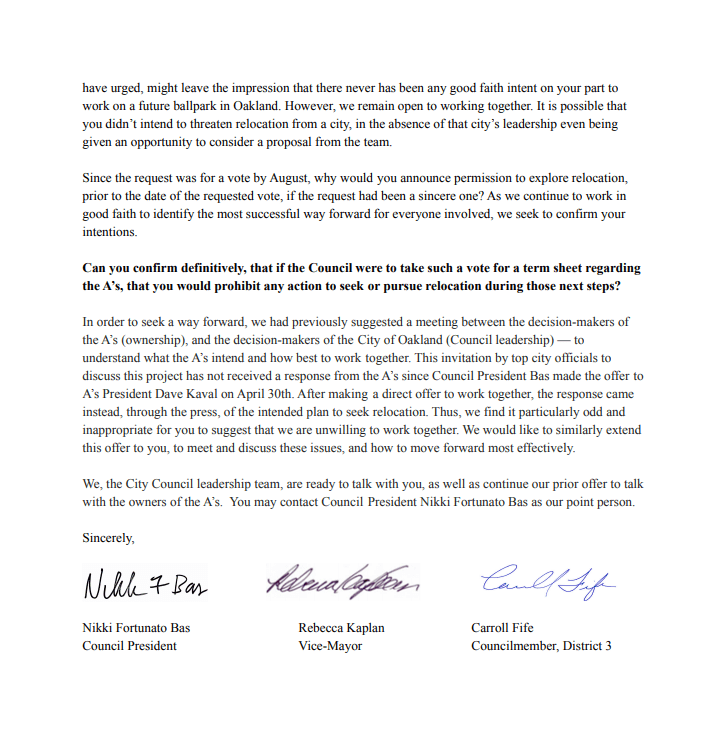
I’ll preface the following (from KRON) by pointing out that the three signatories to the letter are the most ardent skeptics of Howard Terminal. Read what you will into the letter.
The questions are fair. It reminds me of two bits of fairly recent A’s history.
20 years ago: Oakland responds to A's discussions with Santa Clara and Las Vegas by commissioning its own ballpark study. Coda: Santa Clara gets spooked, Vegas doesn't materialize. https://t.co/xsltwfF5CN via @SFGate
In 2015 the City of Oakland released a Coliseum Area Specific Plan. Amazingly, it had real estimates for various types of required infrastructure. Imagine what could happen if the A’s let Howard Terminal goes through a full, proper planning process instead of rushing it.
There’s a lot of additional City-owned land to throw into the pot if they want to sweeten a Howard Terminal deal or nudge the team back to the Coliseum
Ongoing talks over whether the City will sell its half of the Coliseum complex to the A’s are scheduled for May 20. I had a response to that as well:
From Carroll Fife, Oakland District 3 (West Oakland including Howard Terminal) Council Member:
Imma say this loud for the folx in the back: MY IMMEDIATE PRIORITY IN THIS MOMENT IS ADDRESSING HOMELESSNESS & PUBLIC SAFETY. PEOPLE ARE DYING. BASEBALL GAMES ARE SECONDARY. #Priorities




 newballpark.org