The illusion of pendulum swings

There’s been a wide range of reaction from Bud Selig’s non-update yesterday.

  • Gwen Knapp: “No decision means ‘no’ to the A’s. They aren’t getting the rights to San Jose, not yet, not soon, not even over Larry Baer’s stone-cold corpse.”
  • Mark Purdy: “And no action was taken — although Wolff’s quotes do indicate the blue-ribbon panel’s findings back up his contention that none of the Oakland stadium ‘proposals’ amount to anything.” (Purdy also brought up a potential antitrust case on KNBR.)
  • Ray Ratto: “So [the owners] see no compelling reason to hurry toward a decision they don’t want to make anyway.”
  • Art Spander: “The solution to all this is for Wolff, who wants nothing to do with authorities and business people in Oakland, a place he doesn’t live, to reach a compromise.”
  • Robert Gammon: “…it seems clear that the Giants’ presentation was more persuasive and that the rest of the league has no intention of overruling the Giants’ opposition to the A’s move.”
  • Jon Heyman: “Some progress is seen in that a significant amount of discussion is being dedicated to the A’s to the point where the talk has moved from committees to baseball’s Executive Council.”
  • Buster Olney: “The time has come for Oakland Athletics owner Lew Wolff to start firing off lawsuits in effort to move to San Jose — or sell the team.”
  • Ken Rosenthal: “Do not get distracted by any of this. The A’s focus is still on San Jose. The focus of the entire sport is on how the A’s can get to San Jose.”
All of that came from a few rather innocuous quotes from Bud Selig. At this point it doesn’t matter what Selig did or didn’t say – the quotes have been twisted so completely that anyone can weave their own “truth” from owners meetings.

Here’s what we knew going into the meetings:

  • There would be no official action taken on T-rights.

That’s it. Both the A’s and Giants made presentations, which some believe is encouraging and some don’t. Former Giants managing partner Bill Neukom was present at the meetings, presumably to plead the Giants’ case. It seems likely that both teams will continue to make presentations at future owners meetings until a decision is made.

The decision thing is the issue. The sad truth of the matter is that MLB doesn’t have to decide anything anytime soon, just as Lew Wolff doesn’t have to sell the team anytime soon. The A’s will stay afloat via revenue sharing through the end of the CBA, and as long as Wolff and Billy Beane don’t get out in front of their skis in terms of payroll, the team should continue to make money. In that short-term vein, the “best interests of baseball” may be to keep the status quo. You could easily say that Selig is kicking the can down the road, where his eventual successor will have to resolve the dispute. You might also say that the tossed off comment about moving outside the Bay Area is strategic one meant to incite at least a little panic. That may have worked in Miami and Minneapolis, but it’s not going to work here. It never has.

Eventually that short-term position will end and be replaced by a long-term, permanent solution. That’s when some kind of decision will have to be made. Unfortunately for us A’s fans, we have no idea when that might happen. There’s certainly no urgency on the matter. Maybe MLB is waiting for the Giants to retire debt, though the prospect of the team refinancing some of the remaining debt creates a gray area in its own right. The post-redevelopment world hasn’t shaken out yet, and won’t for at least several months.

Until some of these variables settle, it’s in baseball’s best interests to keep both Oakland and San Jose in play. For Selig to kill either option would be poor strategy on his part. San Jose boosters and politicians may be frustrated, but at least the city has most of its pieces in place. Oakland is finally getting some momentum thanks to Don Knauss, though it’s too early to tell if that momentum is real and sustainable. As long as a decision isn’t made on San Jose that shuts out Oakland, another lease extension at the Coliseum can be negotiated. This vague flexibility even opens up the possibility that Fremont could re-enter the picture, perhaps as soon as the next elected mayor takes office in 2013.

The wildcard here would be if San Jose decides to unleash the legal hounds. Again, this is where I think Selig’s M.O. comes into play. As long as Selig can say, “We’re still studying this,” there’s no specific decision to point to that San Jose can build an antitrust case around. Sure, they can make threats, but until someone files a case it won’t mean much.

Until then, what we’ve got here is a Mexican standoff. How do those usually turn out?
Update from May 2012 Owners Meetings

Piping hot updates from Fox Sports’ Ken Rosenthal and Sports Business Journal’s Eric Fisher. First Rosenthal:

;

Now Fisher:

In sum, no news, they’re still working on it and it may take longer to get right.

Selig deserves a lot of criticism for not being more decisive on this matter, but he is absolutely right about the issue being very complicated. Then again, he gets paid $18 million a year to run baseball. It’s his job to deal with complicated issues.

Update 11:26 AM – The media AP is running with the “move out of Oakland” story.

Update 11:47 AM – For added context, a Jon Heyman article yesterday had Bill Neukom at the meetings this week. The fact that he’s still representing the Giants indicates that he’s still the lead for the team on the T-rights issue. Like it or not, he casts a shadow.

Update 2:44 PM – As predicted in the comments, Lew Wolff had to clean up Bud Selig’s mess.

“Number one, my only objective is to remain in the Bay Area,” A’s owner Lew Wolff said Thursday. “And based on all our studies, plus receiving no indication from the blue-ribbon committee that we missed anything, the only location we can find to build a ballpark that’s do-able is in downtown San Jose. I intend to do that. And we intend to invest half a billion dollars in private funds to do so.”

Cleaning up Selig’s mess. That’s what a fraternity brother is for.

Wolff willing to meet with Knauss + Quan & Miley in Chron

From the end of Joe Stiglich’s recap of Tuesday night’s thrilling walk-off slam win (courtesy of Mark Purdy, I assume):

A’s owner Lew Wolff said Tuesday that he would be willing to meet with Don Knauss, the Clorox chief executive officer who is spearheading the latest effort to keep the team in Oakland. But Wolff, who is traveling in Europe, said he would spend most of that meeting outlining his unsuccessful efforts to build an East Bay ballpark.

“If they want to look at all that, I would do that,” Wolff said. “I would be delighted to meet with him.”

For the sake of argument, let’s say that they meet in mid-June. That’s after the owners meetings and before the All-Star break, and without knowing the two men’s schedules, probably enough lead time to schedule something. Wolff explained what he’s going to do, which is in all likelihood to give the presentation he gave MLB some time ago. Knauss will probably try to sell Wolff on Oakland. He may or may not bring up the Giants’ T-rights. He’ll bring up his Coca-Cola/Minute Maid experience. What will he have on hand to try to refute Wolff’s case against Oakland? Keep in mind that Wolff has been working on this stadium business for longer than Knauss has been at Clorox.

Coming out of this hypothetical meeting, expect both men to have their talking points. Wolff will explain that he’s tried everything he could. Knauss will probably say that circumstances merit a fresh approach. Beyond that, what should we expect? Prepared statements? Mini press-conferences? No one should expect some great solution to come out of meeting, or that Wolff will suddenly feel like selling the franchise.

Will Oakland backers continue their PR war for the next month? Interestingly, the thrust of this campaign currently goes over Wolff’s head – appealing to John Fisher and MLB, not addressing Wolff directly.

While most fans were reading the Tribune ad from early Tuesday morning, Oakland Mayor Jean Quan and Alameda County Supervisor Nate Miley penned their own op-ed in the Chronicle. From the piece:

Over the past three years, MLB has made it clear that any new A’s ballpark would require the public agencies to provide land, infrastructure and some parking while the team would finance construction. Under this type of public-private partnership, the city and county’s general fund would not be put at risk. The city and county already own the land, and only minor improvements to the infrastructure surrounding the ballpark are needed. There is ample land at the new ballpark Coliseum site to provide the team with development rights, which could assist with the financing. The parcel is large enough to meet Major League Baseball’s specifications.

That’s a curious selling point, because the reality of Coliseum City appears to be different, at least according to a case study published by the Airport Area Business Association in conjunction with Coliseum City principal JRDV and students at UC Berkeley’s Haas School of Business. From the study:

Oakland, Taking Control of Its Destiny

The Coliseum complex presents a unique opportunity to prepare a pioneering business model that generates revenue for both public and private interests. A winning plan to finance, build, and operate a new Oakland stadium will draw upon historical data and the successes of other urban cities across the U.S. in developing projects that revitalized their surrounding communities and invigorated local and regional economies.

The estimated community benefits amount to upwards of $1.3 billion in direct spending, tax collection, employment, and wage earnings. Nonetheless, can the City of Oakland and Alameda County really afford to go down this path again given that it is still repaying its previous Coliseum bond and loan debts of at least $145 million?

Can Oakland overcome the challenges and obstacles it faces, and make the new stadium a reality? Are the withdrawal of redevelopment monies, the negative perception of Oakland (and especially Deep East Oakland) by investors, and the soft commercial real estate market insurmountable? Can the City of Oakland and Alameda County garner the public support required to approve the necessary public financing and inspire investor confidence?

It’s funny, the PR campaign hasn’t mentioned much about the difficulties Oakland and Alameda County face. It’s also curious, though not surprising, that the study has no mention of the A’s as a future tenant at Coliseum City. It only considers the Raiders and Warriors. Quan and Miley want people to believe that putting in a new ballpark is as easy as adding a bedroom onto a house. It’s all part of the disjointed narrative that the Oakland lobby continues to push: no consensus on a site, all sites are great, no broad, honest public discussion of the obstacles any project faces.

Mile wide, inch deep.

P.S. – A snippet from today’s Oakland Tribune editorial gets the tone right:

The next step — and this will likely be one of the toughest ones — is for the city to demonstrate some uncharacteristic vision. It must grab this opportunity with a firm grip and hold on with all its might.

That will mean putting asunder petty bickering and other nonsense to come together in common purpose. Not just saying the words in a photo op, mind you, but actually doing it.

When was the last time the City of Oakland accomplished a major project that didn’t turn out to be a budget-busting mess marked by political infighting and legal drama?

Ad/Open Letter to Fisher in today’s Oakland Tribune

The following letter was placed in today’s Tribune (PDF).

An Open Letter to John Fisher, Majority Owner of the Oakland A’s

May 8, 2012

Dear Mr. Fisher:

After five years of failed efforts to move the A’s out of Oakland, the time has come for you to sit down with Oakland and Alameda County officials to negotiate to keep the team in a world-class ballpark in Oakland. If you won’t do this, then, as long-time Oakland A’s fans, we’d ask that you please sell this once proud franchise to someone who will own and operate it as both a successful team and as a civic asset for our community.

Since moving to Oakland in 1968, the A’s have achieved tremendous success on the field, winning four World Championships, six American League Pennants, and 13 AL West division titles. The Oakland A’s have produced five Cy Young, seven MVP and seven Rookies of the year winners in Oakland – a far better record of success than almost any Major League team and certainly better than the San Francisco Giants.

Prior to your decision to buy the team, the people of the East Bay supported their A’s, regularly drawing in excess of 2 million fans a year while also receiving strong support from the business community. But your very public campaign to leave Oakland has taken a serious toll on the team’s ability to draw fans. Annual attendance has dropped 25% (from 1.9 to 1.4 million) in the five years since your management team proclaimed, “it’s out of the question” that the A’s will remain in Oakland. The drop-off is even worse if you go back to 2004, the year before you bought the team, when the A’s drew 2.2 million fans. Overall, during your ownership, attendance per game has dropped 33% from 27,000 to 18,000.

This decline in attendance following your ownership of the A’s comes at the same time the East Bay, the A’s territory, has continued to grow rapidly. In fact, the East Bay is one of the fastest growing regions in the area and is home to hundreds of large and growing companies including The Clorox Company, Kaiser Permanente, Safeway, Chevron, Pixar, Peet’s Coffee & Tea, Pandora, Dreyer’s Ice Cream, 24 Hour Fitness and Cost Plus to name just a few. And, the East Bay is also at the geographic center of one of the largest and most important television markets in the country.

And, while the market and the historic record of fan support make clear for all to see that the East Bay is a proven good baseball region, there is nothing that precludes the A’s from competing for corporate sponsorship and fans from Silicon Valley right now – other than, of course, the quality of the product on the field, commitment of the team to provide a good fan experience and the competence of management.

Above and beyond its demonstrated market capacity, the people of the East Bay reflect the mosaic that is California. It is one of the most diverse regions in the country and Oakland is perhaps the most diverse city in the country with large African-American, Latino and Asian-American populations. Baseball constantly talks about its commitment to diversity – and presumably such a commitment would apply to owners such as yourself embracing being in such a diverse market. Oakland and the East Bay’s diversity is a strength that the A’s management should be looking to benefit from and of which Major League Baseball should be proud.

We understand that you and your investors need to make a return on your investment. However, given what you paid for the team and its most recent Forbes magazine valuation, you will certainly achieve a very good return when you choose to sell the team. And, given that the East Bay has proven it is a good baseball market from a business perspective, you will be able to make even more money – and do the right thing as the steward of a civic asset that is so important to the region – by committing to three basic principles.

First, commit to actively work with the ongoing effort to build a new stadium in Oakland. This effort is well underway and making significant progress.

Second, commit to winning by investing in the team. To date, the enterprise value of the team has gone up; you make money through baseball’s revenue sharing model; and re-invest very little back into the product on the field.

And, third, commit to showing respect to the people of Oakland and the East Bay. Since you acquired the team, time and time again efforts have been made to disrespect the fan base and the broader community. Obvious corporate sponsors are never contacted. And, the fan experience at the ballpark is less than ideal as compared to other Major League venues.

Mr. Fisher, the time has come to do the right thing. Sit down. Talk. Agree to keep the team in Oakland where it belongs.

Respectfully,

Greg McConnell
President
Oakland Jobs & Housing Coalition

Mike Davie
Founder, BaseballOakland.com

Jorge Leon
President, Green Stampede

Joseph Haraburda
President & CEO
Oakland Metropolitan Chamber of Commerce

Sara Somers
A’s Season Ticket Holder Since 1988

Capitol Raiders

No, I don’t mean the Raiders moving to Sacramento. I’m referring to the state’s raid on redevelopment agencies, which we discussed last week.

At issue is a matter of dates. The state contends that via its new redevelopment laws, transactions that occurred in 2011 between RDAs and third parties (developers) are up for review, and that those that were done after June 28, 2011 would be struck down. June 28 is notable because that’s the date that bill AB 1X 26 was signed by the Governor. (A companion bill, AB 1X 27, was also signed by Governor Brown, but was killed by the state Supreme Court in December, leaving no path forward for redevelopment as we knew it.)

Cities are saying that there is no implicit cut-off date because none was specified in the legislation. There are dates for when certain transition activities are supposed to occur, but those were not the “effective immediately” date the state is gunning for. The League of California Cities’ lawsuit was filed last July. October 1, 2011 was when the RDAs were supposed to wrap up all activities, but the lawsuit granted a limited stay, so the RDAs were able to continue operations to some extent. San Jose City Attorney Rick Doyle characterized the legislation as “rushed” when referring to the lack of a date. Now the cities are saying that the effective date is April 20, 2012, the date Controller John Chiang sent letters to affected cities ordering properties to be transferred to the state.

If October 1 is decided as the transfer date, both the SJDDA-Wolff land option deal (November 2011) and funding for the Coliseum City feasibility (March 2012) would be in jeopardy. In the land deal’s case, the property would be transferred to the state and would subsequently be sold or auctioned, preferably for as close to market value as possible. The key there is that Wolff locked in a discount based on the property’s use for a ballpark, a price that would be presumably lower than an open market price. If the state were to assume and sell the land, there would still be an opportunity for Wolff to buy the land. The market isn’t great in the Diridon area right now, but when speculation comes into play all bets are off. If the city refuses to put the ballpark  parcels on its transfer list, the state could sue to get the land, which would tie up the deal for some unknown amount of time. Eventually the land will be sold because the state needs to get proceeds for the state budget and for schools, so it’s a matter of when and how much as opposed to if.

In Oakland’s case, the problem is a matter of expenditure, not property. $3.5 million has been approved for the study, which is supposed to be concentrated in the Coliseum-Hegenberger-Edgewater area. If the state gets the funding for the study struck down, all work would have to be terminated and would remain incomplete, unless a third party came in and volunteered the funds for the rest of the study. Perhaps Let’s Go Oakland or Don Knauss’s group could front the money. The issue there is that both groups prefer waterfront ballpark sites over the Coliseum, so those precious resources may not be best spent on what is effectively a third option, and a bunch of stuff that is not related to a ballpark at all.

There’s also a third way that is emerging, though it’s definitely an edge case. The successor agencies that are taking over for the RDAs are county-based bodies that report to the state. Their boards ultimately decide how the assets get divvied up. Some counties have had their own redevelopment agencies that were also affected by the new law. In Sonoma County’s case, they’ve chosen to keep two redevelopment projects going that would normally have been turned over to the state because they felt the projects were worthwhile. There would appear to be a conflict of interest for in-county activities as opposed to city-county activities, which are more arms-length. Alameda County’s board could conceivably come to Oakland’s rescue because both are partners in the Coliseum JPA. At this point it’s too soon to tell if that will a matter of discussion.

Both the Oakland and San Jose situations are not quite doomsday scenarios (that already happened when 1X 26 was passed), but they create uncertainty and delay at the very least. For Lew Wolff it’s a matter of cost. If Bud Selig is looking to put off a decision until all of this shakes out, he certainly has reason to.

The Knauss Plan, for now

Clorox CEO Don Knauss has been making the rounds, first on KQED yesterday, then on KNBR this morning, and finally on The Game during the lunch hour. All three are worth consuming, so if you haven’t done that yet, get through all three links, then come back and read the rest of this post. Cool?

Okay. Knauss was very consistent with his messaging, which should be no big deal for a CEO of a high profile public company. The bullet points from his pitch were these:

  • Knauss and other East Bay business interests would like to meet with Lew Wolff and perhaps MLB to discuss options in Oakland.
  • If current ownership (Wolff/Fisher) continues to believe that there is no shot in Oakland, Knauss has put together a potential ownership group with members in the East Bay and others in SoCal that could buy the team, keep it in Oakland, and build a ballpark.
  • The group has identified three sites in Oakland. The preferred sites are the two on the waterfront: Howard Terminal and Victory Court. The Coliseum complex is the third site, though it is not “preferred”.
  • Financing for the stadium would be patterned after the model the Giants used to build AT&T Park. This includes the selling of seat licenses.

During The Wheelhouse, Mychael Urban pressed Knauss for answers about plan specifics and why the group has never directly contacted Wolff. Knauss replied that in the first case, he wanted to at least until after the May owners meetings (though he didn’t say anything would be released at that point), and in the second case, he “wanted to respect the process” MLB has put forth with the commissioner’s panel and so forth.

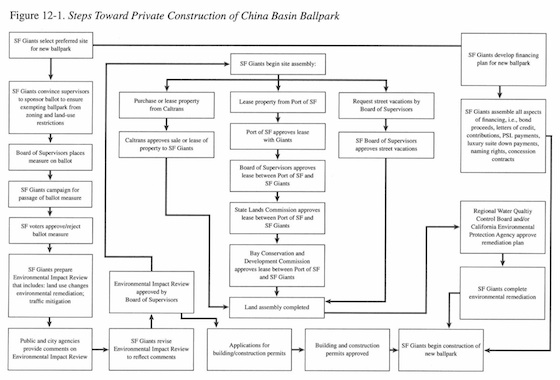
Well then, how does one go about making it work as the Giants did in China Basin? Thankfully, some very smart economists – John M. QuigleyEugene Smolensky, and Stephen J. Agostini – have gone to the trouble of diagramming the process.  The flowchart below comes from a paper titled Stickball in San Francisco. It’s better known as the San Francisco Giants’ case study in the book Sports, Jobs, and Taxes by noted sports economists Roger Noll and Andrew Zimbalist. Ready? Here’s the secret recipe:

stickball

Step-by-step instructions on how to follow the Giants’ plan.


See? Easy peasy, no sweat right? Sure, there are a few things that are different, such as the need for a ballot measure. Oakland has long claimed that it doesn’t need one. That claim originated from two theories: that either Oakland could leverage redevelopment money or the powers within the Coliseum Authority (JPA). The latter still stands technically. The former? As long as Oakland’s pledge to take care of costs to put the site together stands, and those site costs keep rising (Victory Court was at last count $250 million), the Mayor and City Council are going to have an extremely difficult time convincing the voters that they shouldn’t vote on it. Even in the Coliseum’s case, going without a vote is inherently very risky because many of the people on the JPA board are standing office holders, such as Ignacio De La Fuente and Scott Haggerty. The stench of the Mt. Davis deal still hangs thick and heavy over the Coliseum, and the Authority is having trouble refinancing existing debt at the complex. Does anyone honestly think a $2+ billion megaproject like Coliseum City won’t go to a vote? The project is calling for its own streetcar! Maybe Knauss will don a Harold Hill costume the next time he does a press conference.

Then again, Knauss expressed a preference for one of the waterfront sites. We know that Victory Court is incredibly expensive and that some current landowners aren’t exactly going to roll over for a ballpark, even though they are great Oakland supporters. Maybe it’s time to revisit Howard Terminal one more time. It’s difficult to see how the Howard Terminal site would work. Matson, one of the key corporate supporters at yesterday’s press conference, consolidated operations at HT several years ago. There’s no readily available place to relocate Matson should they give up HT. I suppose it’s possible they could give up a portion, say 15 of 50 acres, in exchange for some kind of break from the Port. Then it just be a matter of dealing with the nearby power plant and prepping the site, which would require completely new pilings/foundation work (just like AT&T Park). Judging from the price tag for SF’s Piers 30 & 32, the cost would be around $80 million to start plus whatever the price is to compensate Matson. Whatever that total is, it’s probably cheaper than Victory Court. (Personally I’d pick HT just because of its proximity to Beer Revolution, but that’s just me.)

Finally, there’s the matter of seat licenses. Knauss and his partners think there’s a market there. Lew Wolff has said there isn’t a market from the beginning. Who’s right? I’ll defer to Wolff, who has access to the season and advance ticket sales rolls and has a pretty good idea of what people are willing to pay for tickets and premium offerings. The Giants’ $255 million financing package included $75 million from 15,000 charter seat licenses. That’s a $5,000 average upfront payment (available in installments, of course). Is the market really there as Knauss claims? Consider for a moment that the 49ers are selling seat licenses right now. The Raiders, if they get a new stadium built at the Coliseum, will require their own seat licenses. They may also be in the mix for whatever venue the Warriors cook up. The A’s would be entering the fray with, if using the formula the Giants used, 20% of the ballpark cost, or $100 million of seat licenses. The A’s don’t have the Giants’ 25,000-strong season ticket roll, or the reputation of having a large number of premium ticket buyers (Green Collar Baseball, anyone?). So you’d have three, possibly four teams selling seat licenses along with more expensive tickets. That’s a good way to oversaturate the East Bay, a market which has historically shown trouble maintaining solid fanbases unless the teams are ultra-successful. These financing terms don’t work unless great support can be maintained through thick and thin, or at least if some of the load can be sloughed off to corporate interests. Otherwise someone has to make up the shortfall, and as we saw from the OFMA debacle, the results can be disastrous. MLB and Selig know this, and they won’t be impressed just because someone says “we can work it out”. Selig will want to see pledges, upfront payments, real tangible proof that seat licenses can be supported and that there won’t be a shortfall that drags down the franchise. The CBA has a provision that the A’s have to come off revenue sharing by 2016, unless they’re still at the Coliseum. MLB is not going to approve a plan that creates huge risk for the team and causes them to stay on revenue sharing even with a new ballpark.

Perhaps the best predictor of how portable the Giants’ financing model is comes from a 2002 AP article which quotes former owner Peter Magowan and  Rob Tilliss, the JP Morgan consultant who put the deal together. Magowan:

“You cannot expect a private ballpark to be built in Cincinnati or Milwaukee, there’s not the economic base there. It’s not the Silicon Valley,” he says. “And we couldn’t do it today. We were very lucky in our timing we had low interest rates and a very good economy.”

Tilliss:

“It definitely is not a one-size-fits-all kind of model.”

Knauss’s argument is that economically, Oakland is closer to San Francisco or Silicon Valley than it is to Cincinnati or Milwaukee. I find that hard to believe.

The enemy of my enemy is my friend, Part Deux

Shortly after Commissioner Bud Selig convened his three-man panel to figure out what to do with the A’s, all sorts of political machinations started happening. That included then-Oakland City Attorney John Russo (now City Manager of Alameda) penning a lawsuit threat against the A’s. I wrote back then:

What recourse do the Giants have, then? They can try to go to bat for Oakland, even though they have no history of doing that previously. Even though, in moving to China Basin, they’ve actively siphoned East Bay fans away from the A’s. Even though they’ve held a regional hegemony for decades. It wouldn’t be hard to posture themselves as saviors of baseball in Oakland – no matter how strange that sounds – as it wouldn’t require much effort and could be done in a sort of stealth mode. It wouldn’t be difficult to get a few letters from prominent pols in order, so no problem there either. The best part is for the Giants is that it works. It paints Wolff as a villain and Oakland as a victim, despite the backstory’s greater complexity.

Eerie, no?

Now we have word from the Trib that Jean Quan has met with Giants ownership. That wouldn’t be the first time. Perhaps it’s completely altruistic, in that they’re instructing her on how to put together an AT&T Park-style stadium deal, the kind that Clorox CEO Don Knauss is pursuing. (Knauss also had a lengthy interview with KQED.) Then again, this is the same Giants ownership group that may have pulled a power play to kill the Piccinini-Dolich group’s chances to buy the A’s, because the Giants didn’t want an Oakland-based group owning the A’s:

More likely, Piccinini suspects the San Francisco Giants ownership had a hand in convincing Selig to make sure the deal never materialized, especially since Selig has called the A’s move from Kansas City to Oakland “a terrible mistake.”

“I can tell you there’s an executive with the Giants, who shall go unnamed,” Piccinini said. “I ran into him at a Warriors game. He said, ‘I hear you’re getting involved with the Padres. We want you in San Diego; we just didn’t want you here.’ “

Speaking of Piccinini, he’ll be available soon if he wants to deal with the struggle to be an owner again. Piccinini is part of the Moorad group who were teased the Padres, only to have the rug pulled out from under them. Moorad won’t be able go after another team, knowing that there are permanent veto votes against him within the Lodge. Much of the rest of the Central Valley base of the ownership group should be available, and they could pull in another frontman – Andy Dolich, perhaps?

If Piccinini’s right, the Giants don’t care for the A’s in Oakland or anywhere else in the Bay Area. That makes it frustrating to see Quan consult with the Giants. The Giants aren’t doing the City of Oakland any favors. Just because they may have a somewhat allied interest (keeping the A’s out of San Jose) doesn’t mean they are allied.

If Quan’s smart, she’ll ask for some of the SF sponsors that Oakland will need because as much as the East Bay wants to puff its chest out , the pickings are slim. The Chron 200 is an annual list of the Bay Area’s largest independent, publicly-traded companies by revenue. Generally these are companies with revenues over $100 million annually. Some private companies, like Bechtel, or subsidiaries, like Matson (Alexander & Baldwin), and nonprofits (Kaiser Permanente) are excluded. Distributed by region, San Francisco has 19 of 200, with 5 in Marin County and 26 in San Mateo County. Santa Clara County has 102, or 51% of the list. Oakland has 3 companies on the list, the East Bay in total has 38.

Chron 200 list by city/county-region

If you combine SF, San Mateo, and Marin Counties, you get 50 companies. That’s not significantly greater than the East Bay’s 38 – or 40 if we include Kaiser and Matson. Straight up it would appear that there’s enough corporate strength in the East Bay to make a privately financed, $500 million ballpark happen. But the Giants’ argument for years has been that they needed the South Bay to finance AT&T Park. If that’s true then there’s a logical incongruence at work. Either the South Bay was required and there’s no other way but to include them, or the South Bay wasn’t required and the strength of the West Bay is enough. So which is it?

Also, check out the imbalance of companies in the Giants’ designated territory and the A’s. The Giants have over 75% of the Chron 200. The A’s have less than 20%.

The secrecy of the mystery ownership bidder is also a bit baffling. Lew Wolff has said that no interested party has asked him directly about selling the team. Instead, whoever’s interested has chosen to use back channels to engage Wolff – once. What is the point of that? If the East Bay coalition’s goal is to first work with the current ownership group to develop a plan to keep the A’s in Oakland, why have they never directly called Wolff once? They’ve gone semi-public twice in the last several months to indicate there’s an ownership group in waiting. Seems to me it’s a lot harder to put together a press conference than to call Wolff or arrange a meeting. For whatever reason, they haven’t done the latter. In the last comments thread, a question was posed, “Why doesn’t Lew listen to what these guys have to say?” I think the answer is that they have to present something to the man first. They’ve presented a plan to MLB three years ago that went unanswered. If they want to work with Wolff, they might want to first try to, you know, work with Wolff instead of posturing. It’s somewhat embarrassing that Mayor Quan has probably spent more time talking the Giants brass than the A’s. If A’s ownership is the enemy, don’t pussyfoot around it or hedge. Declare it and get to work. Otherwise it’s just another exercise in scoring PR or political points. And the only real winner in the end is the Giants.

Oakland Press Conference at Clorox HQ (Updated)

Today at 10 AM, there will be a press conference at Clorox headquarters in Downtown Oakland about efforts to keep the A’s in town.

Clorox is handling the media advisories for the event. That’s all I know for the moment. Since I’m still in San Diego, I won’t be able to attend. I’ll keep an eye out for news as it comes in.

Update 10:30 AM – A tweet from KRON’s Haaziq Madyun:

11:10 AM – From Baseball Oakland’s Facebook page:

Today Clorox CEO Don Knauss has announced continued support by the East Bay buisness community in Keeping the A’s in Oakland. He is willing to work with current ownership, however if that cannont happen he is willing to work with another group that is willing to buy the team and pledge support for them (sic) 

11:30 AM – I just got off the phone with Lew Wolff. He confirmed that the team is not for sale and that ownership has explored all options in Oakland.

11:55 AM – Oakland Mayor Jean Quan has put out a press release.

FOR IMMEDIATE RELEASE

May 3, 2012

Clorox and Other Major East Bay Businesses Join Mayor Jean Quan to Voice Their Support
to Keep the A’s in Oakland

OAKLAND, CA– Chairman and CEO of The Clorox Company Don Knauss, joined by several of the largest companies located in the East Bay, today stood with Oakland Mayor Jean Quan to announce support for keeping the Athletics baseball team in Oakland.

At the event, Knauss stated, “Clorox strongly and enthusiastically endorses the efforts of the East Bay business community and City of Oakland to keep the Oakland A’s here in a new, world-class stadium. As former president and CEO of the Minute Maid Company, I was actively involved in the design of the new Houston Astros downtown ballpark and subsequently secured naming rights to change the name to Minute Maid Park. From that experience, I can speak first-hand to the revitalization a world-class ballpark can bring to a city. Certainly, Oakland would benefit greatly from the jobs, tourism and vitality a new stadium would bring.

“The business community is committed to helping drive an effort to support the current ownership group in their quest for a new stadium so long as they are committed to staying in Oakland,” Knauss went on to say. “However, if the current ownership group is not committed to Oakland, we want to make clear that Oakland and the East Bay business community are ready to step up to the plate to help ensure the A’s stay home where they belong in Oakland. We’re confident we have identified an ownership group with the financial wherewithal to buy the team, keep them here and get a new stadium built.”

Added Oakland Mayor Jean Quan, “I want to thank Clorox and members of the business community for doing what is necessary to keep the A’s in Oakland. Developing a world-class sports, entertainment and business complex as a new home for the A’s will generate thousands of jobs and create economic development opportunities for this City.”

At the event, the East Bay business leaders said they are prepared to work with the City, County and A’s ownership to help secure corporate sponsors in the following areas:

  • Stadium Naming Rights
  • Major Corporate Sponsorship Commitments – Significant anchor sponsorships, including seat licenses and luxury boxes. (A number of the companies have already made substantial deposits into an escrow account to demonstrate their seriousness when it comes to such sponsorship commitments.)
  • Other Regional Sponsorships — Given the size and breadth of the East Bay, home to nearly 2.5 million people, representing one of the country’s strongest economic markets and huge marketing and sponsorship opportunities, the business leaders made clear they would work with the City and the County to identify additional corporate supporters throughout the entire Bay Area and beyond, including Sacramento and Stockton.
  • Reaching Out to Business Partners – Given the size of the companies, many have relationships with business partners who would have a strong interest in supporting the team and the region as sponsors.
  • Identifying Specific Industry Anchor Sponsor Opportunities – Pursuing opportunities for the kind of anchor sponsorship relationships Major League Baseball teams typically have in sectors like the airlines, health care, car manufacturers, beverage and food companies, energy companies and major consumer companies.

Among the East Bay businesses represented today are:

  • Bigge Crane & Rigging
  • Jobs and Housing Coalition
  • Kaiser Permanente
  • Matson Navigation Company
  • Oakland Metropolitan Chamber of Commerce
  • Pandora Internet Radio
  • Reynolds & Brown
  • Safeway
  • Signature Development Group
  • Wendel Rosen Black & Dean
  • World Market

If the team is not for sale, and East Bay backers would prefer new ownership, where does that leave us? No different than yesterday or a week ago, I suppose. The game plan by many of the Oakland-only community has been to wait out the process and hope that Selig denies Wolff the rights to San Jose, then come forward with a new ownership group and stadium plans, which may or may not be tied to Coliseum City. The problem with this is that how do you impress Selig, who according to many of the community is out to get Oakland, without some serious level of detail and planning? They’ve had over three years to put something cohesive and coherent together. Press conferences like these, which seem to occur every couple of months, are good at generating media interest. Beyond that, where’s the substance?

Clorox deserves a lot of credit here. Don Knauss is driving this forward, and as I’ve mentioned before, every stadium campaign needs a champion. Knauss might be that guy.

There’s also one key difference between what’s happening with the A’s and what’s going on with the Sacramento Kings. The Maloofs are broke. The Wolff/Fisher group is anything but broke. The only party who can “force” a sale is Selig, and he’d need a very good case to make that happen.

San Jose lists former redevelopment agency assets for sale

As part of efforts to pay down $4 billion in redevelopment debt, the City of San Jose is listing numerous properties owned by the now-dissolved San Jose Redevelopment Agency for sale. Included are the Jose Theater (Improv), Billy DeFrank Center (LGBT), two separate pieces of land on which the Hilton and Camera 12 sit, and numerous others. Many of the properties have liens on them or are tied into long-term ground leases, making them rather unattractive for speculators.

Notably absent from the list are the ballpark parcels near Diridon Station. Those properties were transferred to the San Jose Diridon Development Authority. The state may try to sue for those properties and put them under the control of the SJRA successor agency, though we haven’t seen indicators one way or another on such a move. For now any property sales have to be approved by the successor agency’s board, which is basically under the county’s control.

The notable property on the list is the $31 million North San Pedro site, also known as the Brandenburg property. It’s under contract with developer Barry Swenson for 600 housing units as well as a one-acre park, plus a rerouting of Julian Street through the area. Tony D. suggested a few weeks ago that the ballpark properties could be “swapped” with the North San Pedro parcels, resulting in a very clear site (10+ acres) for the stadium.

There are several issues with the Brandenburg property that could potentially outweigh any advantages it has in its ease of acquisition.

  • The western edge of the site is less than 600 feet from the approach to the 30R runway at SJC airport. I’ve measured noise in the area, and it’s typically 10-15 db greater than at Diridon when a plane is flying over.
  • Due to its proximity to the airport and landing approach, the FAA is going to put up a fight if any building proposal is higher than the one already approved for the area. According to project documents, the apartment buildings that have been approved for Barry Swenson are at most 76 feet tall. A ballpark will be at least 10-15 feet taller, probably more depending on how the lighting elements are designed and incorporated.
  • At 0.8 miles walking distance from Diridon Station, Brandenburg is at the outer limits of what people are usually willing to walk to get to a stadium.
  • A brand new EIR would have to be done, given the change of location and scope. It could take a year to complete, though the City could leverage some existing work such as the recent traffic study. While the NIMBY element at Shasta/Hanchett would be reduced, new NIMBYs from Ryland Park and the Northside could emerge. On the other hand, support could solidify from former Mayor Tom McEnery, who has several interests in San Pedro Square just two blocks away. San Pedro Square is situated so well that I figure that 60% of fans would end up going through it to get to a Brandenburg ballpark.

I don’t know exactly how the land swap would work. Santa Clara County is supposed to get half of the selling price due to its settlement with the City last year, but other than that wrinkle it’s a cut-and-dried deal. Since both the ballpark and Brandenburg sales are at option stage and have not yet been consummated, it could require recalculation of land prices since the ballpark deal was based on a specific land use. For Barry Swenson, the ballpark land probably isn’t all that attractive unless all of it can be acquired, including the AT&T and AERIS properties. Otherwise the developments would look very disjointed and there would be some potential hazards (high pressure flammable gas, electric substation).

It’s not a great option, but it’s out there if someone got really frustrated with how land negotiations were going. Of course, we’d have to get to the point of land negotiations first.

A’s not on May owners meeting agenda

Small item in John Shea’s report today:

Managing general partner Lew Wolff, who attended Tuesday’s game, conceded that the A’s stadium issue won’t be on the agenda at the May 16-17 owners’ meetings, and he wouldn’t guess whether it’ll be included at the next owners’ meetings in August.

As long as Bud Selig keeps leaving the A’s and Wolff twisting in the wind like this, he’s the one who’s going to have to fix it. The A’s lease runs out after 2013. Selig should have to be the one who negotiates any short or long-term Coliseum extension, not Wolff. The Coliseum Authority and Wolff aren’t exactly buddies these days. Then again, Wolff and Selig supposedly are. With friends like these…